Image Segmentation with cage Active Contours
S.Mallesham
M.Tech Student
Sri Chaitanya Institute of Technological Sciences,Karimnagar,India
K.Mallesh
Assistant Professor Department of ECE
Sri Chaitanya Institute of Technological Sciences,Karimnagar,India
Abstract: Image segmentation is a fundamental task in image analysis responsible for partitioning an image into multiple sub-regions based on a desired feature. Active contours have been widely used as attractive image segmentation methods because they always produce sub-regions with continuous boundaries, while the kernel-based edge detection methods, e.g. Sobel edge detectors, often produce discontinuous boundaries. The use of level set theory has provided more flexibility and convenience in the implementation of active contours. However, traditional edge-based active contour models have been applicable to only relatively simple images whose sub-regions are uniform without internal edges. Here in this paper we attempt to brief the taxonomy and current state of the art in Image segmentation and usage of Active Contours.
Keywords: Active Contours, Snakes, Level Sets.
1 Introduction
Segmentation is defined as partitioning portions of an image. It adds structure to a raw image. In the case of medicine, this can involve identifying which portions of am image is the tumor, or separating white matter from grey matter in a brain scan. These reports present a simple implementation of an active contour method using level sets and demonstrate this method’s abilities. This report will present the formulation of the level set method and issues in numerically implementing the problem. It will then follow with results of the implementation and close with areas for further improvements.
In most image study operations, example classifiers need individual objects to be divided from the image, so the explanation of those objects can be transformed into a proper structure for computer
processing. Image segmentation is a basic task, responsible for the separating process. The function of segmentation is to dividing an image into its basic and disjoint sub-regions, which are identical according to their property, e.g. intensity, color, and quality. Segmentation algorithms are usually based on either discontinuity with sub regions, i.e. edges, or equality within a sub-region, though there are a few segmentation algorithms depends on both discontinuity and equality.
The difference between image segmentation and sample classification is often not clear. The purpose of segmentation is simply to divide an image into several sub-regions, while the role of sample classification is to identify the partitioned sub-regions. Thus, segmentation and sample classification generally functions as individual and sequential process as shown in table 1.1. However, they might work as an integrated procedure as shown in table 1.2 depending on the image study problem and the performance of the segmentation process. In both way, segmentation significantly affects the outcome of pattern classification, and frequently determines the ultimate success or failure of the image analysis. Since segmentation is an essential job in image analysis, it is involved in mainly image analysis applications, mostly those connected to pattern classification, e.g. medical imaging, remote sensing, security surveillance, military object detection.
The stage to which segmentations carried depends on the difficulty being solved. That is, segmentation should end when the region of interest (ROI) in the function have been isolated. Due to this
property of trouble dependence, independent
recommend novel segmentation methods with a variation framework called active contours.
Active contours are connectivity-preserving relaxation [10] methods, valid to the image segmentation problems. Active contours have been used for image segmentation and boundary tracking since the first introduction of snakes by Kass et al. [11].
The fundamental idea is to start with first boundary shapes represented in a type of closed curves, i.e. contours, and iteratively change them by applying shrink/expansion operations according to the constraints of images. Those shrink/expansion operations, called contour evolution, are done by the minimization of an energy function like fixed region based segmentation methods or by the simulation of a geometric fractional differential equation (PDE) [12].
An benefit of dynamic contours as image segmentation methods is that they dividing an image into sub-regions with continuous boundaries, while the border detectors based on threshold or local filtering, e.g. Canny [13] or Sobel operator, regularly result in irregular boundaries. Apply of level set theory has provided more flexibility and convenience in the completion of active contours. Depending on the implementation method, active contours can use diverse properties used for other segmentation methods such as edges, statistics, and texture. In this paper, the proposed active contour models using the statistical information of image intensity inside a sub-region.
2.1
Image
Segmentation
using
Active
contours: the Taxonomy
There are two major approaches in image segmentation: edge- and region- based. Edge based segmentation partitions an image based on discontinuities with sub-regions, while region-based segmentation does the similar function based on the uniformity of a desired property within a sub-region. In this chapter, we briefly discuss existing image segmentation technologies as background. a) Edge-based Segmentation
Edge-based segmentation looks for discontinuities in the intensity of an image. It is more likely edge detection or boundary detection rather than the exact meaning of image segmentation. An edge can be defined as the border between two regions with relatively separate properties. The assumption of edgebased segmentation is that every sub-region in an image is sufficiently uniform so that the
transition between two sub-regions can be determined on the basis of discontinuities alone. When this statement is not valid, region-based segmentation, discussed in the next
section, regularly provides more reasonable segmentation outcome. Basically, the idea underlying most edge-detection techniques is the computation of a local derivative operator.
Edge detection by gradient operations usually works well only in the images with sharp intensity transitions and relatively low noise. Due to its sensitivity to noise, various smoothing operation is usually essential as reprocessing, and the smoothing effect consequently blurs the edge information. However, the computational cost is comparatively lower than other segmentation methods because the computation can be complete by a local filtering operation, i.e. convolution of an image with a kernel.
b) Region-based Segmentation
Region-based segmentation looks for equality inside a sub-region, based on a desired property, e.g. intensity, color, and texture. Clustering techniques encountered in pattern classification literature have related objectives and can be applied for image segmentation [14].Region rising [15] is a technique that merges pixels or small sub-regions into a bigger sub region. The simplest implementation of this approach is pixel aggregation [19], which starts with a set of seed points and grows regions from these seeds by appending nearby pixels if they satisfy the given criteria. Additional criteria that use properties to raise the regions lead area growing into more sophisticated methods, e.g. region competition. Region competition [16, 17] merges neighboring sub-regions under criteria involving the equality of regions or sharpness of boundaries. Strong criteria tend to generate over segmented results, while weak criteria lean to produce poor segmentation outcome by over-merging the subregions with blurry boundaries. An alternative of region rising is split-and-merge [18], which partitions an image firstly into a set of arbitrary, disjointed sub-regions, and then combine and/or split the sub-regions in an attempt to satisfy the segmentation criteria.
c) Active Contours
motions. This section provides a theoretical setting of active contours and an indication of existing active contour methods. There are two main approaches in active contours based on the mathematic implementation: snakes and level sets. Snakes explicitly shift predefined snake points based on an energy minimization method, while level set approaches move contours completely as a particular level of a function. As image segmentation methods, there are two kinds of active contour models according to the force evolving the contours: edge- and region-based. Edge- based active contours apply an edge detector, typically based on the image gradient, to locate the boundaries of sub-regions and to draw the contours to the detected boundaries. Edge-based approaches are closely connected to the edge-based segmentation. Region based active contours apply the statistical information of image intensity inside each subset instead of searching geometrical boundaries. Region-based approaches are also closely connected to the region-based segmentation
d) Snakes
The initial model of active contour was proposed by Kass et al. [11] and named snakes suitable to the appearance of contour evolution. Solving the problem of snakes is to locate the contour C that minimizes the total energy term E with the certain set of weightsα , β , and λ . In numerical experiments, a set of snake points residing on the image plane are defined in the first stage, and then the next location of those snake points are determined by the local minimum E. The associated form of those snake points is considered as the contour. Figure 2.1 shows an example of classic snakes [20]. There are about 70 snakes points in the image, and the snake points form a contour around the moth.
The snakes points are firstly placed at more distance from the boundary of the object, i.e. the moth. Then, every point moves towards the optimum coordinates, where the energy utility converges to the minimum. The snakes points ultimately stop on the boundary of the object. The classic snakes give an perfect location of the edges only if the first contour is given sufficiently near the edges because they make use of only the local information along the contour. Estimating a correct position of first contours without prior knowledge is a complex problem. Also, classic snakes cannot detect more than one boundary concurrently because the snakes maintain the equal topology throughout the evolution stage. That is, snakes cannot divide to several boundaries or combine from
multiple first contours. Level set theory [12] has given a result for this problem.
The Level Set Method
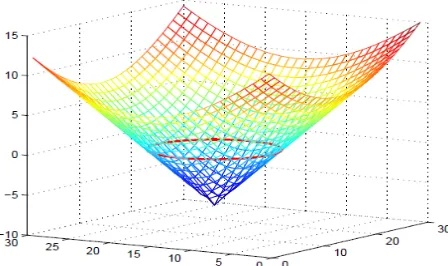
The segmentation problem reduces to finding curve(s) to enclose regions of interest. Intuitively, we can model the curves directly using control points. However, there are issues involved in updating the control points. For example, if two separate closed curves needed to merge into one, or one needs to split into two, when would this merge/split take place? How would an algorithm detect when to merge or split? After this is detected, data structures for the curve would then needed to be updated as well. If control points are too close together, how should they be merged? There are solutions to these difficulties [4]. However, these issues can all be alleviated using the level set method.
Figure 1: Sketch illustrating a circle embedded within a cone
Figure 2: Sketch illustrating how one closed contour embedded in a surface is related to two closed con- tours on another level.
Figure 1: Sketch illustrating a circle embedded within a cone curves in this way, the above mentioned problems of splitting and merging curves are addressed without the need to treat them as special cases. Figure 2 shows how a curve can split into two by moving along the surface of the level set. Using this idea, we can Figure 2: Sketch illustrating how one closed contour embedded in a surface is related to two closed con- tours on another level morph the surface to achieve our desired topology at a specific contour level.
Simulation results
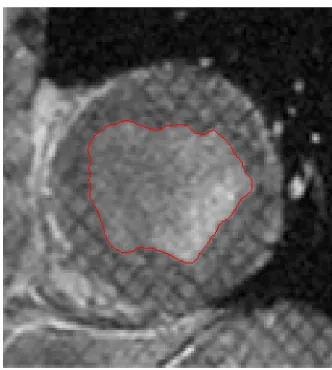
Figure 3: a) input image
b) Segmented image
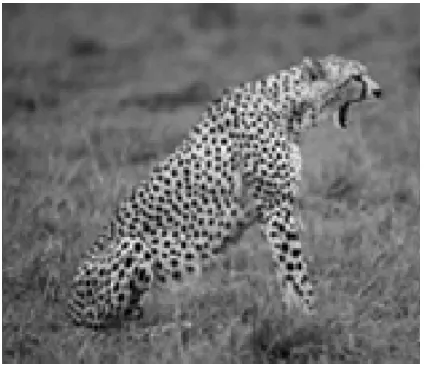
Figure 4: a) input image
Figure 5: a) input image
b) Segmented image
Figure 6: a) input image
b) Segmented image
b) Segmented image
Conclusion
Active contour models (ACMs) integrated with various kinds of external force fields to pull the contours to the exact boundaries have shown their powerful abilities in object segmentation. However, local minimum problems still exist within these models. The current state of the art in image segmentation mostly cornered to furbish active contour models for domain specific image segmentation, more specific to medical images. The majority of the interactive approaches mainly targeting the accuracy of the segmentation process results. It is clearly evident that these interactive models probabilistic due to the role of the observers and in recent literature, it is hard to find interactive models with optimal resource utilization and computational efficiency. Hence the research scope in interactive image segmentation is optimistic. On other side the statistical and numerical analysis models introduced in recent literature are more specific to contextual issues of the domain to which the input images are belongs to. Hence it is clear evident of scope to perform research that introduce machine learning and data engineering approaches those can generalize the optimistic statistical and numerical methods to improve the computational performance and minimal resource usage in active contour based image segmentation.
References
1. Chunming Li; Chiu-Yen Kao; Gore, J.C.; Zhaohua Ding; , "Minimization of Region-Scalable Fitting Energy
for Image Segmentation," Image Processing, IEEE Transactions on , vol.17, no.10, pp.1940-1949, Oct. 2008; doi: 10.1109/TIP.2008.2002304;
2. Bovenkamp, E.G.P.; Dijkstra, J.; Bosch, J.G.; Reiber, J.H.C.; , "User-Agent Cooperation in Multiagent IVUS
Image Segmentation," Medical Imaging, IEEE
Transactions on , vol.28, no.1, pp.94- 105, Jan. 2009; doi: 10.1109/TMI.2008.927351;
3. Srinivasa, G.; Fickus, M.C.; Yusong Guo; Linstedt, A.D.; Kovacevic, J.; , "Active Mask Segmentation of Fluorescence Microscope Images," Image Processing, IEEE Transactions on , vol.18, no.8, pp.1817-1829, Aug. 2009; doi: 10.1109/TIP.2009.2021081
4. Wenxian Yang; Jianfei Cai; Jianmin Zheng; Jiebo Luo;, "User-Friendly Interactive Image Segmentation Through Unified Combinatorial User Inputs," Image Processing, IEEE Transactions on , vol.19, no.9, pp.2470-2479, Sept. 2010; doi: 10.1109/TIP.2010.2048611
5. Ping-Feng Chen; Krim, H.; Mendoza, O.L.; , "Multiphase Joint Segmentation-Registration and Object Tracking for Layered Images," Image Processing, IEEE Transactions on , vol.19, no.7, pp.1706-1719, July 2010; doi:
10.1109/TIP.2010.2045164
6. Figueiredo, I.N.; Figueiredo, P.N.; Stadler, G.; Ghattas, O.; Araujo, A.; , "Variational Image Segmentation for Endoscopic Human ColonicAberrant Crypt Foci," Medical Imaging, IEEE Transactions on , vol.29, no.4,
pp.998-1011, April 2010; doi:
10.1109/TMI.2009.2036258
7. Yazdanpanah, A.; Hamarneh, G.; Smith, B.R.; Sarunic, M.V.; , "Segmentation of Intra-Retinal Layers From Optical Coherence Tomography Images Using an Active Contour Approach," Medical Imaging, IEEE Transactions on , vol.30, no.2, pp.484-496, Feb. 2011; doi: 10.1109/TMI.2010.2087390
8. Delu Zeng; Zhiheng Zhou; Shengli Xie; , "Image Segmentation Based on the Poincaré Map Method," Image Processing, IEEE Transactions on , vol.21, no.3, pp.946-957, March 2012; doi: 10.1109/TIP.2011.2168408 9. Nguyen, T.; Cai, J.; Zhang, J.; Zheng, J.; , "Robust Interactive Image Segmentation Using Convex Active Contour," Image Processing, IEEE Transactions on , vol.PP, no.99, pp.1; doi: 10.1109/TIP.2012.2191566 10. T. Fukuda, Y. Morimoto, S. Morishita, and T.
Tokuyama, “Theory of communication,” ACM
11. M. Kass, A. Witkin, and D. Terzopoulos, “Snakes, active contour model,” International Journal of Computer Vision, pp. 321–331, 1988 12. S. Osher and J. Sethian, “Fronts propagating with curvature dependent speed: Algorithms based on hamilton-jacobi formulations,” Journal of Computationl Physics, pp. 12–49, 1988. 13. J. Canny, “A computational approach to edge detection,” IEEE Transactions on Pattern Analysis and Machine Intelligence, no. 8, p. 769, 1986.
14. A. Jain, Fundamentals of Digital Image Processing. Prentice Hall Information and System Sciences Series, Prentice Hall, 1989
15. C. Brice and C. Fennema, Computer Method in Image Analysis, ch. Scene Analysis using Regions, Los Angeles: IEEE Computer Society, 1977
16. S. Zhu and A. Yuille, “Region competition: Unifying snakes, region growing, and bayes/MDL for multiband image segmentation,” IEEE Transactions on Pattern Analysis and Machine Intelligence, no. 9, pp. 884–200, 1996.
17. S. Zhu and A. Yuille, “Region competition and its analysis: a unified theory for image segmentation,” Tech. Rep. 7, Robotics Lab, Havard University, 1995.
18. K. Fu, R. Gonzales, and C. Lee, Robotics: Control, Sensing, Vision, and Inteligence. New York: McGraw-Hill, 1987.
19. R. Gonzales and R.Woods, Digital Image Processing. Addison-Wesley Publishing, 1st ed., 1993.
20. D. Young, “Active contour models (snakes).”
http://www.cogs.susx.ac.uk/users/davidy/teachvisio