EVM Based on Biometric Identifiers and
Image Processing Using MATLAB
Er. Gausiya Yasmeen, Er. Namita Jaiswal,
Department of Electrical Engineering, Shuats, Allahabad, India
Department of Electrical Engineering, Shuats, Allahabad, India
ABSTRACT: Electronic Voting Machine (EVM) is used to record votes by replacing ballot papers and ballot boxes which were used in earlier traditional voting system. The situation was changed after the arrival of EVM. No more ballot paper, ballot boxes, stamping etc. all these are undiluted into a simple box called ballot unit of EVM. In this application Biometric identifiers are used to provide better security in EVM.
By using Biometric identifiers like Face Recognition and Fingerprint Sensor which are linked with Adhaar card. Votes are stored electronically in EVM ballot box. Thus, it cannot be hacked easily because Biometric identifier cannot be easily misplaced or shared. This application can also be used by Handicapped person by just clicking their picture and matching it with the provided information which is stored in the Database.
KEYWORDS: EVM, Ballot papers, Ballot boxes, Stamping, Biometric identifiers, Face recognition, Finger print sensors.
I. INTRODUCTION
The word ‘vote’ means to choose from a list, to elect or to determine. The main goal of thee voting is to come up with the leaders of the people’s choice. The objective of voting is to allow voters to exercise their right to express their choices regarding specific issues. You can choose your Government. This is one of the biggest benefits of voting.
EVMis a simple Electronic device which is used to record votes in place of ballot papers and ballot boxes which were used in earlier conventional voting system. EVM is a tool for making the electoral process more efficient and affected to increase trust in its management. It increases the security of the ballots, it speed up the processing result and make voting easier.
The EVM was designed by Election Commission of India in partnership with 2 public sectors: Bharat Electronics Limited, Bangalore and Electronics Corporation of India Limited, Hyderabad.
EVMs are more voter-friendly and much simpler from Paper ballot.
EVMs voting save time, energy and money and thus save million of trees in this process.
EVMs reduce the time in casting vote and also reduce the time. And utilizing this machine, count votes and declare results. Recently, that the systems could be tampered with and the security could be changing the votes, but this has not been proved. it save papers. These machines are powered by batteries and do not require electricity which ensures uninterrupted voting. it can accommodate sixty-four voter in a single constituency. In this machine, Votes can be stored for up to ten years. EVM can permanent save the program whose never be change it and have a sealed security chip, therefore votes cannot be rigged without damaging the program. This prevents fraud. Only one vote can be cast per person as the machine will register only the first button pressed.
II. METHODOLOGY
In our proposed work Biometric identifiers are used to provide better security in EVM. By using Biometric identifiers like Face Recognition and Fingerprint Sensor which are linked with Adhaar card.
This application can also be used by Handicapped person by just clicking their picture and matching it with the provided information which is stored in the Database.
III. PROBLEM FORMULATION
Voting System in India has gone through multiple changes. During the first 2 general of Lok Sabha in 1952 and 1957 each candidate were allotted a separate ballot box pasted with the symbol of the candidate and name. Before introduction of EVM, ballot papers were used to cast votes in the Indian Election. Use of ballot paper was time consuming.
In previous work problem with of voting system was that it is more likely to record over votes which end up being cast as no vote.
Over vote occurs when voter accidently marks on ballots more than one time in a particular race. Voters cannot vote for more than one candidate.
Beside the over vote problem, paper ballots can be lost, misplaced, miscounted.
Paper ballots where time consuming but it generates lot of employment for the people who are engaged in vote counting. Where in EVM takes less man power to calculate the votes which directly impacts the employment rate of the people during the election.
What was the need for EVM System?
The main reason for the need of EVM System is its Mobility. Voters always prefer to cast their votes from home, offices, school etc. In this way voters can cast their votes from anywhere. Not only the voter participation will increase but also the Government may save money.
IV. BIOMETRIC IDENTIFIERS
Biometric means a human generated signal or attributes for authenticity or a person identity
Figure 1
A physical Biometric feature includes:
Face detection
Fingerprint detection
Iris detection
A Behavioural Biometric feature includes:
Signature detection
Voice detection
Fingerprint Detection: Fingerprint detection is a biometric Technology. Fingerprint is unique for every individual. Every individual person has different fingerprint patterns. A fingerprint is a collection of many Ridges and Furrows (Valleys).This is the main Objective what makes fingerprint such an amazing tool for fingerprint identification
BIOMETRIC TECHNOLOGY
Figure 2
Likewise we cannot change DNA, in the same way we cannot change our fingerprint. The scars formed in the process of identifying fingerprint become a tool for identification in them. They are a unique id. Fingerprints are same for whole lifetime. They don’t change with time.
Face Recognition: Biometric face recognition, otherwise known as Automatic Face Recognition (AFR), is a particularly attractive biometric approach, since it focuses on the same identifier that humans use primarily to distinguish one person from another: their “faces”. One of its main goals is the understanding of the complex human visual system and the knowledge of how humans represent faces in order to discriminate different identities with high accuracy. Face Recognition technology is a well advanced, that it can be applied for many commercial application such as personal identification, security system, image file processing, psychology, computer interaction, entertainment system, smart card and so on.
III. IMAGE PROCESSING
V.I. DISCRETE WAVELET TRANSFORM (DWT) :
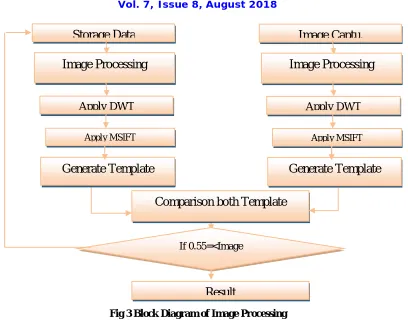
The wavelet transform only focus on small part of wavelet transform. The wavelet is working on the sub-bands (LL, LH, HL, HH). LL is the low frequency sub-band. The low frequency component in both direction horizontal and vertical. The sub-band LL will be most stable sub-band. So that, it can be used for feature representation of an image.
V.II. MODIFIED SIFT
Fig 3 Block Diagram of Image Processing
IV. COEFFICIENT OF CORRELATION (COC)
Correlation is a method for establishing the degree of probability. Linear variable directly comparison between two measured quantities. Karl Pearson defined the Pearson product-moment correlation coefficient. Pearson’s correlation coefficient is widely used in statistical analysis, pattern recognition, and image processing.
CoC= ∑( )( )
∑( ) ∑( )
where and are intensity values of th pixel in 1st and 2nd image, respectively. Also, and are mean intensity values of 1st and 2nd image, respectively.
V. SPECIFICATION REQUIREMENTS
Hardware Requirements: Fingerprint Sensor EVM Controller
Webcam (Face Recognition)
Software Requirements: MATLAB 13
System type: 64-bit operating System Installed Memory: 4 GB
Operating System :Windows 7
Below Hardware Image show
Comparison both Template
VI. HARDWARE EQUIPMENT
Fig 4 Equipment (Arduino, FingerPrint, USB-TTL)
VII. EVM ARCHITECTURE
Electronic Voting Machine consists of 2 Units:
Control Unit and Ballot Unit are interconnected by cable. Each of this unit provided a casing.
cable
Ballot Unit (BU): It is used by the voter and placed in the election booth
It is the unit of the EVM which is operated by the voter to exercise his/her vote.
It consists of: Voter Name, OTP, Date, Time, Candidate Party Name, Party symbols, Submit buttons and various buttons with the party name labelled on it.
EVM
Control Unit
Figure 6
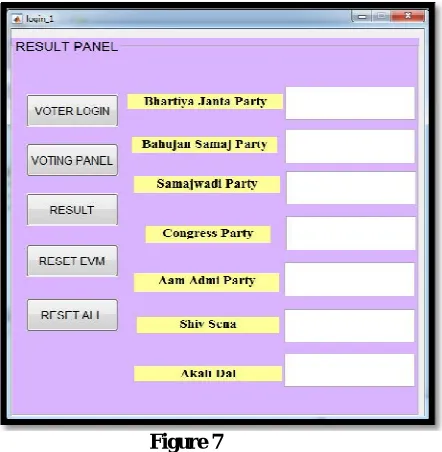
Control Unit (CU): It is used to store votes and used by the poll workers.
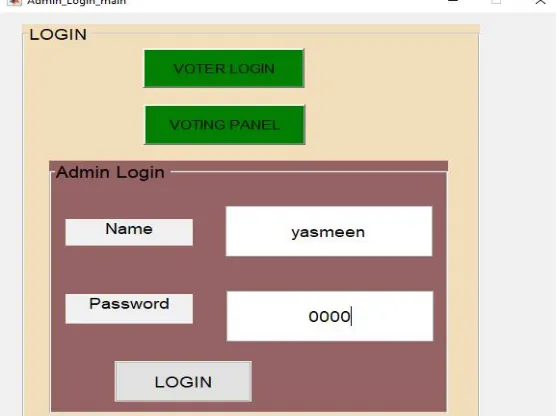
The poll workers or the admin have to login for the to the result panel.
It controls the polling process.
It consists of CU Buttons: Result of the voting, Result EVM, Reset All, Voter Login and Voter panel.
IMPLEMENTATION:
Voter Details
Enter 10 digit mobile No. and 12 digit
Face Detect Input Validity check database
Input Validity check database
Finger Print
Input Validity check database
Generate OTP
Check OTP
EVM Page
Enter Your Name and OTP
Check
Voting
Stop
Start
Voter Login
VIII. PROCESS OF EVM
Step1: Click on Voter Login.
Figure 9
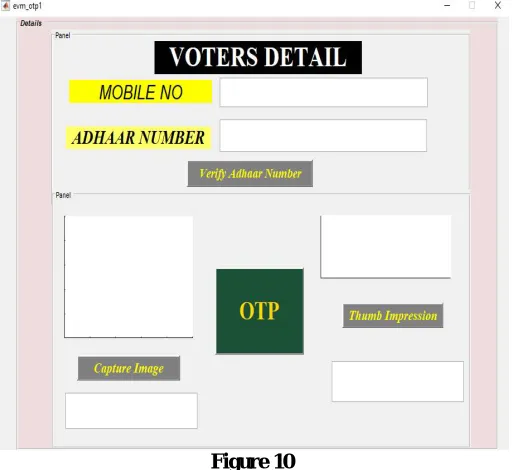
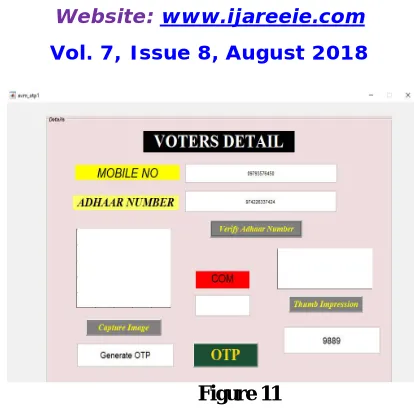
Step2: Then Voters detail page will open. Here voter has to write his/her Mobile no. and Adhaar no. If Mobile no. and Adhaar no. are matched with the provided Database then image capture will be done.
Figure 10
Figure 11
Step4: In this step we have to enter our COM port for further process.
Figure 12
Step5: Enter OTP and click on submit button. After clicking the Submit button voter can vote for its candidate.
Step 6: Click on Admin Login.
Figure 14
Step7: Result Panel will open.
XI. COMPARISION TABLE
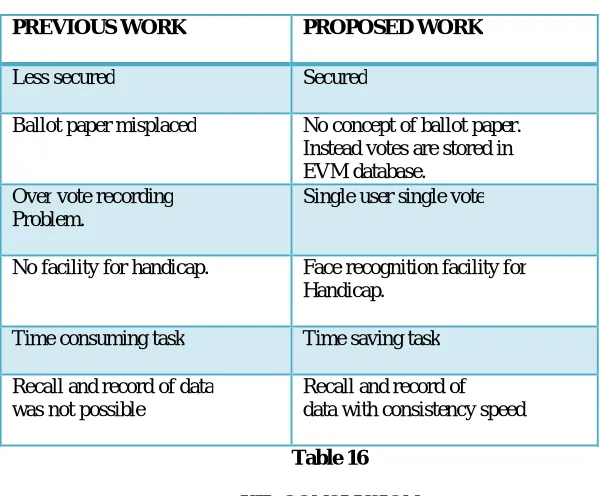
PREVIOUS WORK PROPOSED WORK
Less secured Secured
Ballot paper misplaced No concept of ballot paper. Instead votes are stored in EVM database.
Over vote recording Problem.
Single user single vote
No facility for handicap. Face recognition facility for Handicap.
Time consuming task Time saving task
Recall and record of data was not possible
Recall and record of data with consistency speed
Table 16
XII. CONCLUSION
In our proposed work we have introduced some new concepts and that is implementing by Biometric Identifier. Secured voting. It reduces man power efficiently. Throughout the project, we have been able to develop a Electronic Voting Software which manages and maintains the voter’s information and biometric data of the voters. Also this voting software eliminates the need of and transportation of ballot papers to various designated polling stations, thereby removing any expenses that would have been caused as a result of this.
Finally, this voting software does the task of automating the collation of results in real-time that is as the election is being conducted. If given a second chance, the security features of this project would be greatly improved on, pertaining to both the hardware and the software. Due the immense development of Aadhar card system it can be further improved by the addition of Iris recognition system for more secured polling.
XIII. FUTURE SCOPE
In this EVM application is used to enhance security by eliminating bogus voting and vote repetition using finger print based authentication and Face Recognition based authentication. If Finger Print and Face Recognition is authenticated then it produces OTP (One Time Password) on the voters mobile with in linked with their Adhaar card. In future, security of this application can still be enhanced if finger-print data and face recognition data can be stored and accessed from central server, voting ballot unit is separately placed from control unit.
REFERENCES
[1]. https://aceproject.org/ace-en/topics/et/ete/ete03 [2]. https://www.slideshare.net/smritirai792/ppt-of-e-voting
[3].https://www.slideshare.net/asertseminar/electronic-voting-machine-33017323
[4].Amanpreet kaur, Yashkalyani, Singh Kushagra Harila, Rahulmadhesiya,”Microcontroller Based Voice Activated Mobile Controlled Electronic Voting Machine,” International Journal of Advanced Research in Computer and Communication Engineering Vol.2, Issue 3, March2013, pages 1331-1333.
[6].Gomathi. B, Veena priyadarshini. S”Modernized Voting Machine using Finger Print Recognition,” International Journal of Scientific & Engineering Research, Volume 4, Issue 5, May-2013.
[7].J. Nagi, “Design of an Efficient High-Speed Face Recognition System”, Department of Electrical and Electronics Engineering, College of Engineering, Universiti Tenaga Nasional, March 2007.
[8]. Lin Hong, Yifei Wan and Anil Jain, “Fingerprint Image Enhancement: Algorithm and Performance Evaluation”, IEEE, VOL. 20, NO. 8, AUGUST 1998. [9]. Marius Tico, Pauli Kuosmanen, “Fingerprint Matching Using an Orientation-Based Minutia Descriptor”, IEEE, VOL. 25, NO. 8, AUGUST 2003. [10]. Anil Jain, Lin Hong, Ruud Bolle, “On-Line Fingerprint Verification”, IEEE, VOL. 19, NO. 4, APRIL 1997.