ISSN 2286-4822 www.euacademic.org
Impact Factor: 3.4546 (UIF) DRJI Value: 5.9 (B+)
Design and Development of an Intelligent Tutoring
System for C# Language
BASHAR G. H. AL-BASTAMI
Department of Information Technology Faculty of Engineering & Information Technology Al-Azhar University, Gaza, Palestine
SAMY S. ABU NASER1
Professor of Artificial Intelligence Department of Information Technology Faculty of Engineering & Information Technology Al-Azhar University, Gaza, Palestine
Abstract:
Learning programming is thought to be troublesome. One doable reason why students don’t do well in programming is expounded to the very fact that traditional way of learning within the lecture hall adds more stress on students in understanding the Material rather than applying the Material to a true application. For a few students, this teaching model might not catch their interest. As a result, they'll not offer their best effort to grasp the Material given. Seeing however the information is applied to real issues will increase student interest in learning. As a consequence, this may increase their effort to be taught.
In the current paper, we try to help students learn C# programming language using Intelligent Tutoring System. This ITS was developed using ITSB authoring tool to be able to help the student learn programming efficiently and make the learning procedure very pleasing. A knowledge base using ITSB authoring tool style was used to represent the student's work and to give customized feedback and support to students.
Key words: Intelligent Tutoring System, Authoring Tool, ITSB, C# Language
INTRODUCTION
C# language is a general-purpose and object-oriented programming language. It was designed and developed by Microsoft together with the .NET platform. There is many various software designed with C# language and on the .NET platform such as desktop applications, web applications, office applications, websites, games, mobile applications, and many more [1, 2].
C# language is a high-level language that is like C++ and Java, embarcadero Delphi, C, VB.NET. All programs written in C# are object-oriented styled. They involve of a group of definitions in classes that include methods and the methods include the logic of the program [1, 2].
C# language is one of the most common programing languages. It is used by many developers worldwide. Because C# language is developed by Microsoft as part of their new platform for development and execution of software, the language is extensively spread amongst Microsoft-oriented businesses, the .NET Framework, individual and organizations developers. The C# language and the .NET platform are upheld and managed completely by Microsoft and are not open to third parties [1,2].
students. Intelligent tutoring systems can also deliver real-time data to instructors and developers looking to improve their teaching styles [3-10].
LITERATURE REVIEW
INTELLIGENT TUTORING SYSTEM.
There are a few questions about intelligent tutoring systems
that everyone should know:
What are intelligent tutoring systems?
An intelligent tutoring system is a system designed to be similar to teacher’s behavior in teaching. It can help students studying set of subjects by series of lessons, many questions on each lesson, and offering specific instruction with feedback. It can explain complex student responses and learn as they want. The system makes a profile for each student and estimate the student’s degree of skill. This type of system can change its tutoring behavior in real time. The aim is not merely to know a response is correct or not, but to understand which response of student had incorrect
How does intelligent tutoring system work?
These tools contain a base system, which controls the comprehensive structure and reasoning, and the discrete tutor itself, which are created when experts provide specific material for each lesson. Although tutoring systems vary in how they function, generally the software give questions to be solved and show him the result.
Why is intelligent tutoring system significant?
Where is intelligent tutoring systems going?
Intelligent tutoring system technology in education seemed to make it stress-free to teach and study. The system we are presenting in this paper is desktop application to help in self education but one day we will found online application work on the same approach, so it will allow the tutors to edit and add new information to the tools. It can allow the tutors to provide some instructions to the students that might the students don’t know it. Also, utilization Intelligent tutoring system increase day by day, larger amount of data retrieved from student can help to improve the system. on the other hand some researchers are working to make tutoring system contain voice & video lessons and simulate education environment with feedback cycle between tutors and students. Intelligent systems might one day be able to respond the student’s words, facial expres-sion, or body language.
What are the intelligent tutoring systems effects for teaching and learning?
Intelligent tutoring systems are not designed to replace human instructors, who convey multifaceted social interaction into the learning process. On the other hand, an intelligent tutor can work with a vast number of students both together at the same time and be available all time and everywhere. If the student doesn’t like an instructor or don’t understand of him, he can use intelligent tutor to understand the course or the lesson.
ITS ARCHITECTURE
Figure 1: ITS architecture for C# Language
C# Language architecture has four major components: expert nodule, student model, tutoring module, and user interface. A brief discussion on each of these components follows:
STUDENT MODEL
Before a new student can use the C# intelligent tutoring system, he/she must have a profile in the system. The profile contains information about the student like :last session date the ITS system was used, student name, student number, current score, overall score, level difficulty completed for every lesson, and problem number during the each session. The current score represents student score for the current level. The overall score represents student score for all levels.
TUTORING MODULE
taken back to lesson to study it well then come back to try the exercises again.
USER INTERFACES
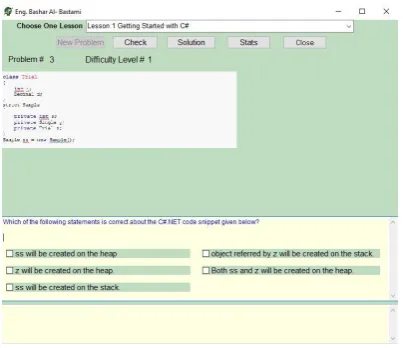
The ITSB authoring tool used for building the C# system supports the user interface and teacher interface. When the teacher’s log in the system, the he/she can add initial information about the student, lessons, exercises, answers, font name, and size of all buttons, menus, combo configure and adjust the fonts, background color, and text color for all forms in the systems, boxes etc. Thus, this interface provides the system with the needed flexibility to be used by both teacher and students. A screenshot of the student and teacher's interfaces are shown in Fig 2 to Fig 9.
EXPERT MODULE
This component is called sometimes the domain module of other ITS architectures.
It contains the material to be taught for the students. In our current tutoring system, the material consists of the following topics in C# language:
Introduction to Programming
Primitive Types and Variables
Operators and Expressions
Console Input and Output
Conditional Statements
Loops
Arrays
Numeral Systems
Methods
Recursion
Exception Handling
Strings and Text Processing
Defining Classes
Text Files
Linear Data Structures
Trees and Graphs
Dictionaries, Hash-Tables and SetsFigure 2: login screen
Figure 4: In this interface, the student chose an example of the lesson that he/she want to study.
Figure 5: After the student read the lesson, the tools offer many questions about the lesson if the student wants to evaluate himself.
1. Correct answer:
2. Wrong answer:
Figure 7: This interface to add new student into the tool with some information to work on it.
Figure 8: This interface shows the students status, problem, difficulty of the questions, his/her score and the title of lesson.
Figure 9: This message appears when the student fails the current difficulty level of a specific lesson.
EVALUATION
give their opinion about the system. The overall impression of both students and teachers were positive. Some of the comment we got from the teachers and students as follows: “go ahead”, “The system will help number of students”, “good but you should make it more flexible to add lessons, examples and questions”, “the system will not improve the education and that will make students doesn’t focus in classes but just depends the system”, “your system will make student lazy to go to the classes, because he has a tutor to understand the lesson”.
CONCLUSION
There is an increasing interest in the new trend of Intelligent Tutoring System for high quality teaching and training because it uses Artificial Intelligent, Cognitive Science and Education to enhance the aptitude of computer supported education to autonomously offer students with effective educational capabilities.
In this paper, we have provided the design and development of an Intelligent Tutoring System for C# language to help student better learn programming languages. An initial evaluation of the system was carried out and the findings were positive.
REFERENCES
1. Jon Skeet, C# in Depth, 3rd edition, Manning Publications;, 2013.
2. Dilyan Dimitrov and others, Fundamentals of Computer Programming With C#, Svetlin Nakov & Co., 2013.
4. Conati C., Gertner A., VanLehn K., 2002. Using Bayesian Networks to Manage Uncertainty in Student Modeling. User Modeling and User-Adapted Interaction. 12(4) p. 371-417.
5. Mitrovic, A., Martin, B., Suraweera, P. Constraint-based tutors: past, present and future. IEEE Intelligent Systems, special issue on Intelligent Educational Systems, vol. 22, no. 4, pp. 38-45, July/August 2007.
6. Professor Glenn D. Blank, Fall 2007: CSE 497: Intelligent
Tutoring Systems.
http://www.cse.lehigh.edu/~glennb/497Tutoring/.
7. Jeremić, Z. (2005). An Intelligent Tutoring System for learning Software Patterns (in Serbian), Master Thesis, Belgrade, Serbia.
8. Naser, S. S. A. (2012). Predicting learners performance using artificial neural networks in linear programming intelligent tutoring system, International Journal of Artificial Intelligence & Applications, Academy & Industry Research Collaboration Center (AIRCC), 3,2, 65-73.
9. Naser, S.S A., & Sulisel, O. (2000). The effect of using computer aided instruction on performance of 10th grade biology in Gaza.
10.Naser, S. A., Ahmed, A., Al-Masri, N., & Abu Sultan, Y. (2011). Human Computer Interaction Design of the LP-ITS: Linear Programming Intelligent Tutoring Systems, International Journal of Artificial Intelligence & Applications (IJAIA), 2(3),60-70.
11.Chrstan Wolf, "I-Weaver: Towards learning stylbase e-learning in computer science education", proceedings of the Australian Computing Education Conference, 2003.
13.Abu Naser, S. (2008). JEE-Tutor: An Intelligent Tutoring System for Java Expression Evaluation, Information Technology Journal, Scialert , 7(3),528-532.
14.Naser, S.S. A. (2008). Developing an intelligent tutoring system for students learning to program in C++, Information Technology Journal, Scialert,7(7),1055-1060. 15.Naser, S.S.A. (2008). Developing visualization tool for
teaching AI searching algorithms, Information Technology Journal, Scialert,7(2), 350-355.
16.Pramuditha Suraweera & Antonija Mitrovic. KERMIT, An Intelligent Tutoring System for Entity Relationship Modeling. Private Bag 4800, Christchurch, New Zealand 17.Naser, S. A. (2008). An Agent Based Intelligent Tutoring
System For Parameter Passing In Java Programming, Journal of Theoretical & Applied Information Technology, 4,7.
18.Mahmoud, A. Y., Barakat, M. S., & Ajjour, M. J. (2016). Design and Development Of ELearning University System.
(Journal of Multidisciplinary Engineering Science Studies (JMESS), 2(Issue 5, May - 2016), 498-504.
19.Mahdi, A. O., Alhabbash, M. I., & Abu Naser, S. S. (2016). An intelligent tutoring system for teaching advanced topics in information security, WWJMRD, 2(12), 1-9.
20.ALDahdooh, R., & Abu Naser, S.S. (2017). Development and Evaluation of the Oracle Intelligent Tutoring System (OITS), European Academic Research, 4(10).
21.Al-Nakhal M.A., & Abu Naser, S. S. (2017). An Intelligent Tutoring System for learning Computer Theory, European Academic Research, 4(10).
22.Hilles, M. M., & Abu Naser, S.S. (2017). Knowledge-based Intelligent Tutoring System for Teaching Mongo Database, European Academic Research, 4(10).
24.Abu Naser, S.S. (2001). A comparative study between Animated Intelligent Tutoring Systems (AITS) and Video-based Intelligent Tutoring Systems (VITS), Al-Aqsa University Journal,5,1 Part,1.
25.C. J. Butz, S. Hua, R. B. Maguire, "A web-based Bayesian intelligent tutoring system for computer programming", Web Intelligence and Agent Systems, Vol.4, No.1, pp.77-97 · January 2006.
26.Abu-Naser, S., Al-Masri, A., Abu Sultan, Y., & Zaqout, I. (2011). A prototype decision support system for optimizing the effectiveness of e-learning in educational institutions, International Journal of Data Mining & Knowledge Management Process (IJDKP),1, 1-13.
27.Alhabbash, M. I., Mahdi, A. O., & Abu Naser, S.S. (2016). An Intelligent Tutoring System for Teaching Grammar English Tenses, European Academic Research, 4(9).
28.Abu-Naser, S., Ahmed, A., Al-Masri, N., Deeb, A., Moshtaha, E., & AbuLamdy, M. (2011). An Intelligent Tutoring System for Learning Java Objects, International Journal of Artificial Intelligence and Applications (IJAIA), 2(2).
29.Naser, S. (2009). Evaluating the effectiveness of the CPP-Tutor an intelligent tutoring system for students learning to program in C++, Journal of Applied Sciences Research, 5(1), 109-114, http://www.aensiweb.com/JASR/.
30.Almurshidi, S. H., & Abu Naser, S. S. (2016). Design and Development of Diabetes Intelligent Tutoring System, European Academic Research, 4(9).
31.Naser, S. S. A. (2012). A Qualitative Study of LP-ITS:
Linear Programming Intelligent Tutoring System,
International Journal of Computer Science & Information Technology, 4(1),209-220, Academy & Industry Research Collaboration Center (AIRCC).
Techniques
, International Journal of Soft Computing, Mathematics and Control, 4(2).33.Abu Naser, S. (1993). A methodology for expert systems testing and debugging, North Dakota State University, USA 1, 1-130