ISSN (Print) : 2320 – 3765 ISSN (Online): 2278 – 8875
I
nternational
J
ournal of
A
dvanced
R
esearch in
E
lectrical,
E
lectronics and
I
nstrumentation
E
ngineering
(An ISO 3297: 2007 Certified Organization)
Vol. 5, Issue 6, June 2016
Control of Voltage Regulation Using
STATCOM
Priyanka Gurav1, S. K. Mittal2
Student, Department of Electrical Engineering, G.H.Raisoni Institute of Engineering and Technology, Pune, Savitribai
Phule Pune University, Pune, India1
Professor, Department of Electrical Engineering, G.H.Raisoni Institute of Engineering and Technology, Pune,
Savitribai Phule Pune University, Pune, India2
ABSTRACT: STATCOM can give quick and effective receptive force backing to keep up force framework voltage strength. In the writing, different STATCOM control techniques have been examined including numerous uses of corresponding indispensable (PI) controllers. Be that as it may, these past works acquire the PI picks up by means of an experimentation approach or broad studies with a tradeoff of execution and materialness. Consequently, control parameters for the ideal execution at a given working point may not be viable at an alternate working point. This paper proposes another control model in view of versatile PI control, which can self-modify the control picks up amid an aggravation such that the execution dependably coordinates a craved reaction, paying little heed to the change of working condition. Since the change is self-ruling, this gives the attachment and-play capacity for STATCOM operation. In the reproduction test, the versatile PI control indicates reliable brilliance under different working conditions, for example, distinctive starting control increases, diverse burden levels, and change of transmission system, sequential unsettling influences, and an extreme aggravation. Interestingly, the routine STATCOM control with tuned, settled PI picks up for the most part perform fine in the first framework, yet may not execute as effective as the proposed control strategy when there is a change of framework conditions.
KEYWORDS: Adaptive control, plug and play, proportional-integral (PI) control, reactive power compensation, STATCOM, voltage stability.
I. INTRODUCTION
ISSN (Print) : 2320 – 3765 ISSN (Online): 2278 – 8875
I
nternational
J
ournal of
A
dvanced
R
esearch in
E
lectrical,
E
lectronics and
I
nstrumentation
E
ngineering
(An ISO 3297: 2007 Certified Organization)
Vol. 5, Issue 6, June 2016
increment in dynamic force exchange causes a brisk diminishing in extent of voltage of the transport. As the basic point is achieved, substantial receptive force misfortunes lead to a high voltage drop and there voltage breakdown happens. To keep the framework, achieving this state is to increase receptive force backing or cut-off responsive force request. This wonder in some cases prompts real pass out .One of the techniques to conquer this issue is to put responsive force support on the weakest transport 9 transport having least edge or close to the breakdown point. Presently a days need of power is expanding in colossal way, subsequently VA stacking is additionally expanding on force transmission line that came about into need of responsive force remuneration. The greater part of the basic burdens in a mechanical low voltage AC framework has a lopsided and/or nonlinear trademark. Subsequently, responsive force ought to be created and repaid legitimately to enhance the force nature of info utility and to keep up voltage profile mains by utilizing a FACTS gadgets, for example, SVC,STATCOM, UPFC, and IPFC. One of the numerous gadgets under the FACTS family, a STATCOM is a directing gadget which can be utilized to manage the stream of responsive force in the framework autonomous of other framework parameters. STATCOM has no long haul vitality support on the dc side and it can't trade genuine force with the air conditioner framework. In the transmission frameworks, STATCOMs essentially handle just key responsive force trade and give voltage backing to transports by balancing transport voltages amid element unsettling influences with a specific end goal to give better transient qualities, enhance the transient solidness edges and to clammy out the framework motions because of these aggravations.
II. MECHANISM STATIC SYNCHRONOUS COMPENSATOR (STATCOM)
A Flexible AC Transmission System (FACTS) is a consolidating power electronic-based or other static controllers which give better power stream control and upgraded dynamic dependability by control of one or more air conditioning transmission framework parameters (voltage, stage edge. What's more, impedance) FACTS controllers is a quick creating region with potential applications.. A FACTS controller can defeat the issue by controlling the impedance, or stage point. A FACTS controller can control the force stream in any way that is fancied. It is conceivable to infuse sought voltage in arrangement with the line.
STATCOM is a standout amongst the most vital shunt FACTS controllers, which have wide applications in electric utility industry. STATCOM has assumed an imperative part in force industry since 1980s and perceived to be one of the key advancements in future force framework. STATCOM depends on the rule that a voltage source inverter creates a controllable AC voltage source behind a reactance so that the voltage contrast over the reactance produces dynamic and receptive force trade between the STATCOM and the transmission system line in a comparable way of a synchronous condenser.
ISSN (Print) : 2320 – 3765 ISSN (Online): 2278 – 8875
I
nternational
J
ournal of
A
dvanced
R
esearch in
E
lectrical,
E
lectronics and
I
nstrumentation
E
ngineering
(An ISO 3297: 2007 Certified Organization)
Vol. 5, Issue 6, June 2016
Fig.1. Schematic configuration of STATCOM
STATCOM comprise of resistance, spillage inductance, and VSI and DC capacitor. Resistance and inductance goes about as attractive coupling to the framework. They give seclusion to inverter circuit and framework circuit. DC capacitor gives consistent voltage, it goes about as source. The STATCOM can keep up full yield current range even at low framework voltage, which likewise makes it more powerful than SVC in enhancing the transient steadiness. In light of the utilization of VSC, STATCOM can trade genuine force with lattice bi-directionally, and autonomously control both responsive force and genuine force, which is not feasible if utilizing a SVC. STATCOM is to stifle voltage variety and control of responsive force in stage with framework voltage. It can make up for inductive and capacitive current straightly and ceaselessly. The terminal voltage V_bus is equivalent to aggregate of inverter voltage V_STATCOM and voltage crosswise over spillage reactance V_L and resistance in inductive and capacitive mode. It implies that if yield voltage of STATCOM V_STATCOM is in stage with transport terminal voltage V_bus and V_STATCOM is more noteworthy than V_bus , STATCOM give responsive energy to the framework. On the off chance that V_STATCOM is littler than V_bus, STATCOM retains receptive force from force framework. In the event that V_STATCOM and V_bus is equivalent then no force will be trade, around then STATCOM will work in coasting mode. Fig.2. demonstrates working standard operation of STATCOM.
ISSN (Print) : 2320 – 3765 ISSN (Online): 2278 – 8875
I
nternational
J
ournal of
A
dvanced
R
esearch in
E
lectrical,
E
lectronics and
I
nstrumentation
E
ngineering
(An ISO 3297: 2007 Certified Organization)
Vol. 5, Issue 6, June 2016
III. STATIC SYNCHRONOUS COMPENSATOR WITH CONTROLLER
PI controller will eliminate forced oscillations. It is used as DC voltage controller which regulates DC capacitor voltage. The PI controller is required precise linear mathematical model and has zero steady state error. The error signal is generated by comparing reference voltage with actual voltage. PI controller tracks the reference voltage and contributes zero steady state error. Reference source current is estimated by regulating the DC capacitor voltage. There are various STATCOM control methods are available but many applications use traditional Proportional-Integral (PI) controller. But , in traditional PI controller we obtain PI gains via a trial-and-error approach or extensive studies with a tradeoff of performance and applicability.By using PI controller the error should be compensated. The PI controller expressed as given below,
Fig.3. Traditional STATCOM PI control block diagram. Points of interest
PI controller will wipe out constrained motions. This controller is utilized as DC voltage controller which manages DC capacitor voltage. The PI controller is required exact direct numerical model and it has zero unfaltering state mistake. The mistake sign is created by contrasting reference voltage and real voltage. PI controller tracks the reference voltage and contributes zero relentless state mistake. Reference source current is evaluated by directing the DC capacitor voltage. Utilizing PI controller mistake ought to be adjusted for the framework.
Downsides
The principle disadvantage of utilizing dreary current control is, there is no control activity, to keep away from the bending from the lattice voltage. With a specific end goal to defeat this disadvantage, it needs some extra calculation. It has most extreme overshoot and high settling time. It has affectability to controller picks up, likewise drowsy reaction because of sudden unsettling influence. At the point when utilizing altered additions PI controllers, it is important to retune them for various operation districts, also change in various stacking power. Likewise adjusting of parameters is tedious. PI controllers are touchy to parameter varieties inalienable in genuine plant operations.
Versatile PI Control for STATCOM
ISSN (Print) : 2320 – 3765 ISSN (Online): 2278 – 8875
I
nternational
J
ournal of
A
dvanced
R
esearch in
E
lectrical,
E
lectronics and
I
nstrumentation
E
ngineering
(An ISO 3297: 2007 Certified Organization)
Vol. 5, Issue 6, June 2016
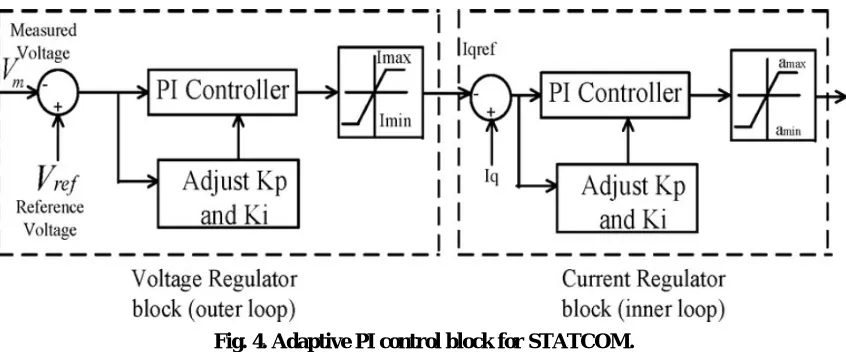
control strategy is with a specific end goal to get the coveted reaction and to abstain from performing experimentation studies to discover appropriate parameters for PI controllers when another STATCOM is introduced in a force framework. With this versatile PI control technique, the dynamical self-change of PI control parameters can be figured it out.
Fig. 4. Adaptive PI control block for STATCOM.
The process of the adaptive voltage-control method for STATCOM is described as follows: 1) Measure the bus voltage Vm(t)
2) Compare the Vm(t) and Vss, where Vss is the steady state voltage. if the difference between these two is not zero then Kp_v and Ki_v automatically and dynamically self adjusted to equate to zero.
3)Similarly in the inner loop Iqref is compared with Iq .if there is any error between these two then Kp_i and Ki_i automatically adjusted to find the suitable angle, so that the exact amount of reactive power can be injected in to the power system network.
Key equation of adaptive PI control,
( ) = −( − ( )) /
Where, ( ) = ( ) + ( )
Conventional PI with Static synchronous Compensator
IV. SIMULATION RESULTS
In the system a 100-MVAR STATCOM is implemented with a 48-pulse VSC and connected to a 500-kV bus. This is the standard sample STATCOM system in Matlab/Simulink library, and all machines used in the simulation are dynamical models. STATCOM uses a Voltage-Sourced Converter (VSC) built of four 12-pulse three-level GTO inverters.
In the system simulation ±100-MVAR STATCOM is implemented with a 48-pulse VSC and connected to a 500-kV
bus.
The comparison of original control and adaptive control are studied for various cases as below:
ISSN (Print) : 2320 – 3765 ISSN (Online): 2278 – 8875
I
nternational
J
ournal of
A
dvanced
R
esearch in
E
lectrical,
E
lectronics and
I
nstrumentation
E
ngineering
(An ISO 3297: 2007 Certified Organization)
Vol. 5, Issue 6, June 2016
(a) Original Control (b) Adaptive Control
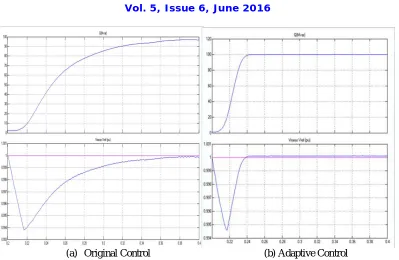
Fig 5.Output reactive power and voltages of (a) original control and (b) adaptive control using the same network and loads as in the original system.
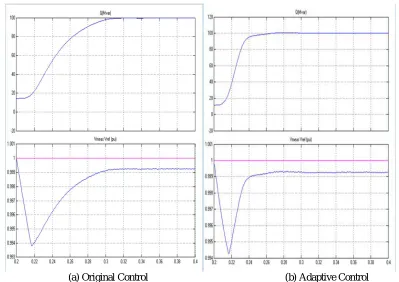
B. The other parameters remains unchanged but the PI controller gains for the original control are changed. Fig 6 shows the when PI control gains are changed to different values adaptive control performs as desired.
(a) Original Control (b) Adaptive Control
ISSN (Print) : 2320 – 3765 ISSN (Online): 2278 – 8875
I
nternational
J
ournal of
A
dvanced
R
esearch in
E
lectrical,
E
lectronics and
I
nstrumentation
E
ngineering
(An ISO 3297: 2007 Certified Organization)
Vol. 5, Issue 6, June 2016
C. In this case the original PI gains are kept as per the original system. While the load at bus changes . The adaptive PI control gives desired response to a change in load shown in Fig 7.
(a) Original Control (b) Adaptive Control
Fig 7.Output reactive power and voltages of (a) original control and (b) adaptive control with change of load.
During steady-state operation the STATCOM control system keeps the fundamental component of the VSC voltage in phase with the system voltage. If the voltage generated by the VSC is higher (or lower) than the system voltage, the STATCOM generates (or absorbs) reactive power. The amount of reactive power depends on the VSC voltage magnitude and on the transformer leakage reactance. The fundamental component of VSC voltage is controlled by varying the DC bus voltage. In order to vary the DC voltage, and therefore the reactive power, the VSC voltage angle (alpha) which is normally kept close to zero is temporarily phase shifted. This VSC voltage lag or lead produces a temporary flow of active power which results in an increase or decrease of capacitor voltages. One of the three voltage sources used in the 500 kV system equivalents can be varied in order to observe the STATCOM dynamic response to changes in system voltage.
V. CONCLUSION
ISSN (Print) : 2320 – 3765 ISSN (Online): 2278 – 8875
I
nternational
J
ournal of
A
dvanced
R
esearch in
E
lectrical,
E
lectronics and
I
nstrumentation
E
ngineering
(An ISO 3297: 2007 Certified Organization)
Vol. 5, Issue 6, June 2016
REFERENCES
[1]Yao Xu, Student Member, IEEE, and Fangxing Li, Senior Member, IEEE" Adaptive PI Control of STATCOM for Voltage Regulation" IEEE TRANSACTIONS ON POWER DELIVERY, VOL. 29, NO. 3, JUNE 2014.
[2] F. Li, J. D. Kueck, D. T. Rizy, and T. Lord, "A preparatory examination of the financial aspects of utilizing conveyed vitality as a wellspring of responsive force supply," Oak Ridge, TN, USA, First Quart. Rep. Monetary Year, Apr. 2006, Oak Ridge Nat. Lab.
[3] A. Jain, K. Joshi, A. Behal, and N. Mohan, "Voltage direction with STATCOMs:Modeling, control and results," IEEE Trans. Power Del., vol. 21, no. 2, pp. 726–735, Apr. 2006.
[4] D. Soto and R. Pena, "Nonlinear control systems for fell multilevel STATCOMs," IEEE Trans. Power Del., vol. 19, no. 4, pp. 1919–1927, Oct. 2004.
[5] H. Li, F. Li, Y. Xu, D. T. Rizy, and S. Adhikari, "Independent and versatile voltage control utilizing different appropriated vitality assets," IEEE Trans. Power Syst., vol. 28, no. 2, pp. 718–730, May 2013.
[6] C. Hochgraf and R. H. Lasseter, "STATCOM controls for operation with lopsided voltage," IEEE Trans. Power Del., vol. 13, no. 2, pp. 538–544, Apr. 1998.
[7] G. E. Valdarannma, P. Mattavalli, and A. M. Stankonic, "Responsive power and unbalance pay utilizing STATCOM with dissipativity based control," IEEE Trans. Control Syst. Technol., vol. 19, no. 5, pp. 598–608, Sep. 2001.
[8] H. F. Wang, "Phillips-Heffron model of force frameworks introduced with STATCOM and applications," Proc. Inst. Choose. Eng., Gen. Transm. Distrib., vol. 146, no. 5, pp. 521–527, Sep. 1999.
[9] N. G. Hingorani and L. Gyugyi, Understanding FACTS: Concepts and Technology of Flexible AC Transmission Systems. Piscataway, NJ: IEEE Press, 1999.
[10] Y. Han, Y. O. Lee, and C. C. Chung, "Altered non-direct damping of inward progression by means of criticism linearisation for static synchronous compensator," IET Gen. Transm.Distrib., vol. 5, no. 9, pp. 930–940, 2011.
[11] A. H. Norouzi and A. M. Sharaf, "Two control plans to improve the dynamic execution of the STATCOM and SSSC," IEEE Trans. Power Del., vol. 20, no. 1, pp. 435–442, Jan. 2005.