
Solution of Economic Dispatch Problem Using
Cuckoo Search Algorithm
Wawan Heryawan1, Medi Yuwono Tharam2, Hasan3, Wendhi Yuniarto4, Hardiansyah5
Department of Electrical Engineering, State Polytechnic of Pontianak, Indonesia1,2,3,4 Department of Electrical Engineering, University of Tanjungpura, Indonesia5
ABSTRACT:This paper presents a cuckoo search algorithm (CSA) for solving the economic dispatch (ED) problem
considering ramp rate limits, prohibited operating zones and transmission loss.CSA is a new meta-heuristic optimization method inspired from the obligate brood parasitism of some cuckoo species by laying their eggs in the nests of other host birds of other species.The effectiveness of the proposed approach has been tested on 6 generator system. The results shows that performance of the proposed approach reveal the efficiently and robustness when compared results of other optimization algorithms reported in literature.
KEYWORDS:Cuckoo Search Algorithm, Economic Dispatch, Ramp Rate Limits, Prohibited Operating Zones.
I.INTRODUCTION
The Economic Dispatch (ED) problem is one of the fundamental issues in power system operation and planning, where the total required load is distributed among the generation units in operation. The main objective of ED problem is to minimizing total generation cost while satisfying load and operational constraints. Traditionally, fuel cost function of a generator is represented by single quadratic function. But a quadratic function is not able to show the practical behaviour of generator. For modelling of the practical cost function behaviour of a generator, a non-convex curve is used in literature. The ED problem is a non-convex and nonlinear optimization problem. Due to ED complex and nonlinear characteristics, it is hard to solve the problem using classical optimization methods.
Most of classical optimization techniques such as lambda iteration method, gradient method, Newton’s method, linear programming, Interior point method and dynamic programming have been used to solve the basic economic dispatch problem [1]. These mathematical methods require incremental or marginal fuel cost curves which should be monotonically increasing to find global optimal solution. In reality, however, the input-output characteristics of generating units are non-convex due to valve-point loadings and multi-fuel effects, etc. Also there are various practical limitations in operation and control such as ramp rate limits and prohibited operating zones, etc. Therefore, the practical ED problem is represented as a non-convex optimization problem with equality and inequality constraints, which cannot be solved by the traditional mathematical methods. Dynamic programming (DP) method [2] can solve such types of problems, but it suffers from so-called the curse of dimensionality. Over the past few decades, as an alternative to the conventional mathematical approaches, many salient methods have been developed for ED problem such as genetic algorithm (GA) [3], improved tabu search (TS) [4], simulated annealing (SA) [5], neural network (NN) [6], evolutionary programming (EP) [7, 8], particle swarm optimization (PSO) [9, 10], differential evolution (DE) [11], and gravitational search algorithm (GSA) [12],biogeography-based optimization (BBO) [13].
II.PROBLEM FORMULATION
The objective of an ED problem is to find the optimal combination of power generations that minimizes the total generation cost while satisfying equality and inequality constraints. The fuel cost curve for any unit is assumed to be approximated by segments of quadratic functions of the active power output of the generator.For a given power system network, the problem may be described as optimization (minimization) of total fuel cost as defined by (1) under a set of operating constraints.
n
i
i i i i i n
i i i
T F P aP bP c
F
1 2
1
)
( (1)
where FTis total fuel cost of generation in the system ($/hr), ai, bi, and ci are the cost coefficient of the i-th generator, Pi
is the power generated by the i-th unit and n is the number of generators. The cost is minimized subjected to the following constraints:
(1) Active Power Balance Equation
For power balance, an equality constraint should be satisfied. The total generated power should be the same as total load demand plus the total line loss.
Loss n
i i
D P P
P
1
(2)
wherePD is the total load demand and PLoss is total transmission losses. The transmission losses PLosscan be calculated
by using B matrix technique and is defined by (3) as,
00 1
0 1 1
B P B P B P
P i
n
i i j
ij n
i n
j i
Loss
(3)
whereBij is coefficient of transmission losses and the B0iand B00 is matrix for loss in transmission which are constant
under certain assumed conditions.
(2) Minimum and Maximum Power Limits
Generation output of each generator should lie between minimum and maximum limits. The corresponding inequality constraint for each generator is
n i
P P
Pimin i imax for 1,2,, (4) where
P
iminandP
imaxare the minimum and maximum outputs of the i-th generator, respectively.(3) Ramp Rate Limits
The actual operating ranges of all on-line units are restricted by their corresponding ramp rate limits. The ramp-up and ramp-down constraints can be written as (5) and (6), respectively.
i i
i t P t UR
P( ) ( 1) (5)
i i
i
t
P
t
DR
P
(
1
)
(
)
(6)wherePi(t) and Pi(t-1) are the present and previous power outputs, respectively. URi and DRi are the up and
ramp-down limits of the i-th generator (in units of MW/time period).
To consider the ramp rate limits and power output limits constraints at the same time, therefore, equations (4), (5) and (6) can be rewritten as follows:
} ) 1 ( , min{ ) ( } ) 1 ( ,
max{Pimin Pi t DRi Pi t Pimax Pi t URi (7)
(4) Prohibited Operating Zones
Such faults may lead to instability in certain ranges of generator power output. Therefore, for units with prohibited operating zones, there are additional constraints on the unit operating range as follows:
pz i
i u
pz i
i l
k i i u
k i
l i i i
i
n i
P P P
pz k
P P P
P P P P
i , 1,2, ,
, , 3 , 2 ,
max ,
, 1
,
1 , min
(8)
where l k i
P, and u
k i
P, are the lower and upper boundary of prohibited operating zone of unit i, respectively. Here, pziisthe
number of prohibited zones of unit iand npz is the number of units which have prohibited operating zones. III.CUCKOO SEARCH ALGORITHM (CSA)
Cuckoo search (CS) is inspired by some species of a bird family called cuckoo because of their special lifestyle andaggressive reproduction strategy. This algorithm wasproposed by Yang and Deb [14]. The CS is an optimizationalgorithm based on the brood parasitism of cuckoospecies by laying their eggs in the communal nests ofother hostbirds, though they may remove others’ eggs toincrease the hatching probability of their own eggs. Somehost birds do not behave friendly against intruders andengage in direct conflict with them. If a host bird discovers the eggs are nottheir own, it will either throw theseforeign eggs away or simply abandon its nest and build a new nest elsewhere [15].
The CS algorithm contains a population of nests or eggs. Each egg in a nest represents a solution and a cuckoo egg represents a new solution. If the cuckoo egg is very similar to the host’s, then this cuckoo egg is less likely to be discovered; thus, the fitness should be related to the difference in solutions. The better new solution (cuckoo) is replaced with a solution which is not so good in the nest. In the simplest form, each nest has one egg. When generating new solutions forx(t1), say cuckoo i, a Lévy flight is performed:
) ( Lévy
) 1
( t i
t
i x
x (9)
where α> 0 is the step size which should be related to the scales of the problem of interest. In most cases, wecan use α
= O (1). The product ⊕ means entry-wise multiplications. Lévy flights essentially provide a randomwalk while theirrandom steps are drawn from a Lévydistribution for large steps:
1 3
, t u ~ Lévy
-
(10)
which has an infinite variance with an infinite mean.Here the consecutive jumps/steps of a cuckoo essentiallyform a random walk process which obeys a power-lawstep-length distribution with a heavy tail. The rules for CS are described as follows:
Each cuckoo lays one egg at a time, and dumps it in arandomly chosen nest;
The best nests with high quality of eggs (solutions)will carry over to the next generations;
The number of available host nests is fixed, and ahost can discover a foreign egg with a probability pa∊[0, 1]. In this case, the host bird can either throwthe egg away or abandon the nest so as to build acompletely new nest in a new location.
The later assumption can be approximated by the fraction paof the n nests which are replaced by new ones(with new
random solutions). With these three rules, thebasic steps of the CS can be summarized as the pseudo-codeshownbellow, 1) Define the objective function f(x),x(x1,,xd)T
2) Set n, pa, and MaxGeneration parameters
3) Generate initial population of n available nests 4) Move a cuckoo (i) randomly by Lévy flights 5) Evaluate the fitness fi
6) Randomly choose a nest (j) among n available nests 7) If fi>fj the replace j by the new solution
8) Abandon a fraction pa of worse nests and create the same fraction of new nests at new location via Lévy flights
10) Sort the solutions and find the best current solution
11) If stopping criteria is not satisfied, increase generation number and go to step 4 12) Post-process results and find the best solution among all.
IV.SIMULATION RESULTS
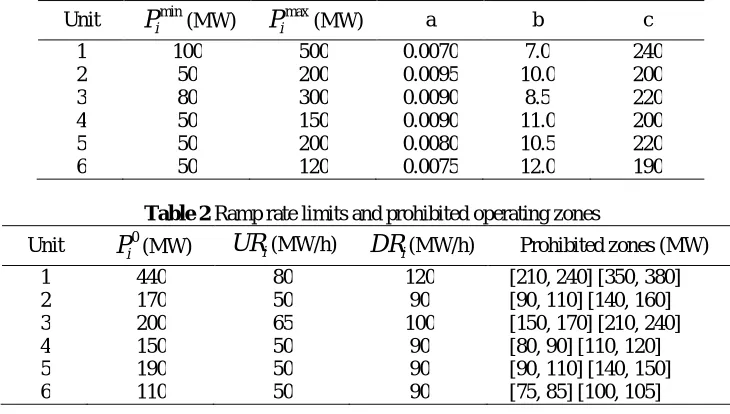
The proposed cuckoo search algorithm (CSA) has been applied to solve ED problem for verifying its feasibility. A sixgenerator systems with power loss, ramp rate limits and prohibited operating zones are considered. The total load demand on the system is 1263 MW. The parameters of all generating units are presented in Table 1 and Table 2 [9], respectively.
Table 1 Cost coefficients and unit operating limits
Unit
P
imin(MW)P
imax(MW) a b c 1 100 500 0.0070 7.0 240 2 50 200 0.0095 10.0 200 3 80 300 0.0090 8.5 220 4 50 150 0.0090 11.0 200 5 50 200 0.0080 10.5 220 6 50 120 0.0075 12.0 190Table 2 Ramp rate limits and prohibited operating zones
Unit
P
i0(MW)UR
i(MW/h)DR
i(MW/h) Prohibited zones (MW)1 440 80 120 [210, 240] [350, 380] 2 170 50 90 [90, 110] [140, 160] 3 200 65 100 [150, 170] [210, 240] 4 150 50 90 [80, 90] [110, 120] 5 190 50 90 [90, 110] [140, 150] 6 110 50 90 [75, 85] [100, 105]
The transmission losses are calculated by Bmatrix loss formula which for 6 generator system is given as:
0150 . 0 0002 . 0 0008 . 0 0006 . 0 0001 0 0002 . 0 0002 . 0 0129 . 0 0006 . 0 0010 . 0 0006 0 0005 . 0 0008 . 0 0006 . 0 0024 . 0 0000 . 0 0001 0 0001 . 0 0006 . 0 0010 . 0 0000 . 0 0031 . 0 0009 0 0007 . 0 0001 . 0 0006 . 0 0001 . 0 0009 . 0 0014 0 0012 . 0 0002 . 0 0005 . 0 0001 . 0 0007 . 0 0012 0 0017 . 0 . . . . . . Bij
0.3908 0.1297 0.7047 0.0591 0.2161 0.6635
0 . 1 3
0
e Bi 0056 . 0 00 B
Table 3 Comparison of the best results of each methods (PD = 1263 MW)
Unit Output BBO[13] GA[16] PSO[16] IDP[16] CSA P1 (MW) 447.3997 474.8066 447.4970 450.9555 447.3990 P2 (MW) 173.2392 178.6363 173.3221 173.0184 173.2408 P3 (MW) 263.3136 262.2089 263.0594 263.6370 263.3812 P4 (MW) 138.0060 134.2826 139.0594 138.0655 138.9796 P5 (MW) 165.4104 151.9039 165.4761 164.9937 165.3914 P6 (MW) 87.0797 74.1812 87.1280 85.3094 87.0529 Total power output (MW) 1275.4460 1276.0217 1275.9584 1275.9794 1275.4448 Total generation cost ($/hr) 15443.09 15459 15450 15450 15443.07 Power losses (MW) 12.446 13.0217 12.9584 12.9794 12.4448
Fig. 1 Cost convergence characteristic of 6-generator system
V.CONCLUSION
In this paper, a cuckoo search algorithm (CSA) has been successfully applied for solving economic dispatch problem considering ramp rate limits, prohibited operating zones and transmission loss. The proposed technique has provided the global solution in the 6 generator system and the better solution than the previous studies reported in literature.
0 10 20 30 40 50 60 70 80 90 100 1.544
1.5445 1.545 1.5455 1.546 1.5465
1.547x 10
4
Iteration
F
u
e
l
c
o
s
t
($
/h
)
REFERENCES
[1] A. J Wood, B. F. Wollenberg, Power Generation, Operation, and Control, 2nd ed., John Wiley and Sons, New York, 1996.
[2] Z. X. Liang, J. D. Glover, “A zoom feature for a dynamic programming solution to economic dispatch including transmission losses”, IEEE Transactions on Power Systems, vol. 7, no. 2, pp. 544-550, May 1992.
[3] C. L. Chiang, “Improved genetic algorithm for power economic dispatch of units with valve-point effects and multiple fuels”, IEEE Transactions on Power Systems, vol. 20, no. 4, pp. 1690-1699, 2005.
[4] W. M. Lin, F. S. Cheng, M. T. Tsay, “An improved tabu search for economic dispatch with multiple minima”, IEEE Transactions on Power Systems, vol. 17, no. 1, pp. 108-112, 2002.
[5] K. P. Wong, C. C. Fung, “Simulated annealing based economic dispatch algorithm”, IEE Proceedings Part C: Generation, Transmission & Distribution, vol. 140, no. 6, pp. 509-515, 1993.
[6] K. Y. Lee, A. Sode-Yome, J. H. Park, “Adaptive Hopfield neural network for economic load dispatch”, IEEE Transactions on Power Systems, vol. 13, no. 2, pp. 519-526, 1998.
[7] T. Jayabarathi, G. Sadasivam, “Evolutionary programming-based economic dispatch for units with multiple fuel options”, European Transactions on ElectricalPower, vol. 10, no. 3, pp. 167-170, 2000.
[8] N. Sinha, R. Chakrabarti, P. K. Chattopadhyay, “Evolutionary programming techniques for economic load dispatch”, IEEE Transactions on EvolutionaryComputation, vol. 7, no. 1, pp. 83-94, 2003.
[9] Z. L. Gaing, “Particle swarm optimization to solving the economic dispatch considering the generator constraints”, IEEE Transactions on Power Systems, vol. 18, no. 3, pp. 1187-1195, 2003.
[10] Shi Yao Lim, Mohammad Montakhab, Hassan Nouri, “Economic dispatch of power system using particle swarm optimization with constriction factor”, International Journal of Innovations in Energy Systems and Power, vol. 4, no. 2, pp. 29-34, 2009.
[11] N. Noman, H. Iba, “Differential evolution for economic load dispatch problems”, Electric Power Systems Research, vol. 78, no. 8, pp. 1322-1331, 2008.
[12] S. Duman, U. Guvenc, N. Yorukeren, “Gravitational search algorithm for economic dispatch with valve-point effects”, International Review of Electrical Engineering, vol. 5, no. 6, pp. 2890-2895, 2010.
[13] A. Bhattacharya, P. K. Chattopadhyay, “Biogeography-based optimization for different economic load dispatch problems”, IEEE Transactions on Power Systems, vol. 25, no. 2, pp. 1064-1077, 2010.
[14] X. S. Yang, S. Deb, “Cuckoo search via Levy flights”, In: Proceedings of world congress on nature & biologically inspired computing, USA; IEEE Publications; pp. 210-214, 9-11 December 2009.
[15] X. S. Yang, S. Deb, “Engineering optimization by cuckoo search”, Int. J. Mathematical Modelling and Numerical Optimisation, vol. 1, no. 4, pp. 330-343, 2010.
![Table 3 Comparison of the best results of each methods (PUnit Output D = 1263 MW) BBO[13] GA[16] PSO[16] IDP[16]](https://thumb-us.123doks.com/thumbv2/123dok_us/7765784.1276706/5.595.82.483.330.657/table-comparison-best-results-methods-punit-output-bbo.webp)
