Study of Power Loss in Three Phase Radial
Distribution System
Rakesh Choudhary[1], Rakesh Singh Lodhi[2] Dr.Pragya Nema[3] PG Scholar, Assistant Professor, Professor
Oriental University,Indore
[email protected], [email protected], [email protected]
ABSTRACT:
Seventy five percent of total global energy demand is supplied by the burning of fossil fuels. But
increasing air pollution, global warming concerns, diminishing fossil fuels and their increasing cost
have made it necessary to look towards renewable sources as a future energy solution.
In this paper review about Power Loss, Load flow analyses in radial distribution system. Study about
enhancing voltage profile and decreasing power losses in electrical systems is must be solved in an
optimal way due to load flow analysis in single phase and three phase radial distribution system. To
improve voltage profile & stability of existing power system, FACTS devices and load flow analysis
are the alternative solution. Different IEEE radial distribution system structure, difference between
radial and ring main system and radial distribution system is shown better as compared to other
distribution system.It describes active power loss, reactive power loss and voltage profile of radial
distribution system as well as study about renewable energy source like distributed generation.
Keywords: Active Power Loss, Radial Distribution system, VAR loss, Distributed Generation
I.
INTRODUCTION:
Power distribution systems have different characteristics from transmission systems. They are characterized as Radial meshed structures; Unbalanced networks/loads [1]. A distribution system originates at a substation where the electric power is converted from the high voltage transmission system to a lower voltage for delivery
to the customers [2]. Fast Decoupled Load Flow method may provide inaccurate results and may not be converged. Therefore, conventional load flow methods cannot be directly applied to distribution systems [4].
II.
LITERATURE SURVEY:
Bjhguyg Mukhtiar Singh, Rajiv K. Varma
et.al
are
being
increasingly
connected
in
distribution systems utilizing power electronic
converters. A novel control strategy for
achieving maximum benefits from these
grid-interfacing inverters installed in 3-phase
4-wire
distribution
systems.
Inverter
is
controlled to perform as a multi-function
device by incorporating active power filter.
Grid-interfacing inverter combination and the
3-phase 4-wire linear/non-linear unbalanced
load at point of common coupling appears as
balanced linear load to the grid. It has been
shown that inverter can be effectively utilized
for power conditioning without affecting
normal operation of real power transfer. As per
review
grid
side
currents
are
always
maintained as balanced and sinusoidal at unity
power factor. Benjamin Kroposki
,
Pankaj K.
Sen
et al
explaining about distributed energy
systems in industry and its technological
advancement. Advanced power electronic
interfaces will allow distributed energy
systems to provide increased functionality
through improved power quality and reactive
power support. In this review there is also
discussion of power electronics applications
and distributed energy systems. J.A. Pec, J.
Mutale P.
et al
distributed generation play a
vital role for new era in electrical power
generation This paper presents an issues
concerning the integration of distributed
generation into electric power systems
especially of the renewable type. The fit and
forget policy of connecting DG to electric
power systems to a new more appropriate
policy of integrating. DG into power system
planning
and
operation
though
active
management of distribution networks some of
the opportunities that could be exploited in
support of the integration and hence greater
penetration of DG into electric power systems
are also explored.
Tripathy et al. [4] presented
a Newton like method for solving
ill-conditioned power systems. Their method
showed voltage convergence but could not be
efficiently used for optimal power flow
calculations.
Sr. No.
Author’s Name Method/Technique Work Done
Outcome
1. Puthireddy
Umapathi Reddy et.al
forward/backward sweep
MATLAB Programming LFS 19-Bus Unbalance system
Determine active power loss, active power, reactive power demand
2. K.JITHENDRA GOWD et. al
Load Flow Solution 13-Node Unbalance
Distribution Networks
compensation
3. J.A. Pec¸as Lopes et. Al
fit and forget approach
Distributed Generation Allocation
Operation and expansion of Distributed generation
4. S. K. Khadam Custom Power Devices
Concept of Power Park
Enhancing integration of RE and Power Quality 5. R. V. Bhadani Newton Raphson
method, CPF
maximum loading and voltage stability margin
DG
Allocation,Improvement of voltage profile, Loss reduction
III.
OBJECTIVE :
The objective is to presents a technique for
steady state power flow control and to
overcome with major problem of voltage
instability, voltage collapse & black out in
radial
distribution
system.
Mathematical
modeling of three phase radial distribution
system as well as distributed generation.
Literature survey clear that voltage stability
problem has been observed from radial
distribution system, so Load Flow Analysis,
Radial
Distribution
System,
Forward
Backward Sweep method and local search
optimization are studies. Active power flow,
reactive power flow, active power loss,
reactive power loss in three phases radial
distribution system is also study to reduce
power loss by applying distributed generation
in some buses of radial distribution system.
IV.
RADIAL DISTRIBUTION SYSTEM
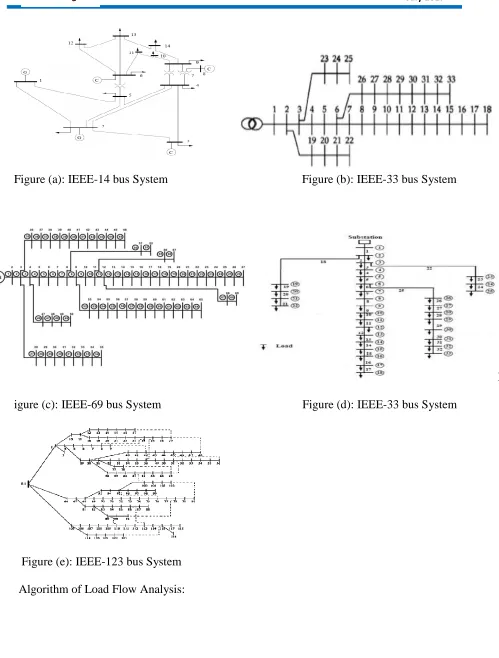
There are study and analysis of different
structure of IEEE bus system. Here we are
considering IEEE-14 bus system (a), IEEE-33
bus system (b), 69 bus system(c)
IEEE-33 bus system (d) and IEEE-123 bus system.
So IEEE-33 bus radial distribution system is
using for load flow analysis as well as
determination of voltage and current profile
when distributed generation is applied to
IEEE-33 bus system. Algorithm of Load flow
analysis of Radial Distribution system in
shown in below figure and comparison
between radial distribution system and ring
Figure (a): IEEE-14 bus System
Figure (b): IEEE-33 bus System
F
igure (c): IEEE-69 bus System Figure (d): IEEE-33 bus System
Figure (e): IEEE-123 bus System
Table: 2 Differences between Radial Distribution System and Ring Main System
V.
CONCLUSION:
In Literature survey there are number of
methods had been used for power/load-flow
analysis of radial distribution system. As study
about load flow analysis of radial distributed
system following points were analyzed:
Radial distribution system should support
electrical energy supply at minimum initial
operation and maintenance cost.
It must satisfy continuous changing of load
demand for active and reactive power.
Electricity is not easily stored and so, adequate
spinning reserve of active and reactive power
should be maintained and controlled in an
appropriate manner.
Sr.
No.
Radial Distribution System
Ring Main System
1.
RDS has a low maintenance
RMS has High maintenance
2.
RDS is very economical and requires
less materials
RMS is very expensive and
requires more materials
3.
RDS initial cost is low
RMS initial cost is high
4.
RDS is Preferred when station is located
at the center of load
To maintain quality of service offered
regulated voltage well maintained constant
frequency level of reliability and security that
guarantees consumers satisfaction in radial
distribution system.
To reducing active power loss and reactive
power loss of radial distribution system is also
possible by using distributed generation as
current scenario.
Power demand of consumers can also fulfill
with the help of distributed generation in radial
distributed generation.
REFRENCES:
[1.]Puthireddy Umapathi Reddy, Sirigiri Sivanagaraju , Prabandhamkam Sangameswararaju “POWER FLOW ANALYSIS OF THREE PHASE UNBALANCED RADIAL DISTRIBUTION SYSTEM” International Journal of Advances in Engineering & Technology, ISSN: 2231-1963 March 2012.
[2.]K.Jithendra Gowd, Ch.Sai Babu, S.Sivanagarajuu “LOAD FLOW SOLUTION FOR UNBALANCED RADIAL DISTRIBUTION SYSTEMS” International Journal of Electrical and Electronics Engineering Research (IJEEER) ISSN 2250-155X Vol.2, Issue 3 Sep 2012.
[3.]S.Tripathy,G.Prasad, O.Malik and G.Hope, “LOAD-FLOW SOLUTIONS FOR ILL- CONDITIONED POWER SYSTEMS BY A NEWTON-LIKE METHOD” IEEE Transactions on Power Apparatus and Systems, Vol.PAS-101, no.10, pp.3648-3657, 1982
[4.]J. B. V. SUBRAHMANYAM “LOAD FLOW SOLUTION OF UNBALANCED RADIAL DISTRIBUTION SYSTEMS” Journal of Theoretical and Applied
Information Technology Vol 6. No1 pp 040 – 051 year 2009.
[5.]Mukhtiar Singh, Student Member, IEEE, Vinod Khadkikar, Member, IEEE, Ambrish Chandra, Senior Member, IEEE and Rajiv K. Varma, Senior Member, IEEE GRID INTERCONNECTION OF RENEWABLE ENERGY SOURCES AT THE DISTRIBUTION LEVEL WITH POWER-QUALITY IMPROVEMENT FEATURES ieee transactions on power delivery, vol. 26, no. 1, january 2011 [6.]Benjamin Kroposki, Christopher
PinkRichard DeBlasioHolly Thomas, Member, IEEE, Marcelo Sim˜oes, and Pankaj K. Sen “BENEFITS OF POWER ELECTRONIC INTERFACES FOR DISTRIBUTED ENERGY SYSTEMS” IEEE transactions on energy conversion, vol. 25, no. 3, September 2010.
[7.] J.A. Pec¸as Lopes N. Hatziargyriou J. Mutale P. Djapic N. Jenkins “INTEGRATING DISTRIBUTED GENERATION INTO ELECTRIC POWER SYSTEMS: A REVIEW OF DRIVERS, CHALLENGES AND OPPORTUNITIES” Electric Power Systems Research 77 1189–1203 Year 2007.
[8.]S.k. Khadem M. basu and M.f. Canlon “POWER QUALITY IN GRID CONNECTED RENWABLE ENERGY SYSTEM: ROLE OF CUSTOM POWER DEVIES” international conferences of renewable energy and power quality ICREPQ, March 2010.
[9.]N.D. Hatziargyriou, T.S. Karakatsanis, M. Papadopoulos, “PROBABILISTIC LOAD FLOW IN DISTRIBUTION SYSTEMS CONTAINING WIND POWER GENERATION” IEEE Transaction Power System page 159–165 year 1993.
of Advance Engineering and Research Development (IJAERD) Volume 1 Issue 2, March 2014.
[11.]D. S. T. Griffin, K. Tomsovic, A. Low “PLACEMENT OF DISPERSED GENERATIONS SYSTEMS FOR REDUCED LOSSES” IEEE 33rd Annual Hawaii Int. Conf. Syst. Sciences (HICSS), 2000.
[12.]N. S. RAU and Y. H. WAN, “OPTIMUM LOCATION OF RESOURCES IN DISTRIBUTED PLANNING” Power System, IEEE Trans., vol. 9, pp. 2014– 2020, November 1994.
[13.]J. V. Milanovic and T. M. David, “STABILITY OF DISTRIBUTION NETWORKS WITH EMBEDDED GENERATORS AND INDUCTION MOTORS” Proc. Winter Meeting Power Eng. Soc, vol. 2, pp. 1023– 1028, 2002. [14.]J. Arrillaga and C. P. Arnold,
“COMPUTER ANALYSIS OF POWER SYSTEMS” John Wiley & Sons, 1990. [15.]P. VijayBabu, S.P.Singh “OPTIMAL
PLACEMENT OF DG IN DISTRIBUTION NETWORK FOR POWER LOSS MINIMIZATION USING NLP & PLS TECHNIQUE” Energy Procedia Volume 90, Pages 441-454 December 2016
[16.]J. B. V. Subrahmanyam, C. Radhakrisna “A SIMPLE METHOD FOR OPTIMAL CAPACITOR PLACEMENT IN UNBALANCED RADIAL DISTRIBUTION SYSTEM”toylar and francis Volume 38,Issue 11 year 2010. [17.]Ishan Gupta, Vivek Gupta
“UNBALANCED RADIAL DISTRIBUTION SYSTEM LOAD FLOW AND VOLTAGE PROFILE ENHANCEMENT IN THE PRESENCE OF DISTRIBUTED GENERATORS” International Journal of Engineering Research & Technology (IJERT) ISSN: 2278-0181 Vol. 4 Issue 05, May-2015. [18.]T. Ramana, V. Ganesh, and S.
Sivanagaraju, “DISTRIBUTED GENERATOR PLACEMENT AND SIZING IN UNBALANCED RADIAL DISTRIBUTION SYSTEM” Cogener.
Distributed Generation, vol. 25, no. 1, pp. 52–71, 2010.
[19.]M. Gomez-Gonzalez, F.J. Ruiz-Rodriguez, F. Jurado, “PROBABILISTIC OPTIMAL ALLOCATION OF BIOMASS FUELED GAS ENGINE IN UNBALANCED RADIAL SYSTEMS WITH METAHEURISTIC TECHNIQUES”, Elsevier. Electric Power Systems Research, vol. 108, pp. 35-42,year 2014.
[20.]U. Ghatak and V. Mukherjee, “A FAST AND EFFICIENT LOAD FLOW TECHNIQUE FOR UNBALANCED DISTRIBUTION SYSTEM”, ELSEVIER. ELECTRICAL POWER AND ENERGY SYSTEMS, vol. 84, pp. 99-110 year 2016. [21.]N. C-Yang, “THREE-PHASE POWER
FLOW CALCULATIONS USING DIRECT ZBUS METHOD FOR LARGE-SCALE UNBALANCED DISTRIBUTION NETWORKS”, IET Generation, Transmission & Distribution Journals, DOI: 10.1049 Vol. 10, No. 4, pp. 1048–1055 year 2016.
[22.]T. M. kumar and V. Ganesh, “OPTIMAL ALLOCATION OF DG UNIT FOR THE RADIAL DISTRIBUTION SYSTEM USING GENETIC ALGORITHM”, International Journal of Innovative Research in Electrical, Electronics, Instrumentation and Control Engineering, IJIREEICE Vol. 3, No. 1, January 2015. [23.]M. Ding and X. Wu, “THREE-PHASE
PROBABILISTIC LOAD FLOW INCLUDING PHOTOVOLTAIC GENERATION IN DISTRIBUTION SYSTEM”, International Journal of Automation and Power Engineering, Vol. 1, pp. 151-158,year 2012.
[24.]G. Vulasala, S. Sirigiri and R. Thiruveedula, “FEEDER RECONFIGURATION FOR LOSS REDUCTION IN UNBALANCED DISTRIBUTION SYSTEM USING GENETIC ALGORITHM”, International Journal of Electrical and Electronics Engineering, Vol. 3, No. 12, pp. 754-762 Year 2009.
THE IMPACT OF WIND ENERGY INTEGRATION INTO DISTRIBUTION NETWORKS”, IEEE Trans. Power Systems, vol. 28, No. 4, pp. 4209-4217, November 2013.