HARDWARE IMPLEMENTATION OF REAL-TIME OPERATING SYSTEM’S THREAD CONTEXT SWITCH
by
Deepak Kumar Gauba
A thesis
submitted in partial fulfillment of the requirements for the degree of Master of Science in Computer Engineering
Boise State University
© 2010
DEFENSE COMMITTEE AND FINAL READING APPROVALS
of the thesis submitted by
Deepak Kumar Gauba
Thesis Title: Hardware Implementation of Real-Time Operating System’s Thread Context Switch
Date of Final Oral Examination: 10 May 2010
The following individuals read and discussed the thesis submitted by student Deepak Kumar Gauba, and they evaluated his presentation and response to questions during the final oral examination. They found that the student passed the final oral examination.
Nader Rafla, Ph.D. Chair, Supervisory Committee
Jennifer A. Smith, Ph.D. Member, Supervisory Committee James R. Buffenbarger, Ph.D. Member, Supervisory Committee
iv
v
ACKNOWLEDGEMENTS
I would like to thank my professors and colleagues at Boise State University for their support, guidance and encouragement. In particular, I would like to sincerely thank my advisor, Dr. Nader Rafla, for his valuable guidance and support while completing my graduate education. The thesis could never have been completed without him.
I would also like to thank Dr. James R. Buffenbarger and Dr. Jennifer A. Smith for being on my thesis committee, and guiding and encouraging me throughout my research work. I am very grateful to Dr. James R. Buffenbarger for his guidance and valuable suggestions during my research work, which helped me, finish my work on time.
vi ABSTRACT
Increasingly, embedded real-time applications use multi-threading. The benefits of multi-threading include greater throughput, improved responsiveness, and ease of development and maintenance. However, there are costs and pitfalls associated with multi-threading.
In some of hard real-time applications, with very precise timing requirements, multi-threading itself becomes an overhead cost mainly due to scheduling and context- switching components of the real-time operating system (RTOS). Different scheduling algorithms have been suggested to improve the overall system performance. However, context-switching still consumes much of the processor’s time and becomes a major overhead cost especially for hard real-time embedded systems.
vii
TABLE OF CONTENTS
ACKNOWLEDGEMENTS ... v
ABSTRACT ... vi
LIST OF FIGURES ... x
LIST OF TABLES ... xi
CHAPTER 1 – INTRODUCTION ... 1
1.1 Organization ... 3
1.2 Contributions of This Thesis ... 3
CHAPTER 2 – RTOS OVERVIEW ... 4
2.1 Plasma MIPS Processor Architecture ... 4
2.1.1 CPU Hardware Architecture ... 4
2.1.2 MIPS Instruction Format ... 8
2.2 Real-Time Operating System ... 9
2.2.1 RTOS Functionality ... 10
2.2.2 Context Switching ... 11
2.2.3 Co-Operative Operating System ... 12
2.3 Summary ... 12
CHAPTER 3 – PROBLEM STATEMENT AND SOLUTION ... 13
3.1 Cost of Context Switching ... 13
viii
3.2 Proposed Solution ... 20
3.3 Summary ... 22
CHAPTER 4 – HARDWARE DESIGN AND IMPLEMENTATION ... 23
4.1 Register File Design ... 23
4.2 Context-Switching Instruction Design ... 24
4.3 Context-Switching Instruction Hardware Implementation ... 25
4.4 Hardware Synthesis and Implementation ... 26
4.5 Summary ... 28
CHAPTER 5 – SOFTWARE DESIGN ... 29
5.1 Co-Operative Operating System Design ... 29
5.1.1 Operating System Design ... 30
5.1.2 Operating System Operation ... 31
5.2 Assembler Modifications ... 34
5.3 Software System Implementation ... 36
5.4 Summary ... 36
CHAPTER 6 – EXPERIMENTAL RESULTS AND ANALYSIS ... 38
6.1 Hardware Verification ... 38
6.3 Test Applications ... 45
6.3.1 Test Application – 1 ... 45
6.3.2 Test Application – 2 ... 48
6.3.3 Test Application – 3 ... 50
ix
BIBLIOGRAPHY ... 56
APPENDIX A-1... 57
APPENDIX A-2... 66
APPENDIX B-1 ... 75
APPENDIX B-2 ... 79
APPENDIX B-3 ... 82
APPENDIX B-4 ... 84
APPENDIX B-5 ... 85
APPENDIX C-1 ... 86
x
LIST OF TABLES
Table 2. 1: MIPS Registers ... 7
Table 2. 2: Instruction Format for Instruction Type R ... 8
Table 2. 3: Instruction Format for Instruction Type I ... 8
Table 2. 4: Instruction Format for Instruction Type J ... 9
Table 4. 1: The cnxt_switch Signal Bit Map ... 24
Table 4. 2: Save Context Instruction Bit Map ... 25
Table 4. 3: Restore Context Instruction Bit Map ... 26
Table 4. 4: FPGA Device Resource Usage for Original Plasma MIPS Architecture and Modified MIPS Architecture ... 27
Table 5. 1: Operating System Interface Functions ... 30
Table 5. 2: “mips_opcode” Structure Data Members ... 35
xi
LIST OF FIGURES
Figure 2. 1: Plasma MIPS Processor Architecture ... 6
Figure 3. 1: Context Switching using Variable Context Size [4] ... 16
Figure 3. 2: Thread State Diagram of OSEK Operating System [2] ... 17
Figure 3. 3: Modified Thread State Diagram of OSEK Operating System [2] ... 18
Figure 3. 4: Modified Thread State Diagram of OSEK Operating System [5] ... 19
Figure 3. 5: Modified MIPS Processor Architecture ... 21
Figure 5. 1: Task Structure ... 31
Figure 5. 2: Co-Operative Operating System’s Flow Chart ... 33
Figure 5. 3: MIPS Instruction Structure Format in GNU Assembler ... 34
Figure 6. 1: Waveform for ‘scxt $4’ Instruction ... 39
Figure 6. 2: Waveform for ‘rcxt $4’ Instruction ... 40
Figure 6. 3: Waveform to Verify an Out-of-Range Instruction Operand ... 42
Figure 6. 4: Context Switch Instructions Waveform ... 44
Figure 6. 5: Flowchart for Test Application – 1 ... 47
Figure 6. 6: Serial Debug Log from Test Application – 1 ... 48
Figure 6. 7: Serial Debug Log from Test Application – 2 ... 50
Figure 6. 8: Serial Debug Log from Test Application – 3A ... 52
CHAPTER 1 – INTRODUCTION
registers are being saved and restored to and from external memory or cache, this will consume some clock cycles depending upon the number of these registers.
This thesis is divided into two major components: hardware and software. The hardware component mainly involves the implementation of a number of register files to hold the operating system’s thread contexts inside the processor and the development of the hardware support for new instructions to store and restore the contexts to and from the newly implemented register files. This concept is verified by actually implementing the register files in a Very high speed integrated circuit Hardware Description Language (VHDL) and executing the new CPU instructions to ensure the correct data movement.
The software component has been further divided into two sub-parts. The first software sub-part is the implementation of a small co-operative operating system that executes the threads in a round-robin fashion, and to develop test applications. These applications need to call the operating system’s scheduler function whenever it needs to switch to the next thread. This co-operative operating system and test applications have been executed on a modified, as well as on a traditional, MIPS processor for a proof of concept and to measure the performance improvement.
1.1 Organization
This thesis is organized in seven chapters. Chapter 1 gives a brief introduction and outline. Chapter 2 explains the MIPS processor architecture and its instruction types; RTOS’s basic design with its scheduler and context-switch components; and, co-operative operating system design. Chapter 3 provides the problem statement and a description of the proposed approach. Chapter 4 talks about the hardware
implementation, which includes modifications in the MIPS processor architecture and details of newly implemented context-switch CPU instructions. Chapter 5 talks about software components, which includes details of the newly implemented co-operative operating system and MIPS assembler modifications. Chapter 6 explores and analyzes the test results generated from the hardware simulation and software test applications.
Finally, Chapter 7 concludes the research and describes some future work based on this thesis.
1.2 Contributions of This Thesis
This thesis provides a review and an in-depth discussion of the different techniques and components required for the context-switching of a RTOS. It also
CHAPTER 2 – RTOS OVERVIEW
A typical real-time embedded system basically consists of two components: an embedded processor and a RTOS. To achieve a required performance, specially designed applications need to be developed as per the processor and RTOS. In this chapter, the architecture of a commonly used processor and the basic functionality of a RTOS are described.
For this research, a Plasma MIPS processor implementation [6] has been chosen for experimentation. The hardware implementation of the Plasma MIPS processor is done in VHDL for Xilinx© and Altera© Field Programmable Gate Array (FPGA) boards. The development work and implementation are carried out on a Xilinx Spartan-3E Starter kit board due to its availability.
2.1 Plasma MIPS Processor Architecture
The Plasma MIPS processor architecture is divided into two parts. The first part describes the hardware architecture, which deals with different modules, buses, and registers. The second part describes the CPU instruction formats and types of instructions.
2.1.1 CPU Hardware Architecture
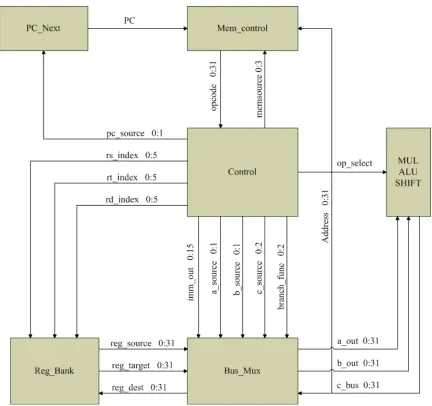
Figure 2. 1: Plasma MIPS Processor Architecture
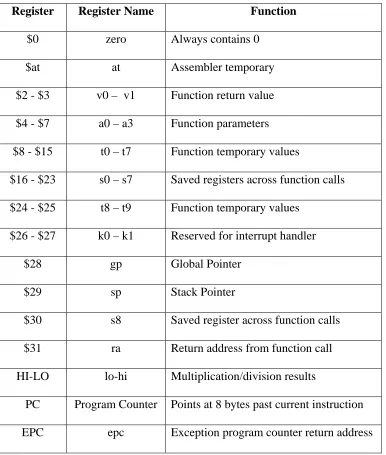
The “reg_bank” module implements all the registers, including program counter (pc), stack pointer (sp), and global pointer (gp), as described in Table 2.1. In the case of the Plasma implementation, all registers in the “reg_bank” module have been
The “control” module also generates three sets of signals (rs_index, rt_index, and rd_index); each is 6 bits wide. These are used to access the registers in the “reg_bank” module. The “reg_bank” module outputs the requested data to the “bus_mux” module from the requested register.
Table 2. 1: MIPS Registers
Register Register Name Function
$0 zero Always contains 0
$at at Assembler temporary
$2 - $3 v0 – v1 Function return value $4 - $7 a0 – a3 Function parameters $8 - $15 t0 – t7 Function temporary values
$16 - $23 s0 – s7 Saved registers across function calls $24 - $25 t8 – t9 Function temporary values
$26 - $27 k0 – k1 Reserved for interrupt handler
$28 gp Global Pointer
$29 sp Stack Pointer
$30 s8 Saved register across function calls $31 ra Return address from function call
HI-LO lo-hi Multiplication/division results
2.1.2 MIPS Instruction Format
There are three types of basic instruction formats in the MIPS processor. These are defined as R-Type, I-Type, and J-Type. The R-Type instruction format is used to create instructions with register operations like load and store instructions; the I-Type instruction format is used to implement instructions that involve immediate data; and, the J-Type is used to implement jump or branch instructions. In the R-Type instruction format, the 6 high order bits (opcode) are 0 and the 6 low order ones (funct) define the function being performed by the instruction. The middle bits indicate indexes of different registers. This is detailed in Table 2.2.
Table 2. 2: Instruction Format for Instruction Type R
Instruction Format for Type R
Bit Position 31 - 26 25 - 21 20 -16 15 - 11 10 - 6 5 - 0
Name opcode rs rt rd shamt funct
Table 2.3 shows the basic Type-I instruction format. The lower-order 16 bits are the immediate data and 6 high order bits (opcode) define the operation. Middle bits represent indexes of source and target registers.
Table 2. 3: Instruction Format for Instruction Type I
Instruction Format for Type I
Bit Position 31 – 26 25 - 21 20 -16 15 - 0
Table 2.4 shows the Type-J instruction format where the lower-order 26 bits indicates the address and remaining bits (opcode) define the operation.
Table 2. 4: Instruction Format for Instruction Type J
Instruction Format for Type J
Bit Position 31 – 26 25 - 0
Name opcode Address
2.2 Real-Time Operating System
In general, an operating system (OS) is responsible for managing the hardware resources of a computer and hosting applications that run on the computer. A RTOS is a specialized type of OS that performs different tasks, but is specially designed to run applications with very precise timing and a high degree of reliability. They are intended for real-time applications. Such applications include embedded systems such as
programmable thermostats, household-appliance controllers, industrial robots, spacecrafts, and industrial-control and scientific-research equipment.
Mobile-phone application and ink-jet printers are examples of a typical soft real-time system.
2.2.1 RTOS Functionality
A RTOS always contains multi-tasking, also known as multi-threading. Multi-tasking is a technique used for processor time allocation. Applications are divided into logical pieces commonly called threads and a kernel (core of the operating system) that coordinates their execution. A thread can be defined as an executing instance of an application and its context is the contents of the CPU registers and program counter at any instant of time. A register is a small fast memory inside a CPU (as opposed to the slower memory outside of the CPU) and is used to speed up the execution of programs by providing quick access to commonly used values, generally those in the midst of a
calculation.
thread becomes ready to execute. If a number of threads in the system have the same priority, then the scheduler will schedule these threads in a round-robin fashion.
2.2.2 Context Switching
Scheduling threads is done based upon their priority and the scheduler invokes the context-switching module of the OS. The context-switching module suspends the current running thread and starts executing the next eligible thread from the scheduler’s ready queue. The context-switching activity can be described in slightly more detail as the kernel performing the following activities with regard to threads on the CPU:
1. Suspends the progression of one thread and store the CPU's state (context) for that thread somewhere in memory.
2. Retrieves the context of the next thread in the scheduler’s ready list from memory and restore it in the CPU's registers.
3. Returns to the location indicated by the program counter (the point at which the thread was suspended in an earlier context switch) in order to resume the thread’s execution.
Context switching occurs as a result of threads voluntarily relinquishing their time in the CPU or as a result of the scheduler making the switch when a process has used up its allocated CPU time slice. A context switch can also occur as a result of a hardware interrupt, which is a signal from a hardware device to the kernel indicating that an event has occurred.
2.2.3 Co-Operative Operating System
A hard real-time operating system cannot be designed without priority-based preemptive scheduling. On the other hand, soft real-time systems can be designed using round-robin scheduling in which all threads are scheduled in round-robin fashion and threads relinquish their CPU time voluntarily after reaching a logical end of the task or after executing for a fixed amount of time. Operating systems with this type of scheduler design are called co-operative operating systems, as threads cooperate with others running on the system.
2.3 Summary
CHAPTER 3 – PROBLEM STATEMENT AND SOLUTION
As described in the previous chapter, context switching is an important part of any multi-tasking OS. It is computationally intensive because it requires considerable
processor time. Thus, context switching represents a substantial cost to the system in terms of CPU time. The cost of context switching goes even higher for a hard real-time system, as that makes it difficult to meet the thread’s deadline.
3.1 Cost of Context Switching
Research has been previously done to measure the cost of context switching in general [1]. The direct cost of context switching includes saving the CPU register data to/from external memory or cache and indirect cost includes perturbation of cache, CPU pipeline, etc [1]. That makes it difficult to measure the total cost of context switching. For a typical hard real-time system, with linear memory architecture, the direct cost of
context switching constitutes the major part of the total context-switching cost. That is why many algorithms have been implemented to reduce the direct cost of context switching [2, 3, 4].
restored during the context switching [1]. Similarly, for the MIPS processor, there are eleven registers that need to be saved, apart from program counter. So, context-switching time varies from processor to processor.
Similarly, a number of commercially available RTOSs like VxWorks, ThreadX, and QNX claim different context-switching times in terms of micro-seconds for different processors. Because of these variables, it is difficult to measure the total
switching time in general. That is why, for this research, measurement of context-switching time is presented in terms of clock cycles.
To explain context-switching overhead, a hypothetical application that requires frequent context switching in a small amount of time is considered. Assume a real-time system with three threads; A, B and, C. Thread ‘A’ reads and samples input data from an analog input; thread ‘B’ processes each sampled datum and generates some control signals; and, thread ‘C’ generates the output signals based upon the control signals generated by thread ‘B’. The sequence of operations is described as follows:
1. Thread ‘A’ reads analog input data and releases CPU control by issuing an OS system call.
2. The Kernel saves the context of thread ‘A’ somewhere in external memory by copying CPU temporary registers, the stack pointer, the program counter, etc. These registers are saved individually in sequence as the CPU is only able to generate one address at a time.
sequence from external memory. After restoring the context, thread ‘B’ starts executing and processing the received sample and then generates the control data. Finally, thread ‘B’ releases the CPU control by executing a system call.
4. Now, the kernel saves the context of thread ‘B’ and restores the context of thread ‘C’ to and from the external memory, respectively. Thread ‘C’ then sends out the control data and releases the CPU control to thread ‘A’ to read the next sample. If input analog data must be sampled at a higher frequency rate, and each sample is very important, then the context switch poses a large overhead, as each context switch would consume many CPU cycles. A typical context switch consumes50 – 80 clock cycles and if a system needs to respond to an event in less than context-switching time, then that can be done by implementing the event response in an interrupt service routine (ISR) and useing an interrupt-driven system instead. But if those events are happening
continuously, then the overall performance of the system will be degraded tremendously, as most threads may not get a chance to execute.
Since the registers are being saved in external memory, only one register could be saved at a time. Consequently, for N registers to be saved and restored, this approach would take at least 2 x 2 x N CPU clock cycles for a complete context switch. Practically, during these many clock cycles, the CPU normally remains idle, not doing any work assigned by the applications. That reduces the overall efficiency of the system.
3.2 Current Approaches
switching time [2, 4, 5]. The software-based solutions mainly reduce the average context-switching time by reducing the context size. The approach suggested by Xiangrong Zhou and Peter Petrov suggests achieving a low cost context-switching by using compiler, micro-architecture, and an OS kernel [4]. This technique identifies the switch points in the executing code, at compile time, at which a minimum number of context registers needs to be saved. If an interrupt occurs and the system needs to do a context switch, then the scheduler defers the context switch untill the execution reaches the next switch point where less context-registers need to be saved. The compiler identifies switch points and also provides the custom software routines to kernel for context switching. The authors used an example to explain the approach, as shown in Figure 3.1[4].If an interrupt occurs at time t1, then all registers need to be saved as all registers are live at that point [4]. But if the context switching is deferred untill time t2,then only 3 registers need to be saved, as shown.
The good part of this approach is that the system is doing the actual task between time t1 and t2, but the duration between t1 and t2 is not fixed and can be longer as interrupt is an asynchronous event and a RTOS thread may miss a deadline. That can be taken care by a good RTOS kernel design but that would lead to a complex and non-deterministic system.
The other software-based approach is for a specific RTOS but can be
implemented for any RTOS. The approach suggested by Zhaohui Wu, Hong Li, Zhigang Gao, Jie Sun, and Jiang Li, creates new thread states, and based upon the thread’s state, the scheduler decides if context save or restore is actually required [2]. It helps in reducing the average context-switch time of the system.
Figure 3. 2: Thread State Diagram of OSEK Operating System [2]
thread is terminated, then it goes to a suspended state. The authors suggested one new state called waiting state, in which the thread goes into waiting state if the thread is waiting for a resource, and it goes into suspended state when it is being terminated. The thread’s ready state is further divided into two states: initial and intermediate.
Figure 3. 3: Modified Thread State Diagram of OSEK Operating System [2]
As shown in Figure 3.3, when a thread becomes active in the suspended state, it will be in the initial state, and when a thread becomes ready from the waiting state, it will be in the intermediate state. When a thread’s state changes from a running state to a
suspended state, then there is no need to save the context as in that case the thread gets terminated. On the other hand, when a thread’s state changes from suspended to
and thus the overall throughput of the system. As the context-switching time would be reduced in some cases, designing a deterministic system with this approach would lead to a very complex design.
Current hardware-based solution use reconfigurable hardware. Research by Hyden Kwok-Hay So, at Berkeley University, uses BORPH (Berkeley Operating system for ReProgrammable Hardware) OS [5]. This operating system is specially designed for FPGA-based reconfigurable hardware. The BORPH kernel supports FPGA applications similar to conventional OS support for programs. The FPGA resources are managed by a kernel similar to other system resources.
Figure 3. 4: Modified Thread State Diagram of OSEK Operating System [5]
3.4 shows the basic block diagram of this reconfigurable hardware-based approach. Since different processes can be created in hardware, which can execute in parallel and keep their state, there is no need of real context-switching for the processes running in the hardware. The OS tasks that require fast context-switching can be implemented as hardware processes to avoid context-switching overhead. This approach is good for hard real-time systems and this would provide good throughput, and also would be
deterministic. But this approach would take lot of hardware resources and it would be difficult to design and maintain such a system.
3.2 Proposed Solution
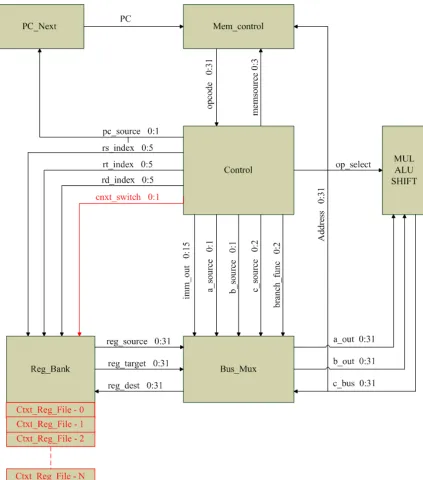
Figure 3. 5: Modified MIPS Processor Architecture
to be developed to use these instructions to exploit the suggested hardware design. Since new instructions are being added to the processor architecture, the MIPS assembler has to be modified to support the new instructions.
3.3 Summary
Context switching is a major bottleneck for hard RTOS-based systems, especially for applications that require frequent context switching, and have stringent deadlines for different threads. Many software approaches try to reduce context-switching overhead, but this leads to making the system non-deterministic, although a deterministic system is one of the basic requirements of a hard RTOS.
CHAPTER 4 – HARDWARE DESIGN AND IMPLEMENTATION
Hardware implementation for the proposed architecture is divided into two parts. The first part describes the implementation of context register files to save the CPU state in the processor itself and the second part describes the hardware implementation of save- context (scxt) and restore-context (rcxt) CPU instructions.
4.1 Register File Design
The Plasma MIPS processor, used for this thesis, implements the “reg_bank”
module in the FPGA’s block RAM [9]. This design won’t work with the suggested approach, as all the context registers must be saved on a register file in one CPU clock cycle, and that cannot be achieved if registers are implemented as RAM locations. To achieve this task, the original Plasma MIPS design is modified by implementing all the “reg_bank” registers in FPGA’s logic blocks. This design requires more FPGA logic resources but provides fast access to registers as compared to the original design.
To prove this concept, only 4 register files are implemented in the “reg_bank”
The number of register files can be extended, depending on the available FPGA resources, to accommodate more threads. To access the register files, two context-switch instructions have been implemented in the hardware. The design of these context-switch instructions is described in the next section, and the VHDL source code for the
“reg_bank” module is placed in APPENDIX A-1.
4.2 Context-Switching Instruction Design
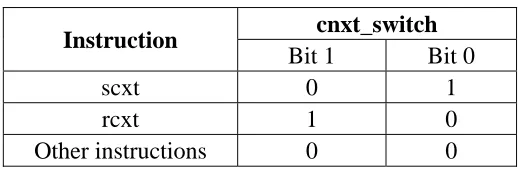
The “mem_control” module of the processor fetches 32-bit machine-code instructions from the memory and passes them to the “control” module for further processing. The control module generates a 62-bit VLWI instruction code, which includes two additional bits for the “cnxt_switch” signal. As shown in Figure 3.5, the 2-bit signal (cnxt_switch 0: 1) is sent out to “reg_bank” module that processes “scxt” and “rcxt” context-switch instructions, based upon the “cnxt_switch” signalvalue. Table 4.1 shows the “cnxt_switch” signal’s bit map.
Table 4. 1: The cnxt_switch Signal Bit Map
Instruction cnxt_switch
Bit 1 Bit 0
scxt 0 1
rcxt 1 0
Other instructions 0 0
Before executing the “scxt” and “rcxt” instructions, software needs to save the index of the register file in any temporary register ($t), and then execute these
context needs to be saved, then the instruction to save the context would be “scxt $4”; and, similarly, if register $4 contains the index of the register file from which the context needs to be restored, then the instruction to restore the context would be “rcxt $4”.
4.3 Context-Switching Instruction Hardware Implementation
As discussed in Chapter 2, three formats of MIPS processor instructions are available. Since we need to store the index of the register file in a temporary register and pass the register as an operand of the instruction, the newly implemented context-switch instructions should be in instruction format Type-R. Table 4.2 shows the bit map
designed for the “scxt” instruction where register “rt” contains the index of the register file in which the current context needs to be saved.
Table 4. 2: Save Context Instruction Bit Map
Save Context Instruction (scxt rt)
Bit Position 31 - 26 25 - 21 20 -16 15 - 11 10 - 6 5 - 0
Name opcode rs rt rd shamt funct
Bit Values 000000 00000 00001 ‐ 10111 00000 00000 111100
Table 4. 3: Restore Context Instruction Bit Map
Restore Context Instruction (rcxt rt)
Bit Position 31 - 26 25 - 21 20 -16 15 - 11 10 - 6 5 - 0
Name opcode rs rt rd shamt funct
Bit Values 000000 00000 00001 ‐ 10111 00000 00000 111101
The software must set the register “rt” correctly, by setting the operand value within the range of available register files, before executing these instructions. Since we have implemented four register files to save contexts, if the value in register “rt” is set out of range (greater than 3), then these instructions would be executed as a No Operation (NOP) instruction and would not harm or change any thread’s context data. This will ensure the overall system’s continuity.
4.4 Hardware Synthesis and Implementation
original MIPS processor in the FPGA, the “Ethernet” peripheral module of the original Plasma MIPS implementation has been removed from the design, as this peripheral is not a part of the processor design, nor needed for our intended usage. Table 4.4 compares the FPGA resource usage between the original and proposed MIPS architecture, respectively.
Table 4. 4: FPGA Device Resource Usage for Original Plasma MIPS Architecture
and Modified MIPS Architecture
Device Resource Type
Total Device Utilization for
Original Architecture
Device Utilization for
Modified Architecture
Used Utilization Used Utilization
Number of Slice Flip Flops 9312 783 8% 3017 32%
Number of 4 input LUTs 9312 3754 40% 8329 89%
Number of occupied Slices 4656 2066 44% 4654 99%
Minimum Period 36.468 ns 38.886 ns
Maximum Frequency 27.421 MHz 25.716 MHz
file and generates a text file containing MIPS hexadecimal instructions in ASCII
(American Standard Code for Information Interchange) format. Then, the “toimage” tool reads the MIPS 32-bit instructions from the text file, breaks them into four 8-bit
segments, and places them in the block RAM source file (“ram_image.vhd”) at
appropriate locations. This VHDL file is used to synthesize and implement the processor design, using Xilinx ISE tools, with the software executable in the FPGA block RAM.
4.5 Summary
CHAPTER 5 – SOFTWARE DESIGN
Software design for this research can be divided into two parts. The first part describes the design and development of a co-operative operating system, which uses the newly implemented CPU instructions for context switching, and three test applications to measure the performance improvement. The second part deals with the modifications in the GNU MIPS tool-chain to support “scxt” and “rcxt” context-switch instructions. For this thesis, these instructions are added in the GNU-MIPS assembler.
5.1 Co-Operative Operating System Design
To prove the validity of the suggested approach and measure the performance improvement, a small basic co-operative OS for the modified MIPS processor has been developed. This OS provides interface functions for application development mainly to initialize, create, and schedule different threads. Table 5.1 lists the interface functions.
Table 5. 1: Operating System Interface Functions
Function Name Description
initOS( ) This function initializes the Task structure for each thread in the system to the default values.
CreateThread( )
This function initializes the Task structure of the thread for the thread’s requirements. It takes parameters as follows;
TaskID - Thread ID
funcptr - Pointer to thread’s starting function
FastCtxtSwitch - Context switching property setting of the thread
Schedule( ) This function schedules the next thread in the queue
5.1.1 Operating System Design
performance between the traditional context-switching approach and the suggested approach.
typedef struct Task {
void (*TaskPtr)(); // Pointer to Thread Starting Function int *State; // context
unsigned char Executed; // 1 – thread has started, 0 otherwise unsigned char TaskID; // Task ID
unsigned char FastCtxtSwitch; // 1 – Require fast context switch, // 0 otherwise
}Task;
Figure 5. 1: Task Structure
At the time of system initialization, all four threads are initialized with “FastCtxtSwitch” to 0. To achieve the context switch using internal register files, an application has to set the “FastCtxtSwitch” member of the “Task” structure, for that thread, to a value greater than 0. So, it is the application’s responsibility to use the context-switching method carefully, based upon the the thread’s requirements and the number of internal register files available in the processor hardware.
5.1.2 Operating System Operation
all threads, the application needs to call the “schedule” OS function to start executing threads.
The “schedule” function schedules threads for execution in round-robin fashion. It picks the next thread in the queue and calls the thread’s starting function if the thread is going to be executed for the first time. Otherwise, it saves the context of the current thread and restores the context of the next thread in the queue. Again, if the restored thread is going to execute for the first time, then the scheduler calls the thread’s starting function. Otherwise, it restores the context of the next thread from the internal register files or from external memory depending on the “FastCtxtSwitch” value of the thread’s task structure.
5.2 Assembler Modifications
The GNU tool chain for the MIPS processor is used to compile the co-operative OS and the test applications. To automate the build process, the newly implemented context- switch instructions are added to the GNU MIPS assembler.
These instructions are added to GNU “binutils” version 2.19 [9]. The “binutils-2.19/gas” (GNU assembler) folder contains the source code for the MIPS assembler. The file “mips-opc.c” in “binutils-2.19/opcode” contains all the instructions supported by the MIPS processor. The new instructions have been added in the file “mips-opc.c”.
The GNU MIPS assembler is implemented in the ‘C’ programming language. Figure 5.3describes the basic structureof MIPS instructions implementation in the assembler.
const struct mips_opcode {
name, args, match, mask, pinfo, pinfo2, membership }
Figure 5. 3: MIPS Instruction Structure Format in GNU Assembler
Table 5. 2: “mips_opcode” Structure Data Members
Structure Member Description
name Instruction string e.g. “add”
args A string describing the arguments to the instruction. match Match hex value of the instruction
mask Bit mask of the instruction
pinfo A collection of additional bits describing the instruction. pinfo2 Additional bits describing the instruction.
membership MIPS version information
Table 5. 3: ‘scxt’ and ‘rcxt’ Instruction Assembler Values
Structure Member Instruction scxt values Instruction rcxt values
name "scxt" "rcxt" args “t” “t”
match 0x0000003c 0x0000003d
mask 0xffffffff 0xffffffff pinfo RD_t RD_t pinfo2 0 0
A message is also added to the assembler source code that gets printed on the screen when using the modified assembler.
5.3 Software System Implementation
The software components developed in this thesis have been implemented in ‘C’ and the MIPS assembly programming language. The source code for the co-operative OS and test applications are compiled using the GNU MIPS tool-chain under cygwin
environment on a Windows-based computer.
To debug the software, debug messages are added. The debug messages are sent to the Universal Asynchronous Receiver Transmitter (UART) serial port. The terminal program on the computer connected to the Xilinx FPGA board through serial cable receives and displays these messages on a computer screen. The same debug serial port is used to send the test application’s results for analysis.
5.4 Summary
A multi-threaded OS is required to test the suggested approach of context
switching. A small co-operative OS that supports four threads has been implemented. The context switching between these threads can be achieved using internal register files as well as external memory based on the context-switching property setting in the “Task” structure of that thread. The GNU MIPS assembler also has been modified to support the newly implemented context-switching instructions.
CHAPTER 6 – EXPERIMENTAL RESULTS AND ANALYSIS
This chapter describes the verification process of the hardware implementation of the proposed approach. It also explains the software used for testing the complete system. The performance of the suggested approach is also evaluated and the results are
compared with traditional context-switching methods.
6.1 Hardware Verification
To verify the correct operation of the context-switch instructions, software using the “scxt” and “rcxt” instructions was developed in the MIPS assembly language and executed on the modified processor in a simulation environment. This verification software first initializes all nine temporary registers of the thread’s context with values from 1 to 9. Register $4 is then set to 2, which is the index of the register file in which the context will be stored, and then the “scxt” instruction is executed. It is expected that the instruction should move all the contents of the context registers to context register file 2 (ctxt_reg2) in 2 clock cycles. Simulation for the “scxt $4” instruction verified this expectation as shown in Figure 6.1
To verify the “rcxt” instruction, the values 2 through 10 are stored in the 9
temporary registers of the processor.Then, the “rcxt” instruction is executed with register $4 value set to 2, indicating the context needs to be restored from the context-register file 2. The contents of register file 2 are moved into the CPU context registers and the
waveform for the “rcxt $4” instruction. As expected, the values of the correct context registers replace the previous context.
Context saved in context register file 2 (ctxt_reg2XX)
Register file index (rt_index = 4) $4 is having register file index
cnxt_switch signal for ‘scxt’ instruction
Context register file index in register 4(reg04 = 2)
Initial values in context registers
Context restored from context register file 2 (ctxt_reg2XX)
Register index (rt_index = 4) that is holding register file index
“cnxt_switch” signal for ‘rcxt’ instruction
Context register file index in register 4(reg04 = 2)
Initial values in context registers
“cnxt_switch” signal value = 2: restore context
Value in $5 Register (7)
“cnxt_switch” signal value = 1: save context
“rcxt” instruction with operand $5
“scxt” instruction with operand $4
Figure 6. 3: Waveform to Verify an Out-of-Range Instruction Operand
the “scxt” and “rcxt” instructions consume 2 clock cycles each to store and restore the context in the register file 1 (ctxt_reg 1) and from register file 2 (cntxt_reg 2),
respectively. So the complete context switch takes place in 4 clock cycles. This value is independent of the number of registers used by the context.
Context restored from register file with index 2
Context saved in register file with index 1
“rcxt” instruction with operand $5
Register $5 = 2
“scxt” instruction with operand $4
Register $4 = 1
Number of cycles consumed
6.3 Test Applications
As discussed earlier, it is difficult to measure the actual cost of context switching due to variables like processor speed, processor architecture, RTOS design, and etc. So, the actual cost of context switching may vary among different systems. The overall impact on system performance, due to context-switching overhead, also depends on the type of application. If an application requires frequent context switching, then the system will spend more time in managing and switching the threads and that will degrade overall performance.
For this thesis, three test applications have been implemented, which require frequent context switching, and each application tests and measures the different aspects of the suggested approach. These test applications use the interface functions provided by the co-operative OS to access the proposed hardware features. Each application
implements four threads and each thread is running in a never-ending loop. Each thread executes a specific task by manipulating global variables in a loop and calls the operating system’s “schedule” function to release control to the next thread. These applications are designed to test the functionality and measure the performance improvement of the proposed approach. The following sections describe the test applications and their results in detail.
6.3.1 Test Application – 1
between threads is not corrupted and thread’s context switching is correct. The flow chart of this application is shown in Figure 6.5.
In this application, the first thread, with TaskID=0, assigns/modifies four global variables and calls the OS function “schedule” to voluntarily release CPU control. This is analogous to thread ‘A’ of our hypothetical application discussed in Chapter 3, which reads analog data. The second thread, with TaskID=1, manipulates the data by summing the variables and storing the result in another global variable. This is analogous to thread ‘B’ that processes the analog data to generate control signals. The third thread, with
TaskID=2, sends the data to the debug serial port, which is analogous to thread ‘C’ that sends the control signal to output port. Finally, one more thread, with TaskID=3, calculates and prints the number of clock cycles consumed to process one data sample. Since each thread is sending out messages to the debug serial port, the output log
Figure 6. 6: Serial Debug Log from Test Application – 1
6.3.2 Test Application – 2
process with the same code as the first two threads, but context-switch using external memory. As the threads TaskID=0 and TaskID=1 does the context-switching using internal register files and TaskID=2 and TaskID=3 does context-switching using external memory, the difference in the clock cycles consumed by these two sets of threads
determines the performance improvement per context-switch in clock cycles. Thread with
TaskID=3 additionally does this calculation and sends the results on the debug serial port in hexadecimal format.
Messages sent to the debug port include: number of clock cycles consumed by threads with TaskID=0 and TaskID=1; number of clock cycles consumed by threads with
Figure 6. 7: Serial Debug Log from Test Application – 2
6.3.3 Test Application – 3
This test application has been developed to calculate the percentage of
Application– 1 for 0x70000 clock cycles without printing any message/results on the debug serial port. After executing the application for 0x70000 clock cycles, the thread with TaskID=3 prints the number of data samples processed during this period. In the second part (test Application – 3B), the process is repeated but with context switching using external memory. The difference in the results of these two executions can be used to calculate overall system performance percentage improvement in terms of number of data samples processed or percentage improvement in data throughput.
Figure 6. 8: Serial Debug Log from Test Application – 3A
CHAPTER 7 – CONCLUSIONS AND FUTURE WORK
This thesis proposed a hardware solution to reduce context-switching overhead in a RTOS. To reduce the context-switching time, context-switch register files were
implemented within the processor architecture. The size of the each register file was equal to the number of CPU context registers. Two special context-switch CPU instructions, to handle saving and restoring the context, were implemented in the hardware. Each of these instructions consumed two clock cycles to move the CPU context registers to or from a context-register file.
The GNU assembler was also modified to support these newly implemented context- switch instructions. A basic co-operative operating system and three test applications were developed to test and measure the performance of the suggested approach.
The proposed approach allowed the RTOS to achieve the context switching in just 4 clock cycles, independent of the number of context registers. This improved the ability of hard RTOSs to meet their basic requirements. Based upon the observations and experimental results, we can draw the following conclusions:
Hard real-time systems, in which frequent context switching is required, can
benefit greatly from this approach.
The proposed approach improves RTOS-based system performance drastically
The suggested approach increases the efficiency of a RTOS-based system as the
system spends less time in managing the threads and therefore uses CPU time more efficiently.
There are multiple improvements possible to the current suggested approach. These improvements can be implemented as per a system requirement or to simplify system functionality. Some of them are listed here.
1. In the current approach, if the ‘scxt’ and ‘rcxt’ instruction’s operand contains an out-of-range register file index, then the instructions behaves as NOP instructions. An exception can be generated to indicate that the context switch has not been completed. In the case of this exception, context-switching can be done using external memory by the exception handler software.
2. A purely software-based solution can also be implemented for an out-of-range register file index. In that case, software needs to check the operand register value before calling context-switch instructions. If the value is out-of-range, then the context would be saved/restored from external memory.
3. For simplicity, the suggested approach can be implemented without adding new instructions. One new register can be implemented in the hardware. The software can write a pre-defined bit pattern to achieve context switch in internal register files.
This approach can also be used for soft RTOS and regular operating systems to improve system throughput. In case of regular operating systems where threads are created at run- time, it is difficult to know the number of threads at system design time. Therefore, it may not be possible to implement register files for all threads in the system. The threads, with frequent context switching, can be set for fast context switching using internal register files by a specially designed scheduler algorithm. This thesis is a step forward in moving the RTOS kernel to hardware.
BIBLIOGRAPHY
[1] Francis M. David, Jeffery C. Carlyle, Roy H. Campbell “Context Switch Overheads for Linux on ARM Platforms” ExpCS, San Diego, California, Article No.: 3, 14-15 June, 2007
[2] Zhaohui Wu, Hong Li, Zhigang Gao, Jie Sun, Jiang Li “An Improved Method of Task Context Switching in OSEK Operating System”, Advanced Information Networking and Applications, 2006. AINA 2006. 20th International Conference, pp. 6, Publication date: 18-20 April 2006
[3] Jeffrey S. Snyder, David B. Whalley, Theodore P. Baker “Fast Context Switches: Compiler and Architectural support for Preemptive Scheduling” Microprocessors and Microsystems, pp. 35-42, 1995. Available:citesser.ist.psu.edu/33707.html
[4] Xiangrong Zhou, Peter Petrov “Rapid and low-cost context-switch through embedded processor customization for real-time and control applications “ DAC San Francisco, CA, Pages: 352 - 357 24-28, July, 2006.
[5] Hyden Kwok-Hay So, Robert W. Broderson“BORPH: An Operating System for FPGA-Based Reconfigurable Computers” DAC University of California, Berkeley, Technical Report No. UCB/EECS-2007-92, 20 July, 2007
[6] Gilles Chanteperdrix, Richard Cochran “The ARM Fast Context Switch Extension for Linux” Papers from the Real Time Linux Workshop, October 14, 2009
[7] MIPS Assembly Language Programmer’s Guide, ASM – 01-DOC, PartNumber 02-0036-005 October, 1992
[8] Express Logic Inc. “Using Event Trace to Analyze Real-Time System Behavior and Increase Throughput”, http://www.rtos.com/PDFs/AnalyzingReal-TimeSystemBehavior.pdf
[9] Xilinx Corp, “Spartan 3E Starter Kit board user Guide” March 9, 2006
[10] Plasma MIPS Processor Design, http://www.opencores.org/project,plasma
[11] GNU compiler and assembler for MIPS, http://ftp.gnu.org/gnu/binutils/
[12] Abraham Silberschatz, Peter Baer Galvin “Operating System Concepts” – Fifth Edition: WILEY, Singapore, 1997
[13] David A. Patterson, John L. Hennessy “Computer Organization and Design” Third Edition: Morgan Kaufmann Publications San Francisco, 2005
[14] Pater J. Ashenden “The Designer’s Guide to VHDL” Third Edition, Morgan Kaufmann Publications San Francisco, 2008
APPENDIX A-1
--- -- File : reg_bank.vhd
--
-- This file implements a register bank with 32 registers that are -- 32-bits wide.
-- These register are implemented as FPGA logic. This file also -- implements 4 context switch register files which are used to -- save the operating systems's thread'd context.
--- library ieee;
use ieee.std_logic_1164.all; use ieee.std_logic_unsigned.all; use work.mlite_pack.all;
entity reg_bank is
port(clk : in std_logic; reset_in : in std_logic; pause : in std_logic;
rs_index : in std_logic_vector(5 downto 0); rt_index : in std_logic_vector(5 downto 0); rd_index : in std_logic_vector(5 downto 0); reg_source_out : out std_logic_vector(31 downto 0); reg_target_out : out std_logic_vector(31 downto 0); reg_dest_new : in std_logic_vector(31 downto 0); intr_enable : out std_logic;
cnxt_switch : in cnxt_switch_func_type); end; --entity reg_bank
architecture logic of reg_bank is
signal reg31, reg01, reg02, reg03 : std_logic_vector(31 downto 0);
signal reg04, reg05, reg06, reg07 : std_logic_vector(31 downto 0); signal reg08, reg09, reg10, reg11 : std_logic_vector(31 downto 0); signal reg12, reg13, reg14, reg15 : std_logic_vector(31 downto 0); signal reg16, reg17, reg18, reg19 : std_logic_vector(31 downto 0); signal reg20, reg21, reg22, reg23 : std_logic_vector(31 downto 0); signal reg24, reg25, reg26, reg27 : std_logic_vector(31 downto 0); signal reg28, reg29, reg30 : std_logic_vector(31 downto 0); signal reg_epc : std_logic_vector(31 downto 0); signal reg_status : std_logic;
-- Context switch register files
signal ctxt_reg05, ctxt_reg06, ctxt_reg07, ctxt_reg08 : std_logic_vector(31 downto 0);
signal ctxt_reg09, ctxt_reg010, ctxt_reg011, ctxt_reg012 : std_logic_vector(31 downto 0);
signal ctxt_reg11, ctxt_reg12, ctxt_reg13, ctxt_reg14 : std_logic_vector(31 downto 0);
signal ctxt_reg15, ctxt_reg16, ctxt_reg17, ctxt_reg18 : std_logic_vector(31 downto 0);
signal ctxt_reg19, ctxt_reg110, ctxt_reg111, ctxt_reg112 : std_logic_vector(31 downto 0);
signal ctxt_reg21, ctxt_reg22, ctxt_reg23, ctxt_reg24 : std_logic_vector(31 downto 0);
signal ctxt_reg25, ctxt_reg26, ctxt_reg27, ctxt_reg28 : std_logic_vector(31 downto 0);
signal ctxt_reg29, ctxt_reg210, ctxt_reg211, ctxt_reg212 : std_logic_vector(31 downto 0);
signal ctxt_reg31, ctxt_reg32, ctxt_reg33, ctxt_reg34 : std_logic_vector(31 downto 0);
signal ctxt_reg35, ctxt_reg36, ctxt_reg37, ctxt_reg38 : std_logic_vector(31 downto 0);
signal ctxt_reg39, ctxt_reg310, ctxt_reg311, ctxt_reg312 : std_logic_vector(31 downto 0);
begin
reg_proc: process(clk, rs_index, rt_index, rd_index, reg_dest_new, reg31, reg01, reg02, reg03, reg04, reg05, reg06, reg07,
reg08, reg09, reg10, reg11, reg12, reg13, reg14, reg15, reg16, reg17, reg18, reg19, reg20, reg21, reg22, reg23, reg24, reg25, reg26, reg27, reg28, reg29, reg30,
reg_epc, reg_status, reset_in, cnxt_switch)
variable RegFileIndex : std_logic_vector(31 downto 0);
begin
if clk'event and clk = '1' then
case rd_index is
when "001101" => reg13 <= reg_dest_new; when "001110" => reg14 <= reg_dest_new; when "001111" => reg15 <= reg_dest_new; when "010000" => reg16 <= reg_dest_new; when "010001" => reg17 <= reg_dest_new; when "010010" => reg18 <= reg_dest_new; when "010011" => reg19 <= reg_dest_new; when "010100" => reg20 <= reg_dest_new; when "010101" => reg21 <= reg_dest_new; when "010110" => reg22 <= reg_dest_new; when "010111" => reg23 <= reg_dest_new; when "011000" => reg24 <= reg_dest_new; when "011001" => reg25 <= reg_dest_new; when "011010" => reg26 <= reg_dest_new; when "011011" => reg27 <= reg_dest_new; when "011100" => reg28 <= reg_dest_new; when "011101" => reg29 <= reg_dest_new; when "011110" => reg30 <= reg_dest_new; when "011111" => reg31 <= reg_dest_new;
when "101100" => reg_status <= reg_dest_new(0); when "101110" => reg_epc <= reg_dest_new; --CP0 14
reg_status <= '0'; --disable interrupts when others =>
end case;
-- Initialise all the registers if reset_in = '1' then
reg_status <= '0'; reg_epc <= x"00000000"; RegFileIndex := x"00000000"; reg01 <= x"00000000";
reg02 <= x"00000000"; reg03 <= x"00000000"; reg04 <= x"00000000"; reg05 <= x"00000000"; reg06 <= x"00000000";
reg07 <= x"00000000"; reg08 <= x"00000000"; reg09 <= x"00000000";
reg10 <= x"00000000"; reg11 <= x"00000000"; reg12 <= x"00000000"; reg13 <= x"00000000"; reg14 <= x"00000000";
reg15 <= x"00000000"; reg16 <= x"00000000"; reg17 <= x"00000000";
reg18 <= x"00000000"; reg19 <= x"00000000"; reg20 <= x"00000000"; reg21 <= x"00000000"; reg22 <= x"00000000";
reg24 <= x"00000000"; reg25 <= x"00000000";
reg26 <= x"00000000"; reg27 <= x"00000000"; reg28 <= x"00000000"; reg29 <= x"00000000"; reg30 <= x"00000000"; reg31 <= x"00000000";
-- Initialize context switch Register files ctxt_reg01 <= x"00000000";
ctxt_reg02 <= x"00000000"; ctxt_reg03 <= x"00000000"; ctxt_reg04 <= x"00000000"; ctxt_reg05 <= x"00000000"; ctxt_reg06 <= x"00000000";
ctxt_reg07 <= x"00000000"; ctxt_reg08 <= x"00000000";
ctxt_reg09 <= x"00000000"; ctxt_reg010 <= x"00000000"; ctxt_reg011 <= x"00000000"; ctxt_reg012 <= x"00000000";
ctxt_reg11 <= x"00000000"; ctxt_reg12 <= x"00000000"; ctxt_reg13 <= x"00000000"; ctxt_reg14 <= x"00000000"; ctxt_reg15 <= x"00000000"; ctxt_reg16 <= x"00000000";
ctxt_reg17 <= x"00000000"; ctxt_reg18 <= x"00000000";
ctxt_reg19 <= x"00000000"; ctxt_reg110 <= x"00000000"; ctxt_reg111 <= x"00000000"; ctxt_reg112 <= x"00000000";
ctxt_reg21 <= x"00000000"; ctxt_reg22 <= x"00000000"; ctxt_reg23 <= x"00000000"; ctxt_reg24 <= x"00000000"; ctxt_reg25 <= x"00000000"; ctxt_reg26 <= x"00000000";
ctxt_reg27 <= x"00000000"; ctxt_reg28 <= x"00000000";
ctxt_reg29 <= x"00000000"; ctxt_reg210 <= x"00000000"; ctxt_reg211 <= x"00000000"; ctxt_reg212 <= x"00000000";
ctxt_reg35 <= x"00000000"; ctxt_reg36 <= x"00000000";
ctxt_reg37 <= x"00000000"; ctxt_reg38 <= x"00000000";
ctxt_reg39 <= x"00000000"; ctxt_reg310 <= x"00000000"; ctxt_reg311 <= x"00000000"; ctxt_reg312 <= x"00000000"; end if;
case cnxt_switch is when SAVE_CNXT => --case rt_index is
case RegFileIndex(2 downto 0) is when "000" =>
ctxt_reg01 <= reg16; ctxt_reg02 <= reg17; ctxt_reg03 <= reg18; ctxt_reg04 <= reg19; ctxt_reg05 <= reg20; ctxt_reg06 <= reg21;
ctxt_reg07 <= reg22;
ctxt_reg08 <= reg23; ctxt_reg09 <= reg28;
ctxt_reg010 <= reg29; ctxt_reg011 <= reg30; ctxt_reg012 <= reg31;
when "001" =>
ctxt_reg11 <= reg16; ctxt_reg12 <= reg17; ctxt_reg13 <= reg18; ctxt_reg14 <= reg19; ctxt_reg15 <= reg20; ctxt_reg16 <= reg21;
ctxt_reg17 <= reg22; ctxt_reg18 <= reg23;
ctxt_reg19 <= reg28; ctxt_reg110 <= reg29; ctxt_reg111 <= reg30; ctxt_reg112 <= reg31;
when "010" =>
ctxt_reg21 <= reg16; ctxt_reg22 <= reg17; ctxt_reg23 <= reg18; ctxt_reg24 <= reg19; ctxt_reg25 <= reg20; ctxt_reg26 <= reg21;
ctxt_reg27 <= reg22; ctxt_reg28 <= reg23;
ctxt_reg211 <= reg30; ctxt_reg212 <= reg31;
when "011" =>
ctxt_reg31 <= reg16; ctxt_reg32 <= reg17; ctxt_reg33 <= reg18; ctxt_reg34 <= reg19; ctxt_reg35 <= reg20; ctxt_reg36 <= reg21;
ctxt_reg37 <= reg22; ctxt_reg38 <= reg23;
ctxt_reg39 <= reg28; ctxt_reg310 <= reg29; ctxt_reg311 <= reg30;
ctxt_reg312 <= reg31; when others =>
end case;
when RSTR_CNXT =>
--case rt_index is
case RegFileIndex(2 downto 0) is when "000" =>
reg16 <= ctxt_reg01; reg17 <= ctxt_reg02; reg18 <= ctxt_reg03; reg19 <= ctxt_reg04; reg20 <= ctxt_reg05; reg21 <= ctxt_reg06;
reg22 <= ctxt_reg07;
reg23 <= ctxt_reg08; reg28 <= ctxt_reg09;
reg29 <= ctxt_reg010; reg30 <= ctxt_reg011; reg31 <= ctxt_reg012;
when "001" => reg16 <= ctxt_reg11; reg17 <= ctxt_reg12; reg18 <= ctxt_reg13; reg19 <= ctxt_reg14; reg20 <= ctxt_reg15; reg21 <= ctxt_reg16;
reg22 <= ctxt_reg17;
reg23 <= ctxt_reg18; reg28 <= ctxt_reg19;
reg29 <= ctxt_reg110; reg30 <= ctxt_reg111; reg31 <= ctxt_reg112;
when "010" =>
reg18 <= ctxt_reg23; reg19 <= ctxt_reg24; reg20 <= ctxt_reg25; reg21 <= ctxt_reg26;
reg22 <= ctxt_reg27; reg23 <= ctxt_reg28;
reg28 <= ctxt_reg29; reg29 <= ctxt_reg210; reg30 <= ctxt_reg211; reg31 <= ctxt_reg212;
when "011" =>
reg16 <= ctxt_reg31; reg17 <= ctxt_reg32; reg18 <= ctxt_reg33; reg19 <= ctxt_reg34; reg20 <= ctxt_reg35; reg21 <= ctxt_reg36;
reg22 <= ctxt_reg37; reg23 <= ctxt_reg38;
reg28 <= ctxt_reg39; reg29 <= ctxt_reg310; reg30 <= ctxt_reg311;
reg31 <= ctxt_reg312; when others =>
end case;
when others => end case; end if;
case rs_index is
when "010101" => reg_source_out <= reg21; when "010110" => reg_source_out <= reg22; when "010111" => reg_source_out <= reg23; when "011000" => reg_source_out <= reg24; when "011001" => reg_source_out <= reg25; when "011010" => reg_source_out <= reg26; when "011011" => reg_source_out <= reg27; when "011100" => reg_source_out <= reg28; when "011101" => reg_source_out <= reg29; when "011110" => reg_source_out <= reg30; when "011111" => reg_source_out <= reg31;
when "101100" => reg_source_out <= ZERO(31 downto 1) & reg_status; when "101110" => reg_source_out <= reg_epc; --CP0 14
when "111111" => reg_source_out <= '1' & ZERO(30 downto 0); --intr vector
when others => reg_source_out <= ZERO; end case;
case rt_index is
intr_enable <= reg_status; reg_target_out <= RegFileIndex; end process;
APPENDIX A-2
--- -- File : Control.vhd
--
-- DESCRIPTION:
-- Controls the CPU by decoding the opcode and generating control -- signals to the rest of the CPU.
-- This file has been modifed to for OS context switch -- instructions implementation in the hardware.
---
library ieee;
use ieee.std_logic_1164.all; use work.mlite_pack.all;
entity control is
port(opcode : in std_logic_vector(31 downto 0); intr_signal : in std_logic;
rs_index : out std_logic_vector(5 downto 0); rt_index : out std_logic_vector(5 downto 0); rd_index : out std_logic_vector(5 downto 0); imm_out : out std_logic_vector(15 downto 0); alu_func : out alu_function_type;
shift_func : out shift_function_type; mult_func : out mult_function_type; branch_func : out branch_function_type; a_source_out : out a_source_type;
b_source_out : out b_source_type; c_source_out : out c_source_type; pc_source_out: out pc_source_type; mem_source_out:out mem_source_type; exception_out: out std_logic;
-- added for OS context switch
cnxt_switch : out cnxt_switch_func_type); end; --entity control
architecture logic of control is begin
control_proc: process(opcode, intr_signal)
variable op, func : std_logic_vector(5 downto 0); variable rs, rt, rd : std_logic_vector(5 downto 0); variable rtx : std_logic_vector(4 downto 0); variable imm : std_logic_vector(15 downto 0); -- Adding Context switch variable - Deepak
variable cnxt_sw : cnxt_switch_func_type; -- change ends - Deepak
variable shift_function : shift_function_type; variable mult_function : mult_function_type; variable a_source : a_source_type; variable b_source : b_source_type; variable c_source : c_source_type; variable pc_source : pc_source_type;
variable branch_function: branch_function_type; variable mem_source : mem_source_type; variable is_syscall : std_logic;
begin
alu_function := ALU_NOTHING; shift_function := SHIFT_NOTHING; mult_function := MULT_NOTHING; a_source := A_FROM_REG_SOURCE; b_source := B_FROM_REG_TARGET; c_source := C_FROM_NULL;
pc_source := FROM_INC4;
branch_function := BRANCH_EQ; mem_source := MEM_FETCH; op := opcode(31 downto 26);
rs := '0' & opcode(25 downto 21); rt := '0' & opcode(20 downto 16); rtx := opcode(20 downto 16); rd := '0' & opcode(15 downto 11); func := opcode(5 downto 0);
imm := opcode(15 downto 0); is_syscall := '0';
cnxt_sw := NO_CNXT_SW;
case op is
when "000000" => --SPECIAL case func is
when "000000" => --SLL r[rd]=r[rt]<<re; 0 a_source := A_FROM_IMM10_6;
c_source := C_FROM_SHIFT;
shift_function := SHIFT_LEFT_UNSIGNED;
when "000010" => --SRL r[rd]=u[rt]>>re; 2 a_source := A_FROM_IMM10_6;
c_source := C_FROM_shift;
shift_function := SHIFT_RIGHT_UNSIGNED;
when "000011" => --SRA r[rd]=r[rt]>>re; 3 a_source := A_FROM_IMM10_6;
c_source := C_FROM_SHIFT;
shift_function := SHIFT_RIGHT_SIGNED;
when "000100" => --SLLV r[rd]=r[rt]<<r[rs]; 4 c_source := C_FROM_SHIFT;
shift_function := SHIFT_LEFT_UNSIGNED;


![Figure 3. 1: Context Switching using Variable Context Size [4]](https://thumb-us.123doks.com/thumbv2/123dok_us/8924591.1845025/27.612.241.455.453.645/figure-context-switching-using-variable-context-size.webp)
![Figure 3. 2: Thread State Diagram of OSEK Operating System [2]](https://thumb-us.123doks.com/thumbv2/123dok_us/8924591.1845025/28.612.253.438.376.559/figure-thread-state-diagram-osek-operating.webp)
![Figure 3. 3: Modified Thread State Diagram of OSEK Operating System [2]](https://thumb-us.123doks.com/thumbv2/123dok_us/8924591.1845025/29.612.217.466.228.423/figure-modified-thread-state-diagram-osek-operating.webp)
![Figure 3. 4: Modified Thread State Diagram of OSEK Operating System [5]](https://thumb-us.123doks.com/thumbv2/123dok_us/8924591.1845025/30.612.204.478.377.568/figure-modified-thread-state-diagram-osek-operating.webp)