A u t o m a t i c D e t e c t i o n and Correction of Repairs in
H u m a n - C o m p u t e r Dialog*
Elizabeth Shriberg~ John Bear, John Doweling
S R I I n t e r n a t i o n a l M e n l o P a r k , C a l i f o r n i a 94025
A B S T R A C T
We have a n a l y z e d 607 sentences of s p o n t a n e o u s h u m a n - c o m p u t e r speech d a t a c o n t a i n i n g repairs ( d r a w n f r o m a cor- pus of 10,718). We p r e s e n t here c r i t e r i a a n d t e c h n i q u e s for a u t o m a t i c a l l y d e t e c t i n g t h e presence of a repair, its loca- tion, a n d m a k i n g t h e a p p r o p r i a t e correction. T h e c r i t e r i a in- volve i n t e g r a t i o n of knowledge f r o m several sources: p a t t e r n matching, syntactic and semantic analysis, and acoustics.
1. I N T R O D U C T I O N
Spontaneous spoken language often includes speech that is not intended by the speaker to be part of the con- tent of the utterance. This speech must be detected and deleted in order to correctly identify the intended meaning. This broad class of disfluencies encompasses a number of phenomena, including word fragments, in- terjections, filled pauses, restarts, and repairs. We are analyzing the repairs in a large subset (over ten thou- sand sentences) of spontaneous speech data collected for the DARPA spoken language program. We have cate- gorized these disfluencies as to type and frequency, and are investigating methods for their automatic detection and correction. Here we report promising results on de- tection and correction of repairs by combining pattern matching, syntactic and semantic analysis, and acous- tics.
The problem of disfluent speech for language under- standing systems has been noted but has received limited attention, ttindle [5] attempts to delimit and correct repairs in spontaneous human-human dialog, based on transcripts containing an "edit signal," or external and reliable marker at the "expunction point," or point of in- terruption. Carbonell and Hayes [4] briefly describe re-
*This research was s u p p o r t e d by the Defense Advanced Re- search Projects Agency u n d e r Contract ONR N00014-90-C-0085 with the Office of Naval Research. It was also s u p p o r t e d by a Grant, NSF IRI-8905249, from the NationM Science Foundation. The views a n d conclusions contained in this document are those of the authors a n d should not be interpreted as necessarily represent- ing the official policies, either expressed or implied, of the Defense Advanced Research Projects Agency of the U.S. Government, or of the National Science Foundation.
l E l i z a b e t h Shriberg is also affiliated with the D e p a r t m e n t of Psychology a t the University of California a t Berkeley.
covery strategies for broken-off and restarted utterances in textual input. Ward [13] addresses repairs in sponta- neous speech, but does not attempt to identify or correct them. Our approach is most similar to t h a t of Hindle. It differs, however, in that we make no assumption about the existence of an explicit edit signal. As a reliable edit signal has yet to be found, we take it as our problem to find the site of the repair automatically.
It is the case, however, that cues to repair exist over a range of syllables. Research in speech production has shown that repairs tend to be marked prosodically [8] and there is perceptual evidence from work using lowpass-filtered speech that human listeners can detect the occurrence of a repair in the absence of segmental information [9].
In the sections that follow, we describe in detail our cor- pus of spontaneous speech data and present an analysis of the repair phenomena observed. In addition, we de- scribe ways in which pattern matching, syntactic and semantic anMysis, and acoustic analysis can be helpful in detecting and correcting these repairs. We use pattern matching to determine an initial set of possible repairs; we then apply information from syntactic, semantic, and acoustic analyses to distinguish actual repairs from false positives.
2. T H E C O R P U S
The data we are analyzing were collected at six sites 1 as part of DARPA's Spoken Language Systems project. The corpus contains digitized waveforms and transcrip- tions of a large number of sessions in which subjects made air travel plans using a computer. In the majority of sessions, data were collected in a Wizard of Oz setting, in which subjects were led to believe they were talking to a computer, but in which a human actually interpreted and responded to queries. In a small portion of the ses- sions, data were collected using SRI's Spoken Language System [12]), in which no human intervention was in-
volved. Relevant to the current paper is the fact that although the speech was spontaneous, it was somewhat planned (subjects pressed a button to begin speaking to the system) and the transcribers who produced lexical transcriptions of the sessions were instructed to mark words they inferred were verbally deleted by the speaker with special symbols. For further description of the cor- pus, see MADCOW [10].
3 . C H A R A C T E R I S T I C S A N D D I S T R I B U T I O N O F R E P A I R S
Of the ten thousand sentences in our corpus, 607 con- tained repairs. We found that of sentences longer than nine words, 10% contained repairs. While this is lower than rates reported elsewhere for human-human dialog (Levelt [7] reports a rate of 34%), it is still large enough to be significant. And, as system developers move to- ward more closely modeling human-human interaction, the percentage is likely to rise.
3 . 1 N o t a t i o n
In order to classify these repairs, and to facilitate com- munication among the authors, it was necessary for us to develop a notational system that would: (1) be relatively simple, (2) capture sufficient detail, and (3) describe t h e
I want ti- M1-
what M1
show me flights M1
I want a flight M1
I want to leave
R1
w h a t are
M~ M2
... fly to boston
R1 M,
... fly from boston
M~ R1
w h a t are
X X
flights to boston.
M1
what are the fares
M1
dMly flights
X M1
one way flight
Z X M1
depart before ... R1
what are the fares M1 M2
from boston R~ M~
from denver
M~ R~
are there any flights
vast majority of repairs observed. The notation is de- scribed fully in [2].
The basic aspects of the notation include marking the interruption point, its extent, and relevant correspon- dences between words in the region. To mark the site of a repair, corresponding to Hindle's "edit signal" [5], we use a vertical bar (I). To express the notion t h a t words on one side of the repair correspond to words on the other, we use a combination of a letter plus a numerical index. The letter M indicates that two words match ex- actly. R indicates that the second of the two words was intended by the speaker to replace the first. T h e two words must be similar, either of the same lexical cate- gory, or morphological variants of the same base form (including contraction pairs like I / I ' d ) . Any other word withi, a repair is notated with X. A hyphen affixed to a symbol indicates a word fragment. In addition, cer- tain cue words, such as "sorry" or "oops" (marked with
CR) as
well as filled pauses(CF)
are also labeled if they occur immediately before the site of a repair.3 . 2 D i s t r i b u t i o n
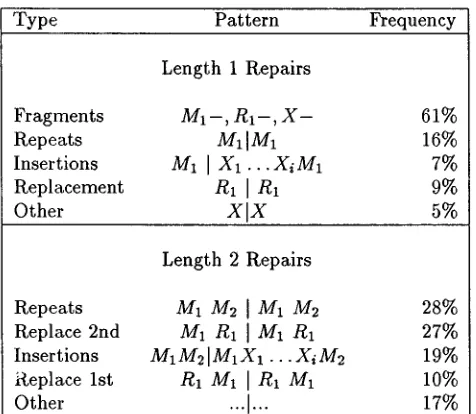
While only 607 sentences contained deletions, some sen- tences contained more than one, for a total of 646 dele- tions. Table 2 gives the breakdown of deletions by length, where length is defined as the number of con- secutive deleted words or word fragments. Most of the deletions were fairly short. One or two word deletions ac- counted for 82% of the data. We categorized the length 1 and length 2 repairs according to their transcriptions. The results are summarized in Table 3. For the pur- pose of simplicity, we have in this table combined cases involving fragments (which always occurred as the sec- ond word) with their associated full-word patterns. T h e overall rate of fragments for the length 2 repairs was 34%.
4 . S I M P L E P A T T E R N M A T C H I N G
We analyzed a subset of 607 sentences containing r e p a i r s
and concluded that certain simple pattern-matching techniques could successfully detect a number of them.
Deletion Length Occurrences Percentage
1 376 59%
2 154 24%
3 52 8%
4 25 4%
5 23 4%
6+ 16 3%
T y p e Pattern Frequency
Length 1 Repairs
Fragments M 1 - , R i - , X - 61%
Repeats M1 {M1 16%
Insertions M1 [ X1 ... XiM1 7%
Replacement R1 [R1 9%
Other X [ X 5%
Length 2 Repairs
Repeats M1 M2 {M1 M2 28%
Replace 2nd M1 R1 I M1 R1 27%
Insertions M1M2IM1X1 . . . X i M 2 19%
Replace 1st
R1
Mi JR1 M1 10%Other ...[... 17%
Table 3: Distribution of Repairs by T y p e
T h e pattern matching component reported on here looks for the following kinds of subsequences:
stems largely from the overlap of related patterns. Many sentences contain a subsequence of words that match not one but several patterns. For example the phrase " F L I G H T < w o r d > F L I G H T " matches three different patterns:
show the FLIGHT earliest FLIGHT
M1 { X M1
show the FLIGHT time FLIGHT date
M1 Ri I M1 R1
show the delta FLIGHT united FLIGHT
R1 M1 I R1 M1
Each of these sentences is a false positive for the other two patterns. Despite these problems of overlap, pattern matching is useful in reducing the set of candidate sen- tences to be processed for repairs. Instead of applying detailed and possibly time-intensive analysis techniques to 10,000 sentences, we can increase efficiency by limit- ing ourselves to the 500 sentences selected by the pattern matcher, which has (at least on one measure) a 75% re- call rate. The repair sites hypothesized by the pattern matcher constitute useful input for further processing based on other sources of information.
• Simple syntactic anomalies, such as "a the" or "to from".
• Sequences of identical words such as " < I > <would> <like> < a > < b o o k > I would like a flight ..."
• Matching single words surrounding a cue word like "sorry," for example "from" in this case: "I would like to see the flights < f r o m > <philadelphia> < i ' m > < s o r r y > from denver to philadelphia."
Of the 406 sentences with nontrivial repairs in our data (more editing necessary than deleting fragments and filled pauses), the program successfully corrected 177. It found 132 additional sentences with repairs but made the wrong correction. There were 97 sentences that con- tained repairs which it did not find. In addition, out of the 10,517 sentence corpus ( 1 0 , 7 1 8 - 201 trivial), it in- correctly hypothesized that an additional 191 contained repairs. Thus of 10,517 sentences of varying lengths, it pulled out 500 as possibly containing a repair and missed 97 sentences actually containing a repair. Of the 500 that it proposed as containing a repair, 62% actually did and 38% did not. Of the 62% that had repairs, it made the appropriate correction for 57%.
These numbers show t h a t although pattern matching is useful in identifying possible repairs, it is less success- ful at making appropriate corrections. This problem
5. N A T U R A L L A N G U A G E
C O N S T R A I N T S
Here we describe experiments conducted to measure the effectiveness of a natural language processing system in distinguishing repairs from false positives. A false pos- itive is a repair pattern that incorrectly matches a sen- tence or part of a sentence. We conducted the experi- ments using the syntactic and semantic components of the Gemini natural language processing system. Gem- ini is an extensive reimplementation of the Core Lan- guage Engine [1]. It includes modular syntactic and se- mantic components, integrated into an efficient all-paths bottom-up parser [11]). Gemini was trained on a 2,200 sentence subset of the full 10,718-sentence corpus (only those annotated as class A or D). Since this subset ex- cluded the unanswerable (class X) sentences, Gemini's coverage on the full corpus is only an estimated 70% for syntax, and 50% for semantics. 2 Nonetheless, the re- sults reported here are promising, and should improve as syntactic and semantic coverage increase.
We tested Gemini on a subset of the data that the pat-
[image:3.612.64.302.51.258.2]Syntax Only
Marked Marked
a s a s
Repair False Positive Repairs 68 (96%) 56 (30%) False Positives 3 (4%) 131 (70%)
Syntax and Semantics
Marked Marked
a s a s
Repair False Positive Repairs 64 (85%) 23 (20%) False Positives 11 (15%) 90 (80%)
Table 4: Syntax and Semantics Results
tern matcher returned as likely to contain a repair. We excluded all sentences t h a t contained fragments, result- ing in a dataset of 335 sentences, of which 179 contained repairs and 176 contained false positives. T h e approach was as follows: for each sentence, parsing was attempted. If parsing succeeded, the sentence was marked as a false positive. If parsing did not succeed, then pattern match- ing was used to detect possible repairs, and the edits as- sociated with the repairs were made. Parsing was then r e a t t e m p t e d . If parsing succeeded at this point, the sen- tence was marked as a repair. Otherwise, it was marked
a s N O O P I N I O N .
Since multiple repairs and false positives can occur in the same sentence, the p a t t e r n matching process is con- strained to prefer fewer repairs to more repairs, and shorter repairs to longer repairs. This is done to favor an analysis t h a t deletes the fewest words from a sentence. It is often the case that more drastic repairs would result in a syntactically and semantically well-formed sentence, b u t not the sentence t h a t the speaker intended. For in- stance, the sentence "show me <flights> daily flights to boston" could be repaired by deleting the words "flights daily", and would then yield a grammatical sentence, but in this case the speaker intended to delete only "flights."
Table 4 shows the results of these experiments. We ran t h e m two ways: once using syntactic constraints alone and again using both syntactic and semantic constraints. As can be seen, Gemini is quite accurate at detecting a repair, although somewhat less accurate at detecting a false positive. Furthermore, in cases where Gemini detected a repair, it produced the intended correction in 62 out of 68 cases for syntax alone, and in 60 out of
64 cases using combined syntax and semantics. In both cases, a large number of sentences (29% for syntax, 50% for semantics) received a NO OPINION evaluation. T h e NO OPINION cases were evenly split between repairs and false positives in both tests.
The main points to be noted from Table 4 are that with syntax alone, the system is quite accurate in detecting repairs, and with syntax and semantics working together, it is accurate at detecting false positives. However, since the coverage of syntax and semantics will always be lower than the coverage of syntax alone, we cannot compare these rates directly.
6 . A C O U S T I C S
A third source of information that can be helpful in de- tecting repairs is acoustics. While acoustics alone cannot tackle th e problem of locating repairs, since any prosodic patterns found in repairs will be found in fluent speech, acoustic information can be quite effective when com- bined with other sources of information, particularly, pattern matching.
Our approach in studying the ways in which acoustics might be helpful was to begin by looking at two pat- terns conducive to acoustic measurement and compar- ison. First, we focused on patterns in which there is only one matched word, and in which the two occur- rences of that word are either adjacent or separated by only one word. Matched words allow for comparisons of word duration; proximity helps avoid variability due to global intonation contours not associated with the patterns themselves. We present here analyses for the
Mi[M1
("flights for < o n e > one person") andMI[XM1
("<flight> earliest flight") repairs, and their associated false positives ("u s air five one one," "a flight on flight number five one one," respectively).Second, we have done a preliminary analysis of repairs in which a word such as "no" or "well" was present as an editing expression [6] at the point of interrup- tion ("...flights <between> < b o s t o n > < a n d > <dallas> < n o > between oakland and boston"). False positives for these cases are instances in which the cue word functions in its usual lexical sense ("I want to leave boston no later than one p m."). Hirshberg and Litman [3] have shown t h a t cue words that function differently can be distin- guished perceptually by listeners on the basis of prosody. Thus, we sought to determine whether acoustic analysis could help in deciding, when such words were present, whether or not they marked the interruption point of a repair.
[image:4.612.79.283.51.238.2]False Positives (N--24)
Repairs (N=12)
Pauses before/ after X before after
X X
(only)
(only)
.08 .58
.83 .00
F0 of X greater than
F0 of 1st ~I1
.08
.92
less than F0 of 1st M1
.42
.08
Table 5: Acoustic Characteristics of
M1 IXM1
RepairsPauses after X (only)
and FO of X less than
FO of 1st M1
Pauses before X (only)
and
F0 of X greater than F0 of 1st M1
False Positives .58 .00
Repairs .00 .92
Table 6: Combining Acoustic Characteristics of
M11XM1
RepairsWord onsets and offsets were labeled by inspection of waveforms and p a r a m e t e r files (pitch tracks and spec- trograms) obtained using the Entropic Waves software package. Files with questionable pitch tracks were ex- cluded from the analysis. An average F0 value for words of interest was determined by simply averaging, within a labeled word, all 10-ms frame values having a probability of voicing above 0.20.
In examining the MilM1 repair pattern, we found t h a t the strongest distinguishing cue between the repairs ( g = 20) and the false positives ( g = 20) was the in- terval between the offset of the first word and the onset of the second. False positives had a m e a n gap of 42 ms
(s.d.
= 55.8) as opposed to 380 ms(s.d.
= 200.4) for repairs. A second difference found between the two groups was that, in the case of repairs, there was a sta- tistically reliable reduction in duration for the second occurrence of M1, with a mean difference of 53.4 ms. However because false positives showed no reliable dif- ference for word duration, this was a much less useful predictor t h a n gap duration. F0 of the m a t c h e d words was not helpful in separating repairs from false positives; b o t h groups showed a highly significant correlation for, and no significant difference between, the m e a n F0 of the matched words.and rarely before the X in the false positives. Note that values do not add up to 100% because cases of no pauses, or pauses on b o t h sides are not included in the table. A second distinguishing characteristic was the F0 value of X . For repairs, the inserted word was nearly always higher in F0 than the preceding M1; for false positives, this increase in F0 was rarely observed. Table 6 shows the results of combining the acoustic constraints in Ta- ble 5. As can be seen, although acoustic features may be helpful individually, certain combinations of features widen the gap between observed rates of repairs and false positives possessing the relevant set of features.
Finally, in a preliminary study of the cue words "no" and "well," we compared 9 examples of these words at the site of a repair to 15 examples of the same words occurring in fluent speech. We found t h a t these groups were quite distinguishable on the basis of simple prosodic features. Table 7 shows the percentage of repairs versus false positives characterized by a clear rise or fall in F0, lexical stress, and continuity of the speech immediately preceding and following the editing expression ("contin- uous" means there is no silent pause on either side of the cue word). As 'can be seen, at least for this limited d a t a set, cue words marking repairs were quite distin- guishable f r o m those same words found in fluent strings on the basis of simple prosodic features.
A different set of features was found to be useful in dis- tinguishing repairs from false positives for the
M11XM1
pattern. These features are shown in Table 5. Cell val- ues are percentages of repairs or false positives t h a t pos- sessed the characteristics indicated in the columns. De- spite the small d a t a set, some suggestive trends emerge. For example, for cases in which there was a pause (de- fined for purposes of this analysis as a silence of greater t h a n 200 ms) on only one side of the inserted word, the pause was never after the insertion ( X ) for the repairsF0 F0 Lexical Continuous rise fall stress speech
Repairs .00 1.00 .00 .00
False positives .87 .00 .87 .73
Table 7: Acoustic Characteristics of Cue Words
Although one cannot draw conclusions from such limited
[image:5.612.58.567.46.193.2] [image:5.612.326.557.571.635.2]d a t a sets, such results are nevertheless interesting. T h e y illustrate t h a t acoustics can indeed play a role in dis- tinguishing repairs from false positives, but only if each p a t t e r n is examined individually, to determine which fea- tures to use, and how to combine them. Analysis of addi- tional p a t t e r n s and access to a larger d a t a b a s e of repairs will help us better determine the ways in which acoustics can play a role in detection of repairs.
7.
C O N C L U S I O N
In s u m m a r y , disfluencies occur at high enough rates in h u m a n - c o m p u t e r dialog to merit consideration. In con- trast to earlier approaches, we have m a d e it our goal to detect and correct repairs automatically, without assum- ing an explicit edit signal. W i t h o u t such an edit signal, however, repairs are easily confused b o t h with false pos- itives and with other repairs. Preliminary results show t h a t p a t t e r n matching is effective at detecting repairs without excessive overgeneration. Our s y n t a x - o n l y ap- proach is quite accurate at detecting repairs and correct- ing them. Acoustics is a third source of information t h a t can be t a p p e d to provide corroborating evidence a b o u t a hypothesis, given the o u t p u t of a p a t t e r n matcher.
While none of these knowledge sources by itself is suffi- cient, we propose t h a t by combining them, and possibly others, we can greatly enhance our ability to detect and correct repairs. As a next step, we intend to explore ad- ditional aspects of the s y n t a x and semantics of repairs, analyze further acoustic patterns, and examine c o r p o r a with higher rates of disfluencies.
A C K N O W L E D G M E N T S
We would like to t h a n k P a t t i Price for her helpful com- ments on earlier drafts, as well as for her participation in the development of the notational system used. We would also like to t h a n k Robin Lickley for his helpful feedback on the acoustics section.
R E F E R E N C E S
1. Alshawi, H, Carter, D., van Eijck, J., Moore, R. C., Moran, D. B., Pereira, F., Pulman, S., and A. Smith (1988) Research Programme In Natural Language Pro- cessing: July 1988 Annual Report, SRI International Tech Note, Cambridge, England.
2. Bear, J., Dowding, J., Price, P., and E. E. Shriberg (1992) "Labeling Conventions for Notating Grammat- ical Repairs in Speech," unpublished manuscript, to ap- pear as an SRI Tech Note.
3. Hirschberg, J. and D. Litman (1987) "Now Let's Talk About Now: Identifying Cue Phrases Intonationally," Proceedings of the ACL, pp. 163-171.
4. Carbonell, J. and P. Hayes, P., (1983) "Recovery Strate- gies for Parsing Extragrammatical Language," Ameri- can Journal of Computational Linguistics, Vol. 9, Num- bers 3-4, pp. 123-146.
5. Hindle, D. (1983) "Deterministic Parsing of Syntactic Non-fluencies," Proceedings of the A CL, pp. 123-128. 6. Hockett, C. (1967) "Where the Tongue Slips, There Slip
I," in To Honor Roman Jakobson: Vol. 2, The Hague: Mouton.
7. Levelt, W. (1983) "Monitoring and self-repair in speech," Cognition, Vol. 14, pp. 41-104.
8. Levelt, W., and A. Cutler (1983) "Prosodic Marking in Speech Repair," Journal of Semantics, Vol. 2, pp. 205- 217.
9. Lickley, R., R. Shillcock, and E. Bard (1991) "Process- ing Disfluent Speech: How and when are disfluencies found?" Proceedings of the Second European Confer- ence on Speech Communication and Technology, Vol. 3, pp. 1499-1502.
10. MADCOW (1992) "Multi-site Data Collection for a Spoken Language Corpus," Proceedings of the DARPA Speech and Natural Language Workshop, February 23- 26, 1992.
11. Moore, R. and J. Dowding (1991) "Efficient Bottom-up Parsing," Proceedings of the DARPA Speech and Natural Language Workshop, February 19-22, 1991, pp. 200-203. 12. Shriberg, E., Wade, E., and P. Price (1992) "Human- Machine Problem Solving Using Spoken Language Sys- tems (SLS): Factors Affecting Performance and User Satisfaction," Proceedings of the DARPA Speech and Natural Language Workshop, February 23-26, 1992. 13. Ward, W. (1991) "Evaluation of the CMU ATIS Sys-