An Efficient Active Learning Framework for New Relation Types
Lisheng Fu
Computer Science Department
New York University
[email protected]
Ralph Grishman
Computer Science Department
New York University
[email protected]
Abstract
Supervised training of models for semantic relation extraction has yielded good perfor-mance, but at substantial cost for the annota-tion of large training corpora. Active learn-ing strategies can greatly reduce this annota-tion cost. We present an efficient active learning framework that starts from a better balance between positive and negative sam-ples, and boosts training efficiency by inter-leaving self-training and co-testing. We also studied the reduction of annotation cost by enforcing argument type constraints. Experi-ments show a substantial speed-up by com-parison to the previous state-of-the-art pure co-testing active learning framework. We ob-tain reasonable performance with only 150 labels for individual ACE 2004 relation types.
1
Introduction
Relation extraction aims to discover the semantic relationship, if any, between a pair of entities in text. This structured information can be used to build higher-level applications such as question answering and other text mining applications.
Relation extraction was intensively studied as part of the multi-site ACE [Automatic Content Extraction] evaluations conducted in 2003, 2004, and 2005. For 2004, six major relation types were defined. Each relation mention takes two entity mention arguments in the same sentence. In annotating text, each entity mention pair with-in one sentence will be labeled if it with-involves one of the relation types. As part of ACE, substantial hand-annotated corpora marked with entities and relations were produced. For example, the ACE 2004 corpus had in total about 5,000 relation in-stances (and about 45,000 same-sentence entity pairs not bearing one of these relations). These large training corpora stimulated research on the supervised training of relation extractors, with
considerable success: the best systems, when given hand-tagged entities, correctly identify and classify relations with an F score above 70% (Jiang and Zhai 2007).
Although supervised methods were effective, annotating a corpus of this size is too expensive in practice to serve as a model for developing new extractors: it requires consideration of 50K instances, of which only a small portion involve the target relation type. In consequence, most research has focused on reducing the annotation cost through semi-supervised learning methods such as bootstrapping systems. However, with limited labeled data, those semi-supervised sys-tems failed to come close to the supervised level of performance. Their performance also varies with the distribution of seeds.
Recent studies have proposed new ways of re-ducing the annotation cost by using active learn-ing. The advantage of active learning is that it can achieve reasonable performance, and even performance comparable to the supervised ver-sion, with few labeled examples, due to its ability to selectively sample unlabeled data for annota-tion.
To further reduce the annotation cost and pro-vide an efficient framework for rapidly develop-ing relation extraction models, we combine ac-tive learning with semi-supervised methods, pro-vide solutions to the imbalanced seed set and uneven co-testing classifiers, and optionally in-corporate argument type constraints. Most rela-tion types now achieve reasonable performance with only 150 labeled instances. Section 2 gives more related work in detail. Section 3 describes the enhancements we have made. Section 4 re-ports the experimental results and the improve-ment in performance when only a few instances have been labeled. Section 5 concludes the paper.
2
Related Work
For reducing the cost of annotation in the task of relation extraction, most prior work used
supervised learning. (Uszkoreit 2011) introduced a bootstrapping system for relation extraction rules, which achieved good performance under some circumstances. However, most previous semi-supervised methods have large performance gaps from supervised systems, and their perfor-mance depends on the choice of seeds (Vyas et al., 2009; Kozareva and Hovy, 2010).
Recent studies have shown the effectiveness of active learning for this task. (Zhang et al., 2012) proposed a unified framework for biomedical relation extraction. They used an SVM as the local classifier and tried both uncertainty-based and density-based query functions and showed comparable results for the two methods. They also proposed using cosine-distance to ensure the diversity of queries.
(Roth and Small 2008) used a dual strategy ac-tive learner (Donmez, Carbonell, & Bennett 2007) in their pipeline models of segmentation, entity classification and relation classification at the same time. They also adopted a regularized ver-sion of the structured perceptron (Collins 2002) instead of SVM and reported better results in active learning. Their work simulated the whole pipeline in active learning to achieve relation extraction, but had no specific research on the stage of relation extraction in the pipeline.
(Zhang 2010) proposed multi-task active learning with output constraints as a generaliza-tion of multi-view learning. The multi-task method relied on constraints on output between different tasks; this might be extended to situa-tions where we need to learn relation sub-types as well as types, but was not applicable when relation extraction is an individual task.
Multi-view learning in a co-testing framework was used in (Sun and Grishman 2012). This pa-per proposed an LGCo-testing framework in which the local view is a maximum-entropy model with local features, and the global view is based on the distributional similarity in a large unlabeled corpus of the phrases between the two entity mentions of a relation. Extractor training was faster than with alternative active learning methods – much faster than with sequential an-notation.
There has been research on combining differ-ent learning methods with active learning to ob-tain further improvement. (Song et al. 2011) used variants of SVM to apply semi-supervised learn-ing after active learnlearn-ing in protein-protein inter-action extrinter-action.
The current paper adopts the earlier co-testing framework (Sun and Grishman 2012) and
exam-ines some of the design issues in order to achieve substantial further speed-ups.
3
Method
3.1FrameworkIn active learning, users are asked to judge whether a particular sentence expresses the target relation between two entity mentions. For a fixed number of queries (fixed annotation cost), active learning aims to achieve the highest performance possible. The work described here builds on a state-of-the-art co-testing based active learning algorithm (Sun and Grishman 2012). Our framework starts with a better initial setting (sec-tion 3.2), and then interleaves self-training with querying (section 3.3). We adjust for imbalanced classifiers (section 3.4) to improve query selec-tion. By enforcing entity type constraints (section 3.5), the annotation cost could be further re-duced. This framework is able to build a bridge between labeled data and unlabeled data more rapidly than previous pure co-testing based ac-tive learning.
The overall procedure is as follows:
Let:
U: unlabeled data V: labeled data
(Labeled positive [relation] or negative [non-relation]) L: Local classifier
G: Global classifier
BEGIN
// Initial set, section 3.2 V = seed set
Add Non-relations to V [see text] Train L, G on V
REPEAT
//Co-testing based on L and G, section 3.3 P = {x U | G(x) = pos & L(x) = neg} N = {x U | G(x) = neg & L(x) = pos}
Q = 5 queries selected from P N, preferring P; FOR each q Q
//Entity type rules, section 3.5 IF q violates entity type constraints THEN V += <q, neg>
ELSE V += <q, user-assigned label> END IF
END FOR Retrain L, G on V
to obtain positives and negatives and add to V Retrain L, G on V
END REPEAT END
3.2Non Relation Approximation
To initiate active learning, we require a small number of seeds (5 in our experiments) for the target relation type. To train the initial model, we also need negative samples. If a small set of neg-ative samples were sufficient, we could ask the user to provide them. However, a small negative set would not be representative of the entire data space, which has far more negative instances than positive ones.1 As a result, such an initial model gives poor performance; queries in early iterations appear irrelevant to the target relation. Better approximating the negative background by adding a certain number of high-confidence neg-ative samples automatically will give the model the ability to distinguish most negative samples from the very beginning, thus accelerating initial learning.
Random sampling could be used to obtain the negative examples because of the sparsity of pos-itives. However, there is the risk that random sampling may introduce too many false negatives, which is not acceptable for the initial set, even though active learning can deal with a certain degree of noise. To overcome this problem, we train an initial model by incrementally adding more probable non-relations. Since every relation is defined under entity type constraints, we have a subset of the unlabeled data in which the men-tion pair violates these constraints on the target relation. The instances in this subset are strongly assured not to be target relations if the entity types are hand-labeled, and somewhat more weakly assured if labeled by a NE tagger. By sampling from this subset of non-relations, we safely approximate the non-relation background of the unlabeled data and foster the early learning of the entity type rules. Thus the queries will also be more meaningful to users even at the begin-ning of the active learbegin-ning process.
In implementing the sampling, we use the met-ric of how much of the non-relation subset we have learned instead of specifying a fixed num-ber of instances. We train the model (a basic lo-cal feature classifier, the same as that in
1 The number of non-relation instances (mention pairs that
are not the target type) is usually much larger than the num-ber of target relations. In ACE 2004, it's about 25 times larger than the most frequent relation, EMP-ORG.
testing, section 3.3) on the labeled instances, ap-ply the classifier to the so-far-unlabeled instances of this subset, and rank the instances by their certainty. We repeatedly select the five most un-certain instances, add them to the labeled set, and retrain the model until the model gives mostly correct predictions on classifying the non-relations in this subset. In the experiments, it is tuned to be 99% accurate on non-relations when the model has roughly balanced precision versus recall on target relations. The balanced model will be a better initial model for later active learning. Meanwhile, the way we add non-relations also enforces early learning of entity type constraints.
3.3Co-testing based query selection
When the initial set is ready, we can start selec-tive sampling and pose queries to improve the model. We use a co-testing method similar to LGCo-Testing (Sun and Grishman 2012), the state-of-the-art active learning algorithm for rela-tion type extension, but give preference to the weaker classifier to get some additional benefit in the early iterations.
LGCo-Testing uses co-testing based on the lo-cal view and the global view to select queries. The local classifier uses a rich set of lexical and syntactic features (from both constituent and de-pendency parses) as well as semantic type infor-mation for the arguments. (Zhou et al. 2005; Jiang and Zhai 2007) studied the effectiveness of different features. The global classifier relies on the similarity of relation phrases (the words be-tween the entity mentions), computed based on the shared contexts of these phrases across a large news corpus. The global classifier returns the relation type of the labeled instances to which the unlabeled instance is most similar (a k -nearest-neighbor strategy, with k=3).2 The in-stances on which the two classifiers disagree is the contention set, from which queries are select-ed. Elements of the contention set are ranked by the KL-divergence, and elements with greater divergence are preferred as queries (because they are likely to be more informative in updating one of the models). Because of the additional knowledge from the global view, this method outperforms other methods in active learning for relation extraction, and thus we choose this method as our query selection function.
2 We closely followed the classifier design in (Sun and
While the global view provides valuable addi-tional knowledge, the global classifier, in prac-tice, gives few positive predictions. In principle, when the two classifiers are evenly matched, co-testing should work quite well at selecting in-formative instances. In this case, their settings favor instances with a positive prediction from the local classifier and a negative prediction from the global classifier, thus influencing the selec-tion of queries. However, in terms of diversity of queries, the global classifier is more capable of discovering unseen instances in the local feature space.
Active learning systems that are based on co-testing may have a similar problem. So we tried to compensate for this by giving preference to the global classifier. In the contention set, the system will first pick as queries instances that the global classifier believes to be positive, and then pick instances that the local classifier predicts to be positive (this may result in selecting queries only from the global classifier in one iteration). The contention set works based on uncertainty. Giving priority to the global classifier is similar to the preference for density in active learning, which usually works better at few labels (Don-mez, Carbonell, & Bennett 2007). To save com-puting time, the selection is only made from the top entropy instances (1000 in our experiments). When there is a substantial amount of annotated data, the local feature model will be able to cover the diversity from the global view. At this point, the contention set will only have examples that the local classifier predicts positive among the top entropy instances, and the priority to the global classifier will not make changes to query selection. We naturally transition to the original uncertainty-based co-testing. This actually gives a kind of mixture of uncertainty-based and densi-ty-based methods, which is expected to give bet-ter overall performance.
3.4Interleaving Self-training
At each iteration of co-testing, the contention set from the local and global classifiers will be the candidate set for queries to be given to the user (section 3.3). We would also like to make use of the agreement set – the elements on which the classifiers agree – to further improve the model. We can do so by applying a semi-supervised method, akin to bootstrapping. To integrate this with active learning, we propose to automatically label selected elements of the agreement set at
each iteration, thus extending the knowledge di-rectly provided by the user.
We employed the same models as those in ac-tive learning for estimating the confidence. In this task, positives are sparse, while negatives are frequent, so we distinguish the strategies for bootstrapping the two classes in the agreement set. For positives in the agreement set, we set a threshold on the local classifier to select suffi-ciently confident instances in order to avoid er-rors even when the model is small. We picked the threshold (0.8) based on our observation of early iteration self-training results. The global classifier works as a constraint to avoid semantic drift. (Sun and Grishman 2011) showed that clus-ters in the global view could be effective con-straints in semi-supervised relation extraction. The global classifier, based on the similarity to the few labeled instances, provides a much strict-er constraint on predicting an instance to be posi-tive, so no threshold was required. Among those positive agreement instances satisfying the local classifier threshold, we select the most confident-ly classified instances to label.
In using those instances which both classifiers agree to be negative, we tend to be greedy. In fact, this is again selecting non-relations from unlabeled data, just as in the initial set setting. In the middle of the active learning, the model is more robust to noisy data, and this negative agreement set is also closer to a pure non-relation set. We employ random sampling on this set to emphasize the diversity since we are less con-cerned about accuracy. To maintain the balance of positives and negatives in the model, we let self-training produce the same number of posi-tives and negaposi-tives. To avoid semantic drift away from human annotation, for each class (positive and negative), we limit the number of self-trained instances to be the same as the number of queries (5) at each iteration.
3.5Entity Type Constraints
Relations are defined within entity type con-straints. For instance, the EMP-ORG relation is limited to the types (PER – ORG), (PER – GPE), (ORG – ORG), (ORG – GPE), and (GPE – ORG) in ACE 2004.3 In supervised learning, this is usually not a big problem.
3 PER = person, ORG = organization, GPE = geo-political
When the number of instances is large enough, the statistical model will effectively incorporate these entity type constraints as long as entity types are extracted as features. However, in ac-tive learning, even with suitable training exam-ples, we will select and present to the user some instances violating these constraints. Applying explicit type filters would save a certain amount of human labeling effort. In practice, this still depends on the quality of the NE tagger. In the experiment section, we show that we can save a certain amount of annotation by using these sim-ple constraints on hand-annotated entities. Since the savings is substantial, especially on some sparse types, it will be still helpful when using an imperfect NE tagger. A similar rule can be con-structed to reject candidate relations where the two arguments are co-referential.
4
Experiments
4.1 Experimental settings
We use the ACE 2004 corpus to simulate active learning. We treat each of the relation types in turn as the target type to be learned. We collect all pairs of entity mentions appearing in the same sentence to be the candidates for querying. Our task is to find the target relations and obtain rea-sonable performance using limited hand-labeled data. We use the original tags in the corpus to answer the queries during the active learning process, which simulates hand-labeling. We take
randomly selected 4/5 of the corpus as the sam-pling space for active learning, and the remaining 1/5 as the test set.
4.2Evaluation
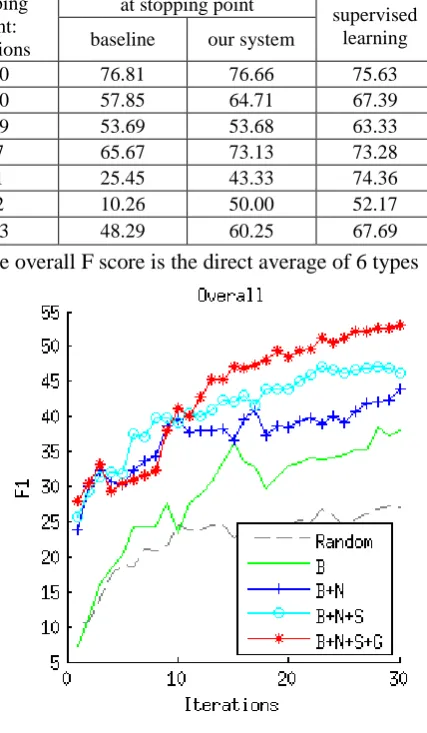
We compare our work to the pure co-testing based active learning (Sun and Grishman 2012), and show the F1 measure given the same number of iterations (5 queries per iteration). For random selection of target seeds, we use the same ran-dom sequence for both the baseline and our framework for fair comparison. In the co-testing framework, the contention set will be empty at some point, which gives the final model of active learning. We report the overall improvement when the system achieves a reasonable perfor-mance with limited human annotation (30 itera-tions) and the final performance (Table 1). The overall result is the average of the F1 measure of all types.
30 iterations stopping point: iterations
at stopping point
supervised learning baseline our system baseline our system
EMP-ORG 58.13 71.52 200 76.81 76.66 75.63 PHYS 34.63 41.16 200 57.85 64.71 67.39 GPE_AFF 18.18 43.01 119 53.69 53.68 63.33 PER-SOC 74.29 68.87 47 65.67 73.13 73.28 ART 25.93 43.33 31 25.45 43.33 74.36 OTHER-AFF 16.67 50.00 22 10.26 50.00 52.17 Overall 37.97 52.98 103 48.29 60.25 67.69
Type # queries in total
#queries that fil-ters apply
Ratio
[image:5.595.73.520.58.421.2]EMP-ORG 1000 91 9.1% PHYS 1000 106 10.6% GPE-AFF 590 84 14.2% PER-SOC 234 64 27.3% ART 151 54 35.8% OTHER-AFF 105 56 53.3%
[image:5.595.84.372.64.329.2]Table 2. Instances auto-labeled by type constraints
Table 1. Comparison with baseline (F1 score). The overall F score is the direct average of 6 types
[image:5.595.306.520.70.437.2]Even though the initial non-relation selection led to early learning of entity type constraints, during the active learning process, there remain queries that could be answered automatically by entity type and co-reference rule filters. The hand-labeling cost could thereby be further duced (Table 2). For some sparse types, the re-duction by these filters is substantial. In practice, this has to deal with noise from the NE tagger, but is still helpful as long as there is a decent NE tagger.
On the whole, our system substantially outper-forms the baseline with a small number of la-beled examples (150 instances, at the 30th itera-tion) and also after a relatively large amount has been annotated (the final model)
To show the effectiveness of each component of our framework, we display the overall perfor-mance comparison including random sampling, over the first 30 iterations (Figure 1). At this point, most of the six relations have not reached their stopping point, and so the benefits of the individual components are more evident.
The overall F1 score is the direct average of the F1 scores of the six types. Non-relation ap-proximation gives an improvement since auto-labeling a certain number of non-relations saves quite a few queries, and the better initial balance of positive and negative examples also makes the model select more informative queries from the beginning. Self-training boosts the system further as it incorporates more instances (especially positives) automatically. After these, the prefer-ence for the global view also gives improvement after 10 iterations. As a trade-off strategy be-tween density and uncertainty, it is common that such methods only outperform the baseline for a certain duration.
With these components and auto-labeling with type constraints (Table 2), we provide a quite reasonable relation extraction system given only 150 labels.4 With more labels, we can approxi-mate supervised learning. So we can build a rela-tion extracrela-tion system quickly when there is no relation annotation in a new corpus. If we need more relations in this new corpus, we can start the framework again, treating previously ac-quired relations as labeled negative instances of the new target relation. Experiments on this mul-tiple relation type extension also show similar gains over the baseline system using our methods.
4 Keep in mind that the best systems, trained on thousands
of examples, only achieve F scores in the low 70’s.
5
Conclusion
We present a more practically efficient way to do active learning than a pure co-testing based algo-rithm. The improvement is most pronounced ini-tially, for small numbers of annotations. We can now achieve reasonable performance for extract-ing relations with very little annotation. Addextract-ing a new relation in an hour now seems within reach.
Each component in the framework is still worth further study. We can consider further ef-forts to enlarge and balance the initial set from the view of non-relation approximation. We can also try more adaptive semi-supervised algo-rithms to interleave with co-testing. The quality of the global classifier in the co-testing also re-mains a constraint, so we will be investigating alternative similarity metrics. While the experi-ments reported here involve simulated active learning, we are now planning real, human-in-the-loop active learning trials.
Acknowledgment
This research was supported in part by the Intel-ligence Advanced Research Projects Activity (IARPA) via Air Force Research Laboratory (AFRL) contract number FA8650-10-C-7058 and via Department of Interior National Business
Center (DoI/NBC) contract number
D11PC20154. The U.S. Government is author-ized to reproduce and distribute reprints for Gov-ernmental purposes notwithstanding any copy-right annotation thereon. The views and conclu-sions contained herein are those of the author and should not be interpreted as necessarily repre-senting the official policies or endorsements, ei-ther expressed or implied, of IARPA, AFRL, DoI/NBC, or the U.S. Government.
References
Michael Collins. 2002. Discriminative training meth-ods for hidden Markov models: Theory and exper-iments with perceptron algorithms. In Proceedings of the Conference on Empirical Methods in Natural Language Processing (EMNLP).
Pinar Donmez and Jaime G. Carbonell and Paul N. Bennett. 2007. Dual strategy active learning. In Proceedings of the European Conference on Ma-chine Learning (ECML).
Zornista Kozareva and Eduard Hovy. 2010. Not all seeds are equal: Measuring the quality of text min-ing seeds. In Proceedings of the North American Chapter of the Association for Computational Lin-guistics (NAACL).
Dan Roth and Kevin Small. 2008. Active learning for pipeline models. In Proceedings of the 23rd Na-tional Conference on Artificial Intelligence (AAAI).
Min Song, Hwanjo Yu, and Wook-Shin Han. 2011. Combining active learning and semi-supervised learning techniques to extract protein interaction sentences. BMC Bioinformatics, 12 (Suppl-12): S4. Ang Sun and Ralph Grishman. 2012. Active Learning
for Relation Type Extension with Local and Global Data Views. In Proceedings of the 21st ACM In-ternational Conference on Information and Knowledge Management (CIKM).
Ang Sun, Ralph Grishman and Satoshi Sekine. 2011. Semi-supervised Relation Extraction with Large-scale Word Clustering. In: Proceedings of HLT '11: the 49th Annual Meeting of the Association for Computational Linguistics (ACL).
Hans Uszkoreit. 2011. Learning relation extraction grammars with minimal human intervention: strat-egy, results, insights and plans. In Proceedings of the 12th International Conference on Computation-al Linguistics and Intelligent Text Processing (CI-CLing).
Vishnu Vyas, Patrick Pantel, Eric Crestan. 2009. Helping Editors Choose Better Seed Sets for Entity Expansion. In Proceedings of the ACM Interna-tional Conference on Information and Knowledge Management (CIKM).
Hong-Tao Zhang, Min-Lie Huang, Xiao-Yan Zhu. 2012. A Unified Active Learning Framework for Biomedical Relation Extraction. In J. Comput. Sci. Technol., 27 (2012), Nr. 6, S. 1302-1313.
Yi Zhang. 2010. Multi-Task Active Learning with Output Constraints. In Proceedings of the 24th Na-tional Conference on Artificial Intelligence (AAAI)