R E V I E W
Potential of robotic systems in phonosurgery
This article was published in the following Dove Press journal: Robotic Surgery: Research and Reviews
Nilesh Vasan Matthew Sharum Jennifer P Rodney
Department of Otolaryngology, Head and Neck Surgery, University of Oklahoma Health Science Center, Oklahoma City, OK 73104, USA
Abstract:There has been rapid growth in the utilization of robotic surgery in the head
and neck. Its utilization in the phonosurgical space has lagged owing to difficulty with access and exposure to the laryngeal site, small working space due to the size of the larynx and the need to work around an endotracheal tube. The goal of this work is to explore recent developments in robotic microlaryngeal surgery. At this time robotic instrumentation is available; however, the range of instruments is not as extensive to match the current microlaryngeal instrumentation that exists for traditional endoscopic surgery. Studies have demonstrated the ability to perform phonosurgery safely with currently available robotic systems but exposure is less than ideal. Work is been under-taken to develop specialized transoral robotic retractors which will improve visualization and allow the robotic instrument to reach the glottis, which has traditionally been the most difficult to area to access. Additional studies will be needed to assess the applica-tion of these systems to more patient populaapplica-tions, and prospective research will be required to compare outcomes of traditional phonosurgery to robotic phonosurgery.
Keywords: phonosurgery, robotic, larynx, glottis, microlaryngeal, endoscopic transoral
robotic surgery, transoral retractor
Introduction
Laryngeal surgery wasfirst performed in the 1800s with the development of direct
laryngoscopy and endolaryngeal surgery. Since then, advances in endolaryngeal surgery have focused on increasing surgical precision with the utilization of
oper-ating microscopes and endoscopes, CO2 lasers and microflap techniques.
Endoscopic and microscopic techniques as well as new microlaryngeal instruments have allowed for more precision surgery and has improved outcomes. Phonosurgery involves the use of microscopes and microsurgical techniques to perform
endolar-yngeal surgery specifically of the glottic larynx, for the restoration and
improve-ment of voice secondary to benign laryngeal conditions. The founding principles of phonosurgery, as with any laryngeal surgery, rests on optimal visualization of the
pathology and surgical field, the ability to use two hands with precise tissue
handling and preservation of normal tissue.1
Despite these current advancements, endolaryngeal surgery is still limited in many ways. The surgeon is required to operate at long distances from the true
surgical field using twenty-two centimeter-long instruments. This leads to a
reduc-tion of sensory feedback, and the long working distances directly relates to
ampli-fication of surgeon hand tremor. The direct laryngoscope, of which there are
multiple sizes and types, provides a very narrow working space and field of
exposure. In addition, the instruments lack distal dexterity, which can contribute
to inadvertent collateral damage to surrounding healthy tissue.2
Correspondence: Nilesh Vasan
Department of Otolaryngology, Head and Neck Surgery, University of Oklahoma Health Science Center, 800 Stanton L Young Blvd, Suite 1400, Oklahoma City, OK 73104, USA
Tel +1 405 271 5504 Email [email protected]
Robotic Surgery: Research and Reviews
Dove
press
open access to scientific and medical research
Open Access Full Text Article
Robotic Surgery: Research and Reviews downloaded from https://www.dovepress.com/ by 118.70.13.36 on 27-Aug-2020
Robotic surgery within the head and neck is a
relatively new and rapidly growing field. Transoral
robotic surgery (TORS) has been described in the treatment of benign and malignant lesions of the oro-pharynx, hypooro-pharynx, larynx, skull base and
paraphar-yngeal space.3 Indeed, TORS has FDA clearance for
the treatment of T1 and T2 oropharyngeal carcinoma with larger tumors having been successfully treated as well. Robotic systems have the potential to overcome many of the limitations of more traditional
endolaryn-geal surgeries. Specifically, robotic systems provide
improved 3D visualization, greater degrees of freedom
at the surgical site and dissipation of surgeon tremor.2
These factors all contribute to increased surgical pre-cision. With the primary goal of laryngeal phonosur-gery being the restoration and optimization of voice, surgical precision is key. Despite this, robotic phono-surgery has lagged behind other anatomical sites within the head and neck in which robotic usage has rapidly been growing, namely within the oropharynx. There are several reasons for the slow advancement of robotic use for phonosurgery. This area has been limited by poor visualization of the glottis due to poor access, 'large' robotic instruments and the narrow working space for these robotic arms. The robotic arms were primarily designed for larger resections in the
abdo-men, thorax, head and neck. Narrower and finer
effec-tor robotic arms modified for the glottis in the upper
airway to allow delicate tissue handling required in phonosurgery had not been a focus of the robotics industry until recently with release of the Medrobotics
Flex system.4
Robotic systems
Currently, there are two main robotic systems utilized in the
head and neck space. Thefirst robotic system to be developed,
the DaVinci Surgical Robot (Intuitive Surgical Inc; Sunnyvale, CA), is used in many anatomical areas and specialties includ-ing within head and neck, cardiac, colorectal, gynecologic and urologic surgeries. The DaVinci S and Si platforms have been approved for use in the head and neck space, and in March 2019, the single port (SP) platform was partially approved for
use in the head and neck space, specifically for radical
tonsil-lectomy and tongue base resection. Given the limited approval of the SP platform, it will not be covered in this review. The DaVinci system utilizes a Master Control and Slave Robot system. The surgeon sits separate from the patient at the master control center. The robot itself has four independently
controlled endoscopic arms; one robotically controlled endo-scopic camera and three robotically controlled arms holding
instruments.5In transoral surgery, only two instrument arms
are utilized with the endoscopic camera. The DaVinci system
does not have instruments specific for microlaryngeal surgery.
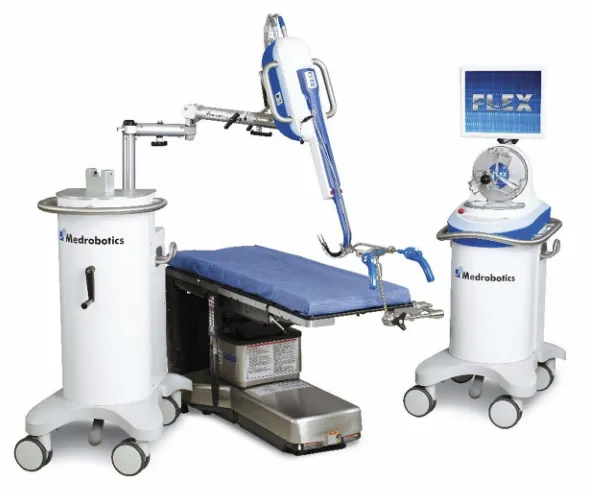
The Flex Robotic System (Medrobotics, Raynham, MA) has FDA approval for use in the head and neck and colorectal sites. The Flex Robotic system has the surgeon positioned at
the patient’s head rather than at a separate console (Figure 1).
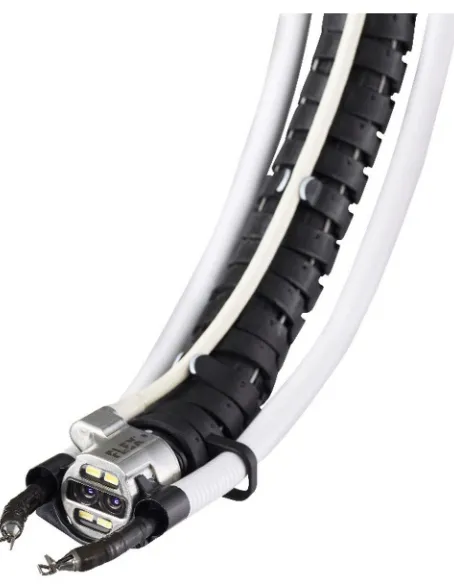
This system employs aflexible endoscopic camera which can
be advanced towards the supraglottis in a non-linear fashion (Figure 2). Once the camera is positioned, the robotic system functions as a stable surgical platform through which the
flexible surgical instruments can be passed through the side
ports into the surgicalfield. These surgical instruments are
manually operated through two side ports by the surgeon compared to the off-set robotic manipulation seen in the
DaVinci system.6 The direct physical connection of the
instruments in the Medrobotic Flex system provides the surgeon direct haptic feedback. The Flex Robotic System
has microlaryngeal surgical instruments developed specifi
-cally for the Flex Robotic system, which provides a com-parative advantage over the DaVinci system. The available microlaryngeal instruments for the Flex Medrobotic system include a CO2 laser holder, alligator graspers, triangle for-ceps, Flex sickle and Flex scissors available in all directions;
however, some specific endolaryngeal instruments are
lack-ing at this time (Figure 3). As interest in robotic
phonosur-gery continues to evolve, the available instrumentation continues to improve.
Surgical advances
In 2005, Hockstein et al demonstrated the ability to utilize the DaVinci robotic system in cadaver models to perform microlaryngeal surgery. In order to visualize the larynx with their technique, they required a Dingman retractor and retracting sutures on both the oral tongue and the epiglottis, and they were able to show that the robotic system could be utilized to perform various
microlaryn-geal procedures. Specifically, they were able to perform
vocal cord strippings, endolaryngeal microflaps, partial
vocal cordectomy and arytenoidectomy. With their com-plex retraction system, they demonstrated good visualiza-tion of the larynx. The robot demonstrated the ability to delicately handle the tissue without tremor; however, this model was limited by the lack of an endotracheal tube use during these microlaryngeal procedures which limits the
ability to generalize their results to live patients.7
Robotic Surgery: Research and Reviews downloaded from https://www.dovepress.com/ by 118.70.13.36 on 27-Aug-2020
Subsequent to this, O’Malley Jr. et al in 2006 applied the DaVinci robotic system to perform robotic glottic micro-surgery in live canine models. In this series, the surgeons were able to successfully utilize the robotic system to perform a submucosal vocal cord dissection in an orotra-cheal intubated canine model without adverse events. The
authors note excellent visualization of the operative field,
significant reduction of surgeon tremor and removal of the
fulcrum effect noted in traditional endolaryngeal surgery given the wristed instruments. In addition, they noted improved operative time with the 5-mm instruments as
compared to the 8-mm instruments.8 Following these
proof of principle studies, the ability to apply robotic techniques shown in cadaveric and animal models was applied in live human laryngeal surgeries.
In 2009, Park et al. performed a prospective study to demonstrate the feasibility of the DaVinci robotic system for the resection of glottic cancer in 4 patients. Park et al. were able to completely resect these malignancies en bloc with clear margins; however, they did require tracheostomy for their
patients.9 In 2011, Blanco et al demonstrated the ability to
use the DaVinci robotic system for the oncologically sound
Figure 2Microlaryngeal Instrumentation available for the Flex robotic system including laser attachment, alligator grasper, triangle forceps, micro-scissors and sickle knife. Note:Copyright © 2019. Medrobotics. Reproduced from Medrobotics [homepage on the Internet]. Raynham, MA. Available from:https://medrobotics.com/gateway/ instruments/. Accessed October 17, 2019.14
Figure 1Medrobotic Flex 3D scope with alligator grasper and triangle forceps which demonstrates the ability for the robot to manipulate in a non-linear fashion. Note:Copyright © 2019. Medrobotics. Reproduced from Medrobotics [homepage on the Internet]. Raynham, MA. Available from:https://medrobotics.com/gateway/ instruments/. Accessed October 17, 2019.14
Robotic Surgery: Research and Reviews downloaded from https://www.dovepress.com/ by 118.70.13.36 on 27-Aug-2020
resection of T1 glottic squamous cell carcinoma. The robot surgical arms were placed outside the bounds of a Lindholm laryngoscope, and the robotic camera was passed through the laryngoscope. Blanco et al were able to resect the carcinoma en bloc with adequate 2 mm margins and they were able to
perform this operation with a 6–0 endotracheal tube in place;
however, restricted access to the anterior commissure was
noted with their use of a Feyh-Kastenbauer (FK) retractor.10
In 2017, Remacle et al. published their case series involving four patients treated for benign glottic lesions with the Flex Medrobotic system. The patients presented with vocal cord polyps, vocal cord keratosis and amyloidosis. For the vocal cord keratosis patient, a type 1 subepithelial cordectomy was performed. The vocal cord polyps and the amyloid lesion cases were resected with the CO2 laser. These patients were all able to be successfully treated, with orotracheal intubation, utilizing the Medrobotic system and discharged home on the
same day.11In 2018, Persky et al. published their multi-center
retrospective review of patients undergoing transoral surgery utilizing the Medrobotic Flex system. Their study highlighted 68 patients who underwent trans-oral robotic surgery of the oropharynx, hypopharynx and larynx. At the supraglottic
subsite, 88% of patients were able to successfully undergo robotic resection, while in the glottic subsite only 50% of patients were able to successfully undergo robotic resection
utilizing the Flex system.12Thisfinding underscores the diffi
-culty of performing microlaryngeal and phonosurgical opera-tions on the glottis.
Alongside these robotic surgical advancements, additional research has been undertaken to further improve access to the glottis. One of the most troublesome aspects for robotic
lar-yngeal phonosurgery is difficulty with exposure. The larynx
has been a difficult anatomic site to address because of
visua-lization and the small space and size requirements. In robotic laryngeal surgeries multiple different types of retractors have been employed to improve glottic exposure. These include FK retractors, Laryngeal Advanced Retractor System (LARS) and
Dingman retractors (Table 1). These retractors suffer from
closed, rigid frames, limited blade rotation and limited frame articulation. The FK retractor is especially cumbersome in its use, and its exposure of the larynx is very limited, particularly for the anterior glottis. Prior studies had noted the need for a complex system involving multiple instruments and tongue
suture retraction in order to access the glottis.7Vasan et al.
demonstrated the benefit of a modular oral retractor (MOR) to
improve access to the glottis.4The MOR retractor (US and
International Patent) has two pivot points on the frame and various tongue blades which can be utilized to improve access
to the glottis (Figures 4and5). The maxillary brace pivot point
augments the ability of the retractor to push the tongue and epiglottis forward, allowing improved visualization of the glottis. The 360° axis of rotation also gives the retractor a more stable purchase on the maxilla. The ability to rotate multiple parts of the retractor around an axis to maximize exposure is not possible with other retractors currently avail-able for robotic laryngeal surgery. The maxillary brace is very similar to a Crowe-Davis retractor in that it widely distributes dental pressure from canine to canine across the superior alveolus as well as protecting the upper teeth from robot arm collision; whereas, the Dingman has two narrow dental braces that anchor on one tooth on each side of the superior alveolus. In their study, Vasan et al. were able to achieve full visualiza-tion of the glottis, and in one case, prolapsed, redundant arytenoid tissue was easily resected with the CO2 laser. This was accomplished without a retracting the tongue using a
suture.13In their follow-up case series, this retractor system
was noted to be effective in providing an easy to use, highly effective retractor system that may be used to facilitate access to the glottis with the robotic systems currently available. In this case series, they were able to adequately resect the
Figure 3Medrobotics Flex robotic system.
Note:Copyright © 2019. Medrobotics. Reproduced from Medrobotics [homepage on the Internet]. Raynham, MA. Available from:https://medrobotics.com/gateway/ instruments/. Accessed October 17, 2019.14
Robotic Surgery: Research and Reviews downloaded from https://www.dovepress.com/ by 118.70.13.36 on 27-Aug-2020
patients’supraglottic lesions with full visualization of both the lesions and the glottis. This was performed without the need for a complex retractor set-up or a retracting suture in the
tongue (Figure 6).4
Conclusion
There has been a rapid growth in the utilization of TORS in the head and neck site; however, its utilization in the
phonosurgical space has lagged owing to difficulty with access
and exposure to the laryngeal site, small working space and the need to work around an endotracheal tube. Robotic instrumen-tation is available; but the range of instruments is not as extensive to match the current microlaryngeal instrumentation that exists for traditional endoscopic surgery. Research has demonstrated the ability to perform phonosurgery safely with robotic systems currently available, i.e. DaVinci Robotic System and Medrobotics Flex System. In addition, further
Table 1Characteristics of currently available retractors for robotic microlaryngeal surgery
Retractor Face Frame Narrow Laryngeal Blade
Blade Anterior-Posterior Advancement
Blade Rotation Around Central Axis
Frame Articulation
Used in Live Humans
Dingman Closed: Rectangle No No No Fixed Yes
Crowe-Davis Open: Oval No No Yes Fixed Yes
Feyh-Kastenbauer (FK) Closed: Square No Yes Yes Fixed Yes
Feyh-Kastenbauer
Weistein-O’Malley (FK-WO)
Closed: Rectangle No Yes Yes Fixed Yes
Laryngeal Advanced Retractor System (LARS)
Closed: Curved Rectangle
Yes Yes Yes Fixed Yes
Lalich Microlaryngeal Robotic Retractor
Closed: Curved Rectangle
Yes Yes No Articulates relative
to the handle
No
Modular Oral Retractor (MOR) System
Open: Oval Yes Yes Yes Articulates relative
to the handle
Yes
Flex retractor Closed: Curved
Rectangle
Yes Yes Yes Articulates relative
to the handle
Yes
Notes:Reprinted fromJournal of Voice, Vol 31, Issue 5, Mcguire DA, Rodney JP, Vasan NR, Improved glottic exposure for roboticmicrolaryngeal surgery: a case series, Pages 628-633, Copyright (2017), with permission from Elsevier.4
Figure 4The MOR system allows the frame to be rotated relative to the handle and for blade rotation around the central access. It is shown here without a tongue blade. The superior pivot allows for change in pitch while the inferior pivot allows for adjustment in the roll of the tongue blade. There are right and left sided frames. Notes:Reprinted fromJournal of Voice, Vol 31, Issue 5, Mcguire DA, Rodney JP, Vasan NR, Improved glottic exposure for roboticmicrolaryngeal surgery: a case series, Pages 628-633, Copyright (2017), with permission from Elsevier.4
Figure 5The different blades available to use with the MOR system. Various blades are available which allow for improved exposure of the tongue base, supraglottic larynx and glottis.
Robotic Surgery: Research and Reviews downloaded from https://www.dovepress.com/ by 118.70.13.36 on 27-Aug-2020
research has been undertaken to develop specialized transoral retractors which allow optimal visualization of the glottis without the need for retraction sutures in the oral tongue or epiglottis. Further research will be needed to assess the appli-cation of these systems to more patients including those with less favorable anatomy as well as within the pediatric popula-tion. Moreover, prospective research will be required to com-pare outcomes of traditional phonosurgery comcom-pared to robotic phonosurgery.
Disclosure
Nilesh R. Vasan MD is the inventor of the MOR system and holds US patent US 9,993,148B2 with the
Board of Regents at the University of Oklahoma. The
authors report no other conflicts of interest in this
work.
References
1. Ford CN. Advances and refinements in phonosurgery.Laryngoscope.
1999;109:1891–1900.
2. Hillel AT, Kapoor A, Simaan N, Taylor RH, Flint P. Applications of robotics for laryngeal surgery. Otolaryngol Clin North Am. 2008;41 (4):781–791.
3. Chia SH, Gross ND, Richmon JD. Surgeon experience and complica-tions with Transoral Robotic Surgery (TORS). Otolaryngol Head Neck Surg.2013;149(6):885–892.
4. Mcguire DA, Rodney JP, Vasan NR. Improved glottic exposure for robotic microlaryngeal surgery: a case series.J Voice.2017;31(5):628–633. 5.Intuitive Surgical. Available from: https://www.intuitive.com/. Cited
February 20, 2019.
6.Medrobotics. Available from:https://medrobotics.com/. Cited February 20, 2019.
7. Hockstein NG, Nolan JP, O’Malley BW, Woo YJ. Robot-assisted pharyngeal and laryngeal microsurgery: results of robotic cadaver dissections.Laryngoscope.2005;115:1003–1008.
8. O’Malley BW, Weinstein GS, Hockstein NG. Transoral Robotic Surgery (TORS): glottic microsurgery in a canine model.J Voice.
2006;20(2):263–268.
9. Park YM, Lee WJ, Lee JG, et al. Transoral Robotic Surgery (TORS) in laryngeal and hypopharyngeal cancer. J Laparoendoscopic Adv Surg Tech.2009;19(3):361–368.
10. Blanco RG, Ha PK, Califano JA, Saunders JM. Transoral robotic surgery of the vocal cord.J Laparoendoscopic Adv Surg Tech.2011;21 (2):157–159.
11. Remacle M, Prasad VM. Preliminary experience in transoral laryngeal surgery with a flexible robotic system for benign lesions of the vocal folds. Eur Arch Oto-Rhino-Laryngol.
2018;275(3):761–765.
12. Persky MJ, Issa M, Bonfili JR, Goyal N, Goldenberg D, Duvvuri U. Transoral surgery using theflex robotic system: initial experi-ence in the United States. Head Neck.2018;40(11):2482–2486. 13. Rodney JP, Vasan NR. Robotic microlaryngeal surgery: a new
retrac-tor that provides improved access to the glottis. SpringerPlus.
2016;5:1.
14. Medrobotics [homepage on the Internet]. Raynham, MA. Available from:
https://medrobotics.com/gateway/instruments/. Accessed October 17, 2019.
Robotic Surgery: Research and Reviews
Dove
press
Publish your work in this journal
Robotic Surgery: Research and Reviews is an international, peer reviewed, open access, online journal publishing original research, commentaries, reports, and reviews on the theory, use and application of robotics in surgical interventions. Articles on the use of supervisory-controlled robotic systems, telesurgical devices, and shared-control
systems are invited. The manuscript management system is comple-tely online and includes a very quick and fair peer review system, which is all easy to use. Visit http://www.dovepress.com/testimonials. php to read real quotes from published authors.
Submit your manuscript here:https://www.dovepress.com/robotic-surgery-research-and-reviews-journal Figure 6The MOR system in place demonstrating the access available to the
supraglottic and glottic regions of the throat for surgery.
Notes:Reprinted fromJournal of Voice, Vol 31, Issue 5, Mcguire DA, Rodney JP, Vasan NR, Improved glottic exposure for roboticmicrolaryngeal surgery: a case series, Pages 628-633, Copyright (2017), with permission from Elsevier.4
Robotic Surgery: Research and Reviews downloaded from https://www.dovepress.com/ by 118.70.13.36 on 27-Aug-2020