Multi-document summarization using off the shelf compression software
Amardeep Grewal , Timothy Allison
, Stanko Dimitrov , Dragomir Radev
Department of Electrical Engineering and Computer Science
Department of Classical Studies
School of Information
University of Michigan
asgrewal,tballiso,sdimitro,radev
@umich.edu
Abstract
This study examines the usefulness of common off the shelf compression software such as gzip in enhancing already existing summaries and producing summaries from scratch. Since the gzip algorithm works by removing repetitive data from a file in order to compress it, we should be able to determine which sentences in a summary contain the least repetitive data by judging the gzipped size of the summary with the sentence compared to the gzipped size of the summary without the sentence. By picking the sentence that increased the size of the mary the most, we hypothesized that the sum-mary will gain the sentence with the most new information. This hypothesis was found to be true in many cases and to varying degrees in this study.
1
Introduction
1.1 The connection between text compression and multidocument summarization
A standard way for producing summaries of text docu-ments is sentence extraction. In sentence extraction, the summary of a document (or a cluster of related docu-ments) is a subset of the sentences in the original text (Mani, 2001). A number of techniques for choosing the right sentences to extract have been proposed in the litera-ture, ranging from word counts (Luhn, 1958), key phrases (Edmundson, 1969), naive Bayesian classification (Ku-piec et al., 1995), lexical chains (Barzilay and Elhadad, 1997), topic signatures (Hovy and Lin, 1999) and cluster centroids (Radev et al., 2000).
Most techniques for sentence extraction compute a score for each individual sentence, although some recent work has started to pay attention to interactions between
sentences. On the other hand, and particularly in mul-tidocument summarization, some sentences may be re-dundant in the presence of others and such redundancy should lead to a lower score for each sentence propor-tional to the degree of overlap with other sentences in the summary. The Maximal Marginal Relevance (MMR) method (Carbonell and Goldstein, 1998) does just that.
In this paper, we are taking the idea of penalizing re-dundancy for multi-document summaries further. We want to explore existing techniques for identifying re-dundant information and using them for producing better summaries.
As in many areas in NLP, one of the biggest challenges in multi-document summarization is deciding on a way of calculating the similarity between two sentences or two groups of sentences. In extractive multi-document summarization, the goal is, on the one hand, to select the sentences which best represent the main point of the doc-uments and, on the other, to pick sentences which do not overlap much with those sentences which have already been selected. To accomplish the task of sentence com-parison, researchers have relied on stemming and count-ing n-gram similarity between two sentences. So, for ex-ample, if we have the following two sentences: “The dogs go to the parks” and “The dog is going to the park,” they would be nearly identical after stemming: “the dog [be] go to the park,” and any word overlap measure would be quite high (unigram cosine of .943).
On a more information theoretic basis, as Benedetto et al. observe (Benedetto et al., 2002a), comparing the size of gzipped files allows us to roughly measure the distance (increase in entropy) between a new sentence and the al-ready selected sentences. Benedetto et al. (Benedetto et al., 2002a) find that on their task of language classifica-tion, gzip’s measure of information distance can effec-tively be used as a proxy for semantic distance. And so, we set out to see if we could usefully apply gzip to the task of multi-document summarization.
Gzip is a compression utility which is publicly avail-able and widely used (www.gzip.org). Benedetto et al. (Benedetto et al., 2002a) summarize the algorithm behind gzip and discuss its relationship to entropy and optimal coding. Gzip relies on the algorithm developed by Ziv and Lempel (Ziv and Lempel, 1977). Following this al-gorithm, gzip reads along a string and looks for repeated substrings, if it finds a substring which it has already read, it replaces the second occurrence with two numbers, the length of the substring and the distance from that loca-tion back to the original string. If the substring length is greater than the distance, then the unzipper will know that the sequence repeats.
In our framework, we use an off-the-shelf extractive summarizer to produce a base summary. We then create a number of summaries containing precisely one more sen-tence than the base summary. If is the total number
of sentences in the input cluster, and is the number of
sentences already included in the base, there are
possible summaries of length sentences. One of
them has to be chosen over the others. In this work, we compress each of the candidate summaries and
observe the relative increase in the size of the compressed file compared to the compressed base summary. The ba-sic idea is that sentences containing the most new infor-mation will result in relatively longer compressed sum-maries (after normalizing for the uncompressed length of the newly added sentence). We will discuss some varia-tions of this algorithm in the next section.
There are two issues which must be kept in mind in ap-plying gzip to problems beyond data compression. First, because of the sequential nature of the algorithm, com-pression towards the beginning of the file will not be as great as that later in the file. Second, there is a 32k limit on the length of the window that gzip considers. So, if “abc” appears at the beginning of a string, and then also appears 33k later (but nowhere in between), gzip will not be able to compress the second appearance. This means that our process is “blind” to sentences in the summary which happen 32k earlier. This could potentially be a drawback to our approach, but in practice, given realistic text lengths, we have not found a negative effect.
The impetus for our approach is (Benedetto et al., 2002a; Benedetto et al., 2002b) who report on their use
of gzip for language classification, authorship attribution, and topic classification. In their approach, they begin with a set of known documents. For each document, they measure the ratio of the uncompressed document to the compressed document. Then they append an un-known document to each un-known document cluster, and compress these new documents. Their algorithm then chooses whichever document had the greatest compres-sion in relation to its original. As (Goodman, 2002) ob-serves, using compression techniques for these tasks is not an entirely new approach, nor is it very fast. Never-theless, we wanted to determine the efficacy of applying Benedetto et al.’s methods to the task of multi-document summarization.
2
Description of the method
The aim of this study was to determine if gzip is effective as a summarization tool when used in conjunction with an existing summarizer. We chose MEAD1, a public-domain summarization system, which can be downloaded on the Internet (Radev et al., 2002). The version of MEAD used in this experiment was 3.07.
To produce a summary of a target length
sen-tences, we perform the following steps:
1. First, get MEAD to create a summary of size
sen-tences, where is specified in advance. This
sum-mary will be called the base sumsum-mary.
2. Compress the base summary using gzip. Let be
the length of the base summary before compression and
be the size in bytes of its compressed version.
3. Create all possible summaries of length using
the remaining sentences in the input cluster.
4. Compress all summaries using gzip.
5. Pick the summary that results in the greatest increase in size in F, where F is one of a number of metrics, as described in the rest of this section.
Example: if a cluster had five sentences total, and a user wanted to create a summary of one sentence from MEAD and one from gzip, then the program would start with the one sentence generated by MEAD and add each of the four remaining sentences to make a total of five ex-tracts. Four of these extracts would have two sentences and one would have the one sentence created by MEAD. After these extracts have been created they are converted to summaries and the number of characters in each sum-mary is calculated. Then the difference in length between the summaries with the one extra sentence and the orig-inal MEAD-only summary is computed and stored. The
1
next step in the process is to gzip all of the summaries and compute the difference in size between the sum-maries with the extra sentence and the original MEAD-only summary and store this change in size. After all these steps have been executed, we have a list of all pos-sible sentences, the number of characters they contain and the size increase they produce after being gzipped with the rest of the summary. Based on this information, we can choose the next sentence in summary depend-ing on which sentence increases the size of the gzipped summary the most or which sentence has the best size to length ratio.
We originally considered six evaluation metrics to use in this study. When choosing the next sentence for an existing summary, all possible sentences were added to the summary one at a time. For each sentence, the in-crease in length of the summary was measured and the increase in size of the gzipped summary was measured. From these two measurements we derived six policies. The top sizes policy picked the sentence which produced the greatest increase in the size of the summary when gzipped. The bot sizes policy picked the sentence which produced the smallest increase in the size of the sum-mary when gzipped. The top lengths policy picked the sentence that increased the number of characters in the summary the most. The bot lengths picked the sentence that increased the number of the characters in the sum-mary the least. The top ratios picked the sentence that had the greatest (size increase)/(length increase) and the bot ratios was the sentence that had the smallest (size in-crease)/(length increase). All policies except bot ratios, top lengths, and top sizes did not show promising pre-liminary results and so are not included in this paper. In addition, the top lengths policy does not really need gzip at all, and so it too is omitted from this paper. More infor-mation about the policies is given in the policies section.
2.1 The clusters used
We performed our experiments on a series of clusters. A cluster is a group of articles all pertaining to one particu-lar event or story. There were a total of five such clusters, and the same set of tests was carried out on each cluster independently from the others. All of our tests were con-ducted on five different clusters of documents, referred to here as the 125 cluster, 323 cluster, 46 cluster, 60 cluster and 1018 cluster. The lengths of each of these clusters in sentences was 232, 91, 344, 150, and 134, respectively. Clusters with such diverse lengths were purposely cho-sen to determine if the quality of the summaries was in any way related to the length of the source material. The various articles were taken from the Hong Kong News corpus provided by the Hong Kong SAR of the People’s Republic of China (LDC catalog number LDC2000T46). This paper contains 18,146 pairs of parallel documents in
English and Chinese, in our case only the English ones were used. The clusters were created at the Johns Hop-kins University Summer Workshop on Language Engi-neering 2002.
[image:3.612.332.521.206.386.2]2.2 An example
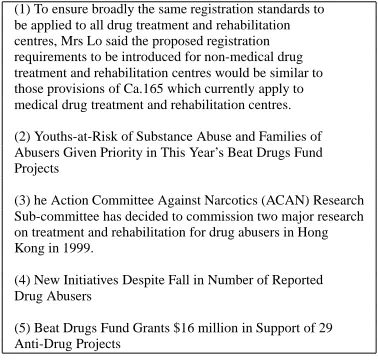
Figure 1 shows a 5-sentence summary produced by MEAD from Cluster 125 of the HK News Corpus. The uncompressed length of this summary is 797 bytes whereas its size after gzip compression is 451 bytes.
(1) To ensure broadly the same registration standards to be applied to all drug treatment and rehabilitation centres, Mrs Lo said the proposed registration requirements to be introduced for non-medical drug treatment and rehabilitation centres would be similar to those provisions of Ca.165 which currently apply to medical drug treatment and rehabilitation centres.
(2) Youths-at-Risk of Substance Abuse and Families of Abusers Given Priority in This Year’s Beat Drugs Fund Projects
(3) he Action Committee Against Narcotics (ACAN) Research Sub-committee has decided to commission two major research on treatment and rehabilitation for drug abusers in Hong Kong in 1999.
(4) New Initiatives Despite Fall in Number of Reported Drug Abusers
(5) Beat Drugs Fund Grants $16 million in Support of 29 Anti-Drug Projects
Figure 1: “Base” MEAD summary consisting of five sen-tences.
Cluster 125 includes 10 documents with a total of 232 sentences. In our example, after five of them have already been included in the 5-sentence summary, there are still 227 candidates for the sixth sentence to include in a 6-sentence summary. As in the rest of the paper, we will be comparing summaries of equal length produced by two different methods, either (a) all sentences are chosen by MEAD, or (b) some sentences are chosen by MEAD and then the rest of the sentences until the target length of the summary are added by gzip.
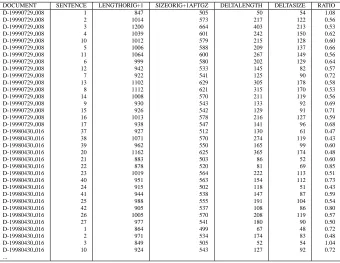
Figure 2 shows some statistics about these 227 sen-tences.
Figure 3 contains the list of sentences included in the five-sentence base summary.
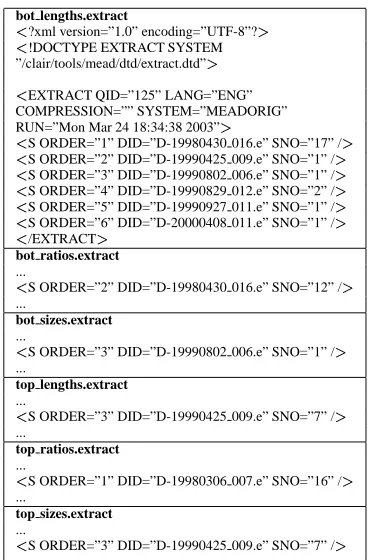
Figure 4 shows the candidate sentences to be included by the different policies in their six-sentence extracts.
3
Experimental setup
DOCUMENT SENTENCE LENGTHORIG+1 SIZEORIG+1AFTGZ DELTALENGTH DELTASIZE RATIO
D-19990729 008 1 847 505 50 54 1.08
D-19990729 008 2 1014 573 217 122 0.56
D-19990729 008 3 1200 664 403 213 0.53
D-19990729 008 4 1039 601 242 150 0.62
D-19990729 008 10 1012 579 215 128 0.60
D-19990729 008 5 1006 588 209 137 0.66
D-19990729 008 11 1064 600 267 149 0.56
D-19990729 008 6 999 580 202 129 0.64
D-19990729 008 12 942 533 145 82 0.57
D-19990729 008 7 922 541 125 90 0.72
D-19990729 008 13 1102 629 305 178 0.58
D-19990729 008 8 1112 621 315 170 0.53
D-19990729 008 14 1008 570 211 119 0.56
D-19990729 008 9 930 543 133 92 0.69
D-19990729 008 15 926 542 129 91 0.71
D-19990729 008 16 1013 578 216 127 0.59
D-19990729 008 17 938 547 141 96 0.68
D-19980430 016 37 927 512 130 61 0.47
D-19980430 016 38 1071 570 274 119 0.43
D-19980430 016 39 962 550 165 99 0.60
D-19980430 016 20 1162 625 365 174 0.48
D-19980430 016 21 883 503 86 52 0.60
D-19980430 016 22 878 520 81 69 0.85
D-19980430 016 23 1019 564 222 113 0.51
D-19980430 016 40 951 563 154 112 0.73
D-19980430 016 24 915 502 118 51 0.43
D-19980430 016 41 944 538 147 87 0.59
D-19980430 016 25 988 555 191 104 0.54
D-19980430 016 42 905 537 108 86 0.80
D-19980430 016 26 1005 570 208 119 0.57
D-19980430 016 27 977 541 180 90 0.50
D-19980430 016 1 864 499 67 48 0.72
D-19980430 016 2 971 534 174 83 0.48
D-19980430 016 3 849 505 52 54 1.04
D-19980430 016 10 924 543 127 92 0.72
[image:4.612.137.477.70.333.2]...
Figure 2: A subset of the 227 candidate sentences (from two documents out of a total of ten) to be included as sentence number six in a six-sentence summary. LENGTHORIG is the length in bytes of the summary, consisting of the original five MEAD-generated sentences plus this candidate sentence, before compression. SIZEORIG+1AFTGZ is the length in bytes of the compressed summary. DELTALENGTH is the difference in uncompressed length (which is also the length of the candidate uncompressed sentence). DELTASIZE is the change in compressed size. RATIO is equal to DELTASIZE divided by DELTALENGTH.
?xml version=”1.0” encoding=”UTF-8”?
!DOCTYPE EXTRACT SYSTEM ”/clair/tools/mead/dtd/extract.dtd”
EXTRACT QID=”” LANG=”” COMPRESSION=”” SYSTEM=”” RUN=””
S ORDER=”1” DID=”D-19980430 016.e” SNO=”17” /
S ORDER=”2” DID=”D-19990425 009.e” SNO=”1” /
S ORDER=”3” DID=”D-19990829 012.e” SNO=”2” /
S ORDER=”4” DID=”D-19990927 011.e” SNO=”1” /
S ORDER=”5” DID=”D-20000408 011.e” SNO=”1” /
[image:4.612.83.290.431.526.2]
/EXTRACT
Figure 3: The list of sentence/document IDs for the five sentences in the base summary.
extracts, the number of sentences contributed by MEAD was incremented by ten starting at zero and the number of sentences contributed by gzip was incremented from one to ten, on top of the MEAD sentences. So for any randomly chosens extract of size , ! #"%$&')(+*
indi-cates the number of sentence contributed by gzip. So an extract of fifty-six sentences contains fifty sentences from MEAD and six from gzip. In this way, a total of 110 ex-tracts were created for all clusters except Cluster 323, for which only 80 extracts were created because there were only 91 sentences total in that cluster. For clarification,
the 110 sentence extract for each cluster contained 100 MEAD sentences and 10 sentences from the chosen gzip policy. The 10 sentence extract for each cluster contained 0 MEAD sentences and 10 sentences from the chosen gzip policy. In order to have a benchmark to compare the gzip modified extracts to, extracts containing an identi-cal number of sentences were created using only MEAD, so a 110 MEAD extract has all of its sentences chosen by MEAD. Relative utility was run on all types of gzip extracts, as well as only MEAD extracts.
3.1 Evaluation methods
bot lengths.extract
?xml version=”1.0” encoding=”UTF-8”?
!DOCTYPE EXTRACT SYSTEM ”/clair/tools/mead/dtd/extract.dtd”
EXTRACT QID=”125” LANG=”ENG” COMPRESSION=”” SYSTEM=”MEADORIG” RUN=”Mon Mar 24 18:34:38 2003”
S ORDER=”1” DID=”D-19980430 016.e” SNO=”17” /
S ORDER=”2” DID=”D-19990425 009.e” SNO=”1” /
S ORDER=”3” DID=”D-19990802 006.e” SNO=”1” /
S ORDER=”4” DID=”D-19990829 012.e” SNO=”2” /
S ORDER=”5” DID=”D-19990927 011.e” SNO=”1” /
S ORDER=”6” DID=”D-20000408 011.e” SNO=”1” /
/EXTRACT
bot ratios.extract
...
S ORDER=”2” DID=”D-19980430 016.e” SNO=”12” /
...
bot sizes.extract
...
S ORDER=”3” DID=”D-19990802 006.e” SNO=”1” /
...
top lengths.extract
...
S ORDER=”3” DID=”D-19990425 009.e” SNO=”7” /
...
top ratios.extract
...
S ORDER=”1” DID=”D-19980306 007.e” SNO=”16” /
...
top sizes.extract
...
S ORDER=”3” DID=”D-19990425 009.e” SNO=”7” /
[image:5.612.332.518.63.470.2]...
Figure 4: The document/sentence ID picked by each of the six policies to be the sixth sentence in the summary.
upper bound (highest utility scores given by the judges) and lower bound (utility scores from randomly chosen sentences). We use this method because, as (Radev et al., 2002) find, Precision, Recall, and Kappa measures as well as content-based evaluation methods are unreliable for short summaries (5%-30%) and especially in the task of multi-document summarization, where there are likely to be several sentences which would contribute the same information to a summary.
4
Results
4.1 Performance of Bot Ratios
When this project was in its initial stages, the ratios policy was designed in the hope that it would produce the high-est quality sentences. However, it was not the bot ratios policy which was expected to succeed, but the top ratios. Top ratio sentences are ideally the sentences which pro-vide the greatest increase in gzip size, for the smallest increase in summary length. Logically, these are the sen-tences that would appear to enhance the summary the most for the smallest cost. Bot ratio sentences are essen-tially the sentences which provide the greatest increase in summary length, for the smallest increase in size. In many cases, they are simply the longest sentences re-maining to be used. The bot ratios policy was originally
bot lengths.summary
...
(3) Anti-drug work poses challenge ...
bot ratios.summary
...
(2) Taking into account these observations, the Government proposes and the Action Committee Against Narcotics supports that a registration scheme should be introduced for non-medical drug treatment and rehabilitation centres, in order to:
...
bot sizes.summary
...
(3) Anti-drug work poses challenge ...
top lengths.summary
...
(3) Notable amongst the approved projects for youths-at-risk are the $2 .5 million proposal to be organised by the Hong Kong Federation of Youth Groups featuring preventive education and guidance for 2 500 high-risk youths from primary and secondary schools , as well as from youth centres in Tsuen Wan and Kwai Tsing districts; and the $2 .3 million project by the Hong Kong Christian Service targeting at 3 000 youths-at-risk , including school drop-outs and unemployed young people , with a view to minimising their exposure to social and moral danger which could lead to substance abuse . ...
top ratios.summary
...
(1) The study will be completed by 2000 . ...
top sizes.summary
...
(3) Notable amongst the approved projects for youths-at-risk are the $2 .5 million proposal to be organised by the Hong Kong Federation of Youth Groups featuring preventive education and guidance for 2 500 high-risk youths from primary and secondary schools , as well as from youth centres in Tsuen Wan and Kwai Tsing districts; and the $2 .3 million project by the Hong Kong Christian Service targeting at 3 000 youths-at-risk , including school drop-outs and unemployed young people , with a view to minimising their exposure to social and moral danger which could lead to substance abuse . ...
Figure 5: The sentence picked by each of the six policies to be the sixth sentence in the summary. The number in parentheses shows where in the summary this sentence will be added. For example, the first policy, bot lengths, would insert the short sentence “Anti-drug work poses challenge” between sentences 2 and 3 of the based five-sentence summary.
[image:5.612.93.277.68.348.2]cre-ated using bot ratios, top sizes and scores for summaries created using only MEAD.
Cluster Avg.MEAD Avg.Top Sizes Avg.Bot Ratios
46 0.83205 0.83428 0.83604 60 0.77109 0.77382 0.76641 125 0.79931 0.78399 0.76606 323 0.79569 0.77731 0.81034 1018 0.84819 0.83244 0.84417 Average 0.80306 0.80169 0.80427
Figure 6: Average Relative Utility Scores
As is indicated in Figure 6, gzip’s bot ratios policy outperformed MEAD by a significant margin in Cluster 323. There is an explanation for these scores which takes into account the fact that the top sizes policy had a lower score than MEAD for this cluster. In a cluster of docu-ments, many of the short sentences are the most repeti-tive ones, usually simply stating the event that occurred or subject of the document and not containing any extra-neous information. Most often it is the longer sentences which provide the extra information which makes for rich summaries. Since the ratio being used in this evaluation is size/length, many of the smaller sentences may have been eliminated from being chosen because of reasons mentioned above. This leaves only the longer sentences to choose from. Since the length of most sentences is far greater than the size increase when gzipped, it makes sense that most remaining sentences would have very low ratio scores. In a larger cluster, many of the sentences subsume each other since there are so many similar sen-tences, but in a small cluster such as 323 there is a great deal less subsumption. If gzip is picking sentences based on the bot ratios policy, normally it would pick many sen-tences that were very similar because the bot ratios policy relies on a greater sentence length as criteria for selection and the small change in gzip size provided by similar sen-tences would only lower the ratio for a potential sentence even more. However, since there is less repetition in a small cluster, the bot ratios policy ends up picking sen-tences which are more different from each other than in a larger cluster. These findings are quite surprising and do not agree with our expectations. The ratio policies were intended to balance the fact that larger sentences will ob-viously contain more information. The bot ratios rela-tive utility scores however indicated that choosing larger sentences resulted in better summaries, with the excep-tion of the 125 cluster. This contradicts the view that the sentence with the greatest increase in gzip size is better suited for a summary. The possible reasons for this con-tradiction are discussed in the next section.
4.2 Clusters and their sizes
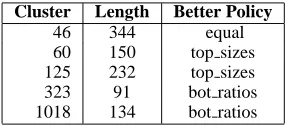
Figure 7 shows the size of each cluster in sentences and indicates whether the top sizes policy performed better
than the bot ratios policy.
Cluster Length Better Policy
[image:6.612.355.498.93.156.2]46 344 equal 60 150 top sizes 125 232 top sizes 323 91 bot ratios 1018 134 bot ratios
Figure 7: Best Policy vs. Cluster Size
One of the reasons that the bot ratios policy outscored the top sizes policy in two out of five clusters may be that the sample size in the clusters in which bot ratios outper-formed top sizes was not large enough. This is illustrated by examining Clusters 125 and 46. In these clusters, the top sizes policy and bot ratios policy were either virtu-ally identical or top sizes outperformed the bot ratios by a considerable margin. It is worth noting that Cluster 46 was by far the largest used in this study at 344 sentences and Cluster 125 was the second largest at 232 sentences. The third largest was Cluster 60 with 150 sentences, in which top sizes also beat bot ratios. The fact that the top sizes policy outscored the bot ratios in these clusters indicates that although in smaller clusters, a larger length indicates a better candidate due to decreased repetition, in a large cluster the sentences with larger length are quite repetitive and picking a sentence based on gzipped size is far more effective for summarization.
This principle is illustrated on a smaller scale when examining the 46 cluster. In the first fifty extracts, the gzip bot ratios policy outscores the top sizes policy forty times. However, in the last 60 extracts, bot ratios outscored top sizes a mere five times. This indicates that early on the sentence with the longest length contains the most useful information, but as the size of the extract in-creases, the longer sentences start to become repetitive and therefore decrease the quality of the extract. One solution to this disparity between large and small clus-ters would be to alter how sentences are chosen based on cluster size or the size of the existing summary. If the cluster or summary was a small one, first all the sentences with the top lengths would be grouped, and of those the sentence with the highest gzip size would be chosen. If the cluster or summary was large, the sentence could be chosen on gzip size alone. Figure 8 is a table indicating scores for both policies and MEAD for this first and last ten sentences of each cluster. For all the clusters with the exception of 125, our hypothesis was correct. The top sizes method was better in the larger last extracts and the bot ratios prevailed early on in the small 1-10 sen-tence extracts.
4.3 Initial Size and RU Scores
Cluster Top Sizes Bot Ratios Greater
[image:7.612.74.299.69.184.2]46 First 10 0.65447 0.66983 Bot Ratios 46 Last 10 0.87376 0.86959 Top Sizes 60 First 10 0.78664 0.90190 Bot Ratios 60 Last 10 0.83311 0.82783 Top Sizes 125 First 10 0.72993 0.51713 Top Sizes 125 Last 10 0.82560 0.82849 Bot Ratios 1018 First 10 0.67481 0.74116 Bot Ratios 1018 Last 10 0.89436 0.89367 Top Sizes Average First 10 0.71146 0.70750 Top Sizes Average Last 10 0.85671 0.85487 Top Sizes
Figure 8: Top Sizes vs. Bot Ratios
in the summary, the quality of sentences chosen should depend on the amount of existing information. Therefore as the size of the extracts increases, the relative-utility scores should also increase for the top sizes policy. How-ever there is also a general trend in which all relative util-ity scores increase as a function of extract size. So in order to determine if the top sizes policy is working cor-rectly, we can compare the difference between MEAD and top sizes for the first twenty and the last twenty sen-tences of each extract and the difference should be greater for the last twenty.
Cluster MEAD Top Sizes Difference
46 First 20 0.80355 0.71992 -0.08364 46 Last 20 0.85816 0.87376 0.01559 60 First 20 0.70489 0.78664 0.08175 60 Last 20 0.85344 0.83311 -0.02034 125 First 20 0.82665 0.72993 -0.09673 125 Last 20 0.82617 0.82560 -0.00057 323 First 20 0.75653 0.66482 -0.09171 323 Last 20 0.83109 0.84960 0.01850 1018 First 20 0.84229 0.74229 -0.10000 1018 Last 20 0.89547 0.89436 -0.00111
Figure 9: Scores vs. Size of Base Extract
In four out of five cases (Figure 8), the top sizes pol-icy behaved as it should have, increasing performance with increasing size. In the one case of cluster 60 where the performance over MEAD actually decreased as size of extract increased, it should be noted that MEAD im-proved more in this cluster than any other cluster. So although the top sizes policy still improved with regard to extract size, it could not improve as quickly as MEAD in that one cluster.
5
Conclusion
Overall, there were many instances when gzip outper-formed MEAD. These mainly occurred after the first ten sentences because for the first ten sentences gzip had very little preliminary data to use in choosing the next sen-tence. Figure 11 lists how many times each policy beat MEAD after the first ten sentences of each cluster and the
number of times that MEAD beat both gzip policies.
Cluster MEAD Top Sizes Bot Ratios
[image:7.612.332.518.93.160.2]46 0/100 96/100 93/100 60 77/100 23/100 4/100 125 50/100 33/100 45/100 323 14/80 25/80 66/80 1018 61/100 16/100 38/100
Figure 11: Frequency of higher gzip scores
The general trend was that both gzip policies out per-formed MEAD in medium length summaries between 20-60 sentences. Furthermore, the top sizes policy outper-formed MEAD more so in large summaries usually with 100+ sentences.
A note on performance. Although theoretically inter-esting, our method is too slow for practical use in fast paced summarization systems. It takes time roughly pro-portional to the size, N of the summary desired. The bot-tleneck in this process is of course, the gzipping process.
5.1 Future Work
These results indicate that gzip can be used to en-hance summaries or even produce large summaries from scratch. One metric lacking in our measurements is that of subsumption. If subsumption data were available for each of the clusters used, it would most likely favor gzip summaries as being more accurate because the gzip al-gorithm is designed to remove the very repetitiveness which subsumption measures. Further work remains to be done on other clusters of various sizes and redundancy as well as with other summarization metrics, such as con-tent based metrics (cosine, overlap, longest-common sub-string, etc.). Nevertheless, we have established the po-tential benefits for applying gzip to the task of multi-document summarization.
6
Acknowledgments
This work was partially supported by the National Science Foundation’s Information Technology Research program (ITR) under grant IIS-0082884. Our thanks go to Ammar Qusaibaty for help with this project as well as the anonymous reviewers for their very helpful com-ments.
References
Regina Barzilay and Michael Elhadad. 1997. Using Lex-ical Chains for Text Summarization. In Proceedings
of the ACL/EACL’97 Workshop on Intelligent Scalable Text Summarization, pages 10–17, Madrid, Spain, July.
Dario Benedetto, Emanuele Cagliot, and Vittorio Loreto. 2002a. Language trees and zipping. Physical Review
[image:7.612.83.290.366.483.2]0.66 0.68 0.7 0.72 0.74 0.76 0.78 0.8 0.82 0.84 0.86 0.88
1 5 9
1
3
1
7
2
1
2
5
2
9
3
3
3
7
4
1
4
5
4
9
5
3
5
7
6
1
6
5
6
9
7
3
7
7
8
1
8
5
8
9
9
3
9
7
1
0
1
1
0
5
1
0
9
number of sentences in extract
R
e
la
ti
v
e
U
ti
li
ty
[image:8.612.102.503.94.346.2]MEAD top_sizes bottom_ratios
Figure 10: The results across all clusters for the Pure MEAD summaries, and the gzip policies top sizes and bot ratios. In shorter length summaries MEAD outscores the gzip policies but as the number of sentences in the summary increase, the gzip policies scores increase enough to be competitive and sometimes better than MEAD.
Dario Benedetto, Emanuele Cagliot, and Vittorio Loreto. 2002b. On J. Goodman’s comment to Language Trees and Zipping. cmp-lg preprint archive.
Jaime G. Carbonell and Jade Goldstein. 1998. The use of MMR, diversity-based reranking for reordering docu-ments and producing summaries. In Research and
De-velopment in Information Retrieval, pages 335–336.
H.P. Edmundson. 1969. New Methods in Automatic Extracting. Journal of the Association for Computing
Machinery, 16(2):264–285, April.
Joshua Goodman. 2002. Extended comment on lan-guage trees and zipping. http://arxiv.org/abs/cond-mat/0202383.
Eduard Hovy and Chin-Yew Lin. 1999. Automated Text Summarization in SUMMARIST. In I. Mani and M.T. Maybury, editors, Advances in Automatic Text
Summa-rization, pages 81–94. The MIT Press.
Julian Kupiec, Jan O. Pedersen, and Francine Chen. 1995. A trainable document summarizer. In Research
and Development in Information Retrieval, pages 68–
73.
H.P. Luhn. 1958. The Automatic Creation of Litera-ture Abstracts. IBM Journal of Research Development, 2(2):159–165.
Inderjeet Mani. 2001. Automatic Summariza-tion. John Benjamins Publishing Company,
Amster-dam/Philadephia.
Dragomir R. Radev, Hongyan Jing, and Malgorzata Budzikowska. 2000. Centroid-based summarization of multiple documents: sentence extraction, utility-based evaluation, and user studies. In ANLP/NAACL
Workshop on Summarization, Seattle, WA, April.
Dragomir Radev, Simone Teufel, Horacio Saggion, Wai Lam, John Blitzer, Arda C¸ elebi, Hong Qi, Elliott Drabek, and Danyu Liu. 2002. Evaluation of text summarization in a cross-lingual information retrieval framework. Technical report, Center for Language and Speech Processing, Johns Hopkins University, Balti-more, MD, June.
J. Ziv and A. Lempel. 1977. A Universal Algorithm for Sequential Data Compression. IEEE Transactions on