Defining and Counting Phonological Classes in Cross-linguistic
Segment Databases
Dan Dediu, Scott R. Moisik
Max Planck Institute for PsycholinguisticsWuldtlaan 1, Nijmegen, The Netherlands [email protected], [email protected]
Abstract
Recently, there has been an explosion in the availability of large, good-quality cross-linguistic databases such as WALS
(Dryer & Haspelmath, 2013), Glottolog (Hammarstr¨om et al., 2015) and Phoible (Moran & McCloy, 2014). Databases
such as Phoible contain the actual segments used by various languages as they are given in the primary language descriptions. However, this segment-level representation cannot be used directly for analyses that require generalizations
over classes of segments that share theoretically interesting features. Here we present a method and the associated
R (R Core Team, 2014) code that allows the flexible definition of such meaningful classes and that can identify the
sets of segments falling into such a class for any language inventory. The method and its results are important for
those interested in exploring cross-linguistic patterns of phonetic and phonological diversity and their relationship to extra-linguistic factors and processes such as climate, economics, history or human genetics.
Keywords:phonetics, phonology, segment classes
1.
Introduction
The patterns of phonetic and phonological diversity are very important to understanding the wider lin-guistic diversity, the processes shaping it and its evol-ution. For several decades now, databases such as the UCLA Phonological Segment Inventory Database
(UPSID) (Maddieson, 1984) have played a major role in allowing (semi-)quantitative analyses of the pat-terns of phonetic and phonological variation around the world. Unfortunately, until relatively recently, such databases used to be relatively small (for ex-ample, UPSID has 919 different segments in 451 lan-guages; http://web.phonetik.uni-frankfurt.de/ upsid_info.html) and offer a rather sparse geograph-ical and genealoggeograph-ical coverage. The recent advent of the World Atlas for Language Structures (WALS) (Haspelmath et al., 2005) and its online and continu-ously updated version (Dryer and Haspelmath, 2013) available at http://wals.info, offer better coverage (currently 2,679 languages, many with lots of missing data) but at the cost of providing only a small number of variables (currently only 20 are listed under “Phon-ology”;http://wals.info/feature) that are discret-ized into a limited number of categories (e.g., feature 1A “Consonant inventories” can only have five val-ues: “small”, “moderately small”, “average”, “moerately large”, and “large”), a representation that is hard to ac-comodate in quantitative analyses and whose use has justifiably generated intense controversy. Fortunately, the last several years have seen the release of phon-etic/phonological databases that are much richer and have better coverage, such as Phoible1 (Moran et al., 2014) and the dataset accompanying a recent compar-ison of phonological and genetics patterns of diversity
1Freely available at
http://phoible.org.
(Creanza et al., 2015) curated by Merritt Ruhlen2. However, such segment-level databases have a major drawback intrinsic to their design in that they cannot be directly used for analyses that require generaliza-tions overclasses of segments that share theoretically interesting features, such as “front rounded vowels”, “retroflex stops” or “clicks”.
In this paper we3 introduce a method that builds on the notion that asystem of atomic featurescan be used to describe each and every possible segment in such databases, allowing the flexible definition of classes of segments4. These classes can then be applied to any given language in the database: the sets of segments that fall into these classes can be identified and coun-ted (and, further on, discretized into a small number of bins or even binarized as presence/absence), result-ing in a higher-level representation of the phonetic and phonological systems of the language. These more gen-eral classes (such as “vowel”, “consonant” or “click”) al-low then the quantitative exploration of more abstract patterns of cross-linguistic diversity and their relation-ship to extra-linguistic factors, among other
applica-2Freely available at http://www.pnas.org/content/
suppl/2015/01/15/1424033112.DCSupplemental/
pnas.1424033112.sd01.txt and http://www.
pnas.org/content/suppl/2015/01/15/1424033112.
DCSupplemental/pnas.1424033112.sd02.txt.
3
Author contributions: DD and SRM desgined the
re-search; SRM defined theFonetikodefeature system and
ap-plied it to thePhoibleandRuhlendatabases; SRM defined
the segment classes and their specification in both feature
systems; DD wrote the R script implementing the classes
and generated the UULIDs; DD and SRM checked the res-ults; DD wrote the paper.
4
tions. As an example, we can investigate the distribu-tion and historical dynamics of “retroflex stops” (con-sonants such as [ú] and [ã]) in the world’s languages using statistical and phylogenetic methods.
TheR(R Core Team, 2014) code that implements this method and the input (the raw data as provided by two segment-level databases) and output files (con-taining, for each language in the databases, the com-position and count of number of segments in each class) are freely available under liberal licenses5 on the GitHub repositoryhttps://github.com/ddediu/ phon-class-counts, where details about the file formats and the implementation are in theREADME.md
file. We hope that these data, the script, and the res-ults will be used in large-scale, cross-disciplinary, data-driven statistical explorations of linguistic diversity and its causes.
2.
Data and Methods
This section describes the two databases and the two feature systems we used, as well as the procedures for defining classes of segments and identifying and count-ing them for a given language inventory.
2.1.
The Databases
Phoible(Moran et al., 2014) is a very large, freely avail-able, and continuously evolving database that contains (in the 2014 edition used for this paper) 2,155 phon-ological inventories for 1,672 distinct languages (some of these languages can have more than one description available) covering 2,160 segment types; in the follow-ing we will denote this database asPhoible orP. Recently, Creanza et al. (2015) have released as Sup-plementary Materials Online (Datasets S1 and S2) a database collected and curated by Merritt Ruhlen con-taining the presence/absence of 728 segment types6 in 2,082 languages (please note that the transcription system used by this database is quite different from the transcription used by Phoible); we will denote this database asRuhlen or R.
These two databases are complementary, in the sense that they describe overlapping but different sets of lan-guages, and the actual inventories of the same language sometimes show differences.
5TheRscript is released under GPL version 3 (http://
www.gnu.org/licenses/gpl.html). The input files created
by us are released under Creative Commons Attribution 4.0
International (CC BY 4.0;http://creativecommons.org/
licenses/by/4.0/), as are all output files. The input files
that do not belong to us are governed by their respective licenses: Attribution-ShareAlike 3.0 Unported (CC
BY-SA 3.0; http://creativecommons.org/licenses/by-sa/
3.0/) for thePhoible data and by the PNAS terms (http:
//www.pnas.org/site/misc/terms.xhtml) for theRuhlen
database.
6
After pre-processing (such as removing symbols that seem to stand for more abstract categories, such as “c” and “v” and their variants, or “vowelharmony”), there are 644 potential segment types.
2.2.
The Feature Systems
ThePhoibledatabase also provides a description of its segments in terms of four possible values, “+”, “–”, “0” and “” (absent), on 37 features such as “tone”, “syl-labic”, “short” and “continuant” (for details seehttp: //phoible.org). This feature system is described as being “[...] loosely based on (Hayes, 2009) with some additions drawn from (Moisik and Esling, 2011)”, and we will denote it in the following as Phoible or P
(with explicit disambiguation from the segment data-base only when necessary).
We also constructed a feature system of a more phon-etic nature inspired from the International Phonphon-etic Alphabet or IPA (International Phonetic Association, 2005) containing 13 features, each with its own set of possible values; we will denote this system as Fon-etikode or F. These features (bold) and their pos-sible values (italic) are: GC (general class): c (con-sonant), v (vowel), ss (suprasegmental/tone); VV (vowel vertical or tongue height): c (close),nc (near close), cm (close mid), m (mid), om (open mid),
no (near open), o (open); VH (vowel horizontal or tongue anteriority): f (front),nf (near front),c (cent-ral), nb (near back),b (back);VM (vowel modifiers):
none,n (+nasal),r(+round),nr (+nasal to +round),
ur (–round to +round), ru (+round to –round), un
(–nasal to +nasal), nu (+nasal to –nasal), nur (nas-alized –round to +round), nru (nasalized +round to –round); CP (consonantal place of articulation):
b (bilabial), bld (bilabio-labiodental), ba (bilabio-alveolar), bpa (bilabio-postalveolar), ld (labiodental),
lv (labiovelar),lu(labiouvular),ll (linguolabial),i (in-terdental), d (dental), a (alveolar), pa (postalveolar),
r (retroflex),dv (dentivelar),av(alveolovelar),ap (al-veolopalatal), p (palatal), pav (postalveolar-velar), v
(velar), u (uvular), ph (pharyngeal), e (epiglottal), g
(glottal);CM(consonantal manner of articulation): s
(stop), f (fricative), af (affricate), n (nasal), a (ap-proximant), t (tap/flap), tr (trill), clk (click); CS (consonantal sequencer): s (simplex), c (complex),
prn (pre- nasalized), pon (post-nasalized), prs (pre-stopped), pos (post-stopped), prg (pre-glottalized),
pog (post-glottalized), pra (pre-aspirated), poa (post-aspirated), prag (pre-aspirated & glotatlized), poag
(post-aspirated & glottalized); Phon (phonation): vl
(voiceless), vd (voiced), pvd (pre-voiced voiceless), b
(breathy voiced), c(creaky); Init(initiation): p (pul-monic egressive),gi (glottal ingressive [implosive]),ge
(glottal egressive [ejective]),vi(velaric ingressive);Pri (primary articulation diacritics): none (no primary ar-ticulation diacritics), ret (retracted),adv (advanced),
mc (mid-centralized), lwd (lowered), rzd (raised), ap
(apical ), lam (laminal), dvb (double vertical bar be-low),dhb(double horizontal bar below),ola (open left angle below),d (dental),c(centralized);Sec (second-ary articulation diacritics): none (no secondary ar-ticulation diacritics),w (labialized), j (palatalized), v
pharyngeal-ized), l (lateral/lateral release), r (rhoticized/rhotic release), wr (labialized with rhotic release), jr (pal-atalized with rhotic release),lv(lateral and velarized),
lj (lateral and palatalized),lw (lateral and labialized),
lph (lateral and pharyngealized), nas (nasalized), glt
(glottalized [vowels only]),vs (velar stop [clicks only]),
vf (velar frication [clicks only]), va (velar affrication [clicks only]), us (uvular stop [clicks only]), uf (uvu-lar frication [clicks only]),ua(uvular affrication [clicks only]); Pros (prosodic properties): none (no pros-odic properties), syl (syllabic), nsyl (non-syllabic),
brev (brief/breve), long (long/geminate), ds (down-step); Tone (tone markers): Chao digits 1-5 (Chao, 1968).
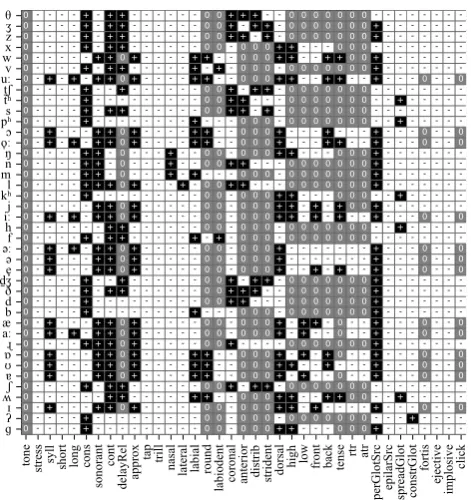
The three figures below show the inventory of English as given by thePhoibledatabase in thePhoiblefeature system (Figure 1) and in the Fonetikode system (Fig-ure 2), as well as the English inventory as given in the
Ruhlen database by theFonetikode system (Figure 3).
tone stress syll short long cons
sonorant
cont
delayRel approx tap trill
nasal lateral labial round labiodent coronal anterior distrib strident
dorsal high low front back tense rtr atr
perGlotSrc epilarSrc spreadGlot constrGlot
fortis
Figure 1: The inventory of English as given byPhoible
and thePhoiblefeature system. Vertical axis: the seg-ments in IPA notation; horizontal axis: the (abbrevi-ated) feature names. Cell color is white for “–”, gray for “0” and black for “+”.
2.3.
Matching Languages: UULIDs
A very important issue when working with language-level databases in general, and exacerbated when combining several such databases, concerns the unique and reproductible identification of the entities involved (languages, language families, dialects, etc). In this paper we use an approach described in detail elsewhere (https://github.com/ddediu/lgfam-newick/blob/ master/paper/family-trees-with-brlength.pdf) which combines four widely-used schemes for
identify-G
nonelwd
none none none
noneret
none
Figure 2: The inventory of English as given byPhoible
(the same segments as in Figure 1) and the Fonetikon
feature system. Vertical axis: the segments in IPA notation; horizontal axis: the feature names. Cell color is white for absent and “none” values, and gray for the other values.
ing linguistic entities: the ISO 639-3 three-letter codes (http://www-01.sil.org/iso639-3), the WALS three-letter codes (http://wals.info/languoid), the AUTOTYP numeric codes (http://www.autotyp. uzh.ch/theory.html), and the Glottolog alpha-numeric codes (http://glottolog.org/glottolog/ glottologinformation).
G
C
V
V
V
H
V
M CP
C
M CS
Ph
on Init Sub Sec
Pr
os
To
ne
ɒ ʊɐ ɡ ʮɡ̌ ɹ ̣
æb d ð e
əf
hI j kl mn
ŋ
ps št wz ž
v v v c c c c v c c c v v c c v c c c c c c c c c c c c c
o nco no cmm nc
b nb c f f c nf
noner none none none none none
vi par
b ai ld g p v a b a v b a paa v a pa
sf af a s sf f f a s a n n n sf f s af f
s s c s s s s s s s s s s s s s s s s s s s
vd vd vd vd vl vd vd vd vd vd vd vd vd vl vl vd vd vl vd vd vd vdvl vl vl vl vd vd vd
p p p p p p p p p p p p p p p p p p p p p p p p p p p p p
none none none none none none none none none none none none none none none none none none none none none none none none none none none none none
none none none none none none none none none none none none none none none none none nonel none none none none none none none w none none
none none none none none none none none none none none none none none none none none none none none none none none none none none none none none
none none none none none none none none none none none none none none none none none none none none none none none none none none none none none
Figure 3: The inventory of English as given byRhulen
(different segments from Figures 1 and 2) and Fon-etikon feature system (same as in Figure 2). Vertical axis: the segments in Ruhlen’s notation (NB. we have mapped all of the APA and non-standard or atypical glyphs that appear inRuhlento their IPA equivalents, but we show here the original glyphs); horizontal axis: the feature names. Cell color is white for absent and “none” values, and gray for the other values.
more than one value (separated by “-”) if, for ex-ample, a scheme distinguishes between several sub-divisions that other schemes lump together. Some examples are (WALS language names, the Indo-European family): “German (Zurich)” [i-gsw][w-gzu][a-1305-1306-1307][g-swis1247], “Urdu” [i-urd][w-urd][a-2671][g-urdu1245], “Romani (Sepe-cides)”[i-][w-rse][a-][g-].
2.4.
Defining classes of segments
The two feature systems,PhoibleandFonetikode, were used to define classes of segments: both Phoible and
Fonetikode were applied to the Phoible database, but only Fonetikode to theRuheln database (because the
Phoiblesystem does not cover certain segments present there), resulting thus in three combinations of a seg-ment database and feature system, denoted in the fol-lowing PP (Phoible +Phoible),PF (Phoible + Fon-etikode), and RF (Ruhlen + Fonetikode). Currently, there are 175 defined classes such as “segment”, “mid vowel”, “retroflex stop”, “bilabial fricative” and “level tone”, but thePhoiblefeature system cannot easily de-scribe some of these (e.g., “level tone”, “contour tone”, “doubly articulated consonant”).
Such classes of segments can be easily defined using our implementation in R(R Core Team, 2014), which is a
very flexible and powerful system for specifying sets of features, their values, and combinations thereof. The implementation supports two ways of describing ture values: either as “+”, “–” or “0” preceding the fea-ture name (the convention used by thePhoiblefeature system), or as the feature name followed by “:” and the comma-separated feature values (the convention used by theFonetikode feature systems). For example, the definition of a segment in the first system is “0tone” and in the second is “GC:c,v”, while avowel is defined as (“+syll & –cons & +sonorant”) and as “GC:v”, re-spectively. These defintions can be combined using boolean logic (and, or, not) and more advanced pro-gramming constructions, resulting in a system that has the expressive power of R.
More precisely, the fundamental function is
`.` <− function( phonemes , f e a t v a l s )
where the phonemes is a data.frame representing the segment inventory of a language in a given feature system such that each segment (‘phoneme’) is represented by one row and each column gives the value for a feature of the system (e.g., for English in the PF case there would be 40 rows and 14 relevant columns including the actual segment, such that the first five rows would be as in Table 1). Thefeatvals
represents the description of the relevant combination of features and values that (partly) describe the class; for example, in the PF system, the segments can de defined as .(phonemes, featvals="GC:c,v")7. The
.()returns a logical vector of the same length as the number of rows (segments) in phonemes with TRUE
signalling that the segment fits the description in
featvals, allowing the combination of multiple calls to .()to be combined using the logical operators !,
& and | or any other processing on vectors of logical values. For example, the retroflexes can be defined as .(phonemes,"GC:c") & .(phonemes,"CP:r")
using the logical conjunction of two subconditions (being a consonant and having a retroflex place of articulation). This allows the definition of a class to be encapsulated in a function, for example being a vowel can be defined as vowels <- function(phonemes){ .(phonemes,"GC:v")} allowing other definitions to reuse them, such as defining diphtongs as diphtongs <- function(phonemes){ vowels(phonemes) & vapply(unique.feat.vals(phonemes, "VV"), function(s) length(s)==2, logical(1))} (where
unique.feat.vals(phonemes, feature) returns the unique values of the feature in the inventory of
phonemes).
Full details and the actual implementation can be found in the GitHub repositoryhttps://github.com/ ddediu/phon-class-counts.
7
Of course, when using the Phoible feature
sys-tem these descriptions are different; in this case
Phoneme GC VV VH VM CP CM CS Phon Init Pri Sec Pros Tone
P c g s s vl p none none none none
S c pa f s vl p none none none none
õ c r a s vd p none none none none
g c v s s vd p none none none none
û c v a s vl p none none none none
...
Table 1: The format of the phonemes argument to the ‘.‘ function exemplified by English in the PF case (showing the first 5 rows/segments).
3.
Results
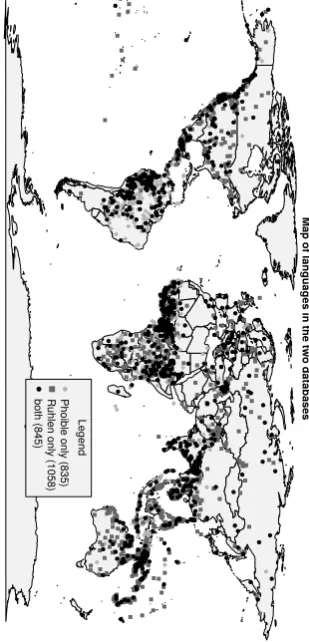
The two databasesPhoibleandRuhlencontain distinct but overlapping sets of languages (Figure 4).
Map of languag
es in the tw
o dat
abases
Legend
Phoible onl
y (835)
R
uhlen onl
y (1058)
bo
th (845)
Figure 4: Map showing the databases’ coverage.
For each of the three combinations of segment database and feature system (see Section 2.4. for details) PP, PF, and RF, there are currently 175 such classes defined, as follows (“.v” stands for vow-els, “.c” stands for consonants; for full details see
https://github.com/ddediu/phon-class-counts):
segments,vowels, monophtongs,diphtongs,triphtongs,
heights.v, lengths.v, long.v, nasal.v, round.v, high.v,
mid.v,low.v,front.v,back.v,tense.v,lax.v,atr.v,rtr.v,
raised.v, retracted.v, fronted.v, glottalized.v, laryn-gealized.v, unique.v, unique.nasal.v, heights mono.v,
heights di.v,heights tri.v,lengths mono.v,lengths di.v,
lengths tri.v, long mono.v, long di.v, long tri.v,
nasal mono.v, nasal di.v, nasal tri.v, round mono.v,
round di.v, round tri.v, high mono.v, high di.v,
high tri.v, mid mono.v, mid di.v, mid tri.v,
low mono.v, low di.v, low tri.v, front mono.v,
front di.v, front tri.v, back mono.v, back di.v,
back tri.v, tense mono.v, tense di.v, tense tri.v,
lax mono.v, lax di.v, lax tri.v, atr mono.v, atr di.v,
atr tri.v, rtr mono.v,rtr di.v,rtr tri.v, raised mono.v,
raised di.v, raised tri.v, retracted mono.v, retrac-ted di.v, retracted tri.v, fronted mono.v, fronted di.v,
fronted tri.v, glottalized mono.v, glottalized di.v, glot-talized tri.v, laryngealized mono.v, laryngealized di.v,
laryngealized tri.v, unique mono.v, unique di.v,
unique tri.v, unique.nasal mono.v, unique.nasal di.v,
unique.nasal tri.v, consonants, places.c, bilabial.c,
labiodental.c, double articulated.c, dental.c, al-veolar.c, dental alveolar.c, palatoalveolar.c, alve-olopalatal.c, postalveolar.c, true retroflex.c, pal-atal.c, velar.c, uvular.c, pharyngeal epiglottal.c,
glottal.c, labial.c, coronal.c, dorsal.c, guttural.c,
manners.c, obstruent.c, voiced obstruent.c, voice-less obstruent.c, aspirated obstruent.c, glottal-ized obstruent.c, stop.c, voiced stop.c, voice-less stop.c, aspirated stop.c, glottalized stop.c,
fricative.c, voiced fricative.c, voiceless fricative.c,
affricate.c, sonorant.c, voiced sonorant.c, voice-less sonorant.c, glottalized resonant.c, nasal.c,
approximant.c, tapflap.c, trill.c, trill tap.c,
coronal trill tap.c, second articulation.c, glot-talized.c, uvt.c, uvt.stops.c, uvt.fricatives.c,
uvt.affricates.c, uvt.nasals.c,uvt.approximants.c,lvt.c,
lvt.stops.c, lvt.fricatives.c, lvt.affricates.c, lvt.nasals.c,
lvt.approximants.c, ratio.voiced.voiceless.obstruents,
ratio.voiced.voiceless.stops,ratio.obstruents.sonorants,
egressive, implosive, ejective, click, voiceless, voiced,
breathy, creaky,tones, level tones,contour tones, bila-bial.fricatives,labiodental.fricatives,alveolar.fricatives,
nonsibilant.dental.fricatives, sibilant.dental.fricatives,
bilabiallabiodental.affricates, bilabial.affricates, ret-roflex.stops, retroflex.fricatives, retroflex.affricates,
retroflex.nasals,retroflex.approximants.
seg-ments [g P S I U 5 6 R ûa: æb dD d
¯Zefl @ @: f h i: jk
hl
m nNofl: O ph stht
¯Su: v w x zZ T] inPP, 40 segments [P S R g û 5 6 I Ua: æb dD d
¯Zefl @ @: f h i: jk
h l m n
Nofl: O phstht
¯Su: v w x zZ T] inPF, and 29 segments [ű g 5 6 Uˇgô
˙æb dDe@f h I j k l m nNp s ˇs t w z ˇz] in RF; and for the same language, there are 13 vow-els [I U 5 6 a: æ efl @ @: i: ofl: O u:] in PP, 13 vow-els [5 6 I U a: æ efl @ @: i: ofl: O u:] in PF, and 7 vowels [5 6 U æ e @ I] in RF. Therefore, for each of the three combinations of database and feature sys-tem (PP, PF and RF) we computed for each lan-guage and class the number of segments in the class (as well as the actual segments that belong to the class). Given that some classes cannot be estimated for the
Phoiblefeature system, we ended up with 167 classes in 1680 languages for PP (classes laryngealized.v, laryn-gealized mono.v, laryngealized di.v,laryngealized tri.v,
double articulated.c,second articulation.c,level tones,
contour tonesare not defined), 175 classes in 1680 lan-guages for PF, and 175 classes in 1903 languages for
RF.
3.1.
Correlation Phoible – Fonetikode
What is the relationship between the two feature sys-tems we are using, Phoible and Fonetikode? Given that the two systems are both applied on the Phoible
database, we compared the class counts and composi-tion generated by these systems. The Pearson correl-ations between the counts are all highly significant (p <0.01 after Bonferroni correction) and vary between 0.16 and 1.00 with an average of 0.88 (and a median of 0.95). The Jaccard index8of the actual segments in the classes averaged across languages varies between 0.00 and 1.00, with a mean of 0.92 and median 0.99. There-fore, for the vast majority of classes the two feature systems strongly agree producing very similar classes.
3.2.
Correlation Phoible – Ruhlen
What is the relationship between the two databases,
Phoible and Ruhlen? Given that we applied the Fon-etikodefeature system to both databases, we compared the classes counts and composition on the 845 lan-guages that are present in both databases. The Pear-son correlations between the counts are all highly sig-nificant (p<0.01 after Bonferroni correction) and vary between -0.03 and 0.94 with an average of 0.51 (and a median of 0.57). The Jaccard index of the actual segments in the classes averaged across languages var-ies between 0.24 and 1.00, with a mean of 0.77 and median 0.82. Therefore, the two databases tend to produce similar (but not identical) classes of segments for the languages shared between them.
8
A measure of similarity between two sets A and B
defined as J(A, B) = ||AA∪∩BB||, i.e. the ratio between the
size of the intersection and the size of the union of the two sets, varying between 0.0 (nothing in common) to 1.0 (identical).
3.3.
Relations Between Classes
To investigate the relationships between the classes, we conducted Principal Component Analysis (Jolliffe, 2002) separately on the three database and feature sys-tem cases. More precisely, given a database and feature system (for example,PP), we constructed the matrix of all languages×all classes where each cell (l, v) con-tains the number of segments classvhas in languagel, excluding the cells with missing data (in the example, a 1680×159 matrix), and we applied PCA on this mat-rix considering the languages as observations (rows) and the classes of segments as variables (columns). ForPP, the first three Princial Components (PCs) ex-plain 40.6% of the variance (with 90% of the variance being explaind by the first 37 PCs): P C1 (18.1%) expresses the agreement among all features (almost all tend to have loadings of the same sign), P C2 (12.9%) distinguishes consonants from vowels, while
P C3(9.6%) is hard to interpret.
ForPF, the first three Princial Components (PCs) ex-plain 38.9% of the variance (with 90% of the variance being explaind by the first 40 PCs): P C1 (16.8%) expresses the agreement among all features, P C2 (12.0%) distinguishes consonants from vowels, while
P C3 (10.2%) is hard to interpret. These results are quite similar toPP, which is to be expected given the high correlations between the two feature systems. ForRF, the first three Princial Components (PCs) ex-plain 39.6% of the variance (with 90% of the vari-ance being explaind by the first 33 PCs): P C1 (17.0%) expresss the agreement among all features,
P C2 (15.1%) distinguishes consonants from vowels, whileP C3(7.5%) is hard to interpret.
Thus, in all three cases, the most important tendency (≈ 17% of the variance) is shared among all classes, followed by the rough distinction between vowels and consonants (≈13% of the variance).
3.4.
Cross-linguistic Distribution
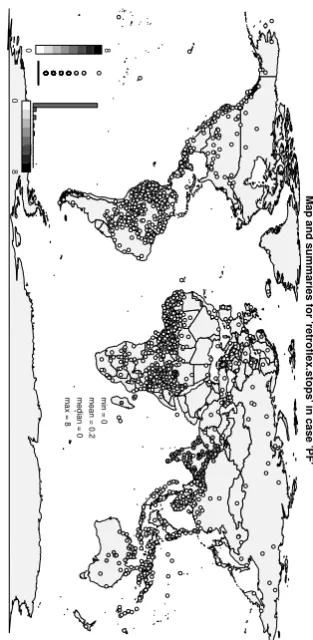
Figures 5 and 6 show the distribution of the number of segments and of the retroflex stops as given byPhoible
with the Fonetikode feature system (PF), but similar maps can be drawn for each class in each database and feature system.
What can be immediately seen is that there is a lot of diversity with interesting geographic patterns that require further analysis.
4.
Discussion and conclusions
Map and summaries for 'segments' in case 'PF'
11
158
11 158
min = 11
mean = 34.3
median = 33
max = 158
Figure 5: Map showing the number of segments per language in the PF case. Each circle is a language with color represeting the number (white = minimum to black = maximum). The bottom-left boxplot and histogram show the distribution of the counts, and the text right of Africa gives basic summaries. The higher counts are visually stacked above the lower counts making them more visible when mutiple lan-guages overlap.
(Phoible and our own IPA-inspired Fonetikode) res-ulting in higher-level descriptions of the languages in terms of classes such as “vowel”, “retroflex stop” or “click”. Such abstract descriptions can then be used to explore the patterns of cross-linguistic diversity, their causes and their relationship to extra-linguistic factors and processes including historical, economic and cli-matic, among others. We hope that the system intro-duced and the results reported here will be useful to a wide range of scientists adressing issues related to the pattens of cross-linguistic diversity.
5.
Acknowledgements
We wish to thank Steve Moran for help with the
Phoible database, and to the creators and maintain-ers of LATEX,R(R Core Team, 2014),Sweave(Leisch, 2002) and RStudio (RStudio Team, 2015). This re-search was funded by theNetherlands Organisation for Scientific Research(NWO) VIDI grant number 276-70-022 to DD.
Map and summaries for 'retroflex.stops' in case 'PF'
0
8
0 8
min = 0
mean = 0.2
median = 0
max = 8
Figure 6: Map showing the number of retroflex stops
per language in thePF case; the conventions are as in Figure 5.
6.
Bibliographical References
Chao, Y. R. (1968). A grammar of spoken Chinese. University of California Press: Berkeley, California. Creanza, N., Ruhlen, M., Pemberton, T. J., Rosen-berg, N. A., Feldman, M. W., and Ramachandran, S. (2015). A comparison of worldwide phonemic and genetic variation in human populations. PNAS, page 201424033.
Matthew S. Dryer et al., editors. (2013). WALS On-line. Max Planck Institute for Evolutionary Anthro-pology, Leipzig. http://wals.info.
Martin Haspelmath, et al., editors. (2005). The World Atlas of Language Structures. Oxford University Press.
Hayes, B. (2009). Introductory Phonology. Blackwell. International Phonetic Association. (2005).
In-ternational phonetic alphabet. Technical re-port, International Phonetic Association. http://www.arts.gla.ac.uk/IPA.
Jolliffe, I. (2002). Principal Component Analysis. Springer Series in Statistics. Springer Verlag: NY, 2 edition.
2002 — Proceedings in Computational Statist-ics, pages 575–580. Physica Verlag, Heidelberg. http://www.stat.uni-muenchen.de/ leisch/Sweave. Maddieson, I. (1984). Patterns of sounds. Cambridge
studies in speech science and communication. Cam-bridge University Press, CamCam-bridge.
Moisik, S. R. and Esling, J. H. (2011). The ‘whole larynx’ approach to laryngeal features. In Proceed-ings of the International Congress of Phonetic Sci-ences (ICPhS XVII), pages 1406–1409.
Steven Moran, et al., editors. (2014). PHOIBLE On-line. Max Planck Institute for Evolutionary Anthro-pology, Leipzig. http://phoible.org.
R Core Team, (2014). R: A Language and En-vironment for Statistical Computing. R Founda-tion for Statistical Computing, Vienna, Austria. http://www.R-project.org.