322
Experimental Investigation to Study the Effects of Vegetable
Oil Based Nano Fluids on Cutting Forces and Surface Quality
in Machining
Vemuri Venkata Phani Babu1, Y Anil Reddy2
1
Assistant Professor, Mechanical Engineering, MLR Institute of Technology, Hyderabad 501401, Telangana, India 2
Assistant Professor, Mechanical Engineering, Hyderabad Institute of Technology and Management, Hyderabad 501401, Telangana, India
Email: [email protected],[email protected],
Abstract- There is a great need of eco friendly alternatives to conventional cutting fluids since their usage poses threat to ecology and the health of workers. The present work aims to study the performance of Nano fluids in machining. Nano particles will be manually mixed in base fluids in different weight proportions at room temperature, followed by mixing with a sonicator for 1hour. The variation of its basic properties like thermal conductivity, specific heat and heat transfer coefficient will be evaluated based on empirical relations to check the viability of the nano lubricants in machining.After ensuring the basic properties of Nano fluids, machining performance will be evaluated with the application of the Nano fluids at varying cutting conditions (cutting speed and feed). Nano fluids will be supplied in Minimum Quantity Lubrication (MQL) at cutting zone with constant flow rate. The temperature of the cutting tool will be sensed by the embedded thermocouple. Talysurf will be employed for measuring average surface roughness (Ra). Variation of cutting tool temperatures and surface roughness of the machined surface with cutting speed and feed will be studied with the prepared Nano lubricants Basic properties of nano lubricants like thermal conductivity, specific heat and heat transfer coefficient are evaluated to understand their performance in machining. The variation of the surface roughness of the machined surface with reference to the type of vegetable oil, percentage of nano boric acid suspensions, cutting speed and feed are assessed utiliz ing Taguchi parameter design.
Index Terms – Nano fluids, machining parameters, vegetable oils, Cutting fluids , Surface Roughness, Taguchi
method , S/N Ratio
1. INTRODUCTION
1.1 VEGETABLE OILS
A vegetable oil is a triglyceride extracted from a plant. Such oils have been part of human culture for millennia. The term "vegetable oil" can be narrowly defined as referring only to substances that are liquid at room temperature, or broadly defined without regard to a substance's state of matter at a given temperature. For this reason, vegetable oils that are solid at room temperature are sometimes called vegetable fats.
1.2 Preparation of nano fluids
1.2.1 Preparation of Nano Particles of Boric acid- High Energy Ball milling process
[image:1.595.320.522.568.697.2]High energy ball milling process is employed for the preparation of nano particles of Boric acid. It is a ball milling process where a powder mixture placed in the ball mill is subjected to high-energy collision from the balls. The figure below shows the motions of the balls and the powder. Since the rotation directions of the bowl and turn disc are opposite, the centrifugal forces are alternately synchronized. Thus friction resulted from the hardened milling balls and the powder mixture being ground alternately rolling on the inner wall of the bowl and striking the opposite wall. The impact energy of the milling balls in the normal direction
attains a value of up to 40 times higher than that due to gravitational acceleration. Hence, the planetary ball mill can be used for high-speed milling.
During the high-energy ball milling process, the powder particles are subjected to high energetic impact. Microstructurally, the mechanical alloying process can be divided into four stages: (a) initial stage, (b) intermediate stage, (c) final stage, and (d) completion stage.
Fig-1 :Schematic view of motion of the ball and powder
323
(a)At the initial stage of ball milling, the powder particles are flattened by the compressive forces due to the collision of the balls. Micro-forging leads to changes in the shapes of individual particles, or cluster of particles being impacted repeatedly by the milling balls with high kinetic energy. However, such deformation of the powders shows no net change in mass.
(b)At the intermediate stage of the mechanical alloying process, significant changes occur in comparison with those in the initial stage. Cold welding is now significant. The intimate mixture of the powder constituents decreases the diffusion distance to the micrometer range. Fracturing and cold welding are the dominant milling processes at this stage. Although some dissolution may take place, the chemical composition of the alloyed powder is still not homogeneous.
(c) At the final stage of the mechanical alloying process, considerable refinement and reduction in particle size is evident. The microstructure of the particle also appears to be more homogenous in microscopic scale than those at the initial and intermediate stages. True alloys may have already been formed.
(d) At the completion stage of the mechanical alloying process, the powder particles possess an extremely deformed metastable structure. At this stage, the lamellae are no longer resolvable by optical microscopy. Further mechanical alloying beyond this stage cannot physically improve the dispersoid distribution. Real alloy with composition similar to the starting constituents is thus formed.
1.3 Optimization of Experiments using Taguchi’s
Orthogonal Arrays
Orthogonal Arrays (OA) are a special set of Latin squares, constructed by Taguchi to lay out the product design experiments. By using this table, an orthogonal array of standard procedure can be used for a number of experimental situations.
While there are many standard orthogonal arrays available, each of the arrays is meant for a specific number of independent design variables and levels. For example, if one wants to conduct an experiment to understand the influence of 4 different independent variables with each variable having 3 set values (level values), then an L9 orthogonal array might be the right choice.The L9 orthogonal array is meant for understanding the effect of 4 independent factors each having 3 factor level values. This array assumes that there is no interaction between any two factor. While in many cases, no interaction model assumption is valid, there are some cases where there is a clear evidence of interaction. A typical case of interaction would be the interaction between the material properties and temperature.
Table 1. Layout of L9 orthogonal array
L9 (34) Orthogonal array
Independent Variables Performance
Parameter Value
Experi ment #
Var iabl e 1
Vari able 2
Var iabl e 3
Varia ble 4
1 1 1 1 1 p1
2 1 2 2 2 p2
3 1 3 3 3 p3
4 2 1 2 3 p4
5 2 2 3 1 p5
6 2 3 1 2 p6
7 3 1 3 2 p7
8 3 2 1 3 p8
9 3 3 2 1 p9
2. LITERATURE SURVEY
M.K. Nizam and Hayder, A Abdul Bari[1] noted that the modification of vegetable oil structure is necessary to enhance its performance as a better lubricant. Vegetable oils naturally suitable to be used as lubricant base oils. With the co-operative of chemical modification methods to enhance its physical properties the vegetable oils are functioning as good as the mineral and synthetics oils or better. Selective addition of additives is crucial to increase its stability and provide the vegetable oils to work der wider range of temperature and pressure.
G.Ajithkumar[2] explained about the various techniques to improve the cold flow properties of vegetable oils by additive addition and different chemical modification process. Conventional procedure for determining pour point is ASTM D97 method. ASTM D97 method is time consuming and reproducibility of pour-point temperatures is poor between laboratories.
M.M.A. Khan, M.A.H. Mithu, N.R. Dhar[3] presented the effects of minimum quantity lubrication (MQL) by vegetable oil-based cutting fluid on the turning performance of low alloy steel AISI 9310 as compared to completely dry and wet machining in terms of chip-tool interface temperature, chip formation mode, tool wear and surface roughness. The minimum quantity lubrication was provided with a spray of air and vegetable oil. MQL machining was performed much superior compared to the dry and wet machining due to substantial reduction in cutting zone temperature enabling ubstantia chip formation and chip-tool interaction.
324
fluids was traditionally based on mineral oil as a base Fluid. This fact is related to the good technical properties and the reasonable price of mineral oils.
2.1 Nanofluids in machining
Bin Shen, Albert J. Shih and Simon C. Tungin investigated the wheel wear and tribological characteristics in wet, dry, and minimum quantity lubrication (MQL) grinding of cast iron. Water-based A1203 and diamond nanofluids were applied in the MQL grinding process and the grinding results were compared with those of pure water. During the nanofluid MQL grinding, a dense and hard slurry layer was formed on the wheel surface and could benefit the grinding performance.
V.Vasu and G, Pradeep Kumar Reddy[16] explained that even though cutting fluids have a reasonably low cost, their handling and carrying costs are very high and also, owing to their toxic nature, dumping of used fluids is a big problem because it can be hazardous to workers and also to the environment. To avoid these problems, a minimal-cutting-fluid technique called minimum quantity lubrication (MQL) was used in machining.
V. Vasu[16] and K. Manoj Kumar investigated that grinding requires high specific energy which develops high temperatures at wheel work piece interface. High temperatures impair work piece quality by inducing tensile residual stress, burn, and micro cracks. Control of grinding temperature is achieved by providing effective cooling and lubrication.
S.Prabhu and B.K.Vinayagam discussed that the surface analysis of nano machined AISI D2 tool steel materials is S.Prabhu and B.K.Vinayagam discussed that the surface analysis of nano machined AISI D2 tool steel materials is measured using atomic force microscopy. The surface roughness and fractal dimensional analysis are the important factors in nano tribology and evaluating the quality of nano machined surface.
3. EXPERIMENTATION
The following vegetable oils are taken as base fluids:
1) Castor oil 2) Sunflower oil 2) Sesame oil
Nano boric acid is taken as solid lubricants. Experimental Setup
a) Lathe Machine
Experiments are conducted on PSG-124 lathe at constant cutting conditions. This machine has both auto feed and variable spindle speed capabilities. Experimental setup on lathe machine is shown in
Specifications
Make : PSG, India
Type of Bed : Straight, Single V
Length of Bed : 2.1 m
Swing over the Bed : 21 cm
Swing over the Carriage : 14 cm
Length between centres : 96 cm
Variable Spindle speed : 63-1250 RPM
Motor Capacity : 10 H.P.
Tool postSquare headed Chuck typeFour Jaw
Fig-2: Lathe Machine
b) Supply of Lubricant
Lubricant oil with solid lubricant suspensions was stored in tank and placed above the axis of machining Lubricant storage tank was open to atmosphere; hence flow of lubricant is due to its self-weight and atmosphere pressure. Flow rate of lubricant mixture was controlled by a regulating value. The solid lubricant mixture was allowed to pass onto the work piece with a help of a pipe that drips the nano fluid mixture on to the work piece as well as the cutting tool continuously while the machining is being done. Each machining lasted for the duration of 3-4 minutes and
the tool temperature were recorded during the
experimentation. Thus the method of lubrication employed drop-wise lubrication.
c) Surface Roughness Testing
The surface roughness tester used in the experiment is SJ-301.The Surf test SJ-301 is a stylus type surface roughness measuring instrument developed for shop floor use. The measurement results are displayed digitally on the touch panel, and output to the built-in printer.
Fig-3: Surface Roughness testing apparatus
Specifications of Detector:
Detection Method : Differential
Inductance Method
Measuring Range : 350 gm(-200 to +150
325
Stylus Material : Diamond
Tip Radius : 5 pm
Measuring Force : 4 mN
Radius of the Skid Curvature : 40 mm
3.1 Experimental procedure
[image:4.595.46.292.285.561.2]All the cutting tests were performed on PSG-124 lathe with cemented carbide tool (SNMG 120408) and heat treated AISI 1040 steel of 30±2 HRC workpiece material. Experiments were carried out at cutting velocities of (60,80,100)m/min, the feed rates set were 0.14,0.16,0.2mm/ revolution and depth of cut was kept constant at 1 mm. Talysurf with stylus radius 0.0025 mm and cut-off length 0.8 mm was employed for measuring average surface roughness (Ra).
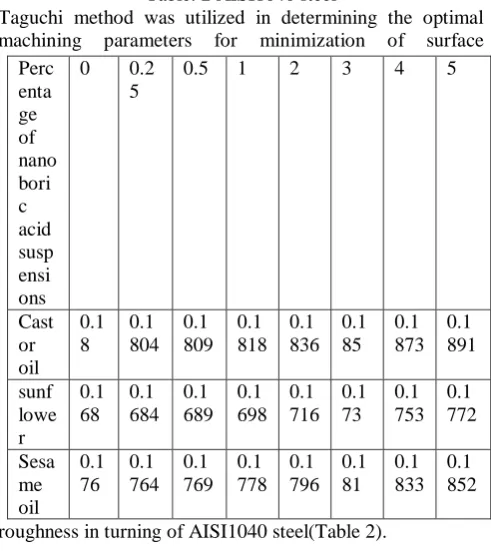
Table. 2 AISI1040 steel
Taguchi method was utilized in determining the optimal machining parameters for minimization of surface
roughness in turning of AISI1040 steel(Table 2).
Table 3: Experimental design using Taguchi method for optimal machining parameters
Trail Oil % of BA Speed Feed
1 1 1 1 1
2 1 2 2 2
3 1 3 3 3
4 2 1 2 3
5 2 2 3 1
6 2 3 1 2
7 3 1 3 2
8 3 2 1 3
9 3 3 2 1
4. RESULTS AND DISCUSSIONS
4.1 Basic Properties
Basic properties of nano lubricants are calculated based on literature and presented in Table 3, to comprehend their performance. Thermal conductivity of nanofluid is calculated by taking into account the thermal conductivities of base fluid and solid lubricant particle The thermal conductivity of a nanofluid is given by
knf = (kf )* (( kp + (n − 1)kf − (n − 1)φ(kf − kp)) ∕ ( kp + (n − 1)kf + φ(kf − kp))
where knf is the nanofluid thermal conductivity, kf is the base fluid thermal conductivity, kp is the bulk solid particle thermal conductivity, φ is the particle volume fraction, and n is an empirical scaling factor that takes into account how different particle shapes affect thermal conductivity. Spherical nanoparticles are used in this study for which n = 3.
For calculation of heat transfer coefficient, Nusselt number, Nu, is obtained from the Hilpert equation for flow over cylinders, due to its analogy with turning process.
Nu= h*D/knf = C.RemPr1/3
where, Re and Pr are Reynold’s number and Prandtl number respectively, h is the heat transfer coefficient, D is the diameter of the workpiece and C & m are constants that depend on the value of Re [18]. There is a slight increase in the thermal conductivity of nanolubricants with percentage increase of nanoparticles compared to base oil. Specific heat decreased with increase in nanoparticles percentage in coconut oil and increased with increase in nanopartcles percentage in canola oil and soyabean oil. The reason for this is the high specific heat of boric acid compared to canola oil and soyabean oil. Heat transfer coefficient increased slightly with percentage increase of nanoparticles in base oil at specific cutting speed. However, significant improvement is observed in heat transfer coefficient with increase in cutting speed at particular quantity of nanoparticle suspensions.
4.2 S/N Ratio
Initially machining is done at different lubrication conditions, i.e. dry, conventional cutting fluid, pure vegetable oils and 0.25% nanoboric acid suspensions in vegetable oils taking speed, feed and depth of cut constant. Among these four conditions, vegetable oils with nano boric acid suspensions performed well in reducing cutting tool temperature, tool flank wear and surface roughness. To analyze the performance of nano boric acid suspensions in vegetable oils, further experiments are carried out by varying the percentage of nano boric acid suspensions at different cutting conditions. In this work, the behavior of four control factors type of vegetable oil, percentage of nanoboric acid in vegetable oil, cutting speed and feed rate were studied. Control factors used and their levels with symbols are depicted in Table 4. The control factors are used to select the best conditions for stability in the design of manufacturing process, whereas the noise factors denote all factors that cause variation. The experimental Perc
enta ge of nano bori c acid susp ensi ons
0 0.2
5
0.5 1 2 3 4 5
Cast or oil
0.1 8
0.1 804
0.1 809
0.1 818
0.1 836
0.1 85
0.1 873
0.1 891
sunf lowe r
0.1 68
0.1 684
0.1 689
0.1 698
0.1 716
0.1 73
0.1 753
0.1 772
Sesa me oil
0.1 76
0.1 764
0.1 769
0.1 778
0.1 796
0.1 81
0.1 833
[image:4.595.39.293.605.730.2]326
observations are further converted into a signal-to-noise (S/N) ratio. Lower surface roughness value represents better machining performance; hence “lower is better” is selected for obtaining optimum machining performance The signal-to-noise (S/N) ratio for “lower is better” is calculated [18] as: η = -10 log [1/n (∑ yi2)], where η is the S/N ratio, yi are the individual surface roughness measurements and n is the number of noise factors.
The array chosen was the L9, which has 9 rows
corresponding to the number of experiments with 4 columns
at three levels, as shown in Table 4.
Table 4: Control factors with symbols and their
levels
Control Factor Sym
bol used
Level 1 Level 2 Level 3
Type of vegetable oil
A Sunflo
wer oil Caster oil Sesame oil Percentage of
nano boric acid
B 0.25 0.5 1
Cutting speed(m) C 60 80 100
Feed
rate(mm/min)
D 0.14 0.16 0.2
Experimental results demonstrate the effect of the four control factors on surface roughness. Mean value of three measurements is used as a response value for surface roughness and standard deviation is calculated for each trial (Table 5). The dispersion of the surface roughness is within the close range, which is understood from these standard deviation values. Maximum standard deviation observed is 0.25 considering all the cases.
Table 5: Experimental design using L9 orthogonal array
Tr ail Oi l % of B A Spe ed Fe ed Ra 1 Ra 2 Ra 3 Ra Av g S.D
1 1 1 1 1 3.7
1 3.4 4 3.4 6 3.5 4 0.1 2
2 1 2 2 2 2.8
7
2.8 2.8
1 2.8 3
0.0 3
3 1 3 3 3 2.8
3 2.7 9 2.7 1 2.7 8 0.0 5
4 2 1 2 3 3.4
9 3.5 3 3.5 6 3.5 3 0.0 2
5 2 2 3 1 3.0
5 3.2 7 3.3 2 3.2 1 0.1 1
6 2 3 1 2 4.3
1 4.8 7 4.5 9 4.5 9 0.2 2
7 3 1 3 2 1.9
7
2.4 1.8
1 1.8 9
0.2 5
9 3 3 2 1 4.7
9 4.3 2 4.6 1 4.6 1 0.1 9
4.3 S/N ratio for surface roughness with control factors A & B
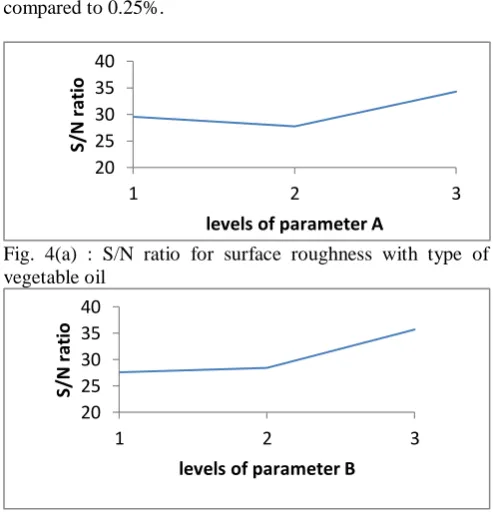
Experimental results reveal the level to be chosen for the ideal cutting parameters as well as the relative effect of each parameter on the S/N ratio. Figure 4 (a) shows the S/N ratio for surface roughness with type of vegetable oil. Among the three vegetable oils selected in the experiment, castor oil has given lower S/N ratio (lower is the better). This may be attributed due to its high thermal conductivity and heat transfer coefficient when compared to sunflower oil and sesame oil. Because of the high thermal conductivity and heat transfer coefficient, heat dissipation in the cutting zone is enhanced which in turn leads to low temperature on cutting tool and reduced tool wear. This low temperatures and lower tool wear promotes good surface quality. Hence, among the selected lubricants castor oil performed well in reducing surface roughness.
S/N ratio values of percentage of nanoboric acid in vegetable oil are presented in fig 4(b). Increase in percentage of nano boric acid affects the surface quality. 0.25% and 0.5% particles in vegetable oils show almost the same S/N ratio, but at 1% particles in vegetable oils a high S/N ratio can be observed which indicates high percentage of nano boric acid in vegetable oil and causes an increase in surface roughness.ction of the material removal because of the increase in kinematic viscosity of the fluids. In this study, among the selected levels 0.5% nano particles is the most advantageous and shows same surface roughness, high thermal condu Basic properties like thermal conductivity and heat transfer coefficient of nano fluids increased with increase in percentage of nano particles, which is required for good lubricant. However, at a certain level these particles lead to obstructivity and heat transfer coefficient compared to 0.25%.
Fig. 4(a) : S/N ratio for surface roughness with type of vegetable oil
Fig 4(b): S/N ratio for surface roughness with % of nano boric acid in vegetable oil
20 25 30 35 40
1 2 3
S/
N
ra
ti
o
levels of parameter A
20 25 30 35 40
1 2 3
S/
N
ra
ti
o
[image:5.595.41.289.267.389.2] [image:5.595.305.552.474.736.2] [image:5.595.39.291.531.769.2]327
4.4 S/N ratio for surface roughness with control factors C & D
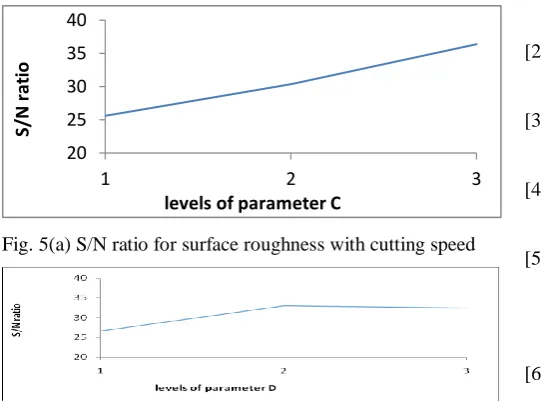
Surface roughness is low at lower cutting speed (fig 5(a)). Even though heat transfer coefficient is increasing with increase in cutting speed, cutting temperatures also increases rapidly. This leads to high tool wear and reduced surface quality. In the present work, selected lubricants and lubricant flow rate may be suitable for lower level of cutting speed. Hence, surface roughness increased with increase in cutting speed. Among the selected three levels of cutting speed, level 1 (60 m/min) is optimum for getting lower surface roughness.
Fig. 5(a) S/N ratio for surface roughness with cutting speed
Fig. 5(b) S/N ratio for surface roughness with feed rate
Figure 5(b) shows S/N ratio for surface roughness with feed rate. It is observed that lower feed rate is appropriate for better surface quality. With high feed rates cutting action becomes difficult and results in high temperatures which lead to more tool wear and high surface roughness. Nano lubricants used in this study are adequate for lower feed rate among the selected levels.
5. CONCLUSION
Nano lubricants are prepared using suspensions of 50nm sized boric acid particles in various vegetable oils. The basic properties of prepared nano lubricants are evaluated. Significant improvement in basic properties has been observed for nano lubricants thus prepared. Experiments are conducted and Taguchi’s L9 orthogonal array is used to optimize the machining parameters using four control factors at three levels. The four control factors taken are type of vegetable oil, percentage of nano borc acid suspensions, cutting speed and feed. Three levels considered pertain to the three types of oils used which are castor oil, sunflower oil and sesame oil. Signal to noise ratios for all the four control factors are plotted and finally the following conclusions can be drawn:
1. Boric acid suspensions in vegetable oils offer an alternative method of lubrication for machining instead of conventional cutting fluids.
2. Among the tested vegetable oils, the performance of
castor oil was the best due to its properties.
3. 0.5% inclusion is the most advantageous among the
inclusion levels.
4. The lubricants yielded better results at lower speeds 5. Better performance of the lubricants is reported at
lower feeds compared to higher feeds.
REFERENCES
[1] Sanjay Mishra and Agarwal, Improvement in surface quality with solid lubrication and turning AISI 4340 steel, Elsevier (2008) .
[2] L.B.Abhang and M.Hamidullah, Experimental
investigation of minimum quantity lubrication in alloy steel turning,
[3] Z.A.Zilani, M.S.Hussain, The influence of solid lubricant in machining parameters of milling operation, Elsevier (2007).
[4] K.Kavir Gama, M.N.Noor, Effect of dry cutting of force and tool life in machining aerospace material Elsevier (2007).
[5] N.Suresh Kumar, P.Venkateshwar rao, Experimental
investigation to study the effect of solid lubricants on cutting forces and surface quality in end milling, International Journal of Machine tools and Manufacture 46(2006) 189-198.
[6] Vasu and G.Pradeep Kumar, effect of minimum
quantity lubrication in machining with cutting fluids including nano particles on surface roughness, tool wear and temperature dissipation , 600 alloy, Elsevier(2007). [7] Kulkarni, D. P., Namburu, P. K., and Das, D. K. Comparison of heat transfer rates of different nanofluids on the basis of the mouromtseff number. In Electronics cooling, vol. 13(3), 2007 (CoolingZone,Westborough, MA).
[8] Holman,J.P. Heat transfer, 8th edition, 2001(McGraw-Hill College, New Delhi).
20 25 30 35 40
1 2 3
S/
N
ra
ti
o
[image:6.595.44.315.245.446.2]