1
An Improved Binarization Method for Degraded
Document
Seema Pardhi
1, Dr. G. U. Kharat
21, Student, SPCOE, Department of E&TC Engineering, Dumbarwadi, Otur
2, Professor, SPCOE, Department of E&TC Engineering, Dumbarwadi, Otur
Email: [email protected][email protected]2
Abstract-
The document binarization of the degraded document is a challenging task due to variation inbackground and foreground. In recent years degraded documentation is active research topic. In this paper, the approach for segmentation of text from the degraded document images is presented by using adaptive image contrast. It is a combination of local image contrast and gradient. The performance of the proposed system is evaluated on the online document image binarization contest (DIBCO) 2014 database. This system gives accuracy of 98.65% and f-measure of 99.29% for γ = 1.
Index Terms- Degraded document binarization, text stroke edge, local thresholding, canny edge.
1. INTRODUCTION
The research areas of document binarization from old, degraded documents attract researchers because of the challenges of segmentation of the foreground text from degraded background. The main aim of the method is to segment out the text from the document background accurately.
The binarization technique is technique which convert gray or color image into binary image. In this research area, binarization segment foreground text from document background. But still document binarization is unsolved problem because of variation in the nature of background. Basically, binarization process is of three main types, Local, Global and hybrid.
A. Local thresholding
In this method the image is converted into the sub-blocks of particular size. It may be a statically or dynamically. Then the threshold value of each block is calculated and according to that local threshold value, the block pixels are converted into black (0) and white (1) image.
B. Global Thresholding
Global thresholding is unlike the local thresholding method. In this method the single threshold value is calculated from whole image and converts the whole image into binary according to calculated threshold value.
c. Hybrid thresholding
Hybrid method is the combination of the local and global thresholding method. It takes the advantages of both the method.
The fig. 1 shows the variation in the document in terms of brightness, stroke edges, width, connections and background. In image processing technique mostly the image binarization process is performed in the pre-processing step.
Fig.1. Degraded document image examples from DIBCO 2014 database
2 The remaining paper is as organized as follows. In
next section II, the reviews of different techniques to binarization of degraded document are presented. The proposed binarization technique is presented in section III. Results are discussed in Section IV. Sections V concluded the papers.
2. LITERATURE SURVEY
Otsu is the global thresholding method. In this method, first histogram of the grayscale image is calculated and separates the background and foreground clusters by choosing optimal threshold [1]. s. The weighted within-class variance, where the class probabilities of different gray-level pixels are estimated as:
𝜎𝑤2 (𝑡) = 𝑞1𝑡 𝜎12(𝑡) + 𝑞2𝑡 𝜎22(𝑡) (1)
Niblack [2] present local thresholding method by calculating local mean and local standard deviation. This method is applicable to all kind of images excluding unable to remove unimportant details. This system failed when image contain large amount of noise. The threshold by Niblack method is given by:
𝑇(𝑖, 𝑗) = 𝑚(𝑖, 𝑗) + 𝜅. 𝜎(𝑖, 𝑗) (2)
Where, m (i,j) is a local mean
σ (i, j) is a standard deviation and k is a constant,
Sauvola [3] presents the technique which is an improvement of Niblack method. This method is working in presence of noise. In this method threshold is calculated by dynamic range of standard deviation. The thresholding by Sauvola is given by
𝑇(𝑖, 𝑗) = 𝑚(𝑖, 𝑗) ∗ (1 + 𝜅 (𝜎(𝑖,𝑗)
𝑅 − 1)) (3)
Where, R is constant and its value suggested as 128 This system has some disadvantages that it does not work for text pixel nearer to background image.
Wolf [4] proposed a method to normalization of contrast and mean of an image and calculate the threshold by the formula given by
𝑇 = (1 − 𝑘) ∗ 𝑚 + 𝑘 ∗ 𝑀 + 𝑘 ∗ 𝑠𝑅 ∗ (𝑚 − 𝑀) (4)
Where, R is highest gray value standard deviation.
Afterword number of author presents the document binarization techniques. Some of these techniques are explained below.
Bolan Suet al. [5] presents the document binarization technique based on Markov Random Model. This method classified document into three parts, background, binarized text and uncertain pixels generated during process.
Abdenour et al. [6] proposed an adaptive thresholding technique. In this technique, descriptor centre of the GLCM matrix is calculated and it is subjectively verified on DIBCO database.
Lopes et al. [7] present an histogram threshold approach based on fuzziness measure. In this method, initially two levels of gray scale are considered to document binarization process is shown in fig. 2.
Fig.2 Block diagram of the proposed system. The proposed system is processed through the four main steps: Pre-processing, Text stroke edge pixel detection, local threshold estimation and post processing. Each step is explained in detailed below.
A. Preprocessing
The input image from DIBCO 2014 database is feed to the system. The old degraded documents having the variation in the background and foreground text. To improve the contrast, histogram equalization technique is used. The histogram equalization helps to improve the contrast hence quality and clarity of the image. Another operation performed to minimize the noise is median filtering. The mask of 3x3 is used for filtering.
3
B. Text stroke edge pixel detection
Mostly, the gradients are used for the edge pixels detection. Gradients are calculated from the image and normalized to compensate the effect of variations from background. This method extracts the strokes edges. LMM [8] is the method which is used to find out the stroke edges by differencing the local minima and maxima of the image. It is given by
𝐶𝑎(𝑖, 𝑗) = 𝛼𝐶(𝑖, 𝑗) + ((1 − 𝛼)(𝐼𝑚𝑎𝑥 (𝑖, 𝑗) − 𝐼𝑚𝑖𝑛 (𝑖, 𝑗)) ) (5)
Where, Ca (i, j) is the local contrast of an image. Imax (i, j) is the maximum local image gradient and Imin (i, j) is the minimum local image gradient and α is the standard deviation and which is given by
𝛼 = (𝑠𝑡𝑑
180) 𝛾
(6)
The γ parameter is important to enhance the contrast of the image and increase the accuracy of system. This contrast map is used to extract the text stroke edges. The canny edge detection method has a capability to reduce the false edges. In this method canny edge detection operation perform on binary edge map.
C. Local Threshold Estimation
The text stroke edge pixel detection method properly extracted edges hence it is easy to select the text from the document image. But it is found that after edge stroke is extracted, the contrast is high nearer to the edge pixel has recognizable intensity change. The local threshold is estimated by considering the edge map, if edge pixel is 0 and next adjacent pixel is 1 then it is consider as a edge else discard that pixel. The local threshold is estimated by using equation
𝑅(𝑥, 𝑦) = 1 𝐸𝑑𝑔 > 𝐸𝑚𝑒𝑎𝑛 + 𝐸𝑠𝑡𝑑 = 0 𝑂𝑡ℎ𝑒𝑟𝑤𝑖𝑠𝑒
(7)
D. Postprocessing
Post processing step collect all edge pixels and connect them while discard others non edge pixels. After that the connected pixels are examine whether the pixel is belongs to foreground or background. 4. PROPOSED ALGORITHM
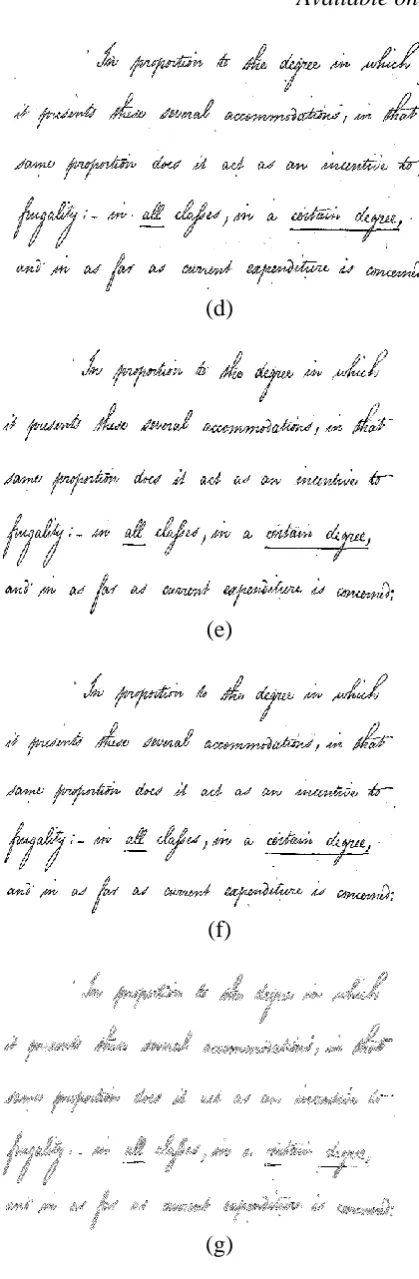
The experimentation is carried on the DIBCO 2014 database. The results of the proposed system are analyzed by qualitative and quantitative analysis.
A. Qualitative analysis
The qualitative analysis is the non statistical representation of the research.
(a)
(b)
4
(d)
(e)
(f)
(g)
(h)
Fig. 3 Qualitative analysis (a) Input degraded document color image from DIBCO 2014 dataset (b)
grayscale image (c)output of sauvola binarization method (d) output of bernsen binarization method (e)
Output of modified bernsen binarization method (f)output of contrast image map construction (g)output
of otsu gobal thresholding method (h) output of proposed system for γ = 1.
B. Quantitative analysis
The quantitative analysis is the statistical representation of the research. The proposed system can be representing in terms of accuracy and f measures. The accuracy of the system in terms of performance measures is given by
𝑎𝑐𝑐𝑢𝑟𝑎𝑐𝑦 = (𝑇𝑃+𝑇𝑁)
(𝑇𝑃+𝑇𝑁+𝐹𝑃+𝐹𝑁)
(8)
Where,𝑓𝑚𝑒𝑎𝑠𝑢𝑟𝑒 =
(2∗(𝑝𝑟𝑒𝑐𝑖𝑠𝑖𝑜𝑛∗𝑟𝑒𝑐𝑎𝑙𝑙))(𝑝𝑟𝑒𝑐𝑖𝑠𝑖𝑜𝑛+𝑟𝑒𝑐𝑎𝑙𝑙)
(9)
𝑝𝑟𝑒𝑐𝑖𝑠𝑖𝑜𝑛 = 𝑇𝑃/((𝑇𝑃 + 𝐹𝑃))
(10)
𝑟𝑒𝑐𝑎𝑙𝑙 = 𝑇𝑃/((𝑇𝑃 + 𝐹𝑁 ))
(11)
5. CONCLUSION
5 REFERENCE
[1] G. N. Otsu, “A threshold selection method from gray level histogram,” IEEE Trans. Syst., Man, Cybern., vol. 19, no. 1, pp. 62–66, Jan. 1979.
[2] W. Niblack, ”An Introduction to Digital Image Processing”, Englewood Cliffs, NJ: Prentice - Hall, 1986.
[3] J. Sauvola and M. Pietikainen, ”Adaptive document image binarization”, Pattern Recognit., vol. 33, no. 2, 2000, pp. 225236,
[4] Wolf, J-M. Jolion, ”Extraction and Recognition of Artificial Text in Multimedia Documents, Pattern Analysis and Applications”, 6(4):309 - 326, (2003).
[5] B. Su, S. Lu, and C. L. Tan, ”Binarization of historical handwritten document images using local maximum and minimum lter”, in Proc.Int. Workshop Document Anal. Syst., Jun. 2010, pp. 159 166.
[6] A. Sehad, Y. Chibani, M. Cheriet and Y. Yaddaden, "Ancient degraded document image binarization based on texture features," 2013 8th International Symposium on Image and Signal Processing and Analysis (ISPA), Trieste, 2013, pp. 189-193.