
Discriminative Boosting from Dictionary and Raw Text – A
Novel Approach to Build A Chinese Word Segmenter
Fandong M eng Wenbin Jiang Hao X iong Qun Liu
Key Laboratory of Intelligent Information Processing Institute of Computing Technology
Chinese Academy of Sciences
{mengfandong, jiangwenbin, xionghao, liuqun}@ict.ac.cn
A
BSTRACTChinese word segmentation (CWS) is a basic and important task for Chinese information processing. Standard approaches to CWS treat it as a sequence labelling task. Without manually annotated corpora, these approaches are ineffective. When a dictionary is available, dictionary maximum matching (DMM) is a good alternative. However, its performance is far from perfect due to the poor ability on out-of-vocabulary (OOV) words recognition. In this paper, we propose a novel approach that integrates the advantages of discriminative training and DMM, to build a high quality word segmenter with only a dictionary and a raw text. Experiments in CWS on different domains show that, compared with DMM, our approach brings significant improvements in both the news domain and the Chinese medicine patent domain, with error reductions of 21.50% and 13.66%, respectively. Furthermore, our approach achieves recall rate increments of OOV words by 42.54% and 23.72%, respectively in both domains.
1 Introduction
Word segmentation is a basic and important task for information processing of Chinese. Most effective approaches (Xue and Shen, 2003; Ng and Low, 2004) to CWS treat it as a charac-ter tagging task, in which the model used to make tagging decisions can be trained by dis-criminative methods, such as Maximum Entropy (ME) (Ratnaparkhi and Adwait, 1996), Con-ditional Random Fields (Lafferty et al., 2001), perceptron training algorithm (Collins, 2002; Collins and Roark, 2004), etc. These methods have achieved good results, but rely on large scale high quality annotated corpora, which are rare in resource-poor languages and domains. Besides, directly adapting a classifier trained on one domain to another domain leads to poorer performance1. Given a dictionary, dictionary maximum matching (DMM) is an alternative in
the case of no available annotated corpora, but its performance is not satisfying due to the poor ability on OOV words recognition.
Raw Text
Classifier Dict
Dictionary Matching
Feature Extraction
Training with ME
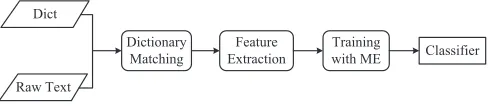
Figure 1: The pipeline of our method.
In this paper, we propose a novel approach of integrating the advantages of discriminative training and DMM, that enables us to utilize only a domain dictionary and a raw corpus to build a high quality word segmenter. Figure 1 describes the pipeline of our method. First, we scan each sentence in the raw corpus, and compare the continuous characters with the words in dictionary by reliable dictionary matching strategy. If successfully matched, we extract feature instances from the matching parts and construct reliable feature instance set. Finally, we train a classifier using all the reliable feature instances by Maximum Entropy approach. To test the efficacy of our method, we do experiments in CWS, with Penn Chinese Treebank 5.0 (CTB) (Xue et al., 2005) and Chinese medicine patent (CMP) corpus. When we use the classifier trained on CTB to process the CMP testing set, the performance is poorer than DMM with dictionary of CMP. Besides, compared with DMM, our method achieves significant im-provements with error reductions of 21.50% and 13.66%, respectively. Besides, the recall rate increments of OOV words are 42.54% and 23.72%, respectively (Section 4).
2 Segmentation as Gap Tagging Classification
Before describing the method of dictionary matching based feature instances extraction, we give a brief introduction of gap tagging classification strategy for segmentation. Formally, a Chinese sentence can be represented as a character sequence: C1:n =C1C2· · ·Cn, where
Ci(i=1,· · ·,n)is a character. We explicitly add the gapGi(i=1,· · ·,n−1)of character
Ci andCi+1 to the sentenceC1:n, denoted asC1:n|G1:n−1 =C1G1C2G2· · ·Gn−1Cn. Then the
segmented results with gaps represented as follows:
C1:e1|G1:e1−1,Ge1,Ce1+1:e2|Ge1+1:e2−1,Ge2,· · ·,Gem−1,Cem−1+1:em|Gem−1+1:em−1
whereCi:j|Gi:j−1 denotes the character-gap sequence with gapsGi:j−1. As is shown above,
there are two kinds of gaps, one occurs inside a word, such asG1· · ·Ge1−1; the other occurs
between two words, such asGe1. Word Segmentation can be treated as a gap tagging problem.
2.1 From Character Tagging to Gap Tagging
Ng and Low (2004) give a boundary tag to each character denoting its relative position in a word. There are four boundary tags: "b" for a character that begins a word, "m" for a character that occurs in the middle of a word, "e" for a character that ends a word, and "s" for a character that occurs as a single-character word. Following Ng and Low (2004), the feature templates and the corresponding instances are listed in Table 1.
Feature Template Instances
Ci(i=−2,· · ·, 2) C−2={,C−1=I,C0=û,C1=Ö,C2=Ü
CiCi+1(i=−2,· · ·, 1) C−2C−1={I,C−1C0=Iû,C0C1=ûÖ,C1C2=ÖÜ
C−1C1 C−1C1=IÖ
Pu(C0) Pu(C0) =0
T(C−2)T(C−1)T(C0)T(C1)T(C2) T(C−2)T(C−1)T(C0)T(C1)T(C2) =44444
Table 1: Character tagging feature templates and the corresponding instances, suppose we are considering the third character "û" in "{IûÖÜ".
Actually, the classical character tagging method can be explained by gap tagging. Given a character-tag sequence· · ·Gi−1CiGi· · ·, taggingGi−1Gito "AA" is equivalent to assigningCito
"m", "AS" is equal to "e", "SA" is equal to "b" and "SS" is equal to "s".
2.2 N-Gram Markov Gap Tagging
For n-gram markov gap tagging, the number of decisions is 2N+1when we consider N+1 gaps
in one step. These decisions compose a decision set, denoted as{A,S}NN+1. The operator
N
stands for the cartesian product between different decision sets. Gap sequenceGi−N:iwill
be tagged in the positionGi with n-gram markov gap classification. Given a character-gap
sequence: x=C1:n|G1:n−1, we aim to find an outputF(x)that satisfies:
F(x) = arg max
y∈{A,S}Nn−1
Score(x,y) (1)
whereScorestands for the score of the tagging sequenceyevaluated by the classifier.
Score(x,y) =X i
Eval(yi−N:i,Φ(x,i)) (2)
Φ(x,i)denotes the feature vector extracted from positionGiof character-gap sequencex.Eval
denotes the evaluated score toyi−N:iselected by classifier, based on feature vectorΦ(x,i).
We use the Maximum Entropy approach to train the classifier, with dynamic programming decoding algorithm to find the highest score. In our experiments, we use 2-gram markov gap tagging, with trading off the performance and speed.
Gap tagging features are denoted by the characters around the gap. When we consider the current gapG0, theith character to the left ofG0isC1−i, and to the right isCi. The gap
Feature Template Instances Ci(i=0,· · ·, 1) C0=û,C1=Ö
CiCi+1(i=−1,· · ·, 1) C−1C0=Iû,C0C1=ûÖ,C1C2=ÖÜ
Table 2: Gap tagging feature templates and the corresponding instances, suppose we are con-sidering the gap between the character "û" and the character "Ö" in "{IûÖÜ".
3 Dictionary-Based Feature Extraction
With annotated corpora, discriminative training approaches for CWS have two stages. Extract-ing feature instances and trainExtract-ing a model with them. Since the trainExtract-ing algorithm has been described in the last section, now we describe the method of dictionary matching based fea-ture extraction by a dictionary and a raw corpus. This method contains two key points, the dictionary matching strategy (Section 3.1) and the tagging strategy (character tagging or gap tagging) of extracting feature instances (Section 3.2).
3.1 Dictionary Bi-direction Maximum Matching
Noting that the dictionary we used does not contain time words, numerals and English strings, which can be accurately recognized by some manual rules. Besides, single-character words are not included in the dictionary for two reasons: First, the single-character word is very flexible and usually appears as a character in a multi-character word. Second, the scale of dictionary is limited and single-character words are in high frequence, a lot of matching errors will occur during dictionary matching.2
To minimize errors caused by the dictionary matching ambiguity, we use forward maximum matching (FMM) and backward maximum matching (BMM) to match the raw corpus with the dictionary, to generate feature instances setsSf mmandSbmm, respectively. Then, we reserves
the intersection of the two feature instances sets to the reliable setSf mm&bmm.
The dictionary matching procedure is that, we scan each sentenceS in the raw corpusR, supposeS = C1:N(Cq(q =1,· · ·,N)is character), and compare the continuous characters
Ci:k(0 ≤ i <k ≤N)with the words in dictionary Dby FMM and BMM, respectively. If
successfully matched, it means that the character sequenceCi:k is matched with the word
Wj(Wj=Ci:k) in dictionary. Then we transform the character sequenceCi:kand its context
(preceding-textandfollowing-textare both made up of two characters,Ci−2Ci−1is the
preceding-text, Ck+1Ck+2 is the following-text) to a text fragment Pwith the structure of "
preceding-text(Ci−2Ci−1)+word(Ci:k)+following-text(Ck+1Ck+2)".
3.2 Gap Tagging Feature Extraction
3.2.1 Features from Multi-Character WordsIt is worth mentioning that the feature instances extracted by the method described in Section 3.1 are from multi-character words. For each text fragment "P= preceding-text(Ci−2Ci−1)+word(Ci:k)+following-text(Ck+1Ck+2)" extracted by FMM and BMM, we extract
feature instances from the gap in three kinds:
1. Gap between the last character of thepreceding-textand the first character of theword
2. Gap between every pair of characters in theword
3. Gap between the last character of thewordand the first character of thefollowing-text
DMM Strategy FMM BMM
Table 4: Gap tagging feature instances sets extracted by FMM, BMM and the intersection of the two sets, for two matching results of character sequence "ûÖÜ" listed in Table 3. "S" means "split", and "A" means "adjoin". "—" means the corresponding "Fragments" are undefined. For example, Table 3 lists the segment results of the sentence "{IûÖܯþ°", by FMM and BMM. It is difficult to distinguish which one is better. So we extract feature instances from both the matching results, and take the intersection of the two feature instances sets. For the two results listed in Table 3, only four characters’ ("û", "Ö", "Ü", "") segmentation results are different. We only list the feature instances sets of "ûÖÜ" extracted by FMM and BMM and the intersection (corresponding to "FMM&BMM") of the two sets in Table 4. As the segmented results of "ûÖÜ" generated by BMM are "ûÖ" and "Ü", two fragments are constructed. Besides, features of "" (single-character word) are not extracted by FMM. Since we can generate feature instances from each character in the matching word (Ci:k), we
can also extract character tagging feature instances from thetext fragment.
3.2.2 Features from Single-Character Words
As we have described in section 3.1, single-character words are not included in the dictionary. Lacking feature instances from single-character words, the ability of character tagging classifier weakened a lot, since the feature instances with tagger "s" can not be extracted. Gap tagging does not need to distinguish whether a character is a single-character word, so we do not have to extract feature instances of single-character words.
strings, or the beginning tag of the sentence, or the ending tag of the sentence, then we take "C" as a single-character word. Next, we can extract feature instances from single-character words as described in section 3.1.
4 Experiments
4.1 Setup
We conducted experiments mainly on two domains:
1. In news domain, we use Penn Chinese Treebank 5.0 (CTB). The dictionaryDct b(33500
words) consists of words extracted from chapters 1-270 (18K sentences). The raw cor-pus3is mainly in news domain with 10M sentences. In order to compare with CMP, we
also extract a smaller scale raw text with 2M sentences from the raw corpus (10M). 2. In Chinese medicine patent (CMP) domain, the dictionaryDcmp(21800 words) is from
our internal resource, consists of words in Chinese medicine patent domain. As the dictionaryDcmpis so specialized with few common words, we combineDcmpandDct b
to a new dictionaryDcmp+ct b(55100 words after duplicate removal). The raw corpus is
from our internal resource. We extract 300 sentences from the raw corpus, and annotate them manually to form the testing set, the others (2M sentences) are used for training. Dictionaries in both domains do not contain time words, numerals, English strings and single-character words.
We use the Maximum Entropy Toolkit developed by Zhang4to train the discriminative model.
Empirically, the number of training iterations is 150 with gaussian prior 3.0 on training process. The performance measurement indicators for word segmentation is balancedF-measure,F= 2PR/(P+R), a function ofPrecision PandRecall R.Precisionis the relative amount of correct words in the system output. Recallis the relative amount of correct words compared to the gold standard annotations.
4.2 Dictionary Based Discriminative Training Results
Given a sentence, we first recognize time words, numerals and English strings by manual rules, then process other parts by the discriminative classifier.
Train On Test On (F1%)
Dictionary S-W Character-tagging Gap-tagging
Dcmp No 56.21 67.55
Dcmp Yes 56.21 67.51
Dcmp+ct b No 53.13 76.23
Dcmp+ct b Yes 55.47 76.37
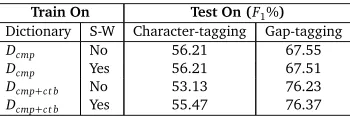
Table 5: Results on CMP by dictionary matching based discriminative classifier with gap tag-ging and character tagtag-ging. "S-W" means feature instances of single-character words, "Yes" stands for containing these feature instances, "No" for not.
First, we check which tagging strategy is more suitable for our method, gap-tagging or character-tagging? In Table 5, it is clear from each row that results generated by gap-tagging
3The raw corpus includes People’s Daily corpus(removing spaces); LDC2002E18, LDC2003E07, LDC2003E14; Hansards portion of LDC2004T07, LDC2004T08 , LDC2005T06; and other raw corpora of our internal resource.
classifier achieve much higher F1 scores than those generated by character-tagging, with +16.66 points on average. Although, adding features instances of single-character words does
improve the performance of both gap-tagging (from 76.23 to 76.37) and character-tagging (from 53.13 to 55.47)5. But the accuracy increment brought by this strategy can not
compen-sate for the defects of character-tagging. Thereby, gap-tagging classification is more suitable for our method.
Method Test On (F1%)
CTB CMP
FMM 91.05 72.30
BMM 91.44 72.63
Dictionary Raw corpus/scale
Dct b News/2M 92.98 —
Dct b News/10M 93.28 —
Dcmp CMP/2M — 67.51
Dcmp+ct b CMP/2M — 76.37
Table 6: Comparisons between DMM and our method (including feature instances of single-character words).
Then, we propose the comparisons between DMM and our method. In Table 6, when we use FMM or BMM on CTB testing set, the corresponding dictionary isDct b, andDcmp+ct bfor CMP
testing set. Comparing row 1 and row 2, we can see that BMM achieves better performance than FMM in both CTB and CMP. On CTB test, our method achieves an increment of 1.54 points onF1score than BMM (from 91.44 to 92.98), with small scale raw corpus. Using the
larger scale raw corpus (10M sentences) leads to a further increment of 0.3 points (93.28), with error reduction6of 21.50%. The result of row 5 (67.51) is lower than row 1 (72.30),
the reason is thatDcmpcontains few common words, so that few feature instances of common
words can be extracted. When usingDcmp+ct b, we get higher performance (76.37).
Dictionary Raw corpus/scale Test On (Recall %)CTB CMP
Dct b News/10M 42.54 —
Dcmp+ct b CMP/2M — 23.72
Table 7: Recall rate of OOV words by our method.
To compare with DMM on the ability of OOV words recognition, we show the recall rate of OOV words by our method in Table 7. As time words, numerals and English strings can be recognized by manual rules, we do not consider them when computing recall rate of OOV words. Besides, we do not consider single-character words which are not included in the dictionary. For DMM method, the recall rates of OOV words are zero both in CTB and CMP. Compared with DMM, our method shows much stronger ability on OOV words recognition, with the recall rate increments of 42.54% and 23.72%, respectively in CTB and CMP. Due to the obvious improvement brought by our method, we can safely conclude that our dictionary matching based discriminative training approach is better than DMM method. With no available annotated corpora, our method achieves considerable performance.
5Results of row 1 and row 2 are not consistent with this situation, as the dictionaryD
cmpcontains much more
specialized vocabulary than common words, resulting in much fewer feature instances of common words. 6Error rate is defined as 1−F
5 Related Work
Many works have been devoted to the word segmentation task in recent years, including the word-based perceptron algorithm (Zhang and Clark, 2007); taking punctuation as implicit an-notations (Li and Sun, 2009); the strategies of stacked modeling (Sun, 2011); the investiga-tion of word structures (Li, 2011); the approach of automatic adaptainvestiga-tion between different corpora (Jiang et al., 2009, 2012); joint model on word segmentation and new word de-tection (Sun et al., 2012) and other single-model approach (Zhang and Clark, 2008, 2010; Kruengkrai et al., 2009; Wang et al., 2010).
There are also some unsupervised approaches with raw text. Peng and Schuurmans (2001) propose an unsupervised approach based on an improved expectation maximum learning al-gorithm and a pruning alal-gorithm based on mutual information. Non-parametric Bayesian tech-niques (Johnson and Goldwater, 2009; Mochihashi et al., 2009) have been introduced to word segmentation. Bootstrapped voting experts algorithm paired with minimum description length is used to for word segmentation (Hewlett and Cohen, 2011). Wang et al. (2011) propose an ESA (Evaluation, Selection, and Adjustment) unsupervised approach to word segmentation. Our method is different from above methods, as we integrate the advantages of discriminative training and DMM. Moreover, we only use a dictionary7and a raw text.
Conclusion
In this paper, we propose an effective approach of integrating the advantages of discriminative training and DMM, to build a high quality word segmenter with only a dictionary and a raw text. We conduct experiments in CWS on both news domain and Chinese medicine patent domain. Our method gains much higher word segmentation accuracy than DMM in both domains, with error reductions of 21.50% and 13.66%, respectively. The capability of OOV words recognition of our method is stronger than DMM by a large margin, with the increments of recall rate 42.54% and 23.72%, respectively.
Our method does not use annotated corpora, we only use a small scale dictionary and a raw text, which are easier to get in resource-poor languages and domains compared with annotated corpora. Theoretically, our method is not only effective in Chinese, but also in languages with no obvious word delimiters in sentences, such as Japanese and some other Asian languages. In the future, we will explore better strategies of extracting high quality features from raw text. Besides, we will try to integrate some unsupervised approaches to our method, which may help us learn more knowledge from raw text.
Acknowledgments
The authors were supported by National Natural Science Foundation of China, Contracts 61202216, and 863 State Key Project No. 2011AA01A207. We are grateful to the anonymous reviewers for their thorough reviewing and informative comments.
References
Collins, M. (2002). Discriminative training methods for hidden markov models: Theory and experiments with perceptron algorithms. InProceedings of the ACL-02 conference on Empirical
methods in natural language processing-Volume 10, pages 1–8. Association for Computational Linguistics.
Collins, M. and Roark, B. (2004). Incremental parsing with the perceptron algorithm. In Proceedings of ACL, volume 2004.
Hewlett, D. and Cohen, P. (2011). Fully unsupervised word segmentation with bve and mdl. InProceedings of the 49th Annual Meeting of the Association for Computational Linguistics: Human Language Technologies: short papers-Volume 2, pages 540–545. Association for Com-putational Linguistics.
Jiang, W., Huang, L., and Liu, Q. (2009). Automatic adaptation of annotation standards: Chinese word segmentation and pos tagging: a case study. InProceedings of the Joint Con-ference of the 47th Annual Meeting of the ACL and the 4th International Joint ConCon-ference on Natural Language Processing of the AFNLP: Volume 1-Volume 1, pages 522–530. Association for Computational Linguistics.
Jiang, W., Meng, F., Liu, Q., and Lü, Y. (2012). Iterative annotation transformation with predict-self reestimation for chinese word segmentation. In Proceedings of the 2012 Joint Conference on Empirical Methods in Natural Language Processing and Computational Natural Language Learning, pages 412–420.
Johnson, M. and Goldwater, S. (2009). Improving nonparameteric bayesian inference:
ex-periments on unsupervised word segmentation with adaptor grammars. InProceedings of
Human Language Technologies: The 2009 Annual Conference of the North American Chapter of the Association for Computational Linguistics, pages 317–325. Association for Computational Linguistics.
Kruengkrai, C., Uchimoto, K., Kazama, J., Wang, Y., Torisawa, K., and Isahara, H. (2009). An error-driven word-character hybrid model for joint chinese word segmentation and pos tagging. InProceedings of the Joint Conference of the 47th Annual Meeting of the ACL and the 4th International Joint Conference on Natural Language Processing of the AFNLP: Volume 1-Volume 1, pages 513–521. Association for Computational Linguistics.
Lafferty, J., McCallum, A., and Pereira, F. (2001). Conditional random fields: Probabilistic models for segmenting and labeling sequence data. InProceedings of the 18th ICML, pages 282–289.
Li, Z. (2011). Parsing the internal structure of words: a new paradigm for chinese word segmentation. InProceedings of the 49th Annual Meeting of the Association for Computational Linguistics: Human Language Technologies. Portland, Oregon, USA: Association for Computa-tional Linguistics.
Li, Z. and Sun, M. (2009). Punctuation as implicit annotations for chinese word segmentation. Computational Linguistics, 35(4):505–512.
Ng, H. and Low, J. (2004). Chinese part-of-speech tagging: One-at-a-time or all-at-once? word-based or character-based. InProceedings of EMNLP, volume 4.
Peng, F. and Schuurmans, D. (2001). Self-supervised chinese word segmentation. Advances in Intelligent Data Analysis, pages 238–247.
Ratnaparkhi and Adwait (1996). A maximum entropy model for part-of-speech tagging. In Proceedings of the conference on empirical methods in natural language processing, volume 1, pages 133–142.
Sun, W. (2011). A stacked sub-word model for joint chinese word segmentation and part-of-speech tagging. InProceedings of the 49th Annual Meeting of the Association for Computational Linguistics, pages 1385–1394.
Sun, X., Wang, H., and Li, W. (2012). Fast online training with frequency-adaptive learning rates for chinese word segmentation and new word detection. InProceedings of the 50th Annual Meeting of the Association for Computational Linguistics, pages 253–262.
Wang, H., Zhu, J., Tang, S., and Fan, X. (2011). A new unsupervised approach to word segmentation.Computational Linguistics, 37(3):421–454.
Wang, K., Zong, C., and Su, K. (2010). A character-based joint model for chinese word segmentation. InProceedings of the 23rd International Conference on Computational Linguistics, pages 1173–1181. Association for Computational Linguistics.
Xue, N. and Shen, L. (2003). Chinese word segmentation as lmr tagging. InProceedings of the second SIGHAN workshop on Chinese language processing-Volume 17, pages 176–179. Association for Computational Linguistics.
Xue, N., Xia, F., Chiou, F., and Palmer, M. (2005). The penn chinese treebank: Phrase structure annotation of a large corpus.Natural Language Engineering, 11(02):207–238.
Zhang, Y. and Clark, S. (2007). Chinese segmentation with a word-based perceptron algo-rithm. InAnual Meeting-Association for Computational Linguistics, volume 45, page 840.
Zhang, Y. and Clark, S. (2008). Joint word segmentation and pos tagging using a single perceptron. InProceedings of ACL, volume 8, pages 888–896.


![Cost effectiveness of microendoscopic discectomy versus conventional open discectomy in the treatment of lumbar disc herniation: a prospective randomised controlled trial [ISRCTN51857546]](data:image/gif;base64,R0lGODlhAQABAIAAAP///wAAACH5BAEAAAAALAAAAAABAAEAAAICRAEAOw==)