Word Sense Disambiguation by Combining Labeled Data Expansion and
Semi-Supervised Learning Method
Sanae Fujita
NTT Communication Science Lab.
Akinori Fujino
NTT Communication Science Lab.
Abstract
Lack of training data is one of the severest problems facing word sense disambigua-tion (WSD). To overcome the problem, we propose a method that combines automatic labeled data expansion (Step-1) and semi-supervised learning (Step-2). The Step-1 and 2 methods are both effective, but their combination has a synergistic effect. In this paper, in Step-1, we automatically extract reliable labeled data from raw cor-pora using dictionary example sentences, even for infrequent and unseen senses (which do not appear in training data, but appear in a dictionary). Then, in Step-2, we apply a semi-supervised classifier and obtain a improvement using easy-to-get unlabeled data. In this step, we also show that we can guess even unseen senses. We target a SemEval-2010 Japanese lex-ical sample WSD task. Both the Step-1 and Step-2 methods performed better than the best published result (76.4 %). Fur-thermore, the combined method achieved much higher accuracy (84.2 %).
1 Introduction
Many words have multiple meanings that change depending on the context. Recently, it has been confirmed that word sense disambiguation (WSD) improves certain NLP applications such as parse selection (Fujita et al., 2007) or Machine Trans-lation (Chan et al., 2007). In international WSD competitions such as SemEval, many tasks have been proposed, which shows that WSD is a prob-lem that attracts a lot of interest. In this paper, we experiment on the Japanese WSD task from the most recent competition, SemEval-2010 (Oku-mura et al., 2010).
Various methods have been proposed for WSD (Navigli, 2009). Unsupervised approaches such as clustering based methods (Pedersen, 2006) and ex-tended Lesk (Lesk, 1986) have been shown to do well (Baldwin et al., 2010), although in general, they are beaten by supervised approaches if train-ing data are provided (Tanaka et al., 2007). With the Japanese WSD tasks at SENSEVAL-2 and SemEval-2010, supervised approaches achieved the best results (Murata et al., 2003; Okumura et al., 2010). However, the lack of training data is a severe problem with non-English languages. Also in the Japanese WSD task, there are only 50 given training instances for each target word and this is insufficient.
Two main types of methods have been proposed to compensate for a lack of training data. One type is the semi-supervised learning method (Niu et al., 2005; Pham et al., 2005) or bootstrapping (Mihal-cea, 2002, 2004; Yarowsky, 1995). These meth-ods use labeled data and unlabeled data, and this is beneficial because unlabeled training data is easy to obtain. These methods are effective and have high applicability, but unfortunately, there is one problem in that this method cannot obtain training data for senses in the lexicon that do not appear in the training data (we call this anunseen sense).
Another type of method designed to make up for a lack of training data, is automatic labeled data expansion (Mihalcea and Moldovan, 1999; Agirre and Martinez, 2000) . They proposed ex-panding the amount of labeled data through a Web search using monosemous synonyms or unique ex-pressions in definitions fromWordNet (Fellbaum,
1998). These methods are also effective, and may be able to obtain labeled data even for unseen senses. But one expected problem will be that the performance is influenced by a sense bias (that is sense frequency) that varies with corpora (Agirre and Martinez, 2004).
Therefore, in this paper, we propose a method
ID 37713 Headwordとる【取る・採る・執る・捕る】toru “take/pick/collect/do/catch”
0-0-1-0 置いてあったものなどを手に持つ。“to get something left into one’s hand.”
0-0-1-1 手で握り持つ。“take and hold by hand.”「手に取って見る」“pick up and see”
0-0-1-2 手に持ってそれを使って仕事をする。“hold something in one’s hand, and work with it.”
「筆を取る」“start writing”
... ...
0-0-8-0 直接に手がけてする意を添える。“add emphasis of undertaking some action directly.”
「式を取り行う」“perform a ceremony”
Figure 1: Simplified Entry from Iwanami Dictionary:とるtoru“take”
that combines automatic labeled data expansion and semi-supervised learning aiming a synergistic effect. That is, we propose a two-step approach: in the first step (Step-1), we automatically expand the labeled training data from raw corpora. In this step, we aim to expand the labeled training data even for unseen and infrequent senses.
Then, in the second step (Step-2), we apply a semi-supervised classifier. In this step, we aim to achieve on improvement using easy-to-get un-labeled data. In this step, we also compare the re-sults obtained using given training data only and show the benefits of our combination method. We also show its effectiveness for unseen senses.
This paper is structured as follows. We describe the target task in § 2. We describe our automatic labeled data expansion method (Step-1) in § 3, the evaluate the data quality using an experiment and human evaluation in § 4. Then we apply a semi-supervised learning method (Step-2) in § 5. We conclude the paper in § 6.
2 SemEval-2010: Japanese WSD
In this paper, we experiment on the SemEval-2010 Japanese WSD task. The sense inventory used in this task was theIwanamiJapanese Dictionary
(Nishio et al. (1994)).Iwanamiwas originally
pa-per dictionary. We show an example entry for
Iwanamiin Figure 1. As shown in Figure 1, each
entry inIwanamihas POS information and
defini-tion sentences, and most of entries have example sentences.Iwanamihas four hierarchical layers in
word sense descriptions. In this task, senses at the third layer are used at the evaluation phase. For example, 0-0-1 and 0-0-8 in Figure 1. Iwanami
includes 60,321 entries split into 85,870 senses, which are merged into 79,611 senses at the third layer. For this task, 50 words (22 nouns, 23 verbs, and 5 adjectives) are selected as the targets, which are split into 219 senses at the third layer; of these,
144 senses appear in the training data. On the other hand, 9 senses are unseen senses that appear in bothIwanami and the test data, but do not
ap-pear in the training data.
Both the training and test data are part of the Balanced Corpus of Contemporary Japanese:
BCCWJ1, which is morphologically analyzed by
UniDic2 and hand-corrected. For each target
word, 50 instances are provided in both the train-ing and test data. We show an example of the given training data in (1). The given training data are morphologically analyzed, but have no informa-tion about the base forms, therefore we added the base forms (lemma) automatically. The given data are also partly tagged with sense IDs ofIwanami.
(1) <mor pos=’動詞-一般’ rd=’トッ’ bfm=’ト ル’ sense=’37713-0-0-1-1’ lemma=’取る’> 取っ</mor>
One feature of this task is that the training and test data come from heterogeneous corpora. The training data include books or magazines (PB),
newspaper articles (PN), and government white
pa-pers (OW). The test data also include documents
from a Q&A site on the WWW (OC). However,
in this paper, we do not focus on domain adap-tation, because 50 instances are insufficient, es-pecially for investigating domain adaptation as re-ported by Fujita et al. (2010) and Shirai and Naka-mura (2010).
3 Method for Automatic Labeled Data Expansion: Step-1
In this section, we introduce our automatic labeled data expansion method (Step-1). The main aim of this step is to obtain reliable labeled data even for unseen and infrequent senses.
As mentioned in § 1, several labeled data ex-pansion methods have been proposed such as Mi-halcea and Moldovan (1999) and Agirre and Mar-tinez (2000, 2004). They mainly usedWordNet’s
monosemous synsets (for example,“recollect”for
remember1) for Web search. This kind of method is effective, and offers the possibility of supplying training data for unseen senses. But unfortunately, we cannot obtain monosemous synonyms because our target task is not tagged withWordNet.
Therefore, in this paper, instead of these meth-ods, we propose a method that provides reliable training data using example sentences from a dic-tionary. Such sentences are informative, but in most case of paper dictionaries such asIwanami,
the examples are fragmentary to save spaces (in
Iwanami, an average of 4 words). Therefore, we
attempt to extract longer, more natural and high quality labeled data from the raw corpus, under strict conditions using fragmentary examples.
That is, first, we extract example sentences (EX)
fromIwanami. Then, we collect sentences that
in-clude an exact match for Iwanami’s example for
sense (sk) of headword (h). Finally, we morpho-logically analyze the candidate sentences, and if both the base form and the coarse POS correspond to those ofh, we tag the words withskand add the sentences to the labeled data.
For example, we can extract an example sen-tence as in (2), from 37713-0-0-1-2 in Figure 1. In (2), the headword is inboldfaceand is tagged with 0-1-2’ (at the third layer, ’37713-0-0-1’).
(2) 筆
pens
を ACC
取る
pick up
“(I) start writing”
The data used in the Japanese WSD task is part of the BCCWJ corpus. Therefore, we use the
re-mainder of theBCCWJ to extract the training data.
Note that its morphological information is not hand-corrected. According to the readme file that comes with theBCCWJ, it includes about 43 million
words.
We show an example of extracted labeled data in (3). The underlined part is exactly the same as the example sentence in (2). Therefore we tag取 るtoru“pick up/take” with 37713-0-0-1-2 and add
this entire sentence to the labeled training data.
(3) 筆
pens
を ACC
取る
pick up
気
feel
は TOP
起ら
become
なかっ
not
た
did
“(I) did not get into start writing”
Because of our strict condition, the size and variation of the extracted labeled data are limited. However, this method gave us longer and more natural reliable labeled data. Besides, most lan-guages have dictionaries, and most of these dictio-naries include examples, we expect our method to be applicable to other languages and dictionaries.
We show the size of the extracted and given training data (Trn) in Table 1. As shown in
Ta-ble 1, the extracted labeled data give less cov-erage of sense types to the given training data, but give them many more instances. On average, 130 labeled sentences were extracted per exam-ple, for 326 example sentences. And training in-stances for 9 unseen senses were extracted from
Iwanami’sEX, and 5 unseen senses were extracted
fromBCCWJ.
Sense Types Instances
Corpus All Unseen All Unseen
Trn 144 - 2,500
-EX 156 9 1,450 46
BCCWJ 114 5 42,430 94
Table 1: Size of extracted and given training data
4 Evaluation of our Labeled Data Expansion Method: Step-1
In this section, we investigate the reliability and effectiveness of our automatic labeled data expan-sion. For this purpose, in § 4.1, we investigate the performance over the Japanese WSD task when we apply the supervised learning approach with and without the extracted labeled data. Then in § 4.2, we also provide a quantitative analysis of the extracted training data.
4.1 Performance over Japanese WSD Task 4.1.1 System Description
Machine Learning Methods We constructed supervised and semi-supervised WSD classifiers for each target word, based on machine learning methods. The classifiers for a target word were designed to select a sense from pre-defined senses for an instance of the target word.
supervised WSD classifier. Let x denote the fea-ture vector for an instance of a target word and
s∈ {s1, . . . ,sk, . . . ,sK}denote a sense of the target word. For the supervised WSD classifier, for the target words, the conditional probability ofsgiven
xis modeled as
P(sk|x;W) = exp(w T kx) ∑Kk0=1exp(wTk0x)
,∀k, (4)
whereW= [w1, . . . ,wk, . . . ,wK]is a parameter ma-trix andwT
k represents the transposed vector ofwk. We estimated the parameter matrix value by using labeled data.
Features For each target word w, we used the surface form, the base form, the POS tag, and the coarse POS categories, such as nouns, verbs, and adjectives ofw. Then we also used bag-of-words in the same sentence. Here the target is the ith word, so we also used the same information for the
i−2,i−1,i+1,andi+2nd words. We used bigrams, trigrams, and skipbigrams back and forth within three words. And we also used domain type PB, PN,OW, andOCas features.
Analytical Setting One anticipated problem with our expanding method in Step-1 is that the extracted data may have a different sense distri-bution from test data. Therefore, to investigate trends based on sense distribution, we employed the entropyE(w)of the frequency distribution in given training data, which is given by
E(w) =− K
∑
k=1
p(sk|w)logp(sk|w), (5)
where p(sk|w)is the probability that wordwwill be sensesk. In other words,p(sk|w)and thenE(w) reflect sense frequency bias. Note thatp(sk|w) dif-fers fromP(sk|x), which is the probability of sense giveneach instanceof the target word.
The entropyE(w)will be lower if one paticular sense appears more frequently. Therefore, follow-ing the SENSEVAL-2 Japanese WSD task (Shi-rai, 2003), we divided the target words into three classes: difficult (Ddi f f: E(w)≥1), middle (Dmid:
0.5≤E(w)<1), and easy (Deasy: E(w)<0.5). There were 9 target words forDdi f f, 20 forDmid, and 21 forDeasy.
4.1.2 Results and Discussion
Learning Curves Because of our strict condi-tion, the variation in the extracted labeled data
is limited, therefore, the system may cause over-learning. So first, we investigate the learning curves by limiting the number of added training instances for eachIwanamiexample.
Table 2 shows average accuracies over target words obtained with various number of added la-beled instances per example.L#in the table shows
the upper-bound for adding labeled instances per example. We used all extracted labeled instances when the number was less than#.
We adjusted the parameters based on a 5-fold cross-validation of the given training data. The best result (RALI-2, Brosseau-Villeneuve et al. (2010)) in a formal run of SemEval-2010 is also shown in Table 2 for reference, and the system uses the most frequent sense as a baseline.
Deasy Dmid Ddi f f Total
Base Line 91.5 67.0 51.3 69.0
RALI-2 - - - 76.4
Trn 90.6 70.9 61.1 77.4
(No expansion)
+L1 90.7 72.0 64.7 78.5†
+L5 90.8 72.1 65.8 78.8†
+L10 90.7 72.9 67.3 79.4†
+L30 90.7 73.8 68.2 79.9†
+L50 90.5 74.0 68.0 79.8†
+L100 90.3 73.4 68.2 79.6†
+L300 90.4 73.5 68.2 79.6†
+ All extracted 89.7 73.6 68.9 79.5
instances
+EX 89.8 72.2 64.9 78.3
+L30+EX 90.1 73.3 68.4 79.5
+L30+EXrL 90.5 74.8 68.4 80.2†
Table 2: Results for given training data (Trn) or
with extracted labeled data (by MEM) : where † shows that there is significant improvement over
Trnby t-test at 5 % level of significance.
Using only the given training data (we call this
Trn, 77.4 %), we achieved an improvement over
the best published method (76.4 %). Even only one labeled instance per example gave better re-sults (78.5 %) than the given training data alone, and 30 labeled instances gave the best result (79.9 %) in total3.
Table 2 shows the accuracy per entropy based difficulty band. We found an interesting trend, namely that expanding the training data tended
to degrade the accuracy for easy words (Deasy), but improved it for the middle (Dmid) and diffi-cult words (Ddi f f). With easy words, the best re-sult (91.5 %) was provided by the selection of the most frequent sense. On the other hand, especially for difficult words, expansion was very effective, and using All extracted instances gave a +7.8 %
(=68.9−61.1) improvement overTrn. Difficult
word means that many more senses appear in cor-pus. In other words, more instances are needed to guess the sense correctly, that is the reason for our method is especially effective for such difficult words.
Adding Original Example Sentences Then, we investigated other conditions. As shown in § 3,
inIwanami, there are 1,450 original example
sen-tences, such as in a sentence (2), for the target words. However we could use only 362 exam-ple sentences to extract labeled instances, such as in a sentence (3). Therefore, 1,088 (=1,450-362) example sentences did not used to extract labeled data.
So, we also added original example sentences in 3 patterns: that is adding [1] all the original ex-ample sentences (EX), [2] 30 extracted labeled
in-stances (L30) andEX, and [3]L30and unused ex-ample sentences (EXrL) that could not be used to
obtain labeled data. These results are also shown at the bottom of Table 24.
As shown in Table 2, the third pattern (+L30
+EXrL) gave the best results (80.2 %), and it is
superior to the patterns using all original exam-ples. The original examples tend to be short, but because shorter examples are easier to match to the raw corpus, we can filter out examples inEXrL
that are too short.
4.2 Human Evaluation of Extracted Training Data
We also provide a quantitative analysis of the extracted training data. The first 5 sentences extracted from BCCWJ were checked manually.
Which included 1,038 sentences for 47 words split into 114 senses. Of which 979 sentences (94.3 %) were considered correct.
BecauseIwanami was different fromWordNet,
we could not make a direct comparison with an-other expansion method such as (Mihalcea and Moldovan, 1999). But the quality of this manual
4Only one result usingEXrLsignificantly improved over Trn.
evaluation result is comparable to that (95.7 %) re-ported in (Mihalcea and Moldovan, 1999).
4.3 Conclusion in Step-1
In this step, we extracted labeled data automati-cally using example sentences fromIwanami. This
method gave us longer, more natural and higher quality labeled data from the raw corpus, and we could obtain the labeled data even for unseen and infrequent senses.
Step-1 provided superior performance (80.2 %) to the state-of-the-art result (76.4 %), and the high effectiveness of this method is proved.
However, it may be difficult to achieve any fur-ther improvement because the extracted data may have an unnatural sense distribution and limited variations. Therefore, to realize an improvement, we employ a semi-supervised learning method in Step-2.
5 Employing Semi-supervised Learning Method: Step-2
In Step-2, we constructed a semi-supervised WSD classfier for each target word by using a succes-ful semi-supervised learning method called Max-imum Hybrid Log-likelihood Expectation (MHLE)
(Fujino et al., 2010). It was reported that theMHLE
method was useful for obtaining better classifi-cation performance especially when there was a large difference between the distributions of the la-beled and test data. As mentioned in § 2, the data of the Japanese WSD task is across very different types of corpus; ranging from formal government paper to rough Web data. That was the reason that we employed the MHLE method.
In this section, we first describe the outline of the MHLE-based semi-supervised WSD classifier (in § 5.1), and then we present our method for extracting unlabeled data (in § 5.2). Finally, we undertake an experiment and investigate the ef-fectiveness of our combination of semi-supervised learning and labeled data expansion (in § 5.3).
5.1 MHLE-based semi-supervised WSD classifier
In the MHLE-based semi-supervised WSD
classi-fier for a taget word, the conditional probability,
are the parameters of these models. By applying the classifier form and training method presented in Fujino et al. (2010), we definedP(s|x)as
P(sk|x;W,Θ,β) =
Pd(sk|x;W)pg(x,sk;Θ)β ∑Kk0=1Pd(sk0|x;W)pg(x,sk0;Θ)β
, ∀k. (6)
We also provided the objective function,Jfor the parameter estimation of P(sk|x;W,Θ,β)by using labeled and unlabeled datasets,L={(xn,sn)}Nn=1, andU={xm}Mm=1as
J = N
∑
n=1
logPd(sn|xn;W)pg(xn,sn;Θ)β
+ M
∑
m=1 log
∑
Kk=1
Pd(sk|xm;W)pg(xm,sk;Θ)β
+ logp(W) +βlogp(Θ). (7)
Here, β(>0) is a combination weight. W and Θ can be estimated as the values that maximize
J for a fixed β value. The local optimal solu-tion ofW and Θ around an initial value can be obtained by an iterative computation such as the EM algorithm (Dempster et al., 1977). Namely, the MHLE-based semi-supervised WSD classifier is constructed by combining the discriminative and generative models trained on both labeled and unlabeled samples (See Fujino et al. (2010) for the details of the combination and training methods).
We employed a maximum entropy model (multinomial logistic regression model) and a naive Bayes model as Pd(s|x;W) and pg(x,s;Θ),
as well as the text classifier presented in Fujino et al. (2010). In the naive Bayes model, the probability distribution of x= (x1, . . . ,xi, . . . ,xV) givens is regarded as a multinomial distribution:
pg(x|s;Θ)∝ ∏Vi=1(θsi)xi,and the joint probability distribution ofxandsis modeled as pg(x,s;Θ) =
pg(x|s;Θ)P(s). Here,θsi>0 and∑Vi=1θsi=1. V
represents the dimension of feature vector x, and θsiis the probability that theith feature appears in an instance whose sense iss. Θ={θsi}s,i is the paremeter set of the naive Bayes model. In our experiments, we setP(s) =1/K. We used
Gaus-sian and Dirichlet priors as p(W) and p(Θ), re-spectively. We tuned theβ (∈0.5,1,2,5,10) value
with a 5-fold cross-validation of the labeled data.
5.2 Extracting Unlabeled Data
As unlabeled data, we extract sentences that in-clude the target words from BCCWJ corpus. We
show an example in (8), the boldface part indi-cates the target word.
(8) 年貢
annual tax
に
as
取る
assess
べし
should
“(You) should assess annual tax”
Because of the looser restriction, we can extract many more sentences than the labeled data in § 3. For example, from BCCWJ alone, we can extract
more than 10,000 instances for 22 words and more than 1,000 instances for the remaining words ex-cept for one (一つ hitotsu“one”).
5.3 Experiment and Evaluation: Step-2
In this section, we describe an experiment in which we employed a semi-supervised classifier based onMHLE.
This experiment has two purposes; that is to in-vestigate the effectiveness of (a)MHLEbased
semi-supervised WSD, and (b) automatically expanded data as labeled data.
5.3.1 Results and Discussion
Table 3 shows the results we obtained using un-labeled data extracted from BCCWJ.U# in the
ta-ble shows the number of used unlabeled instances. In this experiment, we limited the unlabeled data to 10, 100, 200, 300, 500 and 1000. The smaller unlabeled data are subsets of the larger unlabeled data. We also use the given training data and sev-eral types of expanded data as labeled data.
Effectiveness ofMHLE When we used only the given training data as labeled data (Trn), 300
un-labeled data gave the best performance (82.8 %), and it achieved a +5.4 % (=82.8−77.4)
improve-ment.
In addition, in contrast with the results in § 4, some improvements were achieved even for easy words. As described in § 5.1, it has been re-ported that the MHLE was robust even when the
labeled and test data were very different, as with the Japanese WSD task, which came from het-erogeneous corpus. Therefore, we can say that this semi-supervised WSD using a hybrid gener-ative/discriminative approach (MHLE) is effective (with respect to purpose (a) above).
Effectiveness of Automatically Expanded La-beled Data We used several types of expanded data as labeled data; that is, Trn+EX, +L1, +L30, +L1+EXrL, and +L30 +EXrL. Note thatTrn+L30
As shown in Table 3, all of the automatically expanded labeled data provided better results than the given training data alone. Therefore, we can say that these automatically expanded data are bet-ter than the given training data as labeled data (as regards purpose (b) above).
The labeled dataTrn+L30+EXrLgave the best
results in Step-1, but the data that achieved the best result overall was Trn +L1. This shows that
ul-timately the original (fragmentary) example sen-tences are no match for the real world sensen-tences extracted from raw corpora. By comparing +L1
with L30, for easy words in particular, +L1
pro-duced better results than +L30 probably because of the sense bias. But for difficult words, +L30
produced better results than +L1.
In conclusion, also in our combination method, larger labeled data expansion was effective for more difficult words.
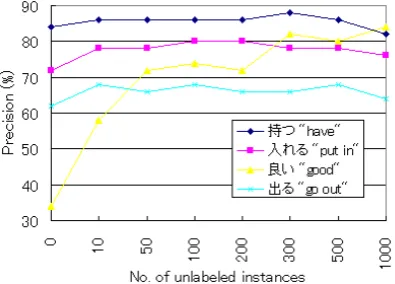
Learning Curves for Sample Words As shown above, MHLE works very effectively, however, that’s not to say that the larger unlabeled data give better results. We show some learning curves for sample target words inDmid, usingTrn+L1as the
labeled data in Figure 2. As this figure shows, the behavior is very different from that of the target words.
For some words, the accuracy still is not satu-rated (For example,良いyoi“good”), but for some
words, the accuracy is decreasing (For example,
持つmotu“have”). In future work, we will
[image:7.595.317.511.79.649.2]inves-tigate the causes of improvement or degradation.
Figure 2: Learning curves for sample target words using expanded training data (Trn+L1) as the
la-beled data (MHLE) (%)
Deasy Dmid Ddi f f Total
Trn 90.6 70.9 61.1 77.4
+U10 91.2 76.7 68.2 81.3
+U100 91.3 78.2 68.4 82.0
+U200 91.9 79.1 69.1 82.7
+U300 91.9 79.6 68.9 82.8
+U500 91.3 78.9 68.0 82.2
+U1000 90.9 79.0 68.0 82.0
Trn+EX 89.8 72.2 64.9 78.3
+U10 91.8 77.5 70.4 82.2
+U100 91.9 79.7 70.9 83.2
+U200 92.3 80.4 72.2 83.9†
+U300 92.4 80.6 71.1 83.8†
+U500 92.0 80.4 72.2 83.8†
+U1000 91.6 80.6 70.0 83.3 Trn+L30+EXrL 90.5 74.8 68.4 80.2†
+U10 91.7 78.1 71.1 82.6
+U100 91.8 79.6 72.9 83.5
+U200 91.8 80.3 72.7 83.8
+U300 91.9 80.0 71.8 83.5
+U500 91.4 80.5 72.2 83.6†
+U1000 91.4 80.5 72.2 83.4 Trn+L1+EXrL 90.6 72.9 62.9 78.5†
+U10 91.7 76.2 67.8 81.2
+U100 92.5 79.8 70.0 83.4†
+U200 92.3 80.6 70.9 83.8†
+U300 92.3 80.4 70.0 83.5
+U500 91.9 81.3 70.4 83.8†
+U1000 91.7 80.6 70.0 83.4
Trn+L30 90.7 73.8 68.2 79.9†
+U10 91.6 78.5 71.8 82.8
+U100 91.8 79.2 72.2 83.2
+U200 92.1 79.9 73.1 83.8
+U300 92.2 80.0 73.6 84.0
+U500 91.5 79.8 72.4 83.4
+U1000 91.0 80.0 72.7 83.3
Trn+L1 90.7 72.0 64.7 78.5†
+U10 92.1 77.1 70.7 82.2
+U100 92.2 79.7 71.1 83.4†
+U300 92.4 80.9 72.2 84.2†
+U500 92.1 80.8 73.1 84.2†
+U1000 91.4 79.7 70.4 83.0 Table 3: Results of semi-supervised learning (MHLE), using given/expanded training data as the labeled data (%): where†shows that there is sig-nificant improvement over results usingTrnas
la-beled data by t-test at 5 % level of significance; that is we comparedTrn+L1toTrn,Trn+L1+U10
[image:7.595.79.277.520.662.2]5.3.2 Effectiveness for Unseen Senses
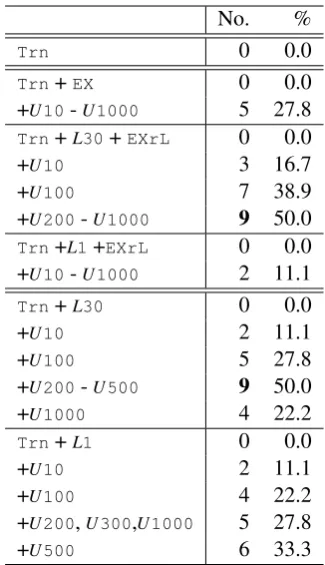
One of the advantages of our method is that it can provide training data even for unseen senses (which did not appear in the given training data but were in the dictionary). Therefore, we in-vestigated the accuracy for unseen senses. In the Japanese WSD task, there are 18 instances for 9 unseen senses (See § 3). Table 4 shows the result for the 18 instances.
When we use expanded labeled data, the system can sometimes guess the unseen senses. The best performance (9 correct (50.0 %)) was achieved by +L30, because more labeled data were provided
even for unseen senses. But also with +L1, 6
in-stances (33.3 %) were correct.
Of course, these unseen senses have no given training data (Trn), so the accuracy is 0 % onTrn.
Therefore, no method based on given training data alone (Trn) can guess these senses correctly. So
this constitutes a significant improvement.
6 Conclusion
In this paper, we proposed a combination WSD method consisting of automatic labeled data ex-pansion (Step-1) and semi-supervised learning (Step-2). We targeted the SemEval-2010 Japanese WSD task, and showed the effectiveness of our proposed method.
In Step-1, we automatically extracted labeled data from raw corpora. We could extract longer, more natural and higher quality labeled data even for unseen senses, with a strict condition using the fragment examples.
In this step, we had already achieved a better performance (80.2 %) than the best result (76.4 %) in the formal run of the Japanese WSD task.
In Step-2, we employed semi-supervised learn-ing. As the semi-supervised learning method, we employed the hybrid generative/discriminative ap-proach (MHLE), because this method has been re-ported to be robust even when the labeled and test data were very different as in the Japanese WSD task, which came from heterogeneous corpus.
As a result, in this step MHLEachieved a good improvement (82.8 %), even when using only given training data as labeled data. Moreover, we showed the effectiveness of our expanded data as labeled data. We investigated which type of ex-panded data was the best as labeled data, then showed that adding only one sentence per original example was the best as labeled data (84.2 %), and
No. %
Trn 0 0.0
Trn+EX 0 0.0
+U10-U1000 5 27.8
Trn+L30+EXrL 0 0.0
+U10 3 16.7
+U100 7 38.9
+U200-U1000 9 50.0
Trn+L1+EXrL 0 0.0
+U10-U1000 2 11.1
Trn+L30 0 0.0
+U10 2 11.1
+U100 5 27.8
+U200-U500 9 50.0
+U1000 4 22.2
Trn+L1 0 0.0
+U10 2 11.1
+U100 4 22.2
+U200,U300,U1000 5 27.8
[image:8.595.334.497.60.343.2]+U500 6 33.3
Table 4: Effectiveness for unseen senses (9 senses, 18 instances)
References
Eneko Agirre and David Martinez. 2000. Ex-ploring Automatic Word Sense Disambiguation with Decision Lists and the Web. CoRR, pp. 11–19.
Eneko Agirre and David Martinez. 2004. Un-supervised WSD based on Automatically Re-trieved Examples: The Importance of Bias . In
Proceedings of the 2004 Conference on Empir-ical Methods in Natural Language Processing: EMNLP-2004, pp. 25–32.
Timothy Baldwin, Su Nam Kim, Francis Bond, Sanae Fujita, David Martinez, and Takaaki Tanaka. 2010. A Reexamination of MRD-based Word Sense Disambiguation. Transactions on Asian Language Information Process, Associa-tion for Computing Machinery (ACM), 9(1):1– 21.
Bernard Brosseau-Villeneuve, Noriko Kando, and Jian-Yun Nie. 2010. RALI: Automatic Weight-ing of Text Window Distances. InProceedings of the 5th International Workshop on Semantic Evaluation, pp. 375–378. Association for Com-putational Linguistics.
Yee Seng Chan, Hwee Tou Ng, and David Chiang. 2007. Word sense disambiguation improves sta-tistical machine translation. InProceedings of the 45th Annual Meeting of the Association for Computational Linguistics: ACL-2007, pp. 33– 40.
A. P. Dempster, N. M. Laird, and D. B. Rubin. 1977. Maximum likelihood from incomplete data via the EM algorithm.Journal of the Royal Statistical Society, Series B, 39:1–38.
Christine Fellbaum. 1998. A semantic network of English verbs. In Christine Fellbaum, edi-tor,WordNet: An Electronic Lexical Database, chapter 3, pp. 70–104. MIT Press.
Akinori Fujino, Naonori Ueda, and Masaaki Na-gata. 2010. A robust semi-supervised classi-fication method for transfer learning. In Pro-ceedings of the 19th ACM International Confer-ence on Information and Knowledge Manage-ment (CIKM’10), pp. 379–388.
Sanae Fujita, Francis Bond, Stephan Oepen, and Takaaki Tanaka. 2007. Exploiting Semantic In-formation for HPSG Parse Selection. In Pro-ceedings of ACL-2007 Workshop on Deep Lin-guistic Processing, pp. 25–32.
Sanae Fujita, Kevin Duh, Akinori Fujino, Hiroto-shi Taira, and Hiroyuki Shindo. 2010. MSS: In-vestigating the Effectiveness of Domain Combi-nations and Topic Features for Word Sense Dis-ambiguation. Inthe 5th International Workshop on Semantic Evaluation, pp. 383–386. Associa-tion for ComputaAssocia-tional Linguistics.
Michael Lesk. 1986. Automatic Sense Disam-biguation using Machine Readable Dictionar-ies: How to Tell a Pine Cone from an Ice Cream Cone. InProceedings of the 5th Annual Interna-tional Conference on Systems documentation, pp. 24–26.
Rada Mihalcea. 2002. Bootstrapping Large Sense Tagged Corpora. InProceedings of the 3rd In-ternational Conference on Language Resources and Evaluation: LREC-2002, pp. 1407–1411. Rada Mihalcea. 2004. Co-training and
Self-training for Word Sense Disambiguation. In
Proceedings of the Conference on Natural Lan-guage Learning (CoNLL-2004), pp. 33–40. Rada Mihalcea and Dan Moldovan. 1999. An
Au-tomatic Method for Generating Sense Tagged Corpora. InProceedings of the American Asso-ciation for Artificial Intelligence (AAAI-1999), pp. 461–466.
Masaaki Murata, Masao Utiyama, Kiyotaka Uchi-moto, Qing Ma, and Hitoshi Isahara. 2003. CRL at Japanese dictionary-based task of SENSEVAL-2. Journal of Natural Language Processing, 10(3):115–143. (in Japanese). Roberto Navigli. 2009. Word sense
disambigua-tion: A survey. ACM Comput. Surv., 41(2):1– 69.
Kamal Nigam, John Lafferty, and Andrew McCal-lum. 1999. Using maximum entropy for text classification. In IJCAI-99 Workshop on Ma-chine Learning for Information Filtering, pp. 61–67.
Minoru Nishio, Etsutaro Iwabuchi, and Shizuo Mizutani. 1994. Iwanami Kokugo Jiten Dai Go Han [Iwanami Japanese Dictionary Edition 5]. Iwanami Shoten, Tokyo. (in Japanese).
Manabu Okumura, Kiyoaki Shirai, Kanako Komiya, and Hikaru Yokono. 2010. SemEval-2010 Task: Japanese WSD. In Proceedings of the 5th International Workshop on Semantic Evaluation, pp. 69–74. Association for Compu-tational Linguistics.
Ted Pedersen. 2006.Word Sense Disambiguation: Algorithms and Applications, volume 33, chap-ter 6, pp. 133–166. Springer.
Thanh Phong Pham, Hwee Tou Ng, and Wee Sun Lee. 2005. Word Sense Disambiguation with Semi-Supervised Learning. In Proceedings of the Twentieth National Conference on Artificial Intelligence: AAAI-2005, pp. 1093–1098. Kiyoaki Shirai. 2003. SENSEVAL-2 Japanese
dictionary task. Journal of Natural Language Processing, 10(3):3–24. (in Japanese).
Kiyoaki Shirai and Makoto Nakamura. 2010. JAIST: Clustering and Classification Based Ap-proaches for Japanese WSD. In Proceedings of the 5th International Workshop on Semantic Evaluation, pp. 379–382. Association for Com-putational Linguistics.
Takaaki Tanaka, Francis Bond, Timothy Baldwin, Sanae Fujita, and Chikara Hashimoto. 2007. Word Sense Disambiguation Incorporating Lex-ical and Structural Semantic Information. In
Proceedings of the 2007 Joint Conference on Empirical Methods in Natural Language Pro-cessing and Computational Natural Language Learning: EMNLP-CoNLL-2007, pp. 477–485. David Yarowsky. 1995. Unsupervised word sense disambiguation rivaling supervised methods. In