Using The Information Processing Theory Into
Teaching Mathematics: A Case Study Of ―Vector‖
Concept
Nguyen Phu Loc, Duong Huu Tong, Vo Khuong Duy
Abstract: Teaching methods are one of the most important factors in the teaching process. Today, mathematics educators have used various scientific and technical achievements to improve the efficiency of mathematics instruction in schools. In keeping with that trend, we are particularly interested in information processing theory developed by the American psychologist Gaz. A. Miller in 1956. This theory holds that the process of human’s leaning goes through three types of memory: sensory memory, short-term memory and long-term memory. Based on this idea, we developed a phase –three teaching model and conducted the experiment on teaching concepts of vector in Geometry 10 with activating the above types of memory. This article describes the teaching process we performed and the results obtained from the experiment.
Index Terms: Information processing theory, long term memory sensory memory, short term memory, mathematics education, vector concept. ————————————————————
1. INTRODCUTION
With the innovation and development of society, the demand for education innovation is also concerned. Therefore, the requirements for today’s teaching doesn’t only meet the goal of providing knowledge but must also create for students the initiative, excitement and positivity in the learning process. Thus, the reality poses a problem about how the teaching of the mathematical concepts needs to be conducted to meet the needs of educational innovation, and to ensure both time and efficiency. Following that trend, Stacey T. Lutz and William G. Huitt wrote the article "Information Processing and Memory: Theory and Applications (2003)" (see [4]); Azizi Yahaya with the article "Information processing and its implications for teaching and learning" (see [2]) which has strengthened the role, necessity and simultaneously pointed out that the application of information processing theory into the teaching process will meet the most of the requirements in education innovation. To examine the feasibility of the application of the information processing theory for teaching mathematics at schools in Vietnam, we developed a three-phase teaching model and applied it to teach the concepts of vector in Geometry 10. The results are the main contents of this report.
2 THE INFORMATION PROCESSING THEORY
Information processing theory is an approach to develop awareness of human; it is referring to the study and analysis of a sequence of events that occur in the human mind when receiving some new information. Information processing theory was developed by George Miller in 1956 (see [7]) when he compared the information processing in humans with computer models. He also said that learning is simply as a change in stored knowledge.
According to Atkinson and Shiffrin (1968), the information processing theory says that the process of human’s learning goes through a process including three types of memory: Sensory memory, Short-term memory and Long-term memory (see [9]).
2.1 Sensory memory
In sensory memory, information is collected by the senses (see, hear, taste, smell, touch) through a process that called ―transmission‖. The environment has a variety of information sources (images, sound, odor, heat, cold, etc.), through activity of receptor cells, it is changed into a form of information that the brain can process. These memories are often unconscious and prolonged in a short time, it prolonged up to 3 seconds.Sensory memory allows individuals to retain the presence of sensory information after initial stimulation has stopped.
2.2 Short-term memory
Short-term memory is the ability to keep a small amount of information in memory in an active state and ready for a short period of time. However, this information will quickly disappear unless we try to keep it consciously. Atkinson and Shiffrin (1968) [9] suggested that the process from sensory memory to short-term memory will prolong about 15-20 seconds, sometimes up to 1 minute, with the capacity of 5 to 9 information. The control system operates and monitors all short-term memory operations, including the selection of information, processing methods, meaning and ultimately deciding whether to transfer it to long-term memory or forget it.
2.3 Long-term memory
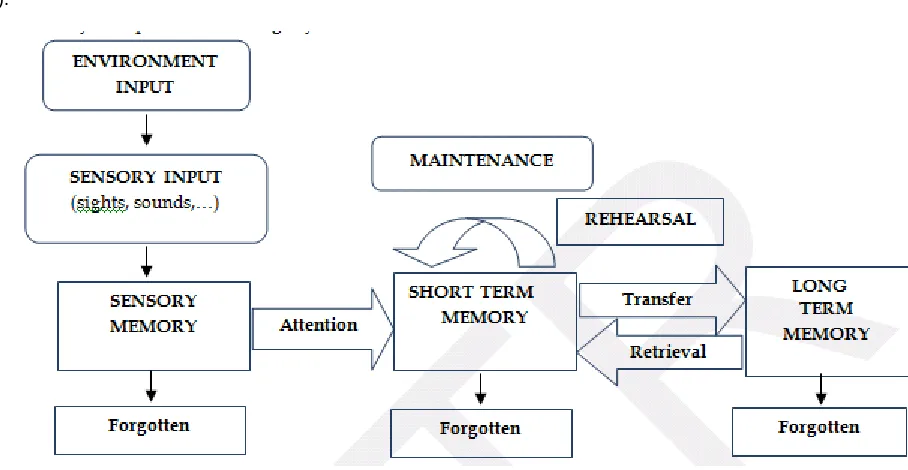
According to Atkinson and Shiffrin (1968), long-term memory is where knowledge information is organized and stored indefinitely. It has unlimited space. [see [9])Abbot (2002) suggests that long-term memory ―is that more permanent store in which information can reside in a dormant state – out of mind and unused – until you fetch it back into consciousness‖ (see [10]).Long-term memory is a permanent storage system which is managed and retrieved to using in the future. Items of information stored in long-term memory may be available for a lifetime Information in long-term memory is organized by structure: declarative, procedures and images (see [8]). The important element of long-term memory is how to organize information well. It is affected by the encryption process (the conversion process from short-term memory to long-term memory) and retrieval processes. The process of an information processing and the relationship between sensory memory, short-term memory and long-term memory are illustrated by the authors with the following diagram (see ————————————————
Nguyen Phu Loc, Assoc.. Prof. Doctor, Can Tho University, VietnamEmail: [email protected]
Duong Huu Tong,PhD, Can Tho University, Vietnam
Figure 1).
Figure 1: The model of information processing theory (Atkinson and Shiffrin, 1968)
3
THE
TEACHING
MODEL
BASED
ON
THE
INFORMATION
PROCESSING
THEORY
Based on the information processing theory of Atkinson and Shiffrin (1968), we propose a teaching model to approach the information theory with 3 main phases as follows.
3.1 Phase 1: Information Input
Teachers will create a learning environment that contains information to teach including various measures to influence the students' senses to draw attention, provoke curiosity and contribute to create learning motivation for students.
3.2 Phase 2: Information Processing
Students process information including connecting new information which have been received in phase 1 with knowledge that students already have known in long-term memory. Students analyze and screen information (with teacher guidance). After that, they also combined with repetition to form new knowledge and temporary storage in the brain.
3.3 Phase 3: Information Storage
Students carry out the process of information transformation with the support of teachers by coding; consolidating the filtered information; recognizing the meaning of information; hence knowledge is stored in long-term memory. Students can use it in new situations.
4 THE PEDAGOGICAL EXPERIMENT
4.1 The purpose of the experiment
The experiment is to consider the feasibility of the phase – three model which is developed as above
4.2 Content and participants
We held the teaching and learning process with content "Concepts of vector in Geometry 10" mathematics program of Vietnamese schools. Participants are students of Class 10A9 (45 students), Tam Vu High School, Hau Giang Province (Vietnam). The experiment was carried out on August 25th, 2018.
4.3 Designing the lesson
We conducted a teaching process that was organized in to 3 phase as proposing above, in which students work individually with the guidance of teachers. In order to evaluate the response of students, we use 8 questions and require students to write their answers in the learning slips
4.4 Implementing the lesson (within 45 minutes)
- Phase 1: Teacher presents real-life pictures which contain direction, arrows (vectors) to combine colors and words of teachers to draw attention and create
- Motivation for students. Students answer questions 1 and 2.
- Phase 2: Teacher lets students process information in the direction of forming concept of vector to answer questions 3,4,5,6
- Phase 3: The teacher suggests students to answer questions 7 and 8 to memorize the concepts of vector and find out the ways to keep information for themselves
4.5 Experimental Results and DiscussionPhase 1:
Observe the `pictures, please answer two following question 1 and 2
Question 1: Observe the above pictures above,
a. Does it draw your attention? Why? B.If yes, what is your the most attention?
Question 2: What are the common features of these pictures?
For question 1 and from Table 1, there were 43 students (accounting for 93.33%) answer that the teacher attracted attention for students. When teacher asked them why they were paying attention that 39 students (86.67%) answered that they have the arrows and there are many vivid images.
Through the answer of students, the teacher started to draw attention for students and formed temporary memories for them.
Table 1 also showed that only one student answered that the
teacher didn’t draw attention for them and there were two students with other answers. However, this number was very small (about 6.67%), so it didn’t influence so much on the achieved results.After that, the teachers continued to ask question 1b and also from Table 1, there were 35 students (77.78%) saying that their most attention was arrow marks, four students (8.89%) focused on the arrows and direction and there were two students (4.44%) saying that their most attention is the arrow in the elevator, 2 students gave other answers and one student didn’t answer this question. In this sentence 1b, the teacher continued drawing attention to the students with arrows. For question 2, when teacher asked about the similarities of the pictures which were shown, from Table 2, it is found out that 41 students (91.11%) answered that all pictures had arrows mark and there were four students giving other answers.
Table 1: Students’ answers to question 1
Table 2: Statistic of students' answers for question 2
Thus, teachers continued to create selective attention for students through the pictures of arrows, it helped them to focus on what was important and forgot what was not needed and create a familiar image to easily approach the concepts of vector. Through questions 1 and 2, the results showed that teacher succeeded in stimulating sensory memory, attention-grabbing effects for students and completing the first stage in forming concepts of vector based on information processing theory
Phase 2:
Question 3: Please indicate the similarities and differences of
Figure AB and Figure CD as follows.
Table 3: Students' answers for question 3
Answers of students N0 (%) - Similar: the straight line has two points
- Different: straight line segment A B doesn’t have arrow mark; straight line C Dhas arrow mark and A B is longer thanC D.
12 26
- Similar: A B and C D are straight lines segment
- Different: straight line segment AB doesn’t have direction; straight line segment CD has direction. Moreover, A B and C D are not equal.
16 35
- Similar: a straight line segment is going through two points.
- Different: there are differences in name, length; andC D has arrow mark to show the direction.
4 8
Other answers 13 28
Answers of students N0 (%)
All pictures have arrows 12
91 All pictures have arrows. These
pictures above show the direction, escape route, direction of movement of vehicles…
9
Every arrow represents one direction
20
Other answers 4 8. 89
Question 1
Answers of students N0 (%)
a.
Yes. Because there is an arrow 25 55.5 Yes. Because there are many
vivid images and there are arrows to point the way.
11 24.
It attracts me because I know way which is a forbidden road, a 2-way street, ...
1 2
Yes. Because I look the direction of arrow, I know the way to go
2 4.
Yes. Because there are many
pictures 3 6
No. Because those images are
seen every day 1 2
Other answers 2 4
b.
Arrows 35 77
Arrow in elevator 2 4. There are direction arrows so
that we can identify and do something follow the instructions
2 4
Arrows, direction 4 8
Empty 1 2
Other answers 2 4
A B
C D
In general, in this question, students gave different answers but they distinguished the similarities and differences between Figure AB and Figure CD. From Table 3, we saw that more 90% of students had the answers or general ideas:
+ Similar: Both figures AB and CD are straight lines segment which go through 2 points
+ Different: They are different about the name, point symbol. The straight line segment in figure AB is longer than the straight line segment in figure CD, the straight line segment in figure AB doesn’t have arrow mark and the straight line segment in figure CD has an arrow mark. From Figure CD, teacher instructed students to analyze, synthesize and combine information in question 1, 2, 3 to form a concept of vector.The goals of teacher in question 3 were to help students to activate and retrieve information from long-term memory: known knowledge of students about points, straight lines, length of straight line segment, etc.… because new knowledge about the concepts of vector will relate to the knowledge that students already have known. In this question, we found that students were very excited and active in their learning processing and they learn actively.
Question 4: What are the factors of vector?
Table 4: Students' answers for question 4
Answers of students N0 (%)
It is straight line segment with direction, starting point, end point and length.
31 68
Vector is a directed straight line segment 3 6 Step 1: straight line segment
Step 2: start and end points Step 3: there is direction
7 15
Other answers 4 8
Table 4 indicated that more than 92% of students answered correctly or had the same ideas about elements related to vectors:A vector is a straight line segment with a direction, with a starting point and an end point. It has a length equal to the length of the straight line segment created by the start and end points"After students have known what "concept of vector" was, students were asked to answer question 4 which helped students encode the information of the new concept.
We found that students acquired concept of vector more easily because of very familiar images, they observed and drew right from the start of lesson and undergone visual coding, students selected elements related to vector to complete question 4, and this information were maintained and stored in student’s memory. Through question 4, we saw that they understood the concept of vector clearly and accurately. However, there were still a few students who did not master the concept, not yet fully listed the factors related to vectors.
Question 5: Let you present the first point, last point, the direction and the length of the following vector:
According to statistical results for this question, the majority of students answer: the first point isD , the last point isC , the direction of D C from D to C and its length is equal to the one of the straight line segmentC D orD C . More than 95% of students correctly answered in question 5. Besides, there were two students answering that direction of the vector was wrong because they were used to be familiar to the concept of the straight segment and when they switch to the vector, they made a mistake. Besides that, there were 4 students who wrote the wrong symbol of the length of the vector.The goal of question 5 was that teacher repeated new knowledge and created knowledge loops and reminded students choosing information in their memory. Besides that, students continued to maintain and stored new knowledge in their brain. Therefore, thanks to this question, teachers also tested ability of students in applying learned knowledge to new situations.
Question 6: With two distinct points (A or B). How many
vectors are there whose the start point and the end point are A or B? Please represent those vectors.
The results of answers of students showed that there were 100% of students answering correctly that2 vectors were created from 2 points (A andB ). They distinguished that there are two different vectors created byA andB : A B (with direction fromA toB ) andB A (with direction fromB toA).Besides, there are 100% of students drawing pictures to represent 2 vectors (A B andB A ). However, there were 3 students writing wrong sign of vector. Overall, for this question, students at class 10A9 in Tam Vu high school answered very well; it is said that the teaching process was effective.The teacher continued to recall information related to new knowledge about concepts of vector and receive positive feedback from students. Therefore, the goal of teachers in this question was to receive positive and accurate feedback about new knowledge from students. Specifically, they were the concept of vector and elements related to vector.In general, through questions 3, 4, 5, and 6, teachers activated student’s long-term memory about inherent knowledge of students. Students selected and processed the necessary information to formulate and record all factors relating to the new concept. At that time, new knowledge has been stored in the brain temporarily. However, over time, this information will disappear if they aren’t maintained and repeated, so we need to transfer this knowledge to better memory (space so wide, longer time…); it is long-term memory.
Phase 3:
Question 7: Let you present a way to remember summary
vector (words or graph).
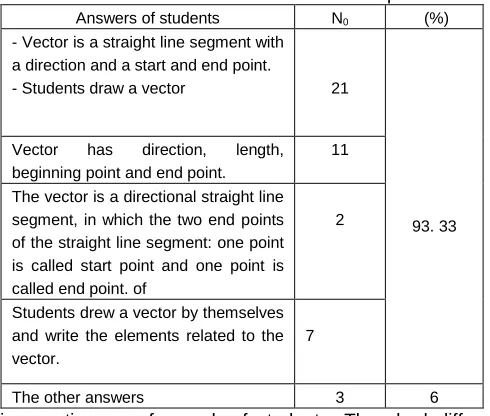
According to statistics, all students provided the same answers or ideas that were recorded in the following table 5:
Table 5: Statistic of students' answers for question 7
Answers of students N0 (%) - Vector is a straight line segment with
a direction and a start and end point.
- Students draw a vector 21
93. 33 Vector has direction, length,
beginning point and end point.
11
The vector is a directional straight line segment, in which the two end points of the straight line segment: one point is called start point and one point is called end point. of
2
Students drew a vector by themselves and write the elements related to the vector.
7
The other answers 3 6
This question was for each of students. They had different answers but more than 93% of answers had the same idea, there were 24 students drawing a diagram. Besides, there were 2 students who didn’t answer this question (see Table 5).
Question 8: Give vector with . Choose the wrong
answer
A. A B has the start point calledA and the end point calledB
B. A B has the start point calledB , and the end point calledA
C. A B has a length ofA B
D. A B has direction fromA to B.
Table 6: Students' answers for question 8
Answers of students N0 (%)
A 0 0
B 45 100
C 0 0
D 0 0
Statistical results showed that 100% of students chose true answer B for question 8 (Table 6).Through questions 7 and 8, the majority of students (93% to 100%) answered correctly or the answers had the same idea even though the presentation was different, it means that the teacher transferred new knowledge from sensory memory to short-term memory and long-term memory. The new knowledge was received by the students with a variety of information about images, content, meaning, nature and methodologies. This new knowledge will be saved in memory for life.
CONCLUSION
In general, the results of answers of students to the above questions allowed us to conclude that most students acquired new concept exactly, most of them could analyze, synthesize and apply this concept into new situations.At the end of the teaching process with the situation of forming concepts of vector, the results showed that the teaching process took place in accordance with the "script" built by the teacher, met the goals that teachers set. From that, it affirms the effectiveness of pedagogical methods when applying information processing theory for teaching mathematics.Thus,
through the experimental results, we find that the application of information processing theory requires teachers to know how create attention and attraction for students; organize the teaching process in which students process information positively; and take measures to help students store knowledge for a long time. In addition, the teaching method also requires students to pay attention, follow the teacher's instructions and have good interaction between teacher and students.
REFERENCES
[1] Ministry of Education and Training (2006), Textbook Basic 10th grade Geometry, Vietnam Education Publishing House Limited Company, Hanoi.
[2] Azizi Yahaya, information processing and its implications to
teaching and learning, University Technology Malaysia. [3] Atkinson, R., & Shiffrin, R. (1971), The control
processes of short-term memory, Scientific American, 224, 82-90.
[4] Stacey T. Lutz, William G. Huitt (2003), ―Information Processing and Memory: Theory and Applications‖, Educational Psychology Interactive. Valdosta, GA: Valdosta State University.
Website
[5] https://info.psu.edu.sa/psu/maths/008%20Information% 20Processing%20Theory%20of%20Learning%2002.pdf [6] https://commons.wikimedia.org/wiki/File:Information_Pr
ocessing_Model_-_Atkinson_%26_Shiffrin.jpg [7] https://icebreakerideas.com/learning
theories/#Information_Processing_Theory_G_Miller https://psychologenie.com/information-processing-theory
[8] https://en.wikipedia.org/wiki/Atkinson%E2%80%93Shiffr in_memory_model
[9] https://en.wikipedia.org/wiki/Atkinson%E2%80%93Shi ffrin_memory_model