Licensed under Creative Common Page 85 http://ijecm.co.uk/
PERCEIVED VALUE AS MEDIATION BETWEEN THE EFFECT
OF SERVICE QUALITY ON CUSTOMER SATISFACTION
BANK MANDIRI BRANCH OFFICE OF BANDA ACEH
Edward Ammi Djamin
Magister Management, Graduate Program, University of Syiah Kuala, Indonesia [email protected]
Permana Honeyta Lubis
Lecturer at Faculty of Economics and Business, University of Syiah Kuala, Indonesia
Sorayanti Utami
Lecturer at Faculty of Economics and Business, University of Syiah Kuala, Indonesia
Abstract
This research aimed to analyze the effect of service quality on customer satisfaction both
directly and indirectly through perceived value. The sampling technique used was quota
sampling. For the study, the sample size comprised of respondents as many 70 customer
Bank Mandiri'. Data analysis technique used was Structural Equation Model (SEM). The
empirical results showed that service quality has a significant effect on perceived value;
perceived value has a significant effect on customer satisfaction; service quality has a
significant effect on customer satisfaction both directly and indirectly through perceived
value.
Licensed under Creative Common Page 86
INTRODUCTION
The banking industry can now be said to be very competitive, which previously had only the banking industry of state banks, but now the banking industry has also been attended by private banks. To be able to survive in the competitive business market, something very important to be considered by every company, including Bank Mandiri Branch Office of Banda Aceh for paying attention to customer satisfaction.
What can be done by Bank Mandiri in order to increase customer satisfaction is by improving service quality. Service quality is an indication of customer satisfaction, if the service received by the customer is in line with his expectations, the customer will be satisfied with the service (Malik, 2012). In addition to service quality, another thing that can be done by Bank Mandiri is to increase customer satisfaction by increasing value for customers. The perceived value is also one of the factors that can determine the level of customer satisfaction, when a customer receives a high value for a service, the customer will feel high satisfaction (Hapsari et al., 2016). The service quality and perceived value have an important role in increasing customer satisfaction, the better the quality of services provided by Bank Mandiri, the higher the value felt by customers for these services which indirectly will also increase customer satisfaction (Al Chalabi & Turan, 2017).
The results of research conducted by researchers previously found that service quality (Rosita, 2015) and perceived value (Hapsari et al., 2016) had a significant effect on customer satisfaction. Meanwhile, there are also results of research conducted by previous researchers previously found that service quality (Tee et al., 2018) and perceived value (Gultom et al., 2016) did not significantly influence customer satisfaction.
Licensed under Creative Common Page 87 Based on the differences in the results of these researchs, it is necessary to conduct further research in order to explain the effect of service quality on customer satisfaction both directly and indirectly through perceived value.
LITERATURE REVIEW
Customer Satisfaction
Based on Expectancy Disconfirmation Theory stated by Oliver (1980), customer satisfaction is a summary of the psychological state that comes from a comparison between customer experience after using a product with customer expectations before using the product. If the product received does not meet expectations, the customer does not feel satisfied, but if the product received meets expectations, the customer will feel satisfied, whereas if the product received exceeds expectations, the customer will feel very satisfied (Lubis et al., 2015).
Perceived Value
The perceived value can be said as the difference between customer evaluation of all benefits obtained with the sacrifices incurred to obtain a particular service (Kotler & Keller, 2016). Perceived value consists of the following dimensions: 1) functional value, namely the value perceived by the customer for the services provided by the company, 2) emotional value, namely the value perceived by the customer that arises through his experience with the company, and 3) social value, namely the value perceived by customers on the company's ability to establish relationships with customers (Ivanauskien et al., 2012).
Service Quality
Licensed under Creative Common Page 88
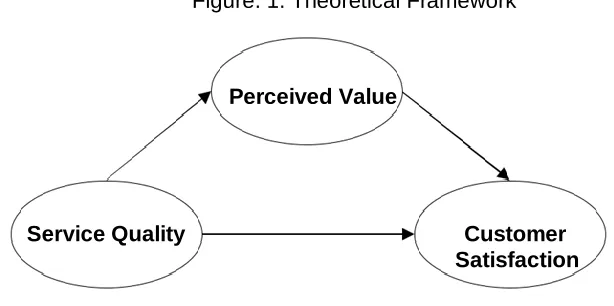
Theoretical Framework
According to Razavi et al. (2012), the quality of services provided by companies can increase the value perceived by customers for these services. Gumussoy & Koseoglu (2016) also said that if customers get higher quality services at lower costs, the value perceived by customers will also increase.
According to Suariedewi & Sulistyawati (2016), service quality is a determinant of customer satisfaction, the better the services provided by a company, the higher the level of satisfaction felt by customers. Malik (2012) also said that service quality is an indication of customer satisfaction, if the service received by the customer is in line with his expectations, the customer will be satisfied with the service.
According to Hapsari et al. (2016), perceived value is one of the factors that can determine the level of customer satisfaction, when a customer receives a high value for a service the customer will also feel high satisfaction. Raza et al. (2012) also said that customer satisfaction reflects feelings derived from the value felt by customers, when a customer receives a high service value from a service, it will also result in high satisfaction.
The results of research by Malik (2012), Wulandari (2015), Hapsari et al. (2016), Suariedewi & Sulistyawati (2016), and Al Chalabi & Turan (2017) found that service quality indirectly has a positive and significant influence on customer satisfaction through perceived value, the results of these research concluded that the better the quality services provided by service providers the value perceived by customers will also increase which indirectly will also increase customer satisfaction.
Figure. 1. Theoretical Framework
Perceived Value
Service Quality Customer
Satisfaction
Based on the theoretical framework, the research hypothesis is determined as follows: H1: Service quality has an effect on perceived value.
Licensed under Creative Common Page 89 H3: Perceived value has an effect on customer satisfaction.
H4: Service quality has an effect on customer satisfactionthrough perceived value.
RESEARCH METHODS
The population in this research were all customers of Bank Mandiri Branch Office of Banda Aceh, while the number of samples in this research were 70 respondents who were selected using quota sampling.Data collection techniques used were questionnaires and documentation, while data analysis techniques used were structural equation model (SEM) with SmartPLS version 3 software.SEM is a multivariate data analysis technique that combines the outer model which aims to determine the specification of the relationship between latent variables and the indicatorsand the inner modelwhich aims to determine the specification of the relationship between latent variables (Hair et al., 2014).
ANALYSIS AND RESULTS
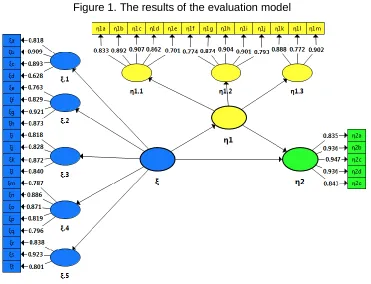
Evaluation of Research Models
Figure 1. The results of the evaluation model
Licensed under Creative Common Page 90 measured variable. Furthermore, the evaluation criteria of other models can be seen in the following table:
Table 1: Model testing
Variable
Average
Variance
Extracted
Composite
Reliability
R
Square
(R2)
Q
Square
(Q2)
ξ Service Quality 0,616 0,963
η1 Perceived Value 0,622 0,947 0,715 0,407
η2 Customer Satisfaction 0,811 0,955 0,768 0,575
Based on the table, it is known that the values obtained from the other assessment criteria are: AVE (> 0.05), Composite Reliability (> 0.7), R2 (> 0.25 ), and Q2 (> 0.02). Thus, the model in this research has fulfilled the minimum assessment criteria required so that the model in this research can be said to be fit.
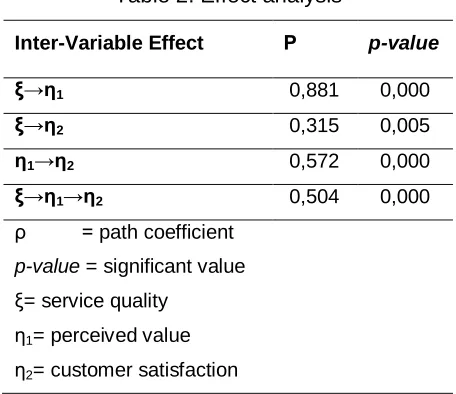
Table 2: Effect analysis
Inter-Variable Effect Ρ p-value
ξ→η1 0,881 0,000
ξ→η2 0,315 0,005
η1→η2 0,572 0,000
ξ→η1→η2 0,504 0,000
ρ = path coefficient
p-value = significant value ξ= service quality
η1= perceived value η2= customer satisfaction
Based on the table, it is known that the effect between service quality, perceived value, and customer satisfaction is as follows:
1) Service quality has a positive and significant effect on perceived value, known from the value of the path coefficient of (0,881) with a significant value that is (0,000).
Licensed under Creative Common Page 91 3) Perceived valuehas a positive and significant effect on customer satisfaction,
known from the value of the path coefficient of (0,572) with a significant value that is (0,000).
4) Service quality has a positive and significant effect on customer satisfaction throughperceived value, known from the value of the path coefficient of (0,504) with a significant value that is (0,000).
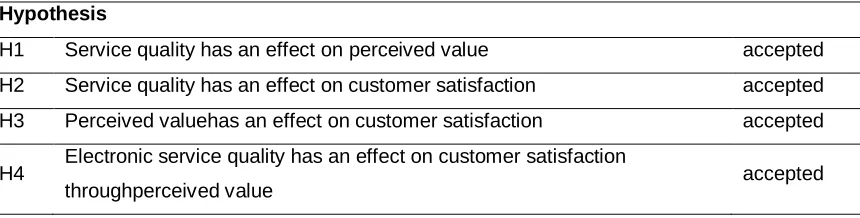
Based on the results of the research, the information received or not the hypotheses formulated can be seen in the following table:
Table 3: Hypotheses testing
Hypothesis
H1 Service quality has an effect on perceived value accepted H2 Service quality has an effect on customer satisfaction accepted H3 Perceived valuehas an effect on customer satisfaction accepted
H4 Electronic service quality has an effect on customer satisfaction
throughperceived value accepted
DISCUSSION
Effect of Service Quality on Perceived Value
Based on the results of the research, it is known that service quality has a positive and significant effect on perceived value, the results conclude that the quality of services provided by Bank Mandiri Banda Aceh has a significant contribution in increasing the value felt by customer. These results indicate that the services provided by Bank Mandiri Banda Aceh are things that can determine the value perceived by customers for these services. Therefore, it is important for Bank Mandiri Banda Aceh to continue to provide, maintain, and improve the quality of services provided to customers so that the value perceived by customers towards Bank Mandiri services in Banda Aceh is increasingly high, because the value perceived by customers is one factor most importantly for Bank Mandiri Banda Aceh gained a competitive advantage.
Effect of Service Quality on Customer Satisfaction
Licensed under Creative Common Page 92 can be improved by providing quality services to customers, because basically service quality is an indication of customer satisfaction, meaning that if services received by customers are in line with expectations, customers will be satisfied with that service. Therefore, it is important for Bank Mandiri Banda Aceh to continue to maintain and improve the quality of services provided to customers so that customers are satisfied with the service, because customer satisfaction is one of the marketing objectives that must be achieved by Bank Mandiri Banda Aceh in conducting its business.
Effect of Perceived Value on Customer Satisfaction
Based on the results of the research, it is known that the perceived value has a positive and significant effect on customer satisfaction, the results conclude that the value perceived by customers for the services provided by Bank Mandiri Banda Aceh has a significant contribution in increasing customer satisfaction. These results indicate that the satisfaction of Bank Mandiri Banda Aceh customers is largely determined by the value perceived by customers for the services provided by Bank Mandiri Banda Aceh, because basically the perceived value is one of the factors that can determine the level of customer satisfaction, when a customer receives a value that high on a service, customers will also feel high satisfaction. Therefore, it is important for Bank Mandiri Banda Aceh to create high value for customers, because the value perceived by customers has an important role in increasing customer satisfaction.
Effect of Service Quality on Customer Satisfaction through Perceived Value
Based on the results of the research, it is known that service quality has a positive and significant effect on customer satisfaction indirectly through perceived value, the results conclude that the better the quality of services provided by Bank Mandiri Banda Aceh, the value perceived by customers for these services will also increase which is also indirectly has a significant contribution in increasing customer satisfaction.
Licensed under Creative Common Page 93
CONCLUSIONS AND RECOMMENDATIONS
Service quality has a significant effect on perceived value; perceived valuehas a significant effect on customer satisfaction; service quality also has a significant effect on customer satisfaction both directly and indirectly through perceived value.The limitations of the research that has been done are on the number of organizations, area, respondents, theories from books and from studies sourced from reputable international journals.
Service quality is one of the factors that greatly determines perceived value and customer satisfaction, therefore it is recommended that Bank Mandiri Banda Aceh continue to improve the quality of its services. One way that can be done by Bank Mandiri Banda Aceh is by using technology in terms of serving its customers, in this case the technology in question is a machine for picking up queue numbers.
REFERENCES
Al Chalabi, H.S.A., & Turan, A. (2017). The Mediating Role of Perceived Value on the Relationship between Service Quality and Customer Service Loyalty: An Explanatory Study for Iraqi Private Banking Sector. Global Business and Management Research: An International Journal, 9(4), 37-66.
Gultom, W.S.T., Yuliati, L. N., & Djohar, S. (2016). Effect of Service Quality, Product Quality and Perceived Value on Customer Satisfaction and Loyalty the Satutani Wood Industry. Jurnal Manajemen & Agribisnis, 13(2), 109-121. Gumussoy, C. A., & Koseoglu, B. (2016). The Effects of Service Quality, Perceived Value and Price Fairness on Hotel Customers’ Satisfaction and Loyalty. Journal of Economics, Business and Management, 4(9), 523-527.
Hair, J. F., Hult, G. T. M., Ringle, C. M., & Sarstedt, M. (2014). A Primer on Partial Least Squares Structural Equation Modeling (PLS-SEM). USA: SAGE Publications.
Hapsari, R., Clemes, M. D., & Dean, D. L. (2016). The Mediating Role of Perceived Value on the Relationship between Service Quality and Customer Satisfaction: Evidence from Indonesian Airline Passengers. Procedia Economics and Finance, 35, 388-395.
Ivanauskienė, N., Auruškevičienė, V., Škudienė, V., & Nedzinskas, S. (2012). Customer Perceptions of Value: Case of Retail Banking. Organizations And Markets In Emerging Economies, 3(1), 75-88.
Kotler, P., & Keller, K. L. (2016). Marketing Management, 15th Edition. New Jersey: Pearson Prentice Hall.
Lubis, P. H., Sucherly., Lubis, A. R., & Kaltum, U. (2015). Implementing Service Profit Chain At Islamic Banking. International Journal of Economics, Commerce and Management, 3(6), 1271-1292.
Malik, S. U. (2012). Customer Satisfaction, Perceived Service Quality and Mediating Role of Perceived Value. International Journal of Marketing Studies, 4(1), 68-76.
Raza, M. A., Siddiquei, A. N., Awan, H. M., & Bukhari, K. (2012). Relationship Between Service Quality, Perceived Value, Satisfaction and Revisit Intention in Hotel Industry. Interdisciplinary Journal of Contemporary Research in Business, 4(8), 788-805.
Razavi, S. M., Safari, H., Shafie, H., & Khoram, K. (2012). Relationships among Service Quality, Customer Satisfaction and Customer Perceived Value: Evidence from Iran's Software Industry. Journal of Management and Strategy, 3(3), 8-27.
Rosita, R. (2015). The Effect of Service Quality on Customer Satisfaction of BNI, BRI, Bank Mandiri and BCA in Bekasi. E-Journal WIDYA Ekonomika, 1(1), 51-57.
Suariedewi, A., & Sulistyawati, E. (2016). The Role of Perceived Value Mediates the Effect of Service Quality on Consumer Satisfaction. E-Jurnal Manajemen Unud, 5(12), 8200-8226.
Licensed under Creative Common Page 94 Wulandari, A. (2015). The Effect of Service Quality on Patient Satisfaction with Perceived Value As a Mediation Variable in Dr. Moewardi's Rsud in Surakarta. Jurnal Ekonomi dan Kewirausahaan, 15(1), 19-27.