Reviewed by Timothy V. Johnson
Corning Environmental Technologies, Corning Incorporated, HP-CB-2-4, Corning, NY 14831, USA;
E
E--mmaaiill:: jjoohhnnssoonnttvv@@ccoorrnniinngg..ccoomm
The annual Society of Automotive Engineers (SAE) World Congress is the automotive industry’s largest conference and covers all aspects of automotive engineering. The 2009 World Congress was held in Detroit, USA, from 20th to 23rd April 2009.There were upwards of a dozen sessions focused on vehicle emissions technology, with most of them on diesel emissions. Attendance was down about 50% relative to earlier years, but most sessions had perhaps fifty to a hundred attendees, and some had more than two hundred.
This review focuses on key developments on diesel emissions control and catalysts from the conference. References in brackets refer to the SAE Technical Papers which can be purchased and downloaded from the SAE website (1).
Selective Catalytic Reduction
Selective catalytic reduction (SCR) is the leading nitrogen oxides (NOx) abatement, or deNOx, strategy for both light-duty and heavy-duty applications. Recent studies have focused on system optimisation to allow 90% and greater deNOx efficiency.
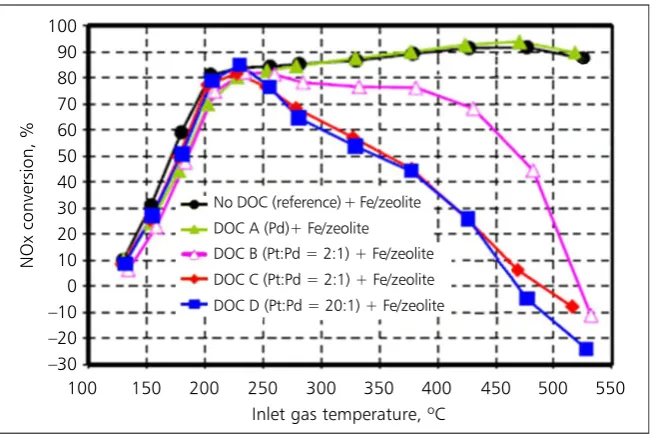
Ford Motor Co continues to lead the publishing of cutting edge SCR papers at the SAE World Congress. At the SAE Powertrains, Fuels and Lubricants Meeting in October 2008, they showed that if upstream plat-inum-containing diesel oxidation catalyst (DOC) sys-tems are exposed to temperatures above 670ºC, plat-inum sublimation and subsequent condensation on the downstream SCR catalyst compromises deNOx efficiency as the presence of platinum leads to the oxidation of ammonia on the SCR catalyst (2).In a fol-low-up paper at the 2009 World Congress,they showed that palladium substitutions for platinum can help stabilise the precious metal, resulting in improved deNOx performance (FFiigguurree 11) (3). Hydrocarbon light-off temperatures were nearly unchanged for the mixtures containing platinum and palladium in a 2:1 ratio versusa platinum-only formulation. The authors showed that the formulation needed to be optimised for the DOC compositions, as one formulation with Pt:Pd = 2:1 outperformed the other.
Copper zeolites are preferred for light-duty applica-tions because they have better low-temperature
Key developments in diesel emissions control and catalysts
deNOx efficiencies. Ford investigators confirmed ear-lier reports by others (see for example (4)) that low-temperature performance strongly depends on ammonia storage status and capability (5).They have now found that about half of the ammonia is stored in sites that hold the ammonia more tightly than the other half. This ammonia was not as readily available during rapid, short-lived changes in conditions as the more loosely held ammonia. Ford also explained ammonia oxidation dynamics unique to copper zeo-lites, with ammonia oxidation reactions in the absence of NOx beginning at 250ºC. DeNOx perform-ance above 400ºC was significantly compromised as a result. No N2O, NO or NO2was detected between
250ºC and 400ºC.
To overcome the high-temperature deNOx deficien-cies of copper zeolites due to ammonia oxidation, Ford showed in another paper that if iron zeolite is used in the front two-thirds of the SCR catalyst, with copper zeolite in the back third, a better balance between low- and high-temperature deNOx efficiency can be realised (6). To regain lost light-off perform-ance, they added a small copper zeolite catalyst
upfront (in an amount equivalent to 8% of the volume of the main catalyst), although this compromised some performance at temperatures above 475ºC due to ammonia oxidation.
There is continued interest in applying SCR cata-lysts to diesel particulate filters (DPFs) to save on space and perhaps cost. Most reports (see for exam-ple (7)) show the expected back pressure increase for the DPF together with a minor compromise in deNOx efficiency of the SCR as soot builds up, at least to modest levels. However, Ford showed a surprising and unexplained drop in deNOx efficiency below 400ºC when going from a space velocity of 30,000 h–1
to 40,000 h–1in dynamometer testing (5), which was
not evident in laboratory reactor studies. They also revealed a consistent loss of deNOx efficiency between 275ºC and 350ºC.
In a sister paper, Ford showed that this latter phe-nomenon may be related to hydrocarbon coking (8). Two copper zeolite catalysts showed reduced deNOx efficiency when exposed to propylene in this temper-ature range. Coking was observed at ~310ºC, which correlates to the onset of propylene oxidation under Inlet gas temperature, ºC
DOC B (Pt:Pd = 2:1) + Fe/zeolite DOC C (Pt:Pd = 2:1) + Fe/zeolite DOC D (Pt:Pd = 20:1) + Fe/zeolite No DOC (reference) + Fe/zeolite DOC A (Pd)+ Fe/zeolite
100 150 200 250 300 350 400 450 500 550
NOx conversion, %
100 90 80 70 60 50 40 30 20 10 0 –10 –20 –30
the experimental conditions. This coking did not affect the DPF back pressure, indicating a morpholo-gy different from that of diesel soot. One zeolite for-mulation showed the same susceptibility to diesel fuel exposure, while the other did not.
Lean NOx Traps
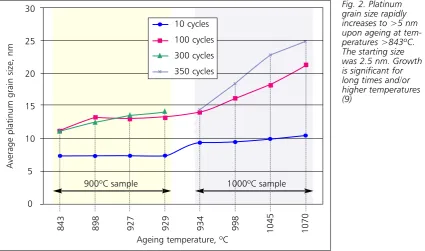
Lean NOx traps (LNTs) are emerging as the favoured deNOx system for smaller diesel passenger cars due to lower costs and smaller space requirements com-pared to SCR systems. They are also the system of choice for lean-burn direct injection gasoline engines. Investigators from the University of Tennessee and Oak Ridge National Laboratory, USA, quantified the ageing behaviour of baria-based LNTs (9). As shown in FFiigguurree 22, platinum grain size increas-es upon exposure to temperaturincreas-es above 843ºC but does not change much with short exposures to 1000ºC. Conversely, with long exposure times, grain size increases over the whole temperature range, with rapid grain growth at above 1000ºC. Similarly, baria grain size increases upon exposure to tempera-tures greater than 929ºC. Baria grain growth more adversely affects nitrate stability (and therefore deNOx efficiency) at temperatures above 300ºC than at 200ºC.
Hydrocarbon slip during the rich LNT regeneration cycle can be problematic. Investigators at Cummins
and Johnson Matthey in the USA and UK looked at two approaches: using a downstream oxygen storage catalyst to release oxygen to burn the hydrocarbons during the rich purge, and using a zeolite-based hydrocarbon trap (10). Trapping the hydrocarbons during the rich purge and then oxidising them during the lean cycle proved more effective than the oxygen storage method at temperatures below 300ºC. The investigators were able to save platinum group metal (pgm) by transferring some of it from the LNT to the hydrocarbon slip catalyst.
Many researchers have shown that hydrogen and carbon monoxide (CO) improve LNT desulfation and low-temperature NOx conversion (see for example (11)). Cummins and Johnson Matthey added an improved partial oxidation catalyst to the LNT formu-lation to generate more hydrogen and CO in situ(10). Desulfation temperatures were dropped from 700ºC to 500ºC, low-temperature (200ºC) deNOx efficiency increased from 40% to 60%, and 0.10 g of rhodium (out of 0.14 g in the catalyst tested) could be replaced with 1.06 g of palladium.
There is emerging interest in combination LNT and SCR systems, wherein ammonia (NH3) is purposefully
generated in the LNT during rich periods, and then stored in the downstream SCR catalyst to reduce NOx. Ford showed that by shifting deNOx capacity to the SCR, LNT pgm loading could be reduced, while
Ageing temperature, ºC
Average platinum grain size, nm
843 898 927 929 934 998 1045 1070
30
25
20
15
10
5
0
10 cycles
100 cycles
300 cycles
350 cycles
900ºC sample 1000ºC sample
improving aged low-temperature deNOx efficiency (85% efficiency at 225ºC for the highly loaded LNT
versus95% efficiency for the lightly loaded LNT + SCR combination), and decreasing ammonia and hydro-gen sulfide emissions (12).
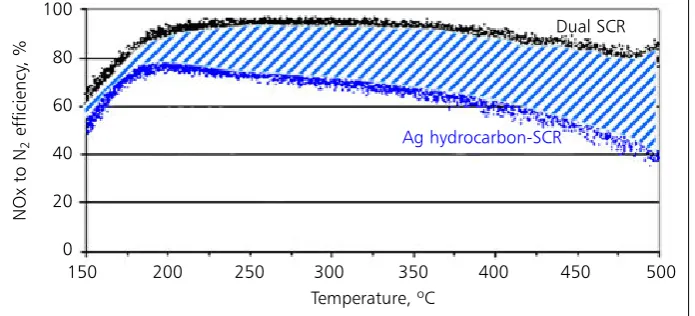
Similarly, Delphi incorporated an iron-zeolite SCR behind a silver-based lean NOx catalyst (creating a ‘dual SCR’ for both hydrocarbon- and NH3-SCR) (13).
The deNOx system has no pgm and does not need an external source of ammonia. As shown in FFiigguurree 33, in the presence of 1% hydrogen the total system deNOx efficiency is >80% at ~175ºC and above, and the NH3
-SCR contributes 10% to 40% of this deNOx efficiency depending on temperature. Even the addition of as lit-tle as 0.1% hydrogen improved system deNOx effi-ciency by 20% to 25% between 200ºC and 325ºC, and fuel penalties were only 1% to 3% at 20% exhaust gas recirculation (EGR), and decreased further at higher EGR levels.
Diesel Particulate Filters
Work is continuing on performance enhancements and fundamental understanding of diesel particulate filters (DPFs). Michigan Technological University, USA, quantified soot oxidation on catalysed soot filters (14). They recommended carrying out partial regenerations to maintain a soot membrane that keeps soot from penetrating into the walls and increasing back pressure.This approach also reduces fuel consumption due to more rapid and efficient oxidation at higher soot loadings.
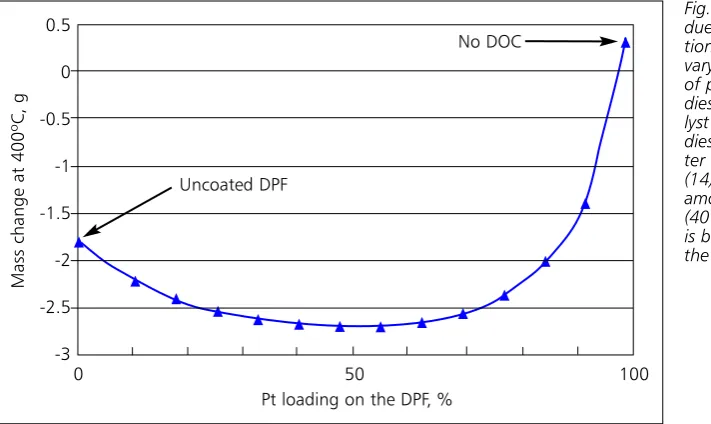
Investigators at Aristotle University of Thessaloniki, Greece, in collaboration with Ecocat Oy (Finland) and Notox A/S (Denmark) used modelling and exper-imental approaches to investigate the effects of pgm distributions and loadings and DPF characteristics on system performance (15). For example, while keeping the total Pt content constant, they showed that it is best to put half of the Pt on the DOC and half on the filter, as shown in FFiigguurree 44. Using a DOC had a much larger impact than total pgm content on soot burn; CO and hydrocarbon oxidation on the DPF was more dependent on washcoat dispersion than on pgm loading; and the application of depth filtration mech-anisms resulted in higher back pressure with no improvement in soot oxidation.
Toyota found counterintuitive particulate filtration results when they increased DPF washcoat loadings (16).FFiigguurree 55shows that particulate emissions initial-ly decrease as washcoat levels increase, but at higher washcoat loadings particle emissions go up. The authors show that 10 μm to 20 μm-diameter pores are highly efficient in removing diesel soot particles due to Brownian motion synergies, but filtration efficiency decreases as the volume of pores with a diameter greater than 30 μm increases. At the higher washcoat loadings, 10 μm to 20 μm pore volume goes down while >30 μm pore volume stays constant.
NGK Insulators Ltd showed some benefits of adding an inorganic membrane to the inlet walls of DPFs (17).The membrane improves initial (or clean) DPF filtration efficiency, and keeps particulates from
Temperature, ºC
NOx to N
2
efficiency
, %
100
80
60
40
20
0
150 200 250 300 350 400 450 500
Ag hydrocarbon-SCR Dual SCR
entering the wall, resulting in lower soot-burdened back pressure.
Some of the more interesting work on DPF catalysts reflects the recent interest in direct soot oxidation catalysis, wherein the soot oxidation is carried out at the soot–catalyst interface by lattice oxygen at rela-tively low temperatures compared to the gaseous oxi-dation (see for example (18)). In an oral-only presen-tation, Honda reported direct oxidation of soot begin-ning at ~200ºC, with rapid oxidation occurring at 250ºC, using the yttrium-manganese-ruthenium-oxide YMn0.95Ru0.05O3as a catalyst (19).
Diesel Oxidation Catalysts
DOCs have been a staple of diesel emissions control for about fifteen years and are present in all systems. Despite the significant commercial tenure of DOCs, researchers in the field are still learning about their behaviour and improving their performance.
For example, researchers at Oak Ridge National Laboratory and the University of Tennessee, USA, investigated DOC poisoning effects by analysing field-aged Pt/CeO2/γ-Al2O3 catalysts from a transit bus
application (low load) (20). Almost all of the ageing effects were attributed to soot accumulating on and
Mass change at 400ºC, g
Pt loading on the DPF, %
0 50 100
0.5
0
-0.5
-1
-1.5
-2
-2.5
-3
No DOC
Uncoated DPF
Fig. 4. Mass change due to soot oxida-tion for systems with varying proportions of platinum on the diesel oxidation cata-lyst (DOC) and the diesel particulate fil-ter (DPF) respectively (14). For a constant amount of Pt (40 g ft–3of DPF), it is best to put half on the DOC
Washcoat loading, g l––1
Pore volume, cm
3g
––1 number per kilometre Particulate emissions,
A–33% A–10% A A+10% A+33%
10–20 μm
> 30 μm 0.25
0.2
0.15
0.1
Particulate emissions Volume of pores size > 30 μm
Volume of pores size 10–20 μm
blocking catalyst sites.Oxidising the soot returned the DOCs to their fresh-state performance. Phosphorous and other ash components had negligible effects.
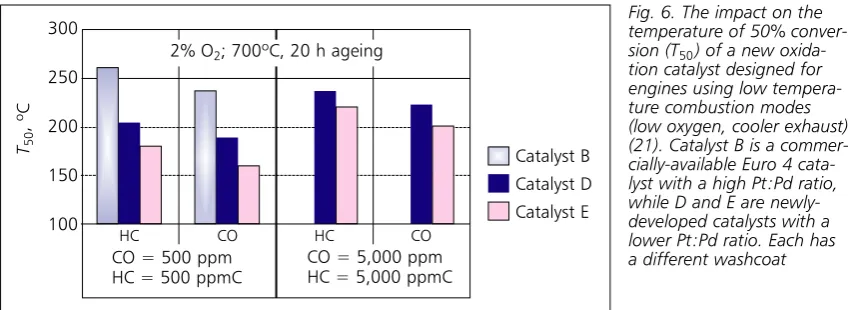
Finally, DOCs will play a very important role in enabling engines to run in low-temperature combus-tion modes. These low-load modes of operacombus-tion use high levels of EGR (low oxygen) to give very low NOx and particulate emissions, but rather high hydrocar-bon and CO emissions in cooler exhaust gas. Investigators at Johnson Matthey (Japan) and Isuzu Advanced Engineering Center, Ltd (Japan) showed that hydrocarbon and CO oxidation temperatures increase as oxygen content decreases and hydrocar-bon + CO levels increase (21).They improved the cat-alyst by improving its oxygen storage properties, sup-pressing CO adsorption, and increasing the number of active sites that have multiple functions.FFiigguurree 66 shows that the temperature of 50% conversion (T50)
for hydrocarbon oxidation for aged catalysts drops from 260ºC to 180ºC.
Conclusions
The 2009 Society of Automotive Engineers World Congress had many valuable contributions and con-tinues the tradition of providing insights into future directions in diesel emissions control.
Although the first selective catalytic reduction cata-lysts were tested on vehicles more than fifteen years ago, much progress is still being made on understand-ing fundamentals, such as ammonia storage and oxi-dation dynamics, and improving performance through composition engineering and optimising the interplay with other components. Hydrocarbon-based deNOx methods are advancing, with more information being provided on durability and further progress being made on cost reduction, specifically
by using the device to generate ammonia for use in a downstream SCR catalyst. Diesel particulate filter development is aimed at further improvements in fil-tration efficiency and regeneration behaviour. Finally, improvements are still being made to diesel oxidation catalysts, the diesel emissions control technology with the longest history, in terms of understanding their in-use ageing and improving their performance in exhaust gas with low levels of oxygen.
References
1 SAE International: http://www.sae.org/
2 H.-W. Jen, J. Girard, G. Cavataio and M. Jagner, ‘Detection, Origin, and Effect of Ultra-Low Platinum Contamination on Diesel-SCR Catalysts’, SAE Technical Paper 2008-01-2488, Powertrains, Fuels and Lubricants Meeting, 6th–9th October, 2008, Chicago, IL, USA 3 G. Cavataio, J. W. Girard, H.-W. Jen, D. Dobson,
J. R. Warner and C. K. Lambert, ‘Impact and Prevention of Ultra-Low Contamination of Platinum Group Metals on SCR Catalysts Due to DOC Design’, SAE Technical Paper 2009-01-0627
4 Y. Murata, S. Tokui, S. Watanabe, Y. Daisho, H. Suzuki and H. Ishii, ‘Improvement of NOx Reduction Rate of Urea-SCR System by NH3Adsorption Quantity Control’, SAE Technical Paper 2008-01-2498, Powertrains, Fuels and Lubricants Meeting, 6th–9th October, 2008, Chicago, IL, USA
5 G. Cavataio, J. W. Girard and C. K. Lambert, ‘Cu/Zeolite SCR on High Porosity Particulate Filters: Laboratory and Engine Performance Evaluations’, SAE Technical Paper 2009-01-0897
6 J. R. Theis, ‘SCR Catalyst Systems Optimized for Lightoff and Steady-State Performance’, SAE Technical Paper 2009-01-0901
7 T. Ballinger, J. Cox, M. Konduru, D. De, W. Manning and P. Andersen, ‘Evaluation of SCR Catalyst Technology on Diesel Particulate Filters’, SAE Technical Paper 2009-01-0910
T50
, ºC
300
250
200
150
100
HC CO
Catalyst B Catalyst D Catalyst E
HC CO
CO = 500 ppm HC = 500 ppmC
CO = 5,000 ppm HC = 5,000 ppmC
2% O2; 700ºC, 20 h ageing
8 G. Cavataio, J. R. Warner, J. W. Girard, J. Ura, D. Dobson and C. K. Lambert, ‘Laboratory Study of Soot, Propylene, and Diesel Fuel Impact on Zeolite-Based SCR Filter Catalysts’, SAE Technical Paper 2009-01-0903
9 N. Ottinger, B. G. Bunting, T. Toops and K. Nguyen, ‘Effects of Rapid High Temperature Cyclic Aging on a Fully-Formulated Lean NOx Trap Catalyst’, SAE Technical Paper 2009-01-0634
10 T. Szailer, N. Currier, A. Yezerets, B. Stroia, H.-Y. Chen, P. Millington and H. Hess, ‘Advanced Catalyst Solutions for Hydrocarbon Emissions Control During Rich Operation of Lean NOx Trap Systems’, SAE Technical Paper 2009-01-0282
11 J. E. Parks, B. West and S. Huff, ‘Characterization of Lean NOx Trap Catalysts with In-Cylinder Regeneration Strategies’, SAE Technical Paper 2008-01-0448, SAE 2008 World Congress & Exhibition, 14th–17th April, 2008, Detroit, MI, USA
12 L. Xu, R. McCabe, W. Ruona and G. Cavataio, ‘Impact of a Cu-zeolite SCR Catalyst on the Performance of a Diesel LNT+SCR System’, SAE Technical Paper 2009-01-0285 13 C. L. Dimaggio, G. B. Fisher, K. M. Rahmoeller and
M. Sellnau, ‘Dual SCR Aftertreatment for Lean NOx Reduction’, SAE Technical Paper 2009-01-0277
14 K. P. Chilumukuru, R. Arasappa, J. H. Johnson and J. D. Naber, ‘An Experimental Study of Particulate Thermal Oxidation in a Catalyzed Filter During Active Regeneration’, SAE Technical Paper 2009-01-1474 15 G. C. Koltsakis, C. Dardiotis, Z. Samaras, T. Kinnunen,
T. Maunula and P. Lundorf, ‘Optimization Methodologies for DPF Substrate-Catalyst Combinations’, SAE Technical Paper 2009-01-0291
16 M. Kuwajima, S. Okawara, M. Tsuzuki, M. Yamaguchi
and S. Matsuno, ‘Analysis of Sophisticated DPNR Catalyst, Focused on PM Particle Number Emissions’, SAE Technical Paper 2009-01-0290
17 Y. Furuta, T. Mizutani, Y. Miyairi, K. Yuuki and H. Kurachi, ‘Study on Next Generation Diesel Particulate Filter’, SAE Technical Paper 2009-01-0292
18 B. W. L. Southward and S. Basso, ‘An Investigation into the NO2-Mediated Decoupling of Catalyst to Soot Contact and Its Implications for Catalysed DPF Performance’, SAE Technical Paper 2008-01-0481, SAE 2008 World Congress & Exhibition, 14th–17th April, 2008, Detroit, MI, USA
19 Y. Isogai, ‘Mechanism Analysis of Carbon Particles Combustion over Hexagonal YMnO3Catalyst’, oral-only presentation, SAE 2009 World Congress & Exhibition, Detroit, MI, USA, 20th–23rd April, 2009
20 S. Eaton, K. Nguyen, T. Toops and B. G. Bunting, ‘The Roles of Phosphorus and Soot on the Deactivation of Diesel Oxidation Catalysts’, SAE Technical Paper 2009-01-0628
21 S. Sumiya, H. Oyamada, T. Fujita, K. Nakamura, K. Osumi and Y. Tashiro, ‘Highly Robust Diesel Oxidation Catalyst for Dual Mode Combustion System’, SAE Technical Paper 2009-01-0280
The Reviewer