Design Of Speed & Area Efficient NoC
Architecture By Integrating Switches With
Simplified Decoder And Reduced Buffers
Vivek tiwari, Kavita khare
Abstract -Network-on-Chip is used to integrate large numbers of Intellectual Property blocks on a single Integrated Chip. NoC router is one of the important parts of networking that is used inside a Chip. In this paper a new NoC router architecture is proposed which consist of firstly a modified crossbar switch secondly eight 8 bit buffers instead of sixteen bit 8 buffers at input and output channel and thirdly modified decoder which is a part of arbiter of NoC router. Proposed NoC Router design reduces area by 3% and delay by 1.39% as compared to conventional NoC router. It is also proposed and analysed here that, new NoC architected if integrated with conventional NoC architecture shows 17.24 % of area saved for 4x4, 8x8, 16x16 and 32x32 meshes NoC architecture when compared with conventional NoC architecture. Proposed NoC Architecture model is simulated in Xilinx ISE 9.2i and target device is Virtex4.
Keywords— Network-on-Chip; NoC router; infifo; outfifo; crossbar switch; Xilinx; RTL simulation;
—————————— ——————————
I.INTRODUCTION
To provide appropriate communication between cores of multi-core chip Network on chip (NoC) is a more reliable way to full fill high performance computing requirements. Network on Chip consist NoC routers and various link to connect them. There are various mesh and torus based topologies to connect all routers with each other [1]. Between two routing techniques deterministic and adaptive routing techniques, deterministic technique where X-Y routing is most popular. Programmable and adaptive NoC router is used as per requirement of new general purpose multi cluster chips. [2].
A deterministic conventional NoC router architecture consist of input output channel, buffer, crossbar switch, MUX, decoder, X-Y router and arbiter[3].
There are several existing area and power efficient NoC architectures [5].Crossbar switch and input output channel used in NoC router is designed to reduce area, power and delay in BiNoC and input output configurable NoC router [6-7].Our proposed work focuses on modification of architecture of crossbar switch and decoder with input output channels of NoC router to make it area and time efficient.
.
Arbiter
Crossbar
switch
Control unit N input
E input
W input
S input
L input
N output
E output
W output
S output
L output
Output control signal Input control signal
Input buffers Output buffers
Figure1 : Conventional NoC router architecture
II-R
ELATEDW
ORKconventional NoC router architecture consist of components namely (i) input output channel with buffer (ii) crossbar switch (iii) arbiter (iv) X-Y router as shown in figure 1. This NoC router consist of five input and five output channel i.e. north, south ,east, west, local input output channel. Each channel is connected with its neighbouring channel through physical channel (link).
Router’s main function is to route data from each input channel to appropriate output channel, to forward data towards final destination.
2991 Components of conventional NoC router
Input/output Ports
A conventional NoC router architecture it consist of input/output ports where both consist of infifo , outfifo , and xy router, where buffer of each channel consist of 16 eight bit buffers[8].
Crossbar switch
Crossbar switch is used to connect five input channel to five output channel it consists lots of switches which arranged in the form of matrix organization[9]. Input and output link of crossbar switch arranged in the form of row and column lines. They arranged in such a way that they crosses each other and switches are placed at their crossing point to establish connectivity between them. Crossbar switch is a non blocking type switch i.e. it does not interfere any other input output connection. In any NoC router crossbar switch and input output channel is main area and power contributor [10], [11],[12],[13],[14],[15].
Arbiter
Arbiter allocates a time slot of the cross-bar switch to move flits from an input channel to an output channel. In a conventional NoC, has an equal number of input lines and output lines and its output is the grant signal as discussed in [16].A conventional NoC Router architecture [17] is simulated in Xilinx9.2i and its simulation results is shown in
Error! No bookmark name
given.
Figure- 2.Figure 2 RTL view of conventional NoC router architecture
Present work proposes a NoC architecture with certain benefits
Modified Crossbar switch acquires less area (less number of LUTs) as compared to conventional NoC router [8], [17]–[20]
Decoder which is part of Arbiter is modified with less complexity and area when compared to conventional NoC router [8], [17]–[20]
Eight 8 bit buffers at input and output channel in contrast with sixteen 8 bit buffers of conventional NoC.
III.
P
ROPOSEDN
OC
R
OUTERA
RCHITECTUREIn proposed NoC router architecture has a input channel ,output channel, crossbar switch, arbiter, X-Y router, decoder, infifo, outfifo such as conventional NoC Router architecture[17].as shown in Figure-3.
In North out North In East out East In South out South In West out West In Local out local
Cross bar switch
Arbiter
Output port N
Output port S Output port E
Output port W Output port L Input port N
Input port E Input port S Input port W Input port L Proposed
Cross bar switch
Control signal Control signal
Figure 3 Proposed NoC Router architecture
In proposed NoC router architecture a conventional crossbar switch, which consist five 4x1 MUX is replaced by a new crossbar switch as shown in Figure-4. New crossbar switch consist of four 2x1 MUX and one 4x1 MUX. Due to this new crossbar structure there is a significant improvement in number of LUT as compared to conventional crossbar switch that is used in conventional NoC router architecture[17].
Figure 4 Block diagram of proposed crossbar switch
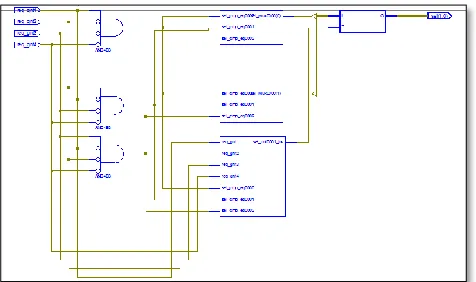
Decoder circuit is shown in figure-5 is used in conventional NoC router architecture to select one selection line request among the four upcoming input data transfer request [17]. This kind of five 4x2 decoder is used in conventional NoC router architecture. In proposed NoC router architecture thesefive decoders are replaced by a simple 2 input 1 output OR gate circuit as shown in Figure-6.
Figure 5 RTL view of Decoder circuit used in conventional NoC router architecture
Figure 6 RTL view of Proposed new 2 input 1 output are gate in place of Decoder circuit.
This proposed logic gate also use less number of LUTs as compares to decoders used in conventional NoC. And contribute to reduce total number of LUTs as compared to conventional NOC.
Infifo, Outfifo circuit is used in input channel and output channel of NoC Router. Sixteen 8 bit memory spaces available in conventional NoC Router architecture whereas in proposed eight 8 bit memory spaces are used. Figure-7 and Figure-8 shows RTL view of infifo used in conventional and proposed NoC router architecture [17].
Figure 7 RTL view of infifo used in conventional NoC router architecture
Figure 8 RTL view of proposed infifo used in Proposed NoC router architecture
Due to improved crossbar switch design. It requires only eight 8 bit memory slots instead of sixteen 8 bit memory slots. At four input port and four output ports i.e. north input output port, south input output port, east input output port, and west input output port. Only at local input and output channel it uses sixteen 8 bit memories. Since proposed router uses only 8 eight bit memory locations at four inputs outputs channel. It significantly reduces total number of memory locations as compare to conventional NoC router.
By incorporating all proposed individual circuit i.e. new crossbar switch, new simplified decoder circuit, new buffer into a NoC router, we get a very efficient and effective NoC router. Which consume less number of LUTs units as compare to conventional NoC router.
IV.
RESULT
2993 conventional NoC router architecture. It is also shown in
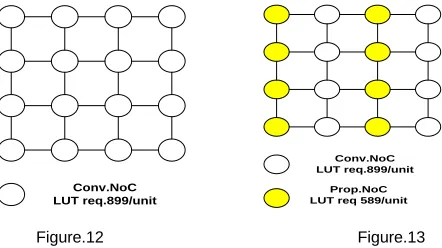
table.1 that 3% less LUTs required in proposed architecture compare to conventional architecture. RTL view decoder circuit is shown in figure.5, which used in conventional router. A less complicated circuits RTL view is shown in Figure.6, which is proposed in this work. The limitation of proposed new NoC architecture when it is implemented in 4x4 mesh architecture is that some of its nodes are not able to receive data from their neighbouring nodes due to straight data transfer feature of proposed NoC router. For optimum performance of this router and to make a mesh NoC structure efficient, it is proposed that it should be used in integration with conventional NoC router. 4x4 mesh architecture only with conventional NoC router and in proposed manner is expressed in Figure-12 and Figure-13 In Table.2 a comparative analysis between proposed and conventional 4x4, 8x8, 16x16 and 32x32 meshes architecture is shown, which shows that proposed mesh structure required 17.24% less number of LUTs as compared to conventional architecture.
TABLE 1:
UTILIZATION OF FPGARESOURCE BY CONVENTIONAL AND PROPOSED NOCROUTER ARCHITECTURE (SELECTED DEVICE
-VIRTEX4)
Resource
Available
Conventional
NoC
Router
architecture
Proposed
NoC
Router
architecture
Use
d
Utilization
Used Utilizatio
n
Slice
6144
812
13%
426
6%
Slice
flip-flops
1228
8
895
7%
555
4%
LUTs
1228
8
899
7%
589
4%
I OBs
240
101
42%
101
42%
GCLK
s
32
1
3%
1
3%
TABLE.2
UTILIZATION OF AREA (NUMBER OF LUT) BETWEEN CONVENTIONAL MESH ARCHITECTURE AND PROPOSED MESH ARCHITECTURE
Mesh
Conventional
NoC
Router(total
LUT)
Proposed NoC
Router(total
LUT)
% of less
LUTs
required
4x4
14384
11904
17.24%
8x8
57536
47616
17.24%
16x16
230144
190464
17.24%
32x32
920576
761856
17.24%
Figure.9: RTL view of proposed memory less NoC router design
Figure 91: Simulation result for proposed memory less NoC Router design
Conv.NoC
LUT req.899/unit
Conv.NoC LUT req.899/unit
Prop.NoC LUT req 589/unit
Figure.12
Figure.13
Figure.12 4x4 NoC architecture with conventional NoC router. Figure.13 shows NoC architecture which has integration of conventional and
proposed switches.
V.
CONCLUSION
In this paper a new NoC router architecture with an efficient crossbar switch, simplified decoder circuit and less number of buffer at input channel and output channel is proposed, which significantly reduce area (number of LUTs) by 3% and delay by 1.39% as compared to conventional NoC router. A combinational n x n mesh architecture, which consist both conventional and proposed architecture in parallel manner is proposed. 4x4, 8x8, 16x16 and 32x32 combinational mesh architecture are analysed and compared with conventional architecture. This analysis shows that proposed mess structure uses 17.24% less number of LUTS as compared to traditional mesh architecture.
VI. REFRENCES
[1] L. Benini and D. Bertozzi, ―Network-on-chip architectures and design methods,‖ IEE Proc. - Comput. Digit. Tech., 2005.
[2] T. Bjerregaard and S. Mahadevan, ―A Survey of Research and Practices of Network-on-chip,‖ ACM Comput. Surv., 2006.
[3] L. Mingche, G. Lei, S. Wei, and Z. Wang, ―Escaping from blocking: A dynamic virtual channel for pipelined routers,‖ in Proceedings - CISIS 2008: 2nd International Conference on Complex, Intelligent and Software Intensive Systems, 2008.
[4] A. Khodwe, V. K. Rajput, P. C. N. Bhoyar, and P. P. M. Nerkar, ―VHDL Implementation Of Reconfigurable Crossbar Switch For Binoc Router,‖ vol. 2, no. 5, pp. 150–156, 2013.
[5] S. N. Ved, A. Arya, A. Bhange, and J. Mekie, ―A Comparative Study of Input Port and Crossbar Configurations in NoC Router Microarchitectures.‖
[6] G. M. Chiu, ―The odd-even turn model for adaptive routing,‖ IEEE
2013.
[8] M. P. Véstias and H. C. Neto, ―A generic network-on-chip architecture for reconfigurable systems: implementation and evaluation.‖
[9] H. C. De Freitas, P. Olivier, and A. Navaux, ―On the Design of Reconfigurable Crossbar Switch for Adaptable On-Chip Topologies in Programmable NoC Routers,‖ Glvlsi, 2009.
[10] D. Park, A. Vaidya, A. Kumar, and M. Azimi, ―MoDe-X: Microarchitecture of a layout-aware modular decoupled crossbar for on-chip interconnects,‖ IEEE Trans. Comput., 2014.
[11] J. Kim, C. Nicopoulos, D. Park, V. Narayanan, M. S. Yousif, and C. R. Das, ―A gracefully degrading and energy-efficient modular router architecture for on-chip networks,‖ in Proceedings - International Symposium on Computer Architecture, 2006.
[12] H. Wang, L. S. Peh, and S. Malik, ―Power-driven design of router microarchitectures in on-chip networks,‖ in Proceedings of the Annual International Symposium on Microarchitecture, MICRO, 2003. [13] C. H. Hoo and A. Kumar, ―An area-efficient partially reconfigurable
crossbar switch with low reconfiguration delay,‖ in Proceedings - 22nd International Conference on Field Programmable Logic and Applications, FPL 2012, 2012.
[14] L. Mhamdi, K. Goossens, and I. V. Senin, ―Buffered crossbar fabrics based on networks on chip,‖ in CNSR 2010 - Proceedings of the 8th Annual Conference on Communication Networks and Services Research, 2010.
[15] K. Goossens, L. Mhamdi, and I. V. Senín, ―Internet-router buffered crossbars based on networks on chip,‖ in 12th Euromicro Conference on Digital System Design: Architectures, Methods and Tools, DSD 2009, 2009.
[16] L. Peh, W. J. Dally, and S. Ca, ―A Delay Model and Speculative Architecture for Pipelined Routers,‖ 2001.
[17] Y. Lu, J. McCanny, and S. Sezer, ―Generic low-latency NoC router architecture for FPGA computing systems,‖ in Proceedings - 21st International Conference on Field Programmable Logic and Applications, FPL 2011, 2011.
[18] M. P. V??stias and H. C. Neto, ―A generic network-on-chip architecture for reconfigurable systems: Implementation and evaluation,‖ in Proceedings - 2006 International Conference on Field Programmable Logic and Applications, FPL, 2006.
[19] T. Theocharides, G. Link, N. Vijaybishnan, and M. J. Irwin, ―A generic reconfigurable neural network architecture implemented as a network on chip.‖
[20] M. P. Véstias, ―Area and Performance Optimization of a Generic Network-on-Chip Architecture,‖ Design, 2006.
Vivek Tiwari received B.E (Electronics and Communication) in 2007 From BCE Mandideep, Bhopal and M.Tech in 2011 with specialisation in VLSI and Embedded System fromTIT Bhopal, Currently he is pursuing part time PhD in Electronics and Communication in MANIT, Bhopal. Network on-Chip (NoC), Reliability and Modelling and Simulation. He is currently an assistant professor in SIRTS Bhopal.