VIA A DIGITAL COMMUNICATION CHANNEL
V. N. PHAT AND J. JIANGReceived 22 March 2004
We deal with the stabilization problem for a class of nonlinear discrete-time systems via a digital communication channel. We consider the case when the control input is to be transmitted via communication channels with a bit-rate constraint. Under an appropri-ate growth condition on the nonlinear perturbation, we establish sufficient conditions for the global and local stabilizability of semilinear and nonlinear discrete-time systems, re-spectively. A constructive method to design a feedback stabilizing controller is proposed.
1. Introduction
In recent years there has been a significant interest in the stabilization problem of dy-namical systems (see, e.g., [1,3,4,6,11,12,14,15,16] and the references therein). In the classical stabilization theory of dynamical systems, the standard assumption is that all data transmission required by the algorithm can be performed with infinite precision. However, in some new models, it is common to encounter situations where observation and control signals are sent via communication channel with a limited capacity. This problem may arise when large number of mobile units need to be controlled remotely by a single decision maker. Since the radio spectrum is limited, communication constraints are a real concern. All these new engineering applications motivated the development of a new chapter of control theory in which control and communication issues are combined together, and all the limitations of the communication channels are taken into account. Communication requirements, especially regarding bandwidth limits, are often challeng-ing obstacles to control systems design (see, e.g., [8,17,18]). Furthermore, the focus has been on memoryless coding, in which the pant output is quantized without reference to its past. The paper [2] deals with a stabilization problem of a linear system with quantized state feedback and shows that if time-invariant system is passed through a fixed, mem-oryless quantizer, then controllability property of the system is impossible. In [7], the asymptotic stabilizability problem is investigated for a linear discrete-time system with a real-valued output when the controller, which may be nonlinear, receives observation data at a fixed known data rate. Petersen and Savkin [9,10] present a feedback scheme for
Copyright©2005 Hindawi Publishing Corporation
linear stabilization over a digital communication channel (DCC) using a nonlinear dy-namic state feedback controller which can be applied to an arbitrary linear discrete-time system subject to standard assumptions of controllability and observability. However, the stabilization method used in these papers requires a significant amount of on-line com-putations and is hardly implementable in real time, especially in many control models described by a system of nonlinear equations.
In this paper, we investigate the stabilizability problem for a special class of nonlinear discrete-time control systems via DCC. The system considered in the paper consists of a linear discrete-time system and a linearly bounded nonlinear perturbation. Based on the state space quantization method used in [2,7,8,9], we establish sufficient conditions for the global stabilizability of semilinear discrete-time systems under an appropriate growth condition on the nonlinear perturbation. The feedback stabilizing coder-controller is de-signed based on the measure of controllability matrix of the system. The approach en-ables us to derive a sufficient condition for the local stabilizability of a more general class of nonlinear discrete-time systems, where the right-hand side function is assumed to be smooth.
2. Problem statement
Consider a nonlinear control discrete-time system of the form
x(k+ 1)=Fx(k),u(k), k∈Z+, x(0)=x
0, (2.1)
wherex(k)∈Rnis the state;u(k)∈Rmis the control;n≥m,F(x,u) :Rn×Rm→Rnis a
given nonlinear function;Z+is the set of all nonnegative integers;Rnis then-dimensional
Euclidean space.
Throughout the paper,Rdenotes the set of all real numbers;Rn×mdenotes the space of
all real (n×m)-matrices;x∞andA∞denote the infinity norms of the vectorx∈Rn and the matrixA=[ai j]∈Rn×m, defined as
x∞= max
i=1,...,n
xi, A∞= max i=1,...,n
m
j=1
ai j; (2.2)
B(a) denotes the closed hypercube inRnwith radiusa >0 defined asB(a)= {x∈Rn: x∞≤a}.
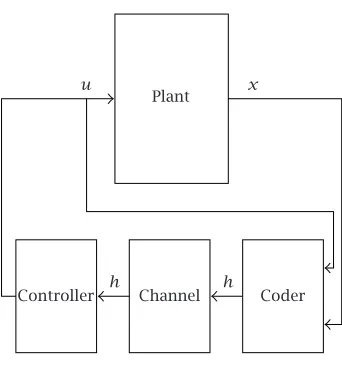
u
Plant x
[image:3.468.148.319.63.248.2]Controller h Channel h Coder
Figure 2.1. Coder-controller system.
(i) Coder
a(pk+p)=ga(pk),h(pk), a(0)=a0, h(pk)=H
a(pk),x(pk). (2.3)
(ii) Controller
a(pk+p)=ga(pk),h(pk), a(0)=a0,
u(pk)=g1a(pk),h(pk),
u(pk+ 1)=g2a(pk),h(pk),
.. .
u(pk+p−1)=gpa(pk),h(pk),
(2.4)
wherea(pk)∈Ris the quantization scaling which is updated every p time steps. We assume that the coder and controller have available the initial value of the quantization scalinga(0)=a0and they haveaccess to the quantization scalingsa(pk) andu(pk).
Definition 2.1. The system (2.1) is said to be globally stabilizable via a DCC, if there exists a coder-controller of the form (2.3)-(2.4) with a quantization scalinga0, and for every
initial conditionx(0)=x0, the corresponding solution x(k) of the closed-loop system
satisfies
x(k)−→0 ask−→ ∞. (2.5)
In this case it is also said that coder-controller (2.3)-(2.4) globally stabilizes system (2.1) via a DCC. If the above assertion holds for allx0belonging to some neighborhood of the
origin inRn, it is said that coder-controller (2.3)-(2.4) locally stabilizes system (2.1) via
The objective of this paper is to construct the coder-controller which globally (locally) stabilizes uncertain system (2.1) via DCC.
3. Semilinear discrete-time systems and state quantization
In this section, we start considering a semilinear discrete control system of the form
x(k+ 1)=Ax(k) +Bu(k) +fx(k),u(k), k=0, 1, 2,. . ., (3.1)
whereA,Bare constant matrices, f(·) is a nonlinear function. In order to describe and analyze our multirate control system, it is convenient to consider an equivalent single-rate system described as follows. For this, we use a multisingle-rate coder-controller in which the control inputu(k) is applied at every time step but a codeword is transmitted on the channel only once everyptime steps.
Letp≥1 be the smallest integer such that rank[B,AB,. . .,Ap−1B]=n. From the
discrete-time system (3.1), we have
x(pk+ 1)=Ax(pk) +Bu(pk) +fx(pk),u(pk), x(pk+ 2)=A2x(pk) +ABu(pk) +Bu(pk+ 1)
+A fx(pk),u(pk)+fx(pk+ 1),u(pk+ 1), ..
.
x(pk+i)=Aix(pk) + j−1
i=0
Aj−i−1Bu(pk+i)
+
j−1
i=0
Aj−i−1fx(pk+i),u(pk+i),
(3.2)
or in the discretep-delay time system
x(pk+p)=Φx(pk) +Gv(k) +
p−1
i=0
Ap−i−1fx(pk+i),u(pk+i), (3.3)
where
Φ=Ap, G=B,AB,. . .,Ap−1B,
v(k)=u(pk),u(pk+ 1),. . .,u(pk+p−1)T. (3.4)
We denotey(k)=x(pk). Then the system (3.3) is rewritten in the single-rate form
y(k+ 1)=Φy(k) +Gv(k) +Wy(k),v(k), (3.5)
where
Wy(k),v(k):= p−1
i=0
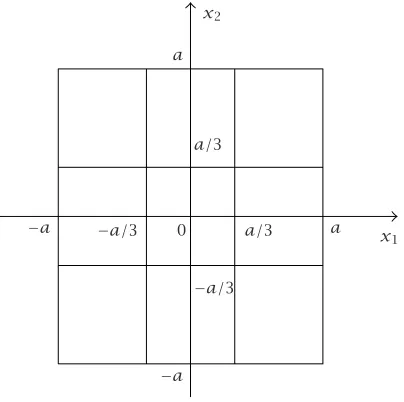
We quantize the state space of system (3.5) as follows. For consistency we denote ¯a(k)= a(pk), ¯h(k)=h(pk). Given sequence ¯a(k), we quantize the state space of system (3.5) by dividing the setB( ¯a(k)) intoqnhypercubes. For eachi∈ {1, 2,. . .,n}we divide the
corresponding state coordinateyi∈Rintoqintervals of the form
I1,i
¯ a(k)=
yi:−a¯(k)≤yi<−a¯(k) +2 ¯aq(k)
, ..
.
Iq,i
¯ a(k)=
yi: ¯a(k)−2 ¯aq(k)≤yi≤a¯(k)
.
(3.7)
Thus, for any vectory∈B( ¯a(k)), there exist unique integersi1,i2,. . .,in∈ {1, 2,. . .,q}such
thaty∈Ii,j( ¯a(k)). According to the integersi1,i2,. . .,in, we define the vector
ηi1,i2,. . .,in :=
−a¯(k) +a¯(k)
2i1−1
q
−a¯(k) +a¯(k)
2i2−1
q .. . −a¯(k) +a¯(k)
2in−1
q . (3.8)
This vector is the center of the corresponding hypercubeIi,j( ¯a(k)) containing the original
pointyand
y∈ηi1,i2,. . .,in
+B
¯
a(k) q
. (3.9)
Note that the regionRn\B( ¯a(k)) partition the state space intoqn+ 1 regions. Then,
in our proposed coder-controller, for y∈B( ¯a(k)), the transmitted codeword will cor-respond to the integers{i1,i2,. . .,in}. For y∈Rn\B( ¯a(k)) we assign the codeword{0}.
Moreover, note that our method of quantization of the state space of system (3.5) de-pends on the scaling parameter ¯a(k), which is available to both the controller and coder at any step timek, and the update law for ¯a(k). Note that the regionsIi,jtogether with the
regionRn\B( ¯a(k)) partition the state space intoqn+ 1 regions (seeFigure 3.1).
Remark 3.1. Note that the numberp >0, as mentioned before, is defined as a finite time at which the linear discrete-time system [A,B] is globally controllable. Following the well-known controllability criterion of discrete-time system (see, e.g., [5,13]), this number is the smallest integer such that rank[A|B]=[A,B,. . .,Ap−1B]=n. Since the matrix [A|B]
a a/3
0 −a/3
−a x
1
−a −a/3 a/3 a
[image:6.468.135.337.69.270.2]x2
Figure 3.1. State quantization.
4. Main results
Consider the discrete-time system (3.1). Assume the following.
Assumption 4.1. The linear discrete-time system [A,B] is globally controllable, that is, there isp≥1 such that rank[B,AB,. . .,Ap−1B]=n.
Assumption 4.2. The function f(x,u) satisfies the following growth condition:
∃c,d >0 :f(x,u)≤cx+du, ∀(x,u)∈Rn×Rm. (4.1)
Introduce the following notations:
K:=G(GG)−1Φ, β= B, α=maxAi,i=0, 1,. . .,p−1,
γ= K, η=(β+d)γq−1 q ,
σ=
c ifp=1,
cα
p−1
i=1
(α+c)i+ i
j=0
(α+c)jη
ifp >1,
ξ=cαqσ+dαpγ(q−1), λ=Φ+ξ
q .
(4.2)
¯
a(k) satisfying
¯
a(k+ 1)=λa(k), a¯(0)=a0, ∀k∈Z+, (4.3)
and for a given integerq >1, by the quantization method described in the previous sec-tion we quantize the state space of system (3.5) by diving the setB( ¯a(k)) intoqn
hyper-cubes of the form (3.7). Note that for anyk∈Z+, ify(k)∈B( ¯a(k)), then there is a vector
η(i1,i2,. . .,in)∈Rnsuch that
y(k)∈ηi1,i2,. . .,in
+B
a¯(k)
q
. (4.4)
Fory(k)∈/ B( ¯a(k)) we assign the codeword{0}. (i) Coder
¯
a(k+ 1)=
λa¯(k) ify(k)∈Ba¯(k), ¯a(0)=a0,
ra¯(k) ify(k)∈/ Ba¯(k),
¯ h(k)=
i1,i2,. . .,in ify(k)∈Ba¯(k), {0} ify(k)∈/ Ba¯(k).
(4.5)
(ii) Controller
¯
a(k+ 1)=
λa¯(k) if ¯h(k)= {0}, ¯a(0)=a0,
ra¯(k) if ¯h(k)= {0},
v(k)= −
Kηi1,i2,. . .,in
if ¯h(k)=i1,i2,. . .,in
, {0} if ¯h(k)= {0},
(4.6)
where the positive integerr∈Z+is chosen so that
r >Φ+cα
p−1
i=0
(α+c)i. (4.7)
Theorem4.3. Suppose that Assumptions4.1and4.2hold, and
λ=Φ+ξ
q <1. (4.8)
Then the coder-controller (4.5)-(4.6) globally stabilizes single-rate system (3.5) via DCC.
Proof. The proof consists of two parts.
(A) We first prove that if there is an integerk0∈Z+such thaty(k0)∈B( ¯a(k0)), then
y(k)∈B( ¯a(k)), for allk≥k0. Indeed, ify(k0)∈B( ¯a(k0)), then by the state space
quanti-zation of system (3.5), there is a vectorη(i1,i2,. . .,in)∈Rnsuch that
yk0
∈ηi1,i2,. . .,in
+B
a¯k
0
q
From (3.5) it follows that
yk0+ 1
∈Φηi1,i2,. . .,in
+ΦB
a¯k
0
q
+Gvk0
+Wyk0
,vk0
. (4.10)
Substituting the controller (4.6) in the last inclusion, we find
yk0+ 1
∈Φη(·) +ΦB
a¯k
0
q
−Φη(·) +Wyk0
,vk0
=ΦB
a¯k
0
q
+Wyk0
,vk0
,
(4.11)
and hence
y
k0+ 1≤Φ
q a¯
k0+Wyk0,vk0. (4.12)
Using condition (4.1), we have W
yk0
,vk0
≤c
p−1
i=0
Ap−i−1xpk
0+i+d
p−1
i=0
Ap−i−1upk 0+i.
(4.13)
Sinceu(pk0+i) ≤ v(k0), and note thatη(·) is the center of the hypercubeIi,j(·)⊂
B( ¯a(k0)), we have
η(·)≤a¯
k0−a¯
k0
q =
q−1 q a¯
k0. (4.14)
Moreover, from the system of discrete-time equations (3.3), we can verify by induction the following estimation:
x
pk0+i≤
(α+c)i+ i−1
j=0
(α+c)jη
x
pk0, (4.15)
for alli=1, 2,. . .,p−1,p >1. Therefore,
W
yk0
,vk0≤
cασ+dαγq−1 q
Thus, we obtain that y
k0+ 1≤Φ
q a¯
k0
+
cασ+dαγq−1 q
ak0
=Φ+ξ
q a¯
k0
=λa¯k0
=a¯k0+ 1
,
(4.17)
which means thaty(k0+ 1)∈B( ¯a(k0+ 1)).
(B) We show that there is at leastk0∈Z+such thaty(k0)∈B( ¯a(k0)). Assume to the
contrary that for allk∈Z+, y(k)∈/ B( ¯a(k)). In this case, takingv(k)=0, from (3.5) it
follows that
y(k+ 1)≤Φy(k)+W
y(k), 0, k=0, 1, 2,. . . . (4.18)
Hence
W
y(k), 0≤c
p−1
i=0
Ap−i−1x(pk+i), k∈Z+. (4.19)
On the other hand, from the system (3.1) withv(k)=0, we can verify by induction that x(pk+i)≤(α+c)iy(k), k∈Z+, (4.20)
then
y(k+ 1)≤Φ+cαp−1
i=0
(c+α)i
y(k), k∈Z+. (4.21)
Therefore
y(k)≤Φ+cαp−1
i=0
(c+α)i k
y0, k∈Z+. (4.22)
By the definition of the sequence ¯a(k), for the casey(k)∈/ B( ¯a(k)), taking any ¯a(0)=a0>
0, we have ¯a(k)=rka
0,k∈Z+, and hence
y(k) ¯ a(k) ≤
Φ+cαp−1
i=0(c+α)i
r
k 1
a0, k∈Z
+. (4.23)
Using the condition (4.7) gives y(k)
¯
a(k) −→0 ask−→ ∞. (4.24)
Thus, there is a numberk0 such that y(k0)∈B( ¯a(k0)), which contradicts the contrary
assumption.
Finally, combining (A) and (B) gives ∃k0∈Z+:y(k)∈B
¯
This means that
y(k)≤a¯(k)=λka
0 ∀k≥k0. (4.26)
Taking condition (4.8) into account, we havey(k)→0 ask→ ∞, which completes the
proof of the theorem.
Theorem4.4. Assume that Assumptions4.1,4.2, and the condition (4.8) hold. Then the multirate state feedback coder-controller of the form (2.3)-(2.4) corresponding to the single-rate coder-controller (4.5)-(4.6) globally stabilizes the system (3.1) via DCC.
Proof. Letx0∈Rnbe an arbitrary initial state. Letx(k) be the solution of system (2.1)
with the multirate coder-controller corresponding to the coder-controller (4.5)-(4.6). By Theorem 4.3,
x(pk)≤λpkx
0 ∀k∈Z+, (4.27)
and hence the solutionx(·) at the time ratepgoes to 0 askgoes to∞. For any time instant pk+j,j=1, 2,. . .,p−1, the solutionx(pk+j), using the estimation (4.13), satisfies the following estimation:
x(pk+j)≤Mx(pk), (4.28)
for some positive numberM >0, and hence the solution also goes to 0, because ofx(pk)→
0. The proof of the theorem is completed.
We now consider nonlinear discrete-time system (2.1), where the nonlinear function F(x,u) is continuously differentiable in (x,u) andF(0, 0)=0. In this case, nonlinear func-tionF(x,u) can be linearized as
F(x,u)=Ax+Bu+ f(x,u), (4.29)
where
A=∂F(0, 0)
∂x , B=
∂F(0, 0)
∂u , (4.30)
and the nonlinear perturbation function f(x,u) satisfies the following bounded growth condition:
∀>0, ∃δ >0 :f(x,u)<x+u, (4.31)
for allx+u< δ. Using the proof ofTheorem 4.3lettingc=d=, ifΦ/q <1, we can choose a number>0 such that
Φ
q +
ασ+αpγq−1 q
Therefore, as a consequence ofTheorem 4.4, we obtain the following result, which gives a sufficient condition for the local stabilizability of nonlinear system (2.1).
Theorem4.5. Assume thatF(x,u)is continuously differentiable in(x,u),F(0, 0)=0, and the system[A,B]is globally controllable. If
Φ
q <1, (4.33)
then the multirate state feedback coder-controller of the form (2.3)-(2.4) corresponding to the single-rate coder-controller (4.5)-(4.6) locally stabilizes nonlinear discrete-time system (2.1) via DCC.
Illustrative example. Consider the following discrete-time system:
x(k+ 1)=1.2x(k) +u(k) +fx(k),u(k), (4.34)
where
fx(k),u(k)=0.2x(k) sinu(k) + 0.5u(k) cos2x(k). (4.35)
We havec=0.2,d=0.5. In this casep=1,q=3. With simple calculations, we find
K:=G(GG)−1Φ=1.2, β= B =1, α=1.2,
γ= K =1.2, η=(β+d)γq−1 q =1.2, σ=c=0.2, ξ=cαqσ+dαpγ(q−1)=1.5840,
λ=Φ+ξ
q =0.928<1, Φ+cα(α+c)
0=1.44.
(4.36)
Takingr=2, the coder and controller of system (4.34) is constructed as follows. (i) Coder
a(k+ 1)=
0.928a(k), x(k)≤a(k), 2a(k), x(k)> a(k),
h(k)=
0, x(k)> a(k), 1, x(k)∈
−a(k),−a(k) 3
,
2, x(k)∈
−a(k) 3 ,
a(k) 3
,
3, x(k)∈
a(k) 3 ,a(k)
.
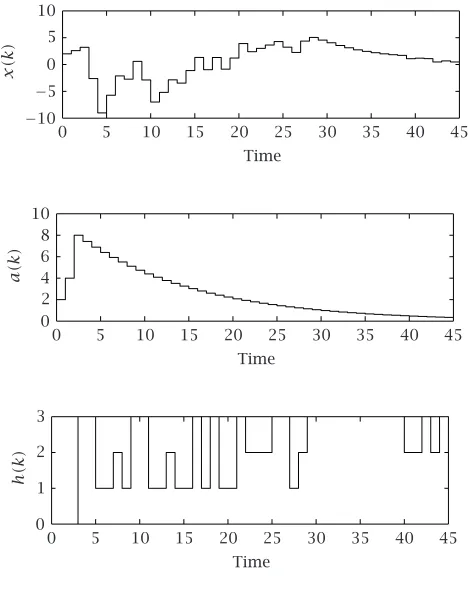
45 40 35 30 25 20 15 10 5 0 Time −10 −5 0 5 10 x( k) 45 40 35 30 25 20 15 10 5 0 Time 0 2 4 6 8 10 a(k) 45 40 35 30 25 20 15 10 5 0 Time 0 1 2 3 h(k)
Figure 4.1. Simulation result.
(ii) Controller
a(k+ 1)=
0.928a(k), h(k)=0, 2a(k), h(k)=0,
u(k)= −
1.2η(k), h(k)= {1, 2, 3}, 0, h(k)=0,
η(k)=
−2a(k)
3 , h(k)=1, 0, h(k)=2,
2a(k)
3 , h(k)=3.
(4.38)
Acknowledgments
This work was done during the first author’s stay at the Department of Electrical En-gineering and Telecommunications, University of New South Wales, Sydney, Australia. The paper was supported by the Australian Research Council and in part by the Na-tional Basic Program in Natural Sciences, Vietnam. The authors would like to thank the anonymous referees for their valuable remarks and comments, which have improved our paper.
References
[1] R. W. Brockett and D. Liberzon,Quantized feedback stabilization of linear systems, IEEE Trans. Automat. Control45(2000), no. 7, 1279–1289.
[2] D. F. Delchamps,Stabilizing a linear system with quantized state feedback, IEEE Trans. Automat. Control35(1990), no. 8, 916–924.
[3] G. Escobar, R. Ortega, and H. Sira-Ramirez,Output-feedback global stabilization of a nonlinear benchmark system using a saturated passivity-based controller, IEEE Trans. Contr. Syst. Tech. 7(1999), 289–293.
[4] G. Feng and J. Ma,Quadratic stabilization of uncertain discrete-time fuzzy dynamic system, IEEE Trans. Circuits Systems I Fund. Theory Appl.48(2001), 1337–1344.
[5] J. Klamka,Controllability of Dynamical Systems, Mathematics and Its Applications (East Euro-pean Series), vol. 48, Kluwer Academic Publishers, Dordrecht, 1991.
[6] Z. G. Li, C. Y. Wen, Y. C. Soh, and W. X. Xie,The stabilization and synchronization of Chua’s os-cillators via impulsive control, IEEE Trans. Circuits Systems I Fund. Theory Appl.48(2001), no. 11, 1351–1355.
[7] G. N. Nair and R. J. Evans,Stabilization with data-rate-limited feedback: tightest attainable bounds, Systems Control Lett.41(2000), no. 1, 49–56.
[8] ,Exponential stabilizability of finite-dimensional linear systems with limited data rates, Automatica39(2003), no. 4, 585–593.
[9] I. R. Petersen and A. V. Savkin,Multi-rate stabilization of multivariable discrete-time linear sys-tems via a limited capacity communication channel, Proceedings of the 40th IEEE Conference on Decision and Control, Orlando, 2001, pp. 304–309.
[10] ,State feedback stabilization of uncertain discrete-time linear systems via a limited capac-ity communication channel, Proceedings of IEEE Conference on Information, Decision and Control, Adelaide, 2002, pp. 211–216.
[11] V. N. Phat,Stabilization of linear continuous time-varying systems with state delays in Hilbert spaces, Electron. J. Differential Equations (2001), no. 67, 1–13.
[12] ,New stabilization criteria for linear time-varying systems with state delay and norm-bounded uncertainties, IEEE Trans. Automat. Control47(2002), no. 12, 2095–2098. [13] ,Constrained Control Problems of Discrete Processes, Series on Advances in Mathematics
for Applied Sciences, vol. 42, World Scientific Publishing, New Jersey, 1996.
[14] V. N. Phat and T. T. Kiet,On the Lyapunov equation in Banach spaces and applications to control problems, Int. J. Math. Math. Sci.29(2002), no. 3, 155–166.
[15] D. J. Stilwell and B. E. Bishop,Platoons of underwater vehicles: communication, feedback and decentralized control, IEEE Control Systems Magazine20(2000), 45–52.
[16] V. Venkataramanan, K. Peng, B. M. Chen, and T. H. Lee,Discrete-time composite nonlinear feedback control with an application in design of a hard disk drive servo system, IEEE Trans. Contr. Syst. Tech.11(2003), 16–23.
[18] ,Systems with finite communication bandwidth constraints. II. Stabilization with limited information feedback, IEEE Trans. Automat. Control44(1999), no. 5, 1049–1053.
V. N. Phat: Institute of Mathematics, 18 Hoang Quoc Viet Road, Cau Giay, 10307 Hanoi, Vietnam E-mail address:[email protected]
J. Jiang: School of Electrical Engineering & Telecommunications, University of New South Wales, Sydney 2052, Australia