© 2015, IJCSMC All Rights Reserved
396
International Journal of Computer Science and Mobile Computing
A Monthly Journal of Computer Science and Information Technology
ISSN 2320–088X
IJCSMC, Vol. 4, Issue. 3, March 2015, pg.396 – 405
RESEARCH ARTICLE
A Tactic for Encrypting Stego-Image
Using AES and BPCS Algorithm
Shruti Gajare
1, Shiney Charles
2, Snehal Wagh
3, Vrunda Bhusari
4¹Computer department & Pune University, India
²Computer department & Pune University, India
³Computer department & Pune University, India
4Computer department & Pune University, India
1
[email protected]; 2 [email protected]; 3 [email protected]; 4 [email protected]
Abstract— In this paper, we are proposing a tactic to provide secure confidential data transmission through the internet which has revolutionized the mode of transmitting data. To achieve this we are using AES algorithm and BPCS steganography technique. The system
which we are proposing will first encrypt the confidential data to be transmitted by using the AES algorithm and then this encrypted data
is encapsulated into an image which acts as a cover image. For encapsulating the encrypted data into the image BPCS steganography is
used which has the reputation of providing large data embedding capacity and preventing the degradation of the quality of the stego
image. And now finally this stego image is encrypted by using AES algorithm thereby providing twofold protection to the confidential data
and thus overcoming the shortcomings of the previous researchers. So at the sender side two keys are generated i.e. a data encryption key
and an image encryption key. Now lastly at the sender side as an add-on feature the encrypted stego image is digital watermarked to
protect the authenticity of the data. Now this final encrypted stego image is sent to the receiver and the receiver would be able to extort the
encrypted data from the encrypted image and then would decrypt the encrypted stego image with the image encryption key. And then
finally with the help of the data encryption key the receiver will decrypt the encrypted data. Hence same set of keys are used for encryption
as well as for decryption and as two separate keys are used for encrypting the data and the image, the process of decryption is separable as
well as reversible due to the use of AES algorithm.
Keywords— Cryptography, Steganography, BPCS (Bit Plane Complexity Segmentation), AES (Advanced Encryption Standard), alpha
© 2015, IJCSMC All Rights Reserved
397
I. INTRODUCTION
Gaining access to internet has become the most essential part of today’s digital world with the fast advancements and modifications in secure areas of research and technology. A usage of internet publically is precarious as there is no privacy. Transmission of confidential data over an internet is risky. Elucidating the complication of data security, a digital image is used to encapsulate the secret information. In today’s rapidly changing digital world, the most important aspect of how to accomplish
security and authentication of data and image is a very big challenge. The internet is the most crucial medium to transmit data from one point to another across the globe. The matter of concern is to overcome the drawbacks of greatly prevailing threats such as confidential data that can be stolen or hijacked by hackers leading to modification or extraction of secure information which results into misuse and unsecure confidential data transmission across the globe.
This paper acquaints us with a novel scheme of separable reversible encrypted data hiding into encrypted image using Advanced Encryption Standards (AES)[1] and Bit Plane Complexity segmentation [2].In our proposed system, on sender side we are encrypting confidential data using AES algorithm to obtain a final encrypted d1ata then we select an image which acts as a cover image in which confidential data is to be hidden[3]. After selecting the image, the next step is to extract the features from the image and then we apply the BPCS algorithm which has a reputation of having high payload capacity[4] to embed encrypted data into the carrier image[5].Then AES algorithm is applied on the stego image so as to obtain an encrypted stego-image. This stego encrypted image is watermarked to protect the integrity of confidential data. This entire mechanism takes place on sender side and then this encrypted stego-image is sent to the receiver. In this model, uses symmetric cryptography. After sending the encrypted image by email we send the keys to the receiver by means of sms or call. The sending of keys via sms or call on mobile results into separation of channel which is a merit of our system because this helps us to increase the security of the system and it results in making the system highly secure.
© 2015, IJCSMC All Rights Reserved
398
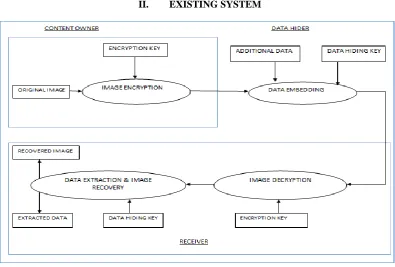
II. EXISTING SYSTEM
Fig. 1 Existing system
© 2015, IJCSMC All Rights Reserved
399
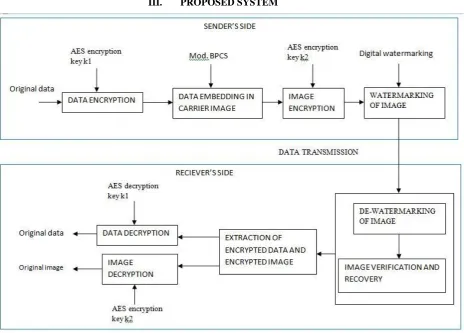
III. PROPOSED SYSTEM
Fig. 2 System architectural diagram
This project provides us a more secure way for sending data over internet by proposing a novel scheme of separable reversible encrypted data hiding into encrypted image using Advanced Encryption Standards (AES) and Bit Plane Complexity segmentation In the proposed system on the sender side, we are encrypting image as well as the data simultaneously. On the sender side firstly we encrypt the image using AES algorithm and then we encrypt the data using AES algorithm Now this encrypted confidential data which we want to embed into the image is encapsulated using modified BPCS, as it has abundant data hiding capacity. So now we get the final stego image which is a combination of encrypted image and data. And the stego image contains confidential data which is to be transmitted over the internet. The process of embedding encrypted data into the encrypted image is known as data hiding. This final encrypted stego image is then transmitted over the internet to the receiver.
© 2015, IJCSMC All Rights Reserved
400
IV. IMPLEMENTATION MODULES
The implementation modules of our proposed system are as follows:
A. Data Encryption
Fig. 3 Data Encryption
In this proposed system, the confidential data which we want to encapsulate is encrypted by means of cryptography. Sender firstly encrypts the data using AES algorithm which uses same key for encryption as well as decryption. AES algorithm uses 128 bits and 10 rounds to produce 128 bits cipher text. AES algorithm is ample of time faster than RSA in case of encrypting abundant amount of data and image.
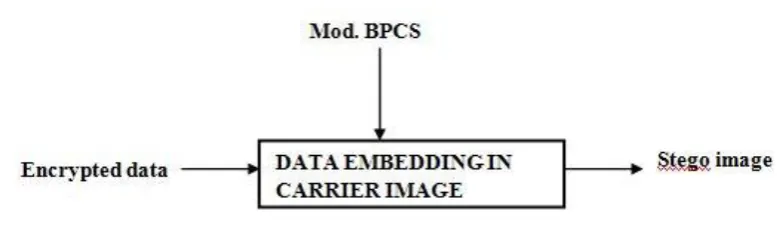
B. Data Embedding
Fig. 4 Data embedding into carrier image
© 2015, IJCSMC All Rights Reserved
401
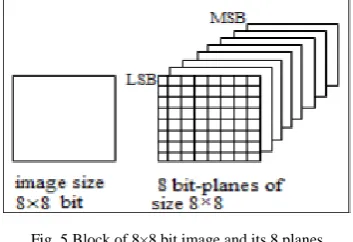
Every bit plane is divided into small square binary pixel blocks which are shown in figure below. The complexity α of each 8 bit plane is determined. The complexity is calculated by the amount of all adjacent pixels that has one black and one white pattern.
Fig. 5 Block of 8×8 bit image and its 8 planes
It uses the more complex regions of the carrier image to encapsulate encrypted data. The complexity of the bit plane is assigned to max minalpha.
Where α = (total length of black and white border in the image) / (The max. possible black–white changes in the image)
The value of α range is 0 ≤ α ≤ 1.If the complexity of bit-plane block is greater than minalpha then the data is embedded into carrier image. Again the complexity of the stego image is computed to check whether it is less than or equal to the value that of
minalpha. If it is less than it is conjugated with white chessboard pattern block and this information of each bit is recorded in 8 bit alpha plane.
C. Encryption of Image
Fig. 6 Encryption of stego image
© 2015, IJCSMC All Rights Reserved
402
D. WatermarkingFig. 7 Digital watermarking the stego image
In this model, digital watermarking technique is used. The major aim is to hide digital information in carrier signal. Generally, watermarking is used to crosscheck the integrity of the carrier signal. Input to this module is the stego encrypted image and the output is watermarked image which is finally sent to receiver.
E. De-watermarking
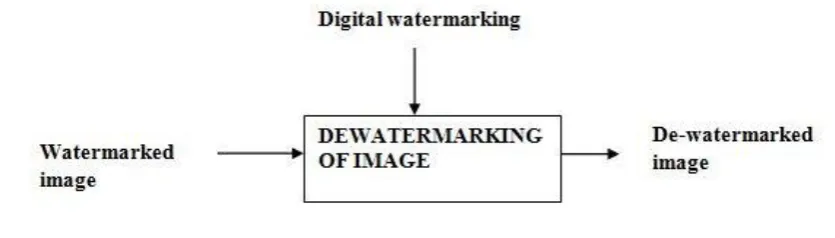
Fig. 8 De-watermarking the stego image
In this module, the water marked image is de-watermarked. It checks whether there are any changes in the watermarked image or not. If yes, then the recovery of image is performed.
F. De-steganography
© 2015, IJCSMC All Rights Reserved
403
G. Image decryptionFig. 10 Image decryption
After obtaining de- steganographic image, the receiver decrypts image by using the AES image encryption key which was used at the sender side. Finally, we obtain original image.
H. Data decryption
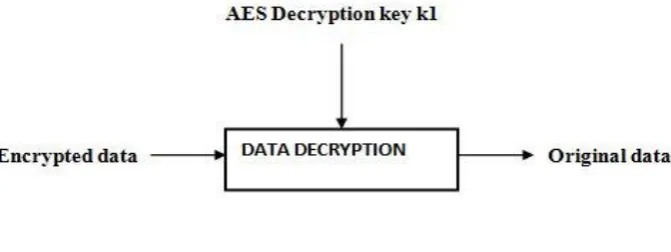
Fig. 11 Data decryption
After extracting confidential data, receiver gets two things encrypted AES key from AES algorithm and cipher text from AES encryption algorithm. Here we get encrypted data from data extraction this encrypted data then decrypted. So now receiver gets one time symmetric key. Using this symmetric key and same AES symmetric key algorithm which was used by sender, receiver encrypts cipher text and gets original data. Under this data transmission will be more secure using protection of AES algorithm.
V. RESULT AND DISCUSSION
© 2015, IJCSMC All Rights Reserved
404
Fig (a): original carrier image
Fig (b): the carrier image containing embedded data
Fig(c): Encrypted stego- image
VI. CONCLUSION
A technique called modified BPCS algorithm and AES algorithm is used in the proposed project which takes all the advantage of the previously proposed system. In this project, modified BPCS technique allows the user to embed large amount of data in the colored image as its pay load capacity is high as compared to Gray scale image. Also, we are providing two-fold protection by encrypting data and the stego- image for secure transmission of data in the network. The colored image is taken as cover image for encapsulating encrypted data in it. In case of colored image, the various features of the image is extracted and the image is divided into three bit planes of 8R,8G and 8B planes and a total of 24 bit plane which allows us to embed 3-bits of data in one pixel of image. Using BPCS algorithm, the encrypted data is hided in the image. After encapsulation, the image is again encrypted using AES algorithm. In order to detect any modification in image, the image is watermarked and is sent to receiver. The receiver will use the exact reverse process as that used as sender side. And using the same keys that are used for encryption, the receiver will decrypt the data and image using separable reversible approach. We have implemented AES algorithm here, as this algorithm operates on block cipher, so its speed is faster and is having three different key sizes. For future implementation, we would be able to use videos in place images to embed large amount of data.
ACKNOWLEGEMENT
© 2015, IJCSMC All Rights Reserved
405
REFERENCES
[1] Adam Berent, “Advanced Encryption Standard by Example” ,V.1.7.
[2] Eiji Kawaguchi and Richard O. Eason, "Principle and Applications of BPCS-Steganography", Kyushu Institute of Technology, Kitakyushu, Japan – University of Maine, Orono, Maine.
[3] M. S. Sutaone, M.V. Khandare," Image Based Steganography Using LSB Insertion Technique. Wireless,Mobile and Multimedia Networks," IET International Conference, pp-146 – 151, Jan 2008.
[4] Nisha,S. Kumar, "Image Quality Assessment Techniques," IJARCSSE,Vol.3, Issue 7, Jul 2013.
[5] S. Bansod,.V. Mane, L. Ragha, “Modified BPCS steganography using Hybrid Cryptography for Improving Data embedding Capacity, “ International Conference on Communication, Information & Computing Technology (ICCICT) Mumbai, India, Oct . 19-20, 2012.
[6] X. Zhang, “Reversible Data Hiding in Encrypted Image,” IEEE signals processing letters, vol. 18, no. 4, pp. 255-258, April 2011
[7] X.Zhang," Separable Reversible Data Hiding in Encrypted Image," IEEE transactions on information Forensics and Security, Vol.7,No.2,April 2012 [8] V.Santosh, J.Harish, R.V.K.Sumanth, N.Vijay and Dr.N.Sandhya," Separable Reversible Data Hiding In Encrypted Images," GRIET, Department of CSE,2013.
[9] T. Bianchi, A. Piva, and M. Barni, “Composite signal representation for fast and storage-efficient processing of encrypted signals,” IEEE Trans. Inform. Forensics Security, vol. 5, no. 1, pp. 180 187, Feb. 2010.
[10] Parag Kadam, Mangesh Nawale, Akash Kandhare and Mukesh Patil, "Separable Reversible Encrypted Data Hiding in Encrypted Image Using AES algorithm and Lossy Technique," 2013 International Conference on Pattern Recognition, Informatics and Mobile Engineering (PRIME)
[11] Rini.J, " Study on Separable Reversible Data Hiding in Encrypted Images ," International Journal of Advancements in Research & Technology, Volume 2, Issue 12, December-2013 223 ISSN 2278-7763.
[12] N.Memon and P. W. Wong," A buyer-seller watermarking protocol," IEEE Trans. Image Process, vol. 10, no. 4, pp. 643–649,Apr. 2001.