© 2014, IJCSMC All Rights Reserved 662
Available Online atwww.ijcsmc.com
International Journal of Computer Science and Mobile Computing
A Monthly Journal of Computer Science and Information Technology
ISSN 2320–088X
IJCSMC, Vol. 3, Issue. 8, August 2014, pg.662 – 668
RESEARCH ARTICLE
Improving the Effectiveness of
Learning Content Retrieval through
Content Classification and Profiling
V.R.Raghuveer
1, R.Mohanasundaram
2¹SCSE, VIT University, Vellore, India
2
SCSE, VIT University, Vellore, India
1
[email protected]; 2 [email protected]
Abstract— eLearning plays an important role in educating the people across the world. With the advancements in the WWW and communication technologies the developing countries like India harness the possibilities of creating educated communities. However the lack of proper learning content and appropriate support for the learners suppress the growth of eLearning. This paper proposes Collaborative eLearning System (CeLS) that uses classification based approach wherein, the LOs are provided through various groups such that the learner could get them from the group that can give the maximum support for learning. The results have highlighted that fact that learning content can no longer be created in ―one size fits all‖ fashion by sensitizing the effects of retrieving the most appropriate learning content for the learners.
Keywords— Learning Objects, granular LOs, classification of LO, learner support, active learning, learner groups
I. INTRODUCTION
V.R.Raghuveer et al,International Journal of Computer Science and Mobile Computing, Vol.3 Issue.8, August- 2014, pg. 662-668
© 2014, IJCSMC All Rights Reserved 663
object repositories, and dynamically tailored to each learner’s needs [3]. In order to achieve this, the LMS must know about the learner’s skills and preferences well in advance.
In a typical eLearning environment, the learner’s skills and preferences are recorded with the help of Learner Profiles (LP). It is this LP that plays a pivotal role in determining the best suitable LO for the learner over their learning cycle. The IEEE Public and Private Information and IMS Learner Information Package standards support creation and migration of LPs across the learning platforms so as to support the learners over different LMSs [6]. However, the LPs created based on these standards focus mainly on the preferences specified by the learner on the type of learning content and the mode of delivery. So the profiles are being used as a tool to filter the LOs based on the explicit preferences of the learners. This hinders the need for considering the implicit requirements of the learners and their changing needs over the learning cycle. Also, the Learning Object Metadata (LOM) which is used with every LO, is rarely given any weight even though it carries the sensitive information about the nature of the object. The survey on the usage of LOM attributes across the LMSs have highlighted that only a few attributes are frequently used along with the LOs and others are mostly being ignored. The reach of any LO created and delivered across the LMS relies on these metadata as it helps in identifying the objects precisely for the learner. The lack of LOM attributes and LP attribute usage that reflects the learner’s dynamic learning requirements has resulted in breeding of LOs that serves no purpose. With the growing demand for collaborative learning spaces, the need for interaction and grouping arises to create knowledge network wherein the learner is capable of sharing the bookmarks, create collaborative content, discuss and form groups to achieve a specific goal. Integrating the social learning as a part of Learning Management Systems helps to achieve effective learning over the existing platforms [4]. So, the LMS of today’s era must support the learner to get the precise content with proper social support in order to capitalize on the growth of technology.
II. PROPOSED SYSTEM
Since the existing systems allow objects to be created in any file format, the contents inside most of the objects are static by nature. The various formats in which the contents are presented to the learners are documents, videos, etc. These formats do not allow the existing content to be modified or allow for new content to be added dynamically. The drawbacks with the existing systems are due to the misunderstanding of the term LO and its definition by the content creators. In order to solve the problems with content presentation and structure, a new method of content creation has to be adapted such that the task of retrieving the precise content becomes easy.
The proposed system named Collaborative eLearning System (CeLS) addresses the issues related to large granular objects like eBooks, documents, etc. These include the common metadata for the entire document or eBook where only a few of the important elements inside the content are addressed through the metadata. To overcome the limitation in retrieving the precise contents, the LO must be assembled by composing the digital content along with the appropriate metadata. Such an assembly would help to create small granular LOs that can be easily retrieved through learner searches.
Granular content creation and assembly
Granularity of a LO can be purely based on the environment in which these LO are used. For example if the LO if it is a video object, it can be of 45 minutes to one hour that represents a class room lecture. However, for text objects there are no such restrictions on the amount of content that could represent a LO. So the text objects can be as simple as a definition or it can be a large one like a lesson or chapter. The Larger the LO, the more difficult for that to be reused by parts.
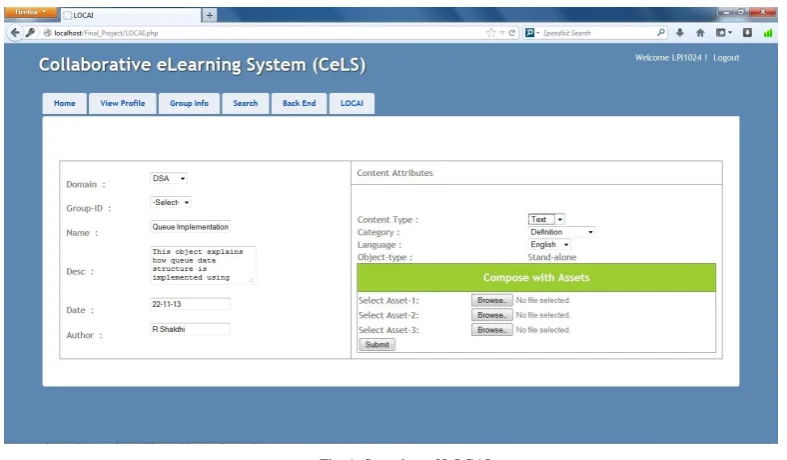
© 2014, IJCSMC All Rights Reserved 664 Fig. 1. Snapshot of LOCAI
LOCAI supports creation of LOs with respect to specific domains. It is this domain information that helps to classify the LOs. The domains are broad subject areas under which the LOs falls under. Examples of domains are data structures, artificial intelligence, etc.
Learner Profile creation
In CeLS the user information is stored under the learner profile. This LP is primarily categorized into Generic Profile (GP) and Specific Profiles (SP). The GP of the learner holds the basic information about the learner viz. personal, academic, preferences, skills, learner’s exposure to subjects, knowledge gained, etc. This information is recorded into the GP at the beginning of a course by the learner. The SP is created for each course the learner takes up. The need for classify the profiles arises out of maintaining specific preferences of the learners with respect to a subject domain. For example the learner may respond well with theorems in mathematics however when it comes to physics the learner may be good at graphical content. The difference in such subject related information is very well maintained across the different SPs created for each subject.
Fig.2. Architecture of CeLS
V.R.Raghuveer et al,International Journal of Computer Science and Mobile Computing, Vol.3 Issue.8, August- 2014, pg. 662-668
© 2014, IJCSMC All Rights Reserved 665
profile and LOs from the LPR and LOR respectively. The retrieved LOs are then filtered by the collaborative filtering approach where the affinity between the LOs and the Learner Profile is determined. This affinity value is used to order the LOs retrieved before it is being delivered to the learners.
Dynamic Learner Profile Update
The learner profile created in CeLS by considering the parameters of the IEEE and IMS standards reflects the activities of the learner over the eLearning environment. This is achieved by dynamically updating the profile of the learner whenever the learner learns a particular topic or they take up an interactive activity like quiz etc. Whenever the learner likes an object, the SP for that domain gets updated over the preferences, skills and knowledge aspects.
Content classification and grouping
This module of CeLS focuses on formation of learning groups and posting of learning contents. The groups thus created are to be administrated by the person who is made in-charge of the group. The content authors are allowed to post the small granular contents into the group under the appropriate domains. The contents thus posted will be advertised to all the members of the group. The group will have the content that will be available to all the members and non-members of the group along with the contents that are only available for its members. Each group has a moderator who has the role of approving or rejecting the LOs based on the suitability of the content. Several groups can be created under each subject domain in-order to host the contents of respective authors. All these groups have a common learning path to be followed by the learners.
Establishing support for LOs
The learners can either explicitly join the group or utilize the public content without joining the group. The group adds additional information to the LO in the form of peer support, alternative content, pre requisite, etc. The LOs of a particular group might have been understood by so many learners in the group. The people who understood that content are considered to be peers. The more the peer support for the content, the more will be the benefit for the learner. So the learner who wishes to learn from their peers would prefer the content that has the peer support. Similarly some learners expect the alternative explanation for the contents which they wish to learn. In such cases, the alternative content support on content adds weight to the content. The content classification helps to diversify the content options available to the learners based on the extent to which the support is provided. Whenever the learner searches for a specific content, the same content available in different groups are presented to the learner so that the learner can choose the content that provides the best support for them. Since the learner is not forced to explicitly join a specific group, the learner has the free hands to utilize the contents of different groups. Once when the learner has utilized a threshold number of objects from a specific group, the system would suggest the learner to join the group and utilize the unused contents of that group. This kind of dynamic group decision method greatly benefits the learners.
Mapping the learner profile to LOs
The final module is mapping the learner profile with the appropriate LOs that provides the proper support to the learners. This can be achieved by determining the attributes of the LP and the group attributes. First the learner profile attributes must be considered to identify the LOs that cater the requirements of the Learner Profile. For this, the learner profile attributes can be assigned weight based on the requirements of the learner. The LOs that caters the requirement of a particular learner profile are then retrieved. Such retrieved object’s parameters have to be evaluated against the learner profile attributes. If there is a match for a profile attribute in an object, then the matching on that attribute is considered to be successful. Otherwise the match on that attribute can be considered a failure.
Query handling and Domain filtering
The learner query keyword is used to retrieve the LOs for the learners. The interface must give the provision for the learner to enter the keyword based on which the search has to be made. Also there must be provision for searching with and without profiling.
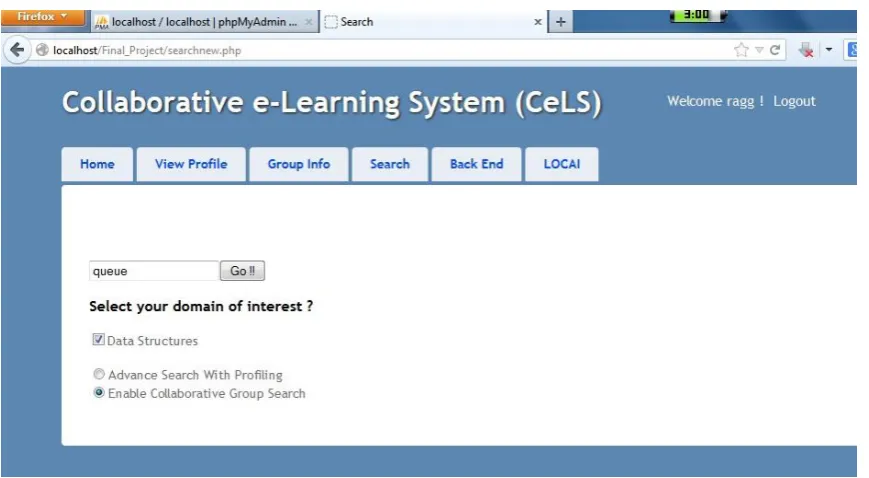
© 2014, IJCSMC All Rights Reserved 666 Fig. 3. Filtering the learner search based on domain
The interface in figure 3 presents the list of all the domains under which the retrieved LOs falls under. The learner in turn selects their domain of interest to fetch the LOs that of that domain. This gives the learner the flexibility in selecting the appropriate domain to filter the content.
Re-ranking the LOs based on learner profile mapping
The match on all the attributes of the learner profile with that of the LO can be represented in the form of a two dimensional matrix space. The rows of the matrix can represent the LOs retrieved and the columns represent the attributes of the learner profile. The cells of this matrix hold the information on whether a profile requirement is catered by that object or not. The collective information on all the cells of a row in that matrix represents the extent to which each object can cater the learner’s requirement.
Fig. 4. Re-ranked results retrieved based on a profile
V.R.Raghuveer et al,International Journal of Computer Science and Mobile Computing, Vol.3 Issue.8, August- 2014, pg. 662-668
© 2014, IJCSMC All Rights Reserved 667
III. EXPERIMENTAL RESULTS
In our work we have created about 64 small granular objects under the subject domain “Data Structures”. These LOs were given the appropriate description keywords and stored inside the LOR. A sample set of 32 learners took part in searching the LOs using the keywords. The learners were categorized into three batches viz. batch1 to batch3. Batch1 learners were beginners, whereas batch2 and batch3 learners were intermediate and advanced learners respectively. As the learners utilize the LOs, their profiles get updated with the information on the object’s utilization by the learner themselves. As the learner took up the Data structures course, the CeLS have recorded the utilization of LOs by the learners. The skills, preferences and knowledge of the learners were updated over the utilization of LOs. The precision of retrieval [5] was calculated through the formula given in 1,
Precision = {relevant documents} {retrieved documents} / {retrieved documents} (1)
Since most of the LOs retrieved are relevant to the query keyword used by the learner, the precision of retrieval at top k results is used as a measure to determine the accuracy. Precision at top k is the number of top k objects utilized over the total number of objects retrieved. The k value may be 1, 3, or 5 depending upon the application or the number of LOs available under a given topic. In our study we have considered the k value as 3 to determine the effectiveness of CeLS.
Table 1.0 lists the difference between the LOs retrieved and the number of LOs relevant for the learner with and without using CeLS based recommendation.
TABLEI
STUDY DATA ON LOS RETRIEVED THROUGH CELS
No. of learners
No. of search iterations
Objects utilized at top 3 (without CeLS)
Objects utilized at top 3 (with CeLS)
Precision at top 3 (without CeLS)
Precision at top 3(with CeLS)
Batch1 12 28 11 19 0.39 0.67
Batch2 10 24 8 17 0.33 0.7
Batch3 10 22 8 13 0.36 0.59
Mean 10.6 21.3 9 16.33 0.36 0.65
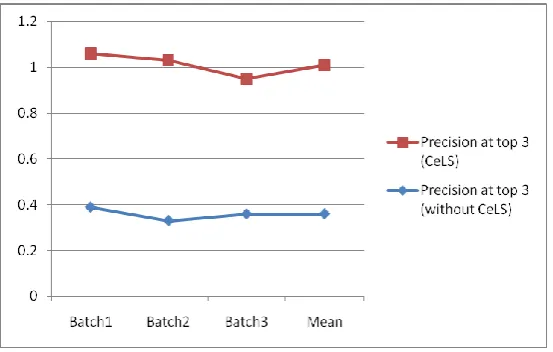
The graph in figure 5 shows the difference between the effectiveness of LO retrieval in traditional LMSs and in CeLS.
Fig. 5. Traditional LO retrieval vs. CeLS
IV.RESULT ANALYSIS
© 2014, IJCSMC All Rights Reserved 668
V. CONCLUSION AND FUTURE WORK
The problems associated with large granular LOs have been resolved by creating an interface to assemble the LOs. These small granular LOs can be used in combination to create a large granular content like a chapter or a lesson. However, due to the voluminous amounts of LOs available across the WWW, there is an inherent need to give the most suitable object for the learner based on their learning skills. So this work addressed the issue by considering the skills, preferences and knowledge of the user with respect to a subject domain to find the most suitable LOs for the learner. Altogether, the CeLS have proved to be effective in retrieving the most relevant objects for the learners which the other popular LMS failed to achieve. The future work is aimed at dynamically updating the weight of the profile attributes in order to give additional privilege for the most important attribute that highlights the learner’s interest.
REFERENCES
[1] Antonio Garrido and Eva Onaindia, Assembling Learning Objects for Personalized Learning: An AI Planning Perspective”, IEEE transactions on Intelligent Systems, March/April 2013, pg: 64-73.
[2] Hanane Zitouni, Lamia Berkani, Omar Nouali “Recommendation of learning resources and users using an aggregation-based approach”, 2012 IEEE Second International Workshop on Advanced Information Systems for Enterprises.
[3] Georgios Tsoulouhas, Dimitrios Georgiou and Alexandros Karakos “Adaptive Content Presentation in Asynchronous Learning Systems”,June 2012,pp 43-49, Democritus University of Thrace, Xanthi, Greece, http://dx.doi.org/10.3991/ijet.v7i2.1911.
[4] Zhao Du, Xiaolong Fu, Can Zhao, Qifeng Liu and Ting Liu, “Interactive and collaborative E-Learning platform with integrated social software and Learning Management System”, Proceedings of the 2012 International conference on Information technology and Software Engineering, Lecture notes in Electrical Engineering 212, Springer-Verlag, 2012, Pg:11-18.
[5] Manning, C. D., Raghavan, P., & Schütze, H. (2008). Introduction to information retrieval (Vol. 1, p. 6). Cambridge: Cambridge university press.