in the Toxin Neutralization Assay
Hang Lu, Jason Catania, Katalin Baranji, Jie Feng, Mili Gu, Janet Lathey, Diane Sweeny, Hannah Sanford, Kavita Sapru, Terry Patamawenu, June-Home Chen, Alan Ng, Zenbework Fesseha, Stefanie Kluepfel-Stahl, Jacob Minang, David Alleva Emergent BioSolutions, Inc., Gaithersburg, Maryland, USA
The cell-based anthrax toxin neutralization assay (TNA) is used to determine functional antibody titers of sera from animals and humans immunized with anthrax vaccines. The anthrax lethal toxin is a critical reagent of the TNA composed of protective anti-gen (PA) and lethal factor (LF), which are neutralization targets of serum antibodies. Cytotoxic potency of recombinant LF (rLF) lots can vary substantially, causing a challenge in producing a renewable supply of this reagent for validated TNAs. To address this issue, we characterized a more potent rLF variant (rLF-A) with the exact native LF amino acid sequence that lacks the addi-tional N-terminal histidine and methionine residues present on the commonly used form of rLF (rLF-HMA) as a consequence of the expression vector. rLF-A can be used at 4 to 6 ng/ml (in contrast to 40 ng/ml rLF-HMA) with 50 ng/ml recombinant PA (rPA) to achieve 95 to 99% cytotoxicity. In the presence of 50 ng/ml rPA, both rLF-A and rLF-HMA allowed for similar potencies (50% effective dilution) among immune sera in the TNA. rPA, but not rLF, was the dominant factor in determining potency of serum samples containing anti-PA antibodies only or an excess of anti-PA relative to anti-rLF antibodies. Such anti-PA content is re-flected in immune sera derived from most anthrax vaccines in development. These results support that 7- to 10-fold less rLF-A can be used in place of rLF-HMA without changing TNA serum dilution curve parameters, thus extending the use of a single rLF lot and a consistent, renewable supply.
A
nthrax is caused by contact withBacillus anthracisspores (via inhalation, ingestion, cutaneous, and injection routes) that germinate and produce a tripartite exotoxin that is the predomi-nant virulence factor of disease (reviewed in reference1). The toxin consists of a binding moiety, protective antigen (PA), which forms complexes with either lethal factor (LF), to form lethal toxin (LT), or edema factor (EF), to form edema toxin. The mechanism of action of these anthrax toxins is that PA forms a heptamer pore that enables LF, a zinc metalloproteinase, or EF, a calmodulin-dependent adenylate cyclase, to translocate to the cytoplasm (2). In most cell types, the protease activity of LF targets the N termi-nus of several mitogen-activated protein kinase kinases, thereby disrupting several cellular functions, leading to different types and degrees of toxicity that are cell type dependent (2). An additional cytotoxic mechanism exists in some, but not all, macrophage types (the cell type most sensitive to LT-mediated lysis) in which LF directly activates the inflammasome-activating molecule, Nlrp1b, leading to caspase-1 activation (3,4).Medical countermeasures against anthrax include the Food and Drug Administration-licensed BioThrax (anthrax vaccine adsorbed), also referred to as AVA (http://www.cdc.gov/phpr /stockpile/stockpile.htm), which is indicated for active immuni-zation for the prevention of anthrax disease. Investigational an-thrax vaccines, including recombinant protein-based vaccines and those with additional adjuvants, are under development (5,
6). Serum titers of anthrax LT-neutralizing antibodies following vaccination have been evaluated in animal models of anthrax dis-ease and in human clinical immunogenicity studies (7–10). While antibodies to all toxin components can be detected via an enzyme-linked immunosorbent assay (ELISA) after vaccination with AVA, serum titers of antibodies to PA are most prevalent and appear to be responsible mainly for LT-neutralizing activity in the anthrax toxin neutralization assay (TNA) (11–14). In fact, most reported TNAs were designed to emphasize this anti-PA antibody
neutral-izing contribution, which is the best-accepted correlate of im-mune protection for certain anthrax vaccine formulations (15–
17). This is primarily because PA is considered the principal antigen in licensed vaccines and those in development (5–7). In-deed, TNA responses have the potential to be species neutral (10), which is an advantage relative to quantitation via antibody bind-ing assays.
The TNA consists of a monolayer of LT-sensitive cell lines, the most widely used being the murine macrophage cell lines J774A and RAW264, to which optimal concentrations of recombinant PA (rPA) and LF (rLF) are added in the presence of serially diluted immune sera. After a 4-h incubation, the degree of cytotoxicity is measured via a redox viability dye, which allows for a 50% effec-tive dilution (ED50) potency value to be obtained from the serum titration curve (18,19). The specific rPA and rLF concentrations of 50 and 40 ng/ml, respectively, have been used in most reported TNA validation and immunogenicity studies of animal and hu-man vaccinations (15,18–24). Although potency among rPA pro-duction lots is consistent (our unpublished observation), the po-tency of rLF is known to vary substantially among lots. This creates a challenge in producing a renewable supply of this critical reagent for validated TNAs; i.e., consistent production of rLF lots of specific potency required for use at 40 ng/ml is difficult (25). This issue has been elucidated with respect to the N-end rule of protein degradation, in which most commercially available rLF is
Received25 January 2013 Returned for modification19 February 2013
Accepted22 April 2013
Published ahead of print1 May 2013
Address correspondence to David Alleva, [email protected].
Copyright © 2013, American Society for Microbiology. All Rights Reserved.
doi:10.1128/CVI.00046-13
on August 17, 2020 by guest
http://cvi.asm.org/
derived from an expression vector that results in two additional amino acid residues, histidine (His) and methionine (Met), at the N terminus (26). This N-terminal amino acid addition increases ubiquitination and proteasomal targeting of rLF for degradation (25,27). Commercially available rLF containing these additional N-terminal His and Met residues (rLF-HMA) has been shown to be less potent than the rLF form with the naturally occurring amino acid sequence (native) of LF (rLF-A), as proteolytic degra-dation of the N terminus of rLF-HMA may lead to variable po-tency (25, 27). Therefore, we determined whether reduced amounts of rLF-A could be used with the standard 50 ng/ml rPA concentration in the TNA to generate serum neutralization po-tency (i.e., ED50) and other serum dilution curve parameters that were similar to those obtained with 40 ng/ml rLF-HMA.
MATERIALS AND METHODS
Production and purification of rPA and rLF preparations.The anthrax LT components rPA, rLF-A, rLF-HMAE(rLF containing additional
N-terminal His and Met residues), and rLF-d (rLF-HMAEN-terminally
di-gested with diaminopeptidase) were produced at Emergent BioSolutions, Inc. (Gaithersburg, MD) (Table 1). Both of the vectors expressing rLF-A and rLF-HMA were licensed from the National Institutes of Health (Be-thesda, MD). Another lot of rLF-HMA, rLF-HMAL, was produced by List
Biological Laboratories, Inc. (Campbell, CA) (Table 1). The fermentation process of rPA, rLF-A, and rLF-HMAEwas based on a method described
elsewhere (26), in which the fermentation product was harvested by cen-trifugation at 2 to 8°C and the supernatant was concentrated using tan-gential-flow filtration. The purification process was performed at 2 to 8°C and consisted of a hydrophobic interaction capture column, an ion-ex-change purification column, and a final hydrophobic polishing column. All purification columns were operated using standard linear salt gradi-ents per the manufacturer’s recommendations. Minor modifications to linear salt gradients were used for rLF purification columns.
Generation of rLF-d was performed by subjecting rLF-HMAEto
N-terminal dipeptidase activity of dipeptidylaminopeptidase I (DAPase I; Qiagen, Valencia, CA) for 1.5 h at 37°C in 10 mM Tris, 1 mM EDTA, pH 8.0. DAPase I was removed by Ni-agarose resin (Qiagen) per the manu-facturer’s recommendations.
SDS-PAGE.Integrity and purity of rLF were analyzed via SDS-PAGE using precast NuPAGE 4 to 12% Bis-Tris gels (Invitrogen, Grand Island, NY). rLF samples were prepared with a final concentration of 1⫻ NuPAGE LDS sample buffer (Invitrogen) and 2-mercaptoethanol (2.5%) in which 1g of protein was loaded on the gel. Electrophoresis was per-formed for 35 min with a constant voltage of 200 V. Gels were stained with microwave blue stain (Protiga, Frederick, MD) and destained with water. Gel images were captured and analyzed by a GS-800 calibrated densitom-eter (Bio-Rad, Hercules, CA).
Western blotting.Western blotting was performed with rLF samples separated by SDS-PAGE (as described above) with 0.1g of protein. The
gel was transferred to an immunoblot polyvinylidene difluoride (PVDF) membrane (Bio-Rad), and a polyclonal anti-rLF mouse serum pool was used to tag the transferred LF protein on the membrane. The tagged LF protein was detected with an alkaline phosphatase-labeled anti-mouse IgG conjugate (KPL, Gaithersburg, MD). The anti-rLF sera were pooled from female CD-1 mice that received two 0.5-ml intraperitoneal (i.p.) injections of 100g rLF-A with 750g Alhydrogel (Alhydrogel 2%; Brenntag Biosector, Frederikssund, Denmark) and 100g CPG 7909 on days 0 and 14. Sera were obtained on day 28. Immunoreactive positive bands were visualized with addition of 5-bromo-4-chloro-3-indolylphos-phate–nitroblue tetrazolium (BCIP/NBT) substrate (KPL), and Western blot images were captured via a GS-800 calibrated densitometer.
Protein N terminus sequencing.N-terminal sequences of rPA and rLF proteins were determined with the Edman degradation method (Mid-west Analytical Inc., St. Louis, MO). Approximately 35g of each protein was transferred to a ProSorb PVDF cartridge (Applied Biosystems, Foster City, CA) and sequenced on a model 477 protein sequencer (Applied Bioysystems). Phenylthiohydantoin (PTH) amino acids were separated on a Perkin-Elmer Spheri-5 ODS column (2.1 by 220 mm), and their relative amounts were used to determine percentages of each protein pres-ent in a mixture.
Generation of immune serum samples from anthrax vaccines. Ani-mal studies were conducted in compliance with the AniAni-mal Welfare Act and followed the principles of the Guide for the Care and Use of Labora-tory Animals from the National Research Council (NRC). These animal procedures were approved by Institutional Animal Care and Use Com-mittee (IACUC). Immune sera were obtained via immunization of differ-ent animal species with various anthrax vaccines, in which all species received either one or two 0.5-ml intramuscular (i.m.) or i.p. injections of various dilutions (1/2.5 to 1/20 in normal saline) of AVA, AVA with 250 g CPG 7909 (Girindus AG, Cincinnati, Ohio) (28), or 75g rPA (Emer-gent BioSolutions Inc.) containing 750g Alhydrogel. Sera were obtained 3 to 74 weeks after a single injection or 2 weeks after a second injection. Nonhuman primates (NHP) were challenged with virulentB. anthracis
spores (Ames strain) 70 days after two immunizations on days 0 and 28. NHP sera were collected 2 months after challenge (Table 2). The following are characteristics of animals used for immunization: female CD-1 mice 5 to 8 weeks of age (Charles River, Raleigh, NC), female New Zealand White rabbits (Spring Valley Laboratories, Inc., Woodbine, MD), and male and female cynomolgus macaques (1.5 to 2.6 kg of body weight; Vietnamese origin; Covance Research Products, Alice, TX). Human subjects were de-scribed previously (28). Aliquots of all sera were stored at⫺20°C and thawed immediately prior to use.
MLA.The J774A.1 mouse macrophage cell line (ATCC; TIB-67, Ma-nassas, VA) was cultured in 75-cm2flasks in Dulbecco’s modified Eagle’s
medium with high glucose (DMEM; Sigma, St. Louise, MO) supple-mented with 10% heat-inactivated fetal bovine serum (FBS; HyClone, Logan, UT), 2 mML-glutamine, 1 mM sodium pyruvate, 0.11 mM so-dium bicarbonate, 50 U/ml of penicillin G, and 50g/ml of streptomycin sulfate (complete DMEM). Endotoxin was not detected in the reagents TABLE 1Preparations and sources of anthrax lethal toxin components recombinant protective antigen (rPA) and lethal factor (rLF)
Reagenta Sourceb(lot no.) Expression vector % of N-terminal amino acid sequencec
rPA Emergent (02-PUR-10-002) pBP103 EVKQE... (95)
rLF-HMAE Emergent (03-PUR-10-001) pSJ115 HMAGG... (95)
rLF-HMAL List Biologicals (1722BB) pSJ115 HMAGG... (21)
rLF-A Emergent (08-PUR-12-001) pSJ115b ...AGGHG... (95)
rLF-d Emergent (011311) pSJ115 ...AGGHG.../...GHG... (50/50)
arLF-A, native amino acid sequence; rLF-HMA, additional N-terminal His and Met residues; rLF-d, rLF-HMA
Edigested with N-terminal dipeptidase. b
Emergent BioSolutions, Inc. (Gaithersburg, MD), and List Biological Laboratories, Inc. (Campbell, CA).
cProtein N-terminal integrity was assessed via Edman degradation sequencing expressed as the percentage of the expected N-terminal amino acid sequence in each preparation. A
total of 4 production lots of rLF-A showed similar results, and at least 7 production lots of rLF-HMAEshowed similar results (all lots showed acceptable purity ofⱖ95% as assessed by N-terminal sequencing).
on August 17, 2020 by guest
http://cvi.asm.org/
and media described above. Cells were harvested with a sterile plastic scraper and suspended in complete DMEM at a density of 3⫻105viable
cells/ml (assessed via trypan blue exclusion assay); 3⫻104cells were
seeded in 100l per well of polystyrene 96-well round-bottom tissue culture plates (BD, Franklin, NJ) and incubated for 16 to 24 h at 37°C, 5% CO2. Culture medium was discarded before incubation with rPA and rLF.
The macrophage lysis assay (MLA) using different concentrations of rPA and rLF was performed by diluting reagents in appropriate volumes of complete DMEM. One hundredl of toxin mixture was transferred to appropriate wells containing adherent cells and incubated for 4 h at 37°C, 5% CO2. Cell viability was assessed via the addition of 25l per well of the
redox viability dye, 3-(4,5-dimethylthiazolyl-2)-2,5-diphenyltetrazolium bromide (MTT; 5 mg/ml in phosphate-buffered saline [PBS]; Sigma), for 1 h at 37°C and 5% CO2that was dissolved with addition of 100l of
solubilization buffer and overnight incubation at 37°C (20% [wt/vol] SDS [Sigma] dissolved in 50% N,N-dimethyl formamide [Sigma] in deionized water with the pH adjusted to 4.7 using 1 M HCl). Absorbance was mea-sured at 570 and 690 nm, and the 690-nm optical density (OD) values were subtracted from the 570-nm values using a calibrated Molecular Devices Versamax plate reader with SoftMax Pro software (version 5.4.1; Sunnyvale, CA). Cells in the negative-control wells containing only com-plete DMEM without toxin showed maximal cell viability (0% cytotoxic-ity), whereas cells cultured with the maximal concentrations of rPA and rLF demonstrated complete (100%) cytotoxicity. The percent cytotoxicity of different combinations of rPA and rLF was calculated as (ODLT sample⫺
OD100% cytotoxicity)/(OD0% cytotoxicity⫺OD100% cytotoxicity)⫻100%. The
cytotoxic potency of rLF (50% effective concentration [EC50]) was
calcu-lated via the sigmoidal dose-response variable slope fit analysis using log10(rLF) (GraphPad Prism 5.04 software; GraphPad Software, Inc., La
Jolla, CA).
TNA.The TNA was performed as previously described (18, 19). Briefly, the J774A.1 mouse macrophage cell line was cultured and seeded in 96-well round-bottomed plates as described for the MLA. Test and reference sera were diluted in a 2-fold serial manner in complete DMEM in a fresh 96-well flat-bottomed dilution plate yielding a total of 7 dilu-tions. LT was prepared at specified concentrations using the appropriate lots of rPA and rLF by diluting reagent stocks in appropriate volumes of complete DMEM. Equal volumes of the diluted LT preparation were added to serial dilutions of sera, and the mixture was incubated for 60 min, at which time 100l of the LT and serum mixture were transferred to appropriate wells containing adherent cells. Culture medium was dis-carded before addition of LT and serum mixtures. Control wells contain-ing diluted serum in complete DMEM without LT (no toxin controls) and naive mouse sera with LT (negative control) were included. Cells were incubated for an additional 4 h at 37°C with 5% CO2. Cell viability was
assessed via MTT reduction assay as described above.
The neutralizing potency (i.e., ED50) of immune sera was calculated
via a 4-parameter logistic (4PL) fit curve (SoftMax Pro 5.4.1 software) as the reciprocal of the dilution at the curve inflection point representing
50% LT neutralization. In some instances in which samples of low neutralizing activity did not achieve complete neutralization, the up-per and lower asymptotes of the test sample neutralization curves were constrained to the upper and the lower asymptotes of the reference serum curve so that accurate ED50values could be determined. ED50
values of test sera were reported if the respective positive-control, negative-control, and reference serum samples passed all plate accep-tance criteria. Plate accepaccep-tance criteria included the following: a ref-erence serum curve coefficient of determination (R2) of⬎0.985, upper
asymptote OD value of⬎0.70, a difference in OD values of the wells containing the lowest and highest serum dilutions of⬎0.55 OD units, two negative-control OD values ofⱕ20% of the coefficient of variance, 6th and 7th serial dilution OD values of the positive-control and ref-erence serum samples were within 0.25 OD units of the negative-control average, the positive-negative-control curve upper asymptote was within 0.297 OD units of that for the reference serum, and positive-control and reference serum OD values were monotonic between the 3rd, 4th, and 5th serial dilutions. Test serum ED50values were
report-able if the dilution curve showed anR2of⬎0.969 and ED50of⬎30, if
OD values were monotonic among 3rd, 4th, and 5th serial dilutions, if the OD value of the lowest possible dilution was ⬎0.601 (limit of detection [LOD]), if the test sera full-curve upper asymptote was within 0.297 OD units of that for the reference serum, and if the curve depth was⬎0.661 OD units. The 50% neutralization factor (NF50) is
the quotient of the ED50of a test sample serum and the ED50of refer-ence sera.
Statistical analysis.Statistical analyses were performed using Graph-Pad Prism version 5.04 (GraphGraph-Pad Software, Inc.) as well as SAS version 9.2 or JMP version 9.0 (SAS Institute, Inc., Cary, NC). For comparisons between two groups, the unpaired, two-tailed Student’sttest was used. When necessary, Welch’s correction for unequal variance was applied. For comparisons between three or more groups, either analysis of vari-ance (ANOVA) (parametric) or Kruskal-Wallis ANOVA (nonparamet-ric) was used depending on the distribution of the data set. For compari-sons to control groups within the multiple groups, Dunnett’s (ANOVA) multiple-comparison posttest was used. For comparisons between all groups within the multiple groups, Dunn’s (Kruskal-Wallis) multiple-comparison posttest was used. The two one-sidedttest (TOST) was used to determine equivalence between TNA curve parameters generated from rLF-HMALor rLF-A used in the TNA. Equivalence bounds were selected
for each curve parameter using 20% of the respective mean values for all samples tested under the standard (rLF-HMAL) conditions. For all
anal-yses described above, the level of statistical significance was established as ␣ ⫽0.05. Lin’s concordance coefficient was used to assess the degree of agreement in ED50and NF50values of the test samples measured in the
TNA using various LT conditions, and Deming linear regression was used to obtain the equivalence line slope and intercept estimates (seeFig. 4 to6).
TABLE 2Immune sera generated from different species and anthrax vaccinesa
Species
Total no. of samples
Vaccine used (no. of samples)
No. of
immunizations Injection route
rPA⫹
Alhydrogel AVA
AVA⫹ CPG 7909
NHP 15 0 15 0 2b i.m.
Rabbit 45 0 8 37 1 or 2c i.m.
Human 12 0 0 12 2 i.m.
Mouse 32 11 12 9 1 i.p.
aSerum samples were obtained from nonhuman primates (NHP), rabbits, humans, and mice that were immunized with one or two injections of vaccine via intraperitoneal (i.p.) or
intramuscular (i.m.) injections.
bNHP subjects were exposed to a lethal aerosolized dose ofBacillus anthracisspores after the second injection.
c
Fifteen samples were derived from one immunization and 30 from two immunizations (7 AVA and 23 AVA/CPG 7909 sera were derived from animals that received two immunizations).
on August 17, 2020 by guest
http://cvi.asm.org/
RESULTS
Biochemical characterization of rLF lots.Most commercially available sources of rLF (e.g., List Biological Laboratories) contain additional N-terminal His and Met residues (rLF-HMA), which
are by-products of the expression vector system (26) and cause a reduction in cytotoxic potency (25,27). By measuring the propor-tion of N-terminal sequences via Edman degradapropor-tion, we showed that rLF-HMA material produced by Emergent BioSolutions (rLF-HMAE) containedⱖ95% of the expected N-terminal se-quence. The same protein produced by List Biological Laborato-ries, Inc. (rLF-HMAL), showed 21% of this expected sequence (Table 1), demonstrating substantial N-terminal degradation. Pre-sumably, this degradation most likely is attributed to differences in trace levels of endogenous protease activity during the production and purification processes. This possibility was supported by a brief (90-min) digestion of rLF-HMAEwith the dipeptidase, DAPase I, resulting in the removal of N-terminal His and Met residues that yielded two rLF digestion products (rLF-d) that varied in length in the first two or four amino acids (Table 1). Such rLF-d material showed an expected profile similar to that of rLF-A by SDS-PAGE and West-ern blotting (Fig. 1). Note that the rLF-A preparation showed a highly pure profile of the expected sequence and material (Table 1andFig. 1). In addition, differences in N-terminal sequence content between rLF-HMA preparations correlated with expected degradation pro-files in SDS-PAGE and Western blot analyses (i.e., rLF-HMAEyielded a single band demonstrating a high degree of purity that is consistent with N-terminal sequencing results, whereas that of rLF-HMAL yielded multiple bands that were consistent with degradation). Note that the SDS-PAGE and Western blotting bands do not resolve dif-ferences among the relatively pure materials that differed by 1 or 2 N-terminal amino acid residues (i.e., rLF-A, rLF-d, and rLF-HMAE) (Fig. 1).
Association of cytotoxic potency with N-terminal residue content of different rLF preparations.Cytotoxic potency of dif-FIG 1Analysis of different rLF preparations via SDS-PAGE (A) and Western
blotting (B). Procedures were described in Materials and Methods. Aliquots of 1.0g (A) or 0.1g (B) of rLF protein were loaded per lane. (A) The gel was stained with microwave blue stain. (B) For Western blotting, SDS-PAGE ma-terial was transferred to an immunoblot PVDF membrane, which was then probed with mouse anti-rLF sera followed by alkaline phosphatase-conjugated anti-mouse IgG conjugate, and rLF bands were visualized with the addition of BCIP/NBT substrate. Both SDS-PAGE and Western blot images were captured by the GS-800 calibrated densitometer. rLF-A, native LF sequence. rLF-HMAE and rLF-HMAL, which contain additional N-terminal Met and His residues, were produced by Emergent BioSolutions and List Biological Laboratories, respectively. rLF-d, rLF-HMAEdigested with N-terminal dipeptidase, which removed 2 or 4 N-terminal residues. Lanes: 1, molecular mass markers; 2, rLF-HMAE; 3, rLF-HMAL; 4, rLF-A; 5, rLF-d (rLF, 90 kDa).
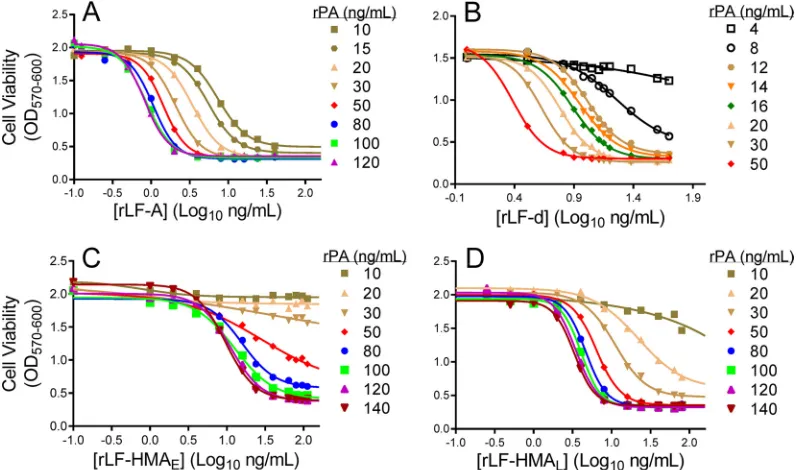
FIG 2(A to D) Anthrax lethal toxin (LT) cytotoxicity profiles of different rLF preparations in the macrophage lysis assay (MLA). Different concentrations of each rLF preparation (Table 1provides lot characteristics) were evaluated for cytotoxic potency in the presence of different concentrations of rPA. rLF-A, native rLF sequence produced by Emergent BioSolutions. rLF-HMAEand rLF-HMALcontain additional N-terminal Met and His residues and were produced by Emergent BioSolutions and List Biological Laboratories, respectively. rLF-d, rLF-HMAEdigested with N-terminal dipeptidase, which removed 2 or 4 N-terminal residues. rLF concentration-response curves were generated using a sigmoidal dose-response variable slope fit analysis using GraphPad Prism 5.04. Data were generated using a single rLF lot that was representative of 4 lots of rLF-HMAE, 2 lots of rLF-d, and 4 lots of rLF-A with similar results.Table 3shows rLF EC50s of each curve.
on August 17, 2020 by guest
http://cvi.asm.org/
ferent rLF expression variants was evaluated using MLA. Different concentrations of rLF-A, rLF-d, rLF-HMAE, and rLF-HMALwere combined with different concentrations of a single rPA lot, and the resulting mixtures were added to monolayers of the LT-sensi-tive macrophage cell line, J774A.1, for assessment of cytotoxicity. Concentration-response curves of rLF cytotoxicity in the MLA demonstrated that different threshold concentrations of rPA and the respective rLF preparation were necessary to achieve complete cytotoxicity (maximum lower plateau of curve) (Fig. 2). In addition, increased potencies of rLF preparations correlated with increased rPA concentration, such that rLF concentra-tion-response curves shifted to the left (more potent) in the presence of greater rPA concentrations (Fig. 2), resulting in decreased EC50s with increasing rPA concentrations (Table 3). For comparison of EC50s among the different rLF preparations, only rPA concentrations that allowed for 100% cytotoxicity were used to calculate EC50s. Consistent with N-terminal se-quence analyses, rLF-A and rLF-d showed similar EC50s in the presence of respective rPA concentrations (Table 3). In addi-tion, rLF-A showed approximately 4-fold greater potency (lower EC50) than rLF-HMAL(similar to results of others [27]) and approximately 16-fold greater potencies than rLF-HMAE. Interestingly, rLF-HMAL showed an approximately 3.5-fold greater potency than rLF-HMAE(in the presence of 100, 120, and 140 ng/ml rPA), which correlated with the increased N-ter-minal degradation of rLF-HMAL. Note also that rLF-A lot pro-duction showed consistent EC50s among 4 lots in the presence of 50 ng/ml rPA (mean EC50s of 2.0, 1.9, 1.7, and 1.7 ng/ml;P⫽ 0.47 by ANOVA). These results confirm those of others that N terminus sequence integrity of rLF has a substantial effect on
cytotoxic potency (25), and that increased potency of the N-terminally degraded rLF-HMALmaterial relative to that of the highly pure, nondegraded rLF-HMAE is consistent with the N-end rule of protein instability via proteasomal degradation. Characterization and selection of rPA and rLF concentra-tions for use in the TNA.We next identified optimal concentra-tions of rLF for use in the TNA to evaluate whether different con-centrations of the different rLF variants had an impact on serum neutralization curve parameters. A requirement for LT compo-nent use in the TNA in our laboratory is that the combination of rLF and rPA concentrations shows 95 to 99% cytotoxicity in the MLA. This degree of cytotoxicity provides optimal toxin activity for assessing serum neutralization potency. An MLA using a single lot of rPA in combination with different rLF materials showed a pattern of reagent concentrations that achieved 95 to 99% cyto-toxic activity in which increases in rPA concentrations required concomitant decreases in rLF concentrations (Table 4). In addi-tion, lower effective concentrations of rPA were associated with more potent rLF preparations. For example, the potent rLF-A and rLF-d materials allowed for 95 to 99% cytotoxic activity in the presence of rPA concentrations as low as 15 ng/ml, whereas the less potent rLF-HMALand rLF-HMAEmaterials allowed for a similar degree of cytotoxicity, with rPA concentrations only as low as 50 and 100 ng/ml, respectively (Table 4).
rLF-A and rLF-HMA effects on serum dilution curve param-eters in the TNA.We identified the optimal concentration of rLF-A that showed cytotoxic activity most similar to that of 40 ng/ml rLF-HMALby testing a range of rLF-A concentrations that passed the 95 to 99% cytotoxicity criteria in the presence of 50 ng/ml rPA. rLF-A concentrations of 5 and 6 ng/ml showed similar TABLE 3Cytotoxic potency (EC50) of rLF preparations in the presence of different concentrations of rPA in the macrophage lysis assay (MLA)
using J774A.1 cells
rLF preparationa
EC50[ng/ml; means (SD) from 6 tests] at the indicated rPA concn (ng/ml)b:
15 20 30 50 80 100 120 140
rLF-A 6 (1.1) 3.8 (0.7) 2.5 (0.4) 1.7 (0.3) 1.1 (0.2) 1 (0.2) 0.9 (0.2) ND
rLF-HMAL NR NR NR 6.5 (1.2) 5.1 (0.8) 4.3 (0.6) 4 (0.5) 3.7 (0.4)
rLF-HMAE NR NR NR NR NR 16.1 (2.9) 13.8 (2.1) 12.1 (2.1)
rLF-d 8.1 (1.7) 5.7 (0.9) 4.6 (0.2) 3.9 (1.7) ND 1.5 (1) ND ND
aDifferent concentrations of each rLF preparation were evaluated for cytotoxic potency in the presence of different concentrations of rPA (rLF-A, native LF sequence; rLF-HMA E and rLF-HMALcontain additional N-terminal Met and His residues and were produced by Emergent BioSolutions and List Biological Laboratories, respectively; rLF-d was derived from rLF-HMAEdigested with N-terminal dipeptidase, which removed 2 or 4 N-terminal residues).
b
rLF dose-response curves that demonstrated 100% cytotoxicity were used to calculate the EC50using a sigmoidal dose-response variable slope fit analysis of log10(rLF) concentration curves using GraphPad Prism 5.04. Data were from a single rLF lot that was representative of 4 lots of rLF-HMAE, 2 lots ofrLF-d, and 4 lots ofrLF-A with similar results. ND, not determined; NR, not reported (EC50s of curves that did not reach 100% cytotoxicity were not reported, because accurate comparisons of curves require similar degrees of cytotoxicity).
TABLE 4Inverse relationship of rPA and rLF concentrations achieving 95 to 99% cytotoxicity in the MLAa
rLF preparationb
rLF concn (ng/ml) causing 95 to 99% MLA cytotoxicity at the indicated rPA concn (ng/ml)c:
140 120 100 80 50 30 20 15 10
rLF-A ND 3 3 3 4–6 8 12–16 24–64 NA
rLF-HMAE 64 64–80 80–112 NA NA NA NA NA NA
rLF-HMAL ND 16 16 24 32–40 NA NA NA NA
rLF-d ND ND 3 ND 6–8 10 13–16 24 NA
aEvaluation of different rLF concentrations in combination with those of rPA demonstrated unique rPA and rLF combinations that achieved optimal cytotoxicity between 95 and
99% for use in the anthrax toxin neutralization assay (TNA). brLF-A, native LF sequence. rLF-HMA
Eand rLF-HMAL, containing additional N-terminal Met and His residues, were produced by Emergent BioSolutions and List Biological Laboratories, respectively. rLF-d was derived from rLF-HMAEdigested with N-terminal dipeptidase, which removed 2 or 4 N-terminal residues.
cND, not determined; NA, not applicable (rLF concentration did not induce at least 95% cytotoxicity).
on August 17, 2020 by guest
http://cvi.asm.org/
cytotoxicity (i.e., cell viability and OD) relative to rLF-HMAL, whereas 4 ng/ml rLF-A showed significantly (P⬍0.05) lower cytotoxicity than rLF-HMAL(Fig. 3A). This cytotoxicity profile correlated with the profile of serum ED50 values, in that ED50 values of two mouse immune serum samples (derived from pooled sera of mice that received a single i.p. injection of AVA plus CPG 7909) obtained in the presence of 4 ng/ml rLF-A were greater than that of rLF-HMAL, whereas those obtained in the presence of 5 and 6 ng/ml A were similar to those obtained with rLF-HMAL(Fig. 3BandC). While both 5 and 6 ng/ml rLF-A yielded similar cytotoxicity results, the lower concentration of 5 ng/ml was selected to ensure that potential excessive cytotoxicity would be avoided. These two immune serum samples were further eval-uated in three independent TNA experiments, each with 4 (lot MS122010) or 5 (lot MS011211) replicate measurements, in the presence of 50 ng/ml rPA with either 5 ng/ml rLF-A or 40 ng/ml rLF-HMAL. The four parameters, A, B, C, and D (upper asymp-tote, slope, ED50, and lower asymptote, respectively), of serum dilution 4PL fit curves generated with 5 ng/ml rLF-A and 40 ng/ml rLF-HMA were similar (Table 5).
The selection of 5 ng/ml rLF-A was confirmed by evaluation of a panel of immune sera obtained from mice immunized with dif-ferent anthrax vaccines (Table 2) in the TNA using 50 ng/ml rPA in combination with rLF-HMAL(40 ng/ml) or three
concentra-tions of rLF-A (4, 5, and 6 ng/ml). As previously described forFig. 3A,4ng/ml rLF-A showed significantly less cytotoxicity, while 5 and 6 ng/ml A showed cytotoxicity similar to that of rLF-HMAL(40 ng/ml). Such modest but significant differences in the degree of cytotoxicity among rLF-A concentrations correlated with modest shifts in serum ED50values; i.e., 4 ng/ml rLF-A re-sulted in slightly greater serum ED50values, while 5 ng/ml rLF-A resulted in serum ED50values most similar to those obtained with 40 ng/ml rLF-HMAL(Fig. 4).
Although 5 ng/ml rLF-A was identified as the optimal concen-tration for TNA serum potency comparisons to the standard con-ditions with 40 ng/ml rLF-HMAL, all three concentrations of rLF-A, 4, 5, and 6 ng/ml, qualified for use in the TNA, because (i) the three concentrations passed the 95 to 99% MLA cytotoxicity criteria using 50 ng/ml rPA and (ii) differences in cytotoxicity and serum ED50values among these concentrations (notably, 4 ng/ml rLF-A) were relatively small (Fig. 3and4). In fact, normalization of each test sample ED50value to an NF50value using the serum reference ED50as the denominator predictably led to normaliza-tion of the differences between 4 ng/ml rLF-A and 40 rLF-HMAL (Fig. 4D). Moreover, the TNA performed with immune sera from mice, humans, NHP, and rabbits vaccinated with different an-thrax vaccines showed that potency values (ED50and NF50) ob-tained with 5 ng/ml rLF-A were similar to those obob-tained with 40 FIG 3Identification of optimal rLF-A concentration relative to rLF-HMALat 40 ng/ml for comparison of TNA ED50values of immune sera. Two lots of pooled sera from mice immunized with AVA plus CPG 7909 (Table 5describes the serum samples) were evaluated in the TNA using 50 ng/ml rPA in the presence of rLF-HMALat 40 ng/ml or rLF-A at 4, 5, or 6 ng/ml. The lowest rLF-A concentration that yielded cytotoxicity and an ED50most similar to that of rLF-HMALwas considered optimal (i.e., 5 ng/ml). Each serum lot was evaluated with 13 replicate measurements, and the means⫾standard deviations (SD) are reported. *, OD (A) and ED50(B and C) values obtained with 4 ng/ml rLF-A were significantly different from those obtained with rLF-HMAL(P⬍0.05 by Kruskal-Wallis test with Dunn’s multiple-comparison posttest).
TABLE 5Effects of rLF preparations on the anthrax TNA serum dilution 4-parameter logistic fit curve characteristics
Serum samplea
rLF preparation ([rPA]/ [rLF], both in ng/ml) nb
Upper asymptote
(OD) Slope ED50
Lower asymptote (OD)
Mean
(⫾SD) P
Mean
(⫾SD) P
Mean
(⫾SD) P
Mean
(⫾SD) P
MS011211 rLF-A (50/5) 3 1.88 (0.10) 0.45 2.27 (0.14) 0.10 2.130 (214) 0.11 0.47 (0.04) 0.14
rLF-HMAL(50/40) 3 1.89 (0.16) 2.06 (0.19) 1.914 (106) 0.43 (0.03)
MS122010 rLF-A (50/5) 3 2.00 (0.18) 0.45 2.30 (0.15) 0.18 10.363 (949) 0.15 0.46 (0.04) 0.20
rLF-HMAL(50/40) 3 1.98 (0.10) 2.19 (0.12) 9.586 (57) 0.44 (0.02)
aAnthrax LT neutralization activity of two different lots (MS122010 and MS 011211) of pooled immune sera from CD-1 female mice (immunized with a single injection of 0.5 ml
of a 5-fold dilution in normal saline of AVA containing 500g/ml CPG 7909) were evaluated in the TNA using 50 ng/ml rPA in the presence of 40 ng/ml rLF-HMALor 5 ng/ml rLF-A. The rLF-A preparation was expressed from vector constructs containing the native LF sequence, whereas that of rLF-HMAL(produced by List Biological Laboratories, Inc., Campbell, CA) contained two additional N-terminal residues, His and Met.
bSerum dilution 4-parameter logistic fit curve parameter values were obtained from 3 independent experiments, each with 4 (MS122010) or 5 (MS011211) replicate measurements.
The 3 mean values from the respective experiments were used to derive the composite mean⫾SD values for each curve parameter, in which no significant differences were found between the composite means of curve parameters obtained with rLF-A or rLF-HMAL(P⬎0.05 by Student’sttest with Welch’s correction for unequal variance).
on August 17, 2020 by guest
http://cvi.asm.org/
ng/ml rLF-HMAL(Fig. 5). Other TNA curve parameters (upper and lower asymptotes and slopes) obtained with A and rLF-HMALwere also similar (data not shown). Note that some of these samples were derived from NHP challenged withB. anthracis
spores after immunization and from species that received one or two immunizations. These results demonstrate the robustness of the rLF-A reagent concentration variable in the TNA, especially via serum NF50values.
Impact of total rLF concentration on TNA curve parameters. The observation that serum potency obtained with 40 ng/ml rLF-HMALwas similar to serum potency obtained with 4, 5, or 6 ng/ml rLF-A suggested that the degree of cytotoxicity, rather than total concentration, of rLF was a primary factor that di-rectly influenced the TNA outcome. This was confirmed by comparing serum TNA potency obtained with rLF-A to that obtained with a blend of rLF-A and rLF-HMAE, such that a total of 40 ng/ml was used (32 ng/ml rLF-HMAEplus 8 ng/ml rLF-A, which showed 95 to 99% cytotoxicity in the MLA). This
40 ng/ml concentration of the rLF blend was designed to be in molar equivalence to that used for rLF-HMAL, but it allowed for evaluation of a defined amount of rLF-A in the presence of a molar excess of less active rLF-HMA molecules. rLF-A alone was used at 4 ng/ml, which showed similar cytotoxicity to that of the rLF blend (Fig. 6). As expected, highly correlative ED50 values of immune sera were observed when either the rLF blend or rLF-A alone was used (Fig. 6). In addition, no significant differences were observed between rLF-A and the rLF blend regarding curve upper asymptotes, lower asymptotes, and slopes, and all curves passed test sample criteria as described in Materials and Methods (data not shown). These results con-firmed that a molar excess of rLF molecules did not affect TNA ED50values. Collectively, these results of the rLF blend confirm that the potent rLF-A used at a 7- to 10-fold lower concentra-tion (4 to 6 ng/ml) than the rLF-HMA material (40 ng/ml) could be used with the standard 50 ng/ml rPA in the TNA and maintain serum dilution curve parameters.
FIG 4(A to F) Serum TNA potency values obtained in the presence of rLF-A were in agreement with those obtained with 40 ng/ml rLF-HMAL. Anthrax LT neutralization potency (ED50and NF50) of immune sera from mice (n⫽32) immunized with different anthrax vaccines (AVA, AVA plus CPG 7909, or rPA plus Alhydrogel;Table 2describes the serum samples) were evaluated in the TNA using 50 ng/ml rPA in the presence of rLF-HMALat 40 ng/ml or rLF-A at 4, 5, or 6 ng/ml, respectively. Negative-control wells showed that 4 ng/ml rLF-A was less cytotoxic (greater OD value) than rLF-HMAL, whereas 5 and 6 ng/ml rLF-A were equivalent in cytotoxicity to that of rLF-HMAL(Fig. 5A). NF50values are the quotient of test sample ED50values divided by the reference serum ED50values obtained from the respective TNA plate (lot MS011211; ED50mean and SD, 2,130⫾214). The dotted line represents the Deming linear regression (orthogonal least-squares estimates) of log10(ED50) and log10(NF50) values obtained with rLF-A and rLF-HMAL, and the solid line represents the line of equivalence (slope, 1; intercept, 0). The degree of agreement between the log10(ED50) and log10(NF50) values obtained with 4, 5, or 6 ng/ml LF-A and 40 ng/ml LF-HMALwas calculated as Lin’s concordance coefficient (rcvalues).
on August 17, 2020 by guest
http://cvi.asm.org/
Dominance of the rPA component of LT in the TNA.The observation that rLF-A and rLF-HMALcytotoxic potency and concentration can vary without affecting serum neutralization curve parameters suggested that the concentration of 50 ng/ml rPA was the critical factor in maintaining these TNA parameters. This importance of 50 ng/ml rPA is based on a concept of rPA dominance in the TNA. To demonstrate the dominant contribu-tion of rPA (relative to rLF), different combinacontribu-tions of rPA and rLF concentrations that achieved 95 to 99% cytotoxicity were evaluated in the TNA to determine the relative importance of each component in the neutralization capacity of immune sera. To evaluate the widest range of rPA concentrations in the TNA, the
more potent rLF-A was used at various concentrations, such that an increase in rPA concentration required a concomitant decrease in rLF concentration to maintain 95 to 99% cytotoxicity (Table 4). Serum samples from mice immunized with AVA containing the oligodeoxynucleotide immunostimulatory sequence CPG 7909 (a Toll-like receptor-9 agonist) showed an inverse correlation be-tween ED50values and rPA concentration and a positive correla-tion with rLF-A and rLF-d concentracorrela-tion in the TNA (Fig. 7). This inverse relationship between serum ED50values and rPA concen-trations is predictable, in that a serum sample dilution curve would be expected to shift to the right (greater ED50) in the pres-ence of a lower concentration of the target molecule (i.e., toxin). Only the rPA, but not the rLF, concentration followed this prin-ciple of inverse correlation with serum potency, suggesting that the rPA concentration, but not that of rLF, would be important in maintaining serum dilution curve parameters.
This hypothesis of rPA concentration dominance in the TNA is further supported with results of the less potent rLF-HMA mate-FIG 5Evaluation of immune sera from multiple species that received different anthrax vaccines showed that TNA potency values obtained with 5 ng/ml rLF-A were equivalent to those obtained with 40 ng/ml rLF-HMAL. Anthrax LT neutralization potency (ED50and NF50) of immune sera (n⫽104) from humans, NHPs, rabbits, and mice immunized with different anthrax vaccines (AVA, AVA plus CPG 7909, or rPA plus Alhydrogel;Table 2describes the serum samples) was evaluated in the TNA using 50 ng/ml rPA in the presence of 40 ng/ml rLF-HMALor 5 ng/ml rLF-A, and log10(ED50) (A) and log10(NF50) (B) were reported. NF50 values are the quotient of test sample ED50values divided by the reference serum ED50values obtained from the respective TNA plate (lot MS011211; ED50mean and SD of 2,130⫾214). The dotted line represents the Deming linear regression (orthogonal least-squares estimates) of log10(ED50) and log10(NF50) values obtained with rLF-A and rLF-HMAL, and the solid line represents the line of equivalence (slope, 1; intercept, 0). The degree of agreement between the log10(ED50) and log10(NF50) values obtained with 5 ng/ml rLF-A and 40 ng/ml rLF-HMALwas calculated as Lin’s concordance coefficient (rcvalues).
FIG 6Assessment of increased rLF molarity on TNA ED50values of anthrax vaccine immune sera. Immune sera (n⫽93) obtained from humans and different animal species (mouse, rabbit, and NHP) immunized with an anthrax vaccine, AVA or AVA plus CPG 7909 (Table 2), were evaluated for neutralization potency (ED50) in the TNA using 50 ng/ml rPA in the presence of 4 ng/ml rLF-A or 40 ng/ml of a blend of rLF preparations (8 ng/ml of the more potent rLF-A and 32 ng/ml of the less potent rLF-HMAE). These con-centrations of rLF preparations showed levels of cytotoxicity (composite mean⫾SD of OD values [n⫽8 mean values from individual experiments]) similar to those of the negative controls of the rLF-A and rLF blends, 0.531⫾ 0.094 and 0.507⫾0.078, respectively (P⫽0.57 by Student’sttest). The dotted line represents the Deming linear regression (orthogonal least-squares esti-mates) of log10(ED50) values obtained with rLF-A and rLF-HMAL, and the solid line represents the line of equivalence (slope, 1; intercept, 0). Degree of agreement between the log10(ED50) values obtained with rLF-A and the rLF blend was calculated as Lin’s concordance coefficient (rc).
FIG 7Dominant contribution of the rPA component of LT in the TNA. The anthrax LT neutralization capacity (ED50) of immune serum derived from mice immunized with AVA plus CPG 7909 (sample lot MS011211) was deter-mined using LT comprised of different concentrations of rPA and rLF-A (A) or rPA and rLF-d (B). Data are mean (⫾SD) ED50values of either 10 (A) or 4 (B) replicate measurements. An asterisk indicates that mean ED50values of rPA/ rLF at 50/4 ng/ml (A) or 50/7 ng/ml (B) were significantly different from values derived with the corresponding rLF/rPA combinations of 20/16 and 100/3 or 100/3.5 ng/ml (P⬍0.05 by ANOVA with Dunnett’s posttest).
on August 17, 2020 by guest
http://cvi.asm.org/
rial used at optimal cytotoxic concentrations with 50 or 100 ng/ml rPA (95 to 99% in MLA). Mouse serum (MS011211; the same sample lot as that used forFig. 7) ED50values derived using rLF-A and rLF-HMA materials (rLF-HMALor rLF-HMAE) were similar, in which 50 ng/ml rPA with 5 ng/ml rLF-A or with 40 ng/ml rLF-HMALyielded ED50values (means⫾standard errors of the means [SEM]) of 2,130⫾214 and 1,914⫾106 (n⫽3), respec-tively, and 100 ng/ml rPA with 2 ng/ml rLF-A or with 100 ng/ml rLF-HMAEshowed ED50values of 1,531⫾67 or 1,517⫾57 (n⫽ 10), respectively. Different rPA concentrations were required be-cause of the substantial differences in cytotoxic potency between rLF-HMALand rLF-HMAE. That is, rPA concentrations lower than 50 or 100 ng/ml were not sufficient to achieve 95 to 99% cytotoxicity of the rLF-HMAL or rLF-HMAE lots, respectively (Table 4).
We hypothesized that the reason for the rPA component of LT in the TNA being the determining factor of serum potency (ED50) is that the anti-PA antibody content in sera derived from AVA immunization was represented in substantially greater levels than anti-LF (i.e., the natural anti-PA/anti-LF ratio of⬎10:1 [11,12,
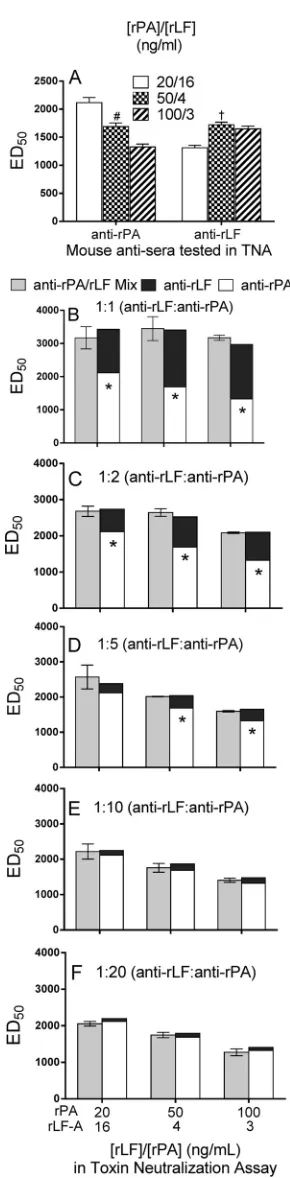
14]), causing a dominance of rPA activity in the TNA. Accord-ingly, there would be rLF dominance in the TNA if the anti-LF antibody fraction was in excess or a codominance of rPA and rLF activities if similar levels of both antibody fractions were present. To test this hypothesis, we generated mouse immune sera that contained only anti-rPA antibodies (immunization with adju-vanted rPA) or only anti-rLF antibodies (immunization with ad-juvanted rLF-A) to evaluate the pattern of LT component domi-nance in the TNA. As expected, sera that contained only anti-rPA antibodies showed a PA dominant pattern of LT neutralization, whereas serum containing only anti-rLF antibodies showed an rLF dominant pattern of LT neutralization (Fig. 8A). Note that the increase in ED50values with decreasing rLF-A concentration was only apparent between 16 and 4 ng/ml rLF-A but not between 4 and 3 ng/ml, presumably due to the relatively small difference between the latter concentrations. Anti-rLF and anti-rPA serum sample mixtures were based on the neutralization activity (i.e., ED50) of the individual anti-rPA and anti-rLF sera, such that a sample of a 1:1 ratio reflected serum content of equivalent ED50 values. When evaluated in the TNA using different combinations of optimal rPA and rLF-A concentrations (i.e., 95 to 99% cytotox-icity in the MLA), there was an additive contribution of the anti-rPA and anti-rLF fractions when both were represented in equal proportions or in an excess of anti-rPA activity of up to 5-fold (Fig. 8BtoD). This additive contribution of each antibody frac-tion was not significant when the ratio of anti-rPA to anti-rLF serum activity was increased to the natural ratios of⬎10:1
ob-FIG 8Additive neutralization activity of anti-rPA and anti-rLF mouse serum mixtures in the TNA. The anthrax LT neutralization capacity of anti-rPA (lot rPA-QC-H1) or anti-rLF-A (lot rLF-QC-2) mouse sera alone (A) or in com-bination (at ratios of 1:1, 1:2, 1:5, 1:10, or 1:20 anti-rLF to anti-rPA) (B to F) was evaluated using the TNA. (Anti-rPA sera were derived from a single im-munization with rPA plus Alhydrogel, and that of anti-rLF was from two immunizations with rLF-A plus Alhydrogel and CPG 7909.) Serum mixture ratios were based on the neutralization capacity of each sample, in which the
final 1:1 mixture contained equal ED50values for the anti-rPA and anti-rLF serum samples. Accordingly, each serum sample evaluated alone was diluted in an equivalent manner with naive mouse serum. LT was composed of 20, 50, or 100 ng/ml rPA with 16, 4, and 3 ng/ml rLF-A, respectively. Data are the ED50s (means⫾SD) of either 2 (1:2 and 1:5 mixtures) or 4 (1:1, 1:10, and 1:20 mixtures) replicate evaluations. (A) A number sign indicates significantly dif-ferent ED50values obtained with 20/16 and 100/3 ng/ml rPA/rLF combina-tions (anti-rPA sera;P⬍0.05, two-tailed Student’sttest). A dagger indicates a significantly different value from the ED50value obtained with the 20/16 ng/ml (rPA/rLF) combination (anti-rLF sera;P⬍0.05 by two-tailed Student’sttest). (B to D) An asterisk indicates significant difference in ED50value of the anti-rPA serum alone (control; white bar) from that of the respective anti-rLF/anti-rPA serum mixture (gray bars) (P⬍0.05 by two-tailed Student’sttest).
on August 17, 2020 by guest
http://cvi.asm.org/
served after AVA immunization (11,12) (Fig. 8EandF). These results support that the TNA can be sensitive to either LT compo-nent, but the excess content of the anti-PA antibody fraction that exists in sera derived from rPA-based or AVA vaccinations favors rPA dominance in the TNA.
DISCUSSION
This study demonstrated that the potent rLF-A material with the native LF amino acid sequence (of high purity) can be used in place of the less potent rLF-HMA material (of variable purity) in the TNA while maintaining serum neutralization curve parame-ters. Because of the increased cytotoxic potency of rLF-A relative to that of rLF-HMA, rLF-A can be used at a 7- to 10-fold lower concentration in the TNA (4 to 6 ng/ml rLF-A versus 40 ng/ml rLF-HMAL), significantly extending the use of a single rLF lot. Such increased longevity of a single rLF-A lot appears to address the supply challenge of a renewable critical reagent for validated TNAs. Indeed, the native sequence characteristic of rLF-A may lend itself to greater biochemical relevancy in the TNA used for critical immunogenicity endpoints in anthrax vaccine and anti-body therapeutic development studies.
The precise inverse correlation of rPA and rLF concentrations to maintain the cytotoxic level at 95 to 99% appears to be dictated by the fixed density of anthrax PA receptors expressed by the fixed number of J774A.1 cells in the TNA culture well (29). Therefore, equilibrium should exist between the two LT component concen-trations, such that a specific concentration of the resulting rPA and rLF cytotoxic complex is achieved that engages a specific number of receptors to maintain 95 to 99% cytotoxicity. The sim-ilarity of 95 to 99% cytotoxicity between 5 ng/ml rLF-A and 40 ng/ml rLF-HMALis likely due to a similar number of active rLF molecules that efficiently bind the finite number of PA heptamers (heptamer formation is limited by rPA concentration; i.e., 50 ng/ ml). Furthermore, it is likely that competitive binding to PA hep-tamers occurs between active and inactive (due to extensive deg-radation) or less active (due to instability mediated by N-terminal His and Met) rLF molecules in the rLF-HMALpreparation. There-fore, a greater concentration of active rLF molecules would be expected in rLF-HMALrelative to that of rLF-A to induce a similar degree of PA binding and cytotoxicity. This rLF competitive bind-ing concept between active and less active rLF molecules is evident in our rLF blend results (Fig. 6), in which the degree of cytotoxicity mediated by 4 ng/ml rLF-A required 8 ng/ml rLF-A in the pres-ence of 32 ng/ml of very-low-potency rLF-HMAE. Note also that the 7:3 molar ratio of PA to LF of the receptor-mediated cytotoxic LT complex on the cell surface (30) is not reflected in the stoichi-ometry of rPA and rLF concentrations, because different ratios of rPA and rLF concentrations other than 7:3 achieved a similar de-gree of cytotoxicity in the MLA (e.g., 95 to 99%) (Table 4).
LT component dominance in the TNA was identified by cor-relating changes in rPA and rLF concentration (while maintaining 95 to 99% cytotoxicity) with the predicted changes in serum ED50 values; i.e., an inverse correlation between toxin concentration and serum potency is predictable, in that a serum sample dilution curve would be expected to shift to the right (greater ED50) in the presence of a lower concentration of the target molecule (i.e., toxin). Because LT contains two toxin components, we used this principle to show that changes in rPA, but not rLF, concentration followed this inverse correlation with ED50of all test sera (except that of anti-rLF sera, which showed an expected inverse
correla-tion with rLF concentracorrela-tion). The rPA component was the deter-mining factor of neutralizing potencies of all test sera because those samples contained either anti-PA antibodies only (i.e., from rPA plus Alhydrogel vaccination) or substantially greater anti-PA neutralizing content relative to that of anti-LF that is expected in sera derived from AVA vaccinations with or without CPG 7909 (11,12). Indeed, most anthrax vaccines in development are de-signed to induce a strong neutralizing anti-PA antibody titer as the predominant protective mechanism (11–14), in which case the rPA concentration, rather than the rLF concentration, would be the dominant component in those respective TNAs. However, the rLF concentration would be the dominant or determining com-ponent in the TNA if the anti-LF antibody neutralization titer was represented either in a pure form or in excess of anti-PA, as with a sample containing a therapeutic anti-LF monoclonal antibody (31,32) or that derived from an rLF-based vaccine. In summary, the dominant LT component of the TNA is determined by the proportional anti-PA and anti-LF neutralizing antibody content of a serum sample.
We showed that the combined neutralizing content of anti-PA and anti-LF sera yielded an additive effect, which is consistent with results of others using anti-PA and anti-LF monoclonal antibodies (32). Interestingly, this additive neutralizing activity of anti-PA and anti-LF polyclonal sera suggests that multiple neutralizing epitopes on PA and LF can be simultaneously recognized by anti-PA and anti-LF antibodies without causing a synergistic neu-tralizing effect. The threshold ratio of anti-PA to anti-LF neutral-izing content at which anti-LF neutralneutral-izing activity cannot be de-tected was 10-fold (Fig. 8). This anti-PA/anti-LF threshold ratio is not dependent on specific anti-LF antibody concentration, be-cause the extensive predilution of serum necessary to generate a full-neutralization TNA curve would result in overdilution of the anti-LF neutralizing fraction if it were at least 10-fold less than that of the anti-PA fraction. Therefore, the anti-LF neutralizing frac-tion was undetectable in our TNA. That anti-PA content is⬎ 10-fold higher than that of anti-LF antibodies in AVA immune sera (11,12) explains why there was no detectable effect on TNA serum potency upon desorption of the anti-LF fraction from sera (14), despite neutralizing activity of anti-LF antibodies isolated from human serum derived from AVA immunization having been demonstrated (11).
One of the first TNA validation reports described the selection of a molar functional excess of 40 ng/ml rLF-HMA relative to that of rPA to skew toward an anti-rPA-selective assay in which satu-ration binding of the anti-LF fraction with excess rLF molecules favored detection of anti-PA-mediated neutralization of LT (11,
19). This conclusion appears to have resulted in the use of the standard concentrations of 50 and 40 ng/ml for rPA and rLF-HMA, respectively, by the majority of laboratories reporting TNA validation and immunogenicity studies (15,18–24). Our results are in agreement with such a concept, in that increasing rLF-A concentration decreased the measured potency (and, most likely, sensitivity) of anti-LF antibody neutralizing activity (Fig. 8A). The idea of using an elevated concentration of low-potency rLF-HMA material is an attractive approach in creating an anti-PA-selective assay, which would be useful in evaluating the specific anti-PA neutralizing contribution in serum samples that contain substan-tial levels of anti-LF content. The objective of our study was to demonstrate that the use of a low concentration of the highly potent rLF-A material would not affect serum potency relative to
on August 17, 2020 by guest
http://cvi.asm.org/
that obtained with the higher concentration of lower potency rLF-HMALin the presence of 50 ng/ml rPA. While the use of lower concentrations of rLF-A relative to rLF-HMALmay pose a theo-retical risk of affecting serum ED50values, this would be unlikely to occur because, in most cases, the serum anti-LF neutralizing fraction is expected to be below the level of detection in the current TNA method (i.e., at least 10-fold lower than that of anti-PA). Indeed, we showed that ED50 values of all sera de-rived from AVA vaccination with or without CPG 7909 (from multiple species, including infection with spores) that are ex-pected to contain anti-LF antibodies were not affected by changes in rLF concentrations (i.e., rLF-A at 5 ng/ml versus rLF-HMALat 40 ng/ml). However, a comprehensive evaluation of anti-PA and anti-LF neutralization ratios in such sera is required to determine the frequency or conditions under which anti-LF content could be elevated to detectable levels in the TNA.
In conclusion, we showed that the standard 50 ng/ml rPA con-centration used in most developed TNAs reported was important in maintaining curve parameters for sera derived from most anthrax vaccines in development (rPA or AVA based). In addi-tion, the specific rLF potency, preparation (N-terminal residue content), or concentration did not appear to be important in ED50 determination of such vaccines as long as the cytotoxic level of LT was maintained at 95 to 99% and the anti-LF fraction was substan-tially smaller (i.e., at least 10-fold) than that of the anti-PA fraction in test sera. Our conclusions are consistent with guidance pre-sented in a commentary forB. anthracistoxin component consen-sus standards in which it was suggested that concentrations of LT components should be empirically derived per lot via checker-board MLA (22).
ACKNOWLEDGMENTS
We thank Sukjoon Park, Boris Ionin, Stephanie Banach, Brett Pleune, and Michael Lacy for their helpful scientific review of the manuscript.
REFERENCES
1.Tournier JN, Rossi PS, Quesnel-Hellmann A, Baldari CT.2009. Anthrax toxins: a weapon to systematically dismantle the host immune defenses. Mol. Aspects Med.30:456 – 466.
2.Moayeri M, Leppla SH.2009. Cellular and systemic effects of anthrax lethal toxin and edema toxin. Mol. Aspects Med.30:439 – 455.
3.Moayeri M, Sastalla I, Leppla SH.2012. Anthrax and the inflammasome. Microbes Infect.14:392– 400.
4.Levinsohn JL, Newman ZL, Hellmich KA, Fattah R, Getz MA, Liu S, Sastalla I, Leppla SH, Moayeri M.2012. Anthrax lethal factor cleavage of Nlrp1 is required for activation of the inflammasome. PLoS Pathog. 8:e1002638. doi:10.1371/journal.ppat.1002638.
5.Cybulski RJ, Jr, Sanz P, O’Brien AD.2009. Anthrax vaccination strate-gies. Mol. Aspects Med.30:490 –502.
6.Friedlander AM, Little SF.2009. Advances in the development of next-generation anthrax vaccines. Vaccine27(Suppl. 4):D28 –D32.
7.Bellanti JA, Lin FY, Chu C, Shiloach J, Leppla SH, Benavides GA, Karpas A, Moayeri M, Guo C, Robbins JB, Schneerson R.2012. Phase 1 study of a recombinant mutant protective antigen ofBacillus anthracis. Clin. Vaccine Immunol.19:140 –145.
8.Centers for Disease Control and Prevention.2010. Use of anthrax vaccine in the United States; recommendation of the Advisory Committee on Immuni-zation Practices, 2009. MMWR Morb. Mortal. Wkly. Rep.59:1–30. 9.U. S. Department of Health and Human Services, Food and Drug
Administration Center for Drug Evaluation and Research, and Cen-ter for Biologics Evaluation and Research.2009. Guidance for indus-try; animal models– essential elements to address efficacy under the animal rule. FDA, Rockville, MD.http://www.fda.gov/cber/guidelines .htm.
10. Fay MP, Follmann DA, Lynn F, Schiffer JM, Stark GV, Kohberger R, Quinn CP, Nuzum EO.2012. Anthrax vaccine-induced antibodies pro-vide cross-species prediction of survival to aerosol challenge. Sci. Transl. Med.4151ra126. doi:10.1126/scitranslmed.3004073.
11. Crowe SR, Garman L, Engler RJ, Farris AD, Ballard JD, Harley JB, James JA.2011. Anthrax vaccination induced anti-lethal factor IgG: fine specificity and neutralizing capacity. Vaccine29:3670 –3678.
12. Hepburn MJ, Hugh DE, Simpson AJ, Brenneman KE, Bailey N, Wilkin-son L, Hornby R, Mateczun AJ, Bell MG, Baillie LW.2007. Immune response to two different dosing schedules of the anthrax vaccine precip-itated (AVP) vaccine. Vaccine25:6089 – 6097.
13. Smith K, Crowe SR, Garman L, Guthridge CJ, Muther JJ, McKee E, Zheng NY, Farris AD, Guthridge JM, Wilson PC, James JA. 2012. Human monoclonal antibodies generated following vaccination with AVA provide neutralization by blocking furin cleavage but not by prevent-ing oligomerization. Vaccine30:4276 – 4283.
14. Taft SC, Weiss AA.2008. Neutralizing activity of vaccine-induced anti-bodies to two Bacillus anthracis toxin components, lethal factor and edema factor. Clin. Vaccine Immunol.15:71–75.
15. Omland KS, Brys A, Lansky D, Clement K, Lynn F.2008. Interlabora-tory comparison of results of an anthrax lethal toxin neutralization assay for assessment of functional antibodies in multiple species. Clin. Vaccine Immunol.15:946 –953.
16. Pitt ML, Little S, Ivins BE, Fellows P, Boles J, Barth J, Hewetson J, Friedlander AM.1999. In vitro correlate of immunity in an animal model of inhalational anthrax. J. Appl. Microbiol.87:304.
17. Little SF, Ivins BE, Fellows PF, Pitt ML, Norris SL, Andrews GP.2004. Defining a serological correlate of protection in rabbits for a recombinant anthrax vaccine. Vaccine22:422– 430.
18. Hering D, Thompson W, Hewetson J, Little S, Norris S, Pace-Templeton J.2004. Validation of the anthrax lethal toxin neutralization assay. Biologicals32:17–27.
19. Li H, Soroka SD, Taylor TH, Jr, Stamey KL, Stinson KW, Freeman AE, Abramson DR, Desai R, Cronin LX, Oxford JW, Caba J, Pleatman C, Pathak S, Schmidt DS, Semenova VA, Martin SK, Wilkins PP, Quinn CP.2008. Standardized, mathematical model-based and validated in vitro analysis of anthrax lethal toxin neutralization. J. Immunol. Methods333: 89 –106.
20. Brady RA, Verma A, Meade BD, Burns DL.2010. Analysis of antibody responses to protective antigen-based anthrax vaccines through use of competitive assays. Clin. Vaccine Immunol.17:1390 –1397.
21. Castelan-Vega J, Corvette L, Sirota L, Arciniega J.2011. Reduction of immunogenicity of anthrax vaccines subjected to thermal stress, as mea-sured by a toxin neutralization assay. Clin. Vaccine Immunol.18:349 – 351.
22. Hughes MA, Burns DL, Juris SJ, Tang WJ, Clement KH, Eaton LJ, Kelly-Cirino CD, McKee ML, Powell BS, Bishop BL, Rudge TL, Shine N, Verma A, Willis MS, Morse SA.2009. The case for developing con-sensus standards for research in microbial pathogenesis: Bacillus anthracis toxins as an example. Infect. Immun.77:4182– 4186.
23. Ngundi MM, Meade BD, Lin TL, Tang WJ, Burns DL.2010. Compar-ison of three anthrax toxin neutralization assays. Clin. Vaccine Immunol. 17:895–903.
24. Parreiras PM, Sirota LA, Wagner LD, Menzies SL, Arciniega JL.2009. Comparability of ELISA and toxin neutralization to measure immunoge-nicity of protective antigen in mice, as part of a potency test for anthrax vaccines. Vaccine27:4537– 4542.
25. Verma A, Wagner L, Stibitz S, Nguyen N, Guerengomba F, Burns DL. 2008. Role of the N-terminal amino acid of Bacillus anthracis lethal factor in lethal toxin cytotoxicity and its effect on the lethal toxin neutralization assay. Clin. Vaccine Immunol.15:1737–1741.
26. Park S, Leppla SH. 2000. Optimized production and purification of
Bacillus anthracislethal factor. Protein Expr. Purif.18:293–302. 27. Gupta PK, Moayeri M, Crown D, Fattah RJ, Leppla SH.2008. Role of
N-terminal amino acids in the potency of anthrax lethal factor. PLoS One 3:e3130. doi:10.1371/journal.pone.0003130.
28. Rynkiewicz D, Rathkopf M, Sim I, Waytes AT, Hopkins RJ, Giri L, DeMuria D, Ransom J, Quinn J, Nabors GS, Nielsen CJ.2011. Marked enhancement of the immune response to BioThrax (anthrax vaccine ad-sorbed) by the TLR9 agonist CPG 7909 in healthy volunteers. Vaccine 29:6313– 6320.
on August 17, 2020 by guest
http://cvi.asm.org/
29. Young JA, Collier RJ.2007. Anthrax toxin: receptor binding, internalization, pore formation, and translocation. Annu. Rev. Biochem.76:243–265. 30. Mogridge J, Cunningham K, Collier RJ.2002. Stoichiometry of anthrax
toxin complexes. Biochemistry41:1079 –1082.
31. Chen Z, Moayeri M, Purcell R.2011. Monoclonal antibody therapies against anthrax. Toxins (Basel)3:1004 –1019.
32. Albrecht MT, Li H, Williamson ED, LeButt CS, Flick-Smith HC, Quinn CP, Westra H, Galloway D, Mateczun A, Goldman S, Groen H, Baillie LW.2007. Human monoclonal antibodies against anthrax lethal factor and protective antigen act independently to protect against Bacillus anthracis infection and enhance endogenous immunity to anthrax. Infect. Immun.75:5425–5433.