Volume 3, No. 5, Sept-Oct 2012
International Journal of Advanced Research in Computer Science
RESEARCH PAPER
Available Online at www.ijarcs.info
ISSN No. 0976-5697
Context Informatics in Ubiquitous Computing
Prof. Ajay Gadicha*, Prof. Vijay B. Gadicha and Dr. A.S.Alvi Assistant Professor in Information Technology Department Amravati
Head Department of Computer Science & Engineering Amravati
Head, Department of Information Technology P.R.M.I.T & R, Badnera Amravati, India [email protected], [email protected], [email protected]
Abstract: Sensing the state of the environment is an important source for context-aware applications. Several approaches exist to provide sensor information to mobile application nodes. As the extreme cases we have pure infrastructures and p u r e a d h o c n e t w o r k s . In order to allow sensor platforms to serve both of these approaches, we have designed a universal sensor platform and integrated it into an infrastructure-based approach as well as into ad hoc networks. In this paper we discuss the requirements on such a platform, the design, and the experiences.
Keywords: AWQL, AWML,
I. INTRODUCTION
Sensing environmental conditions, such as tempera- ture, humidity or light conditions, is - besides location information - an important source of context information. Several approaches exist to provide sensor information to mobile application nodes. As the extreme cases we differ- entiate pure infrastructure-based systems and pure ad hoc- based systems. In an infrastructure-based system, a special context infrastructure is responsible for collecting, storing and offering context information to application nodes. This infrastructure is missing in ad hoc-based systems. Here mobile application nodes access sensors in their vicinity directly using short range communication technologies, store the context information locally and distribute it among other mobile devices while moving around. We will provide a more detailed discussion of these two models in the system model section.[1]
To allow interoperability among the various sensor sources, a common protocol is needed to uniformly access sensor information provided via an infrastructure or via an ad hoc system. In a large-scale project - the Nexus project [7] - we are developing an infrastructure that provides access to various kinds of information embedded in mod- els of the real world ranging from simple models to highly
Detailed 3D models. In order to access and model this information we have developed two XML-based lan- gauges, AWQL and AWML - the Augmented World Query Language and the Augmented World Modeling Language. In parallel to that we investigate the information exchange in plain ad hoc networks.[2]
To evaluate the feasibility of using AWQL and AWML for simple sensor devices, we have developed the Context- Cube, an autonomous sensor device that is deployed in the environment and offers context information [2]. If a sensor device provides access to its information using AWQL and AWML, mobile devices can retrieve this information and
the device can also be easily integrated into the Nexus infrastructure.
The paper is structured as follows. First, we will dis- cuss requirements on a context-retrieving platform that can feed infrastructures as well as ad hoc-based systems with sensor information. After that, the design of the Context- Cube is presented. We will discuss the integration of the Context Cube into the two system models before related work is presented.[3]
II. REQUIREMENTS
First we will discuss the two system models: infrastruc- ture-based and ad h oc-based. Briefly, a h ybr id s y s t e m model is sketched. Then the requirements on the integra- tion of a context sensing device into these system models are presented.
A. System Model:
At t w o extremes, infrastructure-based and ad hoc- based systems both provide a foundation for context-aware computing. In both cases, we assume users to carry mobile application devices, on which context-aware applications are executed. Sensors, either placed in the environment or attached to the mobile devices obtain sensor information. In the future, we expect that sensors will be deployed in a large number providing information about light, tempera- ture, humidity and other environmental conditions. Manu- factured in large quantities, they may become as cheap as an electric bulb and may be installed in the same way. Plugged into a power outlet, energy is not an issue and the sensors can operate nearly maintenance-free.
infrastructure to provide it with their sensor information. Using such an infrastructure allows applications to access context information which has been captured by sensors far away f r o m t h e i r c u r r e n t position b u t r e q u i r e s mobile devices and sensors to be connected to the infrastructure as all communication takes place through the infrastructure. This can become costly, e.g. in terms of energy usage.
In contrast to this, in an ad hoc-based system the con- text information is retrieved directly from autonomous sen- sors in the vicinity and stored on the mobile devices. To obtain context information that is not available locally, mobile devices have to exchange their stored sensor infor- mation with other mobile devices. As a result, it is likely that applications will only gain access to context informa- tion that has been captured in their physical vicinity.
Note, that the context information which is captured and made available immediately via an infrastructure can be considered current. In an ad hoc setting it is hard to ensure that the most recent state of a sensor observation is propagated. For a detailed discussion of this matter, see e.g. [9].
A hybrid system combines approaches, infrastruc- ture and ad hoc-based. Sensors are connected to the infra- structure but can also be accessed by mobile devices. Hence, the context information can be fed both into the infrastructure and directly to mobile application devices.
In the following, we want to look at the requirements resulting from the integration of sensor platforms into such a hybrid system.
B. Context Provision:
Let us now look at context capture and the provision of context to mobile application nodes. In the infrastructure case, the context is captured by sensors which are con- nected to the infrastructure via a sensor/infrastructure-spe- cific protocol. Nodes obtain the information through an interoperability protocol supported by the infrastructure. In An ad hoc case, the sensors may be located on the mobile structure-based approaches will co-exist and a sensor plat- form should be able to serve both worlds. In order to support applications with as much context information as is available, mobile nodes in ad hoc networks should be able to retrieve representation and exchange protocol is required. This pro-
tocol should be suitable for both the integration of the Con-
a. Integration into the Nexus Environment. As the goal
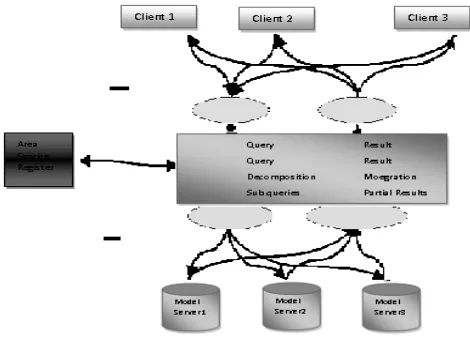
Figure 1: The Nexus Architecture
Using AWQL and AWML or, as we will see, a subset of these languages, for the interaction with the ContextCube allows an easy integration of the Context Cube into the Nexus platform. The N e x u s platform i s built on the assumption that there are a large number of servers holding some part of the Augmented World Model data. A federa- tion layer integrates information from all these heteroge- neous sources to provide the applications with a homogeneous view of the Augmented World. This works as follows (see Figure 1): An application queries a federa- tion component (using AWQL). The federation component checks the Area Service Register for the servers that have relevant information for answering the query. It then sends subqueries to all the sources (again using AWQL) and inte- grates the results of the subqueries (in AWML) into a sin- gle result (again in AWML), which is returned to the application.
The ContextCube can now be integrated into the Nexus platform by registering it with the Area Service Register, providing its location and the available sensors. If the sen- sor information is needed for answering a query, the feder- ation component will find the Context Cube as a source when checking the Area Service Register. It then simply has to query the ContextCube using its standard query lan- guage, AWQL, and will get an answer in AWML.
b. The ContextCube in an Ad Hoc Environment: In
an ad hoc environment mobile devices can communicate directly with any ContextCube in their transmission range using a wireless communication interface. Thus, sensors which are also integrated in an infrastructure can be used directly by devices nearby which do not have access to the infrastructure or do not want to use it, because an uplink to the infrastructure may be too costly, either financially or in terms of energy consumption.
In such an environment we typically have a very heter- ogeneous set of devices. Hence, interoperability plays an important role and can be achieved by using an open proto- col as provided by AWML and AWQL. Using the same protocol for both, the infrastructure and the ad hoc mode offers the advantage of only having to implement a single interoperability protocol for the ContextCube.
III. CONTEXTCUBE PROTOTYPE
This section describes the architecture of the Context- Cube.
A. Hardware:
The central hardware component of the ContextCube is the TINI platform developed by Dallas Semiconductors [13].
Figure 2: The ContextCube prototype
It is equipped with 1 MB of RAM and a multitude of interfaces such as serial RS-232, 1-Wire [14], and multi- purpose I/O ports. The TINI platform includes a runtime environment to execute JAVA applications and a class library that provides access to all hardware interfaces. Fig- ure 2 shows the prototype setup of the ContextCube, which currently looks more like a flat square. However, it should easily be possible to pack the components into a nice little cube, if the ContextCube is to be produced in larger quanti- ties. The 1-wire interface is a serial master-slave bus that provides simple and robust means of connecting sensors to the TINI. Each 1-wire device has a 64 bit globally unique ID that is divided into a 48 bit serial number, an 8 bit device family code, and an 8 bit CRC. The length of the 1- wire bus can be extended to up to 200 m and up to 100 devices can be connected to a single master [14].
The prototype of the ContextCube currently contains sensors for temperature, humidity, brightness, light fre- quency (to detect artificial light), and sound level.
The network interfaces to query the sensors are an IEEE 802.11b interface in ad-hoc mode connected to the RS-232 port of the TINI and its integrated 802.3 interface. The application protocol described in the next section runs on top of the TCP/IP stack of both interfaces.
B. Software:
Figure 3: AWQL Query
In Figure 3 an example AWQL query is shown that queries the current temperature value provided by the tem- perature sensor. As specialized sensors have not been defined as part of the standard Nexus class schema (yet), they had to be defined as an extension. The standard con- cept in Nexus to create such an extension is to define an extended class schema (ecs). In this case the ContextCube ecs defines, for example, the temperature sensor, which extends the general sensor class of the standard Nexus class schema. In the AWQL query, the ContextCube ecs is refer- enced in the scope element. Then, a restriction defines that only objects of the type temperatureSensor are to be returned. A filter specifies that only the attributes value, accuracy and
type are of interest. All other attributes. e.g. the timestamp
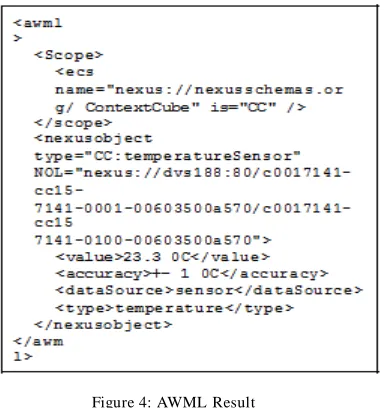
of the sensor reading, are excluded. In Fig- ure 4 the AWML result to the query is shown. Again the scope is specified.The NOL (Nexus Object Locator) is the
Figure 4: AWML Result
Unique ID of the temperature sensor within the Nexus
plat- form. As specified in the query, the values for value,
accu- racy and type are returned.
Now that we have presented an AWQL query and an appropriate AWML result, we will give an overview of how the ContextCube handles incoming AWQL queries and returns the results (see Figure 5). An AWQL query is wrapped in a SOAP message and sent to the ContextCube using the http protocol, which is currently the standard way of sending AWQL queries in Nexus. The http server run- ning on the TINI [15] passes the request to the AWQL servlet that first uses an XML parser [17] to extract the query from the SOAP message. The AWQL request is then passed to the AWQL parser component that ensures the validity of the enquiry and converts it to a sensor request. The sensor request in turn is passed to the sensor worker component, which is able to access the sensors needed for answering the request. The AWML composer receives the sensor readings from the sensor worker and returns an AWML message wrapped in a SOAP envelope to the serv- let. The servlet now passes the response to the requesting client.
In addition to the software components discussed above, the ContextCube needs to support a service discov- ery mechanism to allow devices entering its transmission range to automatically detect it and request its sensor infor- mation. There are a number of existing approaches for ser- vice discovery available (see e.g. [16], [12]). An approach, that is especially suitable for our purpose is UPnP [16], as UPnP, like our system, is based on XML and SOAP, and therefore enables us to reuse the corresponding software components. We will omit a more detailed discussion of the service discovery process in this paper. After the Con- textCube has been discovered, AWQL requests are sent and processed in exactly the same way as shown above.
Figure 5: Overview of the query process
structure, e.g 802.11 or GPRS. The mobile device also has
In many research projects on context-aware computing the target devices have been equipped with sensors that can
This section presents two application scenarios for the ContextCube platform.
A. Ad Hoc Application:
The ad hoc-based access to sensors makes context- aware applications possible even on devices that do not have any integrated sensors. The limited communication range of the devices involved ensures that the requesting device is in the vicinity of the ContextCube. In many cases this allows the assumption that the environmental context of the device is similar to the ContextCube’s context. Addi- tionally, the ad hoc mode of the ContextCube can be used to make the context information available to devices that are in its vicinity but too far away to communicate directly. For such situations it has been shown that a flooding-based information dissemination process can effectively distrib- ute information in an ad hoc network, see e.g. [6]. An application that makes use of such mechanisms is the Usenet-on-the-fly [2]. Here information that is grouped according to topics is replicated on devices in the spatial vicinity of the source.
Aware applications. It provides three main abstractions for context information: context widgets, context interpreters, and context aggregators. The context widgets are the repre- sentation of low-level context information for applications. Context interpreters allow different application-specific interpretations of the same low-level context. The context aggregators are used to combine two or more widgets into higher-level contextual information.
In the TEA project [4] researchers have developed a self-contained awareness device to capture context infor- mation. The device is directly attached to a user’s device and provides information to applications running on that device. It can, for example, be attached to a palm top, a mobile phone, or a wearable computer. The infrastructure of TEA provides means for sensor fusion similar to the Context Toolkit.
The ContextCube is not intended to be attached to a sin- gle device, but serves as an information source for different
applications over time, both in close vicinity and from remote locations. It can serve infrastructures like TEA or the Context Toolkit as well as being used by mobile nodes in an ad hoc network. This, however, requires an interoper- ability protocol for the exchange of sensor data which is not provided by most existing approaches with the excep- tion of the Nexus platform [10]. The languages of the Nexus platform have not originally been designed to be interpreted on small devices, such as sensors. But as we have shown, mation with other Smart-Its. Supporting software infra- structure or sensor interoperability protocol has - so far - not been realized.
V. CONCLUSION
We have presented requirements on a sensor platform that can serve two approaches to provide context informa- tion to applications on mobile devices: infrastructure-based and ad hoc. Since both approaches exist, sensor platforms from t he Perspective of Context-Aware Applications and Mobile Ad Hoc Networks. In: Workshop on Location Model- ing for Ubiquitous Computing, UBICOMP 2001, Atlanta, 2001.
[2]. Becker, C., Bauer, M., and Hähner, J.: Usenet-on-the-fly: supporting locality of information in spontaneous network- ing environments. In: CSCW 2002 Workshop on Ad hoc Communications and Collaboration in Ubiquitous Comput- ing Environments, New Orleans, USA, 2002.
Umgebungskontextes - ContextCube (in german), Studienar- beit (study thesis) Nr. 1849 at the Department of Computer Science, IPVS, University of Stuttgart, Germany, 2002.
[6]. Ho, C., Obraczka, K., Tsudik, G., and Viswanath, K.: Flood-ing for Reliable Multicast in Multi-Hop Ah Hoc Networks. In: Workshop on Discrete Algorithms and Methods for Mobility at the Fifth Annual International Conference on Mobile Computing and Networking (MobiCom'99), Seattle, Washington, USA, 1999
[7]. Hohl, F., Kubach, U., Leonhardi, A., Rothermel, K. and Schwehm, M.: Next Century Challenges: Nexus - An Open Global Infrastructure for Spatial-Aware Applications. In: Proceedings of the Fifth Annual International Conference on Mobile Computing and Networking (MobiCom'99), Seattle, Washington, USA, 1999
[8]. Kasten, O., Langheinrich, M.: First Experiences with Blue- tooth in the Smart-Its Distributed Sensor Network. In: Inter- national Workshop on Ubiquitous Computing and Communications at PACT’01, Barcelona, Spain, 2001.
[9]. Rothermel, K., Becker, C., and Hähner, J.: Consistent Update Diffusion in Mobile Ad Hoc Networks. Technical Report 2002-04, Computer Science Department, University
of Stut- tgart, Germany, 2002.
[10]. Nicklas, D. and Mitschang, B.: The Nexus Augmented World Model: An Extensible Approach for Mobile, Spatial-Aware Applications, 7th International Conference on Object-Ori- ented Information Systems, 2001
[11]. Schmidt, A., Beigl, M., Gellersen, H.-W.: There is more to context than location. In: Interactive Applications of Mobile Computing (IMC), Rostock, Germany, 1998 [12]. Waldo, J.: The Jini Architecture for network-centric
comput- ing. Communications of the ACM, pp. 76-82, July 1999
[13]. TINI platform:
[14]. 1-wire information:
857
[15]. http server:
[16]. Universal Plug and Play Device Architecture, Version 1.0: