Exploit Delivery using Steganography as Covert Channel
Tariq Z. Khairallah
Princess Sumaya University for Technology (PSUT)
King Hussein School of Information Technology
Abstract
Security is a major topic in recent researchers, and finding new methods deliver was the motivations for this research to emphasize and as an awareness to browsers developers to handle
images with more care and to enhance exploit detection technology in the browser, as this paper proves that hackers now can attack users with just an image.
1.
Introduction
The Internet is often filled with ways to deliver Malicious Code to victims utilizing direct and indirect methods to achieve the resultز
This paper discusses delivering exploits “malicious code” to victims using digital steganography by encoding JavaScript code inside the image pixels which are then decoded using an HTML 5 Canvas element that allows for dynamic rendering of images, allowing the attacker to take controls of victims system, steal confidential data or to take the system downs by infecting it with malicious code [1] [2] utilizing images as mediator to deliver them ,these can be done using different covert channels such as advertisements [3], social media sites and popular sites [4].
The exploit delivery using steganography is very risky and hard to detect. In this paper, we analyze these types of attacks are analyzed and impact of the attack is studied. Then we suggest mitigation techniques handles these threats.
2.
Problem
Exploit kits and hackers started using steganography as a new method for delivering malware [1] and sometimes found in social media [5] or by using advertisement images [3] [4]even hiding card data inside images [2] and lately to deliver ransomware “is computer malware that installs covertly on a victim's computer, executes a cryptovirology attack that
adversely affects it, and demands a ransom payment to decrypt it or not publish it” [6].
3.
Overview of Digital Steganography
The word "steganography" can be divided into two parts: stegano + graphy. "Stegano" comes from the Greek word "steganos" meaning "covered" and "graphy" which comes from the Greek word "graphein" meaning "writing:” Thus, steganography literally means "covered writing" [9].
Steganography in its definition is the art of covering messages in a secret way in which only the sender and receiver can reveal the hidden message. Generally, the data is hidden inside an image so that even if a third party discovers the image, there won’t be any suspicious about the image.
3.1.
Digital Steganography Methods
This paper is dedicated to steganography in image files “Cover Image”, image based steganography methods varies and have evolved over the years in its embedding methods [10]
along with its detections methods [11].
There are many different methods to hide information inside of images, such as “
• Discrete Cosine Transform (DCT)
• Discrete Wavelet Transform (DWT)
• Least Significant Bit (LSB)
• Discrete Fourier Transform (DFT)
Our primary focus will be on Least Significant Bit (LSB), one notable note worth mentioning is that any used methods should take into consideration the following points:
2. Perceptual transparency this means that each cover has certain information hiding capacity. If data was loaded into the cover, then it results in degradation of the cover then this will differentiation in original and infected cover will be noted 3. Robustness of the hidden message to remain undamaged.
4. Tamper resistance makes it difficult for the attacker or pirates to alter the original Steganography involves in two fragments of data:
• the cover which works as a medium, and
• Data to be hidden, data which is in this paper is the exploit or malicious code.
3.2.
Least Significant Bit (LSB) Method
The LSB method works by replacing some of the information in a given pixel with information from the data in the image. While it is possible to embed data into an image on any bit-plane, LSB embedding is performed on the least significant bit(s). This minimizes the variation in colors that the embedding creates [12]
The Least Significant Bit (LSB) method is the most common steganography method in which the secret information is hidden in the least significant bits of the image.
Images can be presented in one of the following digital representations
1. 24-bit color: every pixel can have one in 2^24 colors, represented in basic colors (R, G, B): red (R), green (G), blue (B).
2. 8-bit color: every pixel can have one in 256 (2^8) colors,
3. 8-bit grayscale: every pixel can have one in 256 (2^8) shades of gray
Table 1 pixels before data insertion
Pixel 1 = 10011100 Pixel 5 = 11000011
Pixel 2 = 10110101 Pixel 6 = 10110111
Pixel 3 = 10000101 Pixel 7 = 10000111
Pixel 4 = 10110101 Pixel 8 = 10110001
The values after the insertion of an 'A' letter will be:
Table 2pixels after data insertion
Pixel 1 = 10011101 Pixel 5 = 11000010
Pixel 2 = 10110100 Pixel 6 = 10110110
Pixel 3 = 10000100 Pixel 7 = 10000110
Pixel 4 = 10110100 Pixel 8 = 10110001
The same concept could be applied to the 8-bit and 8-bit grayscale images. This is done by adding
very little noise to the original picture, For 24-bit images, this can be extended in some cases to the
second LSBs without being noticeable [13]
4.
Example of the Steganography Exploit
The exploit used in the research is based on two known Common Vulnerabilities and Exposures (CVE) “Common Vulnerabilities and Exposures (CVE®) is a dictionary of common names (i.e., CVE Identifiers) for publicly known cybersecurity vulnerabilities.”:
• CVE-2014-0282 :Microsoft Internet Explorer 8 / 9 / 10 - CInput Use-After-Free
Crash PoC (MS14-035) [14]
• CVE-2009-2478: Mozilla Firefox 3.5 - (Font tags) Remote Buffer Overflow [15]
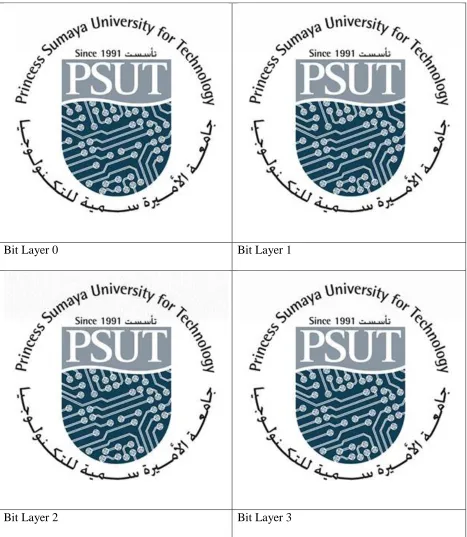
[16] by utilizing two components the decoder and the exploit code, the main job for the decoder is to run the exploit code at the target, the below image is the logo for PSUT used as
demonstration
Figure 1 Cover Used for exploit
Table 3 images bit layers
Bit Layer 0 Bit Layer 1
Bit Layer 4 Bit Layer 5
Bit Layer 6 Bit Layer 7
Browsers rely on two key factors for determining the type of content and thereby invoking the appropriate processor or renderer associated with it.
2. The HTTP Content-Type response header
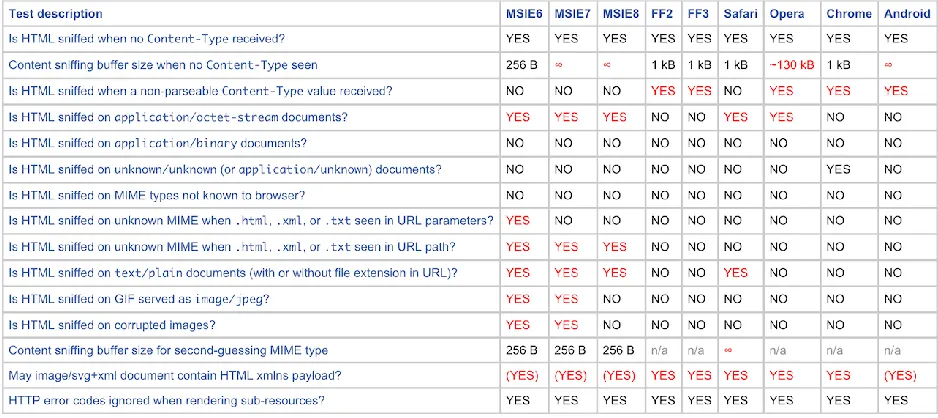
Knowing these two factors give the attacker an advantage to use these weakness in browsers to run the exploit and deliver the malicious code, this is done by omitting the image extension leading the browser to sniff, the below Figure 2 Content Sniffing Matrix shows what content could be sniffed [17] the header content and executing the code inside the image by choosing the appropriate processor for the code chunk its executing [17].
Figure 2 Content Sniffing Matrix
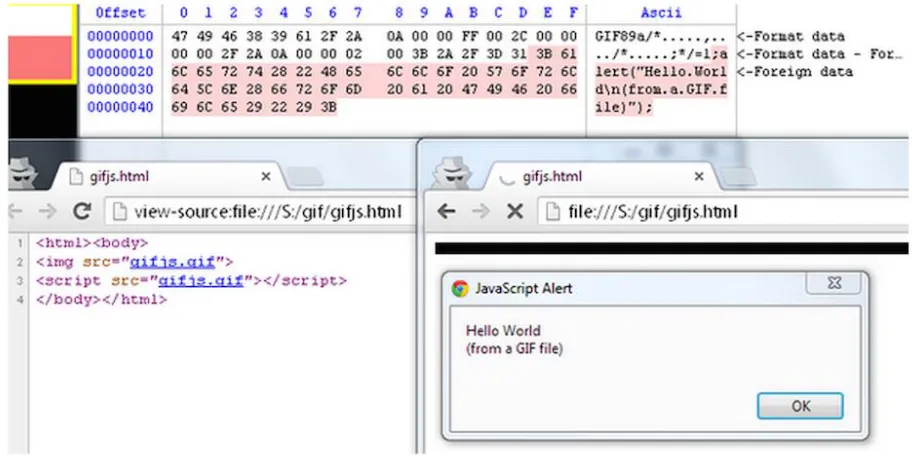
Figure 3 JavaScript in GIF image
5.
Solution
Browser vendors need to start thinking about detecting content before it is rendered in the DOM. This is easier said than done. Server side applications that accept user generated images should currently transcode all received images, for example, transcode a JPG file to a PNG file with slightly degraded quality, and back to JPG. The idea here is to damage any
steganographically encoded data [17]
6.
Future work
• Define new image policies protocols to render images from other websites
• Working towards more secure browsers to detected and disable any malicious
code.
7.
Conclusion
8.
References
[1] E. Chickowski, "New Malware Found Hiding Inside Image Files," 16 10 2016. [Online]. Available: http://www.darkreading.com/endpoint/new-malware-found-hiding-inside-image-files/d/d-id/1320895.
[2] L. Constantin, "Hackers hide stolen payment card data inside website product images," 18 10 2016. [Online]. Available:
http://www.cio.com/article/3132391/hackers-hide-stolen-payment-card-data-inside-website-product-images.html.
[3] D. Goodin, "Millions exposed to malvertising that hid attack code in banner pixels," 12 7 2016. [Online]. Available:
http://arstechnica.com/security/2016/12/millions-exposed-to-malvertising-that-hid-attack-code-in-banner-pixels/.
[4] ESET, "Readers of popular websites targeted by stealthy Stegano exploit kit hiding in pixels of malicious ads," 6 12 2016. [Online]. Available:
http://www.welivesecurity.com/2016/12/06/readers-popular-websites-targeted-stealthy-stegano-exploit-kit-hiding-pixels-malicious-ads/.
[5] J. Vijayan, "Attack Uses Image Steganography For Stealthy Malware Ops On Instagram," 12 10 2016. [Online]. Available:
[6] A. Vamshi, "Anatomy of a Ransomware Attack: Cyber Uses Steganography to “Hide in Plain Sight”," 30 6 2016. [Online]. Available:
https://www.netskope.com/blog/anatomy-ransomware-attack-cerber-uses-steganography-hide-plain-sight/.
[7] J. Buntinx, "Researchers Develop Tool To Embed Malware In Instagram Pictures Through Steganography," 13 10 2016. [Online]. Available:
http://themerkle.com/researchers-develop-tool-to-embed-malware-in-instagram-pictures-through-steganography/.
[8] L. Mosuela, "How It Works: Steganography Hides Malware in Image Files," 4 2016. [Online]. Available:
https://www.virusbulletin.com/virusbulletin/2016/04/how-it-works-steganography-hides-malware-image-files/.
[9] "steganography," 12 2016. [Online]. Available: http://www.thefreedictionary.com/steganography.
[10] A. Cheddad, J. Condell, K. Curran and P. Levitt, "Digital image
steganography: Surveyandanalysisof current methods," SignalProcessing, p. 26, 18 8 2009.
[11] K. Bailey and K. Curran, "An evaluation of image based steganography methods using visual inspection and automated detection techniques," Springer Science, p. 34, 2006.
[13] R. K. Thakur and. C. Saravanan, "Analysis of Steganography with Various Bits of LSB for Color Images," International Conference on Electrical, Electronics, and Optimization Techniques (ICEEOT), 2016.
[14] D. Liudmila, "Microsoft Internet Explorer 8 / 9 / 10 - CInput Use-After-Free Crash PoC (MS14-035)," 24 6 2014. [Online]. Available: https://www.exploit-db.com/exploits/33860/.
[15] . D. Kennedy , "Mozilla Firefox 3.5 - (Font tags) Remote Buffer Overflow," 13 7 2009. [Online]. Available: https://www.exploit-db.com/exploits/9137/.
[16] S. Shah , "stegosploit," 6 2015. [Online]. Available: http://stegosploit.info/. [17] B. Park, D. Kim and . D. Shin, "A Study on a Method Protecting a Secure
Network against a Hidden Malicious Code in the Image," Indian Journal of Science and Technology, 2015.