IJEDR1602329
International Journal of Engineering Development and Research (www.ijedr.org)1871
Data Truthfulness in Cloud by Regeneration Code
Based Public Auditing
Miss. Ankita lande, Dr. P. K. Deshmukh Department of computer engineering Rajarshishahu college of engineering, Pune, India.
________________________________________________________________________________________________________
Abstract— The service widely known as on-demand computing is the other name for cloud computing. It supports a backup system which is like Internet based computing. For saving data which is stored on cloud from corruption and adding fault tolerance to cloud repository which with veracity checking of data and fail reparation will get tough. Due to capacity of lower repair data transfer while discussing fault tolerance the regeneration code become famous. Available remote inspection routines used for regeneration-coded data only provide private auditing, while information proprietors must be online for handling auditing and also addition fixing, which will be not reliable always. In this paper, for the regeneration-code-based cloud repository with multiple key distribution centers we develop a public auditing system. We introduced a proxy for taking care of different points such as recovery issue of in the nonappearance of owners, failed authenticators, which will be favored to recover the authenticators, in a normal public auditing technique. Also, we develop a novel and unique public verifiable authenticator which is created using multiple keys as well as, utilizing partial keys can be recovered by using it. As a result, system we developed is able to make data owner free from all the online loads also we used the ECC Algorithm and Hashing Algorithm to save lots of information private.Unlimited safety examination creates the impression that our system could likewise be comfortable beneath random oracle mannequin moreover; test results show that method we developed is more effective and it has a chance that it can get integrated with regenerating code-based cloud storage.
Index Terms— Cloud computing, Cade regeneration, Distributed KDC.
________________________________________________________________________________________________________
I. INTRODUCTION
Cloud computing also known as ‘on-demand computing’. Data is stored centrally and by third-party user data get processed also solutions for storage issues given to users cloud computing accepts and enterprises with various capabilities.
With minimum efforts from management available resources are cater and freed very often. Due to points such as, high computing power, low cost of services, high performance, and scalability, accessibility and availability cloud computing is very largely demanded service over the globe.
While operating depository storage demands the guarantees related with the authenticity of information on storage, particularly that storage servers get data. Very small part of information is fetched whereas the depository servers store a large amount of data. While storing the data for long period of time there might be high risk for data by the means of machine or human errors. Solutions made previously are not up to the mark for securing data by human or machine errors in the matter of information possession. By extending storage complexity some of systems give a weaker guarantee. Also in all systems available till now are depending on server for fetching the total file, which is not doable when the working with the large amount of information. To maintain the status or economic explanations the service provider of cloud break trust, for hiding the information loss or corruption. So that for the clients it is nice to have a protocol for checking the information they stored on the cloud to make sure that cloud is always maintaining their information. Form past few years regeneration codes are on boom due to their minimized restore bandwidth whilst provides fault tolerance.
Because of high availability as well as reliability at the time of launching low storage overhead in storage framework the regeneration coding in used widely. It is nothing but a process of data security which saves information from getting damaged into fragments, improved, encoded and also precludes duplicate data portions and stored across distinct areas or storage media. To regenerate corrupted information by using data which is stored in some other place as the array in the disk storage approach is the main purpose of erasure coding. This can be turned out to be major measurement of information and any function or system. The system must go through some issues like disk array methods, data grids, disbursed storage purpose, object retailers also archival storage. Presently object-headquartered cloud repository is using of erasure coding.
IJEDR1602329
International Journal of Engineering Development and Research (www.ijedr.org)1872
have data of F. This POR deliver a novel and unusual security definition. Author read PORs as a fundamental gadget for in partially trusted on-line reports. Introduce crypto logic techniques empower users guarantee the security and reliability of records they recover.Remote data Checking (RDC) [4] may be a technique by those buyers will develop that information outsourced at depended servers stays set up after some time. RDC gives buyers to once in a while check condition of information whether it is right or corrupted. Additionally used to recover the broken information. It is utilized distributed frameworks. Presently, a way was needed to feature redundancy supported network composing which can give thought getting tradeoffs as outcome of its strikingly low communication overhead to repair corrupt servers. Author has a tendency to look at and begin the examination of RDC disseminated frameworks structures that consider framework making to debilitate the joined expenses of each the bar and repair stages.
In Cloud computing [5], property holder stores their data on cloud server and when client wants the data related to property holder he will get it from the same server. Data stored on cloud are facing new difficulties which must be sorted autonomously by inspecting service to know the data integrity in cloud. There are few techniques which are working only for static data that’s why those techniques are not usable for auditing of updation of stored data. Therefore, secure dynamic auditing protocol is wanted to win over knowledge holders that the data are legitimately hangs on inside of the cloud.
In this paper [6] author tend to introduce the rest proof-of-retrievability plans with full proofs of wellbeing towards cloud storage. Their rest subject, outlined from BLS signatures and secure within the random oracle model, features a proof-of-irretrievability protocol within which the customer's question and server's reaction are each to an incredible degree short. This topic allows open variability: anyone will go about as a changed, not just the le proprietor. Their second subject that expands on pseudo random functions (PRFs) and is secure in the standard model, allows solely non-open variety.
On this paper [7], Author gives a cozy cloud storage framework developing privacy- retaining open auditing. Author tend to any prolong their result to modify the TPA to does audits for large number of users parallel and with effectiveness.
In this paper [8], author has a tendency to favor a secure non-open cloud for cloud services. Author has a tendency to lapse client unapproved access to cloud offerings and shared storage servers. Their determination offers unknown authentication. This recommends clients' personal qualities (personal details, social details, valid registration) may be endeavored while not revealing clients' conduct. In this way, clients will utilize benefits with none danger of unmistakable evidence their conduct.
III. IMPLEMENTATION DETAILS
A.System Overview
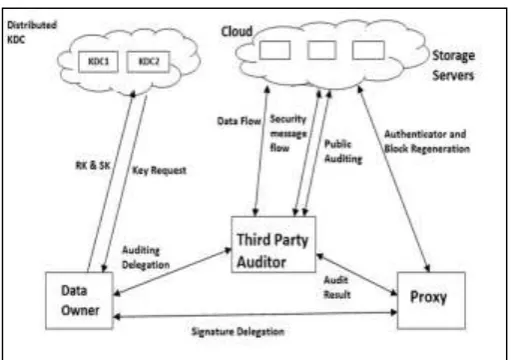
The system is best preferred for business application which is having a cloud servers and number of users. Cloud server let the users to store their encrypted blocks of file as well as respected hash. There is a distributed KDC for the key generation. System makes use of distributed KDC due to the following reason; if one KDC is busy another will be utilized. Load on KDC is divided and performance is boosted due to this. User may encrypt the blocks of file making the use of key. Before storing the block files on cloud storage, client produces the hash of block files and stores it on server.
For the purpose of the file block integrity checking user can request to TPA which is stored on cloud server. In TPA there are hash of blocks are stored. For integrity checking it requests hash of specific file requested by user. It then cross verifies the received hash of file block with hash stored one in its database. If hash is matches, it sends the message to user which shows the file store on server is in good condition i.e. not corrupted. TPA asks to proxy to correct the file in the case if it is corrupted. Proxy has a regeneration code by using which proxy recovers the file which is corrupted and stored on server. After this TPA again verifies for file corruption to see if the file is recovered properly or not. At the end TPA sends notification to the user saying that the file is recovered.
IJEDR1602329
International Journal of Engineering Development and Research (www.ijedr.org)1873
Fig. 1.System ArchitectureB.Algorithm Used
Algorithm 1: Distributed KDC
Input: Token,UID, Number of KDC (KDC_1, KDC_2) Output: key pair (PK, SK)
Process:
1. Check active KDC's 2. IfKDC_1 is active.
3. Check for that users ID keys are generated or not.
4. If keys are not generated then receives attributes from users and generates SK and PK using encryption algorithm and store it in database (DB_1) and also send it to user.
5. Else
6. Get the respective keys for that user ID from database DB_1 and send to the user. 7. If KDC_1 is inactive then then go to KDC_2.
8. At KDC_2 follow the steps 3 to 6.
Algorithm 2: ECC Encryption
Elliptic curve cryptography (ECC) is asymmetric cryptography. Elliptic curves are utilized for many factorization of integer.
• Key Generation
Public key and confidential key are generated by Key Generation. The sender encrypts the message with receiver’s public key and the receiver decrypts with confidential key. After that we have to choose a quantity ’d’ within the variety of ’n’. Using next equation we may create the general public key.
PUK = n * q n = random number i.e. selected within the (1 to n-1).
qIs the point on the curve.
’PUK’ = public key and d = private key.
• Encryption
Let, ’m’ is the message that we're sending. We're going to place this message on the curve. This will more and more have in-depth development small print. Certicom is the organization which does the entire study on ECC. Suppose on the curve ’E’ ’m’ has the point ’M’.
Take ’k’ randomly within [1 - (n-1)]. Cipher text = CT1 and CT2.
CT1 = k*P CT2 = M + k*Q
IJEDR1602329
International Journal of Engineering Development and Research (www.ijedr.org)1874
The system is developed using Java framework (version jdk 8) on Windows platform. The Netbeans (version 8.1) is used as a development kit. The system doesn’t require any particular hardware to run; any standard machine is able of running the application in any system.IV. RESULT AND DISCUSSION
A. DataSet Discussion
We have used number of files of different size varying form 1 KB to 10MB.
B. Results
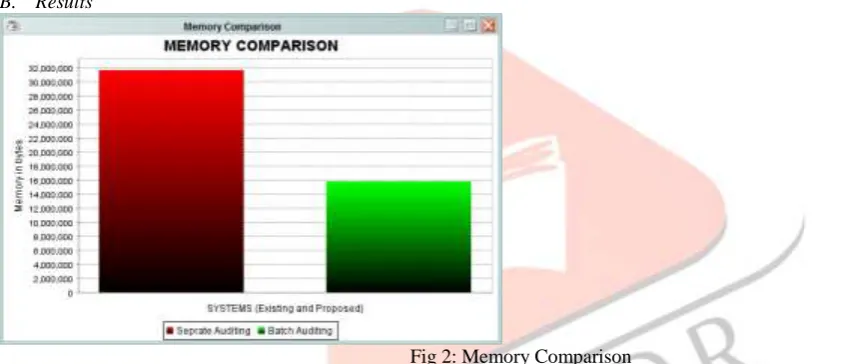
Fig 2: Memory Comparison
Figure 2 depicts the comparison of system with separate auditing and batch auditing. Proposed system requires less memory for auditing of files in batch manner. Separate auditing performs auditing of single file at a time and batch auditing perform auditing of multiple number of files at a time. Therefore overall performance of proposed system is better in terms of minimum memory required for auditing of all files in batch manner.
IJEDR1602329
International Journal of Engineering Development and Research (www.ijedr.org)1875
Figure 4: Time ComparisonFigure 4 depicts the comparison of system with separate auditing and batch auditing. Proposed system requires less time for auditing of files in batch manner. Separate auditing performs auditing of single file at a time and batch auditing perform auditing of multiple number of files at a time. Therefore overall performance of proposed system is better in terms of minimum time required for auditing of all files in batch manner.
CONCLUSION
To keep balance between effectiveness and to maintain a data corruption from information corruption in data storage backup framework are dispute tasks. By storing the data on different server we are minimizing the possibility of information loss but these data fragment storage on different server for the purpose of information backup increases storage space. The data blocks stored on cloud may be are in corrupted format. Our proposed system implements regenerating coding technique for recovering the corrupted data block a proxy if any block is loss or corrupt, also for reducing the computation cost, system utilizes cloud servers for storing the data, since cloud server has a few advantages, for example, security, low cost, high availability and so on. System utilizes distributed KDC, to minimize the load at single KDC. In this, if any one KDC is occupied, client requesting for key to another KDC. To compute the performance of our system, different testes completed on dataset including number of files. The size of the files varies from 1 KBs to 10MB. The test outcomes demonstrates that, our system is perform best than existing one, with respect to, storage space, cost, availability of data, minimize overload at KDC and recovery of files.
REFERENCES
[1] Jian Liu, Kun Huang, Hong R, ”Privacy-Preserving Public Auditing for Regenerating-Code-Based Cloud Storage”, IEEE TRANSACTIONS ON INFORMATION AND SECURITY Vol 1 No 2015
[2] G. Ateniese, R. Burns, R. Curtmola, J. Herring, L. Kissner, Z. Peterson, and D. Song, ”Provable data possession at untrusted stores”, in Proceedings of the 14th ACM Conference on Computer and Communications Security, ser. CCS07. New York, NY, USA: ACM, 2007, pp. 598- 609.
[3] A. Juels and B. S. Kaliski Jr, ”Pors: Proofs of retrievability for large files”, in Proceedings of the 14th ACM conference on Computer and communications security. ACM, 2007, pp. 584-597.
[4] B. Chen, R. Curtmola, G. Ateniese, and R. Burns, ”Remote data checking for network coding-based distributed storage systems”, in Proceedings of the 2010 ACM workshop on Cloud computing security workshop. ACM, 2010, pp. 31-42. RSCOE, Department of Computer Engineering (Computer Science)- 2016 30
[5] K. Yang and X. Jia, ”An efficient and secure dynamic auditing protocol for data storage in cloud computing”, Parallel and Distributed Systems, IEEE Transactions on, vol. 24, no. 9, pp. 1717a1726, 2013.
[6] H. Shacham and B. Waters, ”Compact proofs of retrievability”, in Advances in Cryptology-ASIACRYPT 2008. Springer, 2008, pp. 90- 107.
[7] C. Wang, Q. Wang, K. Ren, and W. Lou, ”Privacy preserving public auditing for data storage security in cloud computing”, in INFOCOM, 2010 Proceedings IEEE. IEEE, 2010, pp. 1-9.