R E S E A R C H
Open Access
Efficient method of two-dimensional DOA
estimation for coherent signals
Heping Shi
1, Zhuo Li
2,5*, Dun Liu
3and Hua Chen
4Abstract
An effective decoherence method called the fourth-order cumulants-based improved Toeplitz matrices reconstruction (FOC-ITMR) is addressed for two-dimensional (2-D) direction-of-arrival (DOA) estimation of coherent signals. To avoid the loss of the array’s physical aperture, the FOC-ITMR method fully utilizes the information of received data from the whole two parallel uniform linear arrays (ULAs) and the changing reference element based on FOC. Compared with previous works, the proposed method can offer excellent decoherence performance in both white noise and color noise environments. In addition, the proposed algorithm can achieve automatic pair-matching without additional computation. The theoretical analysis and simulation results confirm the effectiveness of the proposed algorithm.
Keywords:Direction-of-arrival (DOA), Two-dimensional (2-D), Coherent sources, Fourth-order cumulants (FOC)
1 Introduction
Direction-of-arrival (DOA) estimation is a major research issue in array signal-processing applications such as radar, wireless communication, and sonar [1–5]. Among different DOA estimation methods, 2-D DOA estimation of coherent source signals [6–10] has drawn increasing attentions. Con-ventional high-precision methods, such as MUSIC [11] and ESPRIT [12], have achieved exciting performance. Unfortu-nately, these algorithms are easy to affect by noise as well as require its prior knowledge. Besides, the total number of inci-dent signals must be less than that of the sensors [13]. Fortu-nately, the high-order cumulants, such as the fourth-order cumulants (FOC), have been shown to be a promising method since the noise covariance, which is Gaussian distributed, can be ignored [14–16]. Furthermore, another key motivation of using the FOC is the ability to resolve more number of sources than or equal to that of array elements [17, 18].
In practical, highly correlated or coherent signals are every-where in multipath propagation environments due to reflec-tion and refracreflec-tion of source signals. Based on such scenario, the coherent sources facilitate the rank loss of the covariance matrix, which could result in the failure of the conventional high-resolution algorithms. To achieve signal decorrelation,
the spatial smoothing (SS) [19] and forward-backward spatial smoothing (FBSS) [20] are especially noteworthy, which achieve coherent sources location. Chen et al. [21] have pro-posed a 2-D ESPRIT-like algorithm to attain decorrelation. Based on three correlation matrices, Wang et al. [22] have presented a 2-D DOA estimation method. Recently, Nie et al. [23] have introduced a computationally efficient subspace method with L-shaped array. In [24], an effective 2-D DOA estimation method using a sparse L-shaped array is proposed to obtain good estimation performance and less computational complexity. In [25], the FOC-FSS approach has been presented to remedy rank deficiency problem. In [26], the FOC-TMR method is presented to obtain source location by reconstructing two Toeplitz matrices.
In this paper, a new Toeplitz matrices reconstruction al-gorithm, called the FOC-ITMR, is proposed for 2-D coher-ent signals DOA estimation. The information of the whole two subarrays elements is fully utilized to reconstruct two new matrices by changing the reference element, which can achieve the decorrelation of the coherent signals as well as avoid the loss of array aperture.
2 Signal model
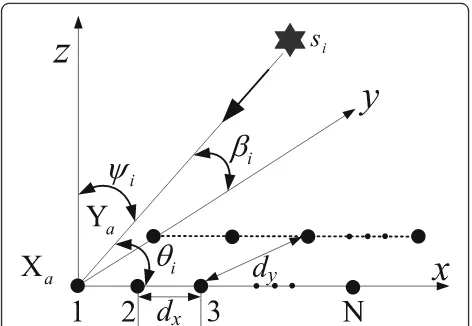
As illustrated in Fig. 1, the antenna array consists of two parallel ULAs (XaandYa) in thex−yplane. Each ULA has N identical omni-directional sensors with spacingdx, and the interelement spacing between the two ULAs isdy.
Suppose that P far-field narrowband source signals si(t) (i =1,…,P) impinge on the two parallel ULAs from * Correspondence:[email protected]
2
Tianjin Key Laboratory of Wireless Mobile Communications and Power Transmission, Tianjin Normal University, Tianjin 300387, China 5College of Electronic and Communication Engineering, Tianjin Normal
University, Tianjin 300387, China
Full list of author information is available at the end of the article
directions (θi,βi), whereθiandβiare measured relatively to the x and y axes corresponding to the ith signal, re-spectively. Thus,ψi, the DOA of theith signal relative to thezaxis, can be written by
cos2θiþ cos2βiþ cos2ψi¼1 ð1Þ
Here,χi= (θi,βi,ψi) are termed as 2-D DOA vector angles. Let the mth element of the subarrayXa be the phase reference, and then the observed signalsxmkð Þt at thekth element in timetcan be expressed as
xm stands for the number of the reference element in subar-ray Xa, and the subscript k(k= 1, 2,⋯,N) of the xm
kð Þt denotes the number of the element along thex positive axis in subarrayXa.nx,k(t) is the additive Gaussian noise of the kth element in subarray Xa and γi indicates the amplitude fading factor of the first Qcorrelative signals (without loss of generality, we assumeγ1= 1).
With a similar processing, employing themth element of the subarrayYaas the phase reference, and then the observed signalsym
kð Þt at thekth element in timetcan be expressed as
3 Angle estimation algorithm 3.1 The FOC-ITMR algorithm
The new proposed algorithm named as FOC-ITMR, which is based on reconstructing two Toeplitz matrices C1 and C2 by using two parallel ULAs, is described in
detail in this subsection. Firstly, we define C1 and C2
with the cumulant elements cmk and ~cmk arranging as follows Then, the Toeplitz matrices C1 and C2 can be
where
D¼diag dð 1;d2;⋯;dPÞ ð12Þ
V¼diag v½ ð Þβ1 ;vð Þβ2 ;⋯;vð ÞβP
¼ ej
2π
λ dycosβ1
ej
2π
λ dycosβ2
⋯
ej
2π
λ dycosβP
2 6 6 6 6 6 4
3 7 7 7 7 7 5
ð13Þ
Clearly, Eq. (11) means that the matrix A is a
Vandermonde matrix as long as θi, (i= 1,⋯,P) comes from different angles. Therefore, Ais a column full-rank matrix, namely, rank (A) =P, whose columns are linearly independent. From the expression ofdiin (8), we can see thatdiis a non-zero constant. Thus, from (12), it is easy to know that the matrixDis of rank P. Moreover, accord-ing to Eq. (13), we confirm thatVsatisfies the condition of full rank for different anglesβi.
The eigenvalue decomposition ofC1can be written as
C1¼
XP i¼1
ηigigHi ð14Þ
where {η1,…, ηP} and {g1,…,gP} are the non-zero
eigen-values and corresponding eigenvectors of the matrix C1.
The pseudo-inverse of the matrixC1is
C† 1¼
XP i¼1
ηi−1gigHi ð15Þ
Due to the fact that A is a column full-rank matrix, from (9), we can attain
DAH¼AHA−1AHC
1 ð16Þ
Combining (10) with (16), the alternative expression of C2can be achieved as follows
C2¼ADVAH
¼AVDAH
¼AV A HA−1A HC
1 ð17Þ
Right multiplying both sides of (17) byC†1A
C2C†1A¼AV AHA
−1AHC
1C†1A ð18Þ
Substituted (14) and (15) into (18) A¼½að Þθ1 ;að Þθ2 ;…;að ÞθP
¼
1 1 … 1
e−j
2π
λ dxð Þ1 cosθ1
e−j
2π
λ dxð Þ1 cosθ2
⋯ e−j
2π
λ dxð Þ1 cosθP
⋮ ⋮ ⋯ ⋮
e−j
2π
λ dxðN−1Þcosθ1 e−j
2π
λ dxðN−1Þcosθ2
⋯ e−j
2π
λ dxðN−1ÞcosθP
2 6 6 6 6 6 6 6 6 6 6 4
3 7 7 7 7 7 7 7 7 7 7 5
ð11Þ
a
b
C2C†1A¼AV A
HA
−1
AH X
P
i¼1
ηigigHi
! XP
i¼1
ηi−1gigHi
!
A
¼AV A HA−1AHX P
i¼1 gigH
iA
ð19Þ
Notice that X
P
i¼1 gigH
i is an identity matrix, that is
XP
i¼1 gigH
i ¼I. Thus, Eq. (19) can be further rewritten as
C2C†1A¼AV AHA
−1AHA
¼AV
ð20Þ
From (20), 2-D angle parameters, which are obtained by performing EVD on C2C†1 denoted as Toeplitz-based generalized DOA matrix, lie inA andV. By performing EVD onC2C†1
C2C†1¼
XP i¼1
ξiuiuHi ð21Þ
where ξi and ui are the non-zero eigenvalues and the corresponding eigenvectors of the matrix C2C†1. Thus, theP bigger signal subspaces can be obtained from (21). It can be verified that the subspaces spanned by Aand the signal subspaces U= [u1,⋯,ui⋯,uP] are the same, whereuiis theith column of the matrixU.
Define hi=ui/ui (1), where ui(j), (j= 1,⋯,N) denotes thejth element of vectorui, and then we can get
κi¼
1
N−1
XN−1 m¼1
arg hiðmþ1Þ hið Þm
:
ð22Þ
where hi(j), (j= 1,⋯,N) represents the jth element of vectorhi.
Therefore, by combining að Þ ¼θi
1;e−j2π
λdxcosθi;…;e−j2λπdxðN−1Þcosθi
h iT
and v βi ¼ej2π
λdycosβi,
the estimated 2-D DOAs can be obtained
a
b
Fig. 3The MRMSE versus SNR in both white and color noises.aθi.
bβi
a
b
θi¼ arccos λ
2πdxκi
ð23Þ
βi¼ arccos
λ
2πdyargð Þξi
: ð
24Þ
Till now, 2-D DOAs of incoming signals, namely, θi andβican be achieved automatically paired according to Eqs. (23) and (24) without additional computations for parameter pair-matching.
The proposed algorithm with finite sampling data can be implemented as follows
Step 1: Compute the cumulant elements cm
k and ~cmk according to (6) and (7), respectively;
Step 2: Reconstruct the two Toeplitz matrices C1and
C2by (9) and (10);
Step 3: Obtain the pseudo-inverse matrix C†1 by per-forming the EVD of the matrixC1;
Step 4: Perform EVD of C2C†1 to obtain the non-zero eigenvalues and the corresponding eigenvector;
Step 5: Estimate the 2-D DOAs of incident coherent source signals via (22)–(24).
3.2 Location analysis
In this subsection, the advantage of the proposed
algorithm is discussed. As for two N×N dimension
Toeplitz matrices, the maximum number of signals that can be distinguished isN−1 by the proposed FOC-ITMR method. Assume that the number of each subarray in
[26] is 2M+ 1, the FOC-TMR method can distinguish
M signals. According to the parameters set in [25], the FOC-FSS method can tell the same number of signals as [26]. In other words, based on the same array config-uration and the same number of sensors, the proposed algorithm has twice larger array aperture than the
a
b
compared FOC-TMR algorithm in [26]. Therefore, the proposed algorithm can not only resolve more signals than the compared method in [26] but also achieve bet-ter estimation performance.
4 Simulation result
In this section, simulation results are presented to illustrate the validity of the proposed method. We evaluate the performance of the proposed FOC-ITMR algorithm via comparison with the FOC-FSS [25] and the FOC-TMR [26] algorithms with several experiments in both white and color Gaussian noise environments. The color Gaussian noisez(t) is simply considered as bellow [26, 27]
zð Þ ¼t n tð Þ−0:8n tð−1Þ þ0:7n tð−2Þ ð25Þ
where n(t) is white Gaussian noise. Two performance indices, called the maximum root-mean-square error (MRMSE) and normalized probability of success (NPS), are defined to evaluate the performance of the algorithms with respect to variables such as SNR and snapshots.
MRMSE¼
ffiffiffiffiffiffiffiffiffiffiffiffiffiffiffiffiffiffiffiffiffiffiffiffiffiffiffiffiffiffiffiffiffiffiffiffiffiffiffiffiffiffiffiffiffiffiffiffi
1 MC
XMC i¼1
max σ^i;r−σi
2
v u u
t ð26Þ
where MC denotes the times of Monte Carlo simulation. σi denotes θi or βi, and ^σi;r is the parameter to be esti-mated ofθi^ orβ^i.
NPS¼ ϒsuc
Τtotal ð
27Þ
where ϒsuc and Τtotal denote the times of success and Monte Carlo trial, respectively. Furthermore, a successful
experiment is that satisfies max ^θi−θi
<ε or max ^
βi−βi
<ε, whereεequals 0.8 and 1.8 for comparison versus SNR and snapshots, respectively.
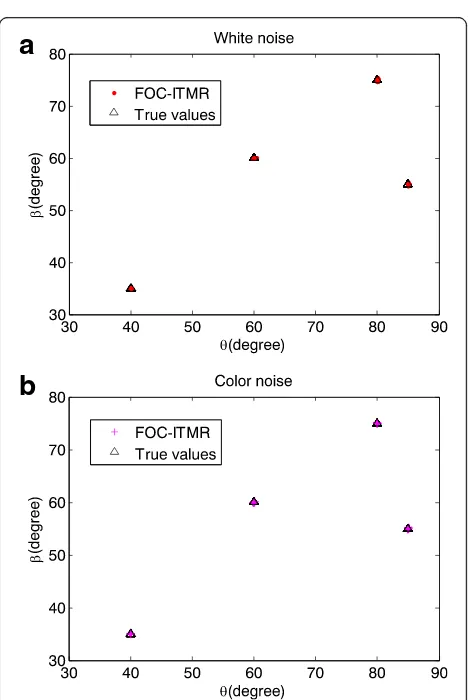
Experiment 1: 2-D DOA estimation performance Assume that four non-Gaussian signals with θi and βi impinge from {40°, 80°, 60°, 85°} and {35°, 75°, 60°, 55°}, separately, and the number of sensors in each subarray is N= 5 with sensor displacementdx=dy=λ/2. Figure 2 plots the paired results of four targets from 50 Monte
a
b
Carlo trials with SNR = 15 dB and snapshots L= 1500, which shows that the 2-D DOA are paired correctly in our scheme in both white and color Gaussian noise situ-ations. On the contrary, the compared FOC-TMR and FOC-FSS methods cannot distinguish them due to array aperture reduced.
Experiment 2: MRMSE and NPS versus SNR
In this simulation, three non-Gaussian signals with θi andβiare incoming from {40°, 85°, 90°} and {45°, 65°, 60°}, separately, and the number of sensors in each subarray is
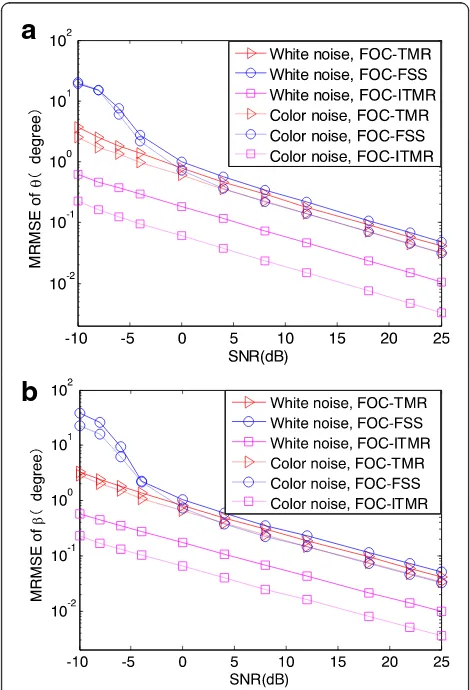
N= 7. The number of snapshots is set toL= 1500, and the SNR is varied from−10 to 25 dB. Theθiand βiMRMSE curves of the proposed method and the FOC-TMR and FOC-FSS methods versus SNR are shown in Fig. 3, where 2000 Monte Carlo trials are used. Figure 3 illustrates that the proposed method has much lower MRMSE than the compared FOC-TMR and FOC-FSS algorithms in both spatially white noise and spatially color noise environ-ments, especially at low SNR. Figure 4 illustrates the NPS of the DOAs versus SNR, which illustrates that the Fig. 7The MRMSE versus angle separation in both white and color noises
performance of the proposed method is better than that of FOC-TMR and FOC-FSS algorithms as the SNR in-creases. The reason is that the proposed algorithm utilizes the whole ULAs to estimate the source signals, which avoids the loss of array physical aperture and achieves ex-cellent decoherence performance.
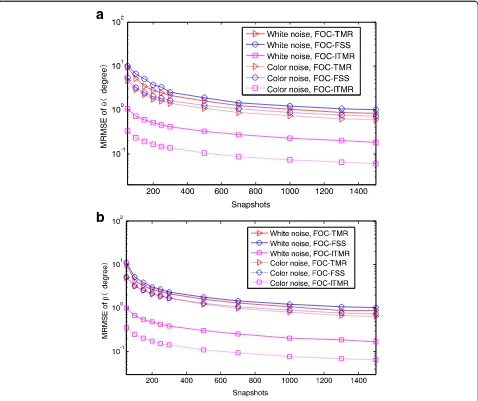
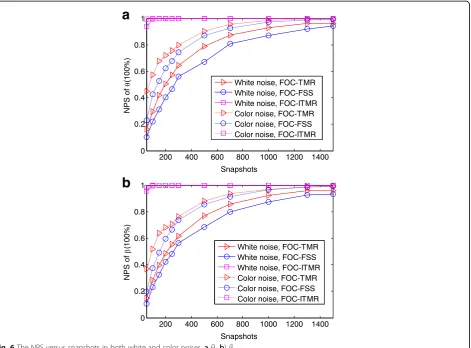
Experiment 3: MRMSE and NPS versus snapshots The third simulation considers the same scenario as the second one at different number of snapshots. When the SNR is 0 dB, the MRMSE of the estimated parameters against number of snapshots is shown in Fig. 5. It can be seen from Fig. 5 that the proposed method achieves higher estimation accuracy than the FOC-TMR and FOC-FSS al-gorithms as the number of snapshots increases.
In addition, the NPS of the DOAs signals against the number of snapshots is shown in Fig. 6 when the SNR is 0 dB. From Fig. 6, we can see that the performance of the proposed algorithm is superior to the compared methods as the number of snapshots is varied from 0 to 500. That is, in small number of snapshots, the superior-ity of the proposed algorithm is more pronounced. This indicates that the proposed algorithm will be more use-ful when the low-computational cost and highly real-time data process are required.
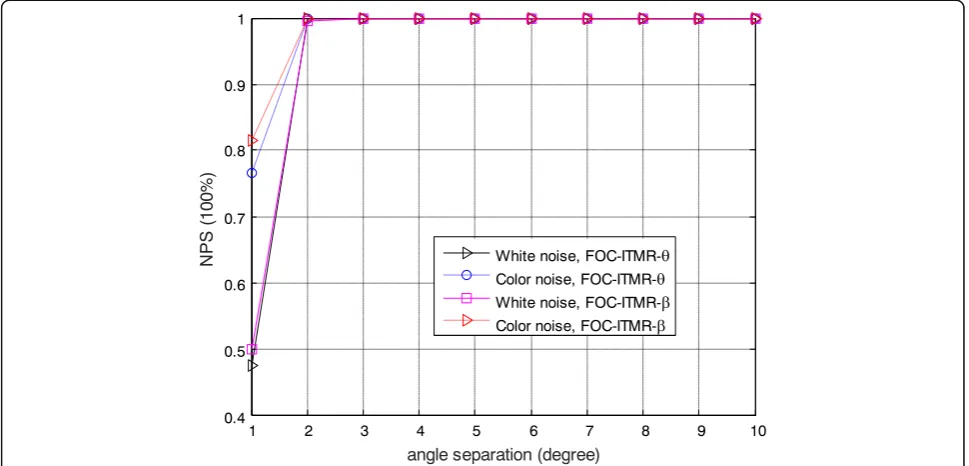
Experiment 4: MRMSE and NPS versus angle separation The fourth simulation studies the estimation per-formance of the proposed algorithm between θ and β. The number of snapshots is 1500, and the input SNR is 10 dB. Consider three non-Gaussian signals with 2-D DOAs θ and β coming from θ=[40o, 85o, 85o+ detra] and β= [45o, 60o+ detra, 60o], where the “detra” denotes the angle separation, varying from 1° to 10°. The simula-tion experiments are based on 200 Monte Carlo trials.
The MRMSE of the 2-D DOAs versus angle separation has been shown in Fig. 7. It can be observed from Fig. 7 that no matter in white Gaussian noise situation or in color Gaussian noise situation, the MRMSE ofθachieves a similar performance to the MRMSE ofβ. Figure 8 shows the NPS of the 2-D DOAs versus angle separation. Apparently, the same conclusions can be drawn. Figure 8 illustrates that the performance of θ is approximately identical to that of theβin both white and color Gaussian noise situations.
5 Conclusions
In this paper, a novel FOC-ITMR method for coherent signals estimation is proposed. The whole information of the two parallel ULAs is fully utilized by changing the reference element to reconstruct the two new cumulants-based matrices, which avoids the loss of array physical aperture. Therefore, the proposed method gains excellent decoherence performance. Simulation results show the validity of the presented FOC-ITMR algorithm.
Acknowledgements
This research was supported by the National Natural Science Foundation of China (61602346), by the Key Talents Project for Tianjin University of Technology and Education (TUTE) (KYQD16001), by the Tianjin municipal science and technology innovation platform, intelligent transportation coordination control technology service platform (16PTGCCX00150) and by the National Natural Science Foundation of China (61601494).
Competing interests
The authors declare that they have no competing interests.
6 Publisher’s Note
Springer Nature remains neutral with regard to jurisdictional claims in published maps and institutional affiliations.
Author details
1School of Automotion and Transportation, Tianjin University of Technology
and Education, Tianjin 300222, China.2Tianjin Key Laboratory of Wireless Mobile Communications and Power Transmission, Tianjin Normal University, Tianjin 300387, China.3School of Electronic Engineering, Tianjin University of Technology and Education, Tianjin 300222, China.4School of Electronic Information Engineering, Tianjin University, Tianjin 300072, China.5College of Electronic and Communication Engineering, Tianjin Normal University, Tianjin 300387, China.
Received: 14 November 2016 Accepted: 28 February 2017
References
1. H Krim, M Viberg, Two decades of array signal processing research: the parametric approach. IEEE Signal Process Mag13(4), 67–94 (1996) 2. Z Li, K Liu, Y Zhao et al., MaPIT: an enhanced pending interest table for NDN
with mapping bloom filter. IEEE Commun Lett18(11), 1423–1426 (2014) 3. Z Li, L Song, H Shi, Approaching the capacity of K-user MIMO
interference channel with interference counteraction scheme. Ad Hoc Netw2016, 1–6 (2016)
4. Z Li, Y Chen, H Shi et al., NDN-GSM-R: a novel high-speed railway communication system via named data networking. EURASIP J Wirel Commun Netw2016(48), 1–5 (2016)
5. X Liu, Z Li, P Yang et al., Information-centric mobile ad hoc networks and content routing: a survey. Ad Hoc Netw2016, 1–14 (2016)
6. H Chen, C Hou, Q Wang et al., Improved azimuth/elevation angle estimation algorithm for three-parallel uniform linear arrays. IEEE Antennas Wirel Propag Lett14, 329–332 (2015)
7. H Wu, C Hou, H Chen et al., Direction finding and mutual coupling estimation for uniform rectangular arrays. Signal Process117, 61–68 (2015) 8. J Liang, D Liu, Joint elevation and azimuth direction finding using L-shaped
array. IEEE Trans Antennas Propag58(6), 2136–2141 (2010)
9. S Kikuchi, H Tsuji, A Sano, Pair-matching method for estimating 2-D angle of arrival with a cross-correlation matrix. IEEE Antennas Wirel Propag Lett
5(1), 35–40 (2006)
10. N Tayem, HM Kwon, Azimuth and elevation angle estimation with no failure and no eigen decomposition. Signal Process86(1), 8–16 (2006)
11. RO Schmidt, Multiple emitter location and signal parameter estimation. IEEE Trans Antennas Propag34(3), 276–280 (1986)
12. R Roy, T Kailath, ESPRIT-estimation of signal parameters via rotational invariance techniques. IEEE Trans Acoust Speech Signal Process37(7), 984–995 (1989) 13. Z Shan, TP Yum, A conjugate augmented approach to direction-of-arrival
estimation. IEEE Trans Signal Process53(11), 4104–4109 (2005)
14. WJ Zeng, XL Li, XD Zhang, Direction-of-arrival estimation based on the joint diagonalization structure of multiple fourth-order cumulant matrices. IEEE Signal Process Lett16(3), 164–167 (2009)
15. TH Liu, JM Mendel, Azimuth and elevation direction finding using arbitrary array geometries. IEEE Trans Signal Process46(7), 2061–2065 (1998) 16. J Liang, Joint azimuth and elevation direction finding using cumulant. IEEE
Sensors J9(4), 390–398 (2009)
17. P Chevalier, L Albera, A Ferreol et al., On the virtual array concept for higher order array processing. IEEE Trans Signal Process53(4), 1254–1271 (2005) 18. E Gonen, JM Mendel, MC Dogan, Applications of cumulants to array
19. N Tayem, HM Kwon, L-shape 2-dimensional arrival angle estimation with propagator method. IEEE Trans Antennas Propag53(5), 1622–1630 (2005) 20. SU Pillai, BH Kwon, Forward/backward spatial smoothing techniques for
coherent signal identification. IEEE Trans Acoust Speech Signal Process
37(1), 8–15 (1989)
21. F Chen, S Kwong, CW Kok, ESPRIT-like two-dimensional DOA estimation for coherent signals. IEEE Trans Aerosp Electron Syst46(3), 1477–1484 (2010) 22. GM Wang, JM Xin, NN Zheng et al., Computationally efficient
subspace-based method for two-dimensional direction estimation with L-shaped array. IEEE Trans Signal Process59(7), 3197–3212 (2011)
23. X Nie, LP Li, A computationally efficient subspace algorithm for 2-D DOA estimation with L-shaped array. IEEE Signal Process Lett21(8), 971–974 (2014) 24. JF Gu, WP Zhu, MNS Swamy, Joint 2-D DOA estimation via sparse L-shaped
array. IEEE Trans Signal Process31(5), 1171–1182 (2015)
25. G Du, N Tong, Y Wang et al., Joint estimation of frequency and 2-D arrival angles of coherent signals in the presence of colored noise. Congr Image Signal Process5, 281–285 (2008)
26. H Chen, C Hou, Q Wang et al., Cumulants-based Toeplitz matrices reconstruction method for 2-D coherent DOA estimation. IEEE Sensors J14(8), 2824–2832 (2014) 27. JF Chen, XL Zhu, XD Zhang, A new algorithm for joint range DOA-frequency
estimation of near-field sources. EURASIP J Appl Signal Process2004(3), 386–392 (2004)
Submit your manuscript to a
journal and benefi t from:
7Convenient online submission 7Rigorous peer review
7Immediate publication on acceptance 7Open access: articles freely available online 7High visibility within the fi eld
7Retaining the copyright to your article