Allorecognition mechanisms during ascidian fertilization
YOSHITO HARADA and HITOSHI SAWADA*
Sugashima Marine Biological Laboratory, Graduate School of Science, Nagoya University, Sugashima, Toba, Japan
ABSTRACT Ascidians (primitive chordates) are hermaphroditic animals, releasing sperm and eggs nearly simultaneously. But, many ascidians, including Ciona intestinalis and Halocynthia roretzi, show self-sterility or preference for cross-fertilization rather than self-fertilization. The molecular mechanisms underlying this allorecognition process are only poorly understood. We recently identified the genes responsible for self-incompatibility in C. intestinalis by a positional cloning: sperm-borne polycystin 1-like receptor, referred to as s-Themis, and its fibrinogen-like ligand called v-Themis on the vitelline coat (VC) are highly polymorphic and appear to be responsible for allorecognition in the fertilization of C. intestinalis. In H. roretzi, on the other hand, we revealed that HrVC70, a 70-kDa main component of the VC consisting of 12 epidermal-growth-factor (EGF)-like repeats, is a candidate allorecognition protein, since the attachment of this protein to the VC during oocyte maturation and its detachment by weak acid are closely linked to the gain and the loss of sterility, respectively, and also since nonsperm rather than self-sperm efficiently bound to HrVC70-agarose. As a binding partner of HrVC70, a 35-kDa GPI-anchored glycoprotein in sperm lipid rafts, referred to as HrUrabin, was identified: HrUrabin appears to play a key role in allorecognizable sperm binding to HrVC70 during fertilization. In the present review, we describe the current progress on the molecular bases of allorecognition, or self-incompatibility, during ascidian fertilization, by considering the SI systems in another organisms including fungies and flowering plants.
KEY WORDS:
self-sterility, self-incompatibility, fertilization, sperm, egg, sperm fusion
BIOLOGY
www.intjdevbiol.com*Address correspondence to: Dr. Hitoshi Sawada. Sugashima Marine Biological Laboratory, Graduate School of Science, Nagoya University, Sugashima, Toba 517-0004, Japan. Fax: +81-599-34-2456. e-mail: [email protected]
Published online: 20th June 2008
0214-6282/2008/$35.00 © UBC Press
Printed in Spain
Abbreviations used in this paper: EGF, epidermal growth factor; SI, self-incompatibility; VC, vitelline coat; ZP, zona pellucida.
Introduction
Self-incompatibility (SI) is observed in many hermaphroditic organisms such as flowering plants. Ascidians (tunicates), inver-tebrate chordates, are all simultaneous hermaphrodites, many of which exhibit self-sterility or preference for cross-fertilization rather than self-fertilization. For studies on the SI system in ascidians, two species belonging to different orders, Ciona intestinalis (Phlebobranchia) and Halocynthia roretzi (Stolidobranchia), have been studied in detail. (Members of the third order, Aplousobranchia, all have internal fertilization, which is much more difficult to study and have not been included here). Although the actual process of self-sterility in these species shows similar aspects, the molecular mechanisms may differ. For example, self-sterility in H. roretzi is much more strict than in C. intestinalis: Halocynthia, but not Ciona, shows no self-fertilization even at high concentrations of sperm. In addition, self-fertile individuals, or cross-sterile combinations of different animals, are sometimes observed in C. intestinalis, which have never been reported in H. roretzi. Therefore, the molecular mechanism of
allorecognition during fertilization is not necessarily conserved among related species, since these changes would be a driving force for speciation (Vieira and Miller, 2006). In the present review, we will discuss the SI mechanisms during ascidian fertili-zation, mainly by focusing on C. intestinalis and H. roretzi.
Biological significance of self-incompatibility and its
responsible factors
2006). In either case, the specific complementary relationship between the male and female molecules must be maintained through generations. This demands a strict co-segregation of both factors. Indeed, a close physical linkage between male and female factors appears to be a common key feature in the previously characterized SI systems (Uyenoyama, 2005).
The SI is thought to be critical to maintain genetic diversity within a species by preventing self-fertilization. However, C. intestinalis may utilize another mechanism in addition to the SI system to promote cross-fertilization; there is a slight difference in the spawning time of sperm and eggs in C. intestinalis, which causes the eggs to be exposed to heterologous sperm before homologous sperm (Millar, 1953).
Thomas Hunt Morgan’s view of self-incompatibility in
ascidian fertilization
Interest in ascidian self-sterility dates back to the works of Thomas Hunt Morgan as a young marine biologist, almost a century ago (Morgan, 1910). His later work focused on the genetics of Drosophila and achieved great success. However, in later life, after moving to the Pacific coast, he went back to his earlier love of marine invertebrates, handing over Drosophila research to his colleagues. Toward the end of his life in 1945, he published a series of papers on genetics in C. intestinalis (Mor-gan, 1939; 1942; 1944).
Morgan’s findings on self-sterility in Ciona are summarized as follows. He found that the vitelline coat (VC) serves as a barrier against self-fertilization and that the barrier is abolished by treatment of the VC with acidic seawater or proteases (Morgan, 1939). Utilizing acid-induced self-fertilization, he raised a number of batches of self-fertilized F1 siblings and examined cross-fertility and -sterility among them (Morgan, 1942; 1944). Cross-sterility is rarely observed in wild populations. But, cross-sterile combinations are sometimes observed not only in self-fertilized siblings but also in experimentally cross-fertilized siblings, sug-gesting that self-sterility is certainly genetically governed. Morgan also discussed the number of SI loci involved (Morgan, 1942; 1944). If SI specificity is governed by a single SI locus, self-fertilized F1 siblings should theoretically be categorized into only three groups (i.e., two homozygotes and one heterozygote), within which individuals show the same SI specificity. In fact, he observed more than three types in SI specificity among self-fertilized F1 siblings. Therefore, Morgan concluded that the ge-netic mechanism of SI in C. intestinalis is mediated by multiple loci: he estimated that there might be six loci involved.
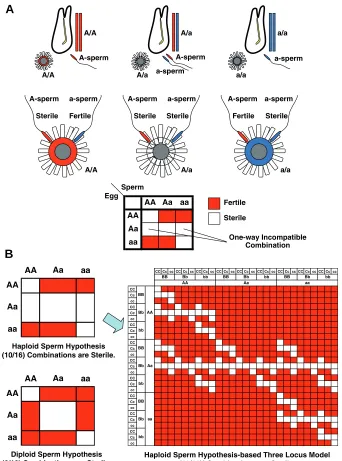
The self-fertilized individuals reared by Morgan contained a considerable number of cross-sterile combinations, among which he recognized two types of cross-sterility: bi-directional and one-way (Morgan, 1942; 1944). The frequent occurrence of one-one-way cross-sterility seemed to be mysterious. Male and female factors in SI loci were supposedly genetically linked; crossing over between these SI genes would not occur, because such a cross-over would disrupt the SI system after a few generations. Morgan introduced a «haploid sperm hypothesis» to explain the occur-rence of one-way cross-sterility (Fig. 1A; Morgan, 1942; 1944). He proposed that self/nonself-discrimination takes place on the basis of self-rejection, and SI specificity is determined by haploid expression in sperm and diploid expression in eggs. According to
his hypothesis, a parent heterozygous at the SI locus (repre-sented as A/a) produces two populations of sperm (A-expressing and a-expressing sperm), either of which can fertilize both types of homozygous eggs (A/A and a/a eggs). In contrast, sperm (A-expressing and a-(A-expressing sperm) from two types of homozy-gotes (A/A and a/a individuals) are sterile to heterozygous eggs (A/a eggs), since heterozygous eggs (or VC) contain both types of female SI gene products, either of which must be recognized by sperm as self. Thus, one important conclusion could be made from this hypothesis: once a one-way cross-sterile pair of indi-viduals was found, a ‘female’ individual of the incompatible combination should be a heterozygote at the responsible SI locus, whereas a ‘male’ individual should be a homozygote.
In Morgan’s report in 1944, he discussed the issue of locus number as follows. «Calculations show that, on the assumption of haploid sperm, there would be expected too many reciprocal steriles for less than six loci on the assumption that identicals are alike in all their factors for self sterility. Six gives an expectation of about 1 to 16. The data from acid selfed eggs give a ratio of 1 to 15, which is sufficiently near expectation for six loci. On the other hand the assumption of diploid sperm and three loci gives a ratio of about 1 to 18, which suffices to cover the data for the offspring of acid selfed eggs.» Although he did not explicitly show a mathematical basis of the above calculations in his paper, we view it as shown in Fig. 1B. Morgan probably assumed a model that is a simple expansion of the above mentioned «haploid sperm scheme» to a multiple-locus system. As shown in Fig. 1B, the ratios of «one type of homozygotes», «heterozygotes», and «the other type of homozygotes» for each SI locus are expected to be 1:2:1 among the self-fertilized siblings, if there were no bias in population viability. Hence, the occurrence of cross-sterility among self-fertilized siblings under a single locus model is calculated to be 10/16 (= 62.5%). If there were another SI locus working synergistically with the first locus and if there were no hierarchical relationships between these two loci, the occurrence of cross-sterility would become a square of 10/16 (= 39%). When the six loci system was assumed, the calculated number ((10/16)6 = 6.0%) comes close to the actual ratio of cross-sterile combina-tions among the acid-induced self-fertilized siblings (1/16 = 6.25%) observed by Morgan. Likewise, in the diploid sperm system, the occurrence of cross-sterility per one SI locus is 3/8, and a cube of 6/16 (= 5.2%) in the three-locus system is comparable with the observed ratio. We do not know whether our speculation is correct. But, if we understood correctly, there is no reason to believe that Morgan’s estimation is reliable. Recently, Murabe and Hoshi (2002) repeated Morgan’s self-fertilization experi-ments and obtained similar results, confirming that the SI system is governed by a multiple locus system. However, they showed that the observed ratio of cross-sterile combinations among selfed siblings was as high as 47% (57/121) (Murabe and Hoshi, 2002), suggesting a smaller number of SI loci.
Biological studies on self-sterility in C. intestinalis
are widely used, because sperm is capable of binding to the VC of glycerinated eggs without causing activation of the fixed eggs or sperm passage through the VC. In C. intestinalis, self-sperm do not bind as firmly to the glycerinated VC as nonself-sperm (Rosati and De Santis, 1978; Kawamura et al., 1987; Murabe and Hoshi, 2002), indicating that this is a useful assay for self/nonself-discrimination during fertilization.
Self-sterility in this species seems to be unstable or not so strict, since insemination by a high concentration of sperm often causes self-fertilization (see Murabe and Hoshi, 2002). Also, strictness of self-sterility in each individual appears to differ day-by-day (Kawamura et al., 1987) and different populations show differences in the rate of self-fertility. Kawamura and his col-leagues reported a detailed observation on the binding process between the VC and sperm in C. intestinalis (Kawamura et al., 1987). They found that not only nonself-sperm but also self-sperm
C. intestinalis and C. savignyi seems to be different from the barrier preventing self-fertilization, since the former, but not the latter, was found to be resistant to the acid-treatment (Byrd and Lambert, 2000).
Molecular basis of SI pathways mediating self- and
nonself-recognitions
It is currently believed that the self/nonself-discrimination pro-cess is based on two different types of molecular interactions. One is a self-recognition, which is mediated by specific interac-tions of two components that are encoded in the same allele. The other type involves the recognition between nonself-derived mol-ecules, in which allorecognizable receptors are evolutionarily selected to interact with allo-ligands but ignore self-ligands. Among the previously characterized SI systems, flowering plants
Fig. 1. Haploid sperm hypothesis for the SI system in C. intestinalis. (A) Haploid sperm hypothesis. (Upper panel) The double-lines beside the animals represent the diploid hypothetical SI gene. Each of the homozygous parents (repre-sented as A/A or a/a) produces a haploid A-sperm or a-sperm, whereas the heterozygous parent produces two populations of sperm (A-sperm and a-sperm). One-way cross-sterility is observed be-tween sperm of the homozygous parent and egg of the heterozygous parent (see text for details).
(Lower panel) Due to the presence of one-way cross-sterile combinations, a cross-sterility pat-tern forms a crank-like shape. (B) Calculations of the occurrence ratio of cross-sterile combinations between artificially self-fertilized F1 siblings (see text for details). (Left panels) Area of each combi-nation is proportional to its theoretical occurrence ratio. Note that the frequency of heterozygotes is twice that of each homozygote. (Right panel) An example of the multiple locus system. In the three-locus system based on the haploid sperm scheme, the cross-sterility pattern forms a «triple-nested-crank-like» shape. Areas of the combina-tions are not proportional to the occurrence ratio.
could initially bind to the glycerinated VC, and rotate the eggs by their flagellar movements. However, such an egg rotation is terminated within a few minutes in most cases, whereas it is lasting for about thirty minutes in the case of nonself-sperm (Kawamura et al., 1987). Interestingly, C. savignyi, a close relative of C. intestinalis, is reported to be self-fertile, but self/nonself-discrimination still takes place in this species: a longer time is required for self-fertilization than for cross-fertilization. When the eggs of C. savignyi were insemi-nated by a mixture of self- and nonself-sperm, cross-fertilization by nonself-sperm was ex-clusively observed, which was revealed by using mutant strains (Jiang and Smith, 2005). Therefore, a self/nonself-recognition system appears to occur even in C. savignyi. A bar-rier against interspecies fertilization between
Sterile Fertile Sterile Sterile Fertile Sterile A-sperm a-sperm A-sperm a-sperm A-sperm a-sperm
A/a a/a
Haploid Sperm Hypothesis-based Three Locus Model (10/16)3Combinations are Sterile.
adopt the former strategy, whereas fungi adopt the latter strat-egy (reviewed in Boehm, 2006).
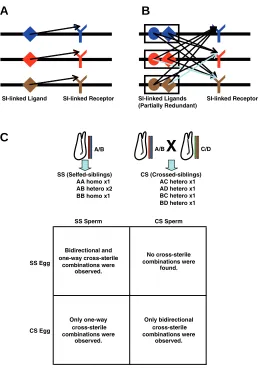
The self-recognition-based SI system is simple as depicted in Fig. 2A. It only demands that each allele of the recognition molecule recognizes a single partner encoded in the same haplotype. In flowering plants, several distinct strategies for the SI system have been reported (see review: Takayama and Isogai, 2005). For example, in the Brassicaceae, pollen ex-presses SCR (S-locus cysteine-rich protein), a ligand for a receptor kinase SRK (S-locus receptor kinase) that is located on the stigma. Both genes are encoded in a multiallelic com-plex, S-locus, which is inherited as one segregating unit. The specific interaction between SCR and SRK in the same haplo-type triggers SRK activation and leads to the inhibition of self-pollen tube elongation in the stigma (Nasrallah, 2002, and this issue). The molecular basis of receptor specificity for several SCR variants has also been reported (Chookajorn et al., 2004). On the other hand, the nonself-recognition-based SI system is more complicated. It requires each allele to interact with all the partners that are in different alleles. The mechanism of mating-type determination in fungi such as mushrooms and other Basidiomycetes, provides an example (Fig. 2B; Hiscock et al., 1996; Casselton, 2002). Basidiomycetes employ hun-dreds to thousands of mating types. For successful mating, compatible gametophytes must have different alleles at two unlinked genetic loci (A and B), both of which have dozens of alleles. Locus A encodes two structurally dissimilar homeodomain transcription-factors. Locus B encodes tandem-arrayed gene modules, each of which contains one pheromone receptor and two pheromones. The products of locus A can only heterodimerize with the products of a different allelic form of locus A. Likewise, pheromones encoded by one B locus can only interact with a receptor of another allele.
In the nonself-recognition-based SI system, one receptor must usually recognize more than one ligand and vice versa. In this case, locus B contains multiple redundant pheromone genes in a single module, which seems to be easier for multiple
molecules to take partial charges in their interactions with multiple binding partners than for one molecule to do the same thing. The number of molecular interactions in the nonself-recognition-based SI system is much higher than that in the self-recognition-based SI system. Once a repertoire of mol-ecules, among which comprehensive heterophilic interactions are implemented, were established, a new allele would rarely emerge. Indeed, it is supposed that the structural diversity in pheromones and pheromone receptors naturally seen in the Basidiomycete SI system may have reached a maximum (Riquelme et al., 2005), suggesting very strong functional constraints on the recognition molecules. Since the number of feasible structural variations may be limited, locus B seems to comprise multiple modules, each of which would have a limited number of alleles, but combinations of which produce a larger number of allele varieties (Riquelme et al., 2005).
Upon which mechanism is the SI system in C. intestinalis based? Although sperm show higher affinity to nonself-sperm than to sperm, genetic studies strongly support the self-recognition model. Murabe and Hoshi cultivated siblings from normal fertilization between two parental animals, one of which is the same as the parent of self-fertilized siblings (Murabe and Hoshi, 2002). They examined the frequency of occurrence of one-way and bi-directional cross-sterile combinations within and between the self-fertilized siblings and cross-fertilized F1
A/B A/B
X
C/DSS (Selfed-siblings) AA homo x1 AB hetero x2 BB homo x1
CS (Crossed-siblings) AC hetero x1 AD hetero x1 BC hetero x1 BD hetero x1
SS Sperm CS Sperm
SS Egg
CS Egg
Bidirectional and one-way cross-sterile
combinations were observed.
Only bidirectional cross-sterile combinations were
observed. No cross-sterile combinations were
found.
Only one-way cross-sterile combinations were
observed.
SI-linked Ligand SI-linked Receptor SI-linked Ligands SI-linked Receptor (Partially Redundant)
Fig. 2. Self- or nonself-recognition-based SI systems. (A) Schematic diagram of the self-recognition-based SI system. The SI ligands only need to interact with the cognate partners in the same haplotype. (B)
Nonself-recognition-based SI system. The ligands need to interact with all the partners in different alleles, which dramatically increases the number of molecular interactions. In nonself-recognition-based sys-tems, an allele of the SI gene typically contains multiple gene copies, which are partially functionally redundant. Such redundancy will help to reduce the functional constraints to the recognition molecules (pale arrows indicate examples of omissible interactions) and increase the number of feasible alleles. (C) Cross-sterility within and among the self-fertilized siblings (SS) and the cross-self-fertilized siblings (CS), one of whose parents is the same as the parent of the SS (after Murabe and Hoshi, 2002). The SS contain homozygote animals, whereas the CS theoreti-cally contains no homozygotes. The haploid sperm hypothesis predicts that one-way cross-sterility only occurs between sperm of the homozy-gous parent and egg of the heterozyhomozy-gous parent, which is consistent with that the one-way cross-sterility was observed only between the SS sperm and SS/CS eggs. CS theoretically contains four heterozygous genotypes, none of which match the three genotypes predicted in SS. This is also consistent with CS sperm always fertile to SS egg and no one-way cross-sterility is observed within the CS.
C
siblings. These results accorded well with the haploid sperm system, which is based on the recognition of self (see Fig. 2C; Murabe and Hoshi, 2002).
Proposed hypotheses on the SI mechanism in C.
intestinalis
In C. intestinalis, a number of candidate molecules have been proposed, which are responsible for the SI system during fertilization. Since acidic treatment of the VC abolishes the barrier against self-fertilization, Kawamura and his colleagues hypothesized that the allorecognition molecules must be solu-bilized from the VC into the acidic seawater (Kawamura et al., 1991). They found that the acid-extract possesses the activity of self/nonself-discrimination, which inhibits the binding of nonself-sperm, but not of self-sperm, to the VC. They partially purified several factors responsible for this activity, and showed that there are a non-allorecognizable glucose-enriched inhibi-tor toward gamete binding and multiple peptide-modulainhibi-tors, which have no inhibitory activity, but certain combinations of which show specific inhibitory ability toward nonself-sperm binding. They assumed that these factors cooperatively func-tion in self/nonself-recognifunc-tion. The molecular nature of allorecognizable peptide-modulators is not known. This ap-pears to be contradictory to the above-mentioned conclusion that the Ciona SI system is based on self-recognition. This apparent discrepancy remains to be clarified.
Self/nonself-discrimination in Ciona is established during oocyte maturation. De Santis and colleagues showed that the SI barrier becomes effective several hours after germinal vesicle breakdown, and is controlled by follicle cells attached to the outer surface of the VC (De Santis and Pinto, 1991). Since ablation of the follicle cells prevents the onset of self-sterility, they proposed that follicle cells release a certain self-sterility factor(s) that binds to the VC (De Santis and Pinto, 1991). They further proposed a hypothesis by analogy to the mammalian cellular immune system (Marino et al., 1998; Marino et al., 1999), in which a major histocompatibility complex (MHC) is expressed in virtually all cells. Peptides produced by proteasome-mediated proteolysis are loaded onto an Cihsp70, which is a molecular chaperone assumed to be an ancestor protein of MHC class I and II molecules in lower vertebrates or invertebrates, and delivered to the surface of the VC (Marino et al., 1999). They also showed that a specific inhibitor of the proteasome prevented the onset of self-sterility (Marino et al., 1999). From these results, they speculated that Cihsp70 and a self-peptide produced by proteasomal degradation might be involved in the SI system of C. intestinalis, which might share the origin of the vertebrate immune system.
To characterize multiallelic recognition molecules, another approach has been carried out. Khalturin, Bosch and their colleagues performed PCR-based subtraction experiments and compared gonad cDNAs between genetically unrelated indi-viduals. They identified several candidate genes that are ex-pressed in developing oocytes or/and follicle cells, and are highly polymorphic among individuals, including CiS7 (EGF-like repeat-containing gene), Ci-META2 (Thrombospondin type I domain-containing gene), vCRL1 (Sushi (or SCR)-domain-containing gene), multiple homologs of H. roretzi VC70
(EGF-like repeats- and ZP-domain-containing gene, see below) (Khalturin et al., 2005; Kurn et al., 2007a, b). However, the localization on the VC and the roles in SI systems of these candidate proteins during fertilization have not yet been dem-onstrated.
Themis, the SI genes in C. intestinalis as revealed by
positional cloning
We recently carried out a positional cloning of the SI loci in C. intestinalis using acid-induced self-fertilized siblings (Harada et al., 2008). This is an excellent experimental system because the diallelic genetic segregation of the SI gene is determined in the F1 generation, not in the F2 generation. We obtained two batches of self-fertilized F1 siblings, and examined pairwise fertility/sterility of their gametes. The genetic mechanism of the SI system was elucidated as follows. 1) Morgan’s «haploid sperm hypothesis» seems to be reasonable, and self/nonself-discrimination is based on the recognition of self. 2) The observed patterns of cross-sterility in both batches can be explained by the two unlinked SI loci model. 3) Fertilization is rejected when the haploidal geno-types of sperm are included in the diploidal genogeno-types of eggs at both loci.
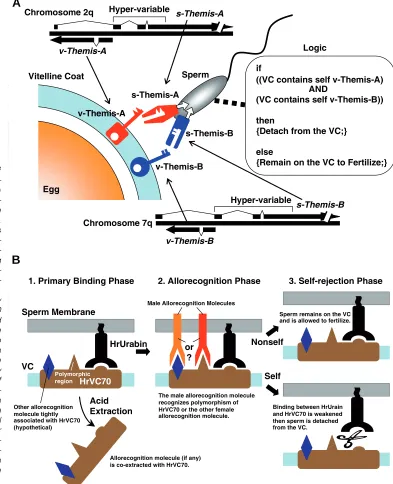
C. intestinalis is a useful animal model, since the draft genome sequences and transcriptomic data are available (Dehal et al., 2002). The detailed physical map of each chromosome has also been recently constructed (Shoguchi et al., 2006). This genomic information enabled us to identify two SI loci (designated as locus A and B) involved in the self-sterility of C. intestinalis (Harada et al., 2008). Loci A and B are located in chromosome 2q and 7q, respectively. Both loci contained a tightly linked pair of polycystin-1 receptors (designated as s-Themis-A and -B: Themis is a Greek goddess of divine order, law and custom who prohibits incest’) and fibrinogen-like ligand (v-Themis-A and -B) genes, the latter of which is located in the first intron of the former in opposite direction, in both cases (Harada et al., 2008). s-/v-Themis-A and -B are exclusive, extremely polymorphic genes that are com-monly encoded within the candidate regions in both loci. Interest-ingly, v-Themis was a sole member of the VC components encoded in locus A as revealed by comprehensive LC/MS/MS analysis. It was also found that mRNAs of s-Themis are ex-pressed in the testis. Polycystin-1 is a causative gene for autoso-mal dominant polycystic disease (ADPKD), and encodes a cal-cium channel that belongs to a transient receptor potential (TRP) superfamily. The involvement of polycystins in fertilization is reported in several other organisms (Kierszenbaum, 2004), in-cluding sea urchins, in which participation in the acrosomal reaction has been proposed (Neill and Vacquier, 2004).
contradiction between the mode of self/nonself-discrimination based on the recognition of self and the apparent higher affinity of VC to nonself-sperm than to self-sperm.
HrVC70, a candidate allorecognition protein during
fertilization of H. roretzi
A large solitary ascidian, Halocynthia roretzi, common around the main island of Japan, is a useful animal for studying fertiliza-tion mechanisms, since a large quantity of readily fertilizable mature sperm and eggs can be easily obtained from the dissected gonads of this species, which is cultured in Korea and Japan for human consumption (Sawada, 2002). In H. roretzi, it is well known
that allorecognition takes place during the interaction between sperm and the VC of the eggs. This was proved by an elegant experiment. In H. roretzi, follicle cells surrounding the VC are necessary for fertilization. For example, in partially defolliculated eggs, sperm penetration always occurs in the vicinity of the remaining follicle cells. Fuke removed follicle cells from eggs by treatment with calcium-free seawater, then reattached them to defolliculated eggs from a different individual in calcium-enriched seawater. Such a «mosaic» egg recovered the ability to be fertilized, and it was revealed that the VC but not follicle cells are responsible for the SI specificity (Fuke, 1983). Since a difference between the binding capabilities of sperm to the non and self-VC is not obvious in H. roretzi as it is in C. intestinalis, sperm are
Egg
Vitelline Coat Sperm
v-Themis-A
s-Themis-A
s-Themis-B
v-Themis-B
if
((VC contains self v-Themis-A) AND
(VC contains self v-Themis-B))
then
{Detach from the VC;}
else
{Remain on the VC to Fertilize;} Hyper-variable
Chromosome 2q
v-Themis-A
s-Themis-A
Hyper-variable
Chromosome 7q
v-Themis-B
s-Themis-B
Logic
1. Primary Binding Phase 2. Allorecognition Phase 3. Self-rejection Phase
or ?
Acid Extraction
Nonself
Self VC
Sperm Membrane
HrUrabin
HrVC70
Male Allorecognition Molecules
Other allorecognition molecule tightly associated with HrVC70 (hypothetical)
Polymorphic region
Allorecognition molecule (if any) is co-extracted with HrVC70.
The male allorecognition molecule recognizes polymorphism of HrVC70 or the other female allorecognition molecule.
Binding between HrUrain and HrVC70 is weakened then sperm is detached from the VC.
Sperm remains on the VC and is allowed to fertilize.
Fig. 3. Molecular mechanisms of ascidian SI systems. (A) Themis-me-diated SI system in C. intestinalis. (B)
A proposed hypothesis for the SI sys-tem of H. roretzi. Self-incompatible fertilization consists of three phases.
(1) Primary binding phase. HrUrabin is responsible for binding to the invari-ant region of HrVC70 and this interac-tion is required for all the succeeding fertilization-related reactions. The poly-morphic region of HrVC70 may deter-mine the SI-specificity; alternatively, another allorecognition molecule may be so tightly associated with HrVC70 that both molecules are co-extracted in the acidic extraction and show the allorecognizable activity in the in vitro experiments. (2) Allorecognition phase. An unidentified male-side allorecogniton molecule specifically recognizes the polymorphic region of HrVC70 or that of the other female-side allorecognition molecule on HrVC70. (3) Self-rejection phase. If a sperm regards the egg as self, it will activate the unidentified protease or glycosidase to ablate the binding be-tween HrVC70 and HrUrabin. Other-wise sperm remains on the VC then activates its lysin system to penetrate through the VC.
A
also able to bind to the autologous VC. However, we recently found that a major VC component protein, HrVC70, showed significantly higher affinity to nonself-sperm than to self-sperm, when it was immobilized onto agarose beads (Sawada et al., 2004; see below).
It is not known yet whether the SI specificity in H. roretzi is genetically controlled, because its long generation time makes breeding experiments difficult. In addition to the SI system during fertilization, H. roretzi shows another allorecognition event in hemocytes, referred to as the ‘contact reaction’ (Fuke, 1980). When hemocytes from different individuals are mixed, they un-dergo a series of cytotoxic reactions. Although the mechanism underlying this process remains unclear, these two recognition systems may share a common molecule or a biomolecular moi-ety, since a monoclonal antibody that inhibits both reactions has been obtained (Arai et al., 2001).
Biochemical behavior of the barrier against self-fertilization in H. roretzi is very similar to that in C. intestinalis. It is known that mature oocytes, but not immature oocytes, are self-sterile and that short treatment (1 min) of mature oocytes with acidic seawa-ter (pH 2 to 3) allows self-fertilization (Fuke, 1983; Sawada, 2002). Furthermore, it is reported that the acquisition of self-sterility during oocyte maturation is blocked by trypsin inhibitors and that exogenously added trypsin stimulates the acquisition of self-sterility (Fuke and Numakunai, 1996; 1999). These results led us to propose that a putative allorecognition protein might be ex-pressed in immature oocytes as a precursor, the active form of which might be generated by limited proteolysis with a trypsin-like protease. This results in the attachment of the active form of a putative allorecognition molecule to the VC during oocyte matu-ration. This molecule might be easily extracted from the VC by weak acid.
To test this possibility, we compared the components of the VCs from immature oocytes with those from mature oocytes of H. roretzi by SDS-PAGE. We then noticed that the amount of a 70-kDa-VC protein HrVC70, which had been identified as a sperm receptor consisting of 12 EGF-like repeats (Sawada et al., 2002a), markedly increased during oocyte maturation and that this protein is easily and almost specifically extracted from the VC by 1-10 mM HCl (pH 2-3) (Sawada et al., 2004). As mentioned above, we showed that the number of nonself-sperm bound to HrVC70-agarose beads is significantly higher than that of self-sperm and that pretreatment of sperm with nonself-HrVC70 more strongly inhibited fertilization than the pretreatment of sperm with self-HrVC70 (Sawada et al., 2004). We also found that self-HrVC70 is a highly polymorphic protein showing no identical sequence among 10 individuals tested: amino acid substitutions were mainly found in a region between the 3rd and 4th Cys residues in each EGF domain, which except for domain-2 is about 6 residues longer than those in other EGF-like repeat-containing proteins such as HrNotch-1, and also in a connecting region between EGF do-mains (Sawada, 2002; Sawada et al., 2004). From these results, together with the fact that even a single amino acid substitution is sufficient to affect the molecular recognition between EGF-like repeat-containing molecules such as Notch, Delta and Serrate (Artavanis-Tsakonas et al., 1995; Jotel et al., 1996), we proposed that HrVC70 is a promising candidate allorecognition molecule during fertilization of the ascidian H. roretzi.
After the sperm attaches to the VC and recognizes it as
nonself, the sperm-borne VC-lysin must be activated, allowing sperm to penetrate through the VC (Sawada, 2002). We recently found that a novel extracellular ubiquitin-proteasome system functions as a lysin during ascidian fertilization (Sawada et al., 2002a, 2002b; see review Sawada, 2002). HrVC70, a main component of the VC with an allorecognizable sperm-receptor activity, was found to be ubiquitinated by ATP, ubiquitin and a ubiquitin-conjugating enzyme complex, all of which are released during the sperm reaction, a phenomenon with vigorous sperm movement and mitochondrial shedding, occurring on the sperm attached to the VC (Lambert and Epel, 1979). Actually, the VC is ubiquitinated after sperm attachment to the VC as revealed by immunocytochemistry using the FK2 monoclonal antibody, which is specific to ubiquitinated proteins and the multiubiquitin chain but not free ubiquitin (Sawada et al., 2002a). In addition, several high-molecular-mass ubiquitinated bands were detected after SDS-PAGE by Western blotting using an anti-HrVC70 antibody as well as FK2 monoclonal antibody. This suggests that HrVC70 is ubiquitinated extracellularly during fertilization. This ubiquitination appears to be necessary for successful fertilization, since the FK2 monoclonal antibody is capable of inhibiting fertili-zation (Sawada et al., 2002a). The ubiquitinating enzyme com-plex released during the sperm reaction was isolated and found to exist as a 700-kDa enzyme complex. This complex seems to function extracellularly under seawater conditions (Sakai et al., 2003). After ubiquitination, the proteasomes located on the sur-face of the sperm head region appear to be activated and degrade the ubiquitinated HrVC70, enabling sperm to penetrate through the VC (Sawada et al., 2002b). A tight coupling mechanism between self/nonself-recognition and lysin systems is an intrigu-ing issue remainintrigu-ing to be solved.
We recently showed that another ascidian species Halocynthia aurantium, in the same genus as H. roretzi, also possesses a strict SI system. To gain insights into the roles of polymorphisms of HrVC70 in SI specificity, we explored an ortholog of HrVC70 in H. aurantium (Ban et al., 2005). The isolated one was designated as HaVC80, consisting of 13 EGF repeats. The gene encoding HaVC80 had a similar structure to that of HrVC70, and was highly polymorphic. It is worth noting that each single EGF-repeat corresponds to a single exon in both genes. In plant SI systems, it is reported that each allele of the SI gene is sometimes conserved across species, because of strong functional con-straints to maintain the specific relationship with its binding partner (e.g. Ioerger et al., 1990). Close inspection of polymor-phisms in both proteins failed to identify an allele shared by these two species, or any particularly variable residues commonly observed in both proteins. Instead, mutations in these proteins seemed to be randomly introduced. In both HrVC70 and HaVC80, the last (12th EGF of HrVC70 and 13th of HaVC80) EGF repeats have no variations, even at the level of nucleotide sequence, suggesting that this region is under a higher negative (purifying) selection pressure than the other regions.
HrUrabin, a sperm binding partner of HrVC70
membrane Ser-protease, HrTTSP-1, capable of binding to HrVC70. Transcripts of HrTTSP-1 are strongly expressed in the testis. Its products contain multiple functional domains involved in protein-and sugar-recognition in the extracellular region (Harada protein-and Sawada, 2007). In addition, we also found that certain residues of HrVC70 are post-translationally modified with carbohydrate chains (Sawada et al., in preparation). Some sugar chains contain a terminal fucose residue. Previous reports indicated that a sperm surface fucosidase is involved in gamete interaction in H. roretzi (Hoshi, 1986; Matsumoto et al., 2002), which may be one of the putative binding partners for HrVC70. Such an interaction be-tween a sugar moiety of the VC and sperm-surface glycosidase may explain, at least in part, a possible interaction between sperm and the VC from the same individual.
Furthermore, we identified a novel protein that strongly inter-acts with HrVC70 by Far western blotting in the sperm LD-DIM (low density-detergent-insoluble membrane, or so-called lipid rafts) fraction (Urayama et al., 2008). This 35-kDa GPI-anchored glycoprotein, referred to as HrUrabin (Halocynthia roretzi unique lipid rafts-derived binding partner), showed a sequence homology to a CRISP (Cys-rich secretory protein) family, some members of which are known to play roles in fertilization (Yudin et al., 2002; Ellerman et al., 2006; Roberts et al., 2006). We showed that HrUrabin also has a function in fertilization, since an antibody against HrUrabin specifically inhibited fertilization. The anti-HrUrabin antibody showed inhibitory activity toward the allorecognizable sperm binding to HrVC70-immobilized beads. Although nonself-sperm shows higher affinity, self-sperm can bind to the HrVC70-agarose beads to some extent. This ‘basal’ affinity was decreased by the anti-HrUrabin antibody to ground level. Interestingly, the antibody also inhibited nonself-sperm binding to HrVC70-agarose. This implies that HrUrabin is needed for the higher affinity of nonself-sperm to HrVC70 as well as for the «basal» affinity of self-sperm to HrVC70. In other words, if other molecules were responsible for higher affinity of nonself-sperm to HrVC70, its activity would also be exhibited depending on HrUrabin. HrUrabin itself showed little polymorphism. Among several indi-viduals, no significant differences were observed in the binding of HrVC70 to HrUrabin on the basis of Far western blotting analysis. These results suggest that HrUrabin may not be the allorecognition molecule per se, although it should play a central role in the SI system with HrVC70.
Conclusions
Ascidians are hermaphrodites, but many ascidians, including C. intestinalis and H. roretzi, show strict self-sterility. We recently identified the genes responsible for self-incompatibility in C. intestinalis by a positional cloning: sperm-borne polycystin 1-like receptor, referred to as s-Themis, and its fibrinogen-like ligand called v-Themis on the VC are highly polymorphic and appear to be responsible for allorecognition in C. intestinalis. We also revealed that HrVC70, a 70-kDa main component of the VC of the eggs, is a promising candidate for the allorecognition molecule, and that HrUrabin, a 35-kDa sperm-borne binding partner for HrVC70, plays a key role in allorecognizable sperm binding to HrVC70 in H. roretzi.
It is an intriguing issue to further investigate whether a homolog of Themis of C. intestinalis occurs in H. roretzi. As seen in plants
(Takayama and Isogai, 2005), the SI systems may recruit different kinds of molecular pairs, if they can undergo allele-specific molecular interactions. It should be noted that an HrVC70-like gene is tightly linked to a polycystin-1 gene in the C. intestinalis genome, which led us to speculate that HrVC70 might act as a ligand for undiscovered polycystin-1 instead of a fibrinogen-like protein. Interaction between HrVC70 and HrUrabin may be re-sponsible for the primary binding between sperm and the VC. Our model for the Ciona SI system proposes the active detaching mechanism in sperm from the VC. It seems plausible that the interaction between the orthologs of HrVC70 and HrUrabin may also occur in C. intestinalis, which becomes a target of the active weakening mechanism probably mediated by yet unidentified proteases or glycosidases.
Acknowledgements
We are grateful to Drs. Charles and Gretchen Lambert and Dr. Victor D. Vacquier for their critical reading of this manuscript and their valuable comments.
References
ARAI, M., SUZUKI-KOIKE, M., OHTAKE, S., OHBA, H., TANAKA, K. and CHIBA, J. (2001). Common cell-surface antigens functioning in self-recognition reac-tions by both somatic cells and gametes in the solitary ascidian Halocynthia roretzi. Microbiol Immunol 45: 857-66.
ARTAVANIS-TSAKONAS, S., MATSUNO, K. and FORTINI, M.E. (1995). Notch signaling. Science 268: 225-32.
BAN, S., HARADA, Y., YOKOSAWA, H. and SAWADA, H. (2005). Highly polymor-phic vitelline-coat protein HaVC80 from the ascidian, Halocynthia aurantium: structural analysis and involvement in self/nonself recognition during fertiliza-tion. Dev Biol 286: 440-51.
BOEHM, T. (2006). Quality control in self/nonself discrimination. Cell 125: 845-58.
BYRD, J. and LAMBERT, C.C. (2000). Mechanism of the block to hybridization and selfing between the sympatric ascidians Ciona intestinalis and Ciona savignyi.
Mol Reprod Dev 56: 541.
CASSELTON, L.A. (2002). Mate recognition in fungi. Heredity 88: 142-7.
CHOOKAJORN, T., KACHROO, A., RIPOLL, D.R., CLARK, A.G. and NASRALLAH, J.B. (2004). Specificity determinants and diversification of the Brassica self-incompatibility pollen ligand. Proc Natl Acad Sci USA 101: 911-7.
DE SANTIS, R. and PINTO, M.R. (1991). Gamete self-discrimination in ascidians: a role for the follicle cells. Mol Reprod Dev 29: 47-50.
DEHAL, P., SATOU, Y., CAMPBELL, R.K., CHAPMAN, J., DEGNAN, B., DE TOMASO, A., DAVIDSON, B., DI GREGORIO, A., GELPKE, M., GOODSTEIN, D.M. et al. (2002). The draft genome of Ciona intestinalis: insights into chordate
and vertebrate origins. Science 298: 2157-67.
ELLERMAN, D.A., COHEN, D.J., DA ROS, V.G., MORGENFELD, M.M., BUSSO, D. and CUASNICU, P.S. (2006). Sperm protein «DE» mediates gamete fusion through an evolutionarily conserved site of the CRISP family. Dev Biol 297:
228-37.
FUKE, M. and NUMAKUNAI, T. (1996). Establishment of self-sterility of eggs in the ovary of the solitary ascidian, Halocynthia roretzi. Roux’s Arch Dev Biol 205:
391-400.
FUKE, M. and NUMAKUNAI, T. (1999). Self-Sterility of Eggs Induced by Exog-enous and EndogExog-enous Protease in the Solitary Ascidian, Halocynthia roretzi.
Mol Reprod Dev 52: 99-106.
FUKE, T. (1980). «Contact reaction» between xenogeneic or alIo-geneic coelomic cells of solitary ascidians. Biol Bull 158.
FUKE, T. (1983). Self and nonself recognition between gametes of the ascidian, Halocynthia roretzi. Roux’s Arch Dev Biol 192: 347-352.
HARADA, Y., TAKAGAKI, Y., SUNAGAWA, M., SAITO, H., YAMADA, L., TANIGUCHI, H., SHOGUCHI, E. and SAWADA, H. (2008). Mechanism of self-sterility in a hermaphroditic chordate. Science 320: 548-550.
HISCOCK, S.J., KUES, U. and DICKINSON, H.G. (1996). Molecular mechanisms of self-incompatibility in flowering plants and fungi - different means to the same end. Trends Cell Biol 6: 421-8.
HOSHI, M. (1986). Sperm glycosidase as a plausible mediator of sperm binding to the vitelline envelope in ascidian. In: Hedrick, J.L. (ed), The Molecular and Cellular Biology of Fertilization. pp. 251-260, Plenum Publishing Corp., New York.
IOERGER, T.R., CLARK, A.G. and KAO, T.H. (1990). Polymorphism at the self-incompatibility locus in Solanaceae predates speciation. Proc Natl Acad Sci USA 87: 9732-5.
JIANG, D. and SMITH, W.C. (2005). Self- and cross-fertilization in the solitary ascidian Ciona savignyi. Biol Bull 209: 107-12.
JOUTEL, A., CORPECHOT, C., DUCROS, A., VAHEDI, K., CHABRIAT, H., MOUTON, P., ALAMOWITCH, S., DOMENGA, V., CECILLION, M., MARECHAL, E. et al. (1996). Notch3 mutations in CADASIL, a hereditary adult-onset
condition causing stroke and dementia. Nature 383: 707-10.
KAWAMURA, K., FUJITA, H. and NAKAUCHI, M. (1987). Cytological characteriza-tion of self incompatibility in gametes of the ascidian, Ciona intestinalis. Dev Growth Differ 29: 627-642.
KAWAMURA, K., NOMURA, M., KAMEDA, T., SHIMAMOTO, H. and NAKAUCHI, M. (1991). Self-nonself recognition activity extracted from self-sterile eggs of the ascidian, Ciona intestinalis. Dev Growth Differ 33: 139-148.
KHALTURIN, K., KURN, U., PINNOW, N. and BOSCH, T.C. (2005). Towards a molecular code for individuality in the absence of MHC: screening for individu-ally variable genes in the urochordate Ciona intestinalis. Dev Comp Immunol 29:
759-73.
KIERSZENBAUM, A.L. (2004). Polycystins: what polycystic kidney disease tells us about sperm. Mol Reprod Dev 67: 385-8.
KURN, U., SOMMER, F., BOSCH, T.C. and KHALTURIN, K. (2007a). In the urochordate Ciona intestinalis zona pellucida domain proteins vary among individuals. Dev Comp Immunol 31: 1242-54.
KURN, U., SOMMER, F., HEMMRICH, G., BOSCH, T.C. and KHALTURIN, K. (2007b). Allorecognition in urochordates: identification of a highly variable complement receptor-like protein expressed in follicle cells of Ciona. Dev Comp Immunol 31: 360-71.
LAMBERT, C.C. and EPEL, D. (1979). Calcium-mediated mitochondrial movement in ascidian sperm during fertilization. Dev Biol 69: 296-304.
MARINO, R., DE SANTIS, R., GIULIANO, P. and PINTO, M.R. (1999). Follicle cell proteasome activity and acid extract from the egg vitelline coat prompt the onset of self-sterility in Ciona intestinalis oocytes. Proc Natl Acad Sci USA 96:
9633-6.
MARINO, R., PINTO, M.R., COTELLI, F., LAMIA, C.L. and DE SANTIS, R. (1998). The hsp70 protein is involved in the acquisition of gamete self-sterility in the ascidian Ciona intestinalis. Development 125: 899-907.
MATSUMOTO, M., HIRATA, J., HIROHASHI, N. and HOSHI, M. (2002). Sperm-egg binding mediated by sperm α-L-fucosidase in the ascidian, Halocynthia roretzi.
Zoolog. Sci. 19: 43-8.
MILLAR, R.H. (1953). Ciona. In L. M. B. C. Mem., vol. XXXV. Univ. Press of
Liverpool, Liverpool, pp.123.
MORGAN, T.H. (1910). Cross- and self-fertilization in Ciona intestinalis. Roux Arch. Entwicklungsmech 30: 206-235.
MORGAN, T.H. (1939). The genetic and the physiological problems of self-sterility
in Ciona. III. Induced self-fertilization. J Exp Zool 80: 19-54.
MORGAN, T.H. (1942). The genetic and the physiological problems of self-sterility in Ciona. V. The genetic problem. J Exp Zool 90: 199-228.
MORGAN, T.H. (1944). The genetic and the physiological problems of self-sterility in Ciona. VI. Theoretical discussion of genetic data. J Exp Zool 95: 37-59.
MURABE, N. and HOSHI, M. (2002). Re-examination of sibling cross-sterility in the ascidian, Ciona intestinalis: genetic background of the self-sterility. Zoolog Sci
19: 527-38.
NASRALLAH, J.B. (2002). Recognition and rejection of self in plant reproduction.
Science 296: 305-8.
NEILL, A.T. and VACQUIER, V.D. (2004). Ligands and receptors mediating signal transduction in sea urchin spermatozoa. Reproduction 127: 141-9.
RIQUELME, M., CHALLEN, M.P., CASSELTON, L.A. and BROWN, A.J. (2005). The origin of multiple B mating specificities in Coprinus cinereus. Genetics 170:
1105-19.
ROBERTS, K.P., ENSRUD, K.M., WOOTERS, J.L., NOLAN, M.A., JOHNSTON, D.S. and HAMILTON, D.W. (2006). Epididymal secreted protein Crisp-1 and sperm function. Mol Cell Endocrinol 250: 122-7.
ROSATI, F. and DE SANTIS, R. (1978). Studies on fertilization in the Ascidans. I. Self-sterility and specific recognition between gametes of Ciona intestinalis.
Exp Cell Res 112: 111-9.
SAKAI, N., SAWADA, H. and YOKOSAWA, H. (2003). Extracellular ubiquitin system implicated in fertilization of the ascidian, Halocynthia roretzi: isolation and characterization. Dev Biol 264: 299-307.
SAWADA, H. (2002). Ascidian sperm lysin system. Zoolog Sci 19: 139-51.
SAWADA, H., SAKAI, N., ABE, Y., TANAKA, E., TAKAHASHI, Y., FUJINO, J., KODAMA, E., TAKIZAWA, S. and YOKOSAWA, H. (2002a). Extracellular ubiquitination and proteasome-mediated degradation of the ascidian sperm receptor. Proc Natl Acad Sci USA 99: 1223-8.
SAWADA, H., TAKAHASHI, Y., FUJINO, J., FLORES, S.Y. and YOKOSAWA, H. (2002b). Localization and roles in fertilization of sperm proteasomes in the ascidian Halocynthia roretzi. Mol Reprod Dev 62: 271-6.
SAWADA, H., TANAKA, E., BAN, S., YAMASAKI, C., FUJINO, J., OOURA, K., ABE, Y., MATSUMOTO, K. and YOKOSAWA, H. (2004). Self/nonself recognition in ascidian fertilization: vitelline coat protein HrVC70 is a candidate allorecognition molecule. Proc Natl Acad Sci USA 101: 15615-20.
SHOGUCHI, E., KAWASHIMA, T., SATOU, Y., HAMAGUCHI, M., SIN, I.T., KOHARA, Y., PUTNAM, N., ROKHSAR, D.S. and SATOH, N. (2006). Chromo-somal mapping of 170 BAC clones in the ascidian Ciona intestinalis. Genome Res 16: 297-303.
TAKAYAMA, S. and ISOGAI, A. (2005). Self-incompatibility in plants. Annu Rev Plant Biol 56: 467-89.
URAYAMA, S., HARADA, Y., NAKAGAWA, Y., BAN, S., AKASAKA, M., KAWASAKI, N. and SAWADA, H. (2008). Ascidian sperm glycosylphophatidylinositol-an-chored CRISP-like protein as a binding partner for an allorecognizable sperm receptor on the vitelline coat. J. Biol. Chem., in press.
UYENOYAMA, M.K. (2005). Evolution under tight linkage to mating type. New Phytol 165: 63-70.
VIEIRA, A. and MILLER, D.J. (2006). Gamete interaction: is it species-specific? Mol Reprod Dev 73: 1422-9.
Related, previously published Int. J. Dev. Biol. articles
See our recent Special Issue Developmental Biology in Poland edited by Tarkowski, Maleszewski and Kloc at: http://www.ijdb.ehu.es/web/contents.php?vol=52&issue=2-3
See our recent Special Issue Ear Development edited by Fernando Giraldez and Bernd Fritzsch at: http://www.ijdb.ehu.es/web/contents.php?vol=51&issue=6-7
Evolutionary embryology resurrected in Japan with a new molecular basis: Nori Satoh and the history of ascidian studies originating in Kyoto during the 20th century
Shigeru Kuratani, Hiroshi Wada, Rie Kusakabe And Kiyokazu Agata Int. J. Dev. Biol. (2006) 50: 451-454
Rab11 is required during Drosophila eye development
Debasmita P. Alone, Anand K. Tiwari, Lolitika Mandal, Mingfa Li, Bernard M. Mechler and Jagat K. Roy Int. J. Dev. Biol. (2005) 49: 873-879
Gametophyte interaction and sexual reproduction: how plants make a zygote
Leonor C. Boavida, Ana Maria Vieira, Jörg D. Becker and José A. Feijó Int. J. Dev. Biol. (2005) 49: 615-632
Origins and plasticity of neural crest cells and their roles in jaw and craniofacial evolution.
Paul A Trainor, Kristin R Melton and Miguel Manzanares Int. J. Dev. Biol. (2003) 47: 541-553
Allogeneic interactions in Hydractinia: is the transitory chimera beneficial?
Sharon Gild, Uri Frank and Ofer Mokady Int. J. Dev. Biol. (2003) 47: 433-438
Autoaggressive, multi-headed and other mutant phenotypes in Hydractinia echinata (Cnidaria: Hydrozoa).
Werner A Müller
Int. J. Dev. Biol. (2002) 46: 1023-1033
The ontogeny of allorecognition in a colonial hydroid and the fate of early established chimeras.
Marc-Aurel Fuchs, Ofer Mokady and Uri Frank Int. J. Dev. Biol. (2002) 46: 699-704
Evolution and developmental expression of nuclear receptor genes in the ascidian Herdmania.
Christine Devine, Veronica F Hinman and Bernard M Degnan 2006 ISI **Impact Factor = 3.577** Int. J. Dev. Biol. (2002) 46: 687-692
Ecological regulation of development: induction of marine invertebrate metamorphosis.
Daniel Jackson, Sally P Leys, Veronica F Hinman, Rick Woods, Martin F Lavin and Bernard M Degnan
Int. J. Dev. Biol. (2002) 46: 679-686
The eyeless mutant gene (e) in the Mexican axolotl (Ambystoma mexicanum) affects pax-6 expression and forebrain axonogenesis.
G W Eagleson, L M Gerlach and T A Platz Int. J. Dev. Biol. (2001) 45: 653-660
Synergistic action of HNF-3 and Brachyury in the notochord differentiation of ascidian embryos.
Y Shimauchi, S Chiba and N Satoh Int. J. Dev. Biol. (2001) 45: 643-652
Cytoskeletal actin genes function downstream of HNF-3beta in ascidian notochord development.