R E S E A R C H
Open Access
Theory of
n
th-order linear general
quantum difference equations
Nashat Faried
1, Enas M. Shehata
2*and Rasha M. El Zafarani
1*Correspondence:
[email protected] 2Department of Mathematics,
Faculty of Science, Menoufia University, Shibin El-Koom, Egypt Full list of author information is available at the end of the article
Abstract
In this paper, we derive the solutions of homogeneous and non-homogeneous nth-order linear general quantum difference equations based on the general quantum difference operatorDβ which is defined byDβf(t) = (f(β(t)) –f(t))/(β(t) –t),
β
(t)=t, whereβ
is a strictly increasing continuous function defined on an interval I⊆Rthat has only one fixed points0∈I. We also give the sufficient conditions for theexistence and uniqueness of solutions of the
β
-Cauchy problem of these equations. Furthermore, we present the fundamental set of solutions when the coefficients are constants, theβ-Wronskian associated with
Dβ, and Liouville’s formula for theβ
-difference equations. Finally, we introduce the undetermined coefficients, the variation of parameters, and the annihilator methods for the non-homogeneousβ
-difference equations.MSC: Primary 39A10; 39A13; 39A70; secondary 47B39
Keywords: A general quantum difference operator;nth-order linear general quantum difference equations;
β
-Wronskian; Homogeneous quantum difference equations; Non-homogeneous quantum difference equations1 Introduction
Quantum difference operator allows us to deal with sets of non-differentiable functions. Its applications are used in many mathematical fields such as the calculus of variations, orthogonal polynomials, basic hypergeometric functions, quantum mechanics, and the theory of scale relativity; see, e.g., [3,5,7,13,14].
The general quantum difference operatorDβgeneralizes the Jacksonq-difference
oper-atorDqand the Hahn difference operatorDq,ω, see [1,2,4,8,12]. It is defined, in [10, p.
6], by
Dβf(t) = ⎧ ⎨ ⎩
f(β(t))–f(t)
β(t)–t , t=s0,
f(s0), t=s0,
wheref :I→Xis a function defined on an interval I⊆R, Xis a Banach space, and
β:I→Iis a strictly increasing continuous function defined onIthat has only one fixed points0∈I and satisfies the inequality (t–s0)(β(t) –t)≤0 for allt∈I. The function
f is said to beβ-differentiable onI if the ordinary derivativefexists ats0. The general
quantum difference calculus was introduced in [10]. The exponential, trigonometric, and
hyperbolic functions associated withDβwere presented in [9]. The existence and
unique-ness of solutions of the first-orderβ-initial value problem were established in [11]. In [6], the existence and uniqueness of solutions of theβ-Cauchy problem of the second-order
β-difference equations were proved. Also, a fundamental set of solutions for the second-order linear homogeneousβ-difference equations when the coefficients are constants was constructed, and the different cases of the roots of their characteristic equations were stud-ied. Moreover, the Euler–Cauchyβ-difference equation was derived.
The organization of this paper is briefly summarized in the following. In Sect.2, we present the needed preliminaries of the β-calculus from [6,9–11]. In Sect. 3, we give the sufficient conditions for the existence and uniqueness of solutions of theβ-Cauchy problem of thenth-orderβ-difference equations. Also, we construct the fundamental set of solutions for the homogeneous linearβ-difference equations when the coefficientsaj
(0≤j≤n) are constants. Furthermore, we introduce theβ-Wronskian which is an effec-tive tool to determine whether the set of solutions is a fundamental set or not and prove its properties. Finally, we study the undetermined coefficients, the variation of parameters, and the annihilator methods for the non-homogeneous linearβ-difference equations.
Throughout this paper,Jis a neighborhood of the unique fixed points0ofβ,S(y0,b) =
{y∈X:y–y0 ≤b}, andR={(t,y)∈I×X:|t–s0| ≤a,y–y0 ≤b}is a rectangle, where
a,bare fixed positive real numbers,Xis a Banach space. Furthermore,Dn
βf =Dβ(Dnβ–1f),
n∈N0=N∪{0}, wheref isβ-differentiablentimes overI,Nis the set of natural numbers.
We use the symbolTfor the transpose of the vector or the matrix.
2 Preliminaries
Lemma 2.1([10]) The following statements are true:
(i) The sequence of functions{βk(t)}∞
k=0converges uniformly to the constant function
ˆ
β(t) :=s0on every compact intervalV⊆Icontainings0.
(ii) The series∞k=0|βk(t) –βk+1(t)|is uniformly convergent to|t–s0|on every compact
intervalV⊆Icontainings0.
Lemma 2.2([10]) If f :I→Xis a continuous function at s0,then the sequence{f(βk(t))}∞k=0
converges uniformly to f(s0)on every compact interval V⊆I containing s0.
Theorem 2.3([10]) If f :I→Xis continuous at s0,then the series
∞
k=0(βk(t)–βk+1(t))×
f(βk(t))is uniformly convergent on every compact interval V⊆I containing s 0.
Theorem 2.4([10]) Assume that f :I→Xand g:I→Rareβ-differentiable at t∈I.
Then:
(i) The productfg:I→Xisβ-differentiable attand
Dβ(fg)(t) =
Dβf(t)
g(t) +fβ(t)Dβg(t)
=Dβf(t)
gβ(t)+f(t)Dβg(t), (ii) f/gisβ-differentiable attand
Dβ(f/g)(t) =
(Dβf(t))g(t) –f(t)Dβg(t)
g(t)g(β(t)) ,
Theorem 2.5([10]) Assume that f :I→Xis continuous at s0.Then the function F defined
by
F(t) = ∞
k=0
βk(t) –βk+1(t)fβk(t), t∈I (2.1)
is aβ-antiderivative of f with F(s0) = 0.Conversely,aβ-antiderivative F of f vanishing at
s0is given by(2.1).
Definition 2.6([10]) Theβ-integral off :I→Xfromatob,a,b∈I, is defined by
b
a
f(t)dβt=
b
s0
f(t)dβt–
a
s0
f(t)dβt,
where
x
s0
f(t)dβt=
∞
k=0
βk(x) –βk+1(x)fβk(x), x∈I,
provided that the series converges atx=aandx=b.f is calledβ-integrable onIif the series converges ataandbfor alla,b∈I. Clearly, iff is continuous ats0∈I, thenf is
β-integrable onI.
Definition 2.7([9]) Theβ-exponential functionsep,β(t) andEp,β(t) are defined by
ep,β(t) =
1
∞
k=0[1 –p(βk(t))(βk(t) –βk+1(t))]
(2.2)
and
Ep,β(t) =
∞
k=0
1 +pβk(t)βk(t) –βk+1(t), (2.3)
wherep:I→Cis a continuous function ats0,ep,β(t) = E 1
–p,β(t).
The both products in (2.2) and (2.3) are convergent to a non-zero number for everyt∈I
since∞k=0|p(βk(t))(βk(t) –βk+1(t))|is uniformly convergent.
Definition 2.8([9]) Theβ-trigonometric functions are defined by
cosp,β(t) =
eip,β(t) +e–ip,β(t)
2 ,
sinp,β(t) =
eip,β(t) –e–ip,β(t)
2i ,
Cosp,β(t) =
Eip,β(t) +E–ip,β(t)
2 ,
and Sinp,β(t) =
Eip,β(t) –E–ip,β(t)
Theorem 2.9([9]) Theβ-exponential functions ep,β(t)and Ep,β(t)are the unique solutions
of the first-orderβ-difference equations
Dβy(t) =p(t)y(t), y(s0) = 1,
Dβy(t) =p(t)y
β(t), y(s0) = 1,
respectively.
Theorem 2.10([9]) Assume that f :I→Xis continuous at s0.Then the solution of the
following equation Dβy(t) =p(t)y(t) +f(t),y(s0) =y0∈X,has the form
y(t) =ep,β(t)
y0+ t
s0
f(τ)E–p,β
β(τ)dβτ
.
Theorem 2.11([11]) Let z∈Cbe a constant.Then the functionφ(t)defined by
φ(t) = ∞
k=0
zkαk(t)
is the unique solution of theβ-IVP
Dβy(t) =zy(t), y(s0) = 1,
where
αk(t) = ⎧ ⎪ ⎪ ⎪ ⎨ ⎪ ⎪ ⎪ ⎩
∞
i1,i2,i3,...,ik–1=0(
k–1
l=1(β,β)lj=1ij)(β k–1
j=1ij
(t) –s0), if k≥2,
t–s0, if k= 1,
1, if k= 0,
with(β,β)i=βi(t) –βi+1(t).
Proposition 2.12([11]) Let z∈C.Theβ-exponential function ez,β(t)has the expansion
ez,β(t) =
∞
k=0
zkα k(t).
Theorem 2.13([11]) Assume that f :R→Xis continuous at(s0,y0)∈R and satisfies the
Lipschitz condition(with respect to y)
f(t,y1) –f(t,y2)≤Ly1–y2 for all(t,y1), (t,y2)∈R,
where L is a positive constant.Then the sequence defined by
φk+1(t) =y0+ t
s0
fτ,φk(τ)
converges uniformly on the interval|t–s0| ≤δto a functionφ,the unique solution of the
β-IVP
Dβy(t) =f(t,y), y(s0) =y0, t∈I, (2.5)
whereδ=min{a,Lbb+M,ρL}withρ∈(0, 1)and M=sup(t,y)∈Rf(t,y)<∞,ρ∈(0, 1).
Theorem 2.14([6]) Let fi(t,y1,y2) :I×
2
i=1Si(xi,bi)→X,s0∈I such that the following
conditions are satisfied:
(i) Foryi∈Si(xi,bi),i= 1, 2,fi(t,y1,y2)are continuous att=s0.
(ii) There is a positive constantAsuch that,fort∈I,yi,y˜i∈Si(xi,bi),i= 1, 2,the following Lipschitz condition is satisfied:
fi(t,y1,y2) –fi(t,y˜1,˜y2)≤A 2
i=1
yi–˜yi.
Then there exists a unique solution of theβ-initial value problemβ-IVP Dβyi(t) =fi
t,y1(t),y2(t)
, yi(s0) =xi∈X, i= 1, 2,t∈I. Corollary 2.15([6]) Let f(t,y1,y2)be a function defined on I×
2
i=1Si(xi,bi)such that the
following conditions are satisfied:
(i) For any values ofyi∈Si(xi,bi),i= 1, 2,f is continuous att=s0.
(ii) f satisfies the Lipschitz condition f(t,y1,y2) –f(t,y˜1,˜y2)≤A
2
i=1
yi–y˜i,
where A> 0,yi,˜yi∈Si(xi,bi),i= 1, 2,and t∈I.Then
D2βy(t) =f
t,y(t),Dβy(t)
, Diβ–1y(s0) =xi, i= 1, 2,
has a unique solution on[s0,s0+δ].
Corollary 2.16([6]) Assume that the functions aj(t) :I→C,j= 0, 1, 2,and b(t) :I→X
satisfy the following conditions:
(i) aj(t),j= 0, 1, 2,andb(t)are continuous ats0witha0(t)= 0for allt∈I,
(ii) aj(t)/a0(t)is bounded onI,j= 1, 2.Then
a0(t)D2βy(t) +a1(t)Dβy(t) +a2(t)y(t) =b(t), Diβ–1y(s0) =xi, xi∈X,i= 1, 2,
has a unique solution on a subinterval J⊆I,s0∈J. 3 Main results
In this section, we give the sufficient conditions for the existence and uniqueness of solu-tions of theβ-Cauchy problem of thenth-orderβ-difference equations. We also present the fundamental set of solutions for the homogeneous linearβ-difference equations when the coefficientsaj(0≤j≤n) are constants. Furthermore, we introduce theβ-Wronskian.
3.1 Existence and uniqueness of solutions
Theorem 3.1 Let I be an interval containing s0,fi(t,y1, . . . ,yn) :I× n
i=1Si(xi,bi)→X,
such that the following conditions are satisfied:
(i) Foryi∈Si(xi,bi),i= 1, . . . ,n,fi(t,y1, . . . ,yn)are continuous att=s0.
(ii) There is a positive constantAsuch that,fort∈I,yi,y˜i∈Si(xi,bi),i= 1, . . . ,n,the following Lipschitz condition is satisfied:
fi(t,y1, . . . ,yn) –fi(t,y˜1, . . . ,y˜n)≤A n
i=1
yi–y˜i.
Then there exists a unique solution of theβ-initial value problemβ-IVP
Dβyi(t) =fi
t,y1(t), . . . ,yn(t)
, yi(s0) =xi∈X, i= 1, . . . ,n,t∈I.
Proof See the proof of Theorem2.14. The proof of the following two corollaries is the same as the proof of Corollaries2.15,
2.16.
Corollary 3.2 Let f(t,y1, . . . ,yn)be a function defined on I×ni=1Si(xi,bi)such that the
following conditions are satisfied:
(i) For any values ofyr∈Sr(xr,br),f is continuous att=s0.
(ii) f satisfies the Lipschitz condition
f(t,y1, . . . ,yn) –f(t,y˜1, . . . ,y˜n)≤A n
i=1
yi–y˜i,
where A> 0,yi,˜yi∈Si(xi,bi),i= 1, . . . ,n,and t∈I.Then
Dnβy(t) =f
t,y(t),Dβy(t), . . . ,Dnβ–1y(t)
,
Diβ–1y(s0) =xi, i= 1, . . . ,n,
(3.1)
has a unique solution on[s0,s0+δ].
The following corollary gives us the sufficient conditions for the existence and unique-ness of solutions of theβ-Cauchy problem (3.1).
Corollary 3.3 Assume that the functions aj(t) :I→C,j= 0, 1, . . . ,n,and b(t) :I→X
sat-isfy the following conditions:
(i) aj(t),j= 0, 1, . . . ,n,andb(t)are continuous ats0witha0(t)= 0for allt∈I,
(ii) aj(t)/a0(t)is bounded onI,j= 1, . . . ,n.Then
a0(t)Dnβy(t) +a1(t)Dβn–1y(t) +· · ·+an(t)y(t) =b(t),
Diβ–1y(s0) =xi, i= 1, . . . ,n,
3.2 Homogeneous linear
β
-difference equationsConsider thenth-order homogeneous linearβ-difference equation
a0(t)Dnβy(t) +a1(t)Dnβ–1y(t) +· · ·+an–1(t)Dβy(t) +an(t)y(t) = 0, (3.2)
where the coefficients aj(t), 0≤j≤n, are assumed to satisfy the conditions of
Corol-lary3.3. Equation (3.2) may be written asLny= 0, where
Ln=a0(t)Dβn+a1(t)Dβn–1+· · ·+an–1(t)Dβ+an(t).
The following lemma is an immediate consequence of Corollary3.3.
Lemma 3.4 If y is a solution of equation(3.2)such that Diβ–1y(s0) = 0, 1≤i≤n,then y(t) =
0for all t∈J.
Theorem 3.5 The nth-order homogeneous linear scalar β-difference equation (3.2) is equivalent to the first-order homogeneous linear system of the form
DβY(t) =A(t)Y(t),
where
Y=
⎛ ⎜ ⎜ ⎝
y1
.. .
yn ⎞ ⎟ ⎟
⎠ and A=
⎛ ⎜ ⎜ ⎜ ⎜ ⎝
0 1 . . . 0
..
. ... . . . ...
0 0 1
–an
a0 – an–1
a0 . . . – a1 a0
⎞ ⎟ ⎟ ⎟ ⎟ ⎠.
Proof Let
y1=y,
y2=Dβy,
.. .
yn–1=Dnβ–2y,
yn=Dnβ–1y.
(3.3)
β-differentiating (3.3), we have
Dβy=Dβy1, Dβ2y=Dβy2, . . . , Dβn–1y=Dβyn–1, Dnβy=Dβyn. (3.4)
Then
Dβy1=y2, Dβy2=y3, . . . , Dβyn–1=yn. (3.5)
Sincea0(t)= 0 onJ, (3.2) is equivalent to
Dnβy= –
an(t)
a0(t)
y–an–1(t)
a0(t)
Dβy–· · ·–
a1(t)
a0(t)
from (3.3) and (3.4), we have
This is equivalent to the homogeneous linear vectorβ-difference equation
DβY(t) =A(t)Y(t), (3.8)
Theorem 3.6 Consider equation(3.2)and the corresponding system(3.8).If f is a solution of (3.2)on J,thenφ= (f,Dβf, . . . ,Dβn–1f)T is a solution of (3.8)on J.Conversely, ifφ=
(φ1, . . . ,φn)Tis a solution of (3.8)on J,then its first componentφ1is a solution f of (3.2)on
J andφ= (f,Dβf, . . . ,Dnβ–1f)T.
Proof Suppose thatf satisfies equation (3.2). Then
Comparing (3.11) with (3.7),φdefined by (3.10) satisfies system (3.7). Conversely, suppose thatφ(t) = (φ1(t), . . . ,φn(t))Tsatisfies system (3.7) onJ. Then (3.11) holds for allt∈J. The
firstn– 1 equations of (3.11) give
φ2(t) =Dβφ1(t),
φ3(t) =Dβφ2(t) =D2βφ1(t),
.. .
φn(t) =Dβφn–1(t) =D2βφn–2(t) =· · ·=Dnβ–1φ1(t),
(3.12)
and soDβφn(t) =Dnβφ1(t). The last equation of (3.11) becomes
a0(t)Dnβφ1(t) +a1(t)Dnβ–1φ1(t) +· · ·+an–1(t)Dβφ1(t) +an(t)φ1(t) = 0.
Thus φ1 is a solution f of equation (3.2); and moreover, (3.12) shows that φ(t) =
(f(t),Dβf(t), . . . ,Dnβ–1f(t))T.
The following corollary is an immediate consequence of Theorem3.6.
Corollary 3.7 If f is the solution of equation(3.2)on J satisfying the initial condition Diβ–1f(s0) =xi, 1≤i≤n,thenφ= (f,Dβf, . . . ,Dβn–1f)T is the solution of system(3.8)on J
satisfying the initial conditionφ(s0) = (x1, . . . ,xn)T.Conversely,ifφ= (φ1, . . . ,φn)Tis the
so-lution of(3.8)on J satisfying the initial conditionφ(s0) = (x1, . . . ,xn)T,thenφ1is the solution
f of (3.2)on J satisfying the initial condition Di–1
β f(s0) =xi, 1≤i≤n.
Theorem 3.8 A linear combination y=mk=1ckykof m solutions y1, . . . ,ymof the
homoge-neous linearβ-difference equation(3.2)is also a solution of it,where c1, . . . ,cmare arbitrary
constants.
Proof The proof is straightforward.
Definition 3.9(A fundamental set) A set ofnlinearly independent solutions of then th-order homogeneous linearβ-difference equation (3.2) is called a fundamental set of equa-tion (3.2).
By the theory of differential equations, we can easily prove the following theorems.
Theorem 3.10 If the solutions y1, . . . ,ynof the homogeneous linearβ-difference equation
(3.2)are linearly independent on J,then the corresponding solutions
φ1=
y1,Dβy1, . . . ,Dnβ–1y1
T
, . . . , φn=
yn,Dβyn, . . . ,Dnβ–1yn T
of system(3.8)are linearly independent on J;and conversely.
Theorem 3.11 Any arbitrary solution y of homogeneous linearβ-difference equation(3.2)
Now, we are concerned with constructing the fundamental set of solutions of equation (3.2) when the coefficients are constants. Equation (3.2) can be written as
Lny(t) =a0Dnβy(t) +a1Dnβ–1y(t) +· · ·+any(t) = 0, (3.13)
whereaj, 0≤j≤n, are constants. From Theorem3.5, equation (3.13) is equivalent to the
system
DβY(t) =AY(t), (3.14)
where
A=
⎛ ⎜ ⎜ ⎜ ⎜ ⎝
0 1 . . . 0
..
. ... . . . ...
0 0 1
–an
a0 – an–1
a0 . . . – a1 a0
⎞ ⎟ ⎟ ⎟ ⎟ ⎠.
The characteristic polynomial of equation (3.13) is given by
P(λ) =det(λI–A) =a0λn+a1λn–1+· · ·+an, (3.15)
whereIis the unit square matrix of ordern,λi, 1≤i≤k, are distinct roots ofp(λ) = 0 of
multiplicitymi, so that k
i=1mi=n.
Theorem 3.12 Let A be a constant n×n matrix.Then the function(t)defined by
(t) = ∞
r=0
Arαr(t)
is the unique solution of theβ-IVP
DβY(t) =AY(t), Y(s0) =I,
whereIis the unit square matrix of order n and
αr(t) = ⎧ ⎪ ⎪ ⎪ ⎨ ⎪ ⎪ ⎪ ⎩
∞
i1,i2,i3,...,ir–1=0(
r–1 l=1(β,β)l
j=1ij)(β r–1
j=1ij(t) –s
0), if r≥2,
t–s0 if r= 1,
I, if r= 0,
with(β;β)i=βi(t) –βi+1(t).
Proof By using the successive approximations, with choosing0(t) =I, we have the
Corollary 3.13 Let A be a constant n×n matrix with characteristic polynomial(3.15),
Proof The proof is straightforward. We have from the previous that
yi(t) =eλi,β(t) = ∞
r=0
λriαr(t), 1≤i≤k,
forms a fundamental set of solutions of equation (3.13).
Example3.14 Consider the homogeneous linear system
DβY(t) =
are the solutions of (3.16). The general solution of system (3.16) is
Y(t) =c1
Example3.15 Consider the homogeneous linear system
whereλ1=λ2=λ3= 2. Then
The general solution of system (3.17) is
Lemma 3.17 Let y1(t), . . . ,yn(t)be n-timesβ-differentiable functions defined on I.Then,
Proof We prove by induction onn. The lemma is trivial whenn= 1. Then suppose that it is true forn=k. Our objective is to show that it holds forn=k+ 1.
and from the induction hypothesis we have
×
satisfies the first-orderβ-difference equation
DβWβ(t) = –P(t)Wβ(t), ∀t∈J\{s0}, (3.20)
Proof First, we show by induction that the following relation
=
n
k=1
(–1)2(k–1)t–β(t)k–1
–ak(t)
a0(t)
Wβ(t)
= –
n–1
k=0
t–β(t)k
ak+1(t)
a0(t)
Wβ(t) = –P(t)Wβ(t),
which is the desired result.
The following theorem gives us Liouville’s formula forβ-difference equations.
Theorem 3.19 Assume that(β(t) –t)P(t)= 1,t∈J.Then theβ-Wronskian of any set of solutions{yi(t)}ni=1,valid in J,is given by
Wβ(t) =
Wβ(s0)
∞
k=0[1 +P(βk(t))(βk(t) –βk+1(t))]
, t∈J. (3.25)
Proof Relation (3.20) implies that
Wβ
β(t)=1 +t–β(t)P(t)Wβ(t), t∈J\{s0}.
Hence,
Wβ(t) =
Wβ(β(t))
1 + (t–β(t))P(t)
= Wβ(β
m(t)) m–1
k=0[1 +P(βk(t))(βk(t) –βk+1(t))]
, m∈N.
Takingm→ ∞, we get
Wβ(t) =
Wβ(s0)
∞
k=0[1 +P(βk(t))(βk(t) –βk+1(t))]
, t∈J.
Example3.20 We calculate theβ-Wronskian of theβ-difference equation
D2βy(t) +y(t) = 0. (3.26)
The functionsy1(t) =cos1,β(t) andy2(t) =sin1,β(t) are solutions of equation (3.26) subject
to the initial conditionsy1(s0) = 1,Dβy1(s0) = 0,y2(s0) = 0,Dβy2(s0) = 1, respectively. Here,
P(t) = (t–β(t)). So, (β(t) –t)P(t)= 1 for allt=s0. Since
Wβ(s0) =
cos1,β(s0) sin1,β(s0)
sin1,β(s0) cos1,β(s0)
=
1 0
0 1
= 1.
Therefore,Wβ(t) = ∞ 1
k=0[1+(βk(t)–βk+1(t))2].
The following corollary can be deduced directly from Theorem3.19.
Corollary 3.21 Let{yi}ni=1be a set of solutions of equation(3.2)in J.Then Wβ(t)has two
(i) Wβ(t)= 0inJif and only if{yi}ni=1is a fundamental set of equation(3.2)valid inJ.
(ii) Wβ(t) = 0inJif and only if{yi}ni=1is not a fundamental set of equation(3.2)valid
inJ.
3.4 Non-homogeneous linear
β
-difference equationsThenth-order non-homogeneous linearβ-difference equation has the form
a0(t)Dnβy(t) +a1(t)Dnβ–1y(t) +· · ·+an–1(t)Dβy(t) +an(t)y(t) =b(t), (3.27)
where the coefficientsaj(t), 0≤j≤n, andb(t) are assumed to satisfy the conditions of
Corollary3.3. We may write this as
Lny=b(t), (3.28)
where, as before,Ln=a0(t)Dβn+a1(t)Dβn–1+· · ·+an–1(t)Dβ+an(t).
By the theory of differential equations, ify1(t) andy2(t) are two solutions of the
non-homogeneous equation (3.28), theny1±y2 is a solution of the corresponding
homoge-neous equation (3.2). Also, by Theorem3.11, ify1(t), . . . ,yn(t) form a fundamental set for
equation (3.2) andϕ(t) is a particular solution of equation (3.27), then for any solution of equation (3.27), there are constantsc1, . . . ,cnsuch that
y(t) =ϕ(t) +c1y1(t) +· · ·+cnyn(t). (3.29)
Therefore, if we can find any particular solutionϕ(t) of equation (3.27), then (3.29) gives a general formula for all solutions of equation (3.27).
Theorem 3.22 Letϕibe a particular solution of Lny=bi(t),i= 1, . . . ,m.Then m
i=1ζiϕiis
a particular solution of the equation Lny= m
i=1ζibi(t),whereζ1, . . . ,ζmare constants.
Proof The proof is straightforward.
3.4.1 Method of undetermined coefficients
We will illustrate the method of undetermined coefficients when the coefficientsaj(0≤
j≤n) of the non-homogeneous linearβ-difference equation (3.27) are constants by simple examples.
Example3.23 Find a particular solution of
D2βy(t) – 3Dβy(t) – 4y(t) = 3e2,β(t). (3.30)
Assume that
ϕ(t) =ζe2,β(t), (3.31)
where the coefficientζ is a constant to be determined. To findζ, we calculate
by substituting with equations (3.31), (3.32) in equation (3.30). Thus a particular solution is
ϕ(t) = –1/2e2,β(t).
In the following example, we refer the reader to see the different cases of the roots of the characteristic equation of second-order linear homogeneousβ-difference equation when the coefficients are constants, see [6].
Example3.24 Find the general solution of
D2βy– 3Dβy– 4y= 2sin1,β(t). (3.33)
The corresponding homogeneous equation of (3.33) is
D2βy– 3Dβy– 4y= 0. (3.34)
Then the characteristic polynomial of (3.34) is
P(λ) =λ2– 3λ– 4 = 0. (3.35)
Therefore,
yh(t) =c1e4,β(t) +c2e–1,β(t).
Now, assume that
ϕ(t) =ζ1sin1,β(t) +ζ2cos1,β(t), (3.36)
whereζ1andζ2are to be determined. Then
Dβϕ(t) =ζ1cos1,β(t) –ζ2sin1,β(t),
D2βϕ(t) = –ζ1sin1,β(t) –ζ2cos1,β(t).
(3.37)
By substituting with equations (3.36), (3.37) in equation (3.33), we get a particular solution
ϕ(t) = –5/17sin1,β(t) + 3/17cos1,β(t).
Then the general solution of (3.33) is
y(t) =c1e4,β(t) +c2e–1,β(t) – 5/17sin1,β(t) + 3/17cos1,β(t).
Example3.25 Find the general solution of
D2βy– 2Dβy– 3y= 2e1,β(t) – 10sin1,β(t). (3.38)
The corresponding homogeneous equation of (3.38) has the solution
yh(t) =c1e3,β(t) +c2e–1,β(t).
The non-homogeneous term is the linear combination 2e1,β(t) – 10sin1,β(t) of the two
functions given bye1,β(t) andsin1,β(t).
Let
ϕ(t) =c1e1,β(t) +c2sin1,β(t) +c3cos1,β(t) (3.39)
be a particular solution of (3.38). Then
Dβϕ(t) =c1e1,β(t) +c2cos1,β(t) –c3sin1,β(t),
D2βϕ(t) =c1e1,β(t) –c2sin1,β(t) –c3cos1,β(t),
(3.40)
wherec1,c2,c3are undetermined coefficients. By substituting with (3.39), (3.40) in (3.38),
we have the particular solutionϕ(t) = –1/2e1,β(t) + 2sin1,β(t) –cos1,β(t). Thus the general
solution of (3.38) is
y(t) =c1e3,β(t) +c2e–1,β(t) – 1/2e1,β(t) + 2sin1,β(t) –cos1,β(t).
Example3.26 Find the general solution of
D2βy– 3Dβy+ 2y=e3,β(t)sin4,β(t). (3.41)
The corresponding homogeneous equation of (3.41) has the solution
yh(t) =c1e2,β(t) +c2e1,β(t).
Let
ϕ(t) =Ae3,β(t)sin4,β(t) +Be3,β(t)cos4,β(t) (3.42)
be a particular solution of (3.41), whereAandBare constants. Then
Dβϕ(t) = 3Ae3,β(t)sin4,β(t) + 4Ae3,β
β(t)cos4,β(t)
– 3Be3,β(t)cos4,β(t) – 4Be3,β
β(t)sin4,β(t), (3.43)
D2βϕ(t) = 9Ae3,β(t)sin4,β(t) + 12Ae3,β
β(t)cos4,β(t)
+ 12Ae3,β
β(t)cos4,β
β(t)– 16Ae3,β
β(t)sin4,β(t)
+ 9Be3,β(t)cos4,β(t) – 12Be3,β
β(t)sin4,β(t)
– 12Be3,β
β(t)sin4,β
β(t)– 16Be3,β
By substituting with (3.42), (3.43) and (3.44) in (3.41), we getA=12 andB= 0. Then the particular solution isϕ(t) = 1/2e3,β(t)sin4,β(t). Thus the general solution of (3.41) is
y(t) =c1e2,β(t) +c2e1,β(t) + 1/2e3,β(t)sin4,β(t).
3.4.2 Method of variation of parameters
We use the method of variation of parameters to obtain a particular solutionϕ(t) of the non-homogeneous linearβ-difference equation (3.27), which can be applied in the case of the coefficientsaj(0≤j≤n) being functions or constants. It depends on replacing the
constantscrin relation (3.29) by the functionsζr(t). Hence, we try to find a solution of the
form
ϕ(t) =ζ1(t)y1(t) +· · ·+ζn(t)yn(t). (3.45)
Our objective is to determine the functionsζr(t). We have
Diβ–1ϕ(t) =
n
j=1
ζj(t)Diβ–1yj(t), 1≤i≤n, (3.46)
provided that
n
j=1
Dβζj(t)Diβ–1yj
β(t)= 0, 1≤i≤n– 1. (3.47)
Puttingi=nin (3.46) and operating on it byDβ, we obtain
Dnβϕ(t) =
n
j=1
ζj(t)Dnβyj(t) +Dβζj(t)Dnβ–1yj
β(t). (3.48)
Sinceϕ(t) satisfies equation (3.27), it follows that
a0(t)Dnβϕ(t) +a1(t)Dβn–1ϕ(t) +· · ·+an(t)ϕ(t) =b(t). (3.49)
Substitute by (3.46) and (3.48) in (3.49) and in view of equation (3.2), we obtain
n
j=1
Dβζj(t)Dnβ–1yj
β(t)= b(t)
a0(t)
.
Thus, we get the following system:
Dβζ1(t)y1
β(t)+· · ·+Dβζn(t)yn
β(t)= 0, ..
.
Dβζ1(t)Dnβ–2y1
β(t)+· · ·+Dβζn(t)Dnβ–2yn
β(t)= 0,
Dβζ1(t)Dnβ–1y1
β(t)+· · ·+Dβζn(t)Dnβ–1yn
β(t)= b(t)
a0(t)
.
Consequently,
Dβζr(t) =
Wr(β(t))
Wβ(β(t)) × b(t)
a0(t)
, t∈I,
where 1≤r≤nandWr(β(t)) is the determinant obtained fromWβ(β(t)) by replacing the
rth column by (0, . . . , 0, 1). It follows that
ζr(t) = t
s0
Wr(β(τ))
Wβ(β(τ))×
b(τ)
a0(τ)
dβτ, r= 1, . . . ,n.
Example3.27 Consider the equation
D2βy(t) +z2y(t) =b(t), (3.51)
wherez∈C\ {0}. It is known that cosz,β(t) and sinz,β(t) are the solutions of the
corre-sponding homogeneous equation of (3.51). We can easily show that
ϕ(t) = 1
z
sinz,β(t)
t
s0
b(τ)Cosz,β
β(τ)dβτ–cosz,β(t)
t
s0
b(τ)Sinz,β
β(τ)dβτ
.
It follows that every solution of equation (3.51) has the form
y(t) =c1cosz,β(t) +c2sinz,β(t)
+1
z
sinz,β(t)
t
s0
b(τ)Cosz,β
β(τ)dβτ–cosz,β(t)
t
s0
b(τ)Sinz,β
β(τ)dβτ
.
3.4.3 Annihilator method
In this section, we can use annihilator method to obtain the particular solution of non-homogeneous linearβ-difference equation (3.27) when the coefficientsaj(0≤j≤n) are
constants.
Definition 3.28 We say thatf :I→Ccan be annihilated provided that we can find an operator of the form
L(D) =ρnDnβ+ρn–1Dnβ–1+· · ·+ρ0I
such thatL(D)f(t) = 0,t∈I, whereρi, 0≤i≤nare constants, not all zero.
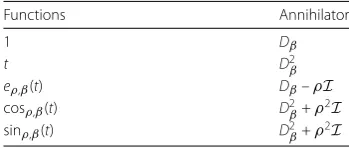
Example3.29 Since (Dβ– 4I)e4,β(t) = 0,Dβ– 4Iis an annihilator fore4,β(t).
Table1indicates a list of some functions and their annihilators.
Example3.30 Consider the equation
D2βy(t) – 4Dβy(t) + 3y(t) =e5,β(t). (3.52)
Equation (3.52) can be rewritten in the form
Table 1 A list of some functions and their annihilators
Functions Annihilator
1 Dβ
t D2β
eρ,β(t) Dβ–ρI
cosρ,β(t) D2β+ρ
2I
sinρ,β(t) D2β+ρ2I
Multiplying both sides by the annihilator (Dβ– 5I), we get that ify(t) is a solution of (3.52),
theny(t) satisfies
(Dβ– 3I)(Dβ–I)(Dβ– 5I)y(t) = 0.
Hence,
y(t) =c1e3,β(t) +c2e1,β(t) +c3e5,β(t).
One can see thatϕ(t) = (1/8)e5,β(t) is a solution of equation (3.52). Therefore, the general
solution of equation (3.52) has the following form:
y(t) =c1e3,β(t) +c2e1,β(t) + (1/8)e5,β(t).
4 Conclusion
In this paper, the sufficient conditions for the existence and uniqueness of solutions of theβ-Cauchy problem were given. Also, a fundamental set of solutions for the homoge-neous linearβ-difference equations when the coefficientsaj(0≤j≤n) are constants was
constructed. Moreover,β-Wronskian and its properties were introduced. Finally, the un-determined coefficients, the variation of parameters, and the annihilator methods for the non-homogeneous case were presented.
Acknowledgements
The authors sincerely thank the referees for their valuable suggestions and comments.
Funding Not applicable.
Competing interests
The authors declare that they have no competing interests.
Authors’ contributions
All authors contributed equally and significantly in writing this article. All authors read and approved the final manuscript.
Author details
1Department of Mathematics, Faculty of Science, Ain Shams University, Cairo, Egypt.2Department of Mathematics,
Faculty of Science, Menoufia University, Shibin El-Koom, Egypt.
Publisher’s Note
Springer Nature remains neutral with regard to jurisdictional claims in published maps and institutional affiliations.
Received: 16 January 2018 Accepted: 18 July 2018
References
2. Annaby, M.H., Mansour, Z.S.:q-Fractional Calculus and Equations. Springer, Berlin (2012)
3. Askey, R., Wilson, J.: Some basic hypergeometric orthogonal polynomials that generalize the Jacobi polynomials. Mem. Am. Math. Soc.54, 1–55 (1985)
4. Bangerezako, G.: An Introduction toq-Difference Equations. Bujumbura (2008)
5. Cresson, J., Frederico, G., Torres, D.F.M.: Constants of motion for non-differentiable quantum variational problems. Topol. Methods Nonlinear Anal.33, 217–231 (2009)
6. Faried, N., Shehata, E.M., El Zafarani, R.M.: On homogeneous second order linear general quantum difference equations. J. Inequal. Appl.2017, 198 (2017).https://doi.org/10.1186/s13660-017-1471-3
7. Gasper, G., Rahman, M.: Basic Hypergeometric Series. Cambridge University Press, Cambridge (1990) 8. Hamza, A.E., Ahmed, S.M.: Theory of linear Hahn difference equations. J. Adv. Math.4(2), 441–461 (2013) 9. Hamza, A.E., Sarhan, A.M., Shehata, E.M.: Exponential, trigonometric and hyperbolic functions associated with a
general quantum difference operator. Adv. Dyn. Syst. Appl.12(1), 25–38 (2017)
10. Hamza, A.E., Sarhan, A.M., Shehata, E.M., Aldowah, K.A.: A general quantum difference calculus. Adv. Differ. Equ.2015, 182 (2015).https://doi.org/10.1186/s13660-015-0518-3
11. Hamza, A.E., Shehata, E.M.: Existence and uniqueness of solutions of general quantum difference equations. Adv. Dyn. Syst. Appl.11, 45–58 (2016)
12. Kac, V., Cheung, P.: Quantum Calculus. Springer, New York (2002)
13. Malinowska, A.B., Torres, D.F.M.: Quantum Variational Calculus. Briefs in Electrical and Computer Engineering—Control, Automation and Robotics. Springer, Berlin (2014)