Article
Dispersion-Free Extraction of In(III) from HCl
Solutions Using a Liquid Membrane Containing
HA324H
+
Cl
-
Ionic Liquid
Francisco J. Alguacil 1 and Félix A. López 1,*
1 National Center for Metallurgical Research (CENIM), Spanish National Research Council (CSIC), Avda.
Gregorio del Amo, 8, 28040 Madrid, Spain. [email protected] and [email protected]
* Correspondence: F.A.López – f.lopez@csic,es (F.L.)
Abstract: The transport of indium(III), from HCl solutions, across a supported liquid membrane in
flat-sheet configuration was investigated, being the carrier the ionic liquid HA324H+Cl- (derived from the tertiary amine Hostarex A324 and hydrochloric acid). Different variables affecting the metal transport: hydrodynamic conditions in the source and receiving phases, metal and HCl concentrations in the source phase, and carrier concentration in the membrane phase, were investigated. Also the transport of indium(III) using carriers of various nature: ionic liquids, alcohol, ketone, phosphine oxide, etc., was compared. The metal transport was modelled describing the transport mechanism as: diffusion across the source diffusion layer, a fast interfacial chemical reaction, and diffusion of the InCl4--carrier complex through the membrane support. Diffusional parameters for the transport of indium(III), from the experimental data and the model, were estimated.
Keywords: indium(III); ionic liquid; liquid membranes; Hostarex A324; transport.
1. Introduction
Indium is classified by the European Commission as a critical raw material both for its economics and high supply risk, which an expected increased in its demand over the next years. The above being a consequence of its special properties and wide industrial uses, i,e., liquid-crystal displays (LCDs), electronics, catalysts, etc. Thus, the recovery of this element from the above sources is an important target, and several technologies had been proposed to resolve such a situation [1],[2],[3],[4],[5],[6],[7],[8],[9],[10],[11],[12],[13]. Besides the above, indium is considered a hazardous element due to its carcinogenic character [14], being its removal from residual aqueous solutions i.e., resulted from a number of the above processes, is of the foremost importance, and here it is when liquid membranes must be considered as a technology suitable for the recovery of metals or other solutes present, in the few mg/L concentration order, in the wastewaters. Included in these liquid membranes operations, supported liquid membranes in their various configurations are useful for this task. Before scaling up the technology in the form of hollow fiber modules, the investigation of a given system, using supported liquid membrane in flat-sheet configuration, is necessary in order to obtain information about the mass transfer process involved in the membrane operation. One important part, in real terms the key-of-the-operation, is the carrier used to transport the metals, and included in them, ionic liquids are a group of chemicals, which properties make of them to be considered as green solvents, and among other uses [15],[16],[17],[18] suitable for the removal of metals from aqueous solutions [19],[20],[21],[22],[23],[24],[25],[26],[27],[28].
As a part of the investigations carried out from our group related from the removal of indium(III) using liquid membrane technologies [5], this work presented results about the removal of indium(III), from HCl solutions, using a flat-sheet supported liquid membrane (FSSLM)
containing the ionic liquid HA324H+Cl-, as carrier. Different hydrodynamic and chemical variables affecting the indium(III) transport process were investigated.
2. Results
It was shown [10], that the extraction of indium(III), from hydrochloric acid media, by the ionic liquid HA324H+Cl- dissolved in Solvesso 100, occurred via the next equilibrium:
aq 4
org
4
H
324
H
Cl
HA
324
H
InCl
Cl
InCl
org
aq (1)
where the subscripts org and aq refereed to the organic and aqueous phases, respectively. It was also determined that the value of the equilibrium constant value, for the above equilibrium, was 10.96 in 1 M HCl medium.
2.1. Influence of the stirring speed in the source phase on indium(III) permeation
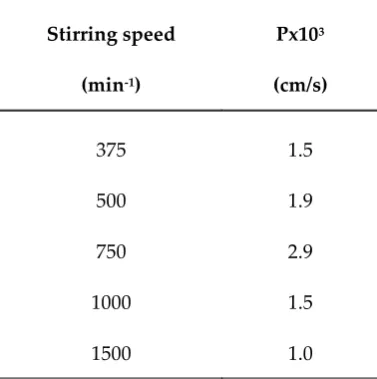
In every separation technology, i.e., liquid membranes, ion exchange or adsorption, and working in batch conditions, it is of a necessity to find, in experimentally form, the best hydrodynamic conditions to ensure maximum solute transport, adsorption, etc., thus, in the present system, the influence of the stirring speed applied to the source phase on metal permeation was investigated by the use of source phases containing 0.01 g/L In(III) in 2 M HCl, and a receiving solution of 0.1 M HCl. The membrane phase was a 0.23 M ionic liquid in Solvesso 100 solution supported in a Durapore GVHP4700 solid support. Table 1 shown the results derived from these experiments.
Table 1. Influence of the stirring speed on permeability of indium(III)
Stirring speed
(min-1)
Px103
(cm/s)
375
500
750
1000
1500
1.5
1.9
2.9
1.5
1.0
It is shown that the indium(III) permeation increased from 375 to 750 min-1 and then decreased, this is attributable to a continuous decrease of the source phase boundary layer with the increase of the stirring speed on this phase, and that a limiting permeability value is obtained at 750 min-1, at this point, the system reached a minimum in the thickness of the aqueous source layer and indium(III) transport maximized, thus:
aq aq lim
d
D
P
being Daq the metal diffusion coefficient in the aqueous source phase (averaging a value of 10-5 cm/s), and daq the thickness of the aqueous source layer, being Plim 2.9x10⁻³, the value of daq is estimated to be of 3.4x10⁻³ cm. Thus, this value represented the minimum thickness of the stagnant source phase layer, considering, the experimental conditions used in this work. It is also shown in Table 4 that at stirring speeds above 750 min-1, the metal permeation decreased, being this caused to the turbulence caused by the stirring speed and the progressive instability of the liquid membrane.
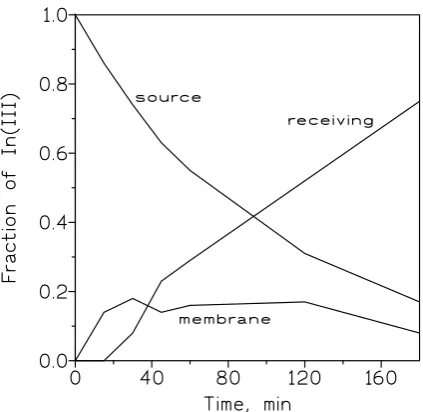
In the limiting conditions and after 3 hours, the percentage of metal recovered in the receiving solution is of 75% with respect to the initial In(III) concentration of the source solution, and 90% with respect to the solute transported from the source to the membrane phases. Figure 1 shown the metal distribution between the three phases, there is a lag time, of near 30 min between this time and time zero, before indium(III) begins to appear in the receiving solution; from 120 min, indium(III) is transported against its concentration gradient driven by the difference in acidity between the source and receiving phases.
Figure 1. Fraction of indium(III) between the source, membrane and receiving phases. Data from the
experiment at 750 min-1.
2.2. Influence of the stirring speed in the receiving phase on In(III) permeation
In the present work, the receiving phase was of 0.1 M HCl, since previous data [10] indicated that this solution was a good strippant for this system. Experiments carried out with this solution, as the receiving phase, the same source and membrane phases than above, and 750 min-1 as stirring speed of the source phase, indicated that in the 500-750 min-1 range of stirring speeds applied on the receiving phase, there was no appreciable difference in the transport of the metal. Thus, stirring speeds of 750 and 500 min-1 in the source and receiving phase were selected for further experiments.
2.3. Influence of HCl concentration in the source phase on indium(III) transport
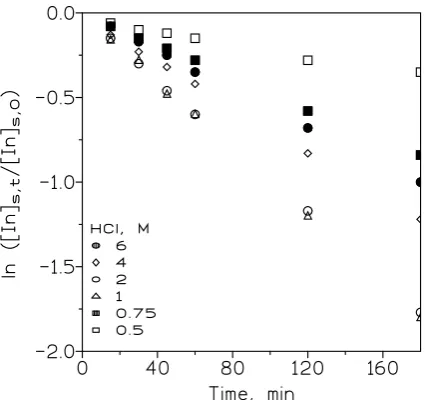
It was showed, that the indium permeation increased with the increase of the HCl concentration in the source solution up to 1-2 M, and then further decreased at higher HCl concentration in this phase.
Figure 2. Influence of HCl concentration in the source phase on In(III) transport. Strirring speeds of
the source and receiving phases: 750 and 500 min-1, respectively.
Moreover, the percentage of indium(III) recovered in the receiving phase was, after three hours, around 90% when using 1 or 2 M HCl solutions.
2.4. Influence of the carrier concentration on In(III) permeation
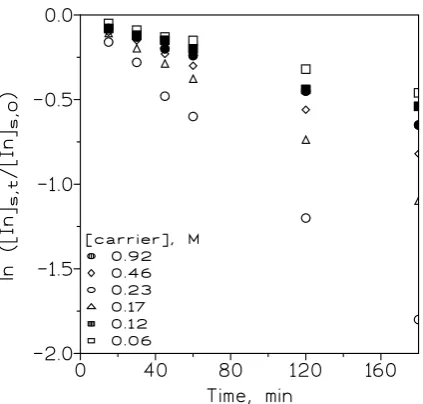
It was mentioned above that the carrier solution is the key for the liquid membrane operation, since a liquid membrane with no carrier phase resulted in no metal transport. Figure 3 showed the results derived when a 0.01 g/L in 1 M HCl source phase was transported across a membrane, containing organic phases of different concentrations of the ionic liquid in Solvesso 100, and using a 0.1 M HCl solution as receiving phase. As it can be observed, a maximum in metal permeability (3.0x10⁻³ cm/s) was reached when a carrier concentration of 0.23 M was used in the membrane phase. The above was attributable that, at low carrier concentrations diffusion of the indium(III)-carrier complex across the liquid membrane governed the step, but at the maximum indium(III) permeation, diffusion of indium(III) across the source phase boundary layer is the rate-determining process. Accordingly to eq. (2), daq was estimated as 3.3x10⁻³ cm, value which matched perfectly with the previously obtained at 2 M HCl concentration in the source phase.
Figure 3. Influence of the carrier concentration on In(III) transport. Source phase: 0.01 g/L In(III) in 1
M HCl. Membrane phase: different concentrations of the ionic liquid, in Solvesso 100, imbibed in GVHP4700 supports. Receiving phase: 0.1 M HCl. Stirring speeds as in Figure 2.
2.5. Influence of the initial indium(III) concentration in the source phase on the metal permeation and flux
These results were derived from membrane phases containing 0.23 M ionic liquid, in Solvesso 100, supported in a GVHP4700 support, and receiving phases of 0.l M HCl. The source phases were of various In(III) concentrations (0.01-0.1 g/L) in 1 M HCl. Table 2 resumed these results. Firstly, it can be seen that the permeation coefficient, P, decreased as the initial metal concentration in the source phase increased, and secondly, the initial metal flux increased with the increase of the initial indium(III) concentration in this phase.
Table 2. Variation of the indium(III) permeation coefficients (P) and fluxes (J) with the variation of
the initial metal concentration in the source phase
Initial In(III) concentration (g/L)
Px103
(cm/s)
Jx1010
(mol/cm2 s)
0.01
0.05
0.1
3.0
0.82
0.72
2.6
3.6
6.3
Stirring speed in the source and receiving phases: 750 and 500 min-1, respectively
The decrease in metal permeation, with the increase of the indium(III) concentration, may be due to that the membranes pores become saturated with the increasingly metal concentrations, whereas in the case of the flux, these results were logical since the flux varies with metal concentrations accordingly to:
and thus, there was an increase of the flux value with the increase of the metal concentration in the source phase. Accordingly with the flux values showed in Table 2, it was seemed that in the range of indium(III) concentrations used in this work, the permeation process was controlled by diffusion of metal species.
With respect to the metal recovered in the receiving phase, these percentages varied between 90-99% (after 3 h), with respect to the metal transported from the source to the membrane phase, for the three initial indium(III) concentrations used in this work.
2.6. Influence of the support characteristics on indium(III) transport
Results derived with GVHP4700 support, were compared when HVHP4700 support was used as solid support in this system, with all the experimental variables as in Figure 3, except that in this case, the membrane phase was of a 0.23 M carrier, in Solvesso 100, solution supported in the HPVP solid support.
The fluxes, see eq. (3) obtained from these experiments were of 2.6x10⁻¹⁰ mol/cm2 s and 1.7x10⁻¹⁰ mol/cm2 s for the GVHP and HVHP supports, respectively; thus, being all the characteristics similar to both supports but the pore size (2.2x10⁻³ cm for GVHP versus 4.5x10⁻³ cm for HVHP), this last characteristic dominated the metal transport, and apparently, the less the pore size the best the transport, and also with respect to the indium(III) recovery in the receiving phase: (91% for GVHP and 59% for HVHP supports, after 3 hours and, as above, with respect to the metal transported from the source to the membrane phases).
2.7. Indium(III) transport using different carriers
The transport of indium(III) was compared when different carriers were used. In this case, the source phase was of 0.01 g/L in 1 M HCl and the receiving phase of 0.1 M HCl. The membrane phases were of 0.17 M carrier in Solvesso 100 solutions supported in the GVHP4700 solid support, and the stirring speeds applied to the source and receiving phase were, as usual, 750 and 500 min-1, respectively.
These transport results, together with the indium(III) recovery in the receiving phase, were summarized in Table 3.
Overall, and under the present experimental conditions, with the ionic liquid HA324H+Cl- the best transport results were obtained, followed by the two ionic liquids Cyphis IL101 and Cyphos IL102, derived from a phosphonium salt. The worst transport result was obtained when 2-ethyl-hexanol was the carrier for indium transport. For each type of carrier used here, in the case of carriers derived from quaternay ammonium , the apparent order found was: tertiary amine (Hostarex A324)>Akiquat 336>primary amine (Primene JMT); in the case of phosphorous derivatives: phosphonium salts>phosphine oxides>phosphoric ester, and for organics containing C-O bonds: ketone>alcohol.
Table 3. Results of In(III) transport, and metal recoveries in the receiving phase, using different
carriers.
Carrier P
(cm/s)
bIn recovery
(%)
Cyphos IL102
Cyphos IL101
Cyanex 923
Tributylphosphate
aPrimene JMT
Aliquat 336
aHostarex A324
2-ethyl-1-hexanol
Isopenty-methylketone
1.2x10⁻³
1.4x10⁻³
8.5x 10⁻⁴
4.1x10⁻⁴ 3.1x10⁻⁴ 2.9x10⁻⁴ 1.8x10⁻³ 4.2x10⁻⁷ 3.9x10⁻⁴ 99 99 99 6 nil 50 83 nil nil
aActing as the corresponding quaternary ammonium salt. bAfter 3 hours, and with respect to the metal transported from the source to the membrane phases
With respect to the indium recovered in the receiving phase, the sequence was not as clear, however near quantitative In(III) recovery was achieved with Cyphos IL101, Cyphos IL102 and Cyanex 923, being 0.1 M HCl solutions not good receiving medium in the case of the primary amine (acting as the correponding ammonium derivative), the ketone and the alcohol.
2.8. Estimation of the diffusional parameters
Accordingly to eq.(1), the equilibrium constant of the reaction can be written as:
4
aq
orgaq org 4
Cl
H
324
HA
InCl
Cl
InCl
H
324
HA
K
(4)
Following the same reasoning published elsewhere [28], an expression for the permeability coefficient can be writen as:
org
where Δaq and Δorg are the transport resistance related to the diffusion by the source and membrane phases, respectively. This expression combines the diffusional and equilibrium parameters involved in the transport of indium(II), from HCl solutions, across a membrane supporting the ionic liquid. Then:
b
1
Cl
H
324
HA
Cl
K
1
P
1
org aq
org 1
aq org
aq
(6)
thus, a plot of 1/P versus 1/b for various carrier concentrations in the membrane phase and 1 M Cl
-concentration in the source solution, may resulted in a straight line with intercept and slope to estimate Δaq and Δorg values, respectively.
The estimate value of the membrane diffusion coefficient:
o r g o r g o r g
d
D
(7)
was 1.5x10⁻² cm2/s, whereas the transport resistance in the source phase was estimated as 166 s/cm.
The diffusion coefficient of the indium(III)-ionic liquid complex in the bulk organic phase can be estimated by:
o r g 2o r gb,
D
D
(8)
and Db,org being of 5.6x10⁻² cm2/s. It can be observed, that Dorg had a lower value than Db,org, the reason may be caused to the diffusional resistance due to the membrane thickness located between the source and receiving phases.
Moreover, an apparent diffusion coefficient for indium(III) can be estimated as:
]
o rg o r g ao r g
c a r r i e r
Jd
D
(10)
3. Materials and Methods
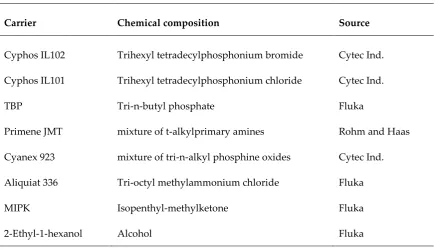
The amine tertiary Hostarex A324 (Hoechst), had as active group: tri-isooctyl amine, was used as the organic precursor of the ionic liquid, the inorganic moiety was hydrochloric acid, and the ionic liquid was generated by reaction of both [10]. Other carriers used in this investigation had the composition showed in Table 5. All were used without further purification. Other chemicals used in the work were of G.R. quality, except the organic diluent Solvesso 100 (99% aromatics) which was obtained from Exxon Chem. Iberia, and was also used without further purification. Though many authors claimed that ionic liquids were used without dilution, the real fact was that in most, if not all the cases, an organic diluent was needed, and its use facilitated the liquid-.liquid extraction operation because, and among others:
i) decreased the high viscosity of the ionic liquid, and, thus, facilitated phase disengagement in the settler,
ii) adequate the range of carrier concentrations to any particular use, avoiding the use of an excess of carrier in the process, with the benefits of decreasing the economic input of it, and favouring the metal transport, as one can see, i.e. in this investigation, that an excess of carrier decreased indium(III) permeability.
Table 5. Chemical composition and source for the carriers
Carrier Chemical composition Source
Cyphos IL102
Cyphos IL101
TBP
Primene JMT
Cyanex 923
Aliquiat 336
MIPK
2-Ethyl-1-hexanol
Trihexyl tetradecylphosphonium bromide
Trihexyl tetradecylphosphonium chloride
Tri-n-butyl phosphate
mixture of t-alkylprimary amines
mixture of tri-n-alkyl phosphine oxides
Tri-octyl methylammonium chloride
Isopenthyl-methylketone
Alcohol
Cytec Ind.
Cytec Ind.
Fluka
Rohm and Haas
Cytec Ind.
Fluka
Fluka
Fluka
Transport experiments were carried out in a two-compartment cell, one compartment each for the (200 cm3) source and (200 cm3) receiving phases, with the membrane support separating both aqueous phases. The source and receiving solutions were mechanically stirred by means of four blades impellers (11.5 cm diameter). Indium(III) permeability (P) was estimated by the use of the common relationship:
Pt
V
A
In
In
ln
0 , s
t ,
s
where [In]s,t and [In]s,0 were the indium concentrations in the source phase an at elapsed time and time zero, respectively, A the effective membrane area (11.3 cm2), V the volume of the source phase, and t the elapsed time. Indium was analyzed in the source and receiving phases by AAS.
The membrane support used in the investigation was Durapore GVHP4700, with 0.75% (porosity, ε), 12.5x10⁻³ cm (thickness, dorg), 1.67 (tortuosity, τ) and 2.2x10⁻⁵ cm (pore size). Durapore
HVHP4700 support had the same specifications than above but 4.5x10⁻⁵ cm (pore size). Both were
composed of polyvinylidene difluoride. The liquid membranes were prepared by immersion of the support in a carrier solution, during 24 hours, and drip it during 20 seconds before placed it in the cell.
4. Conclusions
This investigation demonstrated the ionic liquid HA324H+Cl- is efficient for the transport of indium(III) from hydrochloric acid solutions. The kinetic model for indium(III) permeation showed that the permeation process is controlled by diffusion of the InCl4- species across the source phase layer and diffusion of the In(III)-carrier complex across the liquid membrane, being the former dominant when the carrier concentration in the membrane phase is low.
Author Contributions: F.A.L. Funding acquisition; F.J.A and F.A.L. methodology; F.J.A. formal analysis; F.J.A.
and F.A.L. investigation; F.J.A. writing-original draft; F.J.A. and F.A.L. writing-review & editing.
Funding: This research received no external funding
Acknowledgments: We acknowledge support of the publication fee by the CSIC Open Access Publication
Support Initiative through its Unit of Information Resources for Research (URICI).
Conflicts of Interest: The authors declare no conflict of interest
References
1. López Díaz-Pavón, A.; Cerpa, A.; Alguacila, F.J. Processing of indium (III) solutions via ion exchange
with Lewatit K-2621 resin. Rev. Metal. 2014, 50, e010.
2. Alguacil, F.J.; Lopez, F.A.; Rodriguez, O.; Martinez-Ramirez, S.; Garcia-Diaz, I. Sorption of indium (III)
onto carbon nanotubes. Ecotoxicol. Environ. Saf. 2016, 130, 81–86.
3. Rocchetti, L.; Amato, A.; Beolchini, F. Recovery of indium from liquid crystal displays. J. Clean. Prod.
2016, 116, 299–305.
4. Amato, A.; Rocchetti, L.; Beolchini, F. Environmental impact assessment of different end-of-life LCD
management strategies. Waste Manag. 2017, 59, 432–441.
5. García-Díaz, I.; López, F.A.; Alguacil, F.J. Transport of indium(III) using pseudo-emulsion based hollow
fiber strip dispersion with ionic liquid RNH3+HSO4−. Chem. Eng. Res. Des. 2017, 126, 134–141.
6. Gu, S.; Fu, B.; Dodbiba, G.; Fujita, T.; Fang, B. A sustainable approach to separate and recover indium
and tin from spent indium–tin oxide targets. RSC Adv. 2017, 7, 52017–52023.
7. Amato, A.; Beolchini, F. End of life liquid crystal displays recycling: A patent review. J. Environ. Manage.
2018, 225, 1–9.
8. Akcil, A.; Agcasulu, I.; Swain, B. Valorization of waste LCD and recovery of critical raw material for
circular economy: A review. Resour. Conserv. Recycl. 2019, 149, 622–637.
9. Alguacil, F.J.; Garcia-Diaz, I.; Escudero, E. Extraction of indium(III) from sulphuric acid medium by the
ionic liquid (PJMTH+HSO4−). Sep. Purif. Technol. 2019, 211, 764–767.
10. Alguacil, F.J.; Escudero, E. Solvent extraction of indium(III) from HCl solutions by the ionic liquid
11. Amato, A.; Becci, A.; Mariani, P.; Carducci, F.; Ruello, M.L.; Monosi, S.; Giosuè, C.; Beolchini, F.
End-of-Life Liquid Crystal Display Recovery: Toward a Zero-Waste Approach. Appl. Sci. 2019, 9, 2985.
12. Swain, B.; Lee, C.G. Commercial indium recovery processes development from various e-(industry)
waste through the insightful integration of valorization processes: A perspective. Waste Manag. 2019, 87,
597–611.
13. Vostal, R.; Reiber, M.; Bertau, M. Flüssig/Flüssig‐Extraktion von Indium aus sauren Lösungen. Chemie
Ing. Tech. 2019, 91, 1681–1687.
14. Chang, A.; Li, H.-Y.; Chang, I.-N.; Chu, Y.-H. Affinity Ionic Liquids for Chemoselective Gas Sensing.
Molecules 2018, 23, 2380.
15. Billard, I. Green solvents in urban mining. Curr. Opin. Green Sustain. Chem. 2019, 18, 37–41.
16. Fan, Y.; Niu, Z.; Xu, C.; Yang, L.; Yang, T. Protic Ionic Liquids as Efficient Solvents in
Microwave-Assisted Extraction of Rhein and Emodin from Rheum palmatum L. Molecules 2019, 24,
2770.
17. Patsos, N.; Lewis, K.; Picchioni, F.; Kobrak, M. Extraction of Acids and Bases from Aqueous Phase to a
Pseudoprotic Ionic Liquid. Molecules 2019, 24, 894.
18. Alguacil, F.J. Facilitated Chromium(VI) Transport across an Ionic Liquid Membrane Impregnated with
Cyphos IL102. Molecules 2019, 24, 2437.
19. Alguacil, F.J. Mechanistic investigation of facilitated transport of gold(III) from HCl media using ionic
liquid Cyphos IL102 as carrier across a supported liquid membrane. Gold Bull. 2019.
20. Atanassova, M.; Kurteva, V. Synergism in the Solvent Extraction of Europium(III) with
Thenoyltrifluoroacetone and CMPO in Methylimidazolium Ionic Liquids. J. Solution Chem. 2019, 48, 15–
30.
21. Sobekova Foltova, S.; Vander Hoogerstraete, T.; Banerjee, D.; Binnemans, K. Samarium/cobalt
separation by solvent extraction with undiluted quaternary ammonium ionic liquids. Sep. Purif. Technol.
2019, 210, 209–218.
22. Jean, E.; Villemin, D.; Lebrun, L. New ionic liquids with fluorous anions for supported liquid
membranes and characterization. J. Fluor. Chem. 2019, 227, 109365.
23. Li, S.; Chu, N.; Li, X.; Dong, F.; Shen, Y. Recovery of palladium from acidic nitrate media with triazole
type extractants in ionic liquid. Hydrometallurgy 2019, 189, 105148.
24. Merad, N.S.; Belkhouche, N.-E. A Comparative Study of Experimental Optimization and Taguchi
Design of Co(II) Recovery by Aliquat 336 as Ionic Liquid Carrier. J. Sustain. Metall. 2019, 5, 417–428.
25. Svecova, L.; Papaïconomou, N.; Billard, I. Rh(III) Aqueous Speciation with Chloride as a Driver for Its
Extraction by Phosphonium Based Ionic Liquids. Molecules 2019, 24, 1391.
26. Wang, L.Y.; Guo, Q.J.; Lee, M.S. Recent advances in metal extraction improvement: Mixture systems
consisting of ionic liquid and molecular extractant. Sep. Purif. Technol. 2019, 210, 292–303.
27. Wang, N.; Wang, Q.; Lu, W.; Ru, M.; Yang, Y. Extraction and stripping of platinum (IV) from acidic
chloride media using guanidinium ionic liquid. J. Mol. Liq. 2019, 293, 111040.
28. Alguacil, F.J.; Alonso, M.; Sastre, A.M. Modelling of mass transfer in facilitated supported liquid