Comprehensive Performance Study of Existing
Techniques in Hand Gesture Recognition System
for Sign Languages
Jayshree. R. Pansare#1, Maya Ingle*2
#
School of Computer Science & Information Technology, DAVV, Indore ,India
*
School of Computer Science & Information Technology, DAVV, Indore,India
Abstract
—
Hand Gesture Recognition System (HGRS)has been proved to be a powerful communication tool for deaf and dumb users, irrespective of geographical differences. HGRS is fragmented in six consequent phases applied on captured image namely; Hand Detection, Hand Tracking, Region Extraction, Feature Extraction, Feature Matching, and Pattern Recognition. We have studied various techniques in HGRS for sign languages and now present the analysis of performance of existing techniques in HGRS. Our study is presented on the basis of fragmentation used in HGRS and includes the strength and the scope of improvements for each technique. These observations will be highly useful to the researchers putting efforts in the domain of recognition of sign languages for improving the recognition rate particularly.
Keywords— CAMSHIFT, GMM, Histogram, 3D Model-based
detection, Particle filtering, BLOB, Kalman filter, Template matching, SVM, HMM, ArSL, ASL, DSL.
I. INTRODUCTION
Hand Gesture Recognition System (HGRS) has been proved to be a powerful communication tool for deaf and dumb users, irrespective of geographical differences. There exist various sign languages (denoted by hands mostly) globally along with different structure, grammar, syntax, semantics, pragmatics, morphology, and phonology. Images of bare hand processes to extract a set of features such as translation, rotation and scaling invariant has been applied in image-based Arabic Sign Language (ArSL) system thereby achieving recognition accuracy of 97.5% on a database of 30 Arabic alphabet signs [1].Real-time hand gesture system recognizes 26 static hand gestures of American Sign Language (ASL) using centroid of Binary Linked Object in real-time and achieving 90.19% recognition rate in complex background [2]. Accelerometer and multichannel electromyography sensors applied in HGRS recognizes 72 Chinese Sign Language (CSL) words using with detection rate of 95.3% [3]. Enhanced sign language recognition of 61 Greek Sign Language (GSL) using Hybrid Adaptive Weighting (HAW) process acquires user-identification rate varying from 91.25% to 99.73% [4].
Multi-feature static HGRS utilizes classifiers such as Nearest Mean Classifier, k-Nearest Neighbourhood and Naive Bayes classifier for recognition of Indian Sign Language (ISL) alphabets and numbers. New Multi-feature fusion descriptor accomplishes high recognition rate of 99.61% [5]. Feature point extraction method in HGRS adopted to recognize 32 signs of South Indian Language (SIL) with 98.125% accuracy [6]. HGRS includes stages such as image capturing, image pre-processing, region extraction, feature extraction and histogram matching to recognize 46 Devnagari Sign Language (DSL) alphabets. Maximum possibilities of colour space, illumination conditions and background texture are considered, thereby achieving 87.82% accuracy [7]. It is evident that a lot of research efforts have been made on the recognition of various sign languages. However, there exists a wide scope to present the performance study of techniques applied in HGRS to recognize various sign languages comprehensively so as to provide ease for the research community.
Numerous gesture recognition techniques play an important role in enhancing performance of HGRS systems for recognition of sign languages. Section 2 emphasizes on several existing techniques in HGRS for sign languages in detail. In Section 3, we present the performance study of techniques in HGRS for sign languages based on the performance of specific systems. Lastly, we conclude with the conclusion in Section 4.
II. EXISTING TECHNIQUES IN HGRS
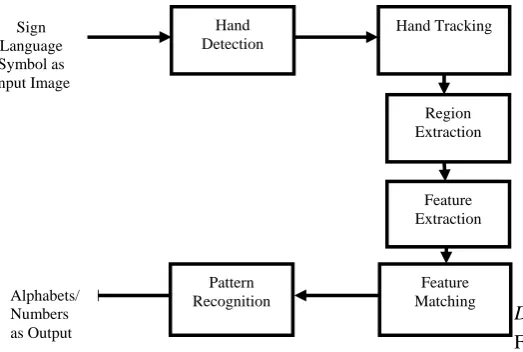
In general, the process adopted in HGRS has been shown in Fig. 1 is fragmented in six consequent phases applied on captured image namely; Hand Detection, Hand Tracking, Region Extraction, Feature Extraction, Feature Matching, and Pattern Recognition. We discuss the techniques in various phases as follows:
A. Hand Detection
with exclusive standard camera and one projector using skin-color detection. The accuracy of the touch detection reached 96.9% at the 40-cm projected distance, which was high enough for most button-based applications [8]. HGRS comprises Continuous Adaptive Mean Shift (CAMSHIFT) algorithm to track skin color after ultimate process promotes detection rate of 93.4% [9]. Recognition system entails infrared camera to capture videos of moving objects. System uses Gaussian Mixture Model (GMM) followed by morphological median filtering operation to remove noise in the background subtracted image. Indoor environment system fulfils an average identification rate of 97.73% [10]. In HGRS the usage of combination of Haar-like and Histogram of Oriented Gradients (HOG) features. Additionally, some new Haar-like features resort to resolve main Haar-like problem specifically high false positive error rate in hand posture perception. The system confirmed that hybrid method can recognize hand gesture with 93.5% accuracy [11]. Novel approach is integrated to detect pointing vector in 2D space of a room. Points in hand contour utilized for the fingertip are discovered in convex hull and contour with precision of 94% [12].3D Model-based Detection utilized in Dynamic Sign Language Recognition (DSLR) system handles smart home interactive applications. System adopted 3-D histograms of a gradient orientation descriptor to represent features with 98.65% accuracy [13]. Motion-based hand detection employed for sign language spotting for detecting signs system might also spot signs from continuous data with 93.5 % detection rate [14]. Hand contour detection applied for recognizance of
hand gestures for Urdu alphabets with excellent results of 97.4% [15].
Fig. 1 Phases in Hand Gesture Recognition System for Recognition of Sign Languages
B. Hand Tracking
Tracking is second phase in HGRS, associated with frame-to-frame correspondence of the segmented hand regions or features. Correlation-based feature tracking utilized in HGRS applied for device controlling with the use inner distance feature with detection rate of 91.67 %
[16]. Template-based tracking resorted for hand pointing detection has multiple applications in many fields such as virtual reality and control devices in smart homes. System detects hand-pointing vectors in live video from a common webcam enacts recognition accuracy of 94% [17]. Kalman Filter incorporated for hand gesture recognition by means of dynamic Bayesian networks includes dynamic hand gesture recognition. Recognition rates of implementation are 90% for all gestures [18]. System attempts feedback on sign performance and learning the usage of Mean Shift algorithm that endeavor a computer vision-based virtual learning environment for teaching communicative hand gestures exploited in Irish Sign Language. Appreciation rate of system classifiers achieved 93.8% accuracy [19]. Particle filtering employed to uncover the fingertips for human computer interface combines particle filtering with particle random diffusion to find the different fingertips quickly. Fingertips are tracked in real-time accomplishes precision of 95% [20]. CONDENSATION algorithm and particle filtering technique are displayed in HGRS for tracking 2D and 3D motion of an image. Enhanced tracking of two hands based on a statistical model utilizing particle filtering provides recognition accuracy of 83% [21]. Contour tracking techniques integrated in RGB-D sensor-based pose estimation. Framework permits tracking hand gestures in 3-D space and matching gestures with simple contour model offers excellent results of 95.43% [22].
C. Region Extraction
Region Extraction phase extracts Binary Linked Object (BLOB) for identifying Region of Interest (ROI). BLOB applied for computer monitoring and controlling with hand movements are implemented for image processing and computer vision techniques. In system hand region is tracked with biggest BLOB gains 96% accuracy [23]. BLOB based on coherent motion included in real-time system for recognition of Indian Sign Language (ISL). System includes red color sensitivity in background with detection of 95% [24]. Contour of BLOBs fetched in real-time HGRS for recognizing 26 alphabets of ASL in complex background concludes identification rate 90.19% [25].
D. Feature Extraction
Feature extraction phase extracts features of images and forms feature vector for training dataset images and running image. Histogram as a feature extracted in static HGRS applied to recognize numbers from 0 to 9. HGRS recognizes hand gestures in a vision-based obtains high recognition rate of 93.1% [26]. Fingertip feature extraction involved to find the fingertips based on the accurate positions of fingertips. The fingertips can be tracked in real-time with an accuracy of 95% [27]. Convex hull points in system incorporate to recognize 24 ASL signs. System accomplishes recognition at a speed of 60 frames /second with precision of 97.1% [28].
Hand Detection
Hand Tracking
Feature Extraction
Feature Matching Pattern
Recognition
Region Extraction Sign
Language Symbol as Input Image
E. Feature Matching
Feature matching phase matches feature vectors of training dataset images and running image. Template matching algorithm applied in HGRS system for identifying SIL. System able to match 160 test images with 320 trained images with accuracy of 98.125% [29]. Contour and Silhouette matching is exploited in HGRS including single color camera without any marker. System is mainly comprised of image pre-processing, skin segmentation, feature extraction and gesture classification. System works in the complex environment conditions for bare hand gestures and attains recognition rate of 93.1% [30]. Chamfer matching in HGRS eliminates expensive training for human’s accustomed to the machines and avoid costly mistakes. System proved to be 82.1% accurate against 1000 images comprising of 10 distinct static hand gesture sets [31].
F. Pattern Recognition
Pattern recognition is very last phase in HGRS thereby selecting best suitable pattern of gesture. Principal Component Analysis (PCA) used in recognition of
behavioral biometric. System uses Independent Component Analysis to reduce dimensionality of the feature vectors. These feature vectors provided to train Support Vector Machine (SVM) for recognition of some individual with recognition rate of 97.73% [32]. Boosting in system investigates multi-touch gestures for user authentication on touch sensitive devices with authentication accuracy of 95% [33]. Hidden Markov Model (HMM) operated in system for dynamic hand gesture recognition by using Intel’s image processing library OpenCV. System brings about recognition rate of 90% for isolated hand gestures for real-time applications [34]. Vision-based HGRS provides outline feature for the nonlinear and non-separable type of data. Data is classified by using SVM with an accuracy of 93.4% for the feasibility system [35]. Advanced Neural Network (ANN) applied in HGRS worn to identify hand gestures using muscle activity separated from electromyogram. System recognizes 6 arm gestures with a success rate of 97.5% [36]. Real-time system recognizes 10 gestures using Bag-of-Features (BOF) including K-Means Scale-Invariant Feature (SIFT) and SVM achieves highest recognition rate of 96.23% in cluttered background [37].
TABLEI
PERFORMANCE STUDY OF TECHNIQUES USED IN HGRS FOR SIGN LANGUAGES
HGRS Techniques No. of Gestures
Rec. Time (Sec/ Frame)
Rec. Accuracy
Frame Resolution
No. of Test Image Gestures
Scale Rotation Background Lighting Condition
Haar Wavelet
Representation 15 0.4 94.89% 160*120 30
Not
Discussed Invariant Wall
Not Discussed
Ada Boost, Adaptive Hand Segmentation, Scale-Space Feature Detection
6 0.09-0.11 93.8% 320*240 195-221 Not
Discussed
Not
Discussed Cluttered
Not Discussed
Viola-Jones Method and SVM, Hu Invariant Moment
3 0.1333 96.2% 640*480 130 Invariant ±300 Different Variant
Haar-Like Features, AdaBoost Classifier
4 0.03 90.0% 320*240 100 Invariant ±150 White Wall Invariant
Real-Time based on inertia feature & Hu Moment
8 0.066667 96.1% 640*480 300 Variant Invariant Not Discussed
Not Discussed
SVM, Body-Face
Centered 6
Not
Discussed 93.4% 100*100 57-76 Invariant
Not
Discussed Wall Invariant
Natural Neural
Model 6
Not
Discussed 76.1% 100*100 38-58 Invariant
Not
Discussed Cluttered
Not Discussed
BOF, SVM 10 0.017 96.23% 640*480
or any size 1000 Invariant Invariant Cluttered Invariant
Centroid of BLOB 26 0.7 90.19% 160*120 40 Invariant Invariant Complex Natural
Histogram 46 0.5 87.82% 160*120 40 Invariant Invariant Static Mixed
Histogram, Skin
III. PERFORMANCE STUDY OF TECHNIQUES USED IN HGRS FOR SIGN LANGUAGES
We have studied various techniques in HGRS for sign languages and now present the analysis of performance of existing techniques in HGRS. This analysis has been performed on the basis of some vital factors such as background, lighting condition, recognition time, frame size etc. and is depicted in Table 1. The following are the important observations associated with the performance issues of techniques in HGRS for recognition of sign languages:
When any HGRS is developed using BOF, SVM techniques, it is possible to achieve highest recognition rate i.e. 96.23%, highest recognition time as 0.017 Frames/ Second with invariant lighting condition in cluttered background.
On the other hand, when Viola-Jones, SVM, Hu Invariant Moment are used in HGRS, the recognition rate of 96.2% and recognition time as 0.1333 Frames/ Second in complex background have been achieved.
Real-time HGRS based on inertia features and Hu Moment techniques aquires recognition rate viz. 96.1 % including recognition time 0.066667 Frames/ Second.
In contrast, Natural Neural Model utilized in HGRS aquires the lowest recognition rate i.e. 76.1 % in cluttered background.
It is evident from Table 1 that recognition rate is affected by frame resolution, number of test image gesture, scale and rotation.
IV.CONCLUSION
We have studied many techniques used to recognize hand gestures/ sign languages in detail. Our study is presented on the basis of fragmentation used in HGRS and includes the strength and the scope of improvements for each technique. A comprehensive comparison of performances of various HGRS techniques has been presented and some important observations have been drawn. These observations will be highly useful to the researchers putting efforts in the domain of recognition of sign languages for improving the recognition rate particularly.
REFERENCES
[1] M. Mohandes, et. al., “Image-Based and Sensor-Based Approaches to Arabic Sign Language Recognition,” IEEE Trans. Human-Machine Syst., vol. 44, no. 4, pp. 551–557, 2014.
[2] J. R. Pansare and M. Ingle, “Real-time static hand gesture recognition for American Sign Language (ASL) in complex background”, Journal of Signal and Information Processing, vol. 3, no. pp. 364-367, 2012.
[3] X. Zhang, et. al., “A Framework for Hand Gesture Recognition Based on Accelerometer and EMG Sensors,” IEEE
Trans. Syst. Cybern. A Syst. HUMANS, vol. 41, no. 6, pp. 1064–
1076, 2011.
[4] V. E. Kosmidou, et. al., “Weighted Intrinsic-Mode Entropy and Signer ’ s Level of Deafness,” IEEE Trans. Syst. Cybern. B Cybern., vol. 41, no. 6, pp. 1531–1543, 2011.
[5] A. Ghotkar, “Vision Based Multi-Feature Hand Gesture Recognition For Indian Sign Language Manual,” Int. J. Smart Sens. Intell. Syst., vol. 9, no. 1, pp. 124–147, 2016.
[6] P. S. Rajam and R. Finger, “Real Time Indian Sign Language Recognition System to aid Deaf-dumb People,” IEEE, pp. 1–6, 2011.
[7] J. R. Pansare, et. al., “Real-time static Devnagri Sign Language translation using histogram” International Journal of Advanced
Research in Computer Engineering & Technology, vol. 2, no. 4, pp.
1-5, 2013.
[8] J. Hu, et. al., “Bare-fingers Touch Detection by the Button ’ s Distortion in a Projector – Camera System,” IEEE Trans. Circuits Syst. Video Technol., vol. 24, no. 4, pp. 566–575, 2014. [9] C. Hsieh and L. Chen, “A Real Time Hand Gesture Recognition
System Based on DFT and SVM,” IEEE, pp. 490–494, 2009. [10] A. Kanwar, “An Appearance Based Approach For Gait Identification
Using Infrared Imaging,” IEEE, pp. 719–724, 2014.
[11] S. Ghafouri and H. Seyedarabi, “Hybrid Method for Hand Gesture Recognition Based on Combination of Haar-Like and HOG Features,” IEEE, pp. 0–3, 2013.
[12] M. R. Abid, et. al., “Dynamic Sign Language Recognition for Smart Home Interactive Application Using Stochastic Linear Formal Grammar,” IEEE Trans. Instrum. Meas., pp. 1–10, 2014.
[13] G. Tofighi, et. al., “Hand Pointing Detection Using Live Histogram Template of Forehead Skin,” in Proceedings 19th Int. Conf. Digit. Signal Process., pp. 383–388, 2014.
[14] H. Yang, et. al., “Sign Language Spotting with a Threshold Model Based on Conditional Random Fields,” IEEE Trans. Pattern Anal.
Mach. Intell., vol. 31, no. 7, JULY 2009, vol. 31, no. 7, pp. 1264–
1277, 2009.
[15] H. Tauseef and M. A. Fahiem, “Recognition and Translation of Hand Gestures to Urdu Alphabets Using a Geometrical Classification,” in Proceedings Second Int. Conf. Vis., pp. 213–217, 2009.
[16] N. Alijanpour, et. al., “Inner Distance Based Hand Gesture Recognition for Devices Control,” IEEE, pp. 742–746, 2008.
[17] G. Tofighi, et. al., “Hand Pointing Detection Using Live Histogram Template of Forehead Skin,” in Proceedings 19th Int. Conf. Digit. Signal Process., pp. 383–388, 2014.
[18] D. Kelly, et. al., “A System for Teaching Sign Language using Live Gesture Feedback,” IE, pp. 2008–2009, 2008.
[19] S. Shiravandi and M. Rahmati, “Hand gestures recognition using dynamic Bayesian networks,” IEEE, pp. 1–6, 2013.
[20] H. Yang, et. al., “Sign Language Spotting with a Threshold Model Based on Conditional Random Fields,” IEEE Trans. Pattern Anal. Mach. Intell., vol. 31, no. 7, pp. 1264–1277, 2009.
[21] S. Worrall, “Two Hand Tracking using Colour Statistical Model with the K-means Embedded Particle Filter for Hand Gesture Recognition,” in Proceedings 7th Comput. Inf. Syst. Ind. Manag. Appl., pp. 201–206, 2008.
[22] Y. Yao, et. al., “Contour Model-Based Hand-Gesture Recognition Using the Kinect Sensor,” IEEE, vol. 24, no. 11, pp. 1935–1944, 2014.
[23] R. Özgür et. al., “Computer Monitoring And Control,” in Proceedings IEEE 22nd Signal Process. Commun. Appl. Conf., 2014, pp. 2110–2113.
[24] J. R. Pansare, et. al., “Real Time Static Hand Gesture Recognition System in Complex Background that uses Number system of Indian Sign Language,” Int. J. Adv. Res. Comput. Eng. &Technology, vol. 2, no. 3, pp. 1086–1090, 2013.
[25] J. R. Pansare and M. Ingle, “Real-time static hand gesture recognition for American Sign Language (ASL) in complex background”, Journal of Signal and Information Processing, vol. 3, no. pp. 364-367, 2012.
[26] J. R. Pansare, et. al., “Real-time static hand gesture recognition system using HCI for recognition of numbers”, International Journal
of Advanced Research in Computer Science, vol. 4, no.4,
[27] R. System, et. al., “Novel FPGA Implementation of Hand Sign,”
IEEE Trans. Circuits Syst. Video Technol., vol. 25, no. 1, pp. 153–
166, 2015.
[28] R. Rd, “Fast Fingertip Positioning By Combining Particle Filtering With Media IC and System Lab,” ICME 2008, pp. 977–980, 2008.
[29] P. S. Rajam and R. Finger, “Real Time Indian Sign Language Recognition System to aid Deaf-dumb People,” IEEE, pp. 1–6, 2011. [30] Y. Xu, et. al., “Bare Hand Gesture Recognition with a Single Color
Camera,” IEEE, pp. 1–4, 2009.
[31] S. U. Ahmad, “Real time Rotation invariant Static hand Gesture recognition using an Orientation based Hash code,” IEEE, 2013. [32] A. Kanwar, “An Appearance Based Approach For Gait Identification
Using Infrared Imaging,” IEEE, pp. 719–724, 2014.
[33] H. Tauseef and M. A. Fahiem, “Recognition and Translation of Hand Gestures to Urdu Alphabets Using a Geometrical Classification,” in Proceedings Second Int. Conf. Vis., pp. 213–217, 2009.
[34] R. Shrivastava, “A Hidden Markov Model based Dynamic Hand Gesture Recognition System using OpenCV,” IEEE, pp. 947–950, 2012.
[35] C. Hsieh and L. Chen, “A Real Time Hand Gesture Recognition System Based on DFT and SVM,” IEEE, pp. 490–494, 2009.
[36] V. Rajesh, et. al., “SEMG Based Human Machine Interface for Controlling Wheel Chair by Using ANN,” IEEE, pp. 1–6, 2009.
[37] X. Zabulis, et. al., “Vision-based Hand Gesture Recognition for Human-Computer Interaction,” pp. 1–56.
[38] N. H. Dardas and N. D. Georganas, “Real-Time Hand Gesture Detection and Recognition Using Bag-of-Features and Support Vector Machine Techniques,” IEEE Trans. Instrum. Meas., vol. 60, no. 11, pp. 3592–3607, 2011.
[39] W. Chung, et. al., “A Real-Time Hand Gesture Recognition Based On Haar Wavelet Representation”, in Proceedings IEEE
International Conference on Robot, Bioinformatics, 2009, pp.
336-341.
[40] Y. Fang, et. al., “A Real-Time Hand Gesture Recognition Method”,
in Proceedings International Conference on Multimedia Expo.,
2007, pp. 995-998.
[41] L. Yun and Z. Peng, “An Automated Hand Gesture Recognition System Based On Viola-Jones Method And Svms”, in Proceedings
2nd International Workshop on Computer Science and Engineering,
2009, pp.72-76.
[42] Q. Chen, et. al., “Real-Time Vision-Based Hand Gesture Recognition Using Haar-Like Features”, in Proceedings IEEE
IMTC, 2007, pp. 1-7.
[43] Y. Ren and C. Gu, “Real-Time Hand Gesture Recognition Based On Vision”, in Proceedings Edutainment, 2010, pp. 468-475.
[44] S. Marcel, “Hand Posture Recognition In A Body-Face Centered Space”, in Proceedings conference on Human Factors Computing