Article
1
Sensing Characteristics of Arrayed Flexible Chloride
2
Sensor Based on the XBee Wireless Sensing System
3
Shi-Chang Tseng1, Tong-Yu Wu1, Jung-Chuan Chou2,3,*, Yi-Hung Liao4, Chih-Hsien Lai2,3,
4
Yu-Hsun Nien5, You-Xiang Wu3, Cian-Yi Wu3 and Si-Hong Lin3
5
6
1 Graduate School of Mechanical Engineering, National Yunlin University of Science and Technology, Douliu 64002,
7
Taiwan, R.O.C.; E-Mail: [email protected]; [email protected]
8
2 Department of Electronic Engineering, National Yunlin University of Science and Technology, Douliu 64002,
9
Taiwan, R.O.C.; E-mail: [email protected]
10
3 Graduate School of Electronic Engineering, National Yunlin University of Science and Technology, Douliu 64002,
11
Taiwan, R.O.C.; E-mail: [email protected]; [email protected];[email protected]
12
4 Department of Information and Electronic Commerce Management, TransWorld University, Douliu 64002, Taiwan,
13
R.O.C.; E-mail: [email protected]
14
5 Graduate School of Chemical and Materials Engineering, National Yunlin University of Science and Technology,
15
Douliou, Taiwan 64002, R.O.C.; E-mail: [email protected]
16
* Correspondence: [email protected]; Tel.: +886-534-2601 #4333
17
18
Abstract: Water quality monitoring was an important objective in the surroundings. In this study, we
19
investigated the sensing characteristics of the arrayed flexible chloride sensor with XBee wireless sensing
20
system. The sensitivity and linearity of the wireless chloride sensing devices were 91.6 mV/pCl and 0.988,
21
respectively. The hysteresis voltages were 50.14 mV and 36.71 mV during the cycles of 1 M→ 10-1 M→
22
1 M→ 10-3 M→ 1 M and 1 M→ 10-3 M→ 1 M→ 10-1 M→ 1 M, respectively. The selectivity coefficients of
23
the ClO− ion, ClO
4− ion, NO3− ion and I− ion for Cl− ion were 5.0×10⁻², 1.0×10⁻¹, 5.9×10⁻³ and 5.6×10⁻¹,
24
respectively. The sensing characteristics of real time measurement were investigated for dynamic
25
microfluidic. The arrayed flexible chloride sensor was integrated with the microfluidic device, syringe pump
26
and wireless sensing system. The sensitivity and linearity were 273.1 mV/pCl and 0.978 at 35 μL/min,
27
respectively.
28
Keywords: arrayed flexible chloride sensor; wireless sensing system; hysteresis voltage; selectivity
29
coefficient; dynamic microfluidic
30
31
1. Introduction
32
Industry countries had a common problem that was water pollutions. Water quality monitoring was an
33
important objective in the surroundings. Many researchers [1-4] used the chemical sensors and optical sensors
34
to measure and analyze the water compositions for the water quality. S. F. Gonski et al. [1] used the
35
Honeywell Durafet pH sensor to measure the pH variations of the river. They investigated the water pollution
36
levels by Honeywell Durafet pH sensor. N. Kato et al. [2] investigated the residual chlorine concentrations of
37
the tap water by detecting electrode and compensating electrode.
38
They investigated the residual chlorine selectivity for their sensors, thus the interferences obtained the
39
hydrogen ion concentration (pH) and dissolved oxygen (DO). A. Aisopou et al. [3] used electrochemical and
40
optical technologies to measure conductivity, pH, free chlorine, total chlorine, DO, oxidative redox potential
41
(ORP) and turbidity. N. Carbó et al. [4] used the voltammetry electronic tongue and pulse voltammetry
42
method to investigate the quality parameters in spring water. The composition of the spring water contained
43
nitrate, sulfate, fluoride, chloride, sodium. The pH ranges of spring water were from 7.3 to 7.8.
44
The drawbacks of the water quality monitoring were the detection distance limit and operation space limit.
45
Many researchers detected different ions and obtained experiment data easier with wireless sensing system
46
[5-15]. The wireless sensing system had been applied to different fields, such as chloride ion detection [5-16],
47
hydrogen ion detection [17-23], glucose detection [23-25] and lactate detection [25].
48
S. Zhuiykov et al. [5] investigated the wireless sensing devices of the conductivity, pH, dissolved metal
49
ions, dissolved oxygen (DO) and dissolved organic carbon (DOC). K. G. Ong et al. [6] detected accurately the
50
hypochlorite ion variations with the wireless sensing devices. The hypochlorite ions sensor integrated with
51
wireless transmission system, and investigated the hypochlorite ion concentration variations, and the
52
hypochlorite ion sensor included the layer of polyurethane and alumina on the magnetically-soft
53
ferromagnetic ribbon. S. Zhou et al. [7] used the Ag/AgCl electrode, reference electrode and radio-frequency
54
identification (RFID) communication protocol to measure and investigate the chloride ion concentrations in
55
the concrete.
56
N. Harris et al. [8] used the screen printed technology to prepare the low cost robust chloride ion sensor.
57
They investigated the sensing characteristic of the chloride ion sensor with IEEE 802. 15. 4 and secure digital
58
(SD) memory card. The chloride sensors were applied to measure the chloride ion concentration for soil
59
column, fluvarium and greenhouse. K. A. Nyni et al. [9] developed the wireless health monitoring system for
60
health monitoring, which contained the devices of the electro cardio gram (ECG), electroencephalogram
61
(EEG) and electromyogram (EMG). They used the Arduino UNO board and Bluetooth module to construct
62
the wireless transmission. J. F. Cheng et al. [10] fabricated the chloride ion sensing devices and Bluetooth
63
wireless measurement system. The wireless sensing devices were used to measure response voltage from 10-4
64
to 1 M NaCl solutions.
65
Our research group [11] investigated the sensing characteristic of the RuO2 chloride ion sensing devices
66
with voltage-time (V-T) measurement system and wireless remote control platform. Our research group [12]
67
integrated the current-voltage (I-V) measurement system with the three Keithley 236 semiconductor
68
parameter analyzers. They investigated the sensing characteristic of the wireless chloride sensor. V. A. T.
69
Dam et al. [13] prepared sweat sensing device by screen printing system. They integrated the sweat sensing
70
device with high impedance voltmeter (Keithley 617A). They investigated the hysteresis effects and detected
71
chloride ion concentrations of the sweat. K. Smettem et al. [14] prepared the wireless chloride ion sensing
72
devices by the screen printed technology, central microcontroller (MCU), real-time clocks (RTC), GPS
73
module and IEEE 802. 15. 4 standard. Their wireless chloride ion sensing devices applied to monitor the
74
water quality of the stream. Y. Abbas et al. [15] investigated the sensing characteristic of near-field-inductive
75
coupling (NFC) of sensing devices and readout coils with the Ag/AgCl electrode. The capacitance variation
76
were from 180 to 200 pF when the chloride ion concentrations from 0.01 to 0.2 M, respectively. J. Jung et al.
77
[16] used the three-electrode electrochemical amperometric analyzer to investigate the sensing characteristics
78
from 1 mM to 100 mM of ruthenium (III) chloride (Ru III). The three electrodes, current-to-voltage (I/V)
79
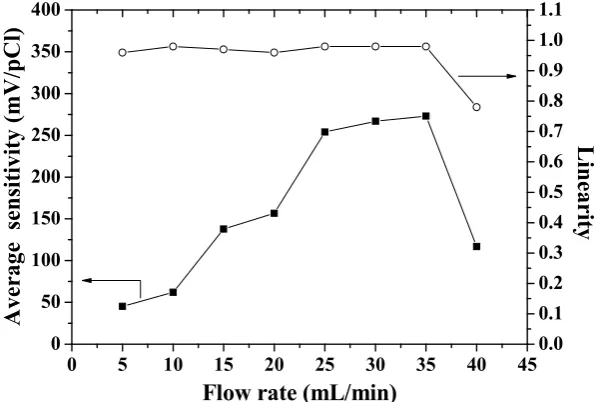
measurement, Bluetooth 4.0 module (WT-12, Bluegiga, Espoo, Finland) and notebook computer were used to
80
set up the three-electrode electrochemical amperometric analyzer. They repaired the silver (Ag) counter
81
electrode and silver-silver chloride (Ag/AgCl) reference and indium tin oxide (ITO) working electrode on the
82
ITO glass.
83
R. Yue et al. [17] integrated solar power supply with wireless sensor system. The wireless sensors were
84
used to detect pH, turbidity and oxygen density. W. Dang et al. [18] used the graphite-polyurethane composite
85
to prepare the pH sensor. The sensitivity of the RFID wireless pH sensor was 11.13 mV/pH. The wireless pH
86
sensor was used to detect sweat pH variation. L. Lu et al. [19] investigated the human gastrointestinal (GI)
87
physiological information by wireless capsule. They repaired the pH micro sensor, pressure micro sensor,
88
temperature micro sensor and radio frequency (RF) transceiver in the wireless capsule. The wireless capsule
89
was used to real test for the animal (pig) and three healthy volunteers. They obtained more data for pH,
90
temperature and pressure by the wireless capsule.
91
R. Rahimi et al. [20] prepared the transparent pH sensor and near field communication (NFC) wireless
92
measurements for wound infection monitoring. The NFC wireless transparent pH sensor was investigated the
93
hysteresis effect, drift effect from pH 4 to pH 10. R. A. Croce et al. [21] used the winding 125 μm platinum
94
(Pt) and silver wire to fabricate the coil-type electrochemical pH sensing devices. They used the coil-type pH
95
sensing devices, Ag/AgCl reference electrode, saturated calomel electrode (SCE), Bluetooth transceiver and
96
computer to investigate the pH detection. B. Zhou et al. [22] repaired the optical fiber sensor to measure the
97
pH solutions. The pH experiment data was transferred to computer by Zigbee wireless network.
98
Our research group studied the wireless sensing system of XBee module with sensing devices [23-25]. The
99
wireless sensing system was used to investigate the sensitivities for many kinds of the chemical substances,
100
such as pH [23], glucose [23-25] and lactate [25]. The advantages of the wireless sensing system of XBee
101
module were high stability, lost cost, portable device, easy operation, rapid detection and real-time monitor
102
[23]. P. Abouzar et al. [26] used the Zigbee wireless system and measurement to investigate the sensing
103
characteristics of wireless sensor networks for precision agriculture. N. A. Cloete et al. [27] integrated the
104
flow sensing device, temperature sensing device, conductivity sensing device, pH sensing device with the
XBee wireless module. They used the XBee wireless water quality monitoring system to investigate the
106
sensing characteristic for real time water quality detection.
107
In order to develop the real-time monitor of chloride ion detection, therefore wireless sensing measurement
108
of XBee integrated with the arrayed flexible RuO2/GO chloride ion sensor to investigate the selectivity
109
coefficients, hysteresis effect, and dynamic microfluidic measurement of the arrayed flexible RuO2/GO
110
chloride ion sensor.
111
2. Materials and Methods
112
2.1. Materials
113
The polyethylene terephthalate (PET) was purchased from Zencatec Corporation (Taiwan). PET sheet was
114
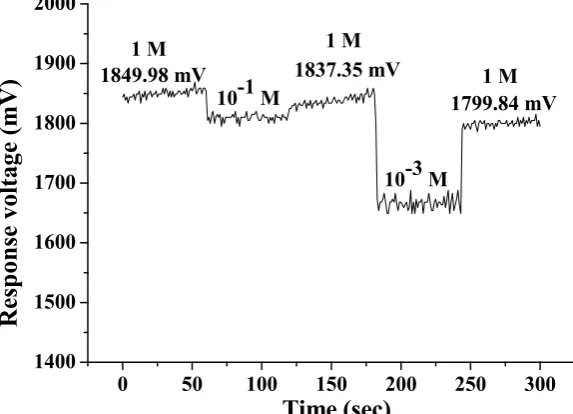
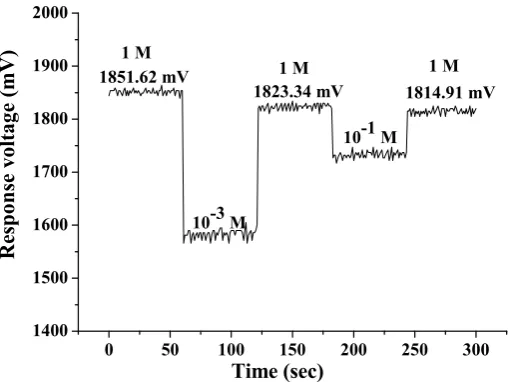
flexible and light weight, which was the substrate of the chloride sensing device. Ruthenium target (Ru, 99.95
115
wt%) was purchased from Ultimate Materials Technology Co., Ltd. (Taiwan), which was used to deposit the
116
membrane of ruthenium dioxide (RuO2) by the radio frequency (R. F.) sputtering system.
117
The silver paste and epoxy thermosetting polymer (product no. JA643) were purchased from Advanced
118
Electronic Material Inc. (Taiwan) and Everwide Chemical Co., Ltd. (Taiwan), respectively. The applications
119
of the silver paste and epoxy thermosetting polymer were conductive wire and insulation layer, respectively.
120
The poly(vinyl chloride) (PVC), bis (2-ethylhexyl) sebacate (DOS) solution (95%), chloride ionophore III
121
(ETH9033) and tridodecylmethy-lammonium chloride (TDDMACl) were purchased from Sigma-Alorich Co.,
122
Ltd. (USA). The tetrahydrofuran (THF) solution were purchased from Nan Ya Plastics Co., Ltd. (Taiwan).
123
THF solution, PVC powder, DOS solution, ETH9033 powder and TDDMACl powder were used to prepare
124
the chloride ion mixture. The sodium cloride (NaCl) was purchased from Avantor Performance Materials, Inc.
125
(USA), it was used to prepare the diffferent chloride ion concentrations from 10-5 M to 1 M NaCl solutions.
126
XBee router and XBee coordinator were purchased from Digi International Inc. (USA). XBee router, XBee
127
coordinator and Arduino Mega 2560 microcontroller board were used to transfer the experiment data to
128
computer.
129
130
2.2. Fabrication of the arrayed flexible RuO2/GO chloride ion sensor
131
The producing process of the flexible arrayed RuO2/GO chloride sensor was shown in Figure 1. The
132
preparation method of the flexible arrayed RuO2/GO chloride sensor was followed the Refs. [28-31]. Then,
133
we dropped 2 μL of the chloride ion mixture on the sensing windows of the GO/RuO2 sensing devices,
134
respectively. The GO/RuO2 chloride ion sensors were dried at room temperature (25 ℃) during 4 days.
135
136
137
138
139
140
141
Figure 1. The producing process of the flexible arrayed RuO2/GO chloride sensor [28-31]. (a) The diagrammatic sketch of
142
the different sensing structures for the flexible arrayed RuO2/GO chloride sensor (b) The schematic diagram of the silver
143
contrast electrode, differential reference electrode and working electrode.
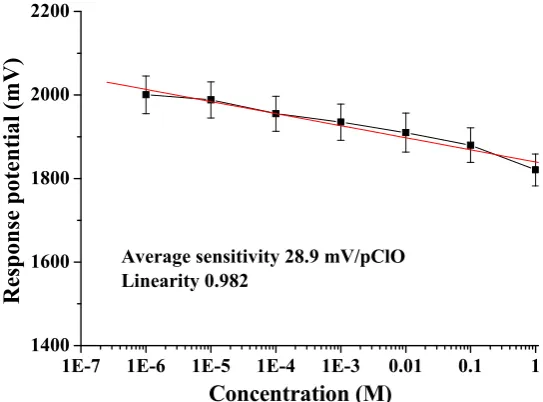
144
145
Silver contrast electrode and differential reference electrode
Working electrode Silver conductive wire RuO2 sensing membrane
GO membrane Chloride ion sensing film
Insulation layer
(a)
2.3. Wireless sensing system
146
The schematic diagram of wireless sensing system of XBee module was shown in Figure 2. The real picture
147
of the wireless sensing system of XBee module was shown in Figure 3 [23-25]. The wireless sensing system
148
of the XBee module contained computer, XBee coordinator, power supply, wireless sensing measurement and
149
flexible arrayed RuO2/GO chloride ion sensor, the wireless sensing measurement of the contained 6-channel
150
readout circuit device, XBee router, Arduino Mega 2560 and analysis software (model: LabVIEW 2012). The
151
six instrumentation amplifiers (AD623) were used to construct the 6-channel readout circuit device. We used
152
the wireless sensing system to measure response voltages with different chloride ion concentrations from 10-5
153
M to 1 M NaCl solutions. The sensitivity, selectivity coefficients and hysteresis voltage were investigated by
154
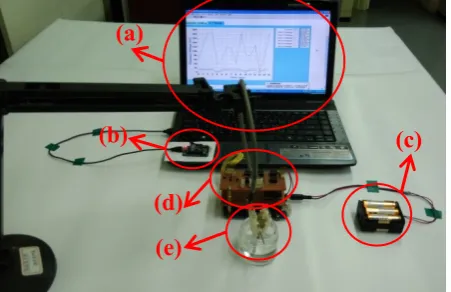
the wireless sensing system. From Figure 4, the wireless sensing system, microfluidic device and syringe
155
pump were used to measure response voltage and investigate real-time monitor of chloride ion detection with
156
different flow rates from 5 μL/min to 40 μL/min.
157
158
159
Figure 2. The schematic diagram of wireless sensing system with the flexible arrayed RuO2/ GO chloride ion sensor
160
[23-25].
161
162
Figure 3. The wireless sensing system with the flexible arrayed RuO2/ GO chloride ion sensor. (a) Computer, (b) XBee
163
coordinator, (c) power supply (d) wireless sensing measurement (XBee router) and (e) flexible arrayed RuO2/GO chloride
164
ion sensor [23-25].
165
166
167
(a)
(b)
(c)
(d)
168
Figure 4. The wireless sensing system with microfluid dymanic system. (a) computer, (b) XBee coordinator, (c) power supply (d)
169
wireless sensing measurement (XBee router), (e) syringe pump and (f) microfluidic device [23-25].
170
171
3. Results and Discussion
172
3.1. Sensitivity in the static state
173
We investigated the sensitivity and linearity of chloride ion sensing device with wireless sensing system.
174
From Figure 5, the sensitivity and linearity were 91.6 mV/pCl and 0.988, respectively. We used the
175
instrumentation amplifiers (AD623) with 2 times gain and set the parameters in LabVIEW, which amplified
176
the voltage value of the flexible arrayed RuO2/ GO chloride ion sensor. The sensitivity comparisons of the
177
chloride ion sensing devices were shown in Table 1. The wireless transmission technology was obtained the
178
RFID [7], Bluetooth [10]. S. Zhou et al. [7] prepare the wireless chloride ion sensor. The sensitivity of
179
wireless chloride ion sensor was 47.83 mV/pCl.
180
Our group used the voltage-time measurement system and the chloride ion devices to measure response
181
voltages and obtained the sensitivity of chloride ion devices [28-30]. The voltage-time measurement system
182
(V-T measurement system) was not wireless data transmission. Therefore, the detection distance of the
183
chloride ion sensing device with voltage-time measurement system was shorter than chloride ion sensing
184
device with wireless sensing system.
185
186
3.2. Sensitivity in the dynamic microfluid
187
The sensitivity variations of the arrayed flexible chloride sensor were integrated by the microfluidic device,
188
syringe pump and wireless sensing system. From Figure 6, the sensitivities of the wireless chloride ion sensor
189
were increased when the flow rates increasing from 5 μL/min to 40 μL/min. The boundary layer was
190
produced by friction and viscous force, and the boundary layer was between chloride membrane and
191
molecular electrolyte [28-30]. The boundary layer thickness was decreased when flow rate increasing.
192
Therefore, the sensitivities of the wireless chloride ion sensor were increased when the flow rates increasing.
193
The best average sensitivity and linearity were 273.1 mV/pCl and 0.978 at 35 μL/min, respectively. When the
194
flow rate was over 35 μL/min, the sensitivities were decreased. The flexible arrayed RuO2/GO chloride ion
195
sensor with the wireless sensing system was quick response and convenient operation, which could be applied
196
to monitor chloride ion concentrations in real time.
197
198
(a)
(e)
(f)
(d)
(b)
1E-6 1E-5 1E-4 1E-3 0.01 0.1 1 1800
2000 2200 2400 2600 2800
R
espon
se vo
ltage (mV
)
Concentration (M)
Average sensitivity 91.6 mV/pCl Linearity 0.988199
Figure 5. The curve of the response voltage versus concentration for the flexible arrayed RuO2/GO chloride ion sensor
200
integrated in the wireless sensing system between 10-5 M and 1 M NaCl solutions.
201
202
203
204
205
206
207
0 5 10 15 20 25 30 35 40 45
0 50 100 150 200 250 300 350 400
Flow rate (mL/min)
A
verage
sens
it
iv
ity
(mV
/p
C
l)
0.0 0.1 0.2 0.3 0.4 0.5 0.6 0.7 0.8 0.9 1.0 1.1
Line
arity
208
Figure 6. The average sensitivity and linearity of the flexible arrayed RuO2/GO chloride ion sensor with the wireless
209
sensing system at different flow rates from 5 μL/min to 40 μL/min.
210
Table 1. The comparisons of the chloride ion sensing devices with other literatures in different chloride ion
223
concentrations.
224
Sensing electrode Measurement system Test solutons (M)
Average
sensitivity
(mV/pCl)
Ref.
RuO2/0.01 wt% GO/Chloride ion
selective membrane XBee wireless V-T sensing system 10 -5 to 1
NaCl solutions 91.6 In this study Ag/AgCl electrode and reference
electrode RFID communication protocol 10
-4 to 1
NaCl solutions 47.8 2017 [7] ITO glass /SnO2/ Chloride ion
selective membrane
Bluetooth wireless measurement system
10-4 to 1
NaCl solutions 51.4
[10] 2012 Silicon substrate/ RuO2/ chlorine ion
selective membrane
Voltage-time (V-T) measurement system and wireless remote control
platform
0 to 1.34×10⁻⁴ NaClO
solutions 1.8 mV/ppm
[11] 2012
Silicon wafer /RuO2/ chlorine ion selective membrane
Current-voltage (I-V) measurement system
with three Keithley 236 semiconductor parameter analyzers
10-4 to 1
NaCl solutions 59.0
[12] 2012
Polyethylene terephthalate /dupont 5876 AgCl conducting paste/ dupont
8153 insulating paste/ pHEMA hydrogel layer
High impedance voltmeter
(Keithley 617A) 10
-3 to 3
NaCl solutions 58.0 2016 [13]
Polyethylene terephthalate /RuO2/Chloride ion selective
membrane V-T measurement system
10-5 to 1
NaCl solutions 25.1 2016 [28] Polyethylene terephthalate
/RuO2/0.01 wt% GO/Chloride ion selective membrane
V-T measurement system NaCl solutions 10-5 to 1 44.5 2018 [29]
Polyethylene terephthalate /RuO2/Chloride ion selective
membrane
V-T measurement system NaCl solutions 10-4 to 1 26.2 2012 [31]
3.3. Investigation of the hysteresis voltage
225
The response voltages of the flexible arrayed RuO2/GO sensors were measured by the V-T measuring
226
system with different measurement cycles of chloride ion concentrations, which from 10-3 M to 1 M NaCl
227
solutions by XBee wireless modules. The experimential results were shown in Figure 7 and Figure 8. The
228
hysteresis voltages were 50.14 mV and 36.71 mV during the cycles of 1 M→ 10-1 M→ 1 M→ 10-3 M→ 1
229
M and 1 M→ 10-3 M→ 1 M→ 10-1 M→ 1 M, respectively.
230
231
0 50 100 150 200 250 300
1400 1500 1600 1700 1800 1900 2000
Time (sec)
Resp
onse voltage (mV)
10-1 M
10-3 M
1799.84 mV 1837.35 mV
1849.98 mV 1 M
1 M 1 M
232
Figure 7. The response voltages of the flexible arrayed RuO2/ GO chloride ion sensor in the NaCl solutions during the
233
235
0 50 100 150 200 250 300
1400 1500 1600 1700 1800 1900 2000
1814.91 mV 1823.34 mV
1851.62 mV
10-1 M
10-3 M
1 M 1 M
Re
sponse
vol
ta
ge
(m
V
)
Time (sec)
1 M
236
Figure 8. The response voltages of the flexible arrayed RuO2/ GO chloride ion sensor in the NaCl solutions during the
237
cycle of 1 M→ 10-3 M→ 1 M→ 10-1 M→ 1 M.
238
239
3.4. Investigation of the selectivity coefficients
240
In this study, we checked the chloride ion selectivity of chloride ion sensing devices with wireless sensing
241
system. We prepared the 30 mL different chloride concentrations from 10-5 M to 1 M NaCl solutions as the
242
major ion A, respectively. The other interfering ions B contained 10-3 M ClO− solution, 10-3 M ClO
4− solution,
243
10-3 M NO
3− solution and 10-3 M I− solution. The 10-5 M to 1 M NaCl solutions were based on a fixed major
244
ion concentration. The selectivity coefficient was obtained from Equations (1) and (2):
245
246
247
∆ 𝑎 = 𝑎 − 𝑎 (1)
248
249
K𝐴,𝐵𝑝𝑜𝑡 = ∆𝑎𝐴
𝑎𝐵 (2)
250
251
252
253
Where ∆ 𝑎 was the increasing quantity of the major ion; 𝑎𝐴′ was the equal concentration when the
254
interfering ion reaches its maximum value; 𝑎𝐴 was the concentration of the background solution; 𝑎𝐵 was
255
the maximum concentration of the interfering ion; and K𝐴,𝐵 𝑝𝑜𝑡
was the selectivity coefficient of matched
256
potential method (MPM) [32]. J. F. Cheng et al. [33] calculated the 𝐾 / values of the HPO42−, F−, SO4−,
257
Br−, I− ions for chloride ion selectivity by MPM. They found the 𝐾 𝐶𝑙−/𝑗 𝑝𝑜𝑡
value sequences were I > Br >
258
SO > F > HPO . K. G. Kumar et al. [34] investigated the 𝐾 / values of the Zn2+, Fe3+, Cu2+, Na+,
259
Mn2+, Co2+, K+, Ca2+, NO
3−, Br−, NO2−, CH3COO− and SO42− ions for chloride ion selectivity. We used the
260
MPM to investigate the chloride selectivity coefficients in this study. From Table 2, the selectivity
261
coefficients of the ClO− ion, ClO
4− ion, NO3− ion and I− ion with Cl− ion were 5.0×10⁻², 1.0×10⁻¹, 5.9×10⁻³ and
262
5.6×10⁻¹, respectively. We found the K Cl−/j pot
value sequences were I > ClO > ClO > NO . According
263
to the experimental results, the chloride ion sensor with the wireless sensing system had good chloride ion
264
selectivity.
Table 2. The selectivity coefficients of the chloride ion sensor with the wireless sensing system under four different
272
interfering ions.
273
Interfering ions Selectivity coefficients log 𝑲𝑪𝒍 /𝒋𝒑𝒐𝒕
ClO− 5.0×10⁻²
ClO4− 1.0×10⁻¹
NO3− 5.9×10⁻³
I− 5.6×10⁻¹
3.5. Chloride ion detection of the tap water
274
Water chlorination of the water treatment plant was an important process for drinking water. The
275
sterilization capabilities were from free chlorine. The free chlorine were contained the hypochlorous acid
276
(HClO) and hypochlorite ion (ClO−) concentrations [7, 34]. We used the wireless sensing system to
277
investigate the sensitivity and linearity for different NaClO solutions from 10-6 M to 1 M. From Figure 9, the
278
average sensitivity and linearity were 28.92 mV/pCl and 0.982, respectively, and it could be found the flexible
279
arrayed RuO2/GO chloride ion sensor integrated in wireless sensing system had good stability for chloride ion
280
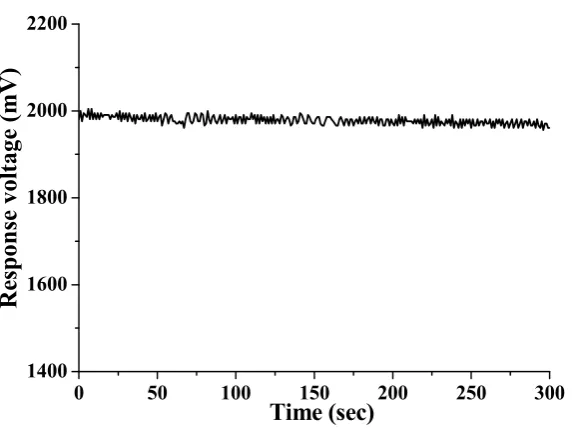
concentration. From Figure 10, the average response voltage was 1978.34 ± 9.89 mV in tap water with XBee
281
wireless measurement system. The chloride concentration ranges of the tap water was between were between
282
10-5 M and 10-4 M.
283
284
285
1E-7 1E-6 1E-5 1E-4 1E-3 0.01 0.1 1
1400 1600 1800 2000 2200
Average sensitivity 28.9 mV/pClO Linearity 0.982
Re
sponse
potential
(mV)
Concentration (M)
286
Figure 9. The curve of the response voltages versus concentration for the flexible arrayed RuO2/GO chloridne ion sensor
287
with the wireless sensing system in the 10-6 M and 1 M NaClO solutions.
288
0 50 100 150 200 250 300 1400
1600 1800 2000 2200
Time (sec)
Re
sponse
vol
tage (mV)
291
Figure 10. The response voltage curve of flexible arrayed RuO2/GO chloride ion sensor with the wireless sensing system
292
in the tap water.
293
294
4. Conclusions
295
The sensitivity and linearity of the chloride ion sensor with the wireless sensing system were 91.6 mV/pCl
296
and 0.988, respectively. The sensitivity and linearity of the flexible arrayed RuO2/GO chloride ion sensor with
297
the XBee wireless sensing system and dynamic microfluidic were 273.1 mV/pCl and 0.978 at 35 μL/min,
298
respectively. The hysteresis voltages were 50.14 mV and 36.71 mV during the cycles of 1 M→ 10-1 M→ 1
299
M→ 10-3 M→ 1 M and 1 M→ 10-3 M→ 1 M→ 10-1 M→ 1 M, respectively. The selectivity coefficients of the
300
ClO− ion, ClO
4− ion, NO3− ion and I− ion with Cl− ion were 5.0×10⁻², 1.0×10⁻¹, 5.9×10⁻³ and 5.6×10⁻¹,
301
respectively. The above experimental results had proved that the wireless sensing system with the flexible
302
arrayed RuO2/GO chloride ion sensor had good selectivity and good stability for chloride ion detection.
303
304
Acknowledgments: This study has been supported by Ministry of Science and Technology, Republic of China, under the
305
contracts MOST 106-2221-E-224-023 and MOST 106-2221-E-224-047.
306
Author Contributions: Shi-Chang Tseng, Jung-Chuan Chou and Tong-Yu Wu conceived and designed the experiments;
307
Tong-Yu Wu and Si-Hong Lin performed the experiments; Cian-Yi Wu and Yi-Hung Liao analyzed the data; You-Xiang
308
Wu and Chih-Hsien Lai checked the analyzed data; Yu-Hsun Nien and Jung-Chuan Chou contributed
309
reagents/materials/analysis tools; Tong-Yu Wu wrote the paper; Jung-Chuan Chou revised the paper.
310
311
Conflicts of Interest: The authors declare no conflict of interest.
312
References
313
1. Gonski, S. F; Cai, W. J.; Ullman, W. J.; Joesoef, A.; Main, C. R.; Pettay, D. T.; Martz, T. R. Assessment of the
314
suitability of durafet-based sensors for pH measurement in dynamic estuarine environments. Estuar. Coast. Mar.
315
Sci., 2018, 200, 152-168.
316
2. Kato, N.; Hirano, N.; Okazaki, S.; Matsushita, S.; Gomei, T. Development of an all-solid-state residual chlorine
317
sensor for tap water quality monitoring. Sens. Actuators, B, 2017, 248, 1037-1044.
318
3. Aisopou, A.; Stoianov, I.; Graham, N. J. D. In-pipe water quality monitoring in water supply systems under steady
319
and unsteady state flow conditions: a quantitative assessment. Water Res., 2012, 46, 235-246.
320
4. Carbó, N.; Carrero, J. L.; Castillo, F. J. G.; Tormos, I.; Olivas, E.; Folch, E.; Fillol, M. A.; Soto, J. Quantitative
321
determination of spring water quality parameters via electronic tongue, Sensors, 2018, 18, 1-12.
322
5. Zhuiykov, S. Solid-state sensors monitoring parameters of water quality for the next generation of wireless sensor
323
6. Ong, K. G.; Paulose, M.; Grimes, C. A. A wireless, passive, magnetically-soft harmonic sensor for monitoring
325
sodium hypochlorite concentrations in water, Sensors, 2003, 3, 11-18.
326
7. Zhou, S.; Sheng, W.; Deng, F.; Wu, X.; Fu, Z. A novel passive wireless sensing method for concrete chloride ion
327
concentration monitoring, Sensors, 2017, 17, pp. 1-13.
328
8. Harris, N.; Cranny, A.; Rivers, M.; Smettem, K.; Lennard, E. G. B. Application of distributed wireless chloride
329
sensors to environmental monitoring: initial results, IEEE Trans Instrum Meas, 2016, 65, 736-743.
330
9. Nyni, K. A.; Vincent, L. K; Varghese, L.; Liya, V. L.; Johny, A. N.; Yesudas, C. V. Wireless health monitoring
331
system for ECG, EMG and EEG detecting, 2017 International Conference on Innovations in Information, Embedded
332
and Communication Systems (ICIIECS), Coimbatore, India, Mar. 2017, 5 pages.
333
10. Cheng, J. F.; Chou, J. C.; Sun, T. P.; Hsiung, S. K.; Kao, H. L. Study on a multi-ions sensing system for monitoring
334
of blood electrolytes with wireless home-care system, IEEE Sens. J., 2012, 12, 967-977.
335
11. Chou, J. C.; Su, M. W.; Chen, C. C.; Yang, S. Y. Cl− and H+ sensing devices for water quality monitoring system,”
336
Circuits and Systems (ISCAS), 2012 IEEE International Symposium on, South Korea, May 2012, 4 pages.
337
12. Chou, J. C.; Chen, C. C.; Lee, C. C. Development of microcontroller applied to chlorine ion measurement system,
338
IEEE Sens. J., 2012, 12, 2215-2221.
339
13. Dam, V. A. T.; Zevenbergen, M. A. G.; Schaijk, R.van Toward wearable patch for sweat analysis, Sens. Actuators,
340
B, 2016, 236, 834-838.
341
14. Smettem, K.; Klaus, J.; Harris, N.; Pfister, L. New potentiometric wireless chloride sensors provide high resolution
342
information on chemical transport processes in streams, Water, 2017, 9, 1-16.
343
15. Abbas, Y.; Have, B. T.; Hoekstra, G. I.; Douma, A.; Bruijn, D. D.; Olthuis, W.; Berg, A. V. D. Connecting to
344
concrete: wireless monitoring of chloride ions in concrete structures, Procedia Engineering, 2015, 120, 965-968.
345
16. Jung, J.; Lee, J.; Shin, S.; Kim, Y. T. Development of a telemetric, miniaturized electrochemical amperometric
346
analyzer, Sensors, 2017, 17, 1-9.
347
17. Yue, R.; Ying, T. A novel water quality monitoring system based on solar power supply & wireless sensor network,
348
Procedia Environmental Sciences, 2012, 12, 265-272.
349
18. Dang, W.; Manjakkal, L.; Navaraj, W. T.; Lorenzelli, L.; Vinciguerra, V.; Dahiya, R. Stretchable wireless system
350
for sweat pH monitoring, Biosens Bioelectron, 2018, 107, 1092-202.
351
19. Lu, L.; Yan, G.; Zhao, K.; Xu, F. An implantable telemetry platform system with asic for in vivo monitoring of
352
gastrointestinal physiological information, IEEE Sens. J., 2015, 15, 3524-3534.
353
20. Rahimi, R.; Brener, U.; Chittiboyina, S.; Soleimani, T.; Detwiler, D. A.; Lelièvre, S. A.; Ziaie, B. Laser-enabled
354
fabrication of flexible and transparent pH sensor with near-field communication for in-situ monitoring of wound
355
infection, Sens. Actuators, B, 2018, 267, 198-207.
356
21. Croce, R. A.; Vaddiraju, S.; Legassey, A.; Zhu, K.; Islam, S. K.; Papadimitrakopoulos, F.; Jain, F. C. A highly
357
miniaturized low-power cmos-based pH monitoring platform, IEEE Sens. J., 2015, 15, 895-901.
358
22. Zhou, B.; Yang, S.; Sun, T.; Grattan, K. T. V. A novel wireless mobile platform to locate and gather data from
359
optical fiber sensorsintegrated into a WSN, IEEE Sens. J., 2015, 15, 3615 -3621.
360
23. Chou, J. C.; Chen, J. T.; Liao, Y. H.; Lai, C. H.; Chen, R. T.; Tsai, Y. L.; Lin, C. Y.; Chen, J. S.; Huang, M. S.;
361
Chou, H. T. Wireless sensing system for flexible arrayed potentiometric sensor based on XBee module, IEEE Sens.
362
J., 2016, 16, 5588-5595.
363
24. Chou, J. C.; Chen, R. T.; Liao, Y. H.; Chen, J. S.; Huang, M. S.; Chou, H. T. Dynamic and wireless sensing
364
measurements of potentiometric glucose biosensor based on graphene and magnetic beads, IEEE Sens. J., 2015, 15,
365
5718-5725.
366
25. Chou, J. C.; Yan, S. J.; Liao, Y. I.; Lai, C. H.; Wu, Y. X.; Wu, C. Y. Remote detection for glucose and lactate based
367
on flexible sensor array, IEEE Sens. J., 2018, 18, 3467-3474.
368
26. Cloete, N. A.; Malekian, R.; Nair, L. Design of smart sensors for real-time water quality monitoring, IEEE Access,
369
2016, 4, 3975-3990.
370
27. Abouzar, P.; Michelson, D. G.; Hamdi, M. RSSI-based distributed self-localization for wireless sensor networks
371
used in precision agriculture, IEEE Trans. Wireless Commun., 2016, 15, 6638-6650.
372
28. Tseng, S. C.; Wu, T. Y.; Chou, J. C.; Liao, Y. H.; Lai, C. H.; Chen, J. S.; Huang, M. S. Research of non-ideal effect
373
and dynamic measurement of the flexible arrayed chlorine ion sensor, IEEE Sens. J., 2016, 16, 4683-4690.
374
29. Tseng, S. C.; Wu, T. Y.; Chou, J. C.; Liao, Y. H.; Lai, C. H.; Chen, J. S.; Yan, S. J.; Huang, M. S.; Tseng, T. W.;
375
Nien, Y. H. Research of sensing characteristic and dynamic measurement of graphene oxides modified flexible
376
30. Chou, J. C.; Ye, G. C.; Wu, D. G.; Chen, C. C. Fabrication of the array chlorine ion sensor based on microfluidic
378
device framework, Solid-State Electron., 2012, 77, 87-92.
379
31. Tseng, S. C.; Wu, T. Y.; Chou, J. C.; Liao, Y. H.; Lai, J. S.; Yan, S. J.; Tseng, T. W. Investigation of sensitivities
380
and drift effects of the arrayed flexible chloride sensor based on RuO2/GO at different temperatures, Sensors, 2018,
381
18, 632-1- 632-12.
382
32. Cheng, J. F.; Chou, J. C.; Sun, T. P.; Hsiung, S. K.; Kao, H. L. Study on all-solid-state chloride sensor based on tin
383
oxide/indium tin oxide glass, Jpn. J. Appl. Phys.,2011, 50, 037001-1 - 037001-8.
384
33. Kumar, K. G.; John, K. S.; Indira, C. J. A chloride ion-selective potentiometric sensor based on a polymeric schiff
385
base complex, Indian J. Chem. Technol., 2006, 13, 13-16.
386
34. Helbling, D. E.; Briesen, J. M. V. Continuous monitoring of residual chlorine concentrations in response to
![Figure 1. The producing process of the flexible arrayed RuO2/GO chloride sensor [28-31]](https://thumb-us.123doks.com/thumbv2/123dok_us/7899729.1311319/3.595.124.379.522.711/figure-producing-process-flexible-arrayed-ruo-chloride-sensor.webp)
![Figure 4. The wireless sensing system with microfluid dymanic system. (a) computer, (b) XBee coordinator, (c) power supply (d) wireless sensing measurement (XBee router), (e) syringe pump and (f) microfluidic device [23-25]](https://thumb-us.123doks.com/thumbv2/123dok_us/7899729.1311319/5.595.177.413.73.208/figure-wireless-microfluid-computer-coordinator-wireless-measurement-microfluidic.webp)