PAPER 8:
APPLICATION OF METHOD OF CONTENT ANALYSIS AND PERCEPTION
SURVEY IN EVALUATING THE EFFECTIVENESS OF PLANNING SYSTEM
IN MANAGING HOUSING SUPPLY
Alias bin Rameli42
ABSTRACT :
Housing planning process is guided by several mechanisms in the planning system, from the preparation of structure and local plans to the development control process. In relation to the issues of overhang, unsold and oversupply, besides postulation that it is caused by housing market failures, there is also an argument which stated that this issues were also contributed by
ineffectiveness of the current housing planning practice. In exploring its factuality, an empirical research has been conducted to explore both process and outcomes of development plans and development control in the Johor Bahru Conurbation area as a case study. The method of content analysis was used to analyse eight (N=8) structure plans, seven (N=7) local plans and eighty-two (n=82) housing development applications. Besides content analysis, a perception survey was also conducted using a structured questionnaire on sixty-one (N= 61) planners in the study area. To seek an insight views on the specific matters, an in-depth interview with the selected
respondents will also be carried out after analysing data from the `pro-formas’ and questionnaire. This paper aims to discuss the research methodology which was applied in evaluating the
effectiveness of planning system in managing housing supply. Prior to that, this paper will briefly discusses on housing development issues and major findings from literature study. Finally, some of the results from preliminary data analysis will also be discussed.
Keywords : Land Use Planning, Housing Planning, Housing Development, Housing Supply
1.0 INTRODUCTION
The planning system plays a pivotal role in housing sector to ensure all groups of population have an access to adequate and decent shelter. In Malaysia, the current planning mechanisms, particularly development plans and development control was recognised as a tool to guide the housing planning process (Alias et al., 2006a). Through preparation of structure plan, the housing development policies will be formulated to achieve various housing development’s objectives. Prior to that, the future housing requirement for certain areas will be forecasted. Subsequently, the land amount, housing quantity and suitable areas for future housing
development will be determined and distributed in the local plans. The housing planning process completed at the development approval stage, where each housing applications will be assessed before it is approved. Through these processes, the housing planning objectives either to meet population’s housing needs as well as to fulfil actual households housing demand should be achieved.
In relation to the determination of housing supply, theoretically, the housing market system should operate to achieve an equilibrium between housing demand and supply. However, in reality the housing market often fails to provide a balanced situation between demand and supply (Bramley, et al. 1995). Imperfection of the market system and unethical speculation by housing developers are amongst the factors contributing to the market failure, resulting in an
42
overhang, unsold and oversupply of housing (Alias et al, 2006a). In some acute cases, the mismatch of housing demand and supply resulted in abandoned housing problem (Ho, 1994). Besides postulation that the housing issues were caused by housing market failure and other factors, there is also an argument which stated that it was contributed by the weaknesses and ineffectiveness of housing planning process (Government of Malaysia, 1999; Chin, 2003; Mohd. Fadzil, 2005). The nature of housing planning system which commonly focus on broad housing needs was identified as one factor which contributes to the existence of the issues (Alias et al., 2006b).
In discussing above arguments, an empirical research has been conducted to explore both process and outcomes of development plans and development control in the Johor Bahru Conurbation area, which was selected as a case study. In general, the method of content analysis was used to evaluate the effectiveness of each planning mechanisms in the housing supply process. A perception survey was also conducted to approach both government and private planners, who are involved in the housing planning process. This paper aims to discuss the methodology which was applied in conducting this research. Prior to that, this paper will also touch on the housing development issues and major findings from literature study. Finally, some of the results from preliminary data analysis will be discussed.
2.0 HOUSING DEVELOPMENT ISSUES IN MALAYSIA
Malaysian housing sector are faced with various issues and problems. Amongst the issues which is regularly being discussed and debated by the housing actors are the overhang, unsold and oversupply of housing which occurred throughout the country.
2.1 Issues of Overhang, Unsold and Oversupply of Housing
Official figures published by the National Property Information Centre (NAPIC) from year 2000 to 2005 shows that the issue of overhang continuously exist in the Malaysian housing property market (Table 1). A total of 51,348 housing units were identified as overhang in the year 2000 with a total worth of RM 6.6 Billion. The latest figure in 2005 also showed that there are 19,577 units or 20.45 % from the total 95,714 units launched, in the category of overhang with a total worth of RM 2.63 Billion. The overhang figure in 2005 slightly increased from 15,558 units (18.9 %) in 2004 and 9,300 units (13.3 %) in 2003, worth RM1.34 Billion and RM1.87 Billion respectively.
Table 1: Overhang Housing Units in Malaysia From 2000 to 2005.
Year Unit Launched Overhang Unit Overhang Rate (%)
Overhang Value (RM Mil)
2000 n.a. 51,348 n.a 6,609.37
2001 179,030 40,977 22.90 5,528.68
2002 277,231 59,750 21.60 7,882.03
2003 69,805 9,300 13.30 1,336.15
2004 82,343 15,558 18.90 1,817.70
2005 95,714 19,577 20.45 2,632.89
Further to overhang issue, statistic on the total unsold unit which comprises completed, under construction and unconstructed housing units are also in a disturbing situation. Figure in 2005 showed that around 102,430 units which represent 32.58 % from 314,441 housing units launched were in the unsold category. The total unsold units in 2005 also indicated an increase compared to the previous figures in 2004 and 2003 (Table 2).
Table 2: Total Unsold Housing Units in Malaysia From 2003 to 2005
Year Total Unit Launched Total Unsold Unit Unsold Rate (%)
2003 266,785 80,454 30.16
2004 313,110 99,369 31.74
2005 314,441 102,430 32.58
Source: Adopted from Malaysian Property Market Reports from year 2000 – 2005.
Besides critical figures on overhang and unsold, data on housing surplus as recorded in most states in Peninsular Malaysia in the year 2000 and 2005 also describes an unhealthy scenario in housing development in Malaysia. Figure in 2000 as shown in Table 3 indicates that out of a total of 5,338,000 units of housing supply (including existing and committed housing units), essentially only 3,941,000 units are required to fulfil the households housing need in Peninsular Malaysia. This figure indicates that around 1,396,000 units which was approved by the planning authorities are actually an oversupply. The issue of oversupply also exist in year 2005, which indicates a surplus at 755,000 units (JPBD Semenanjung Malaysia, 2002).
Table 3: Comparison Between Housing Supply and Housing Need in Peninsular Malaysia, in 2000 and 2005
Housing Supply Housing Need Total Surplus
2000 2000 2005 2000 2005
5,338,000 3,941,200 4,583,000 1,396,800 755,000
Source: Adapted from Housing Technical Report, National Physical Plan (2002).
2.2 Government and Private Sectors’ Response to the Issues
To overcome this issues, Mohd. Talhar highlighted that the approving authorities should manage the supply of land for housing use, by defining target population and specific occupation and introduces the priority scheduling for new housing development.
The above discussions explained that the overhang and oversupply issues were due to various factors. Besides housing market failures, the implementation of existing planning mechanisms and it’s related activities in housing planning process also need to be examined. Thus, the extent to which its effectiveness, the loopholes and weaknesses in managing the housing supply should be clarified further.
3.0 PLANNING SYSTEM AND HOUSING SUPPLY
Fundamentally, the housing planning system are formed to achieve the social, physical and economic goals by providing sufficient housing to cater the population growth (Golland & Gillen, 2004), encouraging sustainable housing development (Golland & Blake, 2004) and ensuring efficiency in housing delivery system and its production process (Einsiedel, 1997; Chan, 1997). In relation to the housing supply, it is important to firstly understand on the role of planning system and its interrelationship with the market system, as well as the housing planning process. Besides that, the nature of housing planning to meet the housing needs and the
requirement to consider housing demand and market criteria in housing planning process should also be understood.
3.1 Relationship Between the Planning and Market System in Housing Supply
The planning system through its land use planning mechanisms and the market system as operated in the housing development and production process are among the elements which exist in the system and the structure of housing supply (Bramley, et al. 1995; Golland, 1998). Short et al. (1986) generally viewed land use planning as a system of negotiation which results in a set of rules governing access to land, before it is surrendered to the market operation. In housing context, Rydin (1993) clarified that among the main tasks faced by the land use planning system is to balance the demand and supply of housing, to allocate sufficient land for future housing requirement and respond to each of housing development applications. With regard to housing supply, although its final determination is shaped by the market systems, the planning system also has a specific role in governing the housing supply process (Einsiedel, 1997). Bramley (2003) perceived that the housing supply which firstly identified at the planning stage will becomes a central importance to the operation of housing markets.
Besides supply, the demand of housing market are also affected by the regulatory, institutional process and policies set by the planning system (Einsiedel, 1997). The interaction between housing market and planning activities will determine the extent to which the housing supply goals can be successfully met (Rydin, 1993). In the situation of housing market failure, it is justified for the land use planning to rectify the failure by properly governing the housing planning process (Rydin, 1993; Einsiedel (1997).
3.2 Role of Planning System in Housing Production Process
process from conducting the housing planning activities to the control of housing development. It ends with developing the housing schemes, either by the government bodies or private
developers.
In relation to the management of housing supply, although the operations of market system govern most part of the housing production process as argued by Einsiedel (1997), the role of planning can be seen in a broader perspective. As shown in Figure 1, it begins with the forward planning process to examine and determine the existing and future housing requirement which is carried out during the preparation of development plans. The housing supply can also be managed at the development control stage, which also becomes an important part in the overall housing production process. At this stage, housing development application will be assessed by the planning authorities, before it is permitted to be developed.
Figure 1: The Role of Planning System in Housing Production Process
3.3 Fulfilling Housing `Need’ and `Demand’ in Housing Planning Process
It is a nature of housing planning as well as other housing development policies to fulfil an objective of meeting housing needs by providing adequate housing (Ratcliffe, 1981; Noraini, 1993; Golland & Gillen, 2004). Although the housing planning goal is considered as achieved when the housing needs was met (Pearce, 1992), it raised several arguments. Nicol (2002) clarified that by only meeting housing needs, it is insufficient to achieve a more integrated and effective housing supply. Nicol suggested that the housing planning process should fulfiled both objectives of meeting housing needs and housing demand. By considering the aspects of housing demand, it enables the household’s requirements as well as their income’s ability to be considered at the initial stage of housing planning process (Golland & Gillen (2004).
Housing Development
Control by Planning Authority
Housing Market Operations by
Housing Developers
Preparation of
Development Plans
Other Activity
Other Activity
Other Activity
To assess, control and approve new housing supply
To examine
existing housing
To determine
future housing
HOUSING PLANNING PROCESS
Determination of housing demand is also associated with the housing choice as required by the population. As explained by Golland & Gillen (2004), demand for choice can be
distinguished by housing tenure (e.g. social-rented sector or private-rented sector), dwelling type and form of housing and the methods of new homes to be developed. As experienced in United Kingdom since early 1980s, the role of government in housing provision has changed from previously focused on meeting broad housing needs to one which is now focusing and addressing the specific demands of households, including at the planning stage (Golland & Gillen, 2004).
3.4 The Importance of Market Criteria in Housing Planning Process
Besides fulfilling household housing demand, the market criteria should also be
considered in housing planning process. As discussed by Bramley (1995), the housing market criteria consists of several elements, such as local housing market conditions and the house buyers preference in terms of price, location and type of housing. The importance of these factors has attracted support from Hull (1997), whose argued that the process of forward planning and production of housing still suffers from lack of reliable information on the market indicators and current flow between the housing markets and levels of investment in the housing stock. Hull stressed that apart from playing a role in meeting housing need and housing demand, the forward planning and development control process should also looks at the importance of the market criteria, especially on the aspect of marketable location.
The importance of considering the market criteria was also addressed by Bramley (1995), who suggested that housing planning process should have a greater degree of awareness of the market, by incorporating policies and procedures in a way that sensitive to the needs of the market. Pearce (1992) and Nicol (2002) also highlighted that it is a responsibility of a local authority to have an adequate understanding of the housing market before making any decision in releasing new housing supply. In similar tone, Golland & Gillen (2004) clarified that it is
necessary for the housing planning process to understand a consumer’s `taste’ of the housing market. Further to the above arguments, Healey (1992) stressed that in achieving the housing development goals, three approaches should be applied by the land use planning system, that is following the market, managing the market and creating the market.
Figure 2: The Planning System’s Framework in Managing Housing Supply
4.0 HOUSING PLANNING PROCESS IN MALAYSIA
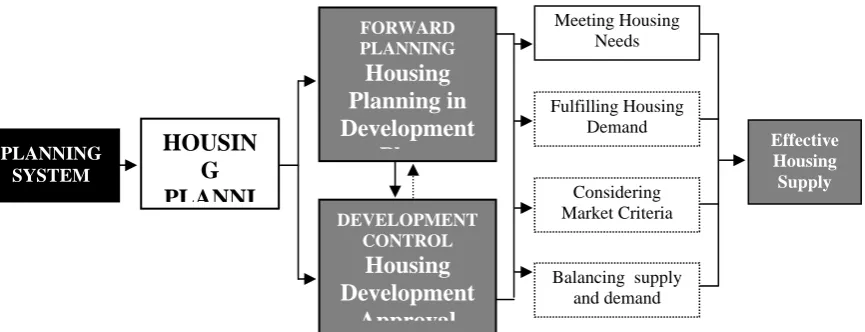
The Malaysian housing planning process is guided by the provisions of Town and Country Planning Act, 1976 (Act 172). This Act has provides a statutory power to the State and Local Authorities to formulate and implements certain policies related to housing development. As shown in Figure 3, the housing development policies will be formulated during preparation of structure plan (SP). A SP begins with examination on the current housing status and followed by forecasting of future housing requirement for the whole SP’s area. The broad housing policies in the SP will be detailed out in the local plans. The preparation of local plan (LP) will also begins with the projection of future housing requirement for certain local plan’s area. It is then followed by the determination of land amount and housing quantity and distribution of suitable areas for future housing development.
Besides roles of structure and local plans, the development control stage also plays an important role in Malaysian housing planning process. At this stage, all housing development applications will be assessed before it is approved by the local planning authorities. In this process, both structure and local plans’ provisions will be used as a basis in considering any housing development applications. After obtaining planning approval, the housing development application also has to go through the land approval process as enacted in the Malaysian National Land Code, 1965 (Act 56). At this stage, planning permission given under the Act of 172 will also be used as a basis for any land development approvals (Alias et al., 2006a).
Meeting Housing Needs
PLANNING SYSTEM
FORWARD PLANNING
Housing
Planning in
Development
Pl
DEVELOPMENT CONTROL
Housing
Development
Approval
Fulfilling Housing Demand
Considering Market Criteria
HOUSIN
G
PLANNI
Effective Housing Supply
Figure 3: The Malaysian Housing Planning Process Related to the Management of Housing Supply
Theoritically, an effective housing supply should be achieved if the above process is adhered. But in reality, loopholes and weaknesses in the current planning practice is also argued as a contributor to the issues of overhang and oversupply of housing in Malaysia. This situation basically describes that ineffectiveness has occurred in the Malaysian housing planning process. However, to ascertain the factuality of this argument, detailed exploration need to be done. Both process an outcomes of each activities in the preparation of development plans and development control process should be properly evaluated by applying an appropriate research methods. The following discussion will discussed on the methodology which was applied in conducting this research.
5.0 RESEARCH METHODOLOGY
Generally, there is a very limited empirical research which discussed on the interrelationship between the planning system and housing supply. With regard to the housing planning process, only several researchers, such as Rydin (1985), Ho (1994), Hull (1997) and Asiah (1999) have identified several significant aspects on housing supply. It is also important to highlight that, basically there is no specific research done which examine and evaluate the extent to which the planning system play its role in managing housing supply.
5.1 Research Purpose
In the situation of limited empirical research on this subject, it is becomes a responsibility of this research to explore in depth on the roles of planning system, as well as its mechanisms and activities in the housing supply process. This research is also conducted to describe on how
Preparation
of structure
Preparation
of local plan
Development
control
•
Examine current housing supply
•Forecast future housing requirement for LP’s area
•Assess, control and approves new housing supply PLANNING ACTIVITIES RELATED TO
HOUSING SUPPLY PLANNING
MECHANISMS
Examine,
Forecast,
Plan,
Control and
Approve
(MANAGIN
•Forecast future housing requirement for SP’s area
•Formulate housing development policies
•Locate suitable location for future housing supply
or to what extent the planning system plays its role in managing the housing supply. By underlined the above research’s purposes, basically it is in-line with the fundamental of conducting empirical research as clarified by Newman (2006). Newman explained that the purposes of social research can be organised into three groups, that is exploratory, descriptive and explanatory. The selection of which most suitable purpose in conducting the research is based on what the researcher is trying to accomplish.
For this research, it was conducted to achieve both exploratory and descriptive research’s fundamentals. Thus, the general purpose of the research is to highlight the issues related to housing supply, followed by exploration on the relationship between planning system and housing supply and ended with describing its effectiveness. In detailed, the purpose of this research is to answer several questions. First, how the mechanisms in the planning system play its role in the housing supply process? Second, how effective are the development plans in conducting housing planning activities? Third, do the housing approval process complies with the development plans and how effective are the process in assessing and controlling the housing supply? Fourth, how effective are the housing planning process in the study area in meeting population’s housing need, fulfilling households housing demand, incorporating market criteria and balancing supply with actual demand?
5.2 Research Approach
The selection of suitable research approach depends on the formation of aim, objectives and the purposes of each research. It is also dependent upon the nature of the research problem (Khairul Baharein, 2001) or the nature of social phenomena to be explored (Morgan & Smircich, 1980). In social science, there are two basic methodological traditions, that is positivism and post-positivism. Finch (1986:7) described positivism as `an approach to the creation of knowledge through research which emphasizes on the model of natural science. The scientist adopts the position of objective researcher, who collected facts about the social world and then builds up an explanation of social life by arranging such facts in a chain of causality’. In contrast, post-positivism is about a reality which `is socially constructed rather than objectively determined. Hence the task of social scientist should not be to gather facts and measure how often certain patterns occured, but to appreciate the different constructions and meanings that people place upon their experience’ (Easterby-smith et al., 1991:24). In other words, positivism is more closely associated to quantitative method of analysis, whilst post-positivism deals with understanding of the subjectivity of social phenomena which requires a qualitative approach (Khairul Baharein, 2001).
In relation to this research, it dealts with the investigation on the oversupply’s phenomena and to what extent the planning system plays its role in managing housing supply. By considering the nature of investigation research, the qualitative method of analysis was deemed appropriate in gathering, analysing and reporting the data (Kamariah. 2002). This method of analysis is also seen as the most suitable approach to evaluate insights on the effectiveness of the process, content and outcomes of the development plans and development approval stage. Basically, selection of this approach is parallel with the opinion by Cassell and Symon (1994:5), whose argued that “only qualitative method are sensitive enough to allow the detailed analysis of investigation or evaluation”. By applying qualitative approach, the research’s emphasis should be given to understand the processes and meanings, which do not require statistical analysis (Asiah, 1999) or detailed measurement in terms of quantity and intensity (Denzin and Lincoln, 1994; Kamariah, 2002).
5.3 Application of Case Study
In conducting the qualitative research as explained above, this research applies the case study approach to explore in depth about the phenomena of oversupply of housing as well as the implementation of housing planning process. Generally, the case study approach is defined as
`in-depth study of the cases under consideration (Hamel, et al., 1993:45). The term of `case’, as explained by Yin (1989) can be refered as an event, an entity and individual or even a unit of analysis. In detailed, the approach of case study refers to `an empirically inquiry that investigates a contemporary phenomena within its real-life context, especially when the boundaries between phenomena and context are not clearly evident and multiple sources are used’ (Yin, 1989:23; 1994:13). Similar argument stated byKamariah (2002), who clarified a case study as an intensive, holistic description and analysis of a single instance, phenomena, or social unit, which describes and explains holistically a social phenomena that can be whether a unit, a single entity or a social process. Meanwhile, Anderson (1993) described a case study as being concerned with `how’ and why’ things happen, allowing the investigation of contextual realities and the differences between what was planned and what actually occured. By selecting a case study approach, it is also in accordance with arguments by Khairul Baharein (2001) and Kherun Nita (2004), whose stated that a case study approach is one of the effective methods to conduct a qualitative research.
For this research, the Johor Bahru Conurbation (JBC) area was selected as a case study. The rationales of selecting this area is based on its urban function as one of the fastest growing region in Southern Peninsular Malaysia. The population of JBC in 2000 is approximately 1,159,079 people, with an average growth rate of 4.59 percent between 1991 – 2000. The high growth of population has directly influenced and increase the housing development in JBC. Figure in 2003 showed that there are 398,911 housing stock in JBC, compared than 304,829 units in 2000. In terms of the housing issues, the JBC area also faced with an overhang and oversupply of housing. For overhang, in 2004, it was recorded at 3,060 units, which represent 80.8% from the total 3,785 overhang units in the Johor State (Property Market Report, 2004). While, for housing supply’s figure, there are approxiamately 748,703 planned housing units which has been approved by the planning authorities in JBC area until 2003. This figure shows that the committed housing supply in JBC area is far exceed from the actual housing need in 2003, which is only required at 305,069 units (JPBD Semenanjung Malaysia, 2004). These figures clearly described that the JBC area is facing a serious housing supply issues. In this situation, it is timely and rational for selecting the JBC area as a case study. By conducting this research, it is hoped that any loopholes and weaknesses in the housing planning process in the JBC area can be identified in systematic way.
5.4 Data Collection
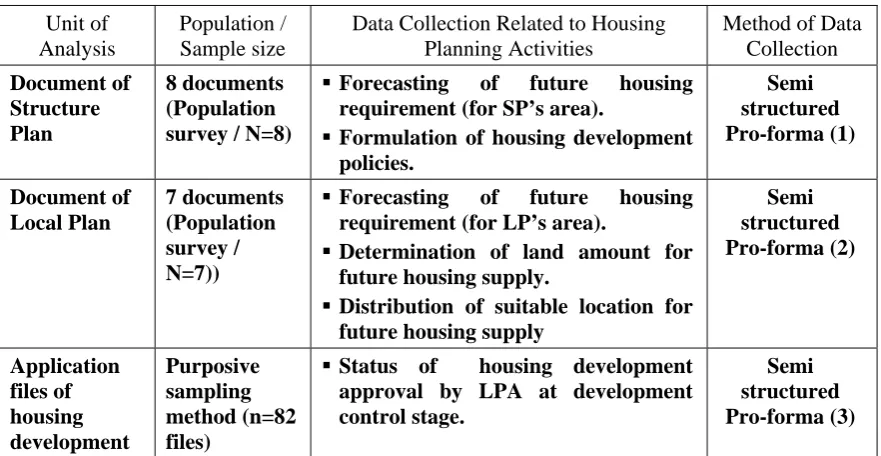
the pro-forma 3 was used to evaluate the approval status of housing development applications as approved by the local planning authorities. Due to numerous housing applications in various size in study area, which is unofficially amounted to 535 applications, this research applied the `purposive sampling’ method in selecting suitable sample. By using this method, only housing applications covering an area of more than 100 hectares or targetted population exceeding 10,000 peoples which approved from 1985 to 2006 were selected as samples. A total of eighty-two (n=82) housing applications were recorded under this category.
Table 4: Data Collection for Planning Document’s Content Analysis
Unit of Analysis
Population / Sample size
Data Collection Related to Housing Planning Activities
Method of Data Collection Document of Structure Plan 8 documents (Population survey / N=8)
Forecasting of future housing
requirement (for SP’s area).
Formulation of housing development
policies. Semi structured Pro-forma (1) Document of Local Plan 7 documents (Population survey / N=7))
Forecasting of future housing
requirement (for LP’s area).
Determination of land amount for
future housing supply.
Distribution of suitable location for
future housing supply
Semi structured Pro-forma (2) Application files of housing development Purposive sampling method (n=82 files)
Status of housing development
approval by LPA at development control stage.
Semi structured Pro-forma (3)
Besides data collection for content analysis, perception survey on the actors involved in housing planning process was also conducted. In this survey, government and private planners were identified as a unit of analysis or respondent. For this purpose, sixty-one (N=61) planners in study area were surveyed. It was done through face-to-face interview using a set of structured questionnaire. The questionnaire was designed to gain their perceptions on the housing issues and effectiveness of each activities in housing planning process in study area. In addition to the document’s content analysis and actor’s perception survey, an in-depth interview with the selected respondents will also be carried out after analysing data from the `pro-formas’ and questionnaire. The purpose of this interview is to seek an insight views on the specific matters related to the planning system and housing supply. A total of sixteen (n=16) respondents amongst the government and private planners directly involved in all the three planning mechanisms and have an experience of more than 10 years as identified during the perception survey will be interviewed. The interview will be conducted using a set of open-ended questions which structured in the interview agenda.
5.5 Data Analysis
In accordance with variety of data in a forms of structured, semi structured and open-ended questions, this research has to apply a different methods to analyse each types of data. For structured and semi-structured questions, either in the content analysis’s pro-formas or
Science (SPSS). For open-ended questions in the pro-formas and interview’s agenda, its will be analysed manually.
Data collected from all the three pro-formas was analysed separately, due to differences in terms of purpose of data and contents of question. Generally, data analysis for pro-forma 1 (content analysis of SP) and pro-forma 2 (content analysis of LP) were arranged in a similar way. Its begin with analysing on general and specific housing supply issues, followed by evaluating effectiveness of each housing planning activities and ended with identifying housing supply’s objectives. For pro-forma 3 (content analysis of housing development’s application files), it focus are on the housing profiles and how each housing applications was assessed at the development control process before it is approved. Most of the data collected in all the three pro-formas, except for open-ended questions, were analysed quantitatively in a form of
descriptive statistics. By doing univariate as well as bivariate analysis, the frequency and cross-tabulation distribution for certain variables (questions) was produced.
For perception survey, due to its questions was arranged in a structured form, it’s not required extra works to develop a new code or recoding to the existing data. In accordance to the objective of the survey, that is to obtain a general perception on the effectiveness of each housing planning activities, only univariate analysis was done to produce a frequency distribution for each variables (questions). For in-depth interview, due to its questions was prepared in a form of open-ended, all the views collected from each interviewee (respondent) will be analysed
qualitatively by listing and quoting relevant text or transcriptions.
6.0 RESULTS FROM PRELIMINARY DATA ANALYSIS
Based on the content and perception analysis, it’s revealed qualitatitive and quantitative results on the effectiveness of each housing planning activities in managing housing supply. Nevertheless, for this paper, only quantitative results in a form of descriptive statistic will be discussed.
6.1 Content analysis of Structure Plan
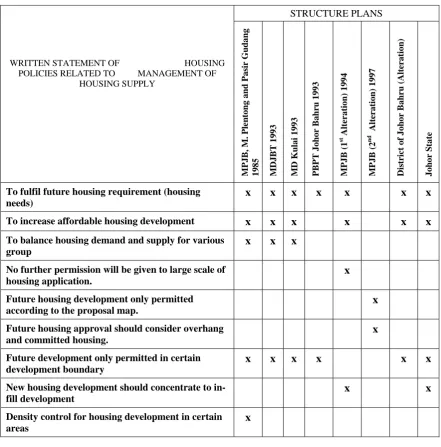
From content analysis of 8 structure plans in the study area, it revealed that there a variety of housing issues discussed in each structure plans, such as shortage of low cost, abandoned, oversupply, unoccupied housing and so on. In relation to forecasting of future housing requirement, 7 structure plans (87.5%) has conducted this activity, except MBJB (Second Alteration - 1997) Structure Plan. In relation to the outcome of forecasting, 6 structure plans or 85.7% was forecasted only in a form of housing amount, except the MPJB, Mukim Plentong and Pasir Gudang Structure Plan, 1985 which also forecasted it in a form of types of housing.
that is MPJB, Mukim Plentong and Pasir Gudang Structure Plan which is also consider an element of actual housing demand.
Table 5: Written Statements of Policy in the Structure Plan Related to Housing Supply
STRUCTURE PLANS
WRITTEN STATEMENT OF HOUSING POLICIES RELATED TO MANAGEMENT OF
HOUSING SUPPLY M P JB, M. P le n
tong and P
a
sir
Gudang
1985 MDJBT 1993 MD Kulai 1993 PBPT Johor Ba
hru 1993
MPJB (1
st Alteration) 1994
MPJB (2 nd Alt eration) 1997 Dis trict of Joh o r Bah ru (Alt era tion ) Johor State
To fulfil future housing requirement (housing needs)
x x x x x x x
To increase affordable housing development x x x x x x
To balance housing demand and supply for various group
x x x
No further permission will be given to large scale of housing application.
x
Future housing development only permitted according to the proposal map.
x
Future housing approval should consider overhang and committed housing.
x
Future development only permitted in certain development boundary
x x x x x x
New housing development should concentrate to in-fill development
x x
Density control for housing development in certain areas
x
6.2 Content Analysis of Local Plan
Skudai Local Plan and Masai-Plentong Local Plan was not identified it. This content analysis also revealed that the land amount which earlier determined in four LPs has not been translated accordingly in the LP’s land use map. Generally, housing land use was zoned exceeding than an actual land amount for future housing requirement.
In relation to the distribution of suitable area for future housing development, there are several factors was considered during preparation of each LPs, such as availability of land adjacent to current housing development (100.0%), assessibility from the main road (100.0%), follow the alignment of development corridor (85.7%) and avoid from developed housing in restricted area (57.1%). With regard to the consideration of future demand and supply and market conditions in distributing suitable location, it’s never been discussed in 5 LPs (71.4%). Although these elements was discussed in another 2 LPs (28.6%), but it’s only stated in the LP’s technical report and not in the final report. In relation to the time-frame for location’s distribution, all the LPs only distributed it for overall planning period, not in the form of certain planning phases. From this analysis, similar to the SP’s content analysis, it’s also revealed that all the LPs are only focus on meeting housing needs and basically neglects the element of actual housing demand and local housing market conditions.
6.3 Content Analysis of Housing Development’s Applications
As mentioned in Section 5.4 (data collection), this analysis is only conducted to eighty-two (n=82) housing development’s applications as samples. The analysis shows that most of housing scheme in the study area was developed in an area between 101-500 hectares (69.5%), followed by 501-1000 hectares (12.2%), below 100 hectares (11.0%), 1001-1500 hectares (2.4%), 1501-2000 hectares (2.4%) and more than 2,000 hectares (2.4%). In terms of total housing units, housing development can be divided into several total housing unit, that is 2500 unit downwards (13.4%), 2501-5000 units (35.4%), 5001-10,000 units (26.8%), 10,001-15,000 units (11.0%) and more than 15,000 unit (13.4%). This figures describe that the study area was developed by a mega scale of housing development, either in a form of land area or total housing units.
This content analysis also revealed several important aspects related to the effectiveness of development control process. In terms of land use zone, only 47.6% (n=39) of housing applications located in the housing land use zone. Around 12.2% (n=10) was zoned in the form of half for housing and another half for others land use and 40.2% (n=33) of housing scheme is situated in others land use zone, such as agriculture, green area, industry and institution. From this analysis, it shows that 52.5% (n=43) of the housing schemes which was approved by the Local Planning Authorities are inconformity with land use zone as determined in the structure or local plans.
6.4 Analysis of Planners’ Perception on the Effectiveness of Planning System
planning process, 95.1% (n=78) of the respondent agreed with the argument that it’s originated from the fundamental of housing planning system, which only focused on meeting broad housing needs and neglect the elements of actual housing demand.
In terms of their perceptions on the role of SP, all respondents (100.0%) aware and agreed that the SP plays a siginificant role in forecasting future housing requirement and formulation of housing development policies. Further to that, 98.4% of respondent agreed that any weaknesses in forecasting will affect and contribute to failure of other stages in the housing planning process. In relation to the formulation of policy, 96.8% of respondent viewed that the SP should also formulate a specific housing policy which consider the element of demand and supply to facilitate the housing development control process. Most of respondents (90.1%) also viewed that due no specific policy to consider the aspects of demand and supply, it contributes to surplus of housing development approval.
With regard to the role of LP, all respondents are aware that the preparation of LP plays a siginificant role in forecasting future housing requirement, determination of land amount and distribution of suitable area for future housing supply. In terms of forecasting activities, 95.1% of them agreed that any weaknesses in forecasting will affect and creates a mistake in the process of determination of land amount for future housing supply and at the stage of housing development approval. For determination of land amount, 86.9% (n=71) of respondents agreed with argument that the land amount which determined in the preparation of local plan is commonly exceeding what has been forecasted, either in the structure or local plan. In relation to the distribution of suitable area for future housing development, 68.9% (n=56) of respondent agreed that the current approaches are not really effective to determine the most suitable location for housing development.
For the development control process, all respondents are aware on the provision of the Act 172, where the local planning authority should take into consideration the provisions of the development plan and conformity with the local plan before granting any planning permission. However, 80.3% (n=66) of the respondent viewed that housing development approval practice by the planning authorities are not really comply with the above legal requirement. Besides perception about the effectiveness of each housing planning activities, perception survey also seeks a general opinion on how to strengthen the Malaysian housing planning system as well as in the study area. From this survey, all the respondent agreed that the fundamentals objective of housing planning system should be changed by not only focus on meeting housing needs, but should also incorporate other aspects, such as household actual demand, household housing choice and conditions of local housing market.
7.0 CONCLUSION
approval process. There are a lot cases, where housing applications was approved by the Local Planning Authority, although it is not situated in the specific housing land use zone as ealier determined in the LPs.
Application of the above methods are also clarify that the housing planning process in study area was successful in achieving the objective of meeting housing needs. However, it’s still not properly operate to fulfil an actual housing demand, balancing demand and supply and considering the local market condition. In overcoming the housing supply issues, especially on oversupply, the fundamental objective of housing planning system which is commonly focus on meeting broad housing needs and neglect the element of actual demand need to be re-examined. The importance of market criteria also need to be considered in the housing planning process.
REFERENCES
Alias Rameli, Foziah Johar and Ho, C.S (2006a). Responsiveness of the Malaysian Planning System in Managing Housing Supply. Proceedings of the International Conference on Sustainable Housing 2006. September 18-19. Universiti Sains Malaysia. 190-196.
Alias Rameli, Foziah Johar and Ho, C.S (2006b). The Management of Housing Supply in Malaysia : Incorporating Market Mechanisms in Housing Planning Process. Proceedings of the International Conference on Construction Industry 2006. June 22-23. Universitas Bung Hatta, Indonesia.
Asiah Othman (1999). The Effect Of The Planning System On Housing Development : A Study Of The Development : A Study Of Developers Behaviour In Kuala Lumpur and Johor Bahru, Malaysia. University of Aberdeen : Ph.D. Thesis.
Bramley, G. (2003). Planning Regulation and Housing Supply In a Market System. In : O’Sullivan, T. and Gibb, K. eds. Housing Economics and Public Policy. United Kingdom : Blackwell Science Ltd. Bramley, G., Bartlett, W. and Lambert, C. (1995). Planning, The Market and Private Housebuilding.
London : UCL Press Ltd.
Chan, K.T. (1997). Housing Delivery System. Proceeding of The National Housing Convention. Kuala Lumpur : 26-27 May, 1997. ISIS Malaysia.
Denzin, N. and Lincoln, Y. (1991). Handbook of Qualitative Research. California : Sage Publication. Einsiedel, V. (1997). Towards A Sustainable Housing Strategy. Proceeding of The National Housing
Convention. Kuala Lumpur : 26-27 May, 1997. ISIS Malaysia. Finch, J. (1994). Research and Policy. London:The Falmer Press.
Foziah Johar (2002). Amalan Kawalan Perancangan Pihak Berkuasa Tempatan Di Semenanjung Malaysia : Tumpuan Kepada Aspek Alam Sekitar. Universiti Kebangsaan Malaysia : Tesis Ph.D.
Golland, A.(1998). System of Housing Supply and Housing Production in Europe : A Comparison of the United Kingdom, the Netherlands and Germany. England : Ashgate.
Golland, A & Gillen, M (2004). Housing need, housing demand and housing supply. In : Golland, A and Blake, R, eds. Housing development : Theory, process and practice. London : Routledge. 45 – 70. Healey, P. (1983). Local Plans in British land use planning. England : Pergamon Press.
Ho Chin Siong (1994). Evaluation Of Housing Estate Development In Relation To Housing Supply In Malaysia (With Reference To Urban Management and Housing Approval System. University of Tokyo, Japan : Ph.D. Thesis.
Hull, A (1997). Restructuring The Debate on Allocating Land for Housing Growth. Housing Studies : July 1997, Vol. 12 Issue 3. Great Britain : 367 – 382.
Jabatan Penilaian dan Perkhidmatan Harta (2000 - 2006). Property Report, 1999 - 2005. Kuala Lumpur : Percetakan Nasional Malaysia Berhad.
Jabatan Perancangan Bandar dan Desa (JPBD) Semenanjung Malaysia (2004). Rancangan Tempatan Daerah Johor Bahru : Laporan Teknikal Sektor Perumahan. Johor : JPBD Semenanjung Malaysia. Kamariah Dola (2002). Incorporating Sustainable Development Principles Into The Local Plan Preparation
Process : The Case of Selected Localities in Southern Region of Peninsular Malaysia. Universiti Teknologi Malaysia : Ph.D. Thesis.
Khairul Baharein Mohd Noor (2001). Case Study : A strategic methodology. Qualitative Research Convention 2001. October 25 – 26. University of Malaya Centre for continuing education.
Kherun Nita Ali (2004). Towards an online knowledge management system for reative maintenance projects. Univerity of Salford, United Kingdom : Ph.D. Thesis.
Mohd. Fadzil Mohd Khir (2005). Isu dan Cabaran Dalam Pembangunan Hartanah. Seminar Kebangsaan Perancangan dan Pembangunan 2005. Majlis Perbandaran Sepang. 1 Jun 2005.
Mohd Talhar Abdul Rahman (2004). Johor Property Investment Outlook and Redefining Property Development Strategies and Portfolios for Competitiveness in Real Estate Investment. The Proceeding of Johor Property Investment Outlook 2004 And Beyond : Monetising Assets, Balancing Supply and Demand. Johor Bahru : Institute of Sultan Iskandar, Universiti Teknologi Malaysia.
Nicol, C. (2002). The Formulation of Local Housing Strategies : A Critical Evaluation. England : Ashgate. Noraini Yusoff (1993). A Culturally Appropriate And Economiccally Sustainable Housing Delivery
System For Malay Urban Low-Income Households In Malaysia. Texas A&M University : Ph.D. Thesis.
Ratcliffe, J., Stubbs, M. and Shepherd, M. (2004). Urban Planning and Real Estate Development (Second Edition). London : Spon Press.
Rydin, Y (1985). Residential development and the planning system : A study of the housing land system at the local level. Diamond, D & McLoughlin J.B. (eds.). Britain : Pergamon.