A PORTAL BASED KNOWLEDGE MANAGEMENT SOLUTION
FOR AN EDITORIAL DEPARTMENT
AIDA MOHAMED
iii
I thank Allah for His mercy and guidance to me. This thesis is specially dedicated to my mother – Johara Bee bt Mazahar Ali and father – Mohamed b Hj Ibrahim. Their love inspires and brings me to success. To brothers and sisters, thank you for the love and support that you have given to me through out all the obstacles I have to face. I am the luckiest person in the world to have all of you. Without you, I could
iv
ACKNOWLEDGEMENT
This thesis gave me the opportunity to learn and explore more about Knowledge Management and the publishing industry. I now know more about this subject matter, which I feel is very exiting and important. Besides, I have also learnt more about human-to-human interaction through out the study phase of getting the requirements from the industry. Hence, I would like to express my greatest appreciation to my supervisor, Professor Dr. Ahmad Zaki Abu Bakar for his support and guidance. Thank you for giving me the opportunity to experience this challenging field.
I am also very thankful to Tuan Haji Hishamuddin Yaacob, Managing Director of Kumpulan Karangkraf Sdn Bhd for giving me the opportunity to work with him in the most successful bumiputra owned publishing company. The support he and his editorial team have given me through out my research has encouraged me and helped me in this project. Not forgetting to mention, Puan Sri Diah, En. Syamil Fahim, En. Abd. Jalil Ali and all the IT team members.
v
ABSTRACT
vi
ABSTRAK
vii
TABLE OF CONTENTS
CHAPTER TITLE PAGE
DEDICATION III
ACKNOWLEDGEMENT IV
ABSTRACT V
ABSTRAK VI
TABLE OF CONTENTS VII
LISTS OF FIGURES XI
LISTS OF TABLES XIII
LISTS OF APPENDICES XIV
1 INTRODUCTION 1
1.1 Overview and Background 1
1.2 Problem Statement 5
1.3 Research Questions 6
1.4 Project’s Objective 7
1.5 The project scope are listed as below: 7
viii
2 LITERATURE REVIEW 9 2.1 Overview 9 2.1.1 Publishing Organizations Definition 10 2.1.2 Knowledge Management Definition 10 2.1.3 Background of Kumpulan Karangkraf Sdn Bhd 10 2.2 Traditional Publishing Business Process Model 11 2.2.1 General Publishing Stakeholders 11 2.3 Business Process of Kumpulan Karangkraf Sdn Bhd 13
2.3.1 Value Chain Analysis 16
2.4 Collaborative Knowledge Management 17
2.4.1 Knowledge Types 17
2.4.2 General Knowledge Model 19
2.4.3 Knowledge Management Framework 21 2.5 Knowledge Management Strategies 22 2.5.1 Classification by Knowledge 22 2.5.2 Classification by Business Process 23 2.5.3 Classification by End Result 25 2.5.4 Linking Knowledge and End Result 26 2.6 Portal 26 2.7.1 Knowledge Management Technology 27 2.7 Prototyping 31 2.8 Success Factors of the Organization through the
Contributions of the Portal 31 2.9 The matrix of the Knowledge Community 33
3 RESEARCH METHODOLOGY 36
3.1 Overview 36
3.2 APQC’s Road Map to Knowledge Management Results: Stages of Implementation 37
3.3 Operational framework 38
ix 3.3.2 Stage 2: Develop Strategy 42
3.3.3 Stage 3: Design and Launch KM Initiative 43 3.3.4 Stage 4: Expend and Support 47 3.3.5 Stage 5: Institutionalize Knowledge Management 48
3.4 Estimated Resources 48
3.4.1 Software and Hardware Requirement 48
4 SYSTEM DESIGN 50
4.1 Introduction 50
4.2 Develop Strategy: Select and Further Study 50 4.2.1 Knowledge Audit Using Questionnaire Form 52
4.2.2 Knowledge Audit Analysis 54
4.2.3 Knowledge Audit through Interview Sessions 60
4.3 Portal requirements 61
4.3.1 User category in the portal 62
4.4 System capabilities 63
4.5 Use Case Diagram 64
4.6 Portal Architecture 66
4.6.1 Database 67
4.6.2 ASP 68
4.7 Knowledge Classification in Publishing Industry 70
4.8 System Module 71
4.8.1 The interface design 72
4.8.2 Home 73
4.8.3 Login 75
4.8.4 Registration 75
4.8.5 Forum 76
4.8.6 Knowledge Base Module and Article Module 78 4.8.7 Create New Announcement Module 79 4.8.8 Correspondence Details and Assignment Record
x
5 IMPLEMENTATION AND TESTING 81
5.1 Introduction 81
5.2 Stage One: Get Started and Project Initiation 82
5.3 Stage 2: Develop Strategy 83
5.4 Stage 3: Design and Launch KM Initiative 84
5.5 Stage 4: Expend and Support 85
5.5.1 Testing the prototype, get feedback and improve
portal 85
5.5.1.1 Input Testing 86
5.5.1.2 Output testing 86
5.5.2 Test Objective 92
5.5.3 Test Findings 92
5.6 Stage 5: Institutionalize Knowledge Management 92 5.6.1 The Policy to enforce the use of the portal 93
5.6.2 Portal Use Policy 93
5.6.3 Recommendations 95
6 DISCUSSIONS AND CONCLUSION 97
6.1 Introduction 97
6.2 Overall Portal Development Discussion 98
6.3 Project Objectives Review 99
6.4 Strengths and Advantages 100
6.5 Constraints and Limitations 102
6.6 Recommendation 103
6.7 Conclusion 104
REFERENCES 106
xi
LISTS OF FIGURES
Figure No Title Page No
1.1 Publishing Core Business Process 2
2.1 General Publishing Stakeholders 12
2.2 Karangkraf Business Porcess 13
2.3 Value Chain Analysis of the Publishing Industry 16
2.4 Dimension of knowledge 18
2.5 General Knowledge Model 20
2.6 KM Technologies 28
2.7 Magazinelaunch.com website. Source:
(http://www.magazinelaunch.com) 30 2.8 The community categories in the organization 34
3.1 APQC’s Roadmap to Knowledge Management Results: Stages
of Implementation. (Source: http://www.apqc.com) 38
3.2 Operational Framework 40
3.3 Model of process flow for UML Analysis & Design
(Source: RUP, 2002) 45
4.1 Years of experience of the respondents 54
4.2 Ownership of knowledge 59
4.3 Use Case Diagram for the Portal 65
4.4 Architecture of the portal 66
4.5 ODBC Setup for KMP System 68
4.6 Portal Home Interface 73
xii
4.8 Login module 75
4.9 User Registration Page Interface 76
4.10 Sub module of Discussion Forum 77
4.11 Sub module of posted message. 77
4.12 Download Module Interface 78
4.13 Knowledge Base Submit form interface 78 4.14 Create new announcement form interface 79
4.15 Correspondence list 80
4.16 Add correspondence details interface 80 5.1 The percentage of the evaluation of the test result 90
xiii
LISTS OF TABLES
Figure No Title Page No
3.1 Summary of Processes and Output of UML Analysis
& Design (Source: RUP, 2002) 47
4.1 Knowledge Context in the Publishing Organization 51
4.2 Results of Degree of Formality 56
4.3 Reference points of the Knowledge in the Publishing Organization 59
4.4 Knowledge Classification by Module 70
4.5 Main Modules of the Portal 72
5.1 Usability and Testing Rating Scale 88
5.2 Test results from the usability testing questionnaire. 90
xiv
LISTS OF APPENDICES
Appendix No Title Page No
A Organizational Structure of Magazines
Unit in Kumpulan Karangkraf 110
B Project Planning 113
C Questionnaire Form 115
D Results of Questionnaire Analysis 122
E Interview Questions 126
F Use Case Documentation 129
CHAPTER 1
INTRODUCTION
1.1 Overview and Background
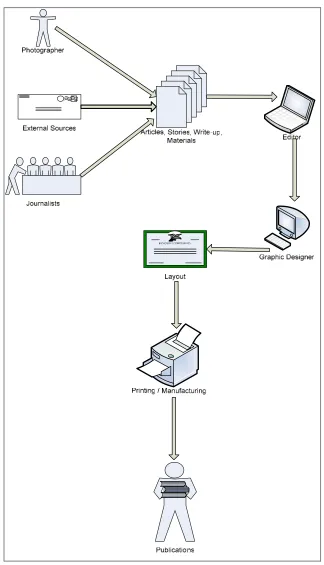
The publishing industry produces a variety of publications, including magazines, books, newspapers, and directories.
2
Figure 1.1: Publishing Core Business Process
3 “prepress” operation; other publishers usually contract out their prepress to
companies in the printing industry, along with the actual printing of the publication.
Meeting deadlines is one of the primary conditions of employment in this industry. Magazines and newspapers, in particular, are published on a very tight schedule and each party involve in the process must be prepared to meet these deadlines. This can often make for a very chaotic and stressful environment, and the staffs frequently may be required to work overtime. Working nights, weekends, and holidays also is common, especially for those working on newspapers.
According to Bureau of Labour Statistic, U.S Department of Labor, the average nonsupervisory worker in newspaper publishing worked 33.0 hours per week in 2002, compared with 33.9 hours per week across all industries. Within periodical publishing, nonsupervisory workers worked an average of 36.1 hours per week, and 39.5 hours per week in book publishing. Part-time employment is significant in this industry, with 17 percent working part time.
The publishing lifecycle is unique, with content diverging and converging at multiple points of the process. There are also many collaborative review and approval flows that must be managed appropriately before everything can come together for print distribution.
4
Most of the staff matured in their field of work in the company with their knowledge and experience. The longer they worked in the industry, the more experience and knowledge they have. The core process that they have to go through to get the best articles is by reading other reference materials, doing researches, meeting peoples for interviews and attending events. Each and every staffs will get stories with different approaches. The one with the best approaching skills will get more information and sometimes exclusive stories.
New staffs need to learn on the best approach to use to accommodate the assignments given by the editors. Different assignments may need different approach. They need to ask for the contacts details from the seniors or searching from other resources. The processes to get the information they need may take longer if they don’t know where to refer.
5 1.2 Problem Statement
The majority of the knowledge within an Editorial Department of a publishing industry belongs to the individual employees and is seldom shared throughout the organization. Each individuals in the department has their own knowledge and expertise areas, however, they are very protective to such knowledge. By being a specialist in certain area, they might have a better position and good influence in the company. Many workflows and content management system has been developed for a publishing industry, but none of them have a knowledge sharing based, to encourage people from this industry to shift the paradigm of “knowledge is owned by individuals” to the new paradigm that the knowledge is belong to the organizations.
When somebody leaves the organization, the knowledge resides in him will be gone too. The main problems the company will face when this occurs are:-
1. Lost of external business contacts that have been established by the respective staff.
6
1.3 Research Questions
In order to be able to build a knowledge management solution portal, several studies need to be carried to answer the following questions:
i. Where is the critical path in the publishing business process that needs to be focused as the knowledge source?
ii. Who has the knowledge in the editorial department?
iii. How to gather the knowledge from staff?
iv. What kind of knowledge need to be collect and gather from the community members?
7
1.4 Project’s Objective
The objectives of this project are:
(i) To conduct a knowledge audit in the editorial department to identify who has what kind of knowledge.
(ii) To develop and test a prototype portal that support knowledge management.
(iii) To help reduce knowledge loss using the developed portal by transferring the knowledge ownership from personal to the company’s asset.
(iv) To outline the organizational strategy in order to encourage the use of the portal.
1.5 The project scope are listed as below:
(i) Kumpulan Karangkraf Sdn Bhd will be used as the project’s case study
(ii) The project will only focus the publishing business process in the editorial department.
(iii) The development of the prototype system is to be based on a portal design and structure.
8 (iv) The project is to be concerned in collecting knowledge and storing the
knowledge in a portal for dissertation purposes.
(v) The prototype is expected to enable knowledge collection, knowledge sharing, and knowledge reuse among stakeholders.
1.6 Significance of the study
The study undertaken is important in determining the existence of knowledge sharing among the editorial staff from different magazines in the company. Sharing of knowledge plays an important role in the development of a successful and reliable publishing company. It will help to improve the general level of competency in order to develop a better and faster information capture and to help to speed up the publishing processes.
106
REFERENCES
Ali Bahrami (1999). ”Object Oriented Systems Devlopment using The Unified
Modelling Languange.”Singapore: Mc Graw-Hill International Editions.61-317
Boyett, J.T. & Boyett, J.H. (2001). ”The Guru Guide to the Knowledge Economy: The Best Ideas for Operating Profitably in a Hyper-Competitive World.”John Wiley & Sons
Brown, C, Spaanjaars, I & Marks,T. (2003). “Beginning Dreamweaver MX:Build 3 Complete Websites”.Wrox Press Ltd
Davenport,T. & Prusak,L. (1998). ”Working Knowledge: How Organizations Manage What They Know.” Boston:Harvard Business School Press
Finneran, T. (2001). ”A Component-based Knowledge Management System: Ciber White Papers”. (Available Online ), http://www.tdan.com/i009hy04a.htm
Hansen, M. (1999). ”What’s Your Strategy for Managing Knowledge ?” Harvard Business Review, March-April 1999.
Hylton, A. (2002). “A KM Initiative is Unlikely to Succeed Without a Knowledge Audit”.(Available Online),
107
Hylton, A. (2002). “A Knowledge Audit Must be People-Centred & People Focused”. (Available Online), http://www.HyltonAssociates.com
Leornard, D. (1998). ”The Role of Tacit Knowledge in Group Innovation.” California Management /Review, Spring
Liebotwiz, J (1999). ”The Knowledge Audit”. (Available Online ), http://userpages.umbc.edu/~buchwalt/papers/KMaudit.htm
Marr, B ( 2001). ” Measuring Knowledge Assets”. (Available Online)
Skyrme, D.J (2002).” The 3CS of Knowledge Sharing: Culture, Co-operation and
Commitment”. (Available Online ), http://www.skryme.com/updates/u64_f1.htm
Tiwana, A.(2000).”The Knowledge Management Toolkit”.Prentice Hall PTR
Universiti Teknologi Malaysia (2001). “Panduan Menulis Tesis.” Johor Darul Takzim, Malaysia: UTM
Walther, Stephen (1998). “Active Server Pages Unleashed.” 1st. ed. Sams.net Publishing.
Zachman, J. (1998).“Information System Architecture”, (Available Online), http://ww.ecea.noaa.gov/downloads/zach1.pdf
Rational. “Rational Unified Process: Best Practice for software development teams.” Rational Software White Paper TP026B Rev 11/01. 1998.
108
Carlson W. (1999). “A Guide To Planning A Knowledge Management System”. (Available Online),
http://faculty.ed.umuc.edu/~meinkej/inss690/carlson/Knowledge%20Manageme
nt.html
Denning S. (2000). “The Springboard: How Story Telling Ignites Action in Knowledge-Era Organizations. What Is Knowledge?”. Boston, London: