Abstract
GEGICK, MICHAEL CHARLES. Analyzing Security Attacks to Generate Signatures from Vulnerable Architectural Patterns. (Under the direction of Dr. Laurie Williams.)
Analyzing Security Attacks
to Generate Signatures from Vulnerable
Architectural Patterns
by
Michael Charles Gegick
A thesis submitted to the Graduate Faculty of
North Carolina State University
in partial fulfillment of the
requirements for the Degree of
Master of Science
Computer Science
Raleigh
2004
APPROVED BY:
_______________________________________ Committee Member
_______________________________________ Committee Member
ii Biography
Acknowledgements
Thanks to the members of my thesis committee, Dr. Laurie Williams (chair), Dr. Annie Antón and Dr. Julia Earp for their support and suggestions during my research. Dr. Williams helped to steer me through the entire thesis and was always optimistic and amazingly patient. I would like to sincerely thank Dr. Gary McGraw (of Cigital), Dr. Michael Reiter (of Carnegie Mellon University), and Dr. Eugene Spafford, Dr. Pascal Meunier, and Rajeev Gopalakrish (each of Purdue University) for taking the time to understand my thesis approach and give opinions on its validity and practicality in the field of security engineering. I would also like to thank Nick Green and Eric Isakson for their suggestions on the approach when I first arrived at the concept. Additionally, Bruce Wieand was helpful in determining if regular expressions were a possible means of representing events that may occur in an attack and deserves much appreciation. Without Julie Starr, the teacher for CSC405 at North Carolina State University, the feasibility and validation studies would not have been possible. She was very cooperative and understanding with the incorporation of my assignment in her class. Many thanks to Penney Martin for helping to elicit the idea proposed in this thesis.
iv Table of Contents
LIST OF TABLES... vi
LIST OF FIGURES... vii
1.0 Introduction ...1
2.0 Background ...5
2.1 Vulnerability Representation ...5
2.2 Security Collaboration for non-experts...14
2.3 Integrating Security into the Software Process ...17
2.4 Risk Management ...19
3.0 Methodology...21
3.1 Background ...21
3.2 Regular Expressions ...23
3.3 The System Design...29
3.4 Knowledge Base of Regular Expressions ...31
3.5 Methodology Scenario – Securing Applications from Enumerated Threats (SAFET) ..32
3.6 Risk Management ...33
4.0 Vulnerability Collection Methodology ...35
4.1 Limitations ...38
5.0 Vulnerability Collection Results...40
6.0 Feasibility Study ...66
6.1 Feasibility Study Methodology ...66
6.2 Feasibility Study Results ...69
6.3 Metadata ...72
6.4 Valid and Invalid Answers ...73
6.5 Unique Attack Paths...78
6.6 Regular Expressions Not Represented in the Design ...80
6.7 Miscellaneous Data...84
7.0 Validation Study ...86
7.1 Validation Study Methodology...86
7.2 Validation Study Results ...87
7.3 Metadata ...90
7.4 Valid and Invalid Answers ...91
7.5 Unique Attack Paths...96
7.6 Regular Expressions Not Represented in the Design ...100
7.7 Miscellaneous Data...103
8.0 Conclusions and Future Work...105
9.0 References...110
10.0 ppendices...112
10.1 Vulnerability Collection...113
10.2 Feasibility Assignment ...135
10.3 Time Spent on the Feasibility Study...145
10.4 Valid and Invalid Attack Paths for the Feasibility Study ...146
10.5 Feasibility Study Likert Scale ...166
10.6 Student Comments on the Feasibility Study ...167
10.7 Time Spent on the Validation Study ...169
10.8 Valid and Invalid Attack Paths for the Validation Study ...170
10.9 Validation Study Likert Scale ...200
10.10 Student Comments for the Validation Study ...201
vi
LIST OF TABLES
Table 1: Regular Expression Operators...25
Table 2: The Initial Five Regular Expressions...40
Table 3: Classes of Vulnerabilities Not Used. ...42
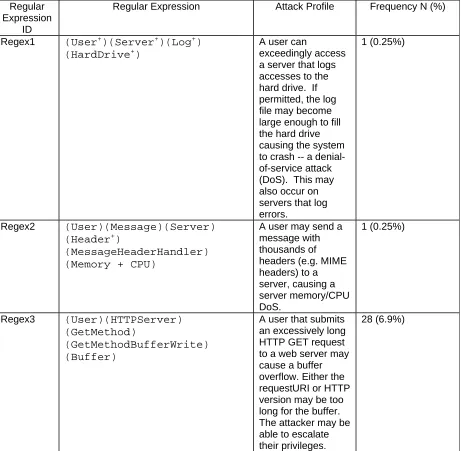
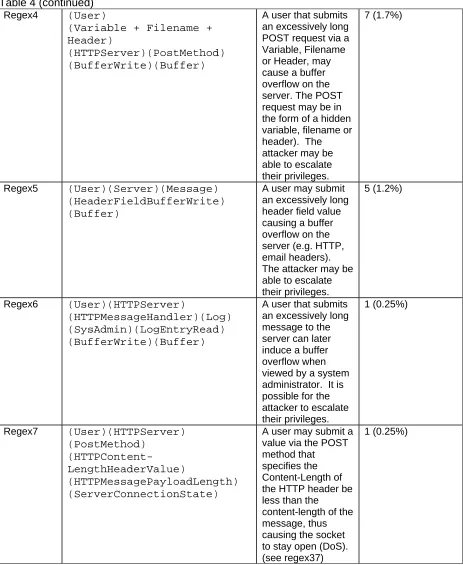
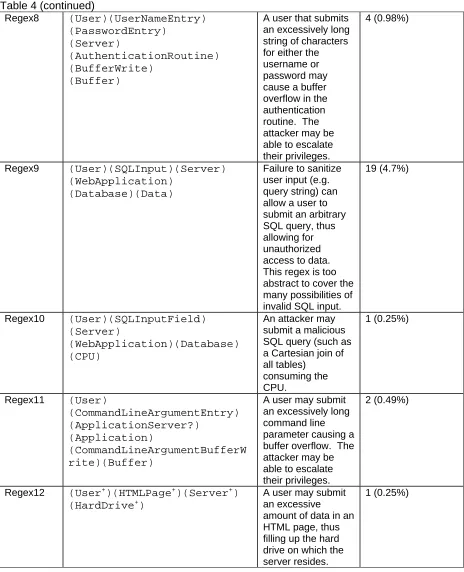
Table 4: Regular Expression Knowledge Base...44
Table 5: Regular Expressions Occurring Frequently in the Knowledge Base...55
Table 6: Further Specified Regular Expressions...57
Table 7: Regular Expressions Representing Buffer Overflows. ...59
Table 8: Regular Expressions Representing Malformed Data. ...61
Table 9: Regular Expressions Representing Remote Executions. ...62
Table 10: Regular Expressions Representing Excessive Data Exploits. ...62
Table 11: Regular Expressions Representing Escalated Privilege Attacks. ...63
Table 12: Regular Expressions Representing Error Message Attacks. ...63
Table 13: Miscellaneous Regular Expressions. ...64
Table 14: Student Answers for One Regular Expression...69
Table 15: Attack Paths Found by 100% of the Participating Students...73
Table 16: Regular Expressions Further Specified...74
Table 17: Regular Expressions with Least Number of Valid Attack Paths...75
Table 18: Regular Expressions without Invalid Attack Paths ...76
Table 19: Regular Expression with the Most Number of Invalid Attack Paths. ...77
Table 20: Regular Expressions with Valid Unique Attack Paths ...78
Table 21: Regular Expressions with Invalid Unique Attack Paths...79
Table 22: Regular Expressions not Found in the Design...81
Table 23: Invalid Attack Paths for Regex20 ...82
Table 24: Valid Attack Paths for Regex17 ...83
Table 25: Student Answers for One Regular Expression...88
Table 26: Regular Expression with the Most Number of Valid Attack Paths...93
Table 27: Regular Expressions without Invalid Attack Paths ...94
Table 28: Regular Expression with the Most Number of Invalid Attack Paths ...95
Table 29: Regular Expressions with Valid Unique Attack Paths ...97
Table 30: Regular Expressions with Invalid Unique Attack Paths...98
Table 31: Regular Expression with the Most Number of Invalid Attack Paths ...101
Table 32: Valid Attack Paths found for Regex22. ...102
Table 33: Invalid Attack Paths found for Regex22. ...103
Table 34: Vulnerability Collection...113
LIST OF FIGURES
Figure 1: Get File Attack Tree ...7
Figure 2: Get File Attack Net...9
Figure 3: A Data Flow Diagram...30
Figure 4: SecurityFocus Example ...35
Figure 5: A Simple Design ...68
Figure 6: Number of Valid Attack Paths per Regular Expression. ...74
Figure 7: Number of Invalid Attack Paths per Regular Expression. ...76
Figure 8: Number Students Indicating that the Regular Expression was not in the Design..81
Figure 9: Number of Valid Attack Paths per Regular Expression. ...92
Figure 10: Number of Invalid Attack Paths per Regular Expression. ...94
Figure 11: Number of Students Indicating that the Regular Expression was not in the Design. ...100
Figure 12: Time Spent on the Feasibility Study ...145
Figure 13: Valid Attack Paths for Regex1. ...146
Figure 14: Valid Attack Paths for Regex2. ...147
Figure 15: Invalid Attack Paths for Regex2...147
Figure 16: Valid Attack Paths for Regex3. ...148
Figure 17: Invalid Attack Paths for Regex3...148
Figure 18: Valid Attack Paths for Regex4. ...149
Figure 19: Invalid Attack Paths for Regex4...149
Figure 20: Valid Attack Paths for Regex5. ...150
Figure 21: Valid Attack Paths for Regex6. ...151
Figure 22: Valid Attack Paths for Regex7. ...152
Figure 23: Invalid Attack Paths for Regex7...152
Figure 24: Valid Attack Paths for Regex8. ...153
Figure 25: Invalid Attack Paths for Regex8...153
Figure 26: Valid Attack Paths for Regex9. ...154
Figure 27: Valid Attack Paths for Regex10. ...155
Figure 28: Invalid Attack Paths for Regex10...155
Figure 29: Valid Attack Paths for Regex11. ...156
Figure 30: Valid Attack Paths for Regex12. ...157
Figure 31: Invalid Attack Paths for Regex12...157
Figure 32: Valid Attack Paths for Regex13. ...158
Figure 33: Valid Attack Paths for Regex14. ...159
Figure 34: Invalid Attack Paths for Regex14...159
Figure 35: Valid Attack Paths for Regex15. ...160
Figure 36: Invalid Attack Paths for Regex15...160
Figure 37: Valid Attack Paths for Regex16. ...161
Figure 38: Invalid Attack Paths for Regex16...161
Figure 39: Valid Attack Paths for Regex17. ...162
Figure 40: Invalid Attack Paths for Regex17...162
Figure 41: Valid Attack Paths for Regex18. ...163
Figure 42: Invalid Attack Paths for Regex18...163
Figure 43: Valid Attack Paths for Regex19. ...164
Figure 44: Invalid Attack Paths for Regex19...164
Figure 45: Valid Attack Paths for Regex20. ...165
viii
Figure 48: Time Spent on the Validation Study...169
Figure 49: Time Spent on the Validation Study...169
Figure 50: Valid Attack Paths for Regex1. ...170
Figure 51: Valid Attack Paths for Regex2. ...171
Figure 52: Invalid Attack Paths for Regex2...171
Figure 53: Valid Attack Paths for Regex3. ...172
Figure 54: Invalid Attack Paths for Regex3...172
Figure 55: Valid Attack Paths for Regex4. ...173
Figure 56: Invalid Attack Paths for Regex4...173
Figure 57: Valid Attack Paths for Regex5. ...174
Figure 58: Invalid Attack Paths for Regex5...174
Figure 59: Valid Attack Paths for Regex6. ...175
Figure 60: Valid Attack Paths for Regex7. ...176
Figure 61: Invalid Attack Paths for Regex7...176
Figure 62: Valid Attack Paths for Regex8. ...177
Figure 63: Valid Attack Paths for Regex9. ...178
Figure 64: Invalid Attack Paths for Regex9...178
Figure 65: Valid Attack Paths for Regex10. ...179
Figure 66: Invalid Attack Paths for Regex10...179
Figure 67: Valid Attack Paths for Regex11. ...180
Figure 68: Valid Attack Paths for Regex12. ...181
Figure 69: Invalid Attack Paths for Regex12...181
Figure 70: Valid Attack Paths for Regex13. ...182
Figure 71: Invalid Attack Paths for Regex13...182
Figure 72: Valid Attack Paths for Regex14. ...183
Figure 73: Invalid Attack Paths for Regex14...183
Figure 74: Valid Attack Paths for Regex15. ...184
Figure 75: Invalid Attack Paths for Regex15...184
Figure 76: Valid Attack Paths for Regex16. ...185
Figure 77: Invalid Attack Paths for Regex16...185
Figure 78: Valid Attack Paths for Regex17. ...186
Figure 79: Valid Attack Paths for Regex18. ...187
Figure 80: Valid Attack Paths for Regex19. ...188
Figure 81: Valid Attack Paths for Regex20. ...189
Figure 82: Valid Attack Paths for Regex21. ...190
Figure 83: Invalid Attack Paths for Regex21...190
Figure 84: Valid Attack Paths for Regex22. ...191
Figure 85: Invalid Attack Paths for Regex22...191
Figure 86: Valid Attack Paths for Regex23. ...192
Figure 87: Invalid Attack Paths for Regex23...192
Figure 88: Valid Attack Paths for Regex24. ...193
Figure 89: Invalid Attack Paths for Regex24...193
Figure 90: Valid Attack Paths for Regex25. ...194
Figure 91: Invalid Attack Paths for Regex25...194
Figure 92: Valid Attack Paths for Regex26. ...195
Figure 93: Invalid Attack Paths for Regex26...195
Figure 94: Valid Attack Paths for Regex27. ...196
Figure 95: Invalid Attack Paths for Regex27...196
Figure 96: Valid Attack Paths for Regex28. ...197
Figure 98: Valid Attack Paths for Regex29. ...198
Figure 99: Invalid Attack Paths for Regex29...198
Figure 100: Valid Attack Paths for Regex30. ...199
1 1.0 Introduction
Adding security late in the software development process, sometimes only after an actual penetration by an attacker, is a common practice in the industry setting. However, adding security to even a partially-completed software application is an insufficient means for securing against threats [20]. If many changes to a partially completed system are needed to fortify the code, then developers may need to make significant modifications to other parts of the system to accommodate the changes. If this is the case, then rewriting the code from scratch with security in mind may be less expensive in terms of time and effort and potentially be less error prone. A means of integrating security at the beginning of the software process is needed to overcome the consequences of starting security when it is too late. Incorporating a feasible method of security can help prevent weak security that leads to drastic consequences, such as endangering the integrity and prosperity of ecommerce and compromising the privacy of electronically-stored health information.
Organizations cannot completely rely on firewalls and cryptography that do not prevent all security attacks. Cryptography has provided many safe opportunities for the computing environment, but it is not a panacea. Fred Schneider’s [16] analysis of CERT advisories shows that the majority of security vulnerabilities occur from “buggy code” and that applying cryptography would have prevented less than 15% of the vulnerabilities. Spafford contends that “using encryption on the Internet is the equivalent of arranging an armored car to deliver credit card information from someone living in a cardboard box to someone living on a park bench.” [9] Thus, software engineering techniques should provide practical techniques for building secure software.
challenge for security experts to expose threats in a system. The efficacy of the security process depends on how early a vulnerability is found in the software process and removed. The longer any defect remains in a product the more expensive it is to fix it in terms of time, resources and money [4] , including security vulnerabilities. It is therefore essential to have a dependable means of identifying vulnerabilities in a software system early enough so that security can be built into the application from the start.
Most security attacks exploit known vulnerabilities in software systems, and thus old vulnerabilities cannot be ignored when building a new application [2]. This suggests that any system that has a vendor’s application with a known vulnerability is highly susceptible to attack and implies that any product with the same functionalities as the vulnerable application is at risk by the same attack. Also, identical intrusions have been known to be repeated years later, suggesting that it is important to secure for even the oldest attacks that may appear forgotten [2]. Script kiddies, those individuals who execute scripts by written crackers, are the most likely candidates to execute these types of repeat attacks. Hence, basic security begins with a thorough knowledge of known attacks and with the examination of whether these same vulnerabilities can threaten a system under development.
3
vulnerabilities to decrease the possibility of overlooking and, thus, perpetuating known vulnerabilities in a system design. Once the vulnerabilities are identified, a risk management process is needed to determine which vulnerabilities threaten the system the most. Software engineers can thus know which threats to secure in their code as they begin to build the system. In this way, security is built into the system at the start of the software process.
Four vulnerability databases (SecurityFocus1, Help Net Security2, Secunia3, and SecurityTracker4) were studied for the purpose of collecting and analyzing the descriptions of previously-discovered vulnerabilities. The descriptions are used to determine the events that occurred in the attack and the components that were responsible for triggering the events. A total of 409 vulnerabilities were analyzed, and 53 regular expressions were produced. An initial twenty of these regular expressions were used in a feasibility study to test if advanced undergraduate students could map the expressions to the components of a system design. The results of the feasibility study motivated further study. Three hundred and fifty two vulnerabilities were additionally studied and 33 more regular expressions were developed. After the completion of this work, a validation study was conducted with advanced undergraduate students and 30 of the regular expressions. The results are discussed in this thesis and suggest that encapsulating known attacks with regular expressions for the identification of vulnerabilities in system designs may be a viable approach to finding security vulnerabilities in the design phase.
In this thesis, we examine the efficacy of using regular expressions to identify security vulnerabilities in software designs. The remainder of this thesis is organized as follows. Chapter 2 provides a background of related work on vulnerability identification. Chapter 3
1
http://www.securityfocus.com 2
http://net-security.org/ 3
http://secunia.com/ 4
5 2.0 Background
This chapter provides information on how vulnerabilities can be represented, how security can be a collaborative effort, where security can be integrated with the software process, and how risk management can be used to manage the assessment and implementation of security.
2.1 Vulnerability Representation
Once a vulnerability is found, it should be documented in a way that others can understand. If documented well, a person who did not find the vulnerability should be able to read the description and find the same vulnerability, if it exists, in their own system. Documenting vulnerabilities to find the same vulnerability in the same context is useful, but does not provide a scaleable approach for the many vulnerabilities among the different systems of today. If a vulnerability or attack can be represented abstractly to show a vulnerability in a different type of system or even a slightly different form, then the documentation becomes applicable to providing security in the general sense.
In 1975, Carlstedt et al. were perhaps the first researchers to generalize what they called “protection errors.” [6] In their discussion, they made abstract representations of objects in the system. For example, any object such as memory, files, or variables was classified as an abstract cell that holds information. They excluded as much information about an error as possible while still instantiating it for specific objects in the system they assessed. Their abstractions are termed error-patterns and are represented by an enumerated list of the events that transpired among objects in the system. A raw pattern is an error pattern that describes a detailed error in a specific operating system as shown in the following example.
1. Load is called by Snap Dump to return the core address of IEAQADOA.
3. The identity of the module loaded is not verified by either Load or Snap Dump.
This raw pattern can be abstracted to higher-level components so it can be applied to a wider class of operating systems. The error pattern in its abstracted form looks like the following:
1. Supervisor procedure A is called by supervisor procedure B to return the core address of a procedure or data element C having name N.
2. It is critical to B that C is the bona fide system element named N. 3. The identity of C is not verified by either A or B. [5]
In the studies of Carlstedt et al., error patterns were applied to operating systems such as OS/360, Multics, TENEX and Exec-8. The authors did not include any numerical or statistical results from their study, but they qualitatively described searches that included the aid of error patters as effectively helping identify many more errors in a system when compared with blind searches that did not include the use of error patterns. In one case, two of the same errors were textually adjacent to each other. The first error was found, but the second was not found until weeks or months after the discovery using the error pattern that described the error. This implies that although a person is able to identify an error they may not be able to find other instances even if the errors are in the same vicinity as the found one.
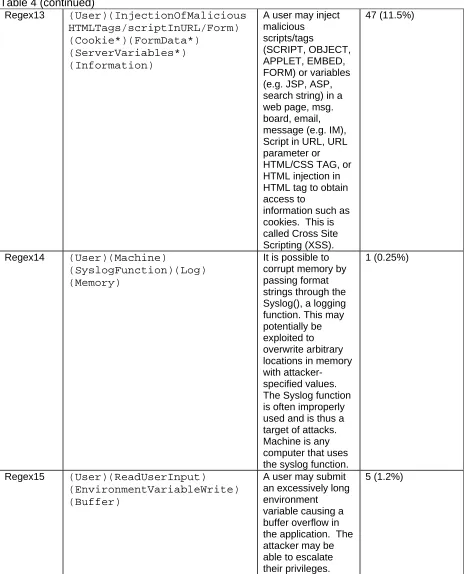
Figure 1: Get File Attack Tree. An attack tree that demonstrates possible scenarios for obtaining a file on a computer.
Each root node of the attack tree represents a goal of the attacker, and each leaf is a possible starting point of an attack. Each node under the root node is either an AND node or an OR node. AND nodes are those nodes that represent multiple goals an attack must accomplish to achieve the next goal. OR nodes are those nodes that an attacker can accomplish independently to reach his/her next goal. AND and OR nodes are distinguished by the insertion of “AND” directly below the parent that has at least two children nodes that represent events that must both be achieved to progress forward in the attack. All other nodes (except the root node) are OR nodes by default. Like the error patterns in the approach by Carlstedt et al. [6], attack trees can be applied to other systems where the
ed for the identification of vulnerable components in a system. Unlike Carlstedt et al.
or designer to understand how the pat
to any organization’s architecture. Designers and analysts read the generic description and look for instances where they can apply the attack profile. Once the architecture is identified as potentially vulnerable, the attack patterns are used to demonstrate the attack scenarios associated with that architecture. The idea of using generic profiles facilitates the process of applying attack trees to different architectures, which aids in the extendibility and thus usefulness of attack trees. An attack tree alone does not provide the additional information that an attack profile and attack pattern contain and thus the approach set by Moore et al. may aid in the identification and understanding of an attack scenario.
In 2001, McDermott developed another graph-based approach to security called attack nets. Attack nets are based on Petri nets, Schneier’s [17] attack trees. Attack nets are same attack scenarios are possible. Therefore, attack trees are also reusable patterns that can be us
[6] who used text-based descriptions, Schneier [17] uses a graph-based approach that shows an attack from the point of view of the attacker whereas the Carlstedt et al. approach uses a series of events in the machine instructions that results in an error.
Moore et al. [15] extend the idea of attack trees by creating attack patterns and attack profiles. Like attack trees, attack patterns contain the overall goal of the attack and the steps for achieving the attack. A list of pre-conditions for the attacker to attack the system is provided as well as the post-conditions, which are the results of a successful attack. Moore et al. [15] propose that an attack profile be associated with attack patterns. Attack profiles describe a common reference model for an analyst
tern can be applied to any architecture related to the vulnerability. Also included in the profile are a set of variants, a set of attack patterns, and a glossary of defined terms and phrases.
9
similar to attack trees in that they can have an attack tree structure and show different attack scenarios in a system; see Figure 2 for an example of an attack net.
Figure 2: Get File Attack Net. An attack net that demonstrates possible scenarios for
obtaining a file on a computer. The tokens at the leaves of the attack tree structure represent the progress of the attack.
ot show. Petri nets need not take the form of an attack tree, but may als
and their goal. The atta
rompted with the standard security requirements are associated with each stereotype. This an advantage over attack trees because the sequence of events is shown via the token. Attack trees do not represent the sequence of events between multiple nodes at the same level of the attack tree. Also, attack nets can model inputs or commands at the transitions that attack trees cann
o be cyclic to show an attack that can repeat the same sequences of actions. For example, a cyclic Petri net may show an attack logging on to different machines on the same network [19].
The supplementary information about the attack can be included in an accompanying document to convey a detailed description of the attack that helps users identify what scenarios are possible in their system. Both the attack tree and attack net scenarios show the view point of an attacker by indicating the attacker’s location
cker’s goal is not explicit in the text-based model used by Carlstedt et al. [6] and is thus an advantage of these graph-based approaches. Furthermore, a graph-based approach is likely to better illustrate an attack than a list of actions in a text format.
11 tech
f, however, the filename use
nique requires software engineers to know UML, which is a beneficial skill for applications that have static requirements at the beginning of the software process.
Bishop and Dilger [3] experiment with an automated pattern-directed search on source code of C applications to identify race conditions on UNIX operating systems. The type of race condition studied is termed time-of-check-to-time-of-use (TOCTTOU) which describes a condition where a system first checks a characteristic of an object (e.g. a file) and then performs a second event that depends on the characteristic of the first event. The specific class of TOCTTOU analyzed is the binding flaw where identifiers of an object are assumed to be true by the second event that carries out an action. The two types of identifiers for files in the UNIX operating system are path names and file descriptors. Path names are a path of pointers that start from the file system root and traverse through subdirectories down to the file. File descriptors are pointers that point to the memory address of the file without having to traverse the file system. File descriptors are bound to a file object making the naming scheme a more direct approach to identifying a file. An example of a TOCTTOU flaw can be demonstrated in a setuid to root program that first uses a file system call to check the access rights of the user before opening it. If the access rights allow the process to open it, then a second file system opens the file as it should. I
d to identify the file changes between the first and second file system calls, then the program can open a file in which the user does not have privileges.
s for each of the five pairs of file system calls permitted the race condition. One of the
tha
ding flaws. IDS rep
condition will not be possible. If only one of the file system calls uses the path name to refer to the file, then the race condition is possible. A human analyzer was used to determine if the programming condition was present for the flagged pairs of file system calls. Then, the environmental condition was manually inspected to determine if a race condition was possible for the file system calls. Their findings show that the analyzer found 24 programming intervals in the sendmail application. Only five of the 24 pairs met the programming condition that was susceptible to the race condition. The environmental condition
five pairs was a previously undiscovered flaw and was made known to the program vendor.
Bishop and Dilger [3] show that a pattern-directed approach for identifying vulnerabilities can be applied directly to source code. Their study suggests that different entities can be searched in a system and determined if their relationship can cause a vulnerability. Unlike Carlstedt et al. that set out to find many error types for an operating system, only a specific type of vulnerability was sought in the source of C programs. The specificity of the source code analyzer is also a differentiating factor in that attack trees and attack nets can be used to show different scenarios of an attack. This is the first approach mentioned in this thesis t attempts for an automated identification process. However, manual analyses are still required to determine if the cases returned by the analyzer are true positives or not.
The goal of intrusion detection systems (IDS) is to model the behavior of a completed/operational system during an attack [14]. This is unlike the objective of attack nets and attack trees, which is to show different scenarios of attacks in a system. Also, IDS cannot show access control violations such as those in TOCTTOU bin
13
eeds to be generic for the IDS to be system-independent. Lastly, The
t can be achieved in the CPA. Upon a match in a
their IDS does have the Kumar and Spafford [13] propose a generic pattern-matching technique as a method for the identification of attacks with IDSs. As with Carlstedt et al. [6], Moore et al. [15], Schneier [17], and McDermott [14], the IDS uses abstract representations of attacks to identify specific attacks in different contexts. There are three levels of abstractions used: Information layer, Signature layer and Matching Engine. The Information Layer is comprised of the raw data used in the analysis. This can either be in the form of an audit trail or network packet. The Signature Layer is a means of representing attacks by their characteristics, which n
Matching Engine is used to match patterns of actions of known attacks to the data in the Information Layer.
The signatures of attacks are a set of strings that are matched by a Colored Petri Automata (CPA). The CPA is based on a Colored Petri net [10] that uses colored tokens for an advanced knowledge of the path the token took from the start state to the end state. In the approach by Kumar and Spafford [13], tokens contained a local set of variables that were written to as the token progressed along the path. All strings that are defined in the Signature Layer are defined by scenarios tha
n audit trail or network analysis, the IDS can signal an alarm to a system administrator that an attack is progressing in their system.
adv
akeholder is not required to inspect a component in the design to determine process for each remaining component in the sys
antage that it is portable to different systems to detect the same errors, which follows the trend of generic identification of the previously mentioned efforts.
The process of matching abstract representations to the instances in a system can be a fatiguing process especially in large systems. Manually searching for errors in code via error types is possible, but depends on the motivation of the individual searching for the error. An automated process of searching is possible, but in the case of the TOCTTOU binding flaws, the search is specific to only one type of error. In the case of the IDS searches, many attacks can be identified, but these type of attacks are not data flow or access control oriented and are used only one the software product is released by the vendor. Applying attack trees to a system requires that either the design or code to be in place, but does not offer a facilitated process of matching the scenarios to the system. Also, attack nets were meant to be created by a brainstorming process when the design or doe of a system is analyzed. This thesis approach attempts to aid the matching process of abstract representations to design by explicitly indicating where in the design a vulnerability may exist. Thus, a st
if the attack is possible and repeat the same tem design.
2.2 Security Collaboration for non-experts
15
ossible, and what security strategy should be tak
ext-based attack profiles in which non-experts could read comprehensive des
(OCTAVE) Method [1] created at the Software Engineering Institute at Carnegie Mellon University is a method that encourages an interdisciplinary team of business, information technology, partners, contractors, service providers and end users to collaborate on the current state of the security, what risks are p
en to secure their system. The broad view of security enables the risk assessment and risk management to be effective as possible.
Without a formalized notation of attacks that is readable to those with no security experience or those unfamiliar to a vulnerability, security is limited to experts that may or may not be available. The practice of abstracting security vulnerabilities and attacks to high-level representations, such as was done by Carlstedt et al. [6], Schneier [17], Moore et al. [15], McDermott [14], Steffan and Schumacher [19], not only makes the vulnerability or attack portable to different contexts, but provides a means of enabling individuals without thorough security backgrounds to perform security analyses. This thesis also suggests a means for non-experts in the security field to contribute to the security process. The text-based vulnerabilities used in Carlstedt et al. [6] approach are at the level where non-experts can read the vulnerability and look for the vulnerability in the operating system code. However, Carlstedt et al. mention that the workers that perform the analyses must at least be familiar with the system to perform the pattern-directed approach. Nonetheless, in his observations Carlstedt [6] noted individuals without any previous experience with protection evaluation could find errors with the use of error patterns. Furthermore, Moore et al. [15] produced t
criptions of attacks and apply them to their architecture for the identification of attack scenarios.
s a Red Hat Linux attack sce
es were adequate to identify precisely wh
difficult process that requires practice. However, once the attack tree is made, non-experts can apply the attack trees to their system for assessing attack scenarios. However, pictures alone cannot describe an attack. The information provided by transitions and tokens in attack nets may still be inadequate to describe an attack. Steffan and Schumacher [19] use an approach they term ATicki, which uses a WikiWikiWeb [7] to share information about attacks between security experts and non-experts. Conditions and transitions are hyperlinked to a WikiPage that contain background information, code samples and discussion threads about the attack. Thus, a non-expert can quickly learn the details of an attack by reading about what others have entered in the web pages. To further clarify an attack, a WikiPage specific to the context of the attack is also provided. This page describes the context of the attack and can also reference other contexts that serve as the base context of the attack. For example, if an attack net describe
nario, then the context page may reference a corresponding Linux WikiWikiWeb scenario since Red Hat Linux inherits its functionality from Linux.
The authors used a ATiki describing PHP vulnerabilities to test the efficacy of sharing knowledge between experts and non-experts. Vulnerabilities were analyzed in SecurityFocus and other security portals to initiate the descriptions of PHP systems and their vulnerabilities. Their analyses were met with ambiguities and questions that were noted on the WikiPages. These gaps were filled in by the users of the WikiPages and eventually the descriptions of the PHP vulnerabiliti
at occurred in an attack. The time required to obtain the accurate descriptions and the users of the system were not specified in the study.
17
ue. Furthermore, code ly known to non-experts and abstract sig
by the risk ma
sequence of components in a system design. The abstract representations of events conceal the low-level details of a component that may be confusing to non-experts. A successful match of a regular expression to a sequence of components in the system design by a non-expert suggests an attack path can be found without prior knowledge of that attack. The attack profile that accompanies the regular expression aids the non-expert (or expert) to understand the context and characteristics of the attack. The thesis approach is similar to the use of attack profiles and attack patterns by Moore et al. [15], but a non-expert may not be able to map the text in the attack profile to the components in the system architecture. Also, the approach in this thesis and the approach by Moore et al. [15] have more opportunity for non-experts to identify places of attack in a system using text-based descriptions to explain the attack. The approaches just mentioned are dissimilar to IDSs and code scanners in that collaboration not a part of the techniq
scanners use low-level descriptions that are not readi
natures of IDSs are only useful when the system is under attack. 2.3 Integrating Security into the Software Process
Security practices can be injected throughout phases of the software process. Some practices are limited to a particular phase where others can be applied to multiple phases. Applying security techniques to applications under development is best done early in the software process. Starting in the design phase permits security to be designed into the application. Knowing what threats are possible to a system allows for a risk management to guide well-informed decisions on how to approach potential attacks. Software developers can start coding security fortifications based on the strategies provided
ized security req
ck profiles suggest where the organization’s arc
attacks are then tested against source code to determine if the scenario is valid. If the tests UMLsec is one example of a security approach that encourages security to begin in the design phase. UMLsec designers can identify possible threat scenarios in their UML diagrams and warn coders of possible attacks with the use of standard
uirements that designate what security measures should be implemented in their code. UMLsec is intended for security-critical systems and is thus best suited for systems with static requirements that are known at the beginning of the software process.
The idea of attack patterns and attack profiles proposed by Moore et al. [15] is intended for designers and analysts. Similar to UMLsec, their approach provides a method of integrating security in the design phase, but the process does not include standardized security requirements. Instead, the atta
hitecture is subject to attack. Thus, attack patterns can be applied in the design phase, but can also be applied in any other software phase where there is enough information exists to apply the graphical attack model.
19
l or similar vulnerability exists. Finally, the attack scenarios undergo risk ma
applied in the development stages of the software process, unlike more time to implement security before the product is released into the
indicate the attacks are valid, then a check in the system is performed to determine if an identica
nagement to determine what vulnerabilities will be addressed and with what priority to fix them.
The approach of this thesis is to attempt the integration of security as early as possible in the software process. The approach using regular expressions and system designs offers the same early start of UMLsec, but does not restrict itself to standardized security requirements nor UML diagrams. Attack profiles, attack patterns, and attack nets also offer the same benefit of starting security early. Approaches that start early in the software process offer security analysts and perhaps non-experts more time to find and fix vulnerabilities than do code scanners such as the one proposed by Bishop and Dilger [3] or searching techniques in code as done by Carlstedt et al. [6] Lastly, techniques to find vulnerabilities that can be
IDSs, enable developers hands of customers. 2.4 Risk Management
aths identified in the matching process of regular expressions to sequences of components in the system design according to the probability and cost associated with the system.
21 3.0 Methodology
In this chapter a background of software security as related to this thesis is provided. Next, a discussion of the use of regular expressions to represent attack paths is given, followed by a section that shows how to apply the regular expressions to a system design. The application of regular expressions to a design is used to expose attack paths that an attacker can use to exploit a vulnerability. The use of a knowledge base to store regular expressions to supply a comprehensive means of identifying many different attack paths is also explained. A scenario of creating and applying regular expressions to system designs is then given to exemplify the process of identifying vulnerabilities. Finally, a risk management section describes what an organization should do once the vulnerabilities of a system design are identified.
3.1 Background
lays the focus of software security, the enforcement of the rules that enforce a controlled environment. Any malicious or inadvertent access because a rule in the policy is not enforced or does not exist is a security breech. [17]
The security policy should not have generic descriptions that describe access control rights for specific components. Instead, each component and resource in the system should have an accurate and detailed list of rules stated in the policy that demonstrates how that object should be accessed. Schneier [17] claims that security should answers questions such as “Secure from whom?” and “Secure for how long?” In this thesis, the strategy is not only from whom or for how long, but accounts for the components in the system accessing a resource. That is, one should not secure the hard drive by asking “How do I protect the hard drive?” They must instead ask themselves “From what components do I protect the hard drive?”
23 3.2 Regular Expressions
In this research, regular expressions are used to model attacks on software systems. A regular expression is a grammar that determines the set of strings in a language. Software engineers can match a set of strings that represent attack paths to system designs during the design phase to identify potential security vulnerabilities. Incorporating vulnerability analyses in the design phase affords developers to design for security. The security coding efforts that are required are recognized early in the software process, which offers two advantages to software developers. First, more time can be allocated to complete the task of securing a vulnerability. Additionally, the appropriate security tactics can be implemented in conjunction with the coding phase instead of added on afterwards when efforts to secure the system may be infeasible.
In this research, regular expressions are used as signatures of previously-successful attacks by representing the events that transpire at each software component involved in the path chosen by the attacker. Each regular expression begins with a “start” event, symbolized by the component that was used to initiate the attack. Each major successive event in the attack is expressed with its associated component and is appended to the string starting with the start component. Finally, the resource the attacker maliciously accessed terminates the string of components to complete the illustration of the attack path. For example, the regular expression below represents a user running a process on a CPU.
(User)(Server)(CPU)
1. A User (the start component) can make an excessive number of requests; 2. The Server (resource) accepts the requests; and finally
3. A process/thread runs on the CPU (resource).
requests, but the server should not be allowed to create the large numbers of threads/processes that run on the CPU. The regular expression only provides a means for searching for specified vulnerable sequences of components in a system design. It does not clearly inform a software engineer how the attack will occur, but shows that the potential for a vulnerability exists and should be handled appropriately. Thus, a description of the attack, or attack profile as used by Moore et al. [15] to elaborate abstract attack patterns can be used in conjunction with the regular expression to accurately describe the events occurring at each component in the attack.
The security requirements doctrine is a document that is created by requirements engineers that contains the rules of how data flows between components. The requirements should be checked against the security policy of an organization that describes which digital assets of a system are to be protected. If the security requirements comply with the descriptions in the security policy, then developers can know what implementations are needed to secure their code. We propose that regular expressions can be used to illuminate the data flow and access-control scenarios that lead to security exploits by showing known instances of where they occur in a system design.
25
chance to perform their duties. Another example is that a malicious client could send an excessive amount of data to a web server in a buffer overflow attack. Thus, the access-control violation is that too much data was written to the memory on the server. In this scenario, access rights cannot be simply turned off or on because there is no way to determine the nature of the client. Thus, observing how data may be un-sanitized in the component transfer can help indicate a noncompliance with the security policy.
There are four regular expression operators used in this thesis, and these are listed in
Table 1: Regular Expression Operators. Four regular expression operators were used to symbolize events in an attack path.
Operator Description Kleene closure (*) An event may occur zero or more times.
+ The event to the left or right of the operator will occur, but not both.
+ (superscript) The event occurs at least once. ? The event occurs zero times or once.
Regular expression operators can be used to further clarify the characteristics of an event. Each of these four operators will be explained by example in this section. In the earlier example there existed no regular expression operators associated with the events. The absence of regular expression operators implies that each event must occur once and only once for a successful attack. Thus, the previous example can be clarified by the use of operators:
(User+)(Server+)(CPU+).
The Kleene closure can indicate where an event may not be required. The same regular expression can be extended to look like
(User+)(Server+)(CPU+)(HardDrive*).
A malicous User submits at least one request, followed by the Server accepting at least one request, followed by the CPU running at least one process/thread, followed by the threads making zero or more disk writes. It is possible that each thread can write large amounts of information to the disk and potentially consume the hard drive thus causing a denial-of-service. This event may or may not occur and is thus characterized with the Kleene closure.
Regular expressions can also make use of the ? operator. In this example,
(User)(CommandLineArgumentEntry)(ApplicationServer?)(Application)
(CommandLineArgumentBufferWrite)(Buffer),
a User works on an application, and enters an excessively long command line argument, which is read by an Application, which may or may not be on server, followed by writing the command line argument, followed by the data overflowing the buffer. This ? operator allows the regular expression to represent that a standalone or sever-based environment is susceptible to the same attack.
Lastly, the + operator can used to show that either the event to left or to the right of the operator occurs, but not both. In this example,
(User) (Variable + Filename + Header)(HTTPServer)(PostMethod)
(BufferWrite)(Buffer),
a User interacts with a web server, makes a POST request with either a long Variable or
Filename or Header, followed by the HTTPServer accepting the request, followed by the
27
written into a buffer, followed by the buffer overflowing. Any of the Variable, Filename, or Header can be used to cause a buffer overflow. Only one of these events is needed to exploit a small buffer on the vulnerable server.
The idea of expressing attacks with regular expressions includes the ability of portraying the same attack in different environments [11]. The components represented by the regular expressions are abstracted and expressed as generically as possible to accomplish a flexible usage in different systems. For example, a denial-of-service attack may occur when a client repeatedly makes a request to a web server. The regular expression for the attack can be represented as
(Client+)(Server+)(LogFile+)(HardDrive+),
which describes a series of Client requests, followed by a series of Server actions, followed by a series of log updates to the LogFile, followed by a series of disk writes to the
HardDrive. The access log records an entry for each request and if enough requests are made, then the hard drive is consumed by the access log file. The same vulnerability may occur in a database, FTP, or audit server environment. Therefore, the regular expression is generic enough to represent the database server with Server. Also, the same attack may occur if an error log file becomes large, and thus the event, LogFile, is generic enough to represent either access log or error log.
In general, regular expressions are also intended to be program language independent so that coding vulnerabilities can be found regardless of the implementation. However, regular expressions such as
(Class)(Subclass)(OverriddenSecuredMethods)(Application)
attack that is captured by this expression is that a Class is extended to form a Subclass. The Subclass overrides secured methods of the parent Class to form its own
OverriddenSecuredMethods. If the OverriddenSecuredMethods are not secured, then a vulnerability may exist in Application. This representation is not overwhelmingly flexible in that it could only apply to programming languages that allow a parent class to be extended, such as Java or C++. This regular expression was the only code level vulnerability extracted from the analyses performed for this study and, thus, the focus of this thesis is at higher/system level vulnerabilities.
A security engineer should always anticipate that an attacker will either defeat or bypass a defense. Thus, a security measure should be implemented at each possible component in an attack path leading toward the target resource. A regular expression can indicate the multiple opportunities to prevent an exploit to encourage layered defenses, a best practice technique [11]. The regular expression,
(User+)(HTTPServer+)(GetRequestRoutine+)(Buffer + CPU)
describes an attack where a User submits at least one large GET request, followed by the
HTTPServer accepting the request at least one request, followed by the
GetRequestRoutine processing at least one request and writing it to a Buffer causing a buffer overflow. Also, if there are many of these large requests, then the CPU must process each one, which could consume the CPU cycles on the machine in which the server resides and cause a denial-of-service. The denial-of-service caused by the consumption of CPU
29
In this way, the two defenses that secure the CPU from wasting cycles in a denial-of-service attack are restricting the number of requests and managing the size of the requests.
3.3 The System Design
31 Dat
fits best with a level design, such as a UML diagram. Regardless of high-level or low-level, regular expressions are constructed to literally match with sequences of components in the design. Thus, a security analyst physically maps the regular expressions to sections of the design. A match between the regular expression and string of components signifies a potential vulnerability. For example, the regular expression
+ + + +
on of old m recurring. Also, if the newest attacks are stored in the knowledge base, then future appli
a flow diagrams were chosen for this research because most of the regular expressions represent high-level components involving data transfer. Also, high-level designs are not impacted as severely as low-level designs upon a change in requirements, which is common in the software life cycle. However, not all regular expressions are limited to system designs. For instance, the regular expression,
(Class)(Subclass)(OverriddenSecuredMethods)(Application),
(Client )(Server )(LogFile )(HardDrive )
can be mapped to Client 4 (component #1) making a request to the , Authentication
Server (component # 2), which logs the request to the Access Log (component # 6), which are stored on the Hard Drive (component # 7). The sequence of components can be represented as “1-2-6-7” which shows a possible attack path in the system design.
3.4 Knowledge Base of Regular Expressions
No application should be a victim of the “oldest trick in the book.” Therefore, an organization should have a compilation of regular expressions and their corresponding profiles in a knowledge base. A knowledge base can be used to aid in the preventi
and forgotten attacks fro
AVE Method [1] encourages all stakeholders in a software project to be inv lve
enting security vulnerabilities for the diverse team is regular expressions. Regular expressions offer a high-level, human-readable model that abstracts operational and low-level detail to achieve a common view of the system among stakeholders. Using a structured format, stakeholders can collaborate on the identification of vulnerabilities in a system design. Furthermore, mapping the events that cause an attack to the components that are responsible for triggering the events narrows the scope of a search for the attack in a broad system design. Thus, stakeholders (technical or non-technical) can participate in the matching of a given set of attack paths, represented by regular expressions, to the sequence of components and resources in the system design. A team effort of exposing threats to a system can show different views of an attack and how the case where a security expert has been temporarily contracted for an organization. The knowledge base thus serves as the collection of regular expressions that are used to examine system designs for potential vulnerabilities.
3.5 Methodology Scenario – Securing Applications from Enumerated Threats (SAFET) The OCT
o d with the assessment of which threats are possible in the system. Customers, marketers, and information technology engineers each have a different perception of how the system will achieve its goals based on their background knowledge of their organization, customer’s demands, and development strategies. For example, customers and business workers may have an advanced knowledge of the tendencies and limitations of users. Additionally, software engineers may have an advanced lower-level view of the system that grasps the intricacies of component functionalities. Bridging these specialized views by working together can help elicit the desired behaviors of the system and illuminate its potential threats.
33
nalysis in an organization’s design for known thre
osed by this research provides a means of identifying security vulnerabilities to provide enough basic security to aid non-experts with important security advice so an application can be released with some confidence of withstanding attacks.
3.6 Risk Management
Many security vulnerabilities are possible in large complex systems, and it is infeasible to secure each one. A risk management team is necessary to prioritize the attack paths found based on how much each threatens the system. The security engineer should be a member of the risk management team is made of members. The vulnerabilities with the most risk are then assigned to software engineers so that security measures can be built into the system from the start. Each component should be analyzed for potential threats and then a numeric value of the risk involved should be calculated using the following Equation 1
isk = (probability) * (loss) (1) they should be addressed. The security a
ats is given the reference Security Analysis for Existing Threats (SAFET).
A security engineer is beneficial for this approach because of their expert knowledge in attacks in software systems. They can help identify subtle attacks that may be overlooked by non-experts or determine if an attack path found by stakeholders is valid or invalid. However, the role of security engineer is not necessary if software engineers have enough expert knowledge about security. Also, a security engineer may not be available to a software team and thus they must make do with what they have. The approach prop
[5]. R
f the software system and thus identify the highest ranking thre
incorporation of security implementations in the application [20]. This equation allows risk analysts to rank the threats o
35 4.0 Vulnerability Collection Methodology
Publicly-known vulnerabilities were collected from the following four full-disclosure vulnerability databases: SecurityFocus owned by Symantec, Help Net Security independently owned by Help Net Security, Secunia, an IT security company, and SecurityTracker owned by SecurityGlobal.net LLC. The SecurityFocus database was the most preferred database because of its ability to search for security attacks and the organization in which it used to display the attacks. An analysis was made of the “discussion” and “exploit” pages for each attack entry in the database (see Figure 4).
Figure 4: SecurityFocus Example. A page from SecurityFocus that shows the different pages about
urpose of making a knowledge base of surveyed attacks. Each attack was investigated in the three other named a GET request vulnerability.
vuln
sults of the effort inconsistent and thus hinder the ability to make accurate conclusions
about the from the
four vulnerability database ing information.
the attack was marked as not having enough information. At the study I had no experience with security vulnerabilities. For each vul
milar to previously liste
d erability databases to confirm the accuracy and ensure the completeness of the attack information before continuing.
At the beginning of the vulnerability database analyses, I attempted to determine exactly how the attack occurred by performing searches on the Internet. The searching yielded hits that included informal web pages and message threads. The process of searching and studying the attacks could require many hours and sometimes there was not any additional information that proved useful. Furthermore, some searches did not yield any hits making the re
study. Therefore, information about the attacks was exclusively obtained s to provide a consistent means of gather
If enough information was available to understand the attack, then a regular expression was generated. Otherwise,
the beginning of
nerability I had to research the terms and descriptions that were included in the attack. For example, I researched how cross-site scripting vulnerabilities occurred when I first encountered a cross-site scripting attack. When I next encountered a cross-site scripting error I was more likely to know how the attack occurred. However, some cross-site scripting errors had variations and required further study. The first week of the analyses resulted in understanding approximately ten vulnerabilities. By the end of the study, I could anticipate how an attack occurred before completely reading the description of the attack in the vulnerability database. Vulnerabilities that were either repeated or si
37
he in
ut details that were not explicitly stated in the descriptions. Thus, for the vulnerabilities that I claimed did not have enough information to form regular expressions may actually be understood by a security expert who could produce a regular expression. The regular expressions in this thesis are not necessarily the regular expressions that should be used by an organization, but may provide ideas and motivation for those who create regular expressions.
The process of producing a regular expression starts with the identification of what events transpired in the attack. The events are represented by the components in the software system that triggered the event. Components are then abstracted to a readable term that can best represent any component of its type. For example, “web server” is abstracted to Server to represent any server (e.g. database, FTP, audit). The terms are then placed in parentheses for readability purposes. Some events that could help elaborate an attack were inserted between the events that are represented by components. For example, BufferWrite is an event that may occur during a buffer overflow attack and may be inserted between the process that performed the event and a buffer. Next, the components are logically arranged in the temporal order of the attack. If an event could be characterized by any of the regular expression operators (?, +, +, *), then they were applied to term. A brief attack profile was also made to elaborate the abstract regular expression. A unique integer ID was then assigned to the regular expression and was entered into the regular expression knowledge base along with its corresponding attack profile. Such a knowledge base can be found in chapter 5.
as compared to the pre-existing regular expressions and
ld value as represented in regex4. Since these three methods k
d)(Vari
(Header)(BufferWrite)(B
If the regular expression was too dissimilar to any of those in the knowledge base, then it was added as a new entry.
The proposed approach of using regular expressio d on two assumptions. First, all components in the design have not already been created, that is no third party software that already has the vulnerability se med that the vulnerabilities will exist with the sequence of compo a security
hat stakeholders use a desig
software process. A high-level design is the minimum r pressions to be used for a security analysis. A low-level design would work best if the requirements
ning of the softw
The accuracy of the regular expressions is dependen the information ffered in the vulnerability databases. Each database allows anyone interested in security
subscribe to their mailing lists to receive the latest security advisories. SecurityFocus, ecunia and SecurityTracker allow anyone to post security vulnerabilities to their web
Each successive attack examined w
attack profiles in the knowledge base. If the attack was a repeat, then it was given the ID of the already existing regular expression. If the attack was similar enough to be included in a pre-existing regular expression, then the two regular expressions were merged. For example, a buffer overflow may occur in a POST request from a large hidden variable, a large filename, or header fie
of overflowing a buffer are similar they were combined into one regular expression to loo like:
(User)( TTPServer)(PoH stMetho able + ame +
uffer) Filen
4.1 Limitations
ns and designs is base
cured is used. It is presu nents/resources unless
measure is taken. The second assumption is t n in their equirement for regular ex
are well known and are static at the begin are process. t on the precision of o
39
alidity of this study is dependent on the accuracy of those posting the
ecially Se have
been referenced in many research papers and are likely l ation for security studies.
pages. Thus, the v
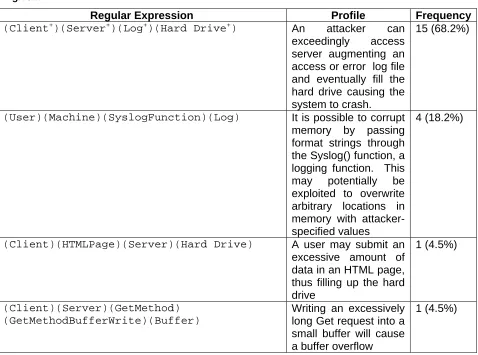
At the initial stages of th e analys as piloted to determine the viability of the approach for abstracting the variety of attacks present. At the time the feasibility study was cond -two vuln ad been analyzed from the SecurityFocus database; these vulnerabilities were able to be abstracted by five regular
xpressions (see Table 2).
given.
5.0 Vulnerability Collection Results
e research, th is approach w
ucted twenty erabilities h
e
Table 2: The Initial Five Regular Expressions. An initial analysis of 22 vulnerabilities yielded five regular expressions. The frequency of the vulnerability occurring in the collection is also
Regular Expression Profile Frequency
(Client+)(Server+)(Log+)(Hard Drive+) An attacker can exceedingly access server augmenting an access or error log file and eventually fill the hard drive causing the system to crash.
15 (68.2%)
(User)(Machine)(SyslogFunction)(Log)
the Syslog() function, a logging function. This It is possible to corrupt memory by passing format strings through
4 (18.2%)
may potentially be exploited to overwrite arbitrary locations in memory with attacker-specified values
(Client)(HTMLPage)(Server)(Hard Drive) A user may submit an excessive amount of data in an HTML page, thus filling up the hard drive
1 (4.5%)
(
(GetMethodBufferWrite)(Buffer)
Client)(Server)(GetMethod) Writing an excessively long Get request into a small buffer will cause a buffer overflow
41 Tab
(Client)(HTMLMessageBoard)(Server) (
An attacker may and script code in board. This code may browser the user who
1 (4.5%) le2 (continued)
HTMLMessageBoard)(Client) include hostile HTML posts to a message be rendered in eh web views the message.
Of this sample, there was evidence that attackers commonly exploited vulnerabilities in the HTTP GET request routine. A search on “GET request” in the SecurityFocus database yielded 35 attacks since December 1998. This frequency gives evidence that the vulnerabilities in SecurityFocus represent a serious threat and are worthy of study.
The most recent attacks at the later stages of the study were obtained by searching for the latest posts to the SecurityFocus database. Three hundred and fifty-two vulnerabilities posted between 19 January 2004 and 9 March 2004 were analyzed and reviewed further in Help Net Security , Secunia , and SecurityTracker. Of these, one was a report and the other a duplicate of a previous vulnerability in SecurityFocus. Therefore, a total of 409 (including the 22 vulnerabilities from the initial study and the 35 vulnerabilities from the search in SecurityFocus) entries in SecurityFocus were studied and of these were 407 confirmed vulnerabilities5. These vulnerabilities were studied and subjected to the process of regular expression generation.
One hundred and seventy (41.8%) of the observed vulnerabilities were not used to make regular expressions. Table 3 sums the type of vulnerabilities excluded from the study.
5
ions.
Frequ
Table 3: Classes of Vulnerabilities Not Used. Six classifications of vulnerabilities were not used to make regular express
Description ency
Lack of information 85 (20.9%) Specific to vendor 48 (11.7%)
Inapplicable 21 (5.2%) Networking 14 (3.4%) Encryption 1 (0.25%)
Hardware 1 (0.25%)
Eighty-five (20.9%) of the vulnerabilities in SecurityFo ptions with sufficient detail to form regular expressions. Often, Help Net S yTracker contained almost identical descriptions to each other s suggesting the lack of detail made available to the public. The absence of detailed information is potentially due
t ndor inform d
market advan cription y given is at a high level, thus preventing the a m a regular ex gh-level abstractions. Therefore, using online vulnerability databases m ficient means for understanding
The scope mmon software application coding problems. Therefore, networking and encryption vulnerabilities Networking attacks made up 14 (3.4%) of the attacks found and include cket level, network protocols, port scan, and switch vulnerabilities. One (0.25%) vulnerability was a hardware roblem that allowed an attack to obtain secret keys in a memory. There as also one encryption vulnerability that existed because the encryption was too weak to ecure user passwords. These classes of attacks are valid and detrimental to software ystems, but do not fit the software coding schemes that regular expressions represent.
herefore, other techniques such are needed in tandem to support the wide variety of ulnerabilities.
cus lacked descri
ecurity, Secunia, and Securit and SecurityFocu
o the ve s not sharing data because the ation could be use that is usuall pressions to hi
ay not be a suf
maliciously or for tage [18]. Furthermore, the des
bility to for
attacks.
of this study was limited to co
were excluded. d attacks at the pa
module’s run-time p
43
%) of the observed vulnerabilities could not be represented as a
sequence of nents in included: (1) the
failure to secu load users to open files
on a server: (3) passwords kept in plaintext, (4) time eal passwords, and (5) configuration errors. Regular expressions rely upon on the interaction of multiple components and thus cannot be used to abstract thes
48 (11.7%) attacks that were specific to vendors and would not likely serve helpful in the protection of typical or example, these soft XP
specific probl en sc and the
ability for Internet Explorer to capture user keystrokes. Retaining attacks that are specific to vendors would increase the size of a vulnerability knowledge base and thus decrease the efficiency of matching the enumerated regular expressions to components in the system d
A total of cted maining vulnerabilities. Table 4 shows the regular expressions and associated profiles. These regular expressions will be classified and explained further in subsequent d
Twenty-one (5.2
events triggered by the compo re permissions to a file; (2) file up
a system. These ability that allowed
d attacks to st
e types of attacks. Lastly, there were
software applications. F included Micro anning files in certain folders, ems, Norton Antivirus crashing wh
esign.
53 regular expressions were abstra from the 237 re

![Figure 3: A Data Flow Diagram. A data flow diagram derived from Howard and LeBlanc [11] can show the flow of data between components, which can be captured by regular expressions](https://thumb-us.123doks.com/thumbv2/123dok_us/1223199.1154104/40.612.138.546.80.599/figure-diagram-diagram-derived-leblanc-components-captured-expressions.webp)