Analysis on Real-Time Multimodal
Biometric Recognition Using Surf Feature
E.Preethi M.E., J.Sorna Sambavi
Assistant Professor, Department of CSE, Holycross Engineering College, Vagaikulam, Thoothukudi, India
M.E., Embedded System Technologies, Holycross Engineering College, Vagaikulam, Thoothukudi, India
ABSTRACT: Fusion of information plays an effective role inmultimodal recognition systems. Fusion of image or information can occur at different levels. In this paper feature level image fusion is used. Fusion at the feature level involves the integration of feature sets corresponding to multiple modalities. Since the feature set contains richer information about the raw biometric data than the match score or the final decision, integration at this level is expected to provide better recognition results. Feature extraction can be performed by using SURF which is a local feature detector and descriptor that can be used for tasks such as object recognition. Here, two different combinations of multimodal biometrics systems are performed. One very important area of image processing, in which algorithms are used to detect and isolate various desired portions or shapes (features). This paper explores a comparison of two most popular algorithms. The algorithms are Joint Sparse Representation code (JSRC) and Multiple kernel learning (MKL). Feature fusion algorithms are applied to each multimodal biometric system individually and the performance of the system is analyzed. In this paper, a feature fusion technique is proposed that considers the class associations in feature sets, and the method was called as Discriminant correlation Technique (DCT), eliminates the between class correlation and restricts the correlations to be within classes.
KEYWORDS: DCT, MKL, JSRC, Feature Extration
I. INTRODUCTION
Figure1.1 Biometric Authentication Systems
II. FEATURE EXTRACTION & FEATURE FUSION
A. Feature extraction techniques
In pattern recognition and in image processing, feature
extraction is a special form of dimensionality reduction. The main goal of feature extraction is to obtain the most relevant information from the original data and represent that information in a lower dimensionality space. Common feature extraction techniques include Histogram of oriented Gradients (HOG), Speeded Up robust features (SURF), Local Binary Patterns (LBP), Haar Wavelets and color histograms.
In computer Vision Speeded Up robust features (SURF) is a patented local feature detector and descriptor. It can be used for tasks such as object recognition, image registration, classification or 3D reconstruction. It is partly inspired by the scale-invariant feature transform (SIFT) descriptor. The standard version of SURF is several times faster than SIFT and more robust against different image transformations than SIFT. To detect interest points SURF uses an integer approximation of the determinant of Hessian blob detector, which can be computed with 3 integer operations using a precomputed integral image. This algorithm has three main parts: interest point detection, local neighborhood description and matching.
B. Feature level fusion using DCT(Discriminant Correlation Technique)
In case of feature level fusion, the data itself or the features extracted from multiple biometrics are fused. Matching-score level fusion consolidates the Matching-scores generated by multiple classifiers pertaining to different modalities. Finally, in case of decision level fusion the final results of multiple classifiers are combined via techniques such as majority voting.
Feature level fusion is believed to be more effective than the other levels of fusion because the feature set contains richer information about the input biometric data than the matching score or the output decision of a classifier. Therefore, fusion at the feature level is expected to provide better recognition results. However, matching-score level fusion and decision level fusion are more popular in the literature and there is not much research on feature level fusion. The reason is the difficulty of feature level fusion in cases where the features are not compatible, e.g., eigen-coefficients of faces and minutiae set of fingerprints, or when commercial biometric systems do not provide access to the feature sets (nor the raw data), which they use in their products. The goal of the feature fusion for recognition is to combine relevant information from two or more feature vectors into a single one, which is expected to be more discriminative than any of the input feature vectors.
III. EXPERIMENTAL RESULTS AND ANALYSIS
A. Recognition Algorithms(MKL and JSRC)
Multiple kernel learning refers to a set of machine
learning methods that use a predefined set of kernels and learn an optimal linear or non-linear combination of kernels as part of the algorithm. Reasons to use multiple kernel learning include a) the ability to select for an optimal kernel and parameters from a larger set of kernels, reducing bias due to kernel selection while allowing for more automated machine learning methods, and b) combining data from different sources (e.g. sound and images from a video) that have different notions of similarity and thus require different kernels. Instead of creating a new kernel, multiple kernel algorithms can be used to combine kernels already established for each individual data source.
Multiple kernel learning algorithms have been developed for supervised, semi-supervised, as well as unsupervised learning. Most work has been done on the supervised learning case with linear combinations of kernels, however, many algorithms have been developed. The basic idea behind multiple kernel learning algorithms is to add an extra parameter to the minimization problem of the learning algorithm. As an example, consider the case of supervised learning of a linear combination of a set of n kernels K. We introduce a new kernel ,where is a vector of coefficients for each kernel.
Algorithm
Multiple kernel learning algorithms have been developed for supervised, semi-supervised, as well as unsupervised learning. Most work has been done on the supervised learning case with linear combinations of kernels, however, many algorithms have been developed. The basic idea behind multiple kernel learning algorithms is to add an extra parameter to the minimization problem of the learning algorithm. As an example, consider the case of supervised
learning of a linear combination of a set of kernels K. We introduce a new kernel , = ∑ =1 whereβis a vector of
coefficients for each kernel. Because the kernels are additive
CLASSIFICATION BASED ON SPARSE REPRESENTATION
In recent years, theories of sparse representation (SR) and compressed sensing (CS) have emerged as powerful tools for efficient processing of data in non-traditional ways. This has led to resurgence in interest in the principles of SR and CS for biometrics recognition. Wright et al. proposed the seminal sparse
representation-based classification (SRC) algorithm for face recognition. It was shown that by exploiting the inherent sparsity of data, one can obtain improved recognition performance over traditional methods especially when data are contaminated by Various artifacts such as illumination variations, disguise, occlusion, and random pixel corruption. Pillai et al. extended this work for robust cancelable iris recognition. Nagesh and Li presented an expression-invariant face recognition method using distributed CS and joint sparsity models. Patel et al. proposed a dictionary-based method for face recognition under varying pose and illumination. A discriminative dictionary learning method for face recognition was also proposed by Zhang and Li. For a survey of applications of SR and CS algorithms to biometric recognition, Motivated by the success of SR in unimodal biometric recognition, we propose a joint sparsity-based algorithm for multimodal biometrics recognition.Our work is based on the well-known regularized regression method. The proposed method imposes common sparsities both within each biometric modality and across different modalities. The idea of joint sparsity has been explored recently for image classification and segmentation. However, our method is different from these previously proposed algorithms based on joint sparse representation for classification. For example, Yuan and Yan proposed a multitask sparse linear regression model for image classification. This method uses group sparsity to combine different features of an object for classification. Zhang et al. proposed a joint dynamic sparse representation model for object recognition. Their essential goal was to recognize the same object viewed from multiple observations, i.e., different poses. Our method is more general in that it can deal with both multimodal as well as multivariate sparse representations. This paper makes the following contributions:. We present a robust feature level fusion algorithm for multibiometric recognition. Through the proposed joint sparse framework, we can easily handle unequal dimensions from different modalities by forcing the different features to interact through their sparse coefficients. Furthermore, the proposed algorithm can efficiently handle large-dimensional feature vectors. We make the classification robust to occlusion and noise by introducing an error term in the optimization. The algorithm is easily generalizable to handle multiple test inputs from a modality. We introduce a quality measure for multimodal fusion based on the joint sparse representation. Last, we kernelize the algorithm to handle nonlinearity in the data samples.
We evaluated our algorithm on two publicly available data sets—the WVU multimodal data set [35] and the AR face data set . In the first experiment, we tested on the WVU data set, which is one of the few publicly available data sets that allows fusion at the image level. It is a challenging data set consisting of samples from different biometric modalities for each subject.
WVU Dataset
The WVU multimodal data set is a comprehensive collection of different biometric modalities such as fingerprint, iris, palmprint, hand geometry, and voice from subjects of different age, gender, and ethnicit. It is a challenging data set, as many of these samples are corrupted with blur, occlusion, and sensor noise
AR Face Dataset
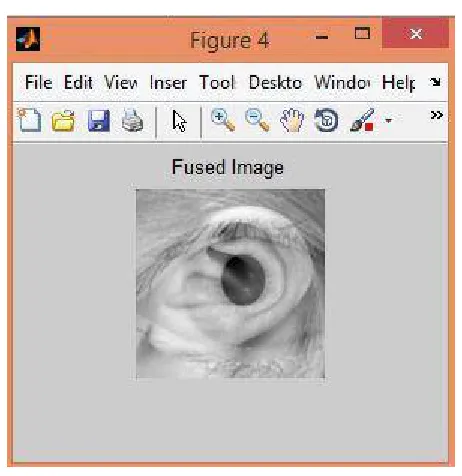
Fig 5: Combination of ear and iris
Fig 6: SURF Feature Extraction
Fig 8: Result After matching Iris and Ear
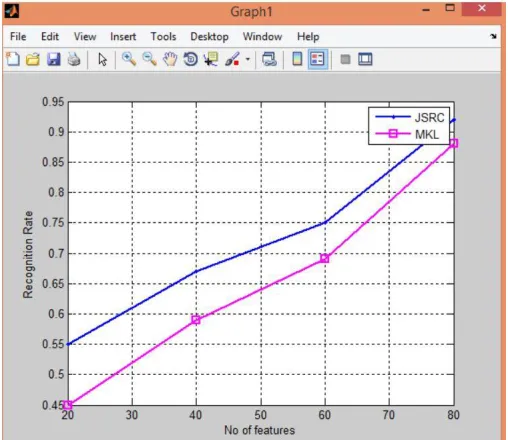
Fig 9: Analysis of JSRC and MKL
IV. CONCLUSION
[3] P. Krishnasamy, S. Belongie, and D. Kriegman, “Wet fingerprint recognition: Challenges and opportunities,” International Joint Conference on Biometrics, pp. 1–7, Washington DC, USA, Oct. 2011.
[4] A. Klausner, A. Tengg, and B. Rinner, “Vehicle classification on multi-sensor smart cameras using feature- and decision-fusion,” IEEE Conference on Distributed Smart Cameras, pp. 67–74, Vienna, Austria, Sept. 2007.
[5] A. Rattani, D. Kisku, M. Bicego, and M. Tistarelli, “Feature level fusion of face and fingerprint biometrics,” IEEE International Conference on Biometrics: Theory, Applications, and Systems, pp. 1–6, Washington DC, USA, Sept. 2007.
[6] X. Zhou and B. Bhanu, “Feature fusion of face and gait for human recognition at a distance in video,” International Conference on Pattern Recognition, vol. 4, pp. 529–532, Hong Kong, Aug. 2006.
[7] A. A. Ross and R. Govindarajan, “Feature level fusion of hand and face biometrics,” Proc. of the SPIE, vol. 5779, pp. 196–204, Orlando, USA, Mar. 2005.
[8] M. G¨onen and E. Alpaydın, “Multiple kernel learning algorithms,” Journal of Machine Learning Research, vol. 12, pp. 2211–2268, 2011.
[9] S. Kakade and D. Foster, “Multi-view regression via canonical correlation analysis,” Learning Theory, pp. 82–96, 2007.
[10] V. Sindhwani and D. Rosenberg, “An rkhs for multi-view learning and manifold co-regularization,” 25th International Conference on Machine learning, pp. 976–983, Helsinki, July 2008.
[11] J. Farquhar, H. Meng, S. Szedmak, D. Hardoon, and J. Shawe-taylor,
“Two view learning: Svm-2k, theory and practice,” Advances in Neural Information Processing Systems, Vancouver, Dec. 2006.
[12] T. Diethe, D. Hardoon, and J. Shawe-Taylor, “Constructing nonlinear discriminants from multiple data views,” Machine Learning and Knowledge Discovery in Databases, pp. 328–343, 2010.
[13] S. Kim, A. Magnani, and S. Boyd, “Optimal kernel selection in kernel fisher discriminant analysis,” 23rd International Conference on Machine Learning, pp. 465–472, Pittsburgh, USA, June 2006.
[14] V. M. Patel and R. Chellappa, “Sparse representations, compressive sensing and dictionaries for pattern recognition,” Asian Conference on Pattern Recognition, pp. 325–329, Beijing, China, Nov. 2011.
[15] V. M. Patel, R. Chellappa, and M. Tistarelli, “Sparse representations and random projections for robust and cancelable biometrics,” International Conference on Control, Automation, Robotics and Vision, pp. 1–6, Guangzhou, China, Dec. 2010.
[16] J. Wright, A. Y. Yang, A. Ganesh, S. S. Sastry, and Y. Ma, “Robust face recognition via sparse representation,” IEEE Transactions on Pattern Analysis and Machine Intelligence, vol. 31, pp. 210–227, Feb. 2009.
[17] J. K. Pillai, V. M. Patel, R. Chellappa, and N. K. Ratha, “Secure and robust iris recognition using random projections and sparse representations,”
IEEE Transactions on Pattern Analysis and Machine Intelligence, vol. 33, pp. 1877–1893, Sept. 2011.
[18] P. Nagesh and B. Li, “A compressive sensing approach for expressioninvariant face recognition,” IEEE Conference on Computer Vision and Pattern Recognition, pp. 1518–1525, Miami, USA, June 2009.
[19] V. M. Patel, T. Wu, S. Biswas, P. Phillips, and R. Chellappa,
“Dictionarybased face recognition under variable lighting and pose,” IEEE Transactions on Information Forensics and Security, vol. 7, pp. 954–965, June 2012.
[20] Q. Zhang and B. Li, “Discriminative K-SVD for dictionary learning in face recognition,” IEEE Conference on Computer Vision and Patternn Recognition, pp. 2691–2698, San Fransisco, USA, June 2010.
[21] J. Wright, Y. Ma, J. Mairal, G. Sapiro, T. Huang, and S. Yan, “Sparse representation for computer vision and pattern recognition,” Proceedings of the IEEE, vol. 98, pp. 1031–1044, June 2010.
[22] A. Wagner, J. Wright, A. Ganesh, Z. Zhou, H. Mobahi, and Y. Ma,
“Towards a practical face recognition system: Robust alignment and illumination via sparse representation,” IEEE Transactions on Pattern Analysis and Machine Intelligence, vol. 34, pp. 372–386, Feb. 2012.
[23] M. Yuan and Y. Lin, “Model selection and estimation in regression with grouped variables,” Journal of the Royal Statistical Society: Series B, vol. 68, pp. 49–67, Feb. 2006.
[24] L. Meier, S. V. D. Geer, and P. Bhlmann, “The group lasso for logistic regression,” Journal of the Royal Statistical Society: Series B, vol. 70, pp. 53– 71, Feb. 2008.
[25] X.-T. Yuan and S. Yan, “Visual classification with multi-task joint sparse representation,” IEEE Conference on Computer Vision and Pattern Recognition, pp. 3493–3500, San Fransisco, USA, June 2010.
[26] H. Zhang, N. M. Nasrabadi, Y. Zhang, and T. S. Huang, “Multiobservation visual recognition via joint dynamic sparse representation,”
International Conference on Computer Vision, pp. 595–602, Barcelona, Spain, Nov. 2011.
[27] S. Shekhar, V. M. Patel, N. M. Nasrabadi, and R. Chellappa, “Joint sparsity-based robust multimodal biometrics recognition,” ECCV Workshop on Information Fusion in Computer Vision for Concept Recognition (IFCVCR), Florence, Italy, Oct. 2012.
[28] N. H. Nguyen, N. M. Nasrabadi, and T. D. Tran, “Robust multi-sensor classification via joint sparse representation,” International Conference on Information Fusion, pp. 1–8, Chicago, USA, July 2011.
[29] R. Tibshirani, “Regression shrinkage and selection via the lasso,” Journal of the Royal Statistical Society: Series B, vol. 58, pp. 267–288, 1996. [30] E. J. Candes, X. Li, Y. Ma, and J. Wright, “Robust principal component analysis?” Journal of ACM, vol. 58, pp. 1–37, May 2011.
[31] J. Yang and Y. Zhang, “Alternating direction algorithms for l1 problems in compressive sensing,” SIAM Journal on Scientific Computing, vol. 33, pp. 250–278, 2011.
[32] M. Afonso, J. Bioucas-Dias, and M. Figueiredo, “An augmented lagrangian approach to the constrained optimization formulation of imaging inverse problems,” IEEE Transactions on Image Processing, vol. 20, pp. 681– 695, March 2011.
[35] U. Park, R. Jillela, A. Ross, and A. Jain, “Periocular biometrics in the visible spectrum,” IEEE Transactions on Information Forensics and Security, vol. 6, pp. 96–106, March 2011.
[36] A. Moorhouse, A. Evans, G. Atkinson, J. Sun, and M. Smith, “The nose on your face may not be so plain: Using the nose as a biometric,” International Conference on Crime Detection and Prevention, pp. 1–6, London, UK, Dec. 2009.P. Sinha, B. Balas, Y. Ostrovsky, and R. Russell, “Face recognition by humans: Nineteen results all computer vision researchers should know about,”
Proceedings of the IEEE, vol. 94, pp. 1948–1962, Nov. 2006.