ISSN(Online): 2319-8753 ISSN (Print): 2347-6710
I
nternational
J
ournal of
I
nnovative
R
esearch in
S
cience,
E
ngineering and
T
echnology
(An ISO 3297: 2007 Certified Organization)
Website: www.ijirset.com Vol. 6, Issue 3, March 2017
Experimental Study on Partial Replacement of
Cement and Sand in High Strength Concrete
V.Priya Dharsini
[1], S.Pandirani
[2],P.Swathii
[3],R.Priyadharshini
[4],P.Manjuladevi
[5]UG Student, Department of Civil Engineering, Vivekanandha College of Engineering For Women(Autonomous),
Tiruchengode, Tamilnadu, India1,2,3,4
Assistant Professor, Department of Civil Engineering, Vivekanandha College of Engineering For Women(Autonomous),
Tiruchengode, Tamilnadu, India5
ABSTRACT: Concrete is the most widely used building material in the world due to its versatility, low cost and durability. Currently high strength concrete is increasingly used in modern concrete technology, particularly in the construction of high rise buildings. This study has been conducted to investigate the possibility of using stone powder with partial replacement for cement and foundry sand for partial replacement with fine aggregate in concrete. The stone powder can be used as a mineral admixture. The utilization of stone powder obtained from quarry waste reduces the environmental problems. Metal foundries use a large amount of sand as part of the metal casting process. The waste generated from industries cause environmental and health problems. This report contained the main topic that gives brief information regarding the generation deposition and utilization of stone powder and foundry sand. To solve such major problems the waste make from quarry and industries can be used for partial replacement of cement and sand in high strength concrete.
KEYWORDS: Concrete, Stone powder, Foundry sand, Fine aggregate, Compressive strength.
I.INTRODUCTION
As the demand for concrete is increasing day by day.Now a days the cost of cement is increasing regularly. Concrete is a composite material made with aggregate, cement and water. Due to this the cost of concrete is increasing so it has to control the cost of concrete by using stone powder which is obtained from waste material of quarry having similar properties of cement. The stone powder is partially replaced with cement. Thus at the same time the need of river sand is also increasing when we use the artificial sand in concrete it should not give proper strength and it is basic need, to find the alternative for sand. The waste foundry sand from metal industries can be used for partial replacement of fine aggregate. The eco-friendly high strength concrete with low cost can be prepared by using these materials. From the previous available literature it was found that replacement of sand by foundry sand and cement with stone powder by certain percentage gives a hardened property of normal strength concrete.
1.1 STONE POWDER
ISSN(Online): 2319-8753 ISSN (Print): 2347-6710
I
nternational
J
ournal of
I
nnovative
R
esearch in
S
cience,
E
ngineering and
T
echnology
(An ISO 3297: 2007 Certified Organization)
Website: www.ijirset.com Vol. 6, Issue 3, March 2017
powder dries up. So it is necessary to dispose the stone waste quickly and use in the construction industry. To solve the problem stone powder can be used as a partial replacement of cement or as a partial replacement of fine aggregates and as a supplementary addition to achieve different properties of concrete
Figure: 1. Stone powder TABLE–1 PROPERTIES OF STONE POWDER
Constituent Value (%)
Sio2 36.96
Al2O3 0.49
Fe2O3 3.40
CaO 28.60
MgO 6.08
SO3 0.15
LOI 22.16
TOTAL 97.78
1.2 FOUNDRY SAND
ISSN(Online): 2319-8753 ISSN (Print): 2347-6710
I
nternational
J
ournal of
I
nnovative
R
esearch in
S
cience,
E
ngineering and
T
echnology
(An ISO 3297: 2007 Certified Organization)
Website: www.ijirset.com Vol. 6, Issue 3, March 2017
till now the innovative use of used foundry sand in concrete formulations as a fine aggregate replacement material was tested as an alternative to traditional concrete.
Figure: 2. Foundry sand
TABLE-2
PROPERTIES OF FOUNDRY SAND Constituents Value (%)
Sio2 83.93
Al2O3 0.021
Fe2O3 0.95
Cao 1.03
Mgo 1.77
SO3 0.057
LOI 2.99
II. EXPERIMENTAL PROGRAM
The details of various materials used in the experimental investigation are,
1) Fine Aggregate- Fine Aggregate which passes through 4.75mm IS sieve, Specific gravity was found to be 2.6, water absorption of 2.15%.
2) Coarse Aggregate- Coarse Aggregate sand passing through to 20mm IS sieve, Specific gravity 2.78, Water absorption 0.38%.
ISSN(Online): 2319-8753 ISSN (Print): 2347-6710
I
nternational
J
ournal of
I
nnovative
R
esearch in
S
cience,
E
ngineering and
T
echnology
(An ISO 3297: 2007 Certified Organization)
Website: www.ijirset.com Vol. 6, Issue 3, March 2017
4) Water- Clean Portable water free from the suspended particles and chemicals were used for mixing and curing. 5) Stone powder should be passing through IS: 90 micron sieve, Specific Gravity 2.55.
6) Foundry Sand used was passing through 4.75mm IS sieve, Specific gravity 2.29.
7)Super plasticizer- High range water reducer, Conplast SP430 was used as super plasticizer, its color was brown and has specific gravity of 1.220 to 1.225.
3. DESIGN MIX
A mix M60 grade was designed as per Indian Standard method (IS 10262-1982) and the same was used to prepare the test samples. The design mix ratio is given in Table 3.
TABLE-3
DESIGN MIX RATIO FOR (M60 MIX)
W= Water, C= cement, F.A. = Fine Aggregate, C.A. = Coarse Aggregate
3.1. Percentage of Partially Replacement of Stone Powder to Cement And Foundry Sand to Fine Aggregate
IV. EXPERIMENTAL METHODOLOGY
The evaluation of used foundry sand and stone powder for use as a replacement of fine aggregate and cement material begins with the concrete testing. Concrete contains cement, water, fine aggregate, coarse aggregate and grit. With the control concrete, i.e. 5%, 15%, and 25% of the fine aggregate is replaced with used foundry sand and 5%, 15%, and 25% of the stone powder is replaced with Cement.
The data from the used foundry sand and stone powder is compared with data from a standard concrete without using replacement materials. The cube and cylinder samples were cast for each concrete mix with partial replacement of fine aggregate and cement. After about 24 h the specimens were de-moulded and water curing was continued till the respective specimens were tested after 7,14 and 28 days for compressive strength and split tensile strength tests.
UNIT FOR MIX RATIO
W (lit)
C
(Kg/m3)
F.A
(Kg/m3)
C. A
(Kg/m3)
By Volume, m3 180 1 0.7 2.21
MATERIAL A0 (NC) A1 A2 A4
Stone powder
0% 5% 15% 25%
ISSN(Online): 2319-8753 ISSN (Print): 2347-6710
I
nternational
J
ournal of
I
nnovative
R
esearch in
S
cience,
E
ngineering and
T
echnology
(An ISO 3297: 2007 Certified Organization)
Website: www.ijirset.com Vol. 6, Issue 3, March 2017
V. RESULTS
5.1 Compressive strength Test
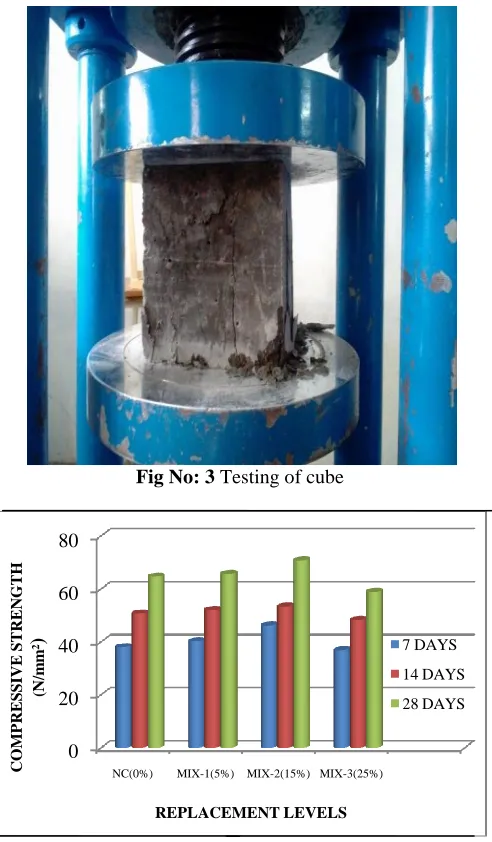
The compressive strength was obtained by testing 150x150x150mm cubes. The curing is maintained for 7, 14 and 28days.It has been found that 15% replacement of fine aggregate and cement showed a furtherance results.
Fig No: 3 Testing of cube
CHART-1: Compressive strength chart for different replacement levels.
0 20 40 60 80
NC(0%) MIX-1(5%) MIX-2(15%) MIX-3(25%)
C
OM
PR
E
S
S
IV
E
S
T
R
E
N
GTH
(N
/m
m
2) 7 DAYS
14 DAYS
28 DAYS
ISSN(Online): 2319-8753 ISSN (Print): 2347-6710
I
nternational
J
ournal of
I
nnovative
R
esearch in
S
cience,
E
ngineering and
T
echnology
(An ISO 3297: 2007 Certified Organization)
Website: www.ijirset.com Vol. 6, Issue 3, March 2017
5.2 Split tensile strength Test
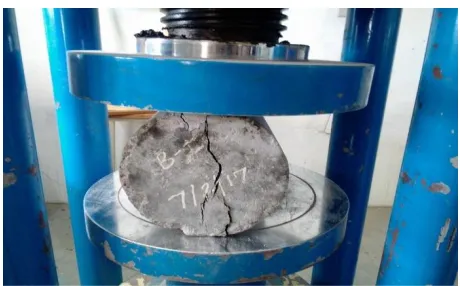
It is carried out for different cylindrical specimens confirming IS 5816:1959 for curing period of 7days, 14days and 28days strength of mixes with 0%, 5%, 15% and 25% replacement show in below chart2. It has been found that 15% replacement of fine aggregate and cement showed a refinement in tensile strength.
Fig No: 4 Testing of cylinder
CHART-2: Split tensile strength chart for Different replacement levels.
VI.CONCLUSION
1) The Compressive Strength of concrete can be increase up to 15% of partial replacement of Stone powder with Cement and 15% of partial replacement of Foundry Sand with Fine aggregate.
0 1 2 3 4 5
NC(0%) MIX-1(5%) MIX-2(15%) MIX-3(25%)
T
E
N
S
IL
E
S
T
R
E
N
GTH
(N
/m
m
2)
REPLACEMENT LEVELS
7 DAYS
14 DAYS
ISSN(Online): 2319-8753 ISSN (Print): 2347-6710
I
nternational
J
ournal of
I
nnovative
R
esearch in
S
cience,
E
ngineering and
T
echnology
(An ISO 3297: 2007 Certified Organization)
Website: www.ijirset.com Vol. 6, Issue 3, March 2017
2) Due to using the stone powder with replacement of cement 10% cost of cement reduced. 3) Reduces environmental Hazards by use of industrial waste product.
4) Waste utilization making it more environmentally friends.
5) Utilization of Stone waste and its application are used for the development of the construction industry, Material sciences.
6) Therefore the 15% partial replacement of cement by stone powder and sand by foundry sand provides the effective results in increase of strength, cost reduction and reduces disposal problems.
VII. ACKNOWLEDGEMENT
I am thankful to Ms. P. Manjuladevi for her guidance. I also thank department of civil engineering, Vivekanandha College of Technology for Women, Tiruchencode. And last but not the least my dear friends who have supported me to complete this work.
REFERENCES
[1]. Tarun R. Naik, Viral M. Patel, Dhaval M. Parikh, Mathew P. Tharaniyil, “Utilisation of used foundry sand in concrete”, Journal of Materials in Civil Engineering, Vol. 6, No. 2, May, 1994.
[2]. Johnny Bolden, Taher Abu-Lebdeh and Ellie Fini, “Utilization of recycled and waste materials in various construction applications”, American Journal of Environmental Science, 9 (1), ISSN: 1553-345X, Pg.14-24, 2013.
[3]. J.M. Khatib, B.A. Herki, S. Kenai, “Capillarity of concrete incorporating waste foundry sand”, Elsevier, Construction and Building Materials 47 (2013) 867-871.
[4]. Elham Khalilzadeh Shirazi “Reusing of Stone Waste in Various Industrial Activities” 2011 2nd International Conference on Environmental Science and Development IPCBEE Vol.4 (2011)
[5] IS: 1489-1991, Specifications for 53-Grade Portland Pozzolana cement, Bureau of Indian Standards, New Delhi, India.
[6] IS: 383-1970, Specifications for coarse and fine aggregates from natural sources for concrete, Bureau of Indian Standards, New Delhi, India. [7] IS: 10262-1982, Recommended guidelines for concrete mix design, Bureau of Indian Standards, New Delhi, India.
[8] IS: 1199-1959, Indian standard methods of sampling and analysis of concrete, Bureau of Indian Standards, New Delhi, India. [9] IS: 516-1959, Indian standard code of practice- methods of test for strength of concrete, Bureau of Indian Standards, New Delhi, India.
[10]J. M. Khatib, S. Baig , A Bougara and C Booth, “Foundry sand utilization in concrete production”, Second International Conference on Sustainable Construction Materials and Technologies, ISBN 978-1-4507-1490-7, June 28-30, 2010.
[11] Rafat Siddique, Geert de Schutter, Albert Noumowe, “Effect of used-foundry sand on the mechanical properties of concrete”, Elsevier, Construction and Building Materials 23 (2009) 976–980.
[12]Prof. P.A. Shirulea, Ataur Rahmanb, Rakesh D.Gupta “Partial Replacement Of Cement With Marble Dust Powder” International Journal of Advanced Engineering Research and Studies April-June, 2012
[13] J.M. Khatib, B.A. Herki, S. Kenai, “Capillarity of concrete incorporating waste foundry sand”, Elsevier, Construction and Building Materials 47 (2013) 867-871.
[14]ACI Committee 211 (ACI 211.4R-93) (1993), “Guide for Selecting Proportions for High-Strength Concrete With Portland Cement and Fly Ash,” American Concrete Institute, Detroit, Michigan, 13 pp.