Design and Analysis of Piston of Internal
Combustion Engine on Different Materials
Using CAE Tool ANSYS
G.Siva Prasad1, K.Dinesh Achari2, E.Dileep Kumar Goud3, M.Nagaraju4, K.Srikanth5
Assistant Professor, Department of Mechanical Engineering, Dr.K.V.S.R.I.T, Kurnool, Andhra Pradesh, India1 B. Tech Student, Department of Mechanical Engineering, Dr.K.V.S.R.I.T, Kurnool, Andhra Pradesh, India2 B. Tech Student, Department of Mechanical Engineering, Dr.K.V.S.R.I.T, Kurnool, Andhra Pradesh, India3 B. Tech Student, Department of Mechanical Engineering, Dr.K.V.S.R.I.T, Kurnool, Andhra Pradesh, India4 B. Tech Student, Department of Mechanical Engineering, Dr.K.V.S.R.I.T, Kurnool, Andhra Pradesh, India5
ABSTRACT: The modern trend is to develop IC Engine of increased power capacity. One of the design criteria is the endeavor to reduce the structures weight and thus to reduce fuel consumption. This has been made possible by improved engine design. In the internal combustion engine there are many reciprocating parts which are responsible for giving the motion to the engine. The piston is “Heart” of the engine and its working condition is the worst one of the key parts of engine in the working environment. So it is very important for design and structural analysis of the piston.
There are lots of research works proposing, for engine pistons, new geometries, materials and manufacturing techniques, and this evolution has undergone with a continuous improvement over the last decades and required thorough examination of the smallest details. Notwithstanding all these studies, there are a huge number of damaged pistons. Damage mechanisms have different origins and are mainly wear, temperature, and fatigue related.
In this study work the analysis of the piston consists of mainly design and analysis. Design the model of the piston in giving design specification on the modeling like PRO-E. Then giving it the constrains which are act on the working condition of the piston after the model of the piston into the analysis software ANSYS in IGES format. Then the analysis becomes completed on the different parameters (temperature, stress, deformation) and easily analysis the result. The different material Al alloy 4032, AISI4340 Alloy Steel & Titanium Ti-6A1-4V. After the analysis of the different material piston it analyzed that the Al alloy is suitable for I.C.Engine piston.
KEYWORDS: Design of Piston, Ansys, Pro-E.
I. INTRODUCTION
The two steps involved in this study are:
1. To design an IC engine piston by using PRO-E software.
2. To perform the structural and thermal analysis of piston by using ANSYS software.
II. PISTON
Piston is a reciprocating component in an engine which converts the chemical energy after the burning of fuel into mechanical energy. The purpose of the piston is to transfer the energy to crankshaft via connecting rod. The piston ring is used to provide seal between the cylinder and piston. It must able to work with low friction, high explosive forces and high temperature around 2000℃ to 2800℃.The piston is to be strong but its weight should be less to prevent inertia forces due to reciprocating motion.
III. FUNCTIONS OF PISTON
To receive the thrust force generated by the chemical reaction of fuel in the cylinder and transmits to connecting rod.
To reciprocate in the cylinder provide seal in suction, compression, expansion and exhaust stroke.
IV. PISTON MATERIALS
Generally pistons are made of Al alloy and cast iron. But the Al alloy is more preferable in comparison of cast iron because of its light weight which suitable for the reciprocating part. There are some drawbacks of Al alloys in comparison to cast iron that are the Al alloys are less in strength and in wearing qualities. The heat conductivity of Al is about of thrice of the cast iron. Al pistons are made thicker which is necessary for strength in order to give proper cooling.
V. DESIGN CONSIDERATION FOR A PISTON
In designing a piston, the following points should be taken into consideration:
1. It should have enormous strength to withstand the high gas pressure and inertia forces. 2. It should have minimum mass to 6096inimize the inertia forces.
3. It should form an effective gas and oil sealing of the cylinder. 4. It should provide sufficient bearing area to prevent undue wear. 5. It should disperse the heat of combustion quickly to the cylinder walls. 6. It should have high speed reciprocation without noise.
7. It should be of sufficient rigid construction to withstand thermal and mechanical distortion. 8. It should have sufficient support for the piston pin.
VI. DESIGN PROCEDURE
The design procedure of piston consists of the following parameters:
Thickness of piston head (t )
Heat flows through the piston head (H)
Radial thickness of the ring (t )
Axial thickness of the ring (t )
Width of the top land (b )
Width of other ring lands (b )
Piston wall thickness towards the open end
Piston pin
Here we are assuming the diameter of the piston according to your requirements.
1. Thickness of Piston Head ( ):
The piston thickness of piston head calculated using the following Grashoff’s formula.
t =D Where,
P= maximum pressure in N/mm².
D= cylinder bore/outside diameter of the piston in mm. D = 50mm.
σ = permissible tensile stress for the material of the piston.
2. Heat Flow Through the Piston Head (H):
The heat flow through the piston head is calculated using the formula
H= C∗HCV∗M∗BP t =
. ∗ ∗( )
Where,
H= Heat flow through the piston head. C=Constant heat supplied to engine(C=0.05).
HCV= Higher calorific value of petrol (HCV=47000 KJ/Kg). M= Mass of fuel used per cycle (M=0.069 Kw/hr).
BP= Brake power (BP=7.5W).
K= Thermal conductivity of material which is 174.15W/mk. Tc = Temperature at centre of piston head in °C.
Te = Temperature at edges of piston head in °C.
3. Radial Thickness of Ring ( ):
t =D
Where,
D = Cylinder bore. D = 50mm.
σ =Allowable bending tensile stress (84 Mpa to 112Mpa for cast iron).
4. Axial Thickness of Ring ( ):
The thickness of the rings may be taken as
t = 0.7t tot
5. Width of the Top Land ( ):
The width of the top land varies from
b = t to1.2t
6. Width of other Lands ( ):
Width of other ring lands varies from
b = 0.75t to3
7. Maximum Thickness of Barrel ( ):
t = 0.03D + b + 4.5
Where,
b = radial depth of piston ring groove.
b = t + 0.4
8. Piston Wall Thickness Towards the Open End:
t = 0.25t to0.35t
9. Piston Pin:
Load on pin due to bearing pressure = P ∗d ∗t
Where, t = 0.45D
Maximum load on piston due to gas pressure= ∗D ∗P
Inside diameter of piston pin
d = 0.6d
VII. CALCULATIONS
1. Thickness of Piston Head ( ):
t = D
= 50 ∗ . ∗
∗
t = 9.58mm
2. Heat Flow through the Piston Head (H):
H= C∗HCV∗M∗BP
= 1216125
t =
. ∗ ∗( )
=
. ∗ . ∗
t = 7.3mm
3. Radial Thickness of Ring ( ):
t =D = 50 ∗ .
t = 1.63mm
4. Axial Thickness of Ring ( ):
t = 0.7t tot
= 0.7∗1.63to1.63
= 1.14to1.63 mm
5. Width of the Top Land ( ):
b = t to1.2t
= 7.3to1.2∗7.3
b = 7.3to 8.76mm
6. Width of other Lands ( ):
b = 0.75t to3
= 0.75∗1.63to3
b = 1.22to3mm
7. Maximum Thickness of Barrel ( ):
t = 0.03D + b + 4.5
= 0.03∗50 + 2.03 + 4.5
t = 8.03mm
b = t + 0.4
= 1.63 + 0.4
b = 2.03mm
8. Piston Wall Thickness Towards the Open End:
t = 0.25t to0.35t
= 0.25∗8.03to0.35∗8.03
t = 2.01to2.81mm
9. Piston Pin:
Load on pin due to bearing pressure = P ∗d ∗t
= 35∗d ∗0.45∗50
= 787.5d
Maximum load on piston due to gas pressure = ∗D ∗P
= ∗50 ∗5
= 9817.44
787.5d = 9817.44
d = 13mm
Outside diameter of piston pin d = 13mm
Inside diameter of piston pin d = 0.6d
= 0.6∗13 = 8mm
Designing of Piston
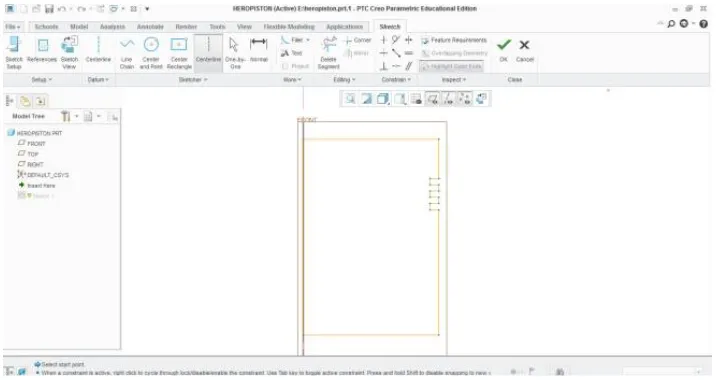
The following are the sequence of steps in which the piston is modeled. • Drawing half portion of piston by using sketcher.
• Generating the model by using revolve command. • Removing the inner material by using extrude command. • Create a piston pin hole.
• Save this model into IGES format.
Fig 1: Piston design in PRO-E
VIII. RESULT AND ANALYSIS Aluminium 4032:
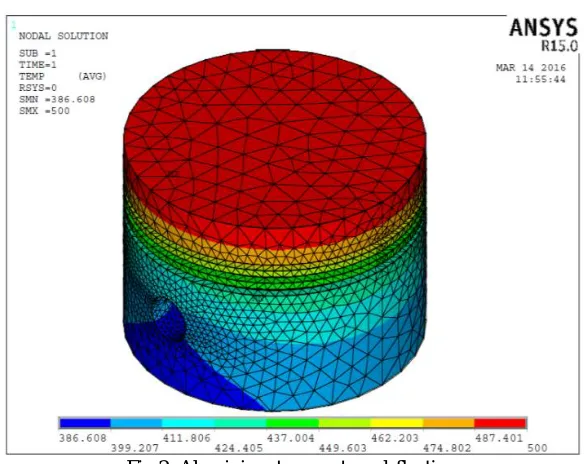
Temperature Distribution:
Fig 2: Aluminium temperature deflection
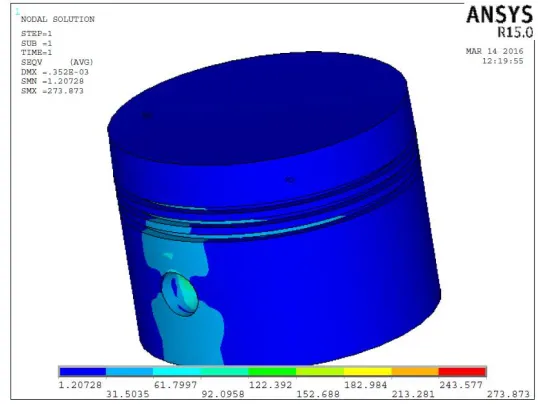
Deformation due to Pressure:
Here we apply the pressure on the top of the piston of 3Mpa and Applying the All DOF on the piston pin rings by which we can find out the deflection in piston.
AISI 4340:
Temperature Distribution:
Same amount of temperature is applied on the piston which is made of AISI 4340 material. The below figure shows the temperature distribution of AISI 4340 material.
Fig 4: AISI 4340 Temperature Distribution
Deformation due to Pressure:
Here we are applying the pressure on the piston which is made of AISI 4340, on the piston head 3Mpa of pressure is applied and Applying the All DOF on the piston pin rings.
IX. CONCLUSION
It is concluded from the above study the piston is designed using PRO-E software and analyzing the piston using the ANSYS software. Only few steps are needed to make drawing in three dimensions. The piston model is imported to ANSYS for analysis. Piston made of two different materials Al alloy 4032 & AISI 4340 Alloy steel are analyzed. Their structural analysis shows that the maximum stress intensity is on the bottom surface of the piston crown in all the materials, but stress Intensity is close to the yield strength of Al alloy piston. Maximum temperature is found at the centre of the top surface of the piston crown. This is equal for all materials. Depending on the thermal conductivity of the materials, heat transfer rate is found maximum in Al alloy piston. For the given loading conditions, Al alloy piston is found most suitable. But when the loading pattern changes, other materials may be considered. With the advancement in material science, very light weight materials with good thermal and mechanical properties can be used for fail safe design of the I.C.Engine. This will reduce the fuel consumption and protect the environment.
REFERENCES
1. Shuoguo Zhao, Design the piston of Internal Combustion Engine by PRO\ENGEER,EMEIT-2012.
2. Isam Jasim Jaber and Ajeet Kumar Rai, Design and Analysis of IC Engine Piston and Piston-Ring Using CATIA and ANSYS Software,
IJMET.
3. Ch. Venkata Rajan ,P.V.K. Murthy, M.V.S. Muraly Krishna, G.M. Prasada Rao, Design Analysis and Optimization Of Piston using CATIA and
ANSYS, International Journal of Innovative Research in Engineering & Science Vol.1 , January 2013.
4. Kesarapu Sandeep Reddy, K.R. Senthil Kumar, P R Jeyakrishnam , Study on Stability of Honeycomb Structured Piston, IJERA.
5. Al-Beiruti, Dr.Basim M. Al Quraishi & Isam Ezzulddinyousif, Thermal effects on Diesel Engine Piston and Piston Compression Rings, Eng. &
Tech Journal Vol. 27, 2009.