Volume 2008, Article ID 352796,12pages doi:10.1155/2008/352796
Research Article
Link-Adaptive Distributed Coding for Multisource Cooperation
Alfonso Cano, Tairan Wang, Alejandro Ribeiro, and Georgios B. Giannakis
Department of Electrical and Computer Engineering, University of Minnesota, 200 Union Street, Minneapolis, MN 55455, USA
Correspondence should be addressed to Georgios B. Giannakis,[email protected]
Received 14 May 2007; Accepted 7 September 2007
Recommended by Keith Q. T. Zhang
Combining multisource cooperation and link-adaptive regenerative techniques, a novel protocol is developed capable of achieving diversity order up to the number of cooperating users and large coding gains. The approach relies on a two-phase protocol. In Phase 1, cooperating sources exchange information-bearing blocks, while in Phase 2, they transmit reencoded versions of the original blocks. Different from existing approaches, participation in the second phase does not require correct decoding of Phase 1 packets. This allows relaying of soft information to the destination, thus increasing coding gains while retaining diversity properties. For any reencoding function the diversity order is expressed as a function of the rank properties of the distributed coding strategy employed. This result is analogous to the diversity properties of colocated multi-antenna systems. Particular cases include repetition coding, distributed complex field coding (DCFC), distributed space-time coding, and distributed error-control coding. Rate, diversity, complexity, and synchronization issues are elaborated. DCFC emerges as an attractive choice because it offers high-rate, full spatial diversity, and relaxed synchronization requirements. Simulations confirm analytically established assessments.
Copyright © 2008 Alfonso Cano et al. This is an open access article distributed under the Creative Commons Attribution License, which permits unrestricted use, distribution, and reproduction in any medium, provided the original work is properly cited.
1. INTRODUCTION
In distributed virtual antenna arrays (VAA) enabled by user cooperation, there is a distinction as to how users decide to become part of the VAA for a given transmitted packet. Most relaying techniques can be classified either as analog forwarding (AF), decode-and-forward (DF), and selective forwarding (SF) [1–3]. In SF, prospective cooperators de-code each source packet and, if correctly dede-coded, they operate by relaying a possibly reencoded signal. In AF, co-operating terminals amplify the received (transmitted signal plus noise) waveform. Both strategies achieve full diversity equal to the number of users forming the VAA, and in some sense their advantages and drawbacks are complementary. One of the major limitations of AF is that it requires storage of the analog-amplitude received waveform, which strains resources at relaying terminals, whereas SF implementation is definitely simpler. However, relaying information in SF is necessarily done on a per-packet basis eventually leading to the dismissal of an entire packet because of a small num-ber of erroneously decoded symbols. This drawback is some-times obscured in analyses because it does not affect the di-versity gain of the VAA. It does affect the coding gain, though, and in many situations, SF does not improve performance of
noncooperative transmissions because the diversity advan-tage requires too high signal-to-noise ratios (SNR) to “kick-in” in practice [4].
Simple implementation with high diversity and coding gains is possible with the DF-based link-adaptive regenera-tive (LAR) cooperation, whereby cooperators repeat packets based on the instantaneous SNR of the received signal [4]. In LAR cooperation, relays retransmit soft estimates of received symbols with power proportional to theinstantaneousSNR in the source-to-relay link—available through, for example, training—but never exceeding a given function of the aver-age SNR in the relay-to-destination link which is available through, for example, low-rate feedback. With LAR-based cooperation, it suffices to perform maximum-ratio combin-ing (MRC) at the destination to achieve full diversity equal to the number of cooperators [4]. Finally, link-adaptive cooper-ation was also considered for power-alloccooper-ation purposes, as in [5,6], and references therein.
sequentially transmit their information bearing signals. Due to the broadcast nature of wireless transmissions, signals are overheard by other terminals that use these received wave-forms to estimate the information sent by other sources. In Phase 2, sources (re)encode the aggregate information packet that they then transmit to the destination. Combining the signals received during both phases, the destination estimates the sources data. The goal of this paper is to analyze the di-versity of LAR-MSC protocols in terms of general properties of the reencoding function used during Phase 2. Particular cases of reencoding functions include (LAR based) (i) repe-tition coding, (ii) distributed complex field coding (DCFC), (iii) distributed space-time (ST) coding, and (iv) distributed error control coding (DECC).
The use of coding techniques (i)–(iv) in SF relaying has been considered in, for example, [8–12], where different di-versity properties are reported. The use of repetition coding as in (i) with average SNR source-relay knowledge at the re-ceivers was tackled in [9] using a piecewise linear (PL) de-tector that established diversity bounds. Alamouti codes [13] were considered as in (iii) with regenerative relays in [10,11]. In particular, full diversity was demonstrated in [11] if the
per-fading error probability of the relay can become avail-able at the destination. DCFC and DECC cooperation in a multiple access channel, using a 2-phase protocol similar to the one proposed here in (ii) and (iv), was advocated by [8,12], respectively. Assuming that to participate in the Phase 2, sources have to correctly decode the packets of all other peers, diversity order as high as the number of cooperating terminals was established.
In general terms, the present work differs from exist-ing alternatives in that LAR cooperation is employed to enable high error performance (in coding gain and diver-sity) even if packets are not correctly decoded and realis-tic channel knowledge is available at terminals and desti-nation. Our main result is to show that the diversity or-der of LAR-MSC coincides with that of a real antenna ar-ray using the same encoding function used by the VAA cre-ated by MSC. In particular, this establishes that for a net-work with N users, the diversity orders are (i) 2 for repe-tition coding, (ii) N for DCFC, (iii) at least the same di-versity order afforded by the ST code in a conventional an-tenna array when we use distributed ST coding, and (iv) for DECC, the same diversity achieved by the ECC over anN-lag block fading channel. Through simulations we also corrobo-rate that, having the same diversity gain, LAR transmissions enable higher coding gains than those afforded by SF-based transmissions.
The rest of the paper is organized as follows. InSection 2, we introduce the 2-phase LAR-MSC protocol. We define a generic encoding function and specialize it to repetition cod-ing and DCFC. We then move on to Section 3 where we present the main result of the paper characterizing the diver-sity gain in terms of the properties of the distributed coder. We discuss the application of our result to repetition coding, DCFC, distributed ST coding, and DECC inSection 3.2. In this section, we also compare these four different strategies in terms of diversity, decoding complexity, synchronization, and bandwidth efficiency.Section 3.1is devoted to prove the
main result introduced inSection 3. We present corroborat-ing simulations inSection 4.
Notation 1. Upper (lower) bold face letters will be used for matrices (column vectors); [·]i,j([·]i) for thei,jth (ith) en-try of a matrix (vector); [·]i,: ([·]:,j) for theith (jth) row (column) of a matrix; [·]i:jwill denote a vector formed ex-tracting elements fromito j;IN theN×Nidentity matrix; 1N theN×1 all-one vector;⊗the Kroneker product;·the Frobenius norm;R∪S(R∩S) the union (intersection) of setsRandS;|S|the cardinality of a setS;∅the empty set; andCN(μ,σ2) will stand for a complex Gaussian
distribu-tion with meanμand varianceσ2.
2. LINK-ADAPTIVE REGENERATIVE
MULTI-SOURCE COOPERATION
Consider a set of sources {Sn}Nn=1 communicating with a
common access point or destinationSN+1. Information bits
ofSnare modulated and parsed intoK×1 blocks of symbols xn := [xn1,. . .,xnK]T with xnk drawn from a finite
alpha-bet (constellation) As. Terminals cooperate in accordance to a two-phase protocol. In Phase 1, sources{Sn}Nn=1
trans-mit their symbols to the destinationSN+1in nonoverlapping
time slots. Thanks to broadcast propagation, symbols trans-mitted by Sn are also received by the otherN−1 sources {Sm}N
m=1,m /=n; see alsoFigure 1. Lety( m)
n represent theK×1 block received at Sm,m ∈ [1,N + 1],m /=nfromSn,n ∈ [1,N]. TheSn→Smlink is modeled as a block Rayleigh fad-ing channel with coefficientsh(nm)∼CN(0, (σ(nm))2γ). Defin-ing normalized additive white Gaussian noise (AWGN) terms w(nm) ∼ CN(0,IK) for theSn → Sm link, we can write the Phase-1 input-output relations as
yn(m)=h(nm)xn+wn(m), m∈[1,N+ 1],n∈[1,N],n /=m, (1)
where we recallm = N + 1 denotes the signal received at the common destinationSN+1. For reference, we also define
the instantaneous output SNR of each linkγ(m)
n := |h
(m)
n |2 and the corresponding average SNR asγ(m)
n = (σ
(m)
n )2γ [cf. h(nm)∼CN(0, (σ(nm))2γ) ].
After Phase 1, each source has available an estimate of the other sources blocks. Letxn(m)denote the estimate of the source blockxnformed at sourceSm,m∈[1,N],m /=n. Due to communication errors,xn(m)will generally differ from the original blockxnand from estimatesx(nl)at different sources Sl=Sm./
In Phase 2, each source transmits to the destination a block that contains coded information from other sources’ blocks. To be precise, consider the set of Phase-1 transmitted blocks, := {xn}N
n=1. Ifxwere perfectly known atSm, itwould
have been possible to form a reencoded blockvmof sizeL×1 obtained fromxthrough a mappingMm, that is,
vm=Mm(x). (2)
S1
Sm
SN
SN+1
. . .
x1
xN
xm
vm
γ(m)1
γ(m)N
γm(N+1)
αmγ(N+1)m
αm:=
min{minm /=n{γn(m)},γ(N+1)m }
γ(N+1) m
Phase-1 Phase-2
Figure1: Transmitted and received signals atSmduring Phase 1 and
Phase 2.
informationxmin the setx(m) := {xm,{xn(m)}Nn=1,n /=m}. The L×1 vectorvmbuilt bySmin Phase 2 is thus obtained from
x(m)as
vm=Mm
x(m). (3)
Comparing (2) with (3) we see that different from the MSC strategies in [7,14], we are encoding based on a set of error-corrupted blocksx(m). To make this explicit, we denoted the
mapped block asvm[cf. (3)] to emphasize that it may be dif-ferent from the desiredvm[cf. (2)].
Propagation of decoding errors can have a detrimental ef-fect on error performance at the destination. To mitigate this problem, our approach is to have sourceSmadjust its Phase-2 transmitted power using a channel-adaptive scaling coef-ficientαm. The block transmitted fromSmin Phase 2 is thus √
αmvm. The signaly(N+1,2)received at the destinationSN +1is
the superposition of theNsource signals; seeFigure 2. Upon defining a matrix of transmitted blocksV :=[v1,. . .,vN]= [M1(x(1)),. . .,MN(x(N))], a diagonal matrix containing the αm coefficientsDα := diag([√α1,. . .,√αN]) and the
aggre-gate channel h(N+1) := [h(N+1) 1 ,. . .,h
(N+1)
N ]T containing the coefficients from all sources to the destination, we can write
y(N+1,2)=VD
αh(N+1)+w(N+1,2). (4)
The destination estimates the set of transmitted blocksx us-ing theNblocks ofKsymbolsy(nN+1,1)received during Phase 1 and the Lsymbols y(N+1,2) received during Phase 2.
As-suming knowledge of the product Dαh(N+1) (through, e.g., a training phase), demodulation at the destination relies on the detection rule
x=arg min x∈AKN
s N
n=1
y(N+1,1)
n −diag
xn
h(N+1)2
+y(N+1,2)−VDαh(N+1)
2
,
(5)
whereV :=[v1,. . .,vN]=[M1(x),. . .,MN(x)]. The search in (5) is performed over the set of constellation codewords x with size|As|KN. Note that this is a general detector for performance analysis purposes but its complexity does not necessarily depend on the size of the setx; see alsoSection 4.
Phase 1 Phase 2
x1
x2
. .. xN
h(N+1)1
h(N+1)2
h(N+1)N
√
α1v1 √
α2v2
. . .
√
αNvN
Figure2: Time-division scheduling forNsources during Phase 1 and simultaneous transmissions during Phase 2.
The goal of this paper is to characterize the diversity of the 2-phase MSC protocol with input/output relations (1) and (4) and detection rule (5) in terms of suitable proper-ties of the mappingsMm. In particular, we will show that for given mappingsMm, an appropiate selection of the co-efficientsDαenables diversity order equal to an equivalent multi-antenna system with Ncolocated transmit antennas; that is, when no inter-source error occurs. Purposefully gen-eral, to illustrate notation, let us describe two examples for
Mmyielding different MSC protocols.
Example 1(repetition coding). A simple cooperation strat-egy for Phase 2 is that each source retransmits the packet of one neighbor; that is, if we build a mapping
Mm: vm= 0T(m−1)P,xTm,0T(N−m)P T
(6)
withm= mod[m,N]+1, themth terminal repeats them−1)st signal’s estimate form /=1 and the first terminal repeats the Nth signal’s estimate. Note that the all-zero vectors appended before and afterxTmare to separate transmissions in time dur-ing Phase 2. With this definition, it can be seen that the opti-mum receiver in (5) simplifies for each entrykto
[xm(N+1)]k=arg min x∈As
y(N+1,1)
m
k−h
(N+1)
m x
2
+y(N+1,2)
(m+1)K+k− √
αmh (mN+1)x
2
. (7)
Example 2 (distributed complex-field coding). Define the N×1 column vectorp(km):=[[x(1m)]k,. . ., [xm]k,. . ., [x(Nm)]k]T and linearly code it using a row 1×NvectorθTm, taken as the mth row of a complex-field coding matrixΘ[15]. Repeating this process for allk, the mappingMmnow becomes
Mm: vm= 0T(m−1)P,θ T
m p(1m),. . .,p(Km)
,0T(N−m)PT. (8)
In this case, the destinationSN+1can decodep(km)using the following detection rule:
pk(N+1)=arg min pk∈AN
s
q(N+1,1)
k −diag(pk)h(N+1)
2
+q(kN+1,2)−diag(Θpk)Dαh(N+1)
2
whereq(kN+1,1):=[[y1(N+1,1)]k,. . ., [y(NN+1,1)]k] T
andq(kN+1,2):=
[[y(N+1,2)]
(k−1)N+1,. . ., [y (N+1,2)
N ]kN] T
.
3. ERROR-PROBABILITY ANALYSIS
The purpose of this section is to determine the high-SNR di-versity order of MSC protocols in terms of suitable properties of the mappingMm. For given channelsH(d):= {h(N+1)
n }Nn=1
from sources to destination andH(s) := {h(m)
n }Nm,n=1,m /=n be-tween sources, we define the so-called conditional (or in-stantaneous) pairwise error probability (PEP) Pr{x /=x |
H(s),H(d)} as the probability of decoding x when x was
transmitted and denoted as Pr{x → x | H(s),H(d)}. The
diversity order of the MSC protocol is defined as the slope of the logarithm of the average PEP as the SNR goes to infinity, that is,
d=min x,x /=x
−lim γ→∞
log EPrx−→x|H(s),H(d)
logγ
. (10)
For MIMO block-fading channels, the diversity orderd depends on the rank distance between constellation code-words [16]. This will turn out to be generalizable to the VAA created in LAR-MSC systems. For that matter, define the set
X:=n|xn−xn=0/
(11)
containing the indices of the sources transmitting different packets. For the samex andxconsider the corresponding phase-2 blocks V andV. We are interested in a subset of columns of (V−V) that form a basis of the span of its columns. This can be formally defined as
V:=n|spanvn−vn
n∈V
=span(V−V), (12) where span(·) denotes the span of a set of vectors or columns of a matrix. With reference toFigure 2, if we assumeV =V, the equivalent system can be seen as a MISO block-faded transmission and the achievable diversity order is related to rank (V−V) = |V| over all possible pairs, where rank(·) denotes the rank of a matrix. We are now challenged to es-tablish similar diversity claims when V=/V along with the contribution to diversity ofXafter Phase 1. The pertinent result is summarized in the following theorem we prove in Section 3.1.
Theorem 1. Consider two distinct blocksx,xand the pairwise-error indicator setsXandVdefined in(11)and(12), respec-tively. Let the Phase-2 power-weighting coefficients{αn}Nn=1be
αm:=min
minm /=n
γ(m)
n
,γm(N+1)
γ(N+1)
m
, (13)
whereγ(m)
n γm(N+1) is the instantaneous (average) SNR of link Sn−Sm(Sm−SN+1),m∈[1,N]. The average diversity order as defined in(10)of the MSC protocol defined in(1)–(5)is
d=min x,x /=x
−lim γ→∞
log Pr{x−→x} logγ
=min
x,x /=x
|X∪V|.
(14)
The coefficientαmin (13) is formed based on the instan-taneous SNR of the links through which blocks{y(nm)}
N n=1,n /=m arrived (available, e.g., by appending a training sequence) and the average SNR of its link to the destination, which is assumed to slowly fade at long scale, and thus is feasible to be fed back. These same conventions have also been adopted in the context of DF protocols in [4,9]. In [9], the average channel is assumed to be known for decoding at the desti-nation, whereas in [4] average knowledge is assumed to be known at the relays; the latter has been proved to be diversity achieving, while the former cannot achieve full-diversity, which in our set-up amounts toN, the number of sources transmitting to the destination.
As detailed in the next subsection, the diversity order can be assessed by establishing proper bounds on the PEP as in, for example, [9] or [4]. However, for systems with the same diversity order, comparing relative performance typically re-lies on their respective coding gains [17, Chapter 2]. Unfor-tunately, analytical assessment of coding gains is rarely pos-sible in closed form especially for the DF-based cooperative systems even for simple constellations using repetition cod-ing; see also [9] for similar comments. For this reason, we will resort to simulated tests in order to assess coding-gain performance inSection 4.
3.1. Proof ofTheorem 1
The difficulty in provingTheorem 1is the possibility of hav-ing decodhav-ing errors between cooperathav-ing terminals, that is,
x(m)
/
=x. Thus, define the set of sources’ indices that estimate xerroneously,
E:=m|x /=x(m). (15)
By definitionE’s complementE contains the indices of the sources that decodedxcorrectly. For a given setE of correct decoders, one expects that sources{Sm}m∈Ehelp to increase
the detection probability, whereas sources{Sm}m∈E tend to
decrease it.
In terms of diversity, not all of the elements ofE con-tribute to increasing its order. In fact, forSmto contribute to the diversity order it also has to belong to the set (X∪V). Thus, we define the set
C:=(X∪V)∩E. (16)
The cardinality ofCcan be bounded as|C| ≥ |X∪V|−|E|. Note also thatC∩E =∅.
Using these definitions, we can condition on the set of correct decoders E and bound (i) the probability Pr{x → {x(m)}N
m=1 |H(s)}of erroneous detection at the sources
af-ter Phase 1; and (ii) the probability Pr{x,{x(m)}N
m=1 → x| H(s),H(d)} of incorrect detection at the destination after
Phase 1 and Phase 2. The result is stated in the following lemma.
Lemma 1. Consider a transmitted blockx, a set of estimated blocks{x(m)}N
m=1at terminals{Sm}Nm=1, and an estimated block
(15)and(16);(ii)letγ(m)
n = |h
(m)
n |2 andγ(nN+1) = |h(nN+1)|2
be the instantaneous SNRs in theSn → Sm and Sn → SN+1 links; and(iii)letαmdenote the power scaling constant in(13). Conditioned on fading realizations,
(a)the conditional probability of decoding {x(m)}N
m=1 at
{Sm}N
m=1 given that x was transmitted in Phase-1 can be bounded as
Prx−→x(m)N
m=1|H(s)
≤κ1exp
−κ2
n∈E
min m /=n
γ(m)
n
(17)
for some finite constantsκ1,κ2;
(b)the conditional probability of detecting x given that
x was transmitted in Phase-1 and {x(m)}N
m=1 in Phase-2 is bounded as
Prx,x(m)N
m=1−→x|H(s),H(d)
≤Q ⎛ ⎝ κ3
n∈Cαnγ(nN+1)−κ4
n∈Eαnγ(nN+1)
κ3
n∈Cαnγ(nN+1)+κ4
n∈Eαnγ(nN+1) ⎞ ⎠
(18)
for some finite constantsκ3,κ4.
Proof. See AppendicesAandB.
Using results (a) and (b) ofLemma 1, we can bound the PEP in (10) to obtain
Prx−→x|H(s),H(d)
≤
∀{x(m)}N m=1
κ1exp
−κ2
n∈E
min m /=n
γ(s)
m,n
×Q ⎛ ⎝ κ3
n∈Cαnγ(nN+1)−κ4
n∈Eαnγ(nN+1)
κ3
n∈Cαnγ(nN+1)+κ4
n∈Eαnγ(nN+1) ⎞ ⎠.
(19)
To interpret the bound in (19) let us note that the factors in (17) and (18) are reminiscent of similar expressions that appear in error-probability analysis of fading channels [18, Chapter 14]. Taking expected values over the complex Gaus-sian distribution of the channels inH(s)andH(d)allows us
to bound the right-hand side of (17) as
E
exp
−κ2
n∈Eminm /=n
γ(m)
n
≤k1γ
−|E|
(20)
for some constant k1. With respect to (18), we expect
de-coding errors at Sn when some of the fading coefficients {γ(m)
n }m /=nare small. In turn, sinceαn ≤minm /=n{γ(nm)}we expectn∈Eαnγ(nN+1)to be small sincen∈Ewhen decoding errors are present atSn. Thus, the right-hand side of (18) can be approximated as
Q ⎛ ⎝ κ3
n∈Cαnγ(nN+1)−κ4
n∈Eαnγ(nN+1)
κ3
n∈Cαnγ(nN+1)+κ4
n∈Eαnγ(nN+1) ⎞ ⎠ ≈Q κ3
n∈C
αnγ(nN+1)
.
(21)
As is well known [18, Chpater 14], the expected value of the right-hand side of (21) can be bounded as
E Q κ3
n∈C
αnγ(nN+1)
≤k2γ
−|C|
(22)
for some constantk2.
Combining (22), (20), and (19), we could deduce that Pr{x→x}:=E[Pr{x→x|H(s),H(d)}]≤(k
1k2γ)−|C|−|E|.
Since|C| ≥ |X∪V| − |E|, we have|C|+|E| ≥ |X∪V|, which establishesTheorem 1. This argument is not a proof however, since (22) is a bound on the approximation (21). Furthermore, the factors in the products of (19) are depen-dent throughαm:=min{minm /=n{γ(nm)},γm(N+1)}/ γm(N+1)[cf. (13)] and cannot be factored into a product of expectations. The next lemma helps us to overcome these technical diffi-culties.
Lemma 2. For some error probabilityPe{γc,γe,ηc,ηe}
satisfy-ing
Pe
γc,γe,ηc,ηe
≤κ1exp
−κ2γe
Q
κ3γcηc−κ4γeηe κ3 γcηc+κ4γeηe
(23)
for some finite constantsκ1,κ2,κ3,κ4, andγc∼Gamma(|C|, 1/γ),γe ∼ Gamma(|E|, 1/γ);γc,ηc,γe, andηeare
nonneg-ative and independent of each other, if the probability density functionsp(ηc)andp(ηe)do not depend onγ, the expectation
overγc,γe,ηc, andηeis bounded as
Pe≤(kγ)−|C|−|E| (24)
withk:=E[k(ηc,ηe)]a constant not dependent onγ.
Proof. See [19].
Combining Lemmas1and2, we can proveTheorem 1as we show next.
Proof ofTheorem 1.Using the definition ofαm in (13), one can derive the following bounds on the probability expressed in (19):
n∈E
αnγ(nN+1)=
n∈E
minminm
γ(m)
n
,γ
γ γ
(N+1)
n
≤
n∈E
min m
γ(m)
n
n∈Eγ(nN+1) γ ,
n∈C
αnγ(N+1)
n =
n∈C
γ(N+1)
n
×
n∈C
minminm
γ(m)
n
,γ γ
γ(N+1)
n
n∈Cγ(nN+1)
≥
n∈C
γ(N+1)
n
minmin∀m,n∈Cγ(nm)
,γ
γ ,
(25)
links of our setup and bound the performance of this system by another one with the same average SNRγin all links, as demonstrated in [19].
If one definesγe:=n∈Eminn{γ(nm)},γc:=n∈Cγ(nN+1), ηe :=min{min∀m,n∈C{γ(nm)},γ}/γandηc :=n∈Eγn(N+1)/γ, then we obtain the upper bound
Prx−→x|H(s),H(d)
≤
∀{x(m)}N m=1
κ1exp
−κ2γe
Q
κ3γcηc−κ4γeηe κ3γcηc+κ4γeηe
,
(26)
whereγ(d)
c ∼ Gamma (|C|, 1/γ),γ(es) ∼ Gamma (|E|, (N− 1)/γ);γ(d)
c ,ηc,γ(es), andηeare nonnegative and independent of each other; that is,
pηc
= η(e|E|−1) |E| −1!exp
−ηe
,
ηc=1
with pr !
min ∀m,n∈Cγ
(m)
n ≥γ "
=exp− |C|(N−1),
pηc= |C|(N−1) exp− |C|(N−1)ηe
with pr !
min ∀m,n∈Cγ
(m)
n < γ "
=1−exp− |C|(N−1). (27)
Finally, because|C| ≥ |X∪V| − |E|, we have
Pr{x−→x} ≤ ∀{x(m)}N
m=1
kγ−|C|−|E|
≤
∀{x(m)}N m=1
kγ−|X∪V|+|E|−|E|=kγ−|X∪V|
(28)
for some constantkthat absorbs the sum over all{x(m)}N
m=1,
because the terms in the sum no longer depend on {x(m)}N
m=1; that is, the bound is independent of the errors
after Phase 1, and so is its diversity order.
3.2. Corollaries
Theorem 1 not only quantifies error performance bounds for our system, but also provides insight on how to de-sign diversity-enabling mappingsMmfor eachSm. The fol-lowing examples illustrate these facts and establish desir-able tradeoffs (summed up inTable 1) accounting for per-formance, complexity, spectral efficiency, and synchronism requirements.
Example 3(repetition coding). InSection 2we described a specific example in which each source transmits information of neighboring sources in separate time slots [cf. (6)]. Now, in view ofTheorem 1, we can establish the following corol-lary.
Corollary 1. Repetition coding defined by the encoding strat-egy in(6)and the detector in(7)achieves diversityd=2.
Proof. If x andxdiffer in at least two subblocks, we have |X| ≥2. In the worst-case event in whichx differs fromx in one unique sub-block, say thenth, we findX= {n}. If we use repetition coding and permute symbols in one position as in (6), thenV= {n}withn /=n. Hence, the union ofXand
Vhasat leasttwo elements and the detector in (7) achieves diversity minx,x /=x{|X∪V|} =2.
Because information is forwarded without modification, this scheme can be interpreted as a relay scenario such as the one in [4]. Thus,Theorem 1demonstrates diversity for clas-sical relay schemes based on repetition coding. This result was already established in [4].
Repetition coding was the first reported cooperation strategy [3]. It features low-complexity detection and does not require symbol synchronization, because each source transmits frames over separate time slots. As demonstrated here, it can achieve diversity 2. With each source transmitting a frame ofKsymbols, and assuming that Phase 1 and Phase 2 have identical durationKN, the per-source bandwidth ef-ficiency of repetition coding isη=K/(KN+KN)=1/(2N).
Example 4(complex-field coding). InSection 2we described the use of CFC to code blocks of symbols. In view of Theorem 1, we can now establish the following corollary.
Corollary 2. For the distributed CFC strategy in(8), ifθm is
designed to guarantee thatθTm(pk−pk)=0/ for anypk=/pkand
for anym, the detector in(9)achieves diversityd=N.
Proof. IfθTm(pk−pk)=0 for any/ m,k, the matrix (V−V) has (full) rankN; that is,|V| =N. Thus, minx,x /=x{|X∪V|} = |V| =N.
The conditionθTm(pk−pk)=0 is the so-called maximum-/ separability criterion. Designs forθmare available in [15] in the context of MIMO systems with either systematic or nu-merically optimized constructions. Interestingly, a matrixΘ enforcing maximum separability exists for any sizeN[15].
As with repetition coding, distributed CFC does not re-quire synchronism at the symbol level. Likewise, the per-source bandwidth efficiency is alsoη = K/(KN+KN) = 1/(2N), but higher diversity gains are possible.
Example 5 (distributed ST coding). Theorem 1also allows us to analyze the performance of the distributed ST coding. Among the several options one may consider, we here an-alyze the performance of any generic ST code designed for a MISO system in which the number of transmit antennas equals the number of sources in our setup (N). Its implemen-tation follows these steps. Suppose sourceSmbuilds anN×1 vectorp(km):=[[x1(m)]k,. . ., [xm]k,. . ., [x
(m)
N ]k]Tafter Phase 1 and maps it to a generic-sizeT×NmatrixT(km)(with rows denoting time and columns denoting space) using a generic ST mappingMST. SourceSmbuildsvmas follows:
Mm: vm= #
T(1m)
:,m $T
,. . .,# T(Km)
:,m $TT
Table1: Comparison between distributed coding strategies.
Diversity order (d) BW efficiencyη Synchr. at symb. level
DSTCN×T fromdSTto min{N,dST+ 1} 1
N+T Needed
Repetition 2 1
2N Not needed
DCFC N 1
2N Not needed
DECCKPparity bits min
dmin, 1 +
% N
!
1− K
(K+P)log2As
"& 1
N+P Not needed
that is,Smconcatenates themth column of theKST mapped matricesT(1m),. . .,T
(m)
K . By construction,vmhas sizeKP×1. Now, the following corollary assesses its performance when applied to our VAA setup.
Corollary 3. Given a generic ST mappingMST that enables
diversitydST in a MIMO system, its distributed implementa-tion as in(29)can achieve diversity at leastd = dST and at mostd=min{N,dST+ 1}.
Proof. IfMST enables diversitydST, it means that for anyk,
rank(Tk−Tk)=dST. Now, adding up contributions from all
sources, matrixVhas sizeKP×Nand is built as [cf. (29)]
V=TT1,. . .,TTK T
. (30)
Equation (30) implies that for anyk rank rank (V−V) = rank(Tk−Tk)= dST. If, by construction,MST is such that
for somex, a worst-caseeventX ∈Vis possible, thend = minx,x /=x{|X∪V|} = |V| =rank(V)=dST. If, instead,MST
is such thatfor allx /=x,X∩V=/∅, thend=minx,x /=x{|X∪
V|} =min{N,|X|+|V|} =min{N,dST+ 1}.
Corollary 3connects the diversity criteria for MIMO ST codes specified in, for example, [20], with its distributed
error-proneimplementation in multisource scenarios. It in-deed demonstrates that a judicious distributed implementa-tion of this ST code may increase its diversity by 1.
Compared to repetition coding or distributed CFC, the distributed ST codes described here require symbol-level synchronism to operate and their performance may degrade if sources are not perfectly synchronized [21,22]. Simula-tions inSection 4will consider this effect. For a general time-span of the codeT, the bandwidth efficiency of this strategy isη=1/(N+T).
Example 6 (distributed error-correcting codes). Suppose that each source transmits
Mm: vm= 0T(m−1)P,vmT,0T(N−m)P T
, (31)
and vm is a P ×1 vector comprising parity check bits of the block x(m). Such mapping implements the distributed
channel-coding strategy in [7,14]. As depicted inFigure 3,
Phase 1 Phase 2
x1
x2
. .. xN
h(N+1)1
h(N+1)2
h(N+1)N
√α 1v1
√
α2v2
. ..
√
αNvN
Figure3: Time-division scheduling forNsources during Phase 1 and Phase 2.
the aggregate block sequence sent to the destination is [x1,. . .,xN,v1,. . .,vN] and has sizeN(K+P). The firstNK symbols sent during Phase 1 then correspond to the system-atic symbols and theNPsymbols sent during Phase 2 com-prise the parity-check portion of a generic ECC scheme. The following corollary states its performance.
Corollary 4. The distributed implementation of ECC codes as described in(31)achieves diversity orderd=dC, where
dC≤min
dmin, 1 +
% N
!
1− K
(K+P)log2As "&
(32)
anddminis the minimum Hamming (free) distance of the ECC.
Proof. It is sufficient to observe that a sequence of
systematic-plus parity-bits [xT1,. . .,xNT, (v)T1,. . ., (v)TN], if transmitted over a point-to-point block-faded channel, achieves diversity dC. This is indeed demonstrated in [16].
Notice that (32) is the Singleton bound. As shown in (32), the code rate and the constellation-employed affect the maximum achievable diversity order of coded transmissions over fading channels [16]. We further remark that in order to achieve diversitydC, one has to judiciously design inter-leavers provided that systematic and parity bits are sent as shown inFigure 3.
4. SIMULATIONS AND COMPARISONS
We present numerical simulations to test error performance of the proposed cooperative protocols. We employ binary phase-shift keying (BPSK). We suppose that all inter-source and source-destination links have the same average output SNR; that is,γ(m)
n =γ, for alln∈[1,N], m∈[1,N+ 1].
4.1. Distributed coding strategies
We will compare the diversity order achieved by the encoding schemes in Examples1,2,3, and4for different numbers of cooperating sourcesN.
4.1.1. Distributed orthogonal ST codes
Here we rely on the ST codes proposed in [23]. IfN=2, then
pk(m)has size 2×1 and we map it to
Tk=
⎡ ⎢ ⎢ ⎣
p(1)k
1 p
(2)
k
2
−# p(1)k
2
$∗ # p(2)k
1
$∗ ⎤ ⎥ ⎥
⎦. (33)
The per-source bandwidth efficiency of this choice isη= 1/4. One can improve the rate without diversity loss by just sending
Tk= −
# p(1)k
2
$∗ ,# p(2)k
1
$∗
(34)
with per-source bandwidth efficiencyη = 1/3. In (33) we have|V| =2 whereas in (34)|V| =1 but still|X∪V| =2. This same strategy can be generalized toN >2 which corre-sponds to the ST orthogonal codes in [20].
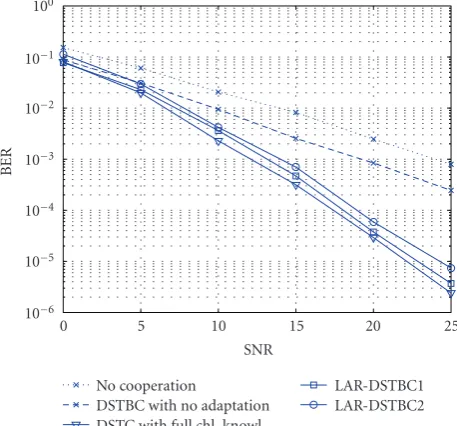
Figure 4 depicts bit-error-rate (BER) as a function of the average SNRγfor different relay locations and schemes. Specifically, we compare (33) DSTBC1), (34) (LAR-DSTBC2), and also [10] (DSTBC with no adaptation) and [11] (DSTBC with full channel knowledge at the destina-tion). For reference, we also depict the BER when sources are not cooperating. Designs using LAR achieve diversity with different coding gains. Designs which do not exploit adap-tivity suffer diversity loss. The performance is fairly close to that obtained with instantaneous channel knowledge [11].
4.1.2. Repetition coding and distributed complex-field coding
Figure 5shows the BER when employing DCFC, repetition coding, and the PL detector in [9] forN =1, 2, 3 cooperat-ing sources. The CFC matrixΘis chosen from [15]. For CFC and repetition-based transmissions, we employ the detectors in (9) and (7). For reference, we again depict the BER when sources are not cooperating. We can verify that, as established inTheorem 1, the slope of the BER varies withNwhen em-ploying CFC and remains fixed to 2 when emem-ploying repeti-tion coding with the same bandwidth efficiency. As a byprod-uct, we also outline the advantages of repetition-based link adaptation compared to [9]; whereas the former achieves diversity 2 in any scenario, the latter loses diversity when
10−6
10−5
10−4
10−3
10−2
10−1
100
BER
0 5 10 15 20 25
SNR No cooperation
DSTBC with no adaptation DSTC with full chl. knowl.
LAR-DSTBC1 LAR-DSTBC2
Figure4: BER of DSTBC forN=2, 3 sources and no cooperation.
10−6
10−5
10−4
10−3
10−2
10−1
100
BER
0 5 10 15 20
SNR No cooperation
PL detectorN=2 RepetitionN=2
RepetitionN=3 DCFCN=2 DCFCN=3
Figure5: BER of DCFC versus repetition and PL relaying strategies forN=2, 3 sources.
sources are sufficiently separated. As already mentioned, rep-etition coding is manifested in the well-known DF-relaying. This motivates us to also include comparisons with the co-herent piecewise-linear (PL) detector of [9], which assumes that the average inter-source SNR is known atD.
4.1.3. Distributed convolutional codes
10−6
10−5
10−4
10−3
10−2
10−1
BER
10 15 20 25
SNR DCCN=2
DCCN=4 No cooperation
Figure6: BER of DCC forN=2, 4 sources.
generator in octal form [5,7] with Hamming (free) distance dfree =5. According to (32), the achievable diversity orders
are dC = 2 for N = 2 and dC = 3 for N = 4. Figure 6 confirms that diversity orders are achieved as predicted by Theorem 1. From the same figure we can also observe that coding gain is reduced. This can be due to the fact that highly corrupted blocks processed by the Viterbi decoder severely degrade its optimality at low SNRs.
4.2. Effect of synchronization
In the context of distributed setups, a fair comparison be-tween distributed Alamouti, DCFC, and repetition coding should also account for synchronization issues. We fix the same bandwidth efficiency to beη=1/4 and set the variation of timing offset to be uniformly distributed as U(−Ts,Ts) around the optimum sampling instant. We assume raised co-sine pulses with roll-offfactorβ = 0.22.Figure 7confirms the severe degradation that simultaneous transmissions suf-fer when accounting for mistiming across sources. More-over, performance degradation increases with the number of users, which clearly offsets the potential diversity gains. We also show the performance of nonsimultaneous trans-missions such as CFC, which do not experience this degra-dation.
4.3. CRC-aided retransmissions versus adaptive techniques
The advantages of MSC using SF as in [8] hinge upon the as-sumption of either error-free links between sources or, as is the case in practice, on correct error-detection decoding per frame. In this practical case, frames with errors are discarded and no signal is retransmitted. This strategy, however, can be inefficient at low SNR and/or when the CRC block size is large, because a single erroneous bit leads one to discard the
10−5
10−4
10−3
10−2
10−1
100
BER
0 5 10 15 20 25
SNR DSTBCN=3 asynchr. DCFCN=3 synchr.
Figure 7: BER of DCFC versus DSTBC for N = 3 and asyn-chronous transmissions.
10−6
10−5
10−4
10−3
10−2
10−1
100
BER
0 5 10 15 20
SNR SF MSCN=2
SF MSCN=3
LAR-SFN=2 LAR-SFN=3
Figure 8: BER of adaptive versus selective retransmissions for packet lengthK=200 bits and DCFC.
entire block. To delineate this assessment, we set both strate-gies to use the same error-correction strategy. For the LAR, we setαn = 1 if no error is detected at user n; otherwise, the block is transmitted withαnas in (13). This slight mod-ification of our protocol, which we name LAR-SF, although not analytically proven here, can be reasonably expected to achieve full diversity. On the other hand, and for the sake of a fair comparison, we increase the average power of SF to match that of adaptive LAR-SF transmissions.
10−6
10−5
10−4
10−3
10−2
10−1
100
BER
0 5 10 15 20
SNR SF MSCN=2
SF MSCN=3
LAR-SFN=2 LAR-SFN=3
Figure 9: BER of adaptive versus selective retransmissions for packet lengthK=1024 bits and DCFC.
link-adaptive transmissions exhibit larger coding gain, which corroborates the fact that discarding large packets renders SF strategies inefficient.
5. CONCLUSIONS
We have developed a link-adaptive relay protocol for use in multisource cooperative scenarios. General diversity perfor-mance was analyzed as a function of the rank properties of the distributed coding strategy. We included repetition cod-ing, distributed CFC, distributed ST codcod-ing, and distributed ECC as particular cases of this general diversity analysis, con-cluding that the attainable diversity order is (i) 2 for repeti-tion coding; (ii)Nfor DCFC; (iii) at least the same diversity order afforded by the ST codes in conventional antenna ar-rays when we use distributed ST coding; and (iv) for DECC the same diversity achieved by the ECC over anN-lag block fading channel. Simulations suggested that synchronization tasks are relevant to be included as part of the design of a VAA. In this context, we found that DCFC offers high-rate, full-diversity, and relaxed synchronization requirements.
APPENDICES
A. PROOF OFLEMMA 1(a)
The probability thatSmfails to detect the blockxnfor alln /=m sent fromSncan be bounded as
Prxn−→xn(m)|H(s)
≤Q#h(m)
n (xn−xn(m)) $
, (A.1)
where Q(z) := 1/√2π-z∞exp (−t2/2)dt. Considering that these are independent processes, the probability that Sm is
inEis
Prx−→x(m)|H(s)≤
N
n=1,n /=m Q#h(nm)
#
xn−xn(m)$ $
.
(A.2)
Letting δn(m) := kK=1|[xn]k−[x(
m)
n ]k|2 denote the squared Euclidean distance between xn and xn(m), and us-ing the fact that function Q(·) is monotonically decreas-ing, its inner term can be bounded ash(m)
n (xn−xn(m)) = .
γ(nm)(δ(nm))
2
≥ .
minm /=n{γ(nm)}minm /=n{(δn(m))
2
}. And thus,
N
m=1,m /=n Q#h(nm)
#
xn−xn(m)$ $
≤(N−1) exp#−1 2minm /=n
γ(m)
n
min m /=n
# δ(nm)
$2$
,
(A.3)
where we also used the fact that Q(z) ≤ exp (−z2/2). The
probability that a set of sourcesEparticipates in error detec-tion can be then readily bounded as
Prx−→x(m)N m=1|H
(s)
≤ /
m∈E
Prx−→x(m)|H(s)≤κ 1exp
! −κ2
m∈E
min m /=n
γ(m)
n "
(A.4)
for some finite constantsκ1andκ2.
B. PROOF OFLEMMA 1(b)
For compactness, we define D(hN+1) := diag (h(N+1))⊗IK, Dα := Dα ⊗IK, y(N+1,1) := [(y1(N+1,1))T,. . ., (yN(N+1,1))T]T and x := [x1,. . .,xN]T and rewrite
N n=1y
(N+1,1)
n −
diag (xn)h(N+1)2 = y(N+1,1)−D(N+1)
h x2. With these defi-nitions, the probability of detection error in (5) is
Prx,x(m)N
m=1−→x|H
(s),H(d)
=Pry(N+1,1)−D(N+1)
h x
2
+y(N+1,2)−VD
αh(N+1)
2
>y(N+1,1)−D(hN+1)x
2
+y(N+1,2)−VD αh(N+1)
2
, (B.1)
wherex := [xT1,. . .,xTN]T. This probability of error can be written as Pr{X >0}, where
X:= −2 Re#y(N+1,1)$HD(N+1)
h (x−x)
−2 Re#y(N+1,2)$H(V−V)D
αh(N+1)
+Dh(N+1)x
2
−Dh(N+1)x
2
+VDαh(N+1)
2
−VDαh(N+1)
2
.
Usingy(N+1,1)=D(N+1)
h x+w(N+1,1)andy(N+1,2)=VD αh(N+1)+ w(N+1,1), it follows thatXin (B.2) is a Gaussian random
vari-able. Thus, the error probability is quantified by Pr{X >0} = Q(−μ/√σ2), whereμis its mean andσ2is its variance and is
given by
Prx,x(m)N
m=1−→x|H
(s),H(d)
=Q
D(hN+1)(x−x)
2
D(hN+1)(x−x)
2
+(V−V)Dαh(N+1)
2
+(V−V)Dαh
(N+1)2−(V−V)D
αh(N+1)2
D(hN+1)(x−x)2+(V−V)Dαh(N+1)
2
.
(B.3)
The second term in the denominator of (B.3) can be ex-panded as(V− V)Dαh(N+1)2 ≤ (V− V)Dαh(N+1)2+ (V−V)Dαh(N+1)2. Defining the Euclidean distanceδn:= K
k=1|[xn]k−[xn]k|2, we can write D
(N+1)
h (x −x)2 =
n∈Xγ(nN+1)δ
2
n, where we have used the definition of the set
Xin (12). Furthermore, one can bound this sum as
n∈Xγ
(N+1)
n δ
2
n≥
n∈X∩Eγ
(N+1)
n δ
2
n. (B.4)
Now we turn our attention to (V−V) and (V−V). Ma-trix (V −V) hasat most |E|linearly independent columns indexed byE; one can thus compute its singular value de-composition (V −V) = AΣB and choose B such that [BDαh(N+1)]n= n√αnh(nN+1)forn ∈E and some nonzero constantn, and bound
(V−V)Dαh(N+1)2≥ n∈Eαnγ
(N+1)
n 2nλn, (B.5)
whereλnis the associated singular valueλn:=[Σ]n,n.
Like-wise, (V −V) has at least |V ∩E| linearly independent columns indexed byV∩Eand following the same reasoning as before, we can bound
(V−V)Dαh(N+1)
2
≤
n∈V∩Eαnγ
(N+1)
n n2λn (B.6)
for some nonzero2
n andλn.
Inequalities (B.4) and (B.5) are lower bounds, whereas (B.6) is an upper bound. Using the fact that Q((a −b)/ √
a+b) ≤ Q((c−d)/√c−d) ifa ≥ candb ≤ d, we can rewrite (B.3) as
Prx,x(m)N
m=1−→x|H(s),H(d)
≤Q
! B−B √
B−B "
,
(B.7)
whereB denotesn∈X∩Eγ(nN+1)δ
2
n+
n∈X∩Eαnγ(nN+1)2nλn, B denotes n∈Eαnγn(N+1)n2λn. Finally, noticing that sums over indexesn∈X∩Eandn∈V∩Ecan be merged into a single sum with indexn∈(X∪V)∩E, and bounding with appropriate nonzero constants, one can readily arrive to (18).
ACKNOWLEDGMENTS
This work was supported through collaborative participa-tion in the Communicaparticipa-tions and Networks Consortium sponsored by the US Army Research Laboratory under the Collaborative Technology Alliance Program, Coopera-tive Agreement no. DAAD19-01-2-0011. The US Govern-ment is authorized to reproduce and distribute reprints for Government purposes notwithstanding any copyright nota-tion thereon. The work of the first author was supported by the Spanish Government Grant no. TEC2005-06766-C03-01/TCM.
REFERENCES
[1] A. Sendonaris, E. Erkip, and B. Aazhang, “User cooperation diversity—part I: system description,”IEEE Transactions on Communications, vol. 51, no. 11, pp. 1927–1938, 2003. [2] A. Sendonaris, E. Erkip, and B. Aazhang, “User
cooation diversity—part II: implementcooation aspects and per-formance analysis,” IEEE Transactions on Communications, vol. 51, no. 11, pp. 1939–1948, 2003.
[3] J. N. Laneman and G. W. Wornell, “Distributed space-time-coded protocols for exploiting cooperative diversity in wireless networks,”IEEE Transactions on Information Theory, vol. 49, no. 10, pp. 2415–2425, 2003.
[4] T. Wang, R. Wang, and G. B. Giannakis, “Smart regenerative relays for link-adaptive cooperation,” to appear inIEEE Trans-actions on Communications.
[5] X. Deng and A. M. Haimovich, “Power allocation for coop-erative relaying in wireless networks,”IEEE Communications Letters, vol. 9, no. 11, pp. 994–996, 2005.
[6] M. O. Hasna and M.-S. Alouini, “Optimal power allocation for relayed transmissions over Rayleigh-fading channels,” IEEE Transactions on Wireless Communications, vol. 3, no. 6, pp. 1999–2004, 2004.
[7] O. Shalvi, “Multiple source cooperation diversity,”IEEE Com-munications Letters, vol. 8, no. 12, pp. 712–714, 2004. [8] A. Ribeiro, R. Wang, and G. B. Giannakis, “Multi-source
coop-eration with full-diversity spectral-efficiency and controllable-complexity,” IEEE Journal on Selected Areas in Communica-tions, vol. 25, no. 2, pp. 415–425, 2007.
[9] D. Chen and J. N. Laneman, “Modulation and demodulation for cooperative diversity in wireless systems,”IEEE Transac-tions on Wireless CommunicaTransac-tions, vol. 5, no. 7, pp. 1785–1794, 2006.
[10] G. Scutari, S. Barbarossa, and D. Ludovici, “Cooperation di-versity in multihop wireless networks using opportunistic driven multiple access,” inProceedings of the IEEE International Workshop on Signal Processing Advances for Wireless Communi-cations, pp. 170–174, Rome, Italy, June 2003.
[11] P. A. Anghel, G. Leus, and M. Kaveh, “Distributed space-time cooperative systems with regenerative relays,”IEEE Transac-tions on Wireless CommunicaTransac-tions, vol. 5, no. 11, pp. 3130– 3141, 2006.
[12] T. E. Hunter and A. Nosratinia, “Diversity through coded cooperation,”IEEE Transactions on Wireless Communications, vol. 5, no. 2, pp. 283–289, 2006.
[14] R. Wang, W. Zhao, and G. B. Giannakis, “Multi-source cooper-ative networks with distributed convolutional coding,” in Pro-ceedings of the 39th Asilomar Conference on Signals, Systems and Computers, pp. 1056–1060, Pacific Grove, Calif, USA, October 2005.
[15] Y. Xin, Z. Wang, and G. B. Giannakis, “Space-time diversity systems based on linear constellation precoding,”IEEE Trans-actions on Wireless Communications, vol. 2, no. 2, pp. 294–309, 2003.
[16] R. Knopp and P. A. Humblet, “On coding for block fading channels,”IEEE Transactions on Information Theory, vol. 46, no. 1, pp. 189–205, 2000.
[17] G. B. Giannakis, Z. Liu, X. Ma, and S. Zhou,Space-Time Cod-ing for Broadband Wireless Communications, John Wiley & Sons, New York, NY, USA, 2006.
[18] J. G. Proakis,Digital Communications, McGraw-Hill Higher Education, New York, NY, USA, 4th edition, 2001.
[19] T. Wang and G. B. Giannakis, “High-throughput cooperative communications with complex field network coding,” in Pro-ceedings of the 41st Annual Conference on Information Sciences and Systems (CISS ’07), pp. 253–258, Baltimore, MD, USA, March 2007.
[20] V. Tarokh, N. Seshadri, and A. R. Calderbank, “Space-time codes for high data rate wireless communication: performance criterion and code construction,”IEEE Transactions on Infor-mation Theory, vol. 44, no. 2, pp. 744–765, 1998.
[21] S. Jagannathan, H. Aghajan, and A. Goldsmith, “The effect of time synchronization errors on the performance of coopera-tive MISO systems,” inProceedings of IEEE Global Telecommu-nications Conference Workshops (GLOBECOM ’04), pp. 102– 107, Dallas, Tex, USA, November 2004.
[22] X. Li, F. Ng, J.-T. Hwu, and M. Chen, “Channel equaliza-tion for STBC-encoded cooperative transmissions with asyn-chronous transmitters,” in Proceedings of the 39th Asilomar Conference on Signals, Systems and Computers, pp. 457–461, Pacific Grove, Calif, USA, October-November 2005.