S T U D Y P R O T O C O L
Open Access
Pragmatic RAndomised controlled trial
of a trauma-focused guided self-help
Programme versus InDividual
trauma-focused cognitive Behavioural therapy for
post-traumatic stress disorder (RAPID): trial
protocol
Claire Nollett
1*, Catrin Lewis
2, Neil Kitchiner
2,3, Neil Roberts
2,3, Katy Addison
1, Lucy Brookes-Howell
4,
Sarah Cosgrove
5, Katherine Cullen
6, Anke Ehlers
7, Sarah Heke
8,9, Mark Kelson
10, Karina Lovell
11, Kim Madden
4,
Kirsten McEwan
12, Rachel McNamara
1, Ceri Phillips
6, Timothy Pickles
1, Natalie Simon
2and Jonathan Bisson
2*Abstract
Background:There is good evidence that trauma-focused therapies for Post-Traumatic Stress Disorder are effective. However, they are not always feasible to deliver due a shortage of trained therapists and demands on the patient. An online trauma-focused Guided Self-Help (GSH) programme which could overcome these barriers has shown promise in a pilot study. This study will be the first to evaluate GSH against standard face-to-face therapy to assess its suitability for use in the NHS.
Methods:The study is a large-scale multi-centre pragmatic randomised controlled non-inferiority trial, with assessors masked to treatment allocation. One hundred and ninety-two participants will be randomly allocated to receive either face-to-face trauma-focused cognitive behaviour therapy (TFCBT) or trauma-focused online guided self-help (GSH). The primary outcome will be the severity of symptoms of PTSD over the previous week as measured by the Clinician Administered PTSD Scale for DSM5 (CAPS-5) at 16 weeks post-randomisation. Secondary outcome measures include PTSD symptoms over the previous month as measured by the CAPS-5 at 52 weeks plus the Impact of Event Scale– revised (IES-R), Work and Social Adjustment Scale (WSAS), Patient Health Questionnaire-9 (PHQ-9), General Anxiety Disorder-7 (GAD-7), Alcohol Use Disorders Test (AUDIT-O), Multidimensional Scale for Perceived Social Support (MSPSS), short Post-Traumatic Cognitions Inventory (PTCI), Insomnia Severity Index (ISI) and General Self Efficacy Scale (GSES) measured at 16 and 52 weeks post-randomisation. Changes in health-related quality of life will be measured by the EQ-5D and the level of healthcare resource utilisation for health economic analysis will be determined by an amended version of the Client Socio-Demographic and Service Receipt Inventory European Version. The Client Satisfaction Questionnaire (CSQ) will be collected at 16 weeks post-randomisation to evaluate treatment satisfaction. (Continued on next page)
* Correspondence:[email protected];[email protected]
1Centre for Trials Research, Cardiff University, 4th Floor Neuadd Meirionnydd,
Heath Park, Cardiff CF14 4YS, UK
2Division of Psychological Medicine and Clinical Neurosciences, Cardiff
University School of Medicine, Haydn Ellis Building, Maindy Road, Cardiff CF24 4HQ, UK
Full list of author information is available at the end of the article
(Continued from previous page)
Discussion:This study will be the first to compare online GSH with usual face-to-face therapy for PTSD. The strengths are that it will test a rigorously developed intervention in a real world setting to inform NHS commissioning. The potential challenges of delivering such a pragmatic study may include participant recruitment, retention and adherence, therapist retention, and fidelity of intervention delivery.
Trial registration: ISRCTN13697710 registered on 20/12/2016.
Keywords: PTSD, Post-traumatic stress disorder, RCT, Randomised controlled trial, Guided self-help, Trauma
focused, Intervention, Internet, Online, Protocol
Background
Post-Traumatic Stress Disorder (PTSD) is a common mental disorder that may develop following exposure to exceptionally threatening or horrifying events. Charac-teristic symptoms include persistent intrusive recollec-tions, avoidance of trauma-related stimuli, negative alterations in thoughts and mood and hyper-arousal [1,
2]. About 3% of the adult population suffer from current
PTSD [3] and average symptom duration is normally
prolonged in those who are untreated [4]. PTSD is asso-ciated with substantial co-morbidity [4–8] and signifi-cant economic burden [9,10].
A number of psychological approaches have been de-veloped to treat PTSD. Evidence suggests that the most effective approaches are trauma focused cognitive behav-ioural therapy (TFCBT), including trauma focused cog-nitive therapy, and eye movement desensitization and reprocessing therapy (EMDR) [11]. TFCBT typically in-volves some degree of structured exposure to and pro-cessing of traumatic memories and trauma reminders, alongside cognitive restructuring of dysfunctional beliefs about the meaning of the trauma. EMDR is a psycho-logical therapy that involves exposure to unwanted and distressing memories whilst focusing on a bilateral stimulation. TFCBT and EMDR have become the treat-ments of choice for PTSD, recommended by clinical
guidelines in the UK and internationally [12–14].
TFCBT protocols vary in the focus on exposure or cog-nitive interventions and differ slightly in the number of treatment sessions that are recommended. National In-stitute for Health and Care Excellence (NICE) recom-mend treatment of 8–12 sessions lasting 60–90 min for individuals who have experienced a single trauma, with a recommendation of more than 12 sessions in chronic, complex cases i.e. with multiple traumas.
Despite a growing consensus that trauma focused psy-chological therapies (TFPTs) represent the most effective way of treating PTSD, they are not always feasible to deliver. There remains a shortage of suitably qualified therapists to deliver these interventions and therefore, in many places, lengthy waiting times are common. If left untreated, PTSD is associated with functional and emo-tional impairment, reduced quality of life, a predisposition
for the development of other psychiatric and physical ill-nesses, increased suicidal ideation, higher healthcare util-isation, and higher rates of alcohol abuse and dependence [15–21]. Current TFPT treatment requires a considerable commitment from the service user to attend weekly out-patient appointments on a regular basis over several months. Therapy can be difficult for some people to access, due to factors such as perceived stigma about attending mental health services, difficulty getting time off work, problems accessing or arranging suitable childcare and travel for people living in remote areas [22–24]. As a result of these and other factors, drop-out from TFPT interventions can be high [11].
Guided self-help (GSH) could offer a solution to these issues. GSH combines the use of self-help materials (e.g., a work-book, or a website), with regular guidance from a trained mental health professional and requires less ther-apist time than an equivalent therther-apist-administered treatment. There is good evidence of the efficacy of GSH in other mental health disorders [25]. In recognition of these findings NICE recommended that a randomised controlled trial (RCT) of GSH should be conducted to assess the efficacy and cost-effectiveness of guided self-help compared with trauma focused psychological inter-ventions for mild and moderate PTSD [12]. If effective, GSH would offer a time-efficient treatment option with the potential to reduce waiting times and would be more accessible and less of a burden to participants. It is also likely that GSH would reduce intervention costs, and may lessen the burden of PTSD to the NHS and society.
was piloted twice with a total of 19 participants with PTSD and refined on the basis of qualitative and quantitative results. Quantitative results strongly sup-ported the potential of the programme to effectively treat PTSD [27].
An interactive online version of the programme was produced through a Knowledge Transfer Partnership (KTP) between Health Care Learning Limited Ltd (HCL) and Cardiff University. The partnership combined HCL’s expertise in developing high quality internet-based pro-grammes, with the academic team’s experience of devel-oping and evaluating psychological interventions for PTSD. A pilot feasibility RCT of the intervention was completed between 2012 and 2014. Forty-two partici-pants with mild to moderate PTSD after a single trau-matic event were randomised to receive immediate GSH or delayed treatment [28].
Following GSH, PTSD sufferers’ symptoms improved
by over 50% (completers only) and over 40% (intention to treat) with an average of 149 min of therapist input; effect sizes that compare favourably with those found for therapist-delivered TFPT. The treatment group had sig-nificantly lower levels of traumatic stress symptoms, de-pression, anxiety and functional impairment at post-treatment and one month follow-up, in comparison to the delayed treatment group, who improved to the same degree after receiving GSH for PTSD. Results of the development and pilot work indicated a strong rationale for conducting a larger scale RCT to determine whether GSH represents a treatment option that should be routinely used in the care of PTSD sufferers, as it is for depression and numerous anxiety disorders.
A Cochrane review of RCTs of online GSH for PTSD in comparison to face-to-face therapy, waitlist or usual care [29] found two previous studies [30, 31]. The first compared online GSH with 104 min of guidance to a waitlist in 42 adults with PTSD [30]. A large within group effect size was found in the GSH group from pre-to post-treatment for self-reported PTSD symppre-toms (Cohen’s d = 1.18) but a smaller between groups effect size was found post-treatment, due to symptom im-provement in the control group. The second RCT com-pared online GSH to a delayed treatment minimal attention group in 62 PTSD sufferers [31]. A larger be-tween group effect size of d = 1.25 was found. The inter-ventions included in both studies were largely text-based and may not have been optimal in terms of usability. The online GSH intervention developed by this study team includes audio and video clips and is therefore more interactive which may explain the positive results seen in the pilot study.
The review demonstrated that there have been no comparative trials of online GSH and face-to-face ther-apy to date, precluding firm decisions being made on
whether to deliver GSH for PTSD as an alternative to face-to-face therapy in the NHS. The proposed study will address this by generating high quality scientific evi-dence for an intervention already developed by us through state of the art methodology. Our aim is to test online GSH as a treatment for adults who have been ex-posed to a single traumatic event. The primary objective of the trial is to determine: Whether an online TFCBT based GSH programme is not inferior to individual TFCBT for patients with PTSD as judged by reduced symptoms of PTSD at 16 weeks post-randomisation, thus enabling decisions to be made about its suitability for use in the NHS. The secondary objectives of the trial are to determine:
1. Whether an online TFCBT based GSH programme is not inferior to individual TFCBT for patients with PTSD as judged by reduced symptoms of PTSD at 52 weeks post-randomisation.
2. Whether an online TFCBT based GSH programme is not inferior in effectiveness to individual TFCBT for patients with PTSD as judged by improved quality of life at 16 weeks and 52 weeks post-randomisation. 3. The impact of an online TFCBT based GSH
programme on functioning, symptoms of depression, symptoms of anxiety, symptoms of PTSD, alcohol use, insomnia, perceived social support, self-efficacy and cognitions for people with PTSD at 16 weeks and 52 weeks post-randomisation.
4. Whether an online TFCBT based GSH programme is cost-effective relative to individual TFCBT for patients with PTSD at 16 weeks and 52 weeks post-randomisation.
5. The factors which may impact effectiveness and successful roll-out of online GSH for PTSD in the NHS if the GSH programme is shown to be effective.
Methods/design
The design is that of a multi-centre pragmatic rando-mised controlled non-inferiority trial with assessors masked to treatment allocation. Individual randomisa-tion will be used.
Study setting
Eligibility criteria
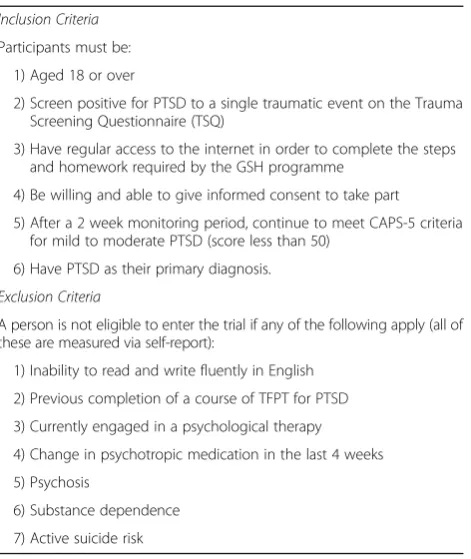
Wide eligibility criteria will be used to ensure good ex-ternal validity. Given the high rate of co-morbidity of PTSD and other conditions such as depression and sub-stance misuse, individuals with co-morbidity will be in-cluded if they satisfy the other inclusion/exclusion criteria and PTSD is considered the primary diagnosis. This is consistent with NICE guidance for the treatment of PTSD [12] and will result in a pragmatic trial. See Table1for Inclusion and Exclusion Criteria.
With reference to inclusion criterion 2, previous work with more complex and severe forms of PTSD, e.g. fol-lowing prolonged and repeated trauma suggests that it often requires increased therapist time and is therefore less likely to be effectively treated by GSH [12]. In terms of criterion 5, symptoms can remit when monitored, hence the 2 week self-monitoring period in which partic-ipants will be asked to complete a simple daily diary of symptoms at home [32, 33]. Participants cannot engage in concurrent psychological therapy whilst in the trial. They can continue taking psychotropic medication but are not eligible if they have had a change in medication 4 weeks prior to being assessed.
Interventions
The trial will compare online GSH against individual face-to-face TFCBT, which is current standard care in the sites taking part in the trial.
TFCBT for PTSD
TFCBT for PTSD is one of the standard treatments adopted by IAPT in England and has been shown to be effective in RCTs in England [11, 33–36] and Northern
Ireland [37]. There are a number of evidence based
TFCBTs and, given the pragmatic nature of the trial, it will be permissible to use any one of them with individ-uals allocated to the TFCBT arm. An example of an evidence-based TFCBT is cognitive therapy for PTSD (CT-PTSD). CT-PTSD involves identifying the relevant appraisals, memory characteristics, triggers, and behav-ioural and cognitive strategies that maintain PTSD symptoms. CT-PTSD addresses these symptoms by: 1) Modifying excessively negative appraisals of the trauma and/ or its sequelae, 2) Reducing re-experiencing by elaboration of the trauma memories and discrimination of triggers, 3) Dropping dysfunctional behaviours and cognitive strategies, particularly those related to avoid-ance of triggers for intrusive symptoms. These are
strat-egies that have the immediate aim of reducing one’s
sense of current threat but have the long-term effect of maintaining the disorder, and are common in PTSD.
In this study, TFCBT will be delivered by experienced psychological therapists currently working in the IAPT or psychological services. They come from a variety of backgrounds, including mental health nurses, clinical psychologists and counsellors, and have varying levels of experience in working therapeutically with people with PTSD. All therapists will attend at least 1 one-day work-shop on one of the TFCBT programmes. In addition, all study therapists are required to attend at least one and a half days training in CT-PTSD delivered by the group who developed CT-PTSD and to be assessed as being at least satisfactorily competent in the delivery of TFCBT by one of the two supervising authors who are experi-enced in TFCBT (NK, NR). The therapists will be given a treatment manual and will receive supervision once per month from one of two authors (NK, NR).
TFCBT will be delivered face-to-face to individual par-ticipants over the course of up to 12 sessions, each
last-ing 60–90 min. Appointments will take place at the
service base. In-session treatment is augmented by daily homework assignments which participants are required to complete between sessions. They will be asked to complete the Impact of Events Scale-Revised (IES-R) at each session to measure and monitor their PTSD symptoms.
Spring: An internet based guided self-help Programme for PTSD
[image:4.595.58.294.454.734.2]Spring is an online GSH programme based on TFCBT. It uses the same principles as TFCBT but aims to reduce contact time with the therapist by providing some of the therapy content and activities in an accessible self-help Table 1RAPID Inclusion and Exclusion Criteria
Inclusion Criteria
Participants must be:
1) Aged 18 or over
2) Screen positive for PTSD to a single traumatic event on the Trauma Screening Questionnaire (TSQ)
3) Have regular access to the internet in order to complete the steps and homework required by the GSH programme
4) Be willing and able to give informed consent to take part
5) After a 2 week monitoring period, continue to meet CAPS-5 criteria for mild to moderate PTSD (score less than 50)
6) Have PTSD as their primary diagnosis.
Exclusion Criteria
A person is not eligible to enter the trial if any of the following apply (all of these are measured via self-report):
1) Inability to read and write fluently in English
2) Previous completion of a course of TFPT for PTSD
3) Currently engaged in a psychological therapy
4) Change in psychotropic medication in the last 4 weeks
5) Psychosis
6) Substance dependence
format. Potential advantages include that the service user can engage in the intervention at a time and place convenient to them which may reduce drop out, and it may also reduce waiting list times as it should reduce the input time required for therapist.
The expectation is that Spring will be delivered by the same therapists delivering the TFCBT. All the therapists will receive a half day’s training from two of the authors who were involved in developing the intervention and delivering it in the pilot study (NK, NR). Therapists also receive ongoing supervision of one or more training cases until they are regarded as competent. The thera-pists will work from a manual and, for the duration of the trial, will receive supervision once per month from NK or NR.
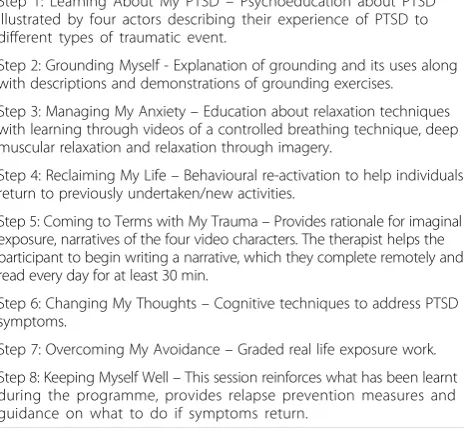
Spring is an 8 week online program comprising eight steps (see Table2. Spring PTSD Steps).
The therapist initially meets with the participant at the service base for an hour to develop a rapport, learn
about the participant’s trauma and describe the
programme, which the participant then completes online in their own time. There are four subsequent fortnightly meetings of 30 min, normally undertaken face-to-face, but potentially deliverable via the internet or telephone, according to participant preference. The participant will also receive four brief telephone calls or email contact between sessions to discuss progress, identify any prob-lems that have arisen and sometimes set new goals. The modules are accompanied by homework. At each ses-sion, the therapist reviews progress by logging into a clinician dashboard, and guides the participant through the programme. The aim of the guidance is to offer con-tinued support, monitoring, motivation and problem
solving. The eight online steps are usually completed in turn with some later steps relying on mastery of tech-niques taught in earlier steps. Each step provides psycho-education and the rationale for specific compo-nents of treatment. Each step activates a tool that be-comes live in the Toolkit area of the website and aims to reduce traumatic stress symptoms. Everything entered into the Toolkit becomes visible (with the participant’s knowledge) to the therapist via the dashboard to facili-tate input. The programme can be accessed online via a web browser or through an App. Participants will be able to use their PCs, tablets or smart phones to engage with the programme. A screenshot taken from Step 1 can be seen in Fig.1: Spring Screenshot. Participants will be asked to complete the IES-R at each face-to-face ses-sion to measure and monitor their PTSD symptoms.
Participant withdrawal
A participant may withdraw or be withdrawn from ei-ther intervention for the following reasons: 1) With-drawal of consent to participate in the intervention by the participant, 2) Any alteration in the participant’s condition which justifies the discontinuation of the intervention in the therapist’s/Principal Investigator’s opinion. For example, developing a condition which would exclude them from the study based on the eligi-bility criteria.
In the case of suicidal ideation, the therapist will assess the participant to determine whether or not they can continue or need to be referred elsewhere. In the case that a participant scores 50+ on the CAPS-5 at follow-up, they will also need to be assessed by the clinical team and may be offered additional treatment. Partici-pants who solely withdraw/are withdrawn from the intervention will continue in follow-up unless they with-draw their consent for this.
Participants can chose to withdraw from the trial intervention, withdraw from follow-up, withdraw from both aspects, or withdraw from both aspects and ask that previously collected data not be used.
Fidelity
[image:5.595.58.292.517.731.2]To ensure the interventions are delivered as intended and according to the manuals, each therapist will aim to audio record at least one session with every participant using a digital recorder (however, this may not be prag-matic for GSH if the sessions are solely conducted on the telephone or by email). The audio recordings will be rated using a general and an intervention specific fidelity checklist by one of two independent raters, who have re-ceived training in the intervention. We will record the number of sessions attended or missed for each partici-pant, and the time spent on the GSH programme to measure adherence.
Table 2Spring PTSD Steps
Step 1: Learning About My PTSD–Psychoeducation about PTSD illustrated by four actors describing their experience of PTSD to different types of traumatic event.
Step 2: Grounding Myself - Explanation of grounding and its uses along with descriptions and demonstrations of grounding exercises.
Step 3: Managing My Anxiety–Education about relaxation techniques with learning through videos of a controlled breathing technique, deep muscular relaxation and relaxation through imagery.
Step 4: Reclaiming My Life–Behavioural re-activation to help individuals return to previously undertaken/new activities.
Step 5: Coming to Terms with My Trauma–Provides rationale for imaginal exposure, narratives of the four video characters. The therapist helps the participant to begin writing a narrative, which they complete remotely and read every day for at least 30 min.
Step 6: Changing My Thoughts–Cognitive techniques to address PTSD symptoms.
Step 7: Overcoming My Avoidance–Graded real life exposure work.
Outcomes
The primary outcome will be the severity of symptoms of PTSD over the previous week as measured by the Clinician Administered PTSD Scale for DSM5 (CAPS-5) [38] at 16 weeks post-randomisation. The CAPS-5 is a 30 item structured interview for assessing PTSD diag-nostic status and symptom severity. It is the gold stand-ard in PTSD assessment and can be used to make a current (past month) or lifetime diagnosis of PTSD or to assess symptoms over the past week. Items correspond to the DSM5 criteria for PTSD. Previous versions of the CAPS have excellent reliability and convergent and dis-criminant validity, diagnostic utility, and sensitivity to clinical change [39]. Sixteen weeks was chosen as a post-intervention measurement.
Secondary outcomes include the severity of PTSD symptoms at 52 weeks post-randomisation to determine whether any effects of the intervention are sustained, and will be measured using the CAPS-5 1 month ver-sion. Other secondary outcomes to be measured at both 16 weeks (to determine the effect of the intervention) and 52 weeks post-randomisation (to determine sus-tained effects) will include symptoms known to be com-monly associated with PTSD along with functional status. To assess these, we will use self-report measures that are routinely collected by IAPT services: 1) Trau-matic stress as measured by the Impact of Event Scale– revised [40], 2) Quality of Life/functional impairment as measured by the Work and Social Adjustment Scale
[41], 3) Depression measured by the Patient Health
Questionnaire-9 [42], 4) Anxiety measured by General
Anxiety Disorder-7 [43] and 5) Alcohol use measured
by AUDIT-O [44].
Additional, non-IAPT measures will be administered at 16 and 52 weeks post-randomisation. Perceived social support will be measured using the Multidimensional Scale for Perceived Social Support [45], and the level of healthcare resource utilisation for health economic ana-lysis will be determined by an amended version of the Client Socio-Demographic and Service Receipt Inventory European Version [46]. Changes in health related quality of life will be measured by the EQ-5D [47] and changes in sleep measured by the Insomnia Severity Index [48]. A short version of the Post-Traumatic Cognitions Inventory [49] and the General Self Efficacy Scale [50] will be collected to determine effects on cognitions and self-efficacy respectively. The Client Satisfaction
Ques-tionnaire [51] will be collected at 16 weeks
post-randomisation only, to evaluate treatment satisfaction. The IES-R will be collected at each therapy contact to provide clinical feedback and also to facilitate imput-ation for missing data, if required. How frequently it is collected will depend on the frequency of therapist con-tact, but is likely to be weekly in the TFCBT arm and fortnightly in the GSH arm.
Process evaluation
A process evaluation conducted alongside the main trial will explore contextual factors and mechanisms of change that may impact on effectiveness and successful rollout of the intervention post-trial. Specifically, we will examine the contextual factors surrounding intervention delivery, which will include assessment of recruitment, retention, fidelity and adherence. The process evaluation will be developed according to the MRC guidance [52] and will make use of both quantitative data (including
[image:6.595.59.539.89.290.2]fidelity measurement, retention, adherence rates, time spent on different steps of the GSH programme) and qualitative data from interviews with therapists and par-ticipants pre- and post-intervention. Detailed informa-tion regarding whether the interveninforma-tion was delivered as intended (fidelity) and the quantity of the intervention implemented (dose) will allow us to test the theorised mechanism of effect of GSH for PTSD (a combination of: psycho-education about PTSD; imaginal and in-vivo exposure work to achieve habituation to distressing im-ages and avoided situations; cognitive work to identify and modify negative/distorted cognitions; and stress management skills to cope with anxiety and other symp-toms) and whether certain factors appear to be more important than others.
Sample size
As the study aims to demonstrate non-inferiority of GSH for PTSD compared to TFCBT, the power calcula-tion considers the non-inferiority margin as opposed to the effect size. The non-inferiority margin will be 5 points on the 80 point CAPS-5 scale. A recent meta-analysis [11] indicates that the standardised mean differ-ence between TFCBT and waitlist/usual care for the
treatment of PTSD is −1.62. This corresponds to 16.6
points on the CAPS-5. This means that if we demon-strate non-inferiority to within 5 points of the gold standard, we will also demonstrate superiority over wait list/usual care in line with International Conference on Harmonisation Harmonised Tripartite Guideline (Statis-tical Principles for Clinical Trials) E9 (ICH E9) guidance for non-inferiority studies [53,54].
Pilot work indicates an intraclass correlation coefficient of 5.6% at the therapist level at 10 weeks. At 22 weeks, however, there was no observable clustering of CAPS-5 scores amongst therapists. Given our primary outcome (CAPS-5) is measured at 16 weeks we have allowed for 1% clustering and recalculated the sample size. We have allowed for 20% attrition. On the basis of the anticipated average therapist cluster size being four, the design effect is 1.03, requiring a 3% inflation of the sample size. This re-sults in a final sample size of 192 (inflated from 186) which provides 90% power (nQuery v7.0).
For the qualitative elements of the study, the sample size will be guided by preliminary analysis and constant comparison (comparing and contrasting themes from other interviews) during each data collection phase, until the research team is satisfied that there is data saturation and no new themes which are important to the research question arise [55]. However, it is helpful to have a guide to sample size for study planning. Based on previous re-search [56] we propose that interviews will be conducted with 10–20 participants and 8 therapists purposefully sampled from the different geographical sites.
Recruitment
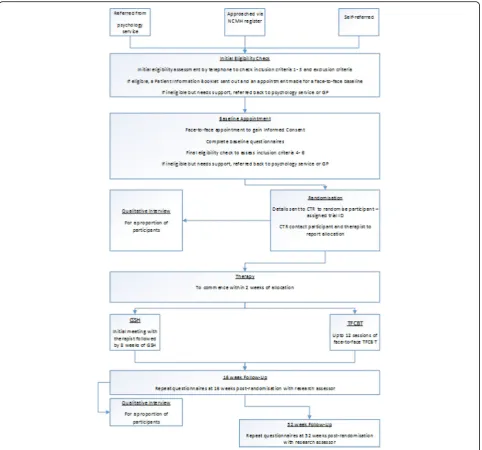
Please refer to Fig. 2: Participant Timeline, for pant activity throughout the study. Prospective partici-pants will be identified through Primary Care Mental Health Services (PCMHS) in South Wales, through IAPT services in England and psychological treatment services in Scotland. Three centres in Cardiff, Manches-ter and Musselburgh will initially oversee recruitment at up to 3 sites each and one site in London. More sites may be added if necessary. Primary care and other rele-vant workers in these services will be educated about the study and the eligibility criteria, and asked to identify and refer patients who may be experiencing PTSD to a single traumatic event and meet two of the other eligibil-ity criteria (aged 18+ with regular access to the internet). They will be provided with a Summary Information sheet of the study, which they can discuss with the pa-tient. With the patient’s consent, they will pass their contact details to the researchers by secure fax or a tele-phone call. The researcher will then teletele-phone the pa-tient to confirm they are over 18 years old with regular internet access, screen positive for PTSD on the Trauma Screening Questionnaire (TSQ) and do not appear to meet any of the exclusion criteria. If the patient is prob-ably eligible, the researcher will send them a copy of the Participant Information Booklet to read before the ap-pointment. If the patient is found to be ineligible, they will be referred back to the referring service. The refer-ring services will be contacted regularly and will be pro-vided with trial branded merchandise such as pens to remind them about the study.
If necessary, to obtain the number of participants re-quired, the Cardiff centre may also recruit participants through the National Centre for Mental Health (NCMH) cohort of participant volunteers. The cohort of over 9500 participants with lived experience of a mental ill-ness currently includes 890 individuals with a diagnosis of PTSD, the majority of whom live in South Wales. A member of the NCMH team would contact potentially eligible individuals who have consented to being con-tacted about future research, to screen for eligibility and invite participation if eligible.
publicise the trial publicly in conjunction with the NCMH communications team. This will include targeted press releases to local media with the offer of an inter-view with one of the study team, news items and
adver-tisements on the NCMH website (www.ncmh.info), and
a social media campaign to raise awareness of the study. We will seek to explore opportunities to recruit through the Criminal Justice System by linking with Victim Sup-port, Sexual Assault Referral Centres (SARCs) and HM Court Services.
A screening log of all ineligible and eligible but not consented/not approached will be kept at each site so that any biases from differential recruitment will be detected.
Allocation and blinding
Where possible, baseline measures will be collected elec-tronically using an online database. Following comple-tion of the baseline assessment, the database will inform the assessor that the participant is eligible for random-isation and the assessor will click the‘Randomise Partici-pant’ button. The database will allocate the participant to either GSH or TFCBT using pre-programmed soft-ware. This information will not be available to the asses-sor, who is blind to allocation, instead the database will email the trial manager who will inform the appropriate therapist. Individual randomisation will be conducted using an online minimisation algorithm generated by the trial statistician. The ratio will be 1:1. Minimisation will
[image:8.595.58.541.87.537.2]ensure balance between trial arms for gender, but will retain a random element and will be stratified by research centre.
It is not possible to blind the therapists or the partici-pants given the complex interventions under investiga-tion. However, the outcome assessors will be blind to treatment allocation and the therapists and participants will be asked not to discuss their allocation with the as-sessor. This will be stressed at the start of the interview and will minimise any potential bias the assessor may have when conducting the outcome assessments. To measure the success or otherwise of allocation conceal-ment, the assessors will be asked to guess the partici-pant’s allocation before and after each assessment. This will be recorded and compared to chance at the end of the study.
Data Collection Methods & Data Management
All assessments will be conducted by research assessors who are either employed as Research Assistants by the centres involved, or are Clinical Studies Officers from the local Clinical Research Network. They will all receive training in rating the outcome measures. For the CAPS-5, this includes at least 1 day full training followed by rating a recording of an interview between an actor and an experienced interviewer. Assessors could be signed off if they score within 10% of the total score agreed by two of the authors (JB, CL), score differently on a max-imum of four items and do not score more than one point different on any individual item. In order to ensure accurate ratings, assessors will receive video CAPS-5 in-terviews every 6 months to rate and return to JB and CL who will provide feedback.
Once they receive a referral, assessors will contact the potential participant by telephone to conduct a screen-ing questionnaire made up of the TSQ and simple ques-tions to assess inclusion criteria 1–3 and all of the exclusion criteria. Eligible participants will be sent a Par-ticipant Information Booklet and a daily diary and will be asked to monitor their symptoms for 2 weeks, as pre-vious studies have found that this results in significant reduction in symptoms for some PTSD sufferers [33].
After the 2 week monitoring period, those still inter-ested in taking part will be asked to attend a face-to-face appointment. Assessors, who have been trained in Good Clinical Practice (GCP) and receiving informed consent, will begin the consent process with the participant by reading through the Patient Information Booklet to-gether and giving them to time to ask questions about the study. The assessor will then ask the participant to complete the triplicate study Consent Form if they are happy to do so. One copy will be given to the participant to keep. The assessor will then conduct the baseline as-sessment, which will assess inclusion criteria 4–6 and
re-check criteria 2 (single event) and exclusion criteria 7. They will collect demographic data and the outcome measures previously outlined. Follow-up assessments will occur, as close as possible, to 16 weeks and 52 weeks post-randomisation. This will involve re-administration of the outcome measures and may be conducted face-to-face or on the telephone.
To improve data quality and completeness we have developed a study specific online database which can be accessed by all of the assessors. During the assessments, participants are encouraged to complete the self-report questionnaires directly onto the computer and assessors also complete the remaining parts of the interview online. The database flags up any missing variables, or entries outside the permissible range, thus ensuring complete and accurate data. Access to the database will be restricted to named study personnel only via a secure login and password. The system will be roles-based with restricted read/write/edit permissions. Any changes made to the data will be stored in the audit log within the system’s database with a full history of changes being recorded. The system will be accessible via any online PC, tablet or mobile device. Data will be stored securely on a secure server. In case of lack of access to an inter-net connection, we also have back-up paper case report forms which are entered onto the database as soon as possible. When paper copies are used, a copy will be sent to the trial co-ordinating centre and the data en-tered will be verified.
Qualitative interviews will be conducted with a sample of participants once they have consented to the trial but ideally prior to starting the intervention, and then again after the intervention. A sample of therapists will also be interviewed prior to commencing delivery of the inter-ventions and again on completion. All interviews will be digitally audio-recorded then transcribed by a member of the study team.
To aid retention, participants will be offered a £10 shopping voucher on completion of the 16 week and 52 week follow-up assessments as a token of appreci-ation for their participappreci-ation in the study. Where a par-ticipant wishes to withdraw from the intervention, their participation in the follow-up assessments will be encouraged. Unless a participant has withdrawn consent
for follow-up, repeated attempts using different
within 1 month of loss of contact or the planned follow-up, a letter will be sent asking the participant to re-establish contact if they are able to and advising that they will be contacted again at the next follow-up point unless they advise otherwise. For any participant reluc-tant to complete the full outcome assessment at follow-up we will attempt to gain the CAPS-5 information as a minimum dataset. As much information as possible will be collected from protocol non-adherers, with a mini-mum of the primary and secondary outcome measures and reasons for non-adherence.
Statistical methods
The primary analysis will be performed using analysis of covariance, predicting follow-up CAPS-5 score control-ling for baseline CAPS-5 score and important patient characteristics (including all minimisation variables). This will be a complete case intention to treat analysis. Checks will be made to ensure there is no appreciable clustering of outcomes within therapists, but if such clustering exists the primary analysis will be hierarchical. The results will be summarised using point estimates, 95% confidence intervals and p-values. Since this is a non-inferiority design, we will be checking whether the confidence interval for the difference between arms lies entirely within the 5 point non-inferiority margin. Partic-ipants with missing CAPS-5 score at follow-up will have a CAPS-5 score estimated from available IES-R scores (this will involve building a prediction model using in-formation from participants with both IES-R and CAPS-5 scores). We will explore differences in treatment effects by gender in a sub-group analysis by including an interaction term between treatment arm and gender.
A sensitivity analysis will use multiple imputation to account for missing data if the number of cases lost due to incomplete information exceeds 10%. Secondary out-comes include: CAPS-5 at 52 weeks, IES-R, WSAS, PHQ-9, GAD-7, AUDIT-O, MSPSS, EQ-5D, ISI, GSES, PTCI, adapted CSSRI-EU and CSQ-8. These are all con-tinuous measures and will be analysed similarly to the primary outcome. Transformations will be explored to improve model fit if distributional assumptions are not satisfied. This will be assessed by visual inspection and formal fit statistics compared to decide on the trans-formation chosen.
IES-R scores over time will be explored using a hier-archical modelling (including clustering by therapist if this is identified in the primary analysis) and an appro-priate covariance structure allowing for IES-R scores within an individual to be correlated over time. Covari-ance structures to be explored include autoregressive terms (AR), moving average (MA), and combined terms (ARMA). This will facilitate the fitting of IES-R trajec-tories over time (since randomisation) interacted with
intervention arm, whilst also controlling for the same covariates as the primary analysis. A sensitivity analysis will use multiple imputation to account for missing data if the number of cases lost due to incomplete informa-tion exceeds 10%. A further sensitivity analysis will ac-count for patient adherence to the protocol using complier adjusted causal effect (CACE) analysis [57]. All analyses will be performed in the R programming lan-guage and environment or SPSS [58,59].
Qualitative data will be analysed using framework ana-lysis [60]. This is a systematic five-stage method, which is increasingly being used in health care research [61]. It will allow us to compare themes across time point, treat-ment centre, and interviewee category (i.e. patient and therapist). We will identify contradictory data, as points of contrast as well as similarities will be important in order to understand uptake of the GSH tool. The method is well defined and allows for greater transpar-ency. Vital measures will be put into place to ensure val-idity and reliability. More than one person will be involved in the analysis and double coding will be car-ried out until consensus is reached. The framework ana-lytic approach has been selected as it is a recognised transparent analytic approach. This qualitative compo-nent has been designed using the principles of the Crit-ical Appraisal Skills Programme qualitative checklist, to ensure the quality of qualitative research [62].
Health economics
An economic evaluation will be conducted from the per-spective of the UK NHS and personal, social services. To determine the cost-effectiveness of GSH versus CBT for PTSD, and the extent to which it can be regarded as representing value for money, two analyses will be under-taken – one will assess the relative cost-effectiveness by estimating the incremental costs of achieving changes in natural units of outcome that commissioners, health care professionals, public health decision makers and service users find relevant (e.g. incremental cost of achieving a percentage improvement in PTSD symptoms as measured by CAPS5). The second analysis will use the EQ-5D util-ities for a cost utility analysis estimating the incremental costs per quality adjusted life year (QALY) gained. The QALY gains will also be used in a net–benefit analysis based on accepted NICE‘value for money’thresholds.
and at follow-up relative to the control group, will be measured using the CSSRI-EU.
As the follow-up is at 52 weeks, no costs and outcomes will be subjected to discounting. Uncertainty around the cost and effectiveness estimates will be investigated by: probabilistic sensitivity analysis, using the incremental cost per QALY as the metric for this assessment measured against the NICE range of ‘willingness to pay’thresholds between £20 k and £30 k per incremental QALY gained represented by cost-effectiveness acceptability curves [65]. a series of one-way sensitivity analyses to assess the im-pact of parameter variation on baseline estimates of the range of incremental cost-effectiveness ratios; and a set of alternative scenarios will be constructed, based on the findings from relevant studies of CBT for PTSD [33,35– 37] to compare the relative cost-effectiveness of GSH against different durations of CBT and supportive care .
In addition to a trial-based analysis, longer-term cost-effectiveness will be assessed using decision analytic modelling methods. The derived model, based on a review of published models at the time of the analysis, will use parameter estimates derived from the trial and information from literature sources relating to long-term effects of PTSD, alongside other sources, to arrive at meaningful long-term estimates of cost-effectiveness and budget impact.
Trial monitoring
The trial will be monitored by a Trial Steering Commit-tee (TSC) made up of independent members including lay members who will meet annually. We will also form a Data Monitoring Committee again made up of mem-bers independent of the trial. There are currently no planned interim analyses or stopping criteria.
All Serious Adverse Events (SAEs) must be reported immediately (and within 24 h of knowledge of the event) to the co-ordinating centre’s safety team. In addition to the usual SAE categories, for the purposes of this trial severe self-harm and harm to others must be reported. Therapists will be asked to notify the study team directly should they be concerned at any time that a participant has caused, or is likely to cause, significant harm to themselves. The therapist should also inform the partici-pant’s GP. Therapists will be asked to inform the appro-priate authorities directly should they become concerned at any time that a participant has, or is likely to cause significant harm to others. Assessors will be asked to complete a brief risk assessment if the participant dis-closes suicidal ideation and should discuss with a mem-ber of the clinical team what action to take.
Screening, recruitment, withdrawal and SAEs will be centrally monitored on a weekly basis. Database valida-tions will be checked every 2 months and all consent forms received at the site will be checked. Following any
amendments to the protocol or associated documents, the sites will be sent new versions and asked to con-firm receipt. Their concon-firmation will be recorded on the relevant log. On site monitoring will occur only if a visit is triggered, for example, repeated protocol or GCP breaches.
Data protection and indemnity
All personnel involved in the trial will act to preserve participant confidentiality and will not disclose or repro-duce any information by which participants could be identified, except where specific consent is obtained. Data will be stored in a secure manner and will be regis-tered in accordance with the Data Protection Act 1998. The data custodian and the translational sample custo-dian for this trial is Cardiff University. The Trial Man-ager, the Database Programmer and Statistician will have access to the final dataset.
Where participants are recruited at NHS sites the NHS indemnity scheme/NHS professional indemnity will apply with respect to claims arising from harm to participants at site management organisations.
Dissemination
Trial findings will be disseminated widely using a variety of tailored methods targeting specific audiences. A sum-mary report of trial results written in lay language will be sent to study participants and other key stakeholders. The report will also be displayed and available at venues used for recruitment. We will hold informal patient-centred meetings at each trial site, to present the results orally and allow time for questions and clarification. We will also hold an open conference at each centre in the final month of the project. If the outcome is positive, the conferences will include free training in the GSH programme for NHS staff coupled with free access to the programme for a certain number of therapeutic en-counters. We will send reports of trial results to NHS commissioners, outlining the cost-saving potential of GSH if applicable and the scope for improving routine clinical practice for PTSD. We will disseminate the find-ings publicly through news items on the NCMH website (www.ncmh.info), which attracts an average of 2250 unique visitors each month, and an article in the widely circulated NCMH newsletter.
Science Media Centre, to maximise coverage. Study out-comes will be presented to the academic community at national and international conferences by means of oral presentation, poster presentation, and interactive work-shops. We will target conferences likely to be attended by large numbers of therapists and managers working in IAPT and other primary and secondary care NHS psy-chological treatment services. We will also disseminate to the third sector and other services likely to deal with individuals with PTSD who could potentially benefit from treatment (e.g. SARCs, Victim Support). We aim to publish the quantitative, qualitative and health economic results in high impact, open-access, peer reviewed jour-nals. A complete account of the research will also be published in the NIHR HTA Journal.
All the dissemination and promotion activities will be supported by project specific webpages on the NCMH website. The webpages will include descriptions of the project, its progress and achievements in plain and sci-entific language, press releases and announcements of and registration for conferences and training events. Ex-ternal evaluation of dissemination plans, including the identification of successful implementation strategies and barriers to implementation among end users (e.g. PTSD sufferers, health service planners and managers, clinicians, clinical professional bodies, etc.) will be undertaken by the TSC.
Discussion
Strengths of the study
This will be the first study to compare GSH for PTSD to a face-to-face therapy and will provide valuable informa-tion on which the NHS can make decisions about its suitability for use. The GSH intervention under investi-gation has been rigorously designed and tested and shown to be effective in pilot work. The study team are highly experienced in PTSD research and include the de-signers of TFCBT and GSH interventions, and the trial is being co-ordinated by an experienced Clinical Trials Unit (Centre for Trials Research, Cardiff University) with thorough Standard Operating Procedures. They will oversee rigorous data collection through the use of an electronic database designed to minimise missing or in-accurate data. The trial is multi-centre across England, Scotland and Wales and will be trialled in the services it would be delivered in if adopted by the NHS, thus en-suring its applicability to real life. The therapists have re-ceived thorough training and supervision in both TFCBT and GSH, and adherence to the protocol man-uals will be checked by fidelity assessors. In addition, the assessors will use the CAPS-5, the ‘gold standard’, to measure PTSD symptoms and have all received training and feedback in using this assessment. Finally, a patient representative has been involved in all stages of the
design of the study, has reviewed the GSH intervention and participant materials and sits on the Trial Manage-ment Committee.
Challenges
This will be a pragmatic study conducted in a real-world NHS setting. Whilst this offers advantages in terms of applicability, it can also present unique challenges which can be broadly classified into three categories. The first is participant recruitment, retention and adherence. We know that people with PTSD can experience high anx-iety and may at times find it difficult to leave the house, use public transport or travel to new places. This could mean a reluctance to take part or missed appointments, making it difficult to deliver the interventions as intended. This is particularly the case for the South Wales participants from two health boards who will be travelling considerable distances to Cardiff for treatment. This will be addressed with participants before they are randomised, to ensure ability to fully commit to the study.
Secondly, therapist retention may be a challenge. All therapists delivering the interventions are NHS em-ployees with high caseloads, and taking part in the re-search is an additional responsibility. As such, there may be times when it is difficult for them to attend the study specific supervision sessions or site initiation visits, and the research team will need to be flexible in terms of de-livering these. If a therapist does need to drop out of the study due to other work commitments or for personal reasons, it will not be a quick process to replace them, given the training requirements. Therefore, we plan to train several therapists at each site to minimise the risks of a site needing to close to recruitment. This also ap-plies to assessors: several of our assessors are employed by the CRN and therefore we are subject to them being able to provide ongoing support.
Thirdly, there may be issues around the fidelity of the delivery. The therapists in the study have prior training in additional therapies and may bring elements of these into their sessions with participants. Conversely, they may not utilise all the tools available in TFCBT or GSH. To assess fidelity to the intervention, therapists have been asked to audio record at least one session from every participant. Whilst this would ideally have been every session, the limited availability of costly encrypted audio recorders meant this is not feasible.
All of these potential challenges will be thoroughly evaluated in the process evaluation.
Conclusion
GSH to face-to-face therapy. This study will be the first to compare the two, thus allowing the NHS and other health services and professionals to make decisions about the suitability of GSH as a treatment option. The study’s strengths are that it is led by a highly experienced team of PTSD researchers in conjunction with a trials unit and is conducted in a real world setting, thus ensur-ing it is applicable to the intended recipients. The chal-lenges will be participant recruitment, retention and adherence, therapist retention and fidelity of interven-tion delivery.
Abbreviations
AR:Autoregressive; AUDIT-O: Alcohol use disorders identification test outcomes; CACE: Complier adjusted causal effect; CAPS-5: Clinician administered PTSD scale for DSM5; CSQ-8: Client satisfaction questionnaire; CSSRI-EU: Client socio-demographic and service receipt inventory; DSM5: The diagnostic and statistical manual of mental disorders, fifth edition; EMDR: Eye movement desensitisation and reprocessing; EQ-5D-5 L: EuroQol-5 dimensions-5 levels; GAD-7: Generalised anxiety disorder; GCP: Good clinical practice; GSES: General self efficacy scale; GSH: Guided self-help; HCL: Health care learning; IAPT: Improving access to psychological therapy;
ICHE9: International Conference on Harmonisation Harmonised Tripartite Guideline (Statistical Principles for Clinical Trials) E9; IES-R: Impact of event scale revised; ISI: Insomnia severity index; MA: Moving average; MRC: Medical Research Council; MSPSS: Multidimensional scale for perceived social support; NCMH: National Centre for Mental Health; NHS: National Health Service; NICE: National Institute for Health and Care Excellence; NIHR: National Institute of Health Research; PCMHS: Primary Care Mental Health Service; PHQ-9: Patient health questionnaire; PTCI: Post-traumatic cognitions inventory; PTSD: Post-traumatic stress disorder; RCT: Randomised controlled trial; SAE: Serious adverse event; SARCS: Sexual Assault Referral Centres; TFCBT: Trauma focused cognitive behavioural therapy; TFPT: Trauma focused psychological therapy; TSC: Trial steering committee; TSQ: Trauma screening questionnaire; WSAS: Work and social adjustment scale
Acknowledgements
Not applicable
Funding
The study has been funded by the National Institute for Health Research (NIHR) who have reviewed and approved the protocol.
Availability of data and materials
Not applicable
Authors’contributions
CN drafted this paper which was added to and modified by all of the other authors. All authors read and approved the final manuscript. JB, CL, NK and NR conceived the original idea for the study and developed the initial protocol. This was refined by CN and added to by all authors in the following capacity: RMc, KL, SH, KA, NS and KMc contributed to trial design, MK and TP lead on the statistical analysis, LBH and KM developed the qualitative aspects of the study and CP and KC designed the health economics section. AE provided guidance on the control intervention (TFCBT) and SC reviewed the trial design and documents from a lay representative perspective.
Ethics approval and consent to participate
The protocol Version 3.0 was approved by Wales Research Ethics Committee Panel 3 (17/WA/0008) on 14th November 2017. All participants will give written informed consent prior to taking part in the baseline assessment.
Consent for publication
Not applicable
Competing interests
CL, NK, NR and JB are members of the research team that developed Spring. The IP for Spring is owned by Cardiff University and, were Spring to be
commercialised, royalties would be payable to the authors in line with Cardiff University’s rules.
Publisher’s Note
Springer Nature remains neutral with regard to jurisdictional claims in published maps and institutional affiliations.
Author details
1Centre for Trials Research, Cardiff University, 4th Floor Neuadd Meirionnydd,
Heath Park, Cardiff CF14 4YS, UK.2Division of Psychological Medicine and
Clinical Neurosciences, Cardiff University School of Medicine, Haydn Ellis Building, Maindy Road, Cardiff CF24 4HQ, UK.3Cardiff & Vale University Health Board, Cardiff University School of Medicine, Haydn Ellis Building, Maindy Road, Cardiff CF24 4HQ, UK.4Centre for Trials Research, Cardiff
University, 7th Floor Neuadd Meirionnydd, Heath Park, Cardiff CF14 4YS, UK.
5
Independent Public and Patient Involvement (PPI) representative, Cardiff, UK.6Swansea Centre for Health Economics, College of Human and Health
Sciences, Swansea University, Singleton Park, Swansea SA2 8PP, UK.
7Department of Experimental Psychology, Oxford Centre for Anxiety
Disorders and Trauma, Paradise Square, Oxford OX1 1TW, UK.8Grenfell Emotional Health and Wellbeing service, Central and Northwest London (CNWL) NHS Trust, St Charles Hospital, Exmoor Street, London, UK.9Formerly
at Institute of Psychotrauma, East London Foundation NHS Trust, 86 Old Montague Street, London E1 8NN, UK.10Department of Mathematics, Laver Building, University of Exeter, Exeter EX4 4QRE, UK.11Division of Nursing,
Midwifery & Social Work, School of Health Sciences, Faculty of Biology, Medicine and Health, The University of Manchester, Room 6.322a, Jean McFarlane Building, Oxford Road, Manchester M13 9PL, UK.12Department of Psychology, University of Derby, Kedleston Road, Derby DE22 1GB, UK.
Received: 7 December 2017 Accepted: 14 March 2018
References
1. American Psychiatric Association, Diagnostic and statistical manual of mental disorders (DSM-5®). Washington DC: American Psychiatric Pub; 2013. 2. World Health Organization,The ICD-10 classification of mental and
behavioural disorders: clinical descriptions and diagnostic guidelines. 1992: Geneva: World Health Organization.
3. McManus, S., et al., Adult psychiatric morbidity in England, 2007: results of a household survey.2009.
4. Kessler RC, et al. Posttraumatic stress disorder in the National Comorbidity Survey. Arch Gen Psychiatry. 1995;52(12):1048–60.
5. Kachadourian LK, Pilver CE, Potenza MN. Trauma, PTSD, and binge and hazardous drinking among women and men: findings from a national study. J Psychiatr Res. 2014;55:35–43.
6. Kline A, et al. Increased risk of alcohol dependency in a cohort of National Guard troops with PTSD: a longitudinal study. J Psychiatr Res. 2014;50:18–25. 7. Baschnagel JS, et al. Relationship between PTSD symptomatology and
nicotine dependence severity in crime victims. Addict Behav. 2008; 33(11):1441–7.
8. Walsh K, et al. Trauma exposure, posttraumatic stress disorder and risk for alcohol, nicotine, and marijuana dependence in Israel. Compr Psychiatry. 2014;55(3):621–30.
9. Ferry FR, et al. The economic burden of PTSD in Northern Ireland. J Trauma Stress. 2015;28(3):191–7.
10. Tanielian T, et al. Invisible wounds of war. Summary and recommendations for addressing psychological and cognitive injuries: DTIC Document; 2008. 11. Bisson JI, et al. Psychological therapies for chronic post- traumatic stress
disorder (PTSD) in adults. Cochrane Database Syst Rev. 2013;(12):CD003388.
https://doi.org/10.1002/14651858.CD003388.pub4.
12. National Collaborating Centre for Mental Health, Post-traumatic stress disorder.2005.
13. Forbes D, et al. Australian guidelines for the treatment of adults with acute stress disorder and post-traumatic stress disorder. Aust N Z J Psychiatry. 2007;41(8):637–48.
14. Foa EB, et al. Effective treatments for PTSD: practice guidelines from the International Society for Traumatic Stress Studies. New York City: Guilford Press; 2008.
16. Dunne RL, Kenardy J, Sterling M. A randomized controlled trial of cognitive-behavioral therapy for the treatment of PTSD in the context of chronic whiplash. Clin J Pain. 2012;28(9):755–65.
17. Galovski TE, et al. Does cognitive–behavioral therapy for PTSD improve perceived health and sleep impairment? J Trauma Stress. 2009;22(3):197–204. 18. Hinton DE, et al. Mechanisms of efficacy of CBT for Cambodian refugees
with PTSD: improvement in emotion regulation and orthostatic blood pressure response. CNS Neurosci Ther. 2009;15(3):255–63.
19. Rauch SA, et al. Changes in reported physical health symptoms and social function with prolonged exposure therapy for chronic posttraumatic stress disorder. Depress Anxiety. 2009;26(8):732–8.
20. Shipherd JC, et al. Veterans seeking treatment for posttraumatic stress disorder: what about comorbid chronic pain? J Rehabil Res Dev. 2007;44(2):153. 21. Olff M, et al. Changes in cortisol and DHEA plasma levels after
psychotherapy for PTSD. Psychoneuroendocrinology. 2007;32(6):619–26. 22. Knaevelsrud C, Maercker A. Internet-based treatment for PTSD reduces
distress and facilitates the development of a strong therapeutic alliance: a randomized controlled clinical trial. BMC Psychiatry. 2007;7(1):1.
23. Davis RG, et al. Treatment barriers for low-income, urban African Americans with undiagnosed posttraumatic stress disorder. J Trauma Stress. 2008;21(2):218–22. 24. Rebello TJ, et al. Innovative strategies for closing the mental health
treatment gap globally. Curr Opin Psychiatry. 2014;27(4):308–14. 25. Lewis C, Pearce J, Bisson JI. Efficacy, cost-effectiveness and acceptability of
self-help interventions for anxiety disorders: systematic review. Br J Psychiatry. 2012;200(1):15–21.
26. Craig P, et al. Developing and evaluating complex interventions: new guidance. Med Res Council. 2008;337:a1655.
27. Lewis C, et al. Development of guided self help (GSH) programme for the treatment of mild to moderate post traumatic stress disorder (PTSD). Depress Anxiety. 2013;30(11):1121–8.
28. Lewis, C.E., et al., Internet-based guided self-help for posttraumatic stress disorder (PTSD): randomized controlled trial.Depression and anxiety, 2017; 34(6):555–565.
29. Lewis C, et al. Internet-based cognitive and behavioural therapies for post-traumatic stress disorder (PTSD) in adults. Cochrane Database Syst Rev. 2015;(5).https://doi.org/10.1002/14651858.CD011710.
30. Spence J, et al. Randomized controlled trial of internet-delivered cognitive behavioral therapy for posttraumatic stress disorder. Depress Anxiety. 2011; 28(7):541–50.
31. Ivarsson D, et al. Guided internet-delivered cognitive behavior therapy for post-traumatic stress disorder: a randomized controlled trial. Internet Interv. 2014;1(1):33–40.
32. Tarrier N, et al. Symptom self-monitoring in the treatment of posttraumatic stress disorder. Behav Ther. 1999;30(4):597–605.
33. Ehlers A, et al. A randomized controlled trial of cognitive therapy, a self-help booklet, and repeated assessments as early interventions for posttraumatic stress disorder. Arch Gen Psychiatry. 2003;60(10):1024–32.
34. Marks I, et al. Treatment of posttraumatic stress disorder by exposure and/or cognitive restructuring: a controlled study. Arch Gen Psychiatry. 1998;55(4):317–25.
35. Ehlers A, et al. Cognitive therapy for post-traumatic stress disorder: development and evaluation. Behav Res Ther. 2005;43(4):413–31.
36. Ehlers A, et al. A randomized controlled trial of 7-day intensive and standard weekly cognitive therapy for PTSD and emotion-focused supportive therapy. Am J Psychiatr. 2014;171(3):294–304.
37. Duffy M, Gillespie K, Clark DM. Post-traumatic stress disorder in the context of terrorism and other civil conflict in Northern Ireland: randomised controlled trial. BMJ. 2007;334(7604):1147.
38. Weathers, F.W, Blake D D.; Schnurr, P.P.; Kaloupek, D.G.; Marx, B.P.; Keane, T. M. The life events checklist for DSM-5 (LEC-5) 2013.
39. Blake DD, et al. The development of a clinician-administered PTSD scale. J Trauma Stress. 1995;8(1):75–90.
40. Weiss DR, Marmar CR. In: Wilson J, Keane TM, editors. The impact of event scale - revised, in Assessing Psychological Trauma and PTSD. New York: Guilford; 1996. p. 399–411.
41. Mundt JC, et al. The work and social adjustment scale: a simple measure of impairment in functioning. Br J Psychiatry. 2002;180(5):461–4.
42. Kroenke K, Spitzer RL, Williams JB. The Phq-9. J Gen Intern Med. 2001; 16(9):606–13.
43. Spitzer RL, et al. A brief measure for assessing generalized anxiety disorder: the GAD-7. Arch Intern Med. 2006;166(10):1092–7.
44. Saunders JB, et al. Development of the alcohol use disorders identification test (AUDIT): WHO collaborative project on early detection of persons with harmful alcohol consumption-II. Addiction. 1993;88(6):791–804.
45. Dahlem NW, Zimet GD, Walker RR. The multidimensional scale of perceived social support: a confirmation study. J Clin Psychol. 1991;47(6):756–61. 46. Thornicroft G, Beecham J, Knapp M. Costing psychiatric interventions.
Measuring mental health needs. London: Gaskell; 2001. p. 220–4. 47. The EuroQol Group. EuroQol - a new facility for the measurement of
health-related quality of life. Health Policy. 1990;16(3):199–208.
48. Morin CM, et al. The insomnia severity index: psychometric indicators to detect insomnia cases and evaluate treatment response. Sleep. 2011;34(5):601–8. 49. Foa P, et al. Tumour markers CEA, NSE, SCC, TPA and CYFRA 21.1 in
resectable non-small cell lung cancer. Anticancer Res. 1999;19(4C):3613–8. 50. Scholz U, Gutiérrez-Doña B, Sud S, Schwarzer R.Is general self-efficacy a
universal construct? Psychometric findings from 25 countriesEuropean. J Psychol Assess. 2002;18(3):242–51.
51. Larsen DL, et al. Assessment of client/patient satisfaction: development of a general scale. Eval Program Plann. 1979;2(3):197–207.
52. Moore GF, et al. Process evaluation of complex interventions: Medical Research Council guidance. BMJ. 2015;350:h1258.
53. International Conference on Harmonisation. ICH harmonised tripartite guideline for statistical principles for clinical trials. London: Brookwood Medical Publ; 1998. 54. Chow SC, Shao J. On non-inferiority margin and statistical tests in active
control trials. Stat Med. 2006;25(7):1101–13.
55. Glaser BG, Strauss AL, Strutzel E. The discovery of grounded theory. Strateg Qual Res Nurs Res. 1968;17(4):364.
56. Guetterman TC. Descriptions of sampling practices within five approaches to qualitative research in education and the health sciences. In: Forum qualitative Sozialforschung/forum: qualitative social research; 2015. 57. Jo B, et al. Cluster randomized trials with treatment noncompliance. Psychol
Methods. 2008;13(1):1.
58. R Core Team. A language and environment for statistical computing. R foundation for statistical computing. Vienna; 2015.
59. Corporation I. IBM SPSS statistics for Windows, version 23.0. NY: IBM Corporation Armonk; 2015.
60. Programme CAS. Critical appraisal skills Programme (CASP) qualitative research: appraisal tool. 10 questions to help you make sense of qualitative research. Oxford: Public Health Resource Unit; 2006. p. 1–4.
61. NICE. NICE reference case 2013 guide to the methods of technology appraisal; 2013. p. 33–61.
62. Critical Appraisal Skills Programme, CASP Qualitative Research Checklist. [online] Available athttp://www.casp-uk.net/checklists. Accessed 12 Nov 2017. 63. Curtis LA, B A. Unit costs of health and social care 2016. Canterbury:
Personal Social Services Research Unit, University of Kent; 2016. 64. Department of Health, NHS reference costs 2015–16.2016.
65. Fenwick E, Claxton K, Sculpher M. Representing uncertainty: the role of cost-effectiveness acceptability curves. Health Econ. 2001;10(8):779–87.
• We accept pre-submission inquiries
• Our selector tool helps you to find the most relevant journal • We provide round the clock customer support
• Convenient online submission • Thorough peer review
• Inclusion in PubMed and all major indexing services • Maximum visibility for your research
Submit your manuscript at www.biomedcentral.com/submit