Wide Angle Compton Scattering within the SCET factorization
framework
Nikolay Kivela
1Helmholtz Institut Mainz, Johannes Gutenberg-Universität, D-55099 Mainz, Germany
Abstract. Existing data for the electromagnetic proton form factors and for the cross section of the wide angle Compton scattering (WACS) show that the hard two-gluon exchange mechanism (collinear factorization) is still not applicable in the kinematical region where Mandelstam variables s ∼ −t ∼ −uare about few GeV2. On the other
hand these observables can be described in phenomenological models where spectator quarks are soft which assumes a large contribution due to the soft-overlap mechanism. It turns out that the simple QCD factorization picture is not complete and must also include the soft-overlap contribution which can be described as a certain matrix element in the soft collinear effective theory (SCET). Then the leading power contribution to WACS amplitude is described as a sum of the hard- and soft-spectator contributions. The existing experimental data allows one to check certain conclusions based on the assumption about dominant role of the soft-spectator mechanism.
1 Introduction
The first data for the differential cross section of WACS has already been obtained long time ago [1]. New and more precise measurements were carried out at JLab [2]. Double polarization observables for a polarized photon beam and by measuring the polarization of the recoiling proton were also measured at Jefferson Lab (JLab) [3]. New measurements of various observables at higher energies are planned at the new JLAB 12 GeV facility, see e.g. [4].
The asymptotic limit of the WACS cross section, as predicted by QCD factorization, has been studied in many theoretical works [5–8]. It was found that the leading-twist contribution described by the hard two-gluon exchange between three collinear quarks predicts much smaller cross sections than is observed in experiments. One of the most promising explanations of this problem is that the kinematical region of the existing data is still far away from the asymptotic limit where the hard two-gluon exchange mechanism is predicted to dominate. Hence one needs to develop an alternative theoretical approach which is more suitable for the kinematic range of existing experiments.
Several phenomenological considerations, including the large value of the asymmetry KLL [3]
indicate that the dominant contribution in the relevant kinematic range can be provided by the so-called soft-overlap mechanism. In this case the underlying quark-photon scattering is described by the handbag diagram with one active quark while the other spectator quarks are assumed to be soft.
Various models have been considered in order to implement such scattering picture within a theoretical framework: diquarks Refs.[13], GPD-models [9–12] and constituent quarks [14] .
An attempt to develop a systematic approach within the soft collinear effective theory (SCET) framework was discussed in Refs.[15–17]. The description can be considered as a natural extension of the collinear factorization to the case with soft spectators.
In Refs [15, 16] the factorization of the three leading power amplitudes has been studied and a phenomenological analysis was made. The three amplitudes describing Compton scattering which involve a nucleon helicity-flip are power suppressed and they were neglected. In Ref.[17] these am-plitudes were also included into description, together with all kinematical power corrections. For that purpose the factorization of helicity-flip amplitudes has been discussed assuming that it can be described as a sum of hard- and soft-spectator contributions. Corresponding soft contributions are described as matrix elements of the appropriate subleading SCET operators. Assuming that such soft contributions are dominant we estimate their possible numerical impact on the cross section and asymmetries.
2 SCET factorization for the WACS amplitudes
The amplitude of Compton scatteringγ(q)+N(p)→γ(q)+N(p) can be parametrized as [18]
Mγp→γp = −e2ε∗μ(q)εν(q) ¯N(p)AμνN(p), (1) Aμν = −Tμν
12 (T1+K/T2)− T μν
34 (T3+K/T4)+T μν
5 iγ5T5+T μν 6 iγ5K/T6
, (2)
whereedenotes the electromagnetic charge of the proton,N(p) is the nucleon spinor. In Eq.(2) we introduced the orthogonal tensor structures
T12μν =−PμPν
P2 , T μν 34 =
NμNν N2 , T
μν 5 =
PμNν−PνNμ P2K2 , T
μν 6 =
PμNν+PνNμ
P2K2 , (3)
with
P=1
2(p+p
), K= 1 2(q+q
), P=P−K(P·K)
K2 ,Nμ=εμαβγP α1
2(p−p )β
Kγ. (4)
The scalar amplitudesTi ≡ Ti(s,t) are functions of the Mandelstam variables. In the WACS kine-maticss∼ −t ∼ −u ∼ Q2 Λ
QCDthese amplitudes include various contributions associated with
the hard and long distance QCD dynamics. Using the SCET framework one can perform a system-atic analysis of the various contributions including one which are associated with the soft spectator scattering (soft-overlap).
It turns out that in the case of nucleon target the soft spectator scattering mechanism is not sup-pressed comparing the hard spectator one. Therefore the complete factorization description must include both of them. The factorisation description of the soft spectator contribution is more compli-cate then the hard one because it involves hard and hard-collinear scales. The hard scale appears due to hard subprocesses describing partons with the virtualities of orderQ2, the hard-collinear scale is
associated with the scattering of the hard-collinear particles with the virtualities of orderΛQwhere we introduced a generic soft scaleΛ∼ΛQCD. Assuming that hard, hard-collinear and soft scales are
well separatedQ2ΛQΛ2
QCDthe factorisation of the hard modes and hard-collinear modes can
= +
Ci
F1
Hi
Ψ Ψ
Ti
Figure 1.The reduced diagrams describing the factorization formula in Eq.(5).
matrix elements of operators constructed from the SCET-II fields do not depend on the hard scale and must be considered as a nonperturbative.
The kinematical region, where present data have been collected, corresponds to the relatively small value of the hard-collinear scaleμhc < 1 GeV. Therefore in this case one has to stop after factorization of the hard modes. The SCET-I matrix elements in such situation must be also considered as nonpertubative input despite they formally depend on the hard scaleQ.
In Refs.[15, 16] it was shown that the complete leading power factorization formula can be written as
Ti(s,t)=Ci(s,t)F1(t)+Ψ∗Hi(s,t)∗ Ψ, i=2,3,4. (5)
Here the first term on therhsdescribes the soft-spectator contribution while the second term corre-sponds to the well known hard-spectator mechanism. For illustration, in Fig.1 we show the different contributions in Eq.(5) as appropriate reduced diagrams. In the largeQlimit bothcontributions in Eq.(5) behave asQ−6up to logarithmic corrections and give
T2,4,6(s,t)∼Q−6, Q→ ∞. (6)
For large values ofQthe soft-spectator scattering is strongly suppressed due to the so-called Sudakov logarithms and therefore the hard-spectator contribution becomes dominant. But for moderate values ofQthe effect of the Sudakov suppression is still weak therefore the soft-spectator contribution is quite large or even dominant.
The expression in Eq.(5) does not include the amplitudesT1,3,5. These amplitudes describe the
scattering when the helicity of nucleon is not conserved. Corresponding contribution in the cross section is suppressed by powerO(1/Q2) comparing the helicity conserving amplitudes. However the
factorization of the amplitudesT1,3,5can also be describes in the same way as in Eq.(5) but the soft
spectator contribution will be described by the set of the subleading SCET-I operators. More detailed consideration the SCET factorization for the amplitudesT1,3,5is given in Ref.[17].
The asterisks in Eq.(5) denote the convolution with respect to the collinear quark fractions, Ψ denotes the nucleon distribution amplitudes which describe the non-perturbative dynamics in the hard-spectator contributions. The hard coefficient functionsHi(s,t) in Eq.(5) define the full dependence of the hard-spectator contribution on the Mandelstam variables. The leading-order approximation for these functions are defined by the two-gluon exchange diagrams and therefore they are of order α2
s(Q2).
The hard coefficient functionsC2,4,6in the soft spectator term in Eq.(5) can be computed
system-atically order by order in pQCD. The leading-order expressions read
C2(s,t)=−C4(s,t)= s−u
su , C6(s,t)= t
su. (7)
The non-perturbative dynamics in the soft-spectator contribution in Eq.(5) is described by the SCET form factor (FF)F1(t). In the SCET framework it is defined as
pe2q
¯
ξn(0)Wnγ⊥σWn¯†ξn¯(0)−ξ¯n¯(0)Wn¯γ⊥σWn†ξn(0)
|pSCET=Nn¯ γ σ
⊥Nn¯ F1(t), (8)
wherenand ¯ndenote the auxiliary light-like vectors associated with the nucleon momenta
p= √−tn¯ 2+
m2 N √
−t n 2
√ −tn¯
2, p= m2
N √
−t ¯ n 2+
√
−tn2 √−tn2, (9) The fieldsξnandξ¯nin Eq.(8) denotes the hard-collinear quark fields in SCET-I (with the appropriate
flavor) andWndenotes hard-collinear Wilson line
Wn(z)=P exp
ig
0
−∞dsn¯·A
(n)
hc(z+sn¯) , (10)
and similarly for the fields with the label ¯n.
This SCET FF depends only from the large momentum transfert. However this dependence is associated only with the hard-collinear modes which can not be factorized for small values of the hard-collinear scale. One can see from Eq.(5) that the energy (s) dependence is completely defined by the hard coefficient functionCiand therefore can be computed in the perturbation theory. SCET analysis allows one to show that at large values of−tone expect thatF1(t) ∼ (−t)−2. Therefore at
largeQthe soft spectator term decreases with the same power as the hard spectator contribution. The FFF1(t) and the hard coefficient functionsCialso depend on the factorization scaleμFwhich
is not shown for simplicity. This scale defines the separation between the hard and hard-collinear regions. This scale dependence can be computed from the renormalization of the SCET operator in Eq.(8). In the NLO one finds [16]
μ d
dμCi(s,t;μ 2)= αs
4πCF
4 ln[−t/μ2]−6+O(αs)Ci(s,t;μ2), (11)
Solving this equation one can resum the large logarithms to all order in perturbation theory.
3 Phenomenology
In order to apply the factorization formula (5) in a phenomenological analysis one must define the unknown nonperturbative form factorF1. This task can only be solved by using a nonperturbative
ap-proach within the SCET framework. At present time such apap-proach has not yet developed. Meanwhile a useful phenomenological consideration can be carried out. This is possible due to the universality of the definition of the SCET FFF1 in the factorization approach and due to its specific properties.
This one unknown quantity describes the three independent amplitudesT2,4,6. Therefore the idea is to
re-express this quantity in terms of any one amplitude and then use this expression for the remaining two amplitudes. This allows one to establish the relation between the three amplitudes up to well defined hard-spectator corrections.
In order to be specific let us use Eq.(5) and write forF1the following expression
F1(t)=R(s,t)−Ψ∗H2(s,t)∗Ψ/C2(s,t). (12)
Here we define the ratio
R(s,t)= T2(s,t)
C2(s,t, μ2=−t)
Note that therhsof Eq.(12) does not depend on the total energys. Substituting this equation in the expressions for the amplitudesT4,6(5) we obtain
Ti(s,t)=Ci(s,t)R(s,t)+Ψ∗
Hi(s,t)−Ci(s,t)H2(s,t)
C2(s,t) ∗ Ψ
. (14)
On the left side of this equation we have a well defined physical amplitude therefore the right side must also be well defined. This means that the potential end-point singularities in the hard-spectator corrections must cancel in the difference on therhsof Eq.(14). We assume that all the hard coefficient functions in Eq.(14) are defined atμ2 =−t. We also used the different values of the total energysin
Eq.(14) in order to stress that the substitution (12) does not depend on the energys.
If the values of the hard-spectator contributions in Eq.(14) are small, then such terms can be neglected and we obtain
Ti(s,t)Ci(s,t)R(s,t)⇔ Ti(s ,t)
Ci(s,t) R(s,t). (15) Notice that this formula is valid to all orders inαsfor the coefficientCibut at orderα2sone has to take
into account the hard-spectator corrections.
Obviously the choice of the amplitudeTifor the definition of the ratioRin (13) does not play any essential role. In the definition (13) we also used a freedom to fix the factorization scale and chose μ2=−tas simplest realization.
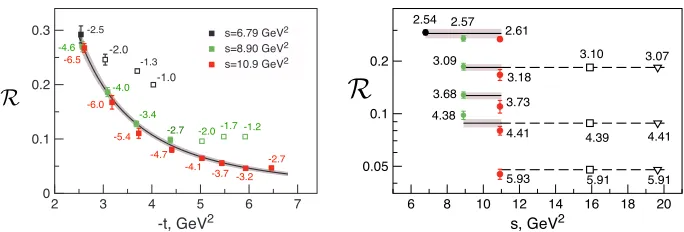
If the bulk contribution to the amplitudesTi(s,t) is provided by the soft-overlap term then one expects (this is also implied by Eq.(15) ) that the ratioRdepends only very weakly on the energys
d
dsR(s,t)0, (16)
This picture can be verified when comparing with the data. Consider the unpolarised WACS cross section. Using expressions (15) for the amplitudesT2,4,6 and neglecting the helicity flip amplitudes T1,3,50 and power suppressed terms∼m/Qwe obtain
dσ dt =
πα2 s2 |R(s,t)|
2(− su)
1
2|C2(s,t)|
2+1
2|C4(s,t)|
2+|
C6(s,t)|2
. (17)
If the ratioR(s,t) depends mostly on the momentum transfertthen the energy dependence of the cross section in Eq.(17) is defined only by the hard coefficient functions. Using Eq.(17) one can extract the absolute value|R(s,t)|and to check the equation Eq.(16) using the experimental data for the cross section. In Fig.2 we show the results obtained for the ratioRwhere we also take into account the power suppressed kinematical corrections. From Fig.2 we see that this approximate scaling behavior is observed in the region where−u≥2.5 GeV2. Hence we can adopt this value as a phenomenological
lower limit of applicability of the described approach. For smaller values ofuthe extracted values of R(shown by the open squares) demonstrate already a clear sensitivity tos. Thus one can observe that for−u=1.3 GeV2(−t=3.7 GeV2) the obtained value ofRis about a factor 2 larger than the scaling
curve. This observation clearly demonstrates that the given approach cannot describe the cross section data at small values ofu.
References
R
2.54 2.57 2.61
3.09
3.18 3.68
3.73 4.38
4.41
5.93
3.10 3.07
4.39 4.41
5.91 5.91
R
0.05 0.1 0.2
s, GeV2
6 8 10 12 14 16 18 20
Figure 2. Left:The ratioRas function oft. The corresponding values ofuare shown by the numbers next to the symbols. The open squares mark out the points with−u<2.5GeV2. The solid line represents an empirical
fit, the gray bands show the 99% confidence interval.Right:The ratioRas a function of energysat fixed values oftin the region where−u>2.5GeV2. The corresponding values of−tare shown by the numbers next to the
symbols. The open squares and triangles mark out the predicted points which will be checked in cross section measurements at JLab with the 12GeV beam facility.
[2] A. Danagoulian et al. [Hall A Collaboration], Phys. Rev. Lett. 98 (2007) 152001 [nucl-ex/0701068 [NUCL-EX]].
[3] D. J. Hamiltonet al.[Jefferson Lab Hall A Collaboration], Phys. Rev. Lett.94(2005) 242001 [nucl-ex/0410001].
[4] D. Hamiltonet al.[Jefferson Lab Hall C Collaboration], E1214003, “Wide-angle Compton Scat-tering at 8 and 10 GeV Photon Energies”.
[5] A. S. Kronfeld and B. Nizic, Phys. Rev. D44(1991) 3445 [Erratum-ibid. D46(1992) 2272]. [6] M. Vanderhaeghen, P. A. M. Guichon and J. Van de Wiele, Nucl. Phys. A622(1997) 144C. [7] T. C. Brooks and L. J. Dixon, Phys. Rev. D62(2000) 114021 [hep-ph/0004143].
[8] R. Thomson, A. Pang and C. -R. Ji, Phys. Rev. D73(2006) 054023 [hep-ph/0602164]. [9] A. V. Radyushkin, Phys. Rev. D58(1998) 114008 [hep-ph/9803316].
[10] M. Diehl, T. Feldmann, R. Jakob and P. Kroll, Eur. Phys. J. C8(1999) 409 [hep-ph/9811253]. [11] M. Diehl, T. Feldmann, R. Jakob and P. Kroll, Phys. Lett. B460(1999) 204 [hep-ph/9903268]. [12] M. Diehl, T. Feldmann, H. W. Huang and P. Kroll, Phys. Rev. D 67 (2003) 037502
[hep-ph/0212138].
[13] P. Kroll, M. Schurmann and W. Schweiger, Int. J. Mod. Phys. A6(1991) 4107. [14] G. A. Miller, Phys. Rev. C69(2004) 052201 [nucl-th/0402092].
[15] N. Kivel and M. Vanderhaeghen, JHEP1304(2013) 029 [arXiv:1212.0683 [hep-ph]]. [16] N. Kivel and M. Vanderhaeghen, Nucl. Phys. B883(2014) 224 [arXiv:1312.5456 [hep-ph]]. [17] N. Kivel and M. Vanderhaeghen, Eur. Phys. J. C75(2015) 10, 483 [arXiv:1504.00991 [hep-ph]]. [18] D. Babusci, G. Giordano, A. I. L’vov, G. Matone and A. M. Nathan, Phys. Rev. C58(1998)