Effects of Al
2O
3Addition on the Microstructure and Properties of
CoCr Alloys
Qin Hong, Peikang Bai *, Jianhong Wang
College of Materials Science and Engineering North University of China
Taiyuan, Shanxi, 030051, China
Abstract
In typical Cobalt-chromium (CoCr) alloys powders, aluminum oxide (Al2O3) powder
can be added. In the present study, we successfully prepared alloyed samples of
various powder ratios by laser cladding, and analyzed their microstructure and carbide
structural characteristics, including microhardness, biological properties, morphology
(using scanning electron microscopy), and crystal structure (using X-ray powder
diffraction). Elemental distribution was also determined by energy-dispersive X-ray
spectral analysis. The results showed that Al2O3 addition caused the alloy to change
from slender columnar crystals to columnar grains similar, to equiaxed grains. In
addition, Al2O3 agglomeration zones appeared, and carbide structures were altered.
The mechanism of the observed performance changes was also analyzed.
Keywords: CoCr alloy; Microstructure;Powder modified;Al2O3
*Correspondingauthor:[email protected]
1. Introduction
The development of dental restoration has always been closely related to the
progress of oral materials. Finding the most suitable materials and manufacturing
techniques has always been the interest of dentists. In recent years, the use of
all-ceramic restorations has been increasing in terms of oral repair materials, but their
application has been impaired due to their high melting point and hardness, which
impedes machining in terms of cutting and plasticity[1]. Therefore, metal-based
medical materials are currently the first choice of dental prosthetic materials[2].
Cobalt-chromium (CoCr) alloys are cost-effective, and enjoy good physical and
mechanical properties and good biocompatibility[3-5]. They are therefore used in a
wide range of applications in the oral repair field, and remain one of the most
commonly used materials in clinical practice.
CoCr alloys have been the focus of many studies. For example, Wiper et al. have
and studied the effects of metal-porcelain bonding properties in porcelain teeth,
including the metal-porcelain bonding strength that was tested using the international
standard IS09693:1999. They found that the metal-ceramic bond strength of metal
liners produced by 3D printing were effectively improved, and that the alloy
properties were better than those of alloys produced by casting [6-8].Hedberg et al.
found that the rapid cooling in the selective laser melting (SLM) technique, led to the
formation of a molybdenum (Mo)-rich phase in medical cobalt-chromium (CoCr)Mo
alloys. A large proportion of hexagonal close-packed-type Cr23C6 particle phases were
texture of the molten pool changing the corrosion resistance of these materials[9].
Second-phase particles with a size of <10 μm were found to effectively improve
CoCrMo alloy mechanical properties[10].
In addition, the processing technology of CoCr alloys, their microstructure, and
properties under different processes have extensively been studied[2,11-14], including a
large number of studies on heat treatment processes and surface modification of CoCr
alloys[15-18]. Cast CoCr alloys with coarse microstructure and solidification defects
have been reported[19]. One of the major advantages of SLM technology, compared to
foundry technology, is that the microstructures of CoCr alloys prepared under this
technique are small.To date, there have been few studies on the preparation of CoCr
alloys by laser cladding technology.
In recent years, increasing research has been performed on the preparation of
metallic materials by laser cladding technology, and it has been found that the
manufacturing accuracy is basically the same as SLM technology[20]. Because of the
smaller dentures that laser cladding technology affords. Our present study uses laser
cladding technology to make alloy materials and provide more methods for denture
production.
Microalloying has always been a hot topic in material research. Making
microalloyed elements fully exert their strengthening effects has a direct relationship
to the alloy itself and elemental additions. Few studies have focused on the use of
carbides for the modification of CoCr alloy powders. Al2O3 is the main material
addition results in a significant change in the structure of single crystals during
directional solidification of CoCr alloy, ultimately increasing alloy strength[23].The
main goal of the present study is to further examine the modification of CoCr powder
by Al2O3 powder addition. Original and modified powders were processed by single
laser cladding forming, and their phases and microstructures were characterized by
scanning electron microscopy (SEM) and X-ray powder diffraction (XRD). The
mechanical properties of the two samples were also tested and compared to those of
traditional CoCr alloy carbide in terms of the alloy morphology and the improvement
in mechanical properties. This study provides a theoretical and technical reference for
modification of existing CoCr powder applications.
2. Materials and method
The CoCr alloy used in this experiment was a CoCr-0404 alloy powder,
produced by Renishaw Co,Inc. (Gloucestershire, UK). The mass fraction of Cr, Mo,
Si, Mn, Fe and C are 29.5%, 5.3%, 0.7%, 0.5%, 0.4% and 1.2%, respectively. The
powder had particle size that ranged from 10.3 to 31.2 µm, a density of 8.3 g/cm3, and
a melting point of 1380°C.
2.1 Preparation of sintered powder
Six groups of mixed powder were prepared by adding 2.5%, 5%, 7.5% and 10%
Al2O3 to CoCr alloy, respectively. Each group of powder is placed in an Al2O3
crucible with a depth of 10 mm. Then, the crucible was baked in an oven at 90°C for 3
h.The powder particle size was measured using a Mastersizers 2000 laser particle size
analyzer (Malvern Instruments Ltd., Worcestershire, UK). The surface morphology of
filament-quipped scanning electron microscope (SEM; KYKY Technology Co., Ltd.,
Beijing, China). The powder was measured for powder liquidity (time) and bulk
density, in accordance with the standard methodology GB/T 1482-2010
"Determination of metal powder fluidity of the funnel method (Hall flowmeter)", and
GB/T 1479.1-2011 "Determination of bulk metal powder density Part 1: funnel
method".
2.2 Sample preparation
The experiment was carried out on a 4.0 KW LDF4000-100 fiber semiconductor
laser (Laserline GmbH, Mülheim-Kärlich, Germany). A previous series of
experiments determined the best process parameters : Laser output power P ≤ 1000 W,
scanning speed V ≤ 4 mm/s, spot diameter R ≤ 2 mm, laser scanning time 3 s. CoCr
alloy test parts were obtained after scanning the horizontal cross-section parallel to the
scanning direction of the line cutting and mosaic.
2.3 Microstructural analysis
For metallographic etching, samples were ground and polished with Murakami's
reagent (potassium ferricyanide 10 g, sodium hydroxide 10 g, and deionized water
100 ml) heated to corrosion. The specific method involved soaking a sample in 20 ml
of nitric acid + 3 drops of hydrofluoric acid solution for 10 to 80 h, then placing it for
corrosion in Murakami's reagent at 90°C for 20 min. The samples were observed
microscopically, using an AXIO ScopeA1 optical microscope (Carl Zeiss Microscopy
GmbH, Göttingen, Germany). The microstructure of the specimen was observed using
phase composition was analyzed using a D/max-Rb XRD apparatus (Rigaku Corp.,
Tokyo, Japan).
2.4 Mechanical properties
In this experiment, the microhardness of several samples was tested on a Vickers
hardness tester (DHV-1000, Shanghai Shangcai Testing Machine Co., Ltd., Shanghai,
China) with a load of 0.98 N, and dwell time of 15 s. The measurement was done
every 1 mm in the vertical direction of the cross-section.
According to the GB/T228.1-2010 standard methodology, the tensile properties
of the specimens were tested on an electronic universal testing machine E43.504
(MTS Systems Corp., Eden Prairie, MN, USA). The tensile strength test was carried
out at room temperature at a rate of 0.5 mm/min.
3. Results and discussion
3.1Alloy powder microstructure and phase analysis
The analysis of XRD diffraction peaks of the CoCr alloy powder, showed that
the main peak of the powder appears at 38–39°, and that the main phase was
face-centered cubic (fcc)-γ-Co phase (Fig. 1). The standard cell parameters a and
fcc-γ phase were a = 0.35447 ±0.0002 (ICDD card number 15-806) and the surface
indices at γ (111), γ (112), and γ (220) matched. After adding Al2O3, the main peak of
the composite powder appeared at 40–42°.
XRD data was further analyzed and it was observed that the main phase did not
change substantially after Al2O3 addition, but the Al2O3 phase was identified. The
main peak of the diffraction spectrum shifted upon the addition, which according to
Bragg's Law, is attributed to structural changes in the unit cell, which cause the
change in the diffraction peak positions. This shows that the interplanar spacing and
lattice constant have become smaller, which would affect the power’s deformation
performance.
The powder’s particle morphology remained almost spherical without Al2O3
addition, while smaller particles appeared with Al2O3 addition, compared to samples
to which Al2O3 was not added (Fig. 2). The smaller sized particles had higher specific
surface energy and melting enthalpy, and they melted rapidly under laser action. They
also had good filling effects in gaps between large particles, such that the bulk density
of the powder increased. This reduced the void defects inside the formed parts and
improved their mechanical properties and surface quality.
Further analysis of the powder properties showed that the Al2O3 powder had a
bulk density > 4.2 g/cm3, which satisfies the general requirements of the process of
laser cladding forming.
Fig. 2. Powder particle morphology: cobalt chromium alloy powder morphology (a) and
morphology of the same powder plus 5% Al2O3 (b).
3.2 Microstructural and phase analysis of pure CoCr alloy powder for forming
sample parts
The sample surface and grain structures after molding were observed by SEM.
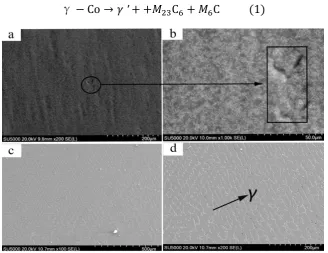
The crystal structure appeared relatively uniform and compact after molding (Fig. 3a).
However, there were also visible flaws under 1000X magnification, like the local area
uplift phenomenon seen in Fig. 3b.The reason for this was that, during the forming
process, impurities were present in the powder, which rendered the powder uneven or
led to the formation of tiny masses, resulting in local volumes that lack sufficient
density. The microstructural orientation of the CoCr alloy showed no obvious
macro-defects, such as pores and cracks on the surface of the sample (Fig. 3c). This
showed that densification of the formed part or piece under this method was high.
At temperatures above 417°C, the matrix of the Co-based alloy formed the
γ-phase (also called austenite) of the fcc structure, and the γ-phase of the fcc structure
was converted to the γ-phase with its allotrope ε-phase. As the γ-phase was
thermodynamically unstable, γ → ε phase transformation occurred during laser
scanning of CoCr alloy powder, resulted in a rapid-melting and rapid-solidification
process.
The Co-base alloy, rapidly melted by laser heating, did not undergo phase
transformation and remained in γ-Co phase. This was because the rapid cooling of the
substrate to room temperature caused γ-Co phase to be retained due to the phase
change. This observation, combined with XRD analysis, indicates that the final phase
of the CoCr alloy produced γ-Co and carbide phases. The main phase transformation
involved the formation of carbide resulting from the formation of fine columnar γ-Co
grains composed of cellular dendrites from Cr, and also the formation of Mo dendrite
during rapid solidification (Formula 1). Therefore, carbon also moved into the
inter-dendritic regions and grain boundaries[24].
γ− Co → 𝛾 ′+ +𝑀23C6+ 𝑀6C (1)
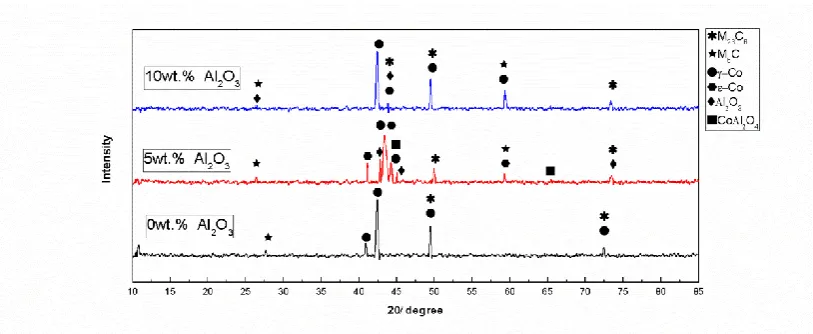
Fig. 4. XRD patterns of theCoCr alloy sample with 0, 5, and 10% Al2O3.
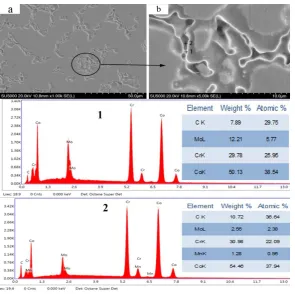
Further analysis of the microstructure of the alloys, revealed that the
metallographic structure of a single-channel scanned CoCr alloy specimen was
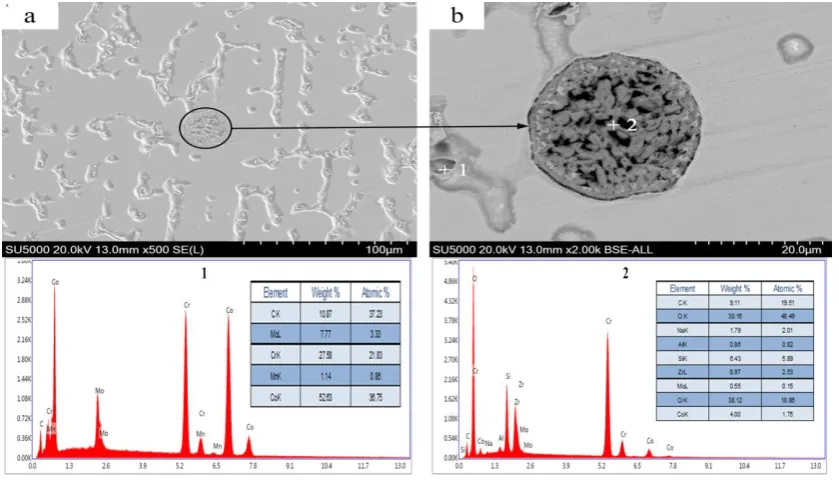
composed of austenite and a carbide-like structure (Fig. 5a). Its crystal structure was
columnar crystalline, with carbide distributed in the grain boundaries, and some
agglomeration occurring in the material’s internal structure (Fig.5b). The
microstructures consisted of a Co-based solid solution and an agglomerated second
phase, which was shown by XRD analysis to be a carbide phase. There were generally
two types of carbonized structures in CoCr alloys, M23C6 and M6C, in which M6C
carbide was rich in Mo, while M23C6 was rich in Cr[25]. From energy-dispersive X-ray
spectroscopic (EDS) results, it was speculated that one area was a Mo-rich M6C
carbide and reticular while another was a Cr-rich M23C6-type carbide (mainly Cr23C6;
Fig. 5b, points 1 and 2, respectively).
The correct amount of carbon can form carbides with the corresponding elements
in Co-based alloys. Those carbides have long been considered as major strengthening
phases in Co-based alloys[26-28].The existence of these carbides affects the materials’
addition to the improvement in the CoCr alloy mechanical properties.[25,29] Thus, the
next step was to analyze how to improve the mechanical and biological properties of
CoCr alloys by controlling the amount of carbide in the alloy.
Fig. 5. Microstructure of 0% added Al2O3 samples, and EDS analysis.
3.3 Microstructural and phase analysis of alloy powder molded parts after Al2O3
addition
XRD analysis revealed that the alloy phases after the addition of Al2O3 were
γ-CO, ε-Co, M23C6, M6C, Al2O3, and CoAl2O4 (Fig. 4). Compared to pure CoCr alloy,
the XRD diffraction pattern of the alloy with Al2O3 content of 5% showed that the
main phase peak weakened, the angle shifted to the right, the carbide result changed,
and the M6C phase increased.At this time, ε-Co appeared, compared relative to the γ
phase without Al2O3 because of the lower thermal conductivity of Al2O3 (10.022
Al2O3 particles contained in the crystals and crystal fronts (Fig. 7), hindered heat
transfer not only from the liquid, but also from the solid part of the solidification,
eventually causing a portion of the γ-Co to convert to ε-Co particles at a slower
cooling rate. The main phase of the reaction is shown in Formula 2.
γ− Co → 𝛾 ′ + 𝜀′+ M C23 6+M C6 +Al2O3 + CoAl2O4 (2)
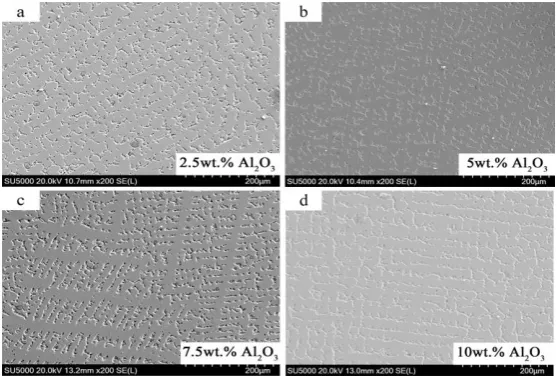
Comparing Figures 6 and 3d, it can clearly be seen that the alloy structure was
still columnar crystalline after Al2O3 addition, but the columnar grains were visibly
smaller, and even smaller than those without Al2O3 addition. Also, a large amount of
carbide disappeared and Al2O3 agglomeration areas appeared.
When the Al2O3 content was 5%, the grain boundaries were the most visible in
the microstructure, with the columnar grains small in size, and the structures similar
to equiaxed grains (Fig. 6a–6d). Carbide accumulation areas were almost undetectable,
and the microstructure and properties of the characterized parts are therefore judged to
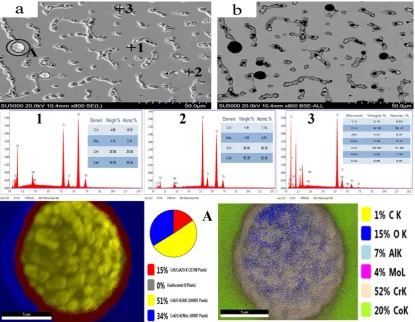
be the best when Al2O3 content was 5%. Further analysis was carried out on
characterized parts, and grain boundaries observed under magnification, which
revealed that in local areas are similar to the cellular structure, and that the columnar
grain structure disappeared, (Fig 8a, point 1). In the deep regions of the material with
Al2O3 particles (Fig. 8a, point 3), it was seen, from the backscatter plot of Figure 8b,
that the black areas were precipitated Al2O3 particles, whereas the bright white areas
were composed of carbide. According to EDS results, in Figure 8a, point one was
Mo-rich M6C and point two Cr-rich M23C6. When compared with a non-Al2O3 alloy,
size was small, and the position where it occurred changed, and did not take the form
of a mesh or sheet, but became granular. The conclusion here was that the addition of
Al2O3 to the alloy reduced the final carbide content of the molded part.This is due to
In CoCr alloys, γ-Co grains themselves have heavy faulting, which creates the
nucleation centers for carbides in CoCr alloys[30]. In this study, adding Al2O3 caused
the final morphology of γ-Co grains to change during the nucleation process. Due to
the fine structure, it is inferred that the stacking faults of γ-Co grains were reduced
along with carbide nucleation, which changed the time and amount of carbides
produced.
In Figure 8a, point 3 and area A were examined using EDS, and Al and O were
detected there. Considering these results in combination with XRD analysis (Fig. 4),
we conclud that the amount of carbides was further reduced. Al was a solid solution in
the Co-based solid solution, the main phase of the peak slowly weakened, the angle
shifted to the right, the carbide results changed, and the M6C phase increased. M6C
carbides have been reported to have good thermal stability, and M23C6 carbides were
shown to convert to M6C at a solution temperature of 1165°C[31]. During the laser
cladding process, there was a heat-effected zone that led to the conversion of M23C6
carbide to M6C type. Furthermore, the addition of Al2O3 reduced the nucleation sites
of M23C6 carbides, created the proper conditions for the conversion of M23C6 to M6C.
When the Al2O3 content was 7.5%, columnar crystals increased (Fig. 6c), but the
arrangement was chaotic and the overall structural properties not as good as those
microstructure remained columnar (Fig. 9a). By comparison with XRD analysis (Fig.
4), we see that the main peak becomes taller and narrower with more carbide. There
were still deep areas similar to those found in the previous alloy (Fig. 9b), where
carbides were present in a manner similar to those without Al2O3 (Fig. 9, 1 points).
The elemental distributions at points 1 and 2 were detected by EDS scanning, showed
that in deep regions (points 1 and 2) the elements were different from the previous
alloy (Fig. 8), the Al disappeared, and C content increased. The C content also
significantly increased at other points. The analysis of the elemental distributions at
points 1 and 2 in Fig. 9 revealed that the elements at these points were essentially the
same as those in the pure CoCr alloy.
The existence of Al2O3 particles clearly changed the CoCr alloy’s microstructure.
The reason for these results was that Al2O3 has a small particle size, large surface
energy, and high melting point. When Al2O3 particles were added in small amounts,
they were uniformly distributed in the liquid metal (Fig. 7), which not only increased
the degree of super-cooling but also promoted spontaneous nucleation at the front of
columnar solidification and hindered dendrite growth. During rapid solidification and
crystallization, a portion of Al2O3 particles was in the solid solution, and some
nucleation occurred spontaneously at the solid-liquid interface (Fig. 10). Because of
the large surface effects by Al2O3 particles, they accessed atoms from the surrounding
metal liquid and grew after nucleation. As was observed in Figure 8b, part of the
Al2O3 particle agglomeration resided in the columnar stem, and part of the columnar
that Al2O3 was larger in area than the surface area, and was absorbed very easily onto
material surfaces.
When the Al2O3 content was increased to 10% and Al2O3 particles increased, the
solid solution was rapidly contacted with more Al2O3 particles, which grew as nuclei.
The contacting particles were not in the form of solid nuclei but as solid solution
particles. These large and elongated particles had different orientations in the
columnar crystal structure, and interlocked with each other. Since it is very easy to
induce cracks in these interlocking regions during processing, the mechanical
properties were significantly reduced. In several samples with 10% Al2O3 content, the
comprehensive analysis of the microstructural properties was the worst. In summary,
the microstructure and properties of the alloy were the best when 5% Al2O3 was
added.
Fig. 7. Constituency laser melting process diagram.
Fig. 9. Microstructural analysis of 10% Al2O3.
Fig. 10. Modified sample crystallization process diagram (5% wt. Al2O3).
3.4 Mechanical properties
The hardness of 5% CoCr alloy from the boundary to the center was the best of
the several alloys, with an average Vickers hardness of 338.775HV, which
corresponded to 335 HV of the CoCr alloy tooth standard, slightly above the standard
Fig. 11. Microhardness distribution of CoCr alloy doped with different Al2O3 percentages.
The representative stress-strain curves of CoCr alloy doped with different Al2O3
percentages shows that the tensile properties of CoCr alloy were the best when the
content of Al2O3 was 5%, reaching a value of 856 MPa, which was markedly higher
than the minimum value (665 MPa) recommended in ISO5832-4 and GB17100 (Fig.
12). Furthermore, the specimen also exhibited a high elongation-to-failure percentage
of 12.79%, while ISO5832-4 specifies that the minimum requirement for elongation is
Fig. 12. Stress-strain curves of CoCr alloy doped with different Al2O3 percentages.
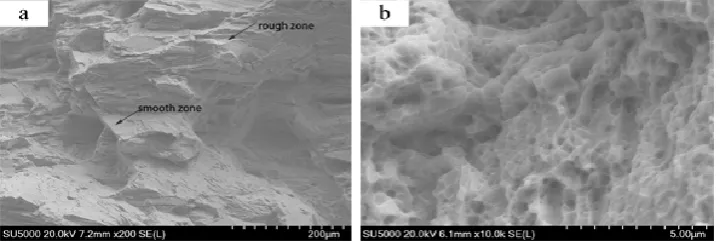
The tensile strength of alloy specimens with 5% Al2O3 was tested, and the
fracture surfaces examined at different magnifications, showed that the former
interface between powder particles could not be distinguished, indicating that the
alloy achieved full metallurgical bonding (Fig. 13a). In addition, a mixture of smooth
and rough zones was observable, with the presence of a high portion of rough regions
indicative of predominantly ductile fracture [32]. The fracture surfaces of the alloy had
parabolic tearing edges and dimple-like structures (Fig. 13a and 13b, respectively),
suggesting ductile tendency quasi-cleavage fracture[22]. It appeared that the alloy
Fig. 13. Micrographs of fracture surfaces of tensile specimens containing 5%Al2O3. (a) Fracture surface of tensile specimens
(b) The magnified fracture surface of Fig.13(a)
K. Yamanaka has studied high entropy alloys [24], and found that carbides (M23C6
and M6C) are much harder than the surrounding γ-substrates, and tend to strengthen
the alloy. In this study, when the Al2O3 content was 5%, the alloy microstructure and
carbide morphology were changed on one hand, and the carbide morphology changed
on the other, which enhanced the alloy’s microhardness and elongation. In addition,
the microstructures were mainly fine columnar crystals, thus producing higher
ultimate tensile strength. The carbide content increased with the increase of content,
but the grain size was coarse, which resulted in the deterioration in the mechanical
properties of the CoCr alloy.
We found that after adding 5% Al2O3, the microstructure of the alloy became
finer, and played the role of fine grain strengthening. It is precisely under this effect
that the mechanical properties of the alloy were improved remarkably. Also, the γ-Co
grain boundary might have provided a rapid diffusion path for Cr and Mo. and due to
enhanced diffusion, the carbide eutectic structure was very hard, and the carbides
dispersed in the eutectic phase existed at the interface, which improved the alloy’s
of improving the mechanical properties of the CoCr alloy. Therefore, this study
provided insight for improving the wear properties and biocompatibility of CoCr
alloys.
3.5 Formation Mechanism of the CoAl2O4 Phase
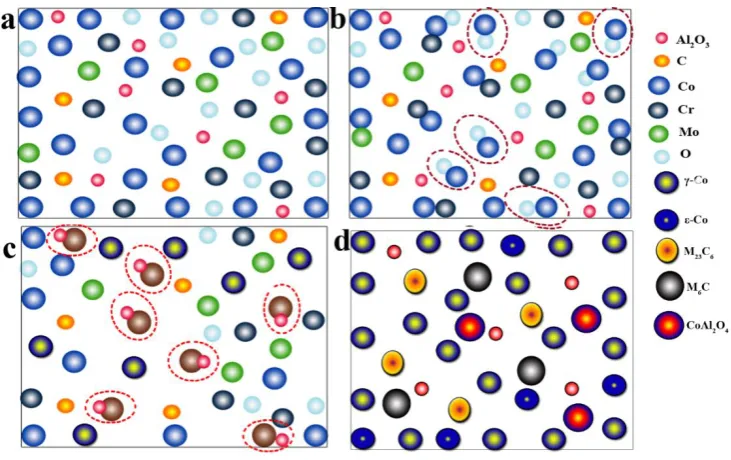
The formation of an alloy from mixed powders after the addition of Al2O3,
showed that the mixture was melted (Fig. 14a). As the temperature increased, Co and
O reacted to form CoO, while the diffusion of Cr and Mo began to occur (Fig. 14b),
then the previously formed CoO and Al2O3 reacted to form CoAl2O4 (Figs. 14c and
14d).
The appearance of the CoAl2O4 phase might also have been due to the fact that
Al2O3 particle bonds were not saturated, and that new nucleation centers in the molten
pool were growing. As the nucleation centers grew, the O and Co in the alloying
material were adsorbed and combined during the growth process.
Fig. 14. Compound formation process.
Co + O → CoO (3) CoO + Al2O3 → CoAl2O4 (4)
We calculated Gibbs free energy of reaction (3) at 298~2000K by referring to
Thermochemical Data of Pure Substances[33]. The results show that reaction (3) can
be carried out spontaneously, which indicates that the reaction is easy to proceed (In
Fig. 15). Due to the strong interactions between Co and Al2O3, a cobalt acicular spinel
compound was easily produced, and was difficult to reduce[34], meaning that reaction
(4) occurred easily as well, and that the resulting CoAl2O4 allowed the final
morphology to assume the fine microstructure observed in the present study.
Fig. 15. Gibbs Free Energy of reaction at different temperatures.
4. Conclusion
This work mainly studies on the powder properties and molding properties of
CoCr alloy with adding different proportion of Al2O3 were studied, and compared
with pure CoCr alloy, the following conclusions were drawn.
(1)Among all the ratios, the microstructure and mechanical properties of the
alloy are the best when the content of Al2O3 is 5%. At this time, the deep region of
hinders the growth of dendrite. These results showed the columnar grain size of the
alloy obviously smaller than that of the alloy of without adding Al2O3.
(2)With the addition of Al2O3, the accumulation area of carbides in the
microstructure of the alloy almost disappeared and the M6C phase increased, which
indicates the change of microstructure and morphology of CoCr alloy.
(3)The average Vickers hardness of the alloy mixed with 5% Al2O3 is 338.775
HV, and the tensile strength is 856 MPa. From the fracture morphology analysis of the
alloy, it is concluded that the local plastic zone appears during the fracture of the alloy.
It suggests that the mechanical properties of the alloy are improved.
5. Acknowledgments
This research work was supported by Primary Research and Development Plan
of Shanxi Province (Grant No. 201603D121020-1). The authors are grateful for these
grants.
References
1. Handbook of Materials for Medical Devices,
https://www.researchgate.net/publication/313151336_Handbook_of_Materials_for_Medical_ Devices
2. J. Li, C. Chen, J. Liao, L. Liu, X. Ye, S. Lin, J. Ye, Bond strengths of porcelain to cobalt-chromium alloys made by casting, milling, and selective laser melting, J Prosthet Dent,
118(1), 69-75 (2017)
3. A 5-Year Retrospective Study of Cobalt-Chromium–Based Fixed Dental Prostheses,
http://www.quintpub.com/journals/ijp/abstract.php?iss2_id=1129&article_id=13320&article= 8&title=A%205-Year%20Retrospective%20Study%20of%20Cobalt-Chromium%96Based%2 0Fixed%20Dental%20Prosthesesxx
4. Y.S. Al Jabbari, T. Koutsoukis, X. Barmpagadaki, S. Zinelis, Metallurgical and interfacial characterization of PFM Co-Cr dental alloys fabricated via casting, milling or selective laser melting, Dent Mater, 30(4), e79-88 (2014)
on erosion–corrosion resistance, Wear, 259(1-6), 219-229 (2005)
6. K. Quante, K. Ludwig, M. Kern, Marginal and internal fit of metal-ceramic crowns fabricated with a new laser melting technology, Dent Mater, 24(10), 1311-1315 (2008)
7. T. Traini, C. Mangano, R.L. Sammons, F. Mangano, A. Macchi, A. Piattelli, Direct laser metal sintering as a new approach to fabrication of an isoelastic functionally graded material for manufacture of porous titanium dental implants, Dent Mater, 24(11), 1525-1533 (2008) 8. V. Alt, M. Hannig, B. Wostmann, M. Balkenhol, Fracture strength of temporary fixed partial
dentures: CAD/CAM versus directly fabricated restorations, Dent Mater, 27(4), 339-347 (2011)
9. Y.S. Hedberg, B. Qian, Z. Shen, S. Virtanen, I.O. Wallinder, In vitro biocompatibility of CoCrMo dental alloys fabricated by selective laser melting, Dent Mater, 30(5), 525-534 (2014)
10. B. Qian, K. Saeidi, L. Kvetkova, F. Lofaj, C. Xiao, Z. Shen, Defects-tolerant Co-Cr-Mo dental alloys prepared by selective laser melting, Dent Mater, 31(12), 1435-1444 (2015)
11. N. Poolphol, T. Sakkaew, K. Kachin, P. Jantaratana, W. Vittayakorn, Physical, mechanical and magnetic properties of cobalt-chromium alloys prepared by conventional processing, Materials Today: Proceedings, 4(5), 6358-6364 (2017)
12. K.C. Li, D.J. Prior, J.N. Waddell, M.V. Swain, Comparison of the microstructure and phase stability of as-cast, CAD/CAM and powder metallurgy manufactured Co-Cr dental alloys, Dent Mater, 31(12), e306-315 (2015)
13. S. Yager, J. Ma, H. Ozcan, H.I. Kilinc, A.H. Elwany, I. Karaman, Mechanical properties and microstructure of removable partial denture clasps manufactured using selective laser melting, Additive Manufacturing, 8, 117-123 (2015)
14. O.B.M.d.G.C.d.M.R.R.J.M.D.d.A. Rollo, Effect of beryllium on the castability and resistance of ceramometal bonds in nickel-chromium alloys 《Journal of Prosthetic Dentistry》, 80(5), 570-574
(1998)
15. H.M. Ayu, S. Izman, R. Daud, G. Krishnamurithy, A. Shah, S.H. Tomadi, M.S. Salwani, Surface Modification on CoCrMo Alloy to Improve the Adhesion Strength of Hydroxyapatite Coating, Procedia Engineering, 184, 399-408 (2017)
16. R.I.M. Asri, W.S.W. Harun, M. Samykano, N.A.C. Lah, S.A.C. Ghani, F. Tarlochan, M.R. Raza, Corrosion and surface modification on biocompatible metals: A review, Mater Sci Eng C Mater Biol Appl, 77, 1261-1274 (2017)
17. M. Mori, N. Sato, K. Yamanaka, K. Yoshida, K. Kuramoto, A. Chiba, Development of microstructure and mechanical properties during annealing of a cold-swaged Co-Cr-Mo alloy rod, J Mech Behav Biomed Mater, 64, 187-198 (2016)
18. P. Mengucci, G. Barucca, A. Gatto, E. Bassoli, L. Denti, F. Fiori, E. Girardin, P. Bastianoni, B. Rutkowski, A. Czyrska-Filemonowicz, Effects of thermal treatments on microstructure and mechanical properties of a Co-Cr-Mo-W biomedical alloy produced by laser sintering, J Mech Behav Biomed Mater, 60, 106-117 (2016)
19. K. Yamanaka, M. Mori, A. Chiba, Nanoarchitectured Co-Cr-Mo orthopedic implant alloys: nitrogen-enhanced nanostructural evolution and its effect on phase stability, Acta Biomater,
9(4), 6259-6267 (2013)
Direct Laser Metal Deposition of Ni 3 Al Intermetallic Alloy, Procedia IUTAM, 23, 138-146 (2017)
21. J. Cai, G.P. Nordin, S. Kim, J. Jiang, Surface properties and corrosion behavior of Co-Cr alloy fabricated with selective laser melting technique, Cell Biochemistry & Biophysics, 67(3), 983-990 (2013)
22. A. Takaichi, Suyalatu, T. Nakamoto, N. Joko, N. Nomura, Y. Tsutsumi, S. Migita, H. Doi, S. Kurosu, A. Chiba, N. Wakabayashi, Y. Igarashi, T. Hanawa, Microstructures and mechanical properties of Co-29Cr-6Mo alloy fabricated by selective laser melting process for dental applications, J Mech Behav Biomed Mater, 21, 67-76 (2013)
23. K. Hagihara, T. Nakano, K. Sasaki, Anomalous strengthening behavior of Co–Cr–Mo alloy single crystals for biomedical applications, Scripta Materialia, 123, 149-153 (2016)
24. <钴铬铝合金1-s2.0-0025541687903958-main.pdf>,
25. E. Bettini, T. Eriksson, M. Boström, C. Leygraf, J. Pan, Influence of metal carbides on dissolution behavior of biomedical CoCrMo alloy: SEM, TEM and AFM studies, Electrochimica Acta, 56(25), 9413-9419 (2011)
26. K. Huang, K. Marthinsen, Q. Zhao, R.E. Logé, The double-edge effect of second-phase particles on the recrystallization behaviour and associated mechanical properties of metallic materials, Progress in Materials Science, 92, 284-359 (2018)
27. Y. Liao, R. Pourzal, P. Stemmer, M.A. Wimmer, J.J. Jacobs, A. Fischer, L.D. Marks, New insights into hard phases of CoCrMo metal-on-metal hip replacements, J Mech Behav Biomed Mater, 12, 39-49 (2012)
28. A. Chiba, K. Kumagai, N. Nomura, S. Miyakawa, Pin-on-disk wear behavior in a like-on-like configuration in a biological environment of high carbon cast and low carbon forged Co– 29Cr–6Mo alloys, Acta Materialia, 55(4), 1309-1318 (2007)
29. C. Song, M. Zhang, Y. Yang, D. Wang, Y. Jia-kuo, Morphology and properties of CoCrMo parts fabricated by selective laser melting, Materials Science and Engineering: A, 713, 206-213 (2018)
30. <真五Review of ceramics.pdf>,
31. C. Rao, EFFECT OF HEAT TREATMENT ON CORROSION BEHAVIOR OF WELD DEPOSITED Co-Cr-Mo ALLOY, ARPN Journal of Engineering and Applied Sciences, (2016 , 11
(20) :), 12188-12191
32. X. Xian, Z. Zhong, B. Zhang, K. Song, C. Chen, S. Wang, J. Cheng, Y. Wu, A high-entropy V 35 Ti 35 Fe 15 Cr 10 Zr 5 alloy with excellent high-temperature strength, Materials & Design,
121, 229-236 (2017)
33. I.B.G. Platzki, <纯物质热化学数据手册 上卷.pdf>,