233 |
P a g e
AUTOMATED SUGARCANE NODE CUTTING
MACHINE VIA IMAGE PROCESSING
Kiran Bhange
1,Ajit Bhong
2,
Akash Chattar
31,2,3
Department of Mechanical Engineering, Parvatibai Genba Moze COE,
Wagholi, Pune (India)
ABSTRACT
Sugarcane planting with traditional methods is costly, time-consuming and necessary compression of buds in the field is not achieved easily because of stalk planting in sugarcane. In tradition planting method, great human force and high volume of sugarcane stalk in hectare is required. To solve this problem and mechanizing of sugarcane planting, we suggest the application of machine vision system and Image Processing methods to identify nodes from sugarcane and to plant it as a seed by planting machines
Keywords: Image Processing, Sugarcane Planting, Automation.
I INTRODUCTION
India is a country which is dependent on Farming as a main source of income for many families. Farmers are thus primly important for us. In India agriculture has facing serious challenges like scarcity of agricultural labour, not only in peak working seasons but also in normal time. This is mainly for increased nonfarm job opportunities having higher wage, migration of labour force to cities and low status of agricultural labours in the society. Sugarcane is the world's largest crop 2010 Food Agricultural Organization (FAO) estimates it was cultivated on about 23.8 million hectares in more than 90 countries, with a worldwide harvest of 1.69 billion tons. Brazil was the largest producer of sugarcane in the world and India in second position. In our state i.e. Maharashtra, crops like Rice, Wheat, Sugarcane grow in majority. Sugarcanes are important part of it. Nearly 35 to 45 % of field is under Sugarcane only.
Sugarcane (Saccharum sp.) is a clonally propagated grass of the Gramineae family characterized by a high degree of polyploidy and is a crop of major importance providing about 65% of the world sugar. Reproductive tissue is harvested as the economic product in nearly all field crops but this is not the case in sugarcane. In sugarcane, the stalks are the harvested tissue and stalk size has a major influence on yield. There has been virtually some research reported on the variation in size of individual stalk internodes with position on the stalk and with crop growth.
234 |
P a g e
method 3.5 to 4. MT seed is required per hectare. This method requires more seed and human force for planting hence it is costly. Instead of conventional method of planting, row method of sugarcane planting is used for maintaining optimum plant population. It is easy for management and gives high yield. It uses two eyed sets and planting is done by keeping 4 to 6 cm distance between two sets. This type of planting needs 2 to 2.5 MT seed per hectare.Sugarcane planting with traditional method is costly, time-consuming, requires great human force and high volume of sugarcane stalk per hectares. Now a day’s sugarcane planting machines are used to reduce the human force and
time. However, these machines do not have control on cutting location. In uncontrolled cutting process 3 to 6 buds set may get planted instead of single bud. This ultimately results into more population of sugarcane stalk which affects the yield. Sometimes, cut may appear on the bud as well, which results into no germination of the bud and we lose the seed. Also, it has no facility to identify diseased node, so planting of diseased nodes affects the yield and quality of the sugarcane. In addition to proper controlled cutting of stalk, it is necessary to identify any disease in the node as it affects the yield and quality of the sugarcane. Unfortunately the traditional sugarcane planting machines do not have any such facility. This chapter deals with solutions to overcome these problems and talks about use of image processing method for seed selection.
II SUGARCANE HARVESTING METHODS
1. Manual method 2. Mechanized harvesting
In manual harvesting method harvesting of sugarcane is done manually with the help of human labours. Hand harvesting accounts for more than half of production, and is dominant in the developing world. In hand harvesting, the field is first set on fire. The fire burns dry leaves, and kills any lurking venomous snakes, without harming the stalks and roots. Labours then cut the cane just above ground-level using cane knives or machetes.
A skilled harvester can cut 500 kilograms (1,100 lbs.) of sugarcane per hour. But manually sugarcane harvesting is more labour intensive and as compare to machine harvesting the cutting speed is very slow .In Manual Harvesting to cut one acre of sugarcane 15-16 labours are required they take 3 days to cut one acre and involves harvesting of 60-70 tons per acre with labours being paid 500-550 Rupees per ton of harvest hence total cost of harvesting per acre comes up to 30,000-35,000 Rupees. Steps to be taken in Cut and Withdrawn methods
(a) It will be detracted (b) The base will be cut (c) Topped
235 |
P a g e
Now days in many countries mechanical sugarcane harvester is used for sugarcane harvesting. It is fully automated. It requires very less time for cutting sugarcane around large area. Many foreign company involved sugarcane manufacturing like john deer, new Holland. In mechanization now by using large scale harvesting machine takes about 6-7 hours for harvesting one acre averaging about 60-70 tons with labour costing around 3,500- 4,000 Rupees per hour hence the total cost of harvesting per acre comes up to 20,000-25,000 Rupees. Mechanical harvesting of sugar cane can be done in two ways:2.1 Using Whole stalk Harvester
The whole stalk harvester, also known as soldier harvester, method was one of the most popular means of sugar harvesting in Louisiana until 1992, when the “chopper harvester” surpassed it in popularity. The method essentially
involves cutting the entire cane right to its base, removing the top, and placing the canes into heap rows. The rows of canes are then burned to remove trash and leaves and a bell grab loader loads them into a trailer to be transported to the sugar mill. This method was not fully embraced as it included a number of disadvantages, including not being able to handle lodged canes and cane over 120 tons. This method did not work on slopes that inverted 10 per cent or more. Cutters embraced the system because it was cheaper to put to work than the chopper system, it was easy to do, and less frequent losses were associated with it.
2.2 Using Chopper Harvester
This method is similar to whole stalk harvesting in that the entire cane is cut, topped, and deposited into the machine, bottom ended. The canes are cut into billets measuring 656 feet (200 m) in length by mesh rollers or rotor knives and then burnt. Dirt is removed from by an extraction mechanism. The billets travel up a conveyor, which sends them through a secondary extractor.
Manual harvesting method is:
Time consuming
Less profit
Shortage of labour
Labour fatigue
Mechanized harvesting is
High initial cost
High operating cost
Area require for operation is more
Skilled worker is require
236 |
P a g e
2.3 Application of image processing techniques in the characterization of plant leaf:-
A plant leaf characterization system based on a personal computer. This system uses a digital scanner to acquire leaf images with a resolution of 150 dpi. These images are afterwards processed in order to compute some leaf characteristic parameters, such as: leaf area and perimeter, existence of holes, width and length. With the implemented algorithms the errors between the measurements and the real values were typically less than ∓3% and ∓2.5% for the area and linear measurements, respectively. These tests and results were realized using sets of known
size images and leaf images that were measured with the proposed system and with a commercial calibrated leaf area system Li-Cor from Delta-T devices.
III BLOCK DIAGRAMS AND WORKING
3.1 Image Processing Method for Node Selection
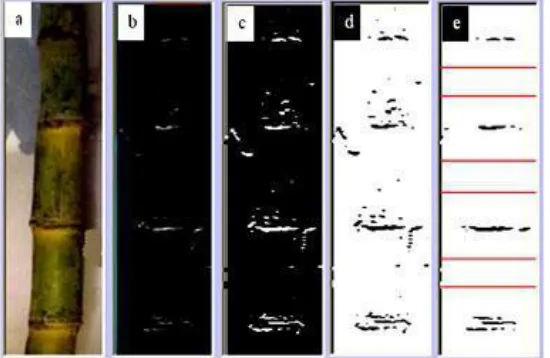
Sugarcane stalk consists of segments called joints as shown in Figure. Joint is made up of a node. Node is a place where the bud, growth ring, leaf scare and root primordial are located. Growth ring and leaf scare forms continuous edges and root primordial appear as alternative dot. Inter node distance (distance between two successive nodes) plays important role in deciding water stress and diseases in the sugarcane.
the signal to actuator to cut the node. Cutting is carried by using linear actuator. Pneumatically operated linear actuator is made with the cutter at the end, cuts the node. The node cut by cutter is carried by collector. If node is not present (or defected node) is not sensed by camera, so no cutting operation is carried, it is forwarded to another collector.
Considering the advantages of STP method of plantation and experience of agricultural researchers the proposed work starts with assumption that the sugarcane node is said to be normal if:
233 |
P a g e
Fig. Block diagram for image processing for selection of sugarcane node
The proposed methodology of identification of normal nodes is elaborated in Figure
The system consists of following important components
1. Personal Computer (PC),
2. Charged Coupled Device (CCD) camera and Lighting system, 3. Control system and Cutter,
4. Conveyor belt drive system.
3.2 Working
234 |
P a g e
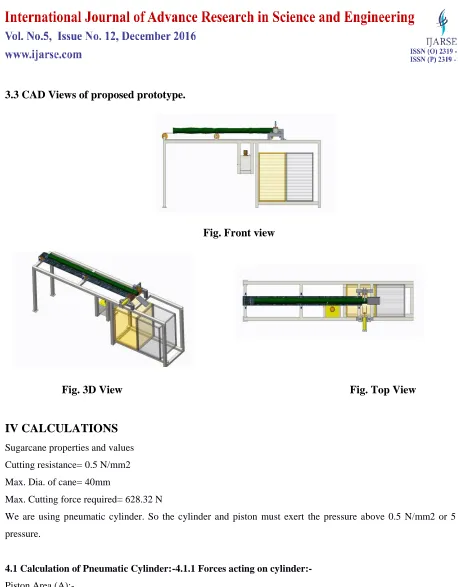
3.3 CAD Views of proposed prototype.
Fig. Front view
Fig. 3D View
Fig. Top View
IV CALCULATIONS
Sugarcane properties and values
Cutting resistance= 0.5 N/mm2
Max. Dia. of cane= 40mm
Max. Cutting force required= 628.32 N
We are using pneumatic cylinder. So the cylinder and piston must exert the pressure above 0.5 N/mm2 or 5 bar
pressure.
4.1 Calculation of Pneumatic Cylinder:-4.1.1 Forces acting on cylinder:-
Piston Area (A):- A = (/4) x D2
= (/4) x (25 x 10-3)2 = 2.01 x 10⁻⁴ m2
Piston rod Area (a):-
235 |
P a g e
= (/4) x (10 x10-3) 2= 7.85x 10⁻⁵ m2
4.1.2Force during extending stroke:-
P = F/A
6x105 = F/ (2.01 x 10⁻⁴) F= 120.6 N
Mass = F/g
= 120.6 / 9.81 Mass = 12.29 kg
4.1.3 Force during retracting stroke:-
P = F / (A-a)
6x105 = F / (2.01 x 10⁻⁴ – 7.853 x 10⁻⁵) F = 73.47 N
Theoretical force at 6 bar when advancing of piston = 125N
Piston rod threading end = M10 x 1.5 pitch
4.1.4 Node Cutting rate
It has been observed practically that time required for image processing and actuation of the actuator takes about 2 seconds for a single node to cut. The length of the belt in our project is about 1000 mm, which accommodates 7 nodes approximately.
Therefore, for 7 nodes 14 seconds are required for 1000 mm length of sugarcane. With respect to above calculation, near about 1800 nodes can be cut in 1 hour continuously with the help of our model.
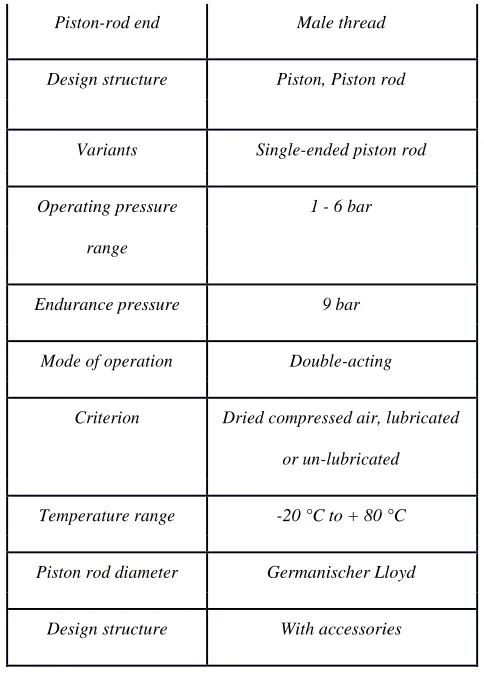
Criterion Feature
Stroke 100 mm
Piston diameter 25 mm
Piston rod diameter 10 mm
Piston rod thread M10
Speed range 50 – 800 mm/ sec
236 |
P a g e
Piston-rod end Male thread
Design structure Piston, Piston rod
Variants Single-ended piston rod
Operating pressure 1 - 6 bar
range
Endurance pressure 9 bar
Mode of operation Double-acting
Criterion Dried compressed air, lubricated
or un-lubricated
Temperature range -20 °C to + 80 °C
Piston rod diameter Germanischer Lloyd
Design structure With accessories
Table 1. Cylinder Specification
V FUTURE SCOPE
In recent years, agriculture has become less popular. Hence, the lands acquired by farmers are more and implement large scale
cultivation. Hence, to manage and tend the farms labour required will increase, thus opening a market for automation based
equipment for farming. This computer vision based machine will automate the basic task of cutting the sugarcane bud which is
used for plantation of sugarcane. In the coming years, the product will get popular along with other products which will
237 |
P a g e
VI CONCLUSION
The main aim of this review paper is to have a proper understanding of different aspects of present harvesters as well as different harvesting practices to reduce the efforts which were put in by farmers in terms of money, labour, time, physical efforts for optimum performance. Above discussed parameters will definitely provide the basic ideas associated with sugarcane harvesting. Sincere efforts must be made to design a suitable harvester in order to provide more profit, stability in terms of economic considerations and machine to be design will help Both whom having small or big farms and definitely farmer can overcome the labour crises problem.
REFERENCES
[1]. Investigation on Mechanical Properties of Sugarcane Stalks for the Development of a Whole Cane Combine
Harvester.
[2]. Adarsh J Jain , Shashank Karne , Srinivas Ratod ,Vinay N. Thotad and Kiran P , “Design and fabrication of small scale sugarcane harvesting machine”, IJMERR ISSN-2278-0149,vol-2,No-3 july2013
[3]. T. Moontree , S. Rittidech, And B. Bubphachot,“Development of sugarcane harvester using small engine in northeast Thailand”, International journal of physical sciences vol-7(44),pp-5510-5917,november2012
[4]. Makrand Patil, P. D. Patil, “Optimization of blade angle for cutting system of sugarcane harvester”
,International indexed and referred research journal, march 2013,ISSN-0975-3486,vol-4
[5]. Yuichi Kobayashi, Kanji Otsuka, Ken Tariwaki, Mitsuho Sugimoto and Kyo Kobayashi, “Devlopment of kenaf harvesting technology using a modified sugarcane harvester” ,JARQ 37(1),pp-65-69(2003)
[6]. Juan Thomos Sanchez, “ Sugarcane mechanical harvesting :future applications in sugar business in cuba” ,ASCE 2011
[7]. Yanmei Meng, Yuanling Chen ,shanping Li , Chaolin Chen , Kai Xu ,fanglan Ma,xiaobio Dai, “Research on orthogonal experiment of numeric simulation of macromolecule cleaning element for sugarcane harvester” ,august 2008 Elsevier E Meyer, “ Some measurements of mechanical sugarcane harvester performance” , proc s
afrc sugr technol ass (1999)73
[8]. D.deurveilher, F. Chiroleu, M. Chanet, J. P Chanet, D. Boffety, “ICT for traceability of sugarcane harvesting operations in small farm”.
[9]. Paulo Rodrigues Peloia, Marcos Milan and Thiago Liborio Romanelli, “Capacity of the mechanical harvesting process of sugar cane billets”, science agriculture v-67.no-6,pp-619-623,nov-dec2010