CONTOURLET TRANSFORM WITH FIREFLY
ALGORITHM FOR DESPECKLING OF SAR IMAGES
K.M.Savithri
1, Dr.I.Shanthi
21
GRG Polytechnic College, Coimbatore, Tamil Nadu, India.
2
Sree Sakthi Engineering College, Coimbatore, Tamil Nadu, India.
ABSTRACT
Nowadays, the removal of noise in image processing is a challenge for researchers. Among all noise, speckle noise existing in satellite images, medical images and Synthetic Aperture Radar images is definitely to be removed since the details of the image are corrupted. This paper provides despeckling of Synthetic Aperture Radar (SAR) images using a new method, comprising of Contourlet transform with Firefly Algorithm (FA) to enhance the edge feature and contrast of the image. Initially, the non-linear stretch and shrink Contourlet co-efficients are applied with an improved gain function to integrate the speckle reduction with feature enhancement. Then in order to optimize the result, an evolutionary computation method such as, Firefly Algorithm is employed because of its speedy convergence. The final performance of despeckled image is compared with the combination of Contourlet transform and another optimization technique called Modified Particle Swarm Optimization (MPSO). The experimental results show that the proposed method outperforms the despeckling of image so that the texture and edge details of an image are preserved.
Keywords
SAR image, Speckle noise despeckling, Contourlet transform, Firefly Algorithm, ENL, SMPI and PSNR.
I.INTRODUCTION
SAR imaging produce multiplicative speckle noise. To recover the sharp and clean image from the given noisy image caused due to image acquisition conditions, denoising is applied. SAR images can be used to interpret information and have many applications like bio-mass estimation, sea ice monitoring, crop estimation, flood control, oil spill monitoring and soil moisture content measurement. But a SAR image is inherently affected by speckle noise, which reduces the efficiency of the post processing steps in image processing and makes it more difficult to interpret. The main goal of despeckling process is to suppress the multiplicative noise while preserving all the scene features such as textures and edges. The speckle noise reduces the intensity level of image and tends to blur the image by reducing its fine details [1].
As the power of the signal increases the speckle noise will also increases by the same amount. Hence speckle is multiplicative noise and it can be explained with a standard deviation equal to its pixel reflectivity value. The speckle noise model can be represented in an equation (1) as,
f (i ,j) = g( i, j) * n ( i, j) + h (i ,j) (1)
where f (i, j) is the measured pixel level,
g (i ,j) is the desired pixel reflectivity,
n (i ,j) is the multiplicative noise and
h ( i ,j) is the additive noise.
Here i, j represent the indices of the spatial location.
Since the additive noise h (i ,j) is much less than multiplicative noise n ( i, j), it can be removed.
To fit within the display range of the envelope detected echo SAR signal is applied with logarithmic compression, which transforms the multiplicative noise into additive white Gaussian noise. This is given by,
log [f (i ,j)] = log [g (i ,j) ] + log [n (i,j) ] and rewritten as,
where log [f(i ,j)] is denoted as D (i, j) and the terms log [g(i ,j)] and log [n(i ,j)] are denoted as
X (i, j) and Y (i, j) respectively. Also the logarithmic conversion is used, that the additive noise can be easily removed.
About two decades, researchers developed many techniques to filter the speckle noise and retaining the image details. One method is that employs multiple look processing in frequency domain [2][3] thereby averaging statistically dependent looks on the same scene. This technique enhances the radiometric resolution at the expense of blurring. Next to this the classical spatial filters like Median filter, Lee filter [4], Kuan filter, Frost filter and other despeckling algorithms were used to do the filtering effectively with less computation complexity. In this type of filtering the image details are not effectively preserved resulting with blurred edges. Also single scale representation of a signal in time or frequency is inefficient as it is difficult to differentiate signal from noise and also these kinds of filters are not suitable for non-stationary scene signal. However it is still an unsolved problem and there is no comprehensive method that solve all the constraints taken into consideration. These limitations are overcome by using transforms based filtering of speckle noise.
Previously the concept of filtering with the use of Wavelet transform [5-7] , Curvelet Transform [8-11] and the combination of these two domains [12] were done. The Wavelet transform is a basic and powerful tool that acts on the despeckling of SAR images because of its properties of time-frequency localization, multiresolution, sparsity and decorrelation. It exhibits good performance in despeckling but during the filtering some artifacts occur and also it is not directional. Another problem in Wavelet domain is that it identifies only point discontinuities and not able to diagnose the direction of any line shaped discontinuity in the image. The extension of this is carried over by Curvelet transform [13, 14]. The Curvelet transform is used to provide optimal sparse approximations of piece wise smooth image but offers limited localization in the spatial domain because of its band limited nature. The other multi-scale analysis is experimented with Ridgelet transform [15]. The Ridgelet transform is only suited for discontinuities along straight line. For complex images where the edges were mainly along curves, the Ridgelet transform is not optimal.
followed by Directional Filter Banks to link the point of discontinuities into linear structure. Sparse representation for two dimensional piece wise smooth signal that resemble images is produced by Contourlet transform. Further the global search strategy, such as Firefly algorithm (FA) developed by Xin-She Yang at Cambridge University in 2007 inspired by the behavior and motion of the fireflies is applied to get the optimized result. Thus the combination of Contourlet transform with the optimization technique such as Firefly algorithm is implemented to do the despeckling of SAR images. The remainder of this paper is organized as follows: In Section II reveals about the Contourlet transform. The global search strategies, the Firefly algorithm and Particle Swarm Optimization technique are explained in Section III. The proposed method of despeckling and enhancement of SAR image based on the Contourlet with Firefly algorithm is explained in section IV. This section presents about optimization of parameters with fast convergence to integrate the speckle reduction with feature enhancement. Section V deals with the Quality evaluation metrics that decide the performance of the despeckled image and Experimental result and Analysis are focused in section VI. Section VII finally concludes the paper.
All the classical filters depend on the local statistical data related to the output denoised filter and the occurrence of the filter window over an area. Hence it is difficult to remove speckle noise without losing any data. If the filter window covers the edge of the image, the denoised output pixel value will be replaced by the statistical data from both sides of the edge of different intensity distributions.
To overcome the limitations of these spatial filters, an alternative technique has to be implemented to do the smoothing of an image with transform based operations.
2. CONTOURLET TRANSFORM
with a problem of orientation selectivity. This major drawback is overcome by the Contourlet transform which represents the multi-scale geometric analysis.
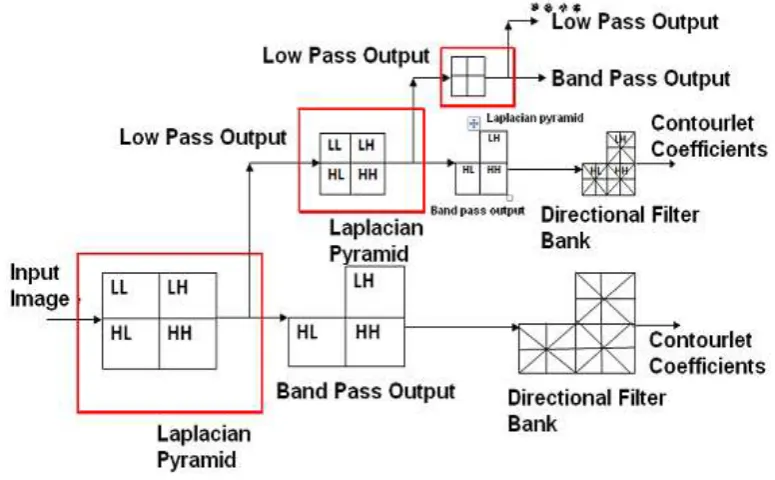
The Contourlet transform consists of two steps which is the Laplacian Pyramid (LP) decomposition and the Directional Filter Banks (DFB) as shown in Figure (1).
Fig. 1 Illustration of Contourlet Transform
The Figure(1) illustrates the construction of Contourlet transform by the Laplacian Pyramid(LP) [19,20,21] and the Directional Filter Banks(DFB)[22,23,24]. The input image consisting of frequency components like LL(Low Low), LH(Low High), HL(High Low) and HH(High High) is applied to LP which generates a low pass output(LL) and band pass outputs (LH,HL and HH). Then the Contourlet co-efficient are obtained by passing the pass band output to DFB [25]. To obtain more Contourlet co-efficients, the low pass output from the LP is applied to another LP till the fine details of the image are obtained. Hence the LP captures point discontinuities and DFB links point discontinuities to obtain linear structure of smooth contour.
3. OPTIMIZATION TECHNIQUES IN IMAGE ENHANCEMENT
There are various Metaheuristic Algorithms [26] developed to solve the optimization problems effectively. The parameters of Contourlet co-efficients are optimized by the evolutionary computation methods. There are two methods considered here to optimize the parameters of Contourlet co-efficients in the despeckling of SAR images say Firefly Algorithm (FA) [27] developed by Xin-She Yang at Cambridge university in 2007 and Particle Swarm Optimization (PSO) [28] which is a population based technique inspired by the social behavior of the bird flocking or fish schooling introduced by social psychologist James Kennedy and engineer Russell C.Eberhart during 1995. Here the improved version of PSO say Modified Particle Swarm Optimization technique is considered for comparison.
3.1 Firefly Algorithm (FA)
Numerous firefly species occupied in the sky produce short and rhythmic flashes in the moderate temperature region. Mostly specific species produce specific pattern. A kind of pattern formed by the attraction of male and female species depends upon many factors like the rhythm of the flashes, rate of flashing and the amount of time for which the flashes are observed. Fireflies communicate with each other only within a limited distance normally few hundred meters at night. The light is absorbed by air and becomes weaker, also the intensity of light decreases as the distance from the light source increases.
The brightness is proportional to the value of the objective function for a maximization problem. The variation in light intensity and formulation of attractiveness are the important points in Firefly algorithm since the attractiveness of a firefly is determined by its objective function.
The movement of firefly ‘i’ that is attracted to another more attractive (brighter) firefly ‘j’ is determined by,
p𝑖 = 𝑝𝑖+ 𝐴0𝑒−𝛾𝑑𝑖𝑗2 𝑝
𝑗 − 𝑝𝑖 + 𝛼€𝑖 (3)
where, is due to attraction, α is a randomization parameter and
Mostly A0 is considered as 1 and [0, 1].
3.2 Particle Swarm Optimization (PSO)
The Particle Swarm Optimization (PSO) algorithm is an addition to the list of global search techniques. This is well suited for continuous variable problems and has more importance in optimization community. PSO consists of a swarm of particles and finds the optimal region in the complex search space through the interaction between the particles. PSO can be easily implemented and is computationally inexpensive in terms of both memory requirement and speed. Thus this algorithm is used in the optimization of parameters in the gain function to enhance the feature of the SAR image.
The classic PSO is as follows. If the search space is D-dimensional, the position of ith particle can be represented as a D-dimensional vector Xi = (xi1, xi2, xi3…. xiD)
and the velocity of the particle as Vi= (vi1, vi2, vi3……. viD). The best previously visited
position of the ith particle is represented by Pi = (pi1, pi2, pi3 ……piD) and the global best
position of the swarm found so far is denoted by, Pg = (pg1, pg2, pg3 ……pgD). The fitness of
each particle can be evaluated by putting its position into a designated objective function. The particle’s velocity and its new position are updated as follows:
𝑣𝑖𝑑𝑡+1= 𝑤𝑡𝑣
𝑖𝑑𝑡 + 𝑐1𝑟1𝑡 𝑝𝑖𝑑𝑡 − 𝑥𝑖𝑑𝑡 + 𝑐2𝑟2𝑡 𝑝𝑔𝑑𝑡 − 𝑥𝑖𝑑𝑡
𝑥𝑖𝑑𝑡+1 = 𝑥
𝑖𝑑𝑡 + 𝑣𝑖𝑑𝑡+1
where d = {1,2,…….D}, i = {1,2,…….N}, N is the population size, the subscript t denotes the iteration number, w is an inertia weight, r1 and r2 are two random values in the range
[0,1] and c1 and c2 are the cognitive and social scaling parameters which are positive
constants. Some improvements are introduced to the classic PSO to avoid the premature of the swarm say Modified PSO. If the noise in image is more, the uncertainty of the image is also more. To integrate these two aspects, the evaluation criterion Ev (I) (to despeckle and
enhance the given image ‘I‘) is given by equation (4),
𝐸𝑣 I =
exp(𝜂(𝐼) (𝑀 𝑋 𝑁))
ln(𝐻 𝐼 ) (4)
Among these two optimization techniques the FA is potentially powerful than a favorable optimization tool [29]. Also FA includes the self-improving process and is better than PSO in terms of convergence time.
4. Proposed Methodology Of Despeckling And Enhancement Of Sar Image
The proposed despeckling and enhancement algorithms used for SAR images can be explained using the block diagram representation as shown in figure (2).
Fig. 2 Block diagram of the proposed despeckling and enhancement of SAR image.
The step by step procedure of the block diagram is explained as follows:-
The original noisy SAR image is applied to the Logarithmic transformation block in which the multiplicative noise is converted into additive Gaussian noise as discussed in equation (2). There the original SAR image, I(m,n) is changed to I’(m,n) with removable
additive noise where ‘m’ and ‘n ‘ represents the row and column of the image.
Applying Contourlet transform to I’(m,n) up to ‘n’ levels of Laplacian Pyramidal
decomposition and ‘m’ directional decomposition at each level the Contourlet co-efficients are achieved.
Then thresholding of Contourlet transformed image is performed. Thresholding is applied to the image to despeckle the image so that each pixel in an image is replaced if the pixel image intensity level is less than some fixed constant called threshold. If a Contourlet sub band coefficients is smaller than a predefined threshold it will be set to zero; otherwise it is kept unchanged, this function is known as hard thresholding. So it is seen that the thresholding step performs the initial act of image denoising by removing the unaccepted values less than threshold value. Here hard thresholding is applied.
Starck et.al [30] introduced image despeckling using hard thresholding of Curvelet co-efficients and then Starck et.al [31] proposed the modified method to enhance the edges in an image with improved gain function. Here the gain function ka is improved by
modifying the Contourlet coefficients in order to enhance edges in SAR image. The gain function ka is represented in equation (7) as,
𝑘𝑎(𝑖,𝑗 ) =
1 , 𝑖𝑓 𝑖 < 𝑎𝑗 𝑖 − 𝑎𝑗
𝑎𝑗 𝑛 2𝑎𝑗
𝑥
+2𝑎𝑗 − 𝑖
𝑎𝑗 , 𝑖𝑓 𝑎𝑗 ≤ 𝑖 < 2𝑎𝑗 𝑛
𝑖 𝑥
, 𝑖𝑓 2𝑎𝑗 ≤ 𝑖 < 𝑛 𝑛
𝑖 𝑦
, 𝑖𝑓 𝑖 ≥ 𝑛
(5)
where j = the noise standard deviation x =the degree of nonlinearity y = the dynamic range compression a = the normalization parameter
n = is a parameter and its value under which coefficients are amplified. The equation (7) works under two conditions that when,
i) n = sj where s is an additional parameter.
ii) n = þMc with þ < 1. Mc – Maximum Contourlet coefficient thus holds of relative band.
This foundation includes three T1, T2 and T3 which meet T1 = aj, T2 = 2 T1,
T3 = n and T1< T2< T3.
If n = sj the gain function is improved effectively but by taking ‘s’ as an additional parameter neither reduce the noise nor amplify the noise. Hence hard threshold is applied in the gain function to enhance the features of SAR image. This is done by simultaneously suppressing the speckle by modifying the gain function equation (5) to an equation (6) as,
𝑘𝑎(𝑖,𝑇)=
0 , 𝑖𝑓 𝑖 < 𝑇1 𝑖 − 𝑇1
𝑇1 𝑇3 𝑇2
𝑥
+𝑇2− 𝑖
𝑇1 , 𝑖𝑓 𝑇1 ≤ 𝑖 < 𝑇2
𝑇3 𝑖
𝑥
, 𝑖𝑓 𝑇2 ≤ 𝑖 < 𝑇3 𝑇3
𝑖 𝑦
, 𝑖𝑓 𝑖 ≥ 𝑇3
The main challenge in the improvement of gain function is proper selection of the parameters T1, T2, T3, x & y. Hence the parameters are optimized using
the global search Firefly Algorithm.
Apply the inverse Contourlet transform on the thresholded image and then exponential transformation is carried over to obtain the despeckled image.
The parameters for the despeckled image are computed.
Each despeckled and enhanced image is evaluated using evaluation function.
Repeat the steps till the stop condition of the Firefly Algorithm is satisfied.
5. QUALITY EVALUATION METRICS
This proposed algorithm has been implemented with MATLAB. The measurement of image enhancement is difficult to measure since there is no common algorithm used. Statistical measurement could be made to obtain the performance of the filter used to obtain the despeckled image. The effectiveness of applying the proposed algorithm to SAR image despecking is examined quantitatively using the Quality Evaluation metrics like, Mean Square Error (MSE), Root Mean Square Error (RMSE), Signal to Noise Ratio (SNR), Peak Signal to Noise Ratio (PSNR), Equivalent Number of Looks (ENL), Edge Save Index (ESI), Speckle Suppression Index (SSI) and Speckle Suppression and Mean Preservation Index (SMPI).
Let us consider the original image as ‘G (m,n)’, denoised image as ‘F (m,n)’ and ‘N (m,n)’ as noise.
5.1.1. Mean Square Error (MSE)
For any two images x and y [F and G], if one image is considered to be the noisy approximation of the other, the Mean Square Error is defined as,
𝑀𝑆𝐸 = 1
𝑥𝑦 𝐹 𝑚, 𝑛 − 𝐺 𝑚, 𝑛 2 (7) 𝑦−1
𝑛=0 𝑥−1
𝑚=0
5.1.2. Peak Signal to Noise Ratio (PSNR)
𝑃𝑆𝑁𝑅 = 20𝑙𝑜𝑔10
𝑀𝑎𝑥𝑖
𝑀𝑆𝐸 (8)
If Maxi2 is considered as Maximum Intensity of noisy image and MSE is Mean Square Error
then the higher quality image is obtained for higher value of PSNR.
RESULT ANALYSIS AND DISCUSSIONS
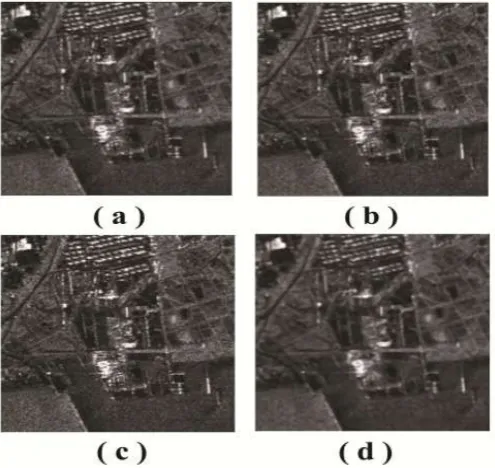
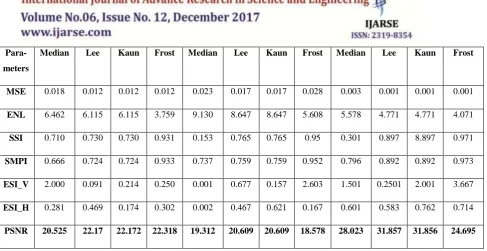
In this section, analysis of simulated results of the despeckled SAR image is presented. The despeckling procedure has been implemented using MATLAB tool and the experimental results are presented. The performance of the despeckled image is quantitatively determined by measuring all the Quality metrics of the image. Three noisy images say, the terrain of Bedfordshire, Southeast England, Horsetrack near Alburquerque and Tomakomai, Japan are taken for experimental purpose. The despeckling of these SAR images are carried over using the spatial filters like Median, Lee, Kuan and Frost filters. The despeckled image results are shown in figures 3, 4 and 5 and their Quality metrics are tabulated in Table 1.
Fig 3: Despeckled Images of Bedfordshire Using (a) Median filter
Fig 4: Despeckled Images of Horsetrack Using (a) Median filter
(b) Lee filter (c) Kuan filter (d) Frost filter
Fig 5: Despeckled Images of Tomakomai, Japan Using (a) Median filter
(b) Lee filter (c) Kuan filter (d) Frost filter
Table 1: Comparison of performance metrics of different spatial filters
Para-meters
Median Lee Kaun Frost Median Lee Kaun Frost Median Lee Kaun Frost
MSE 0.018 0.012 0.012 0.012 0.023 0.017 0.017 0.028 0.003 0.001 0.001 0.001
ENL 6.462 6.115 6.115 3.759 9.130 8.647 8.647 5.608 5.578 4.771 4.771 4.071
SSI 0.710 0.730 0.730 0.931 0.153 0.765 0.765 0.95 0.301 0.897 8.897 0.971
SMPI 0.666 0.724 0.724 0.933 0.737 0.759 0.759 0.952 0.796 0.892 0.892 0.973
ESI_V 2.000 0.091 0.214 0.250 0.001 0.677 0.157 2.603 1.501 0.2501 2.001 3.667
ESI_H 0.281 0.469 0.174 0.302 0.002 0.467 0.621 0.167 0.601 0.583 0.762 0.714
PSNR 20.525 22.17 22.172 22.318 19.312 20.609 20.609 18.578 28.023 31.857 31.856 24.695
From the results it is observed that the PSNR values are low in spatial domain classical filters. Thus to improve the performance of despeckled image by enhancing the feature and edge details, the proposed method by the combination of contourlet transform with Firefly algorithm has been implemented. The simulated results are shown in figure 6, 7 and 8 and the Quality metrics which determines the performance of filtering using the Contourlet transform with MPSO is compared with our proposed method presented in the Table 2.
(a)
Fig.6 Despeckling and Enhancement result of Bedfordshire SAR image. a. Original
image, b. Despeckled image using Wavelet Transform with FA, c. Despeckled image
using Coutourlet Transform with FA.
(a) (b) (c)
Fig.7 Despeckling and Enhancement result of Horsetrack SARimage. a. Original
image, b. Despeckled image using Wavelet Transform with FA, c. Despeckled image
using Coutourlet Transform with FA.
(a) (b) (c)
Fig.8 Despeckling and Enhancement result of Tomakomai SARimage. a. Original
image, b. Despeckled image using Wavelet Transform with FA, c. Despeckled image
using Coutourlet Transform with FA.
Table 2: Performance metrics of despeckled SAR images using Contourlet Transform
with Firefly Algorithm
The results of proposed method is compared with results of the previous algorithm, despeckling of SAR image using Contourlet Transform with Modified Particle Swarm Optimization.
From the table 2, it is observed that after simulation, the combination of Contourlet transform with Firefly Algorithm produces much improved Peak Signal to Noise Ratio (PSNR). It is also seen that, on comparison the Edge Save Index on both horizontal and vertical directions are higher in the proposed technique than Contourlet transform with Modified Particle Swarm Optimization. From the parametric results it is evident that the proposed method produces more efficient despeckled SAR image with enhanced feature and edge details.
7.CONCLUSION
In this paper, an adaptive method of speckle reduction and feature enhancement for SAR images based on Contourlet transform with Firefly algorithm have been proposed. An improved Quality metrics of the image is developed to integrate the speckle reduction with feature enhancement, by nonlinearly shrinking and stretching the co-efficients of Contourlet Parameter Contourlet Transform with MPSO Contourlet Transform with FA Contourlet Transform with MPSO Contourlet Transform with FA Contourlet Transform with MPSO Contourlet Transform with FA
MSE 0.000104 0.0012 0.000156 0.0008 0.00134 0.0004
ENL 16.7895 4.4170 30.0964 3.9763 16.692 3.5460
SSI 0.9372 0.9964 0.5627 0.9970 0.6862 1.0035
SMPI 0.9861 0.9945 0.5638 0.9964 0.6796 1.0033
ESI-H 0.8065 0.7844 0.0309 1.0946 0.2002 1.2828
ESI-V 1.0342 0.6856 0.5728 0.8246 0.0732 0.8641
transform and optimized the parameters using Firefly Algorithm. The Firefly algorithm is applied to make the speedy convergence and avoid premature convergence in optimizing the parameters. The result of the proposed method is compared with the previous technique, the despeckling using Contoulet transform with Modified Particle Swarm Optimization. After the analysis, it is concluded that the simulated and real SAR images were despeckled and their features were enhanced which provide excellent performance of despeckling with our proposed method. This is computationally expensive due to iterative operation of Firefly Algorithm and improved version may be adopted by parallel operation which will reduce the computation time effectively and can be taken as future work.
REFERENCES
1.Goodman JW and Opt.Soc.Amer J (1976) Some fundamental properties of speckle. 16(11): 1145 -1149.
2.Tinku Acharya, Ajoy K Ray (2005)Image processing: Principles and Applications.Willy- Interscience., NewJercey.
3.Poornachandra S (2008) Wavelet based denoising using sub band dependent threshold for ECG signals.Digital signal processing (18):49-55.
4.Lee G (1981) Refined filtering of image noise using local statistics. Computer Graph Image Process 15(4):380-389.
5.Xie H, Pierce LE and Ulaby FT (2002) SAR speckle reduction using wavelet denoising and Markov random field modeling. IEEE Trans. Geo. Sci. Remote Sens. 40(10): 2196-2212. 6.Dia M, Peng C, Chan AK and Loguinov D (2004) Bayesian wavelet shrinkage with edge detection for SAR image despeckling. IEEE Trans.Geoscience Remote sens. 42(8):1642-1648.
7.Ranjani JJ and Thiruvengadam SJ (2010) Dual- Tree Complex wavelet transform based SAR despeckling using interscale dependence. IEEE Trans. Geosci. Remote sens. 8(16). 8.Schimitt A, Wessel B and Roth A(1999) Curvelet approach for SAR image denoising, structure enhancement and change detection. In Proc. ISPRS, CMRTO9, Paris.
9.Candes EJ and Donoho DL (1999) Curvelets- A Surprisingly effective non-adaptive representation for objects with edges, curve and surface fitting.
11. Starck JL, Candes EJ and Donoho DL (2002) The Curvelet transform for Image denoising. IEEE Trans. Image Process.11(6):670-684.
12. Saevarrson BB and Benedicktsson JA (2004)Combined wavelet and Curveletdenoising of SAR images. in Proc. IGARSS 6(3):4255-4238.
13. CandesEJ,DemanetL,Donoho DL and Ying L(2006)Fast discrete Curvelet transforms SIAM J Multi-scale Model.Simul. 5(3):861-899.
14. Ulfarsson MO, Sveinsson JR and BenediktssonJA(2002)Speckle reduction of SAR image in the Curvelet domain, in Proc. IGARSS 315-317.
15. Candes EJ (1998) Ridgelets: Theory and applications, Ph.D Dissertation, Dept. of Statistics, Stanford Univ., Stanford CA.
16. Saevarrson BB and Benedicktsson JA (2008) Combined wavelet and Contourlet denoising of SAR images. in Proc. IGARSS 3(3):1150-115
17. Do MN and Vetterli M (2002) Contourlets: A Directional multi-resolution mage representation Proc.IEEE International Conference on Image processing. (1): 357-360. 18. Do MN and Vetterli M (2005)The Contourlet transform, an efficient directional Multiresolution image representation: IEEE Trans. Image Processing, 14(12): 2091-2106. 19. Do MN and Vetterli (2001) Pyramidal directional filter banks and Curvelets: Proc. IEEE Int. Conference on Image Processing, (3): 158- 161
20. Burt PJ and Adelson EH (1983) The Laplacian pyramid as a compact image code: IEEE Trans. on Communication, 31(4) : 532– 540.
21. Zhiling Longa B and Nicolas H. Younana (2005) Denoising of images with Multiplicative Noise Corruption : 13th European Signal Processing Conference.
22. Duncan DY Po, Do MN (2006) Directional multi-scale modeling of images using the Contourlet transform: IEEE Transactions on Image Processing, 15 (6): 1610-1620.
23. Eslami R and Radha H (2003) The contourlet transform for image denoising using cycle spinning, presented at the Asimolar Conference on Signals,S ystems and Computers, Pacific Grove, USA, 2: 1982-1986.
25. Chan WY, Law NF and Siu WC (2003) Multiscale feature analysis using directional filter bank : Proc. Joint Conference of the Fourth International Conference on Information, Communications and Signal Processing, 822-826.
26. Xin-She Yang (2008) Nature inspired Metaheurisstic Algorithms, Luniver press.
27. FarahaniSh M, Abshouri AA, Nasiri B and Meybodi MR (2011) A Gaussian Firefly Algorithm: International Journal of Machine Learning and Computing: 1.
28. Kennedy J and Eberhart R C (1995) Particle Swarm Optimization:IEEE International conference on Meural Networks, Piscataway,NJ.,1942-1948.
29. Saibal K Pal, Rai C S and Amrit Pal Singh (2012) Comparative study of Firefly Algorithm and Particle Swarm Optimization for Noisy Non-linear optimization problems, I.J. International Systems and applications, MECS,10:50-57.
30. Starck JL, Candes EJ and Donoho DL (2002) The Curvelet transform for image denoising:IEEE Trans.Image Process.11(6):670 -684.