353 |
P a g e
ULTRA WIDE BAND ENERGY DETECTION
USING COMPRESSED SENSING BASED NBI
DETECTION
Tejashri Govind Patil
E&TC, Parvatibai Genba Moze College of Engineering Wagholi, Pune, (India)
ABSTRACT
Now a day, ultra-wideband (UWB) energy detectors are developed enormously with compressed sensing (CS)
theory inenvironment of multipath fading. Wideband communication is sensitive to narrowband interference
(NBI), so it is necessary for efficient UWB energy detector to mitigate NBI-affected measurements without
harming samples containing important information. According to the traditional sampling
theorem,UWBrequires huge bandwidth for short range communication with little utilization. To avoid this
wastage of frequency band, CS process usessub-Nyquist rate and provides compressedversion of received
signal. In this paper,reconstruction-based energy detectoris presented which is robust to NBI. In this
article,notch out method is employed at the detector for the mitigationof NBI-affected measurements. Energy
detection of the UWB detector before adding NBI and aftermitigating NBI is compared. Experimental results
show that the presented energydetector is robust to NBI due to superior performance of the notch out method.
Keywords: Compressed sensing, Energy detector, Narrowband interference, ultra-wideband
Communication field
I.
INTRODUCTION
Digital communication is evident of growth in applications which consists signals of very high bandwidth. To
receive these signals, reducing the sampling rate is the challenge. Compressive sampling gives reduced and
efficient sampling than the traditional sampling rate. The ultra-wideband (UWB), impulse-radio (IR) signals are
most attractive because of their unique properties such as fine time resolution, high user capacity as well as low
probability of interception and detection [1], [2]. But, the big problems in employment of IR-UWB is power
consumption in sensitivity of wide band signals towards narrow band interference (NBI) and analog to digital
converter (ADC).
According to the FCC, UWB signals are defined as signals having a fractional bandwidth greater than 20% or
signals having an absolute bandwidth greater than 0.5 GHz [3]. There are two techniques to generate a UWB
signal. One is carrier-lessand other is carrier based. Earlier technique uses spreading schemes like frequency
354 |
P a g e
next technique is also known as impulse radio (IR) this technique uses transmission of short pulses in timedomain which occupies the complete frequency band. Its transceiver is simpler than the earlier technique of
UWB signal generation. Also, the transmit power in IR-UWB can be decreased by transmitting same
information over multiple frames, with each frame transmitting at a very low power.
According to Shannon-Nyquist-Whittaker-Kotel nikov sampling theorem [4]-[5], a band-limited signal x(t) can
be recovered fully from its sampled version x(iT) only if 𝑇≤1/(2𝐹𝑚𝑎𝑥). In other words, sampling rate should be equal to or greater than twice the maximum frequency of the signal so that signal is reconstructed completely.
But the signals with large bandwidth like UWB signals which is having 3.1-10 GHz bandcarry less information,
so that they are sparse in nature. If those signals are sampled at traditional sampling rate, ADC can be
overburdened and it requires lots of power [6]-[7], so they need to be sampled according to the amount of
information contained in the signal. It can be achieved by CS theory which is proposed by D. L. Donoho and E.
J. Candes in [8]-[9]. According to CS theory, the sparse signal can be recovered properly with lower than the
traditional sampling rate. The measurement matrix and reconstruction algorithm play important role for efficient
performance of CS theory. In this paper, we use CS to reduce receiver sampling rate and implementation
complexity as well as, digital notch to eliminate narrow band interference (NBI) effect.
Our contribution:
We show here, the NBI symbol affects severely when added with UWB symbol by using energy detection
equation provided in [10].
We use the digital notch proposed in [11], to eliminate the NBI affected measurements from the
compressed version of the received vector.
By using energy detection and bit error probability equations for Gaussian distributed channel provided in
[10], we compare the detector before adding NBI and after notching out NBI.
II.
LITERATURE SURVEY
The field of UWB communication employed with CS theory is under huge development. In [12] the receiver
which is proposed for IR-UWB communication using CS is characterized by bursty traffic and severe power
constraints. The receiver can acquire and track the channel response in any of the environmental conditions and
severe inter-symbol interference. The receiver proposed in [12] is further extended in [11] using notch out
method for NBI mitigation. The CS theory reconstructs the sparse signal and also provides the generalized
likelihood radio test (GLRT) detector for I-UWB [13]. The GLRT detector of [13]is again developed with
matching pursuit (MP) algorithm for pilot assisted IR-UWB detection in [14]. The IR-UWB detector proposed
in [14] to suppress NBI using subspace detection which also further extended in [15]. The signal can be
theoretically sub-sampled by projection matrix according to CS theory, but the multiplication of matrix and
signal needs already sampled received signal. The random matrix is not realizable using hardware also
under-sampling is uncontrollable. In CS measuring projection stage, as described in [16] these problems can be solved
by replacing random matrix with analog to information converter (AIC). But, this method does not guarantee the
355 |
P a g e
Novel differential detection method is proposed which exploits CS framework and optimization problem isformulated to jointly reconstruct the sparse signal and differentially encoded data in [17]. The differential
detection method proposed in [17] is further extended in [18] for multiple symbols using generalized likelihood
ratio tests. In [19]-[20], for CS based UWB communication methods for channel estimation are provided. In
[21], time delay estimation is provided. In [10] there are two types of CS based UWB energy detectors proposed
one is direct compressed energy detection and other is reconstruction based energy detector. TABLE 2.1 shows
the difference between both the detectors [10].
From the bellow table, we can say that both the detectors are importantin different situations with their own
applications. But these energy detectors are very sensitive to the NBI because of large bandwidth symbol. The
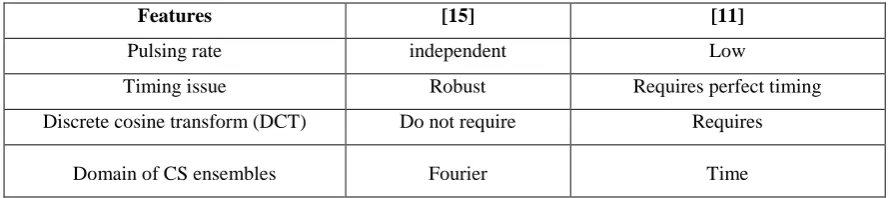
NBI affected IR-UWB measurements can be mitigated using method proposed in either [11] or [15].
Table 2.1 Comparison of direct compressed and reconstruction based UWB energy detector
[10].
Features Direct compressed energy detector
Reconstruction based energy
detector
Type of samples Compressed samples Reconstructed samples
Timing information Cannot be relaxed Can be relaxed
Measurement process Identical Independent
Theoretical BEP Requires orthogonal measurement matrix
Requires random measurement
matrix
TABLE 2.2 comparisons of NBI mitigation methods
Features [15] [11]
Pulsing rate independent Low
Timing issue Robust Requires perfect timing
Discrete cosine transform (DCT) Do not require Requires
Domain of CS ensembles Fourier Time
III.
METHODOLOGY
Compressed sensing
For conversion of the analog signal into digital with the traditional method, first step is to sample it and after
that compress by eliminating zero or near to zero valued samples. For sampling the complete signalin this
processlarge power consumption is required. But the compressed sensing unifies both, the compression and
sampling processes so it is called as compressive sampling [8]-[9]. Compressed sensing (CS) is a signal
processing technique for efficiently acquiring and reconstructing a signal, by finding solutions to
underdetermined linear systems.
356 |
P a g e
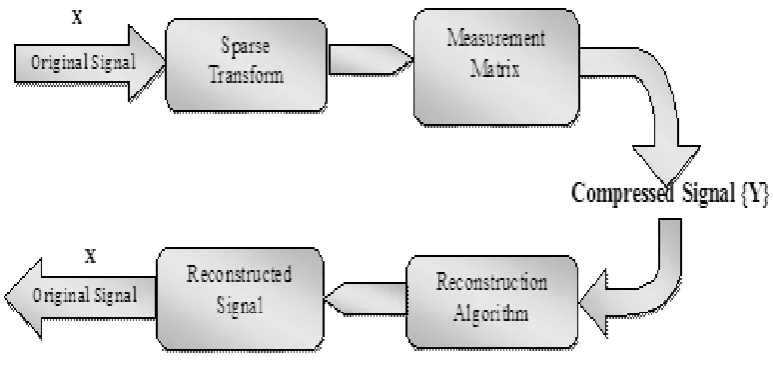
Fig. 1 Process of compressed sensing theory
As shown in Fig. 1, in the process of CS, reconstruction algorithm and measurement matrix have important
role in reconstructing and compressing the signal respectively. The linear system to be passed through the CS
process can be considered as, 𝑌=𝜙𝑋⋯ (1) where, 𝑋 is an 𝑁×1 vector of optimization variables, 𝑌 is an 𝑀×1 vector of compressed measurements as𝑀<𝑁 and 𝜙is an 𝑀×𝑁 dimensional measurement matrix. Here, sparse vector is X which contains less number of non-zero valued samples than the zero valued samples. The
measurement matrix converts the signal as ℝ𝑁→ℝ𝑀. But measurement matrix should satisfy Restricted Isometry Property (RIP) to provide recoverable compressed version of the original signal [9]. For each
integer=1,2,⋯ , RIP property define the isometry constant 𝛿𝑠 of a matrix 𝜙 as the smallest number such that , (1−𝛿𝑠)‖𝑋‖𝑙22≤‖𝜙𝑋‖𝑙22≤(1+𝛿𝑠)⋯ (2) holds for all s-sparse vectors X[9]. A vector is said to be s-sparse if it has at
most s non-zero entries. This propertyis satisfied by the random matrices like Gaussian, Bernoulli and also
structured matrix like Fourier [10]. The most challenging task in CS theory is to recover the original signal from
incomplete samples. For reconstruction process, X represents the unknown vector and the problem is to find X
from Y given 𝜙 [3]. This problem is popularly written with 𝑙2-norm as, 𝑃2: 𝑎𝑟𝑔min𝑋‖𝑋‖22𝑠𝑢𝑐ℎ𝑡ℎ𝑎𝑡𝑌=𝜙𝑋⋯ (3) The minimum norm solution can be obtained from 𝑙2-norminstead of handling individual element, it measures total energy of the vector X. It cannot reconstruct the original signal properly from compressed version. The
number of nonzero elements from X can be counted by replacing squared 𝑙2-normwith an 𝑙0-norm [3] as, 𝑃0:
𝑎𝑟𝑔min𝑋‖𝑋‖0𝑠𝑢𝑐ℎ𝑡ℎ𝑎𝑡𝑌=𝜙𝑋⋯ (4) The 𝑙0-norm solution provides sparse solution but not unique, unlike 𝑙
2-norm solution. But, the 𝑙1-norm solution provides compromise between 𝑙1-norm and 𝑙2-norm solution. In terms
of sparsity, it is closer to 𝑙0-norm where as in terms of uniqueness or being convex, it is closer to 𝑙2-norm.It can be written as, 𝑃1: 𝑎𝑟𝑔min𝑋‖𝑋‖11𝑠𝑢𝑐ℎ𝑡ℎ𝑎𝑡𝑌=𝜙𝑋⋯ (5) P1 is a convex optimization problem and can be easily solved by a linear programming (LP). P1 is also known as basis pursuit (BP) [22]. The compressed signal can be
recovered exactly under two conditions first is original signal should be sparse and second is the measurement
357 |
P a g e
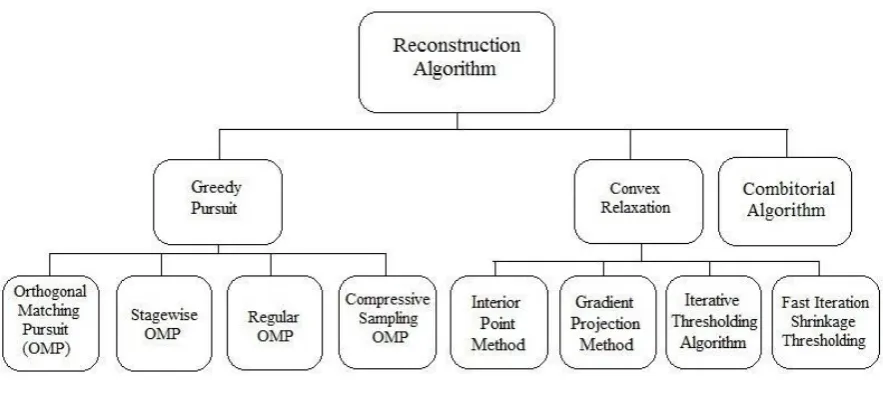
Fig. 2 Classifications of reconstruction algorithms in CS theory
First is the greedy pursuit, such as the orthogonal matching pursuit (OMP) method [24], the stage wise OMP
(StOMP) method [25] and the regularized OMP (ROMP) method [26], the compressive sampling matching
pursuit (CoSaMP) method [23], where these methods build up an approximation one step at a time. Second is
the convex relaxation algorithm, such as the interior-point method [27], the gradient projection method [28] and
the iterative thresholding algorithm [29] and the last is the combinatorial algorithms that acquire structured
samples of the signal that support rapid reconstruction by group testing [23]. Each algorithm has its own pros
and cons in a particular reconstruction problem. So the reconstruction algorithm should be chosen according to
the requirement in specific application.
System model
The system described in Fig.3 transmits the 𝑗𝑡ℎ information symbol with m-ary pulse position modulation (PPM).In PPM, the delay is added in the signal for modulation which is easy to implement. For transmitting the
𝑗𝑡ℎ information symbol, consider a signal 𝑈𝑗(𝑡) containing 𝑁𝐹 frames of length𝑇𝐹,so that the signal length
becomes 𝑇=𝑁𝐹×𝑇𝐹 and delayed by 𝑇𝑚=𝑇𝐹𝑚 for PPM modulation. The transmitted 𝑗𝑡ℎ symbol can be
represented as𝑈𝑗(𝑡)=Σ𝑏(𝑡−𝑁𝐹−1𝑖=0(𝑖+𝑗𝑁𝐹)𝑇𝐹−𝑐𝑗𝑇𝑚), where 𝑐𝑗∈(0,1,⋯,𝑚−1) and 𝑏(𝑡) is second derivative of Gaussian pulse with unit energy of duration𝑇𝑏≪𝑇𝑚.If ℎ(𝑡) is represented as impulse response of Gaussian communication channel, then the received signal is,
𝑟(𝑡)=𝑈𝑗(𝑡)∗ℎ(𝑡)+𝑤𝑗+𝐼𝑗(𝑡) (6)
where 𝑤𝑗(𝑡) and 𝐼𝑗(𝑡)is the additive noise and interference symbol of bandwidth is𝐼𝐵, corresponding to 𝑗𝑡ℎ information symbol respectively and 𝑈𝑗(𝑡)∗ℎ(𝑡)=𝑔𝑗(𝑡)is the received pulse waveform of bandwidth 𝑈𝐵 with duration 𝑇𝑔.
For Nyquist-rate sampling of the symbol, we take 𝑁 samples per frame period𝑇𝐹, whereas 𝑁/𝑚 samples for each slot. Then the 𝑖𝑡ℎ sampled frame corresponding to𝑗𝑡ℎ symbol is given by,
358 |
P a g e
for𝑘=0,1,⋯,𝑁−1. We assume that the NBI zero means, unit power elements whereas, 𝑤𝑗,𝑘𝑖 has independent identically distributed (i.i.d.) zero mean Gaussian with variance𝜎2.Fig.3 Block diagram of NBI robust UWB energy detector.
The sampling of received signal using Nyquist-rate consumes large amount of energy due to sparse nature of the
signal. The zero or near to zero valued samples produced after applying equation (7) are eliminated. By
replacing Nyquist sampling with compressed sampling this wastage of energy can be removed.
For compressing the signal, measurement matrix Φ is so chosen that it contains rows which are approximately
orthogonal to each other [10]. Now, the received signal is applied to 𝑀×𝑁 matrix Φ to get compressed version of signal. For 𝑖𝑡ℎ frame, applying CS to equation (6), we get,
𝐷
𝑗𝑖=Φ
𝑟
𝑗𝑖=
𝐺
𝑗𝑖+
𝑉
𝑗𝑖+
𝑍
𝑗(8)
where, 𝐷𝑗𝑖 is the 𝑀×1 compressed measurement vector. Similarly,𝑍𝑗𝑖and𝑉𝑗𝑖 are the compressed versions of NBI symbol and noise respectively. Along with huge advantages, the UWB symbol has sensitivity towards NBI
due to its wide bandwidth feature. The UWB measurements are deteriorated due to addition of NBI symbol and
UWB symbol. In this paper, we have applied the ‗notch out‘ method [11] to suppress the NBI affected
measurements from compressed vector. In this method, first step is to choose Fourier ensemble of magnitude
1/√𝑁and its frequency is selected from (𝐹𝑐−Ω2,𝐹𝑐+Ω2), which are decoherent with UWB signal and coherent
with NBI, to ensure that only few measurements are affected by NBI. Then, we can implement notch to mitigate
NBI affected measurements. For at most 1 NBI we find,
𝑠
=argmax
𝑠𝜖{0,1,…,𝑀−1}|
𝐷
𝑠| (9)
Now, take
𝐴
~
𝛼
𝐼𝐵𝛾, where
𝛾
=
𝑈𝐵𝑀is test function spacing and
𝛼
is nothing but the safety factor lies
between 4 to 8. The NBI mitigated measurements can be obtained by notching out
𝐴
+1 measurements
359 |
P a g e
𝑁
𝐼largest values from compressed measurement vector
D.
To reduce the time required for the frames
individually, the NBI eliminated measurements of
𝑁
𝐹frames are averaged reconstructing and applied
to approximated massage passing (AMP) algorithm to reconstruct the original signal [10]. The
iterative thresholding (ITH) algorithm has better simplicity and speed than other reconstruction
algorithms, but its performance is not good in sparsity-undersampling (SU). However, the AMP
performs well in SU along with better speed and simplicity. The AMP can be explained briefly for
𝑛
𝑡ℎiteration as follows,
𝑦
𝑗[𝑛+1]=
𝑆
(
𝑦
𝑗[𝑛]+
𝛷
𝑇𝑥
𝑗[𝑛],
𝜏
[𝑛])
(10)
where,
𝑥
𝑗[𝑛]=
𝐷
𝑗−
𝛷𝑦
𝑗[𝑛]+1
𝜇𝑥
𝑗[𝑛−1]〈𝑆
′
(
𝑦
𝑗[𝑛−1]+
𝛷
𝑇𝑥
𝑗[𝑛−1],
𝜏
[𝑛−1])
〉
(11)
Here,
𝜏
is iteratively updating threshold and
〈𝑆
′(∙)
〉
is the average of derivative all samples of
soft-thresholding over N samples. The value provided by
𝑦
𝑗𝑛is the reconstructed vector of signal. Now,
these samples are provided to reconstruction based energy detector, which is provided in [10]. For
𝑁
𝑚non-zero samples, detection is done as follows,
𝑐
̂
𝑗(𝑅−𝐸𝐷)=max
𝑐𝑗Σ[1
𝑁
𝐹Σ[
𝑏
̌
𝑘]
𝑖𝑁+𝑐𝑘𝑁𝑚+𝑝𝑁𝐹−1𝑖=0]
2𝑁𝑚−1𝑝=0(12)
The Nyquist rate energy detection is obtained by replacing reconstructed samples with Nyquist rate
samples in (12). For analysis of energy detection, the bit error probability (BEP) of both Nyquist-rate
energy detector and reconstruction based energy detector is given in same [10].
𝑃
(𝑅−𝐵𝐸𝑃)=1−2
Г
(
𝑁2)
𝑁2[
Г
(
𝑁4)]
2[
𝜎
𝑟𝜎
𝜔𝜎
𝑟2+
𝜎
𝜔2]
𝑁2×2
𝐹
1(1,
𝑁
2;
𝑁
4+1;
𝜎
𝑟2𝜎
𝑟2+
𝜎
𝜔2) (13)
Where 2
𝐹
1(∙,∙;∙;∙)is the Gaussian hyper geometric function.
𝑃
𝑁−𝐵𝐸𝑃=1−2
Г
(
𝑁2)
𝑁2[
Г
(
𝑁4)]
2[
𝜎
𝛽0𝜎
𝐹0𝜎
𝛽02+
𝜎
𝐹02]
𝑁2×2
𝐹
1(1,
𝑁
2;+1;
𝜎
𝛽02𝜎
𝛽02+
𝜎
𝐹02) (14)
Where
𝜎
𝛽02≜
(1+
𝜎2𝑁𝐹)
𝑎𝑛𝑑𝜎
𝐹02≜
(
𝜎2𝑁𝐹)
IV.
EXPERIMENTAL RESULT
This section presents the simulation results occurred from the detector developed in previous section. We
consider, the UWB signal is transmitted along Gaussian distributed physical channel with the elements having
zero mean and unit variance. The received signal is compressed by applying it to the random measurement
matrix. Let the number of interference, 𝑁𝐼=1 for experiment purpose. But, we can simulate this detector for multiple numbers of interferences. In AMP algorithm, the threshold policy is in the form of 𝜏[𝑛]=𝛿𝜎𝜔[𝑛] , which is infeasible in practice. So, threshold can be updated as suggested in [9],
𝜏
[𝑛]=
𝜏
+1
𝜇𝜏
[𝑛−1]〈𝑆
′
(
𝑥
𝑘[𝑛−1]+
𝛷
𝑇𝑦
𝑘[𝑛−1],
𝜏
[𝑛−1])
〉
(15)
where, 𝜏 is a constant.
We have considered four detectors for analysis purpose. The first detector is based on Nyquist rate sampling,
the second is based on compressive sampling i.e. nothing but reconstruction based, the third detector is having
NBI effect and in forth detector the NBI mitigation method is implemented. All the four detectors are
360 |
P a g e
compression ratio (mu) in Fig.8 – Fig.11. All the detectors have same transmission parameters. Thetransmitted second derivative of Gaussian pulse has duration of 1nsec. For experimentation purpose, we take
frame length as 100nsec and number of frames in one symbol is 30, so the duration of symbol is
multiplication of
𝑁
𝐹and
𝑇
𝐹. For every frame,
the number of samples is considered to be 200.All thedetectors are analyzed with equation (12) and (13) for energy detection and bit error probability respectively.
Due to implementation of orthogonal random matrix at compression, the plot of ABEP is following the plot of
ED in all the simulated results.
Fig.4 Comparison of Nyquist Rate and reconstruction based energy detectors w.r.t. Eb/No.
361 |
P a g e
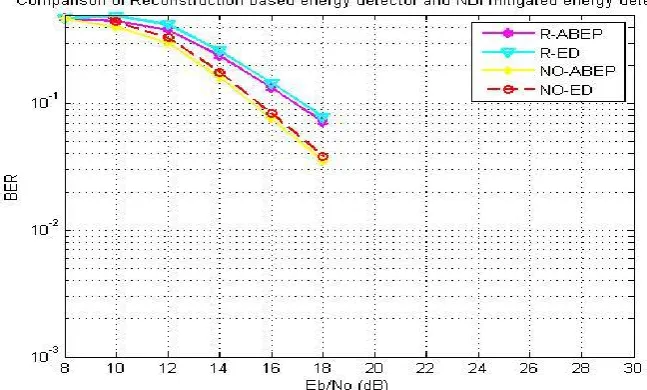
Fig. 6 Comparison of detectors in the presence of NBI and after mitigating NBI w.r.t. Eb/No
In Fig.4 and Fig.8 we can observe that, there is large difference between energy detection of Nyquist rate
based and compressive sampling based energy detectors. The CS based energy detectors gives better energy
detection than the traditional sampling based energy detectors. After adding the NBI symbol with UWB
symbol, the effect can be observed in Fig.5 and Fig.9. Then the notch out method is implemented to eliminate
the NBI affected measurements from compressed measurements. After eliminating the NBI effect, it is
compared with the detector having NBI effect in Fig.6 and Fig.10. The Fig.7 and Fig.11 shows the
effectiveness of the notch out method to remove the NBI from the compressed version of the signal. The
energy detection of the detector in the absence of NBI and after mitigating NBI is similar. It is the evident that
the notch out method will remove the NBI successfully.
362 |
P a g e
Fig.8 Comparison of Nyquist rate energy detector and compressed sampling based energy
detector w.r.t. mu
Fig.9 Comparison of energy detector in the absence of and in the presence of NBI
363 |
P a g e
Fig.11 Comparison of energy detector in the absence of NBI and after mitigating NBI w.r.t m
V.
CONCLUSION
In this paper, we have developed compressed sensing-based UWB energy detector for narrowband interference
it is robust. Due to reduction in sampling rate than the traditional sampling rate this detector consumes less
power. The wideband communication is sensitive to NBI; so that we have implemented the method which
mitigates the NBI-affected measurements from compressed version of the received signal without harming
much of the other measurements. From the simulated results, thus we have observed that CS-based energy
detection is better than the Nyquist rate energy detection
REFERENCES
[1] M. Ghavami, L. B. Michael, and R. Kohno, Ultra Wideband Signaland Systems in
CommunicationEngineering, 2nd ed. New York, NY,USA: Wiley, 2007.
[2] M. Z. Win and R. A. Scholtz, ―Impulse radio: How it works,‖ IEEECommun. Lett., vol. 2, no. 2, pp. 36–38,
Feb. 1998.
[3]ShahzadGishkori, ―Compressive Sampling for Wireless Communications‖, 2014
[4] Vetterli M., Marziliano P., and Blu T. Sampling signals with finite rate of innovation. IEEE Transactions on
Signal Processing, 50(6):1417–1428, June 2002.
[5] M. Unser. Sampling—50 years after shannon. In Proceedings of the IEEE, volume 88, pages 569–587, April
2000.
[6] B. Le, T. Rondeau, J. Reed, and C. Bostian, ―Analog-to-digital converters,‖ IEEE Signal Process. Mag., vol.
22, no. 6, pp. 69–77, Nov. 2005.
[7] R.Walden, ―Analog-to-digital converter survey and analysis,‖ IEEE J. Sel. Areas Commun., vol. 17, no. 4,
pp. 539–550, Apr. 1999.
[8] D. L. Donoho. Compressed sensing. IEEE Transaction on Information Theory, 52(4):1289–1306, April
364 |
P a g e
[9] E. J. Candes, J. Romberg, and Tao T. Robust uncertainty principles: Exact signal reconstruction from highlyincomplete frequency information. IEEE Transaction on Information Theory, 52(2):489–509, February
2006.
[10] S. Gishkori and G. Leus. Compressive sampling based energy detection of ultra-wideband pulse position
modulation. IEEE Transaction, Signal Processing, 61(15):3866–3879, 2013.
[11] Anand Oka and Lutz H.-J.Lampe. Compressed sensing reception of burstyuwb impulse radio is robust to
narrow-band interference. In GLOBECOM, pages 1–7. IEEE, 2009.
[12] Anand Oka and Lutz Lampe. A compressed sensing receiver for uwb impulse radio in bursty applications
like wireless sensor networks. Physical Communication, 2(4):248–264, December 2009.
[13] Z. Wang, G. R. Arce, J. L. Paredes, and B. M. Sadler.Compressed detection for ultra-wideband impulse
radio. In Signal Processing Advances in Wireless Communications (SPAWC), 2007, pages 1–5. IEEE, June
2007.
[14] Zhongmin Wang, Gonzalo R Arce, Brian M Sadler, Jose L Paredes, and Xu Ma. Compressed detection for
pilot assisted ultra-wideband impulse radio. In IEEE International Conference on Ultra-Wideband, 2007.
ICUWB 2007., pages 393–398. IEEE, 2007.
[15] Z. Wang, G.R. Arce, B.M. Sadler, J.L. Paredes, Sebastian Hoyos, and Zhuizhuan Yu.Compressed uwb
signal detection with narrowband interference mitigation.In IEEE International Conference on
Ultra-Wideband, 2008. ICUWB 2008., volume 2, pages 157–160. IEEE, 2008.
[16] Weidong Wang, Shafei Wang, Jun an Yang, and Hui Liu. Undersampling of ppm-uwb communication
signals based on cs and aic. Springer publication on Circuits Systems and Signal Processing, March 2015.
[17] ShahzadGishkori, Geert Leus and Vincenzo Lottici Compressive Sampling Based Differential Detection for
UWB Impulse Radio Signals 2012 Elsevier.
[18] ShahzadGishkori, Vincenzo Lottici and Geert Leus, Compressive Sampling Based Multiple Symbol
Differential Detection for UWB Communications 2014 IEEE.
[19]Jose L Paredes, Gonzalo R Arce, and Zhongmin Wang. Ultra-wideband compressed sensing: channel
estimation. IEEE Journal on Signal Processing, 1(3):383–395, Oct. 2007. [20] Peng Zhang, Zhen Hu,
Robert C. Qiu, and Brian M. Sadler. A compressed sensing based ultra-wideband communication system.
In Proceedings of the 2009 IEEE International Conference on Communications, pages 4239–4243,
Piscataway, NJ, USA, 2009. IEEE Press.
[21] K. Gedalyahu and Y. C. Eldar. Time-delay estimation from low-rate samples: A union of subspaces
approach. IEEE Transaction on Signal Processing, 58(6):3017–3031, June 2010.
[22] S. S. Chen, D. L. Donoho, Michael, and A. Saunders, ―Atomic decomposition by basis pursuit,‖ SIAM
Journal on Scientific Computing, vol. 20, pp. 33–61, 1998.
[23] Deanna Needell and Tropp Joel A. Cosamp: Iterative signal recovery from incomplete and inaccurate
samples. ACM Transaction on Communication, 53(12):93–100, December 2010.
[24] Tropp JA, Gilbert AC. Signal recovery from random measurement via orthogonal matching pursuit. IEEE
Trans Inform Theory 2007;53(12):4655–66.
[25] Donoho DL, Tsaig Y, Drori I, Starck JL. Sparse solution of underdetermined linear equations by stagewise