179 | P a g e
LAPLACE TRANSFORM AND ITS APPLICATIONS
Manchala Sabitha
Dept of Mathematics. DIET, Hyderabad (India)
ABSTRACT
An introduction to Laplace Transform is the topic of this paper. It deals with what Laplace Transform is, and
what is it actually used for. The definition of Laplace Transform and most of its important properties have been
mentioned with detailed proofs. This paper also includes a brief overview of Inverse Laplace Transform. A
number a methods used to find the time domain function from its frequency domain equivalent have been
explained with detailed explanations. It also includes the formulation of Laplace Transform of certain special
function like the Heaviside’s Unit Step Function and the Dirac Delta Function. A few practical life applications
of Laplace Transform have also been stated.
Keywords: Laplace Transform, Heaviside’s, properties, Dirac Delta.
I. INTRODUCTION
This paper deals with a brief overview of what Laplace Transform is and its application in the industry. The Laplace Transform is a specific type of integral transform. Considering a function f (t), its corresponding Laplace Transform will be denoted as L[f(t)], where L is the operator operated on the time domain function f(t). The Laplace Transform of a function results in a new function of complex frequency s. Like the Fourier Transform, the Laplace Transform is also used in solving differential and integral equations. It is also predominantly used in the analysis of transient events in the electrical circuits where frequency domain analysis is used.Important analytical method for solving linear ordinary differential
II. DEFINITION OF LAPLACE TRANSFORM
Consider a function of time f(t). If this function satisfies certain conditions and if the integral, ∅(s) = 𝑒0∞ −𝑠𝑡𝑓 𝑡 𝑑𝑡 Exists, then ∅(s) represents the Laplace Transform of f(t), i.eL[f(t)]= 𝑒0∞ −𝑠𝑡𝑓(𝑡)𝑑𝑡 …(1)
III. PROPERTIES AND THEOREMS OF LAPLACE TRANSFORM
3.1 Linearity Property: If𝑘1 and 𝑘2 are constants, then, 𝐿[𝑘1𝑓1 𝑡 + 𝑘2𝑓2 𝑡 = 𝑘1𝐿 𝑓1 𝑡 +
𝑘2𝐿[𝑓2(𝑡)]………(2)
3.2 Change of Scale Property:
A linear multiplication or division of a constant with the
variable is known as scaling. Thus, ife L[f(t)]=∅(s) then by change of scale property,𝐿 𝑓 𝑎𝑡 =
1 𝑎∅
𝑠
𝑎 … … … (3)
3.3 First Shifting Theorem
180 | P a g e
3.4 Second Shifting Theorem
The Second Shifting Theorem of Laplace Transform states that ifL[f(t)]=∅(s), then the Laplace Transform of thefollowing function,𝑔 𝑡 = 𝑓 𝑡 − 𝑎 𝑤𝑒𝑛 𝑡 > 𝑎 𝑎𝑛𝑑 𝑔 𝑡 = 0 𝑤𝑒𝑛 𝑡 < 𝑎.Is expressed as L[g(t)]=𝑒−𝑎𝑠∅(𝑠)………….(5)
3.5 Multiplication of powers of the variable
The variable that has been used so far is‘t’. Thus, if wemultiply powers of t with the original function f (t),
theLaplace transform can be expressed as𝐿 𝑡𝑛𝑓 𝑡 = −1 𝑛 𝑑
𝑛
𝑑𝑠𝑛∅ 𝑠 … … . 6 3.6 Division of variable
If L[f(t)]=∅(s), then the Laplace Transform when thefunction is divided by the variable can be expressed as𝐿 𝑓 𝑡
𝑡 = ∅ 𝑠 … … . (7)
∞
𝑠
IV. LAPLACE TRANSFORM OF DERIVATIVES
Let f (t) be the time domain function. The LaplaceTransform of its derivative can be expressed as𝐿 𝑓/ 𝑡 =
𝑠𝐿 𝑓 𝑡 − 𝑓 0 … … … . . (8)
V. LAPLACE TRANSFORM OF INTEGRALS
When the time domain function is integrated, its LaplaceTransform can be expressed as,𝐿[ 𝑓 𝑢 𝑑𝑢] =0𝑡
1𝑠∅𝑠…….(9)
VI. INVERSE LAPLACE TRANSFORM
6.1 Definition
If L[f(t)] = ∅(s) = 𝑒0∞ −𝑠𝑡𝑓 𝑡 𝑑𝑡, then f (t) is called theInverse Laplace Transform of∅(𝑠). It can be denoted as,𝐿−1 ∅ 𝑠 = 𝑓 𝑡 … … … . (10)
Thus, the frequency domain function ∅(s) can beconverted to its corresponding time domain equivalent f Converted to its corresponding time domain equivalent f(t) using the Laplace Inverse operator (𝐿−1).
VI. DIFFERENT METHODS OF OBTAINING INVERSE LAPLACE TRANSFORM
There are numerous ways to obtain the Inverse Laplace Transform of a given frequency domain function. The choice of the method employed in solving a problem on Inverse Laplace Transform depends on the nature and structure of the problem itself. Often it would be notedthat a single problem can be solved by multiple methods .A few methods have been explained below.
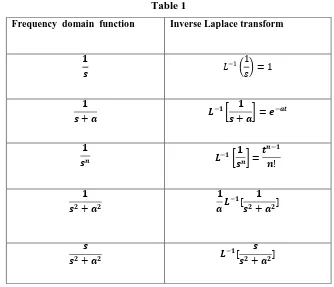
7.1 Using Standard Results
181 | P a g e
Table 1
7.2 Using First Shifting Theorem
First Shifting Theorem can be expressed as, 𝐿[𝑒−𝑎𝑡f(t)]=∅ 𝑠 + 𝑎 this means that if f(t)=𝐿−1 ∅ 𝑆 then𝐿−1 ∅ 𝑆 + 𝑎 = 𝑒−𝑎𝑡𝑓 𝑡 = 𝑒−𝑎𝑡𝐿−1 ∅ 𝑠 ………..(11)
7.3 Use of Partial Fractions
Whenever possible, it is always easier to solve a problem on Inverse Laplace Transform by expressing the given function ∅(s) into a sum of linear or quadratic partial fraction as,
∅(s) = 𝐴
(𝑠+𝑎)𝑟 + 𝐵𝑠+𝑐
(𝑠2+𝑎2)𝑟 and then use standard results given in table 1 to find corresponding Inverse Laplace
Transform.
7.4 Using Change of Scale Property
From equation 3, the change of scale property can be expressed as,L[f(at)]=1𝑎∅(𝑎𝑠)
Thus if f(t) =𝐿−1 [ ∅(s) ], taking Inverse Laplace Transform,𝐿−1[𝑎1∅(𝑎𝑠)]=f(at)…….(12)
7.5 Convolution Theorem
7.5.1 Definition
If 𝑓1 𝑡 𝑎𝑛𝑑 𝑓2(𝑡) and are two functions, then the following integral 𝑓0𝑡 1 𝑢 𝑓2 𝑡 − 𝑢 𝑑𝑢
Is called the convolution of 𝑓1 𝑡 𝑎𝑛𝑑 𝑓2 𝑡 and is denoted
as𝑓1 𝑡 * 𝑓2 𝑡
∴𝑓1(𝑡)∗𝑓2(𝑡)) = 𝑓1 𝑢 𝑓2 𝑡 − 𝑢 𝑑𝑢 𝑡
0 …….(13) 7.5.2 Theorem
Let L[𝑓1(𝑡)] = ∅1(𝑠) 𝑎𝑛𝑑 𝐿[𝑓2(𝑡)] = ∅2(𝑠) 𝑡𝑒𝑛 𝐿−1[∅1 𝑠 ∅2 𝑠 = 𝑓0𝑡 1 𝑢 𝑓2 𝑡 − 𝑢 𝑑𝑢…(14)
Where 𝑓1 𝑡 = 𝐿−1 ∅1 𝑠 𝑎𝑛𝑑𝑓2 𝑡 = 𝐿−1[∅2 𝑠 ]
Frequency domain function Inverse Laplace transform
𝟏
𝒔 𝐿−1
1 𝑠 = 1
𝟏
𝒔 + 𝒂 𝑳−𝟏
𝟏
𝒔 + 𝒂 = 𝒆−𝒂𝒕
𝟏
𝒔𝒏 𝑳−𝟏
𝟏 𝒔𝒏 =
𝒕𝒏−𝟏
𝒏!
𝟏 𝒔𝟐+ 𝒂𝟐
𝟏 𝒂𝑳−𝟏[
𝟏 𝒔𝟐+ 𝒂𝟐]
𝒔
𝒔𝟐+ 𝒂𝟐 𝑳−𝟏[
182 | P a g e
7.6 Using Differentiation of ∅(s)
If L[f(s)] = ∅(s), then using n=1 in equation 6,L[t f(t)]=-∅1(𝑠)
∴𝑡 𝑓 𝑡 = −𝐿−1[∅1 𝑠 ]
∴𝑡 𝐿−1[∅ 𝑠 = −𝐿−1[∅1 𝑠 ]
∴𝐿−1[∅(s)] = - 1 𝑡𝐿
−1[∅1 𝑠 ]…….. (15)
This method is particularly used to find the Inverse Laplace Transform of functions having
𝑡𝑎𝑛−1𝑥, 𝑐𝑜𝑡−1𝑥 𝑎𝑛𝑑 𝑙𝑜𝑔𝑥 𝑡𝑒𝑟𝑚𝑠. 7.7 Using Integration of f (t)
Equation (9) gives us the result of the Laplace Transform when the function f (t) is integrated as
shown,L[ 𝑓0𝑡 𝑢 𝑑𝑢] =1
𝑠∅(𝑠)
∴ 𝑓 𝑢 𝑑𝑢 = 𝐿−1 1 𝑆∅(𝑠)] 𝑡
0 But by definition, f(u) =𝐿−1 [∅(s)]
∴𝐿−1 1
𝑆∅ 𝑠 = 𝐿
−1 ∅ 𝑠 𝑑𝑠 … . . (16) 𝑡
0
VIII. LAPLACE TRANSFORM OF PERIODIC FUNCTIONS
Considering f (t) to be a periodic function with period a, it’s Laplace Transform can be expressed as,𝐿 𝑓 𝑡 =
1
1−𝑒−𝑎𝑠 𝑒−𝑠𝑡 𝑎
0 𝑓 𝑡 𝑑𝑡….. (17).
IX. HEAVISIDE’S UNIT STEP FUNCTION
Heaviside’s Unit Step Function can have only two possible values either 0 or 1. It can be defined as, 𝐻 𝑡 = 0, 𝑡 < 0
1, 𝑡 ≥ 0The function takes a jump of unit magnitude at x=0.
Taking the Laplace transform of the above function
L[H(t)]= 𝑒0∞ −𝑠𝑡H(t)dt
∴𝐿 𝐻 𝑡 = 𝑒∞ −𝑠𝑡
0 dt
= L[1]
∴L[H(t)]=1
𝑠 …....(18)
X. IMPULSE FUNCTION (OR DIRAC DELTA FUNCTION)
The impulse function is obtained by taking the limit of the rectangular pulse as its width, tw, goes to zero but holding the area under the pulse constant at one.
Solution of ODEs by Laplace Transforms Procedure:
Take the L of both sides of the ODE.
Rearrange the resulting algebraic equation in the s domain to solve for the L of the output variable, e.g., Y(s).
Perform a partial fraction expansion.
183 | P a g e
XI. APPLICATIONS
Laplace Transforms are put to incredible amount of use insolving differential equations and in circuit analysis whichinvolves the components like resistors, inductors and capacitors. Most often, during circuit analysis, the timedomain equations are first written and then Laplace Transform of the time domain equation is taken to convertit to its frequency domain equivalent. However, it is alsopossible to convert the circuit impedance into itsfrequency domain equivalent and then proceed, both ofwhich produce the same result.
XII. CONCLUSION
This paper thus, consisted of a brief overview of what Laplace Transform is, and what is it used for. The primary use of Laplace Transform of converting a time domain function into its frequency domain equivalent was also discussed. Major properties of Laplace Transform and a few special functions like the Heaviside’s Unit Step Function and Dirac Delta Functions were also discussed in detail. It also included a detailed explanation of Inverse Laplace Transform and the various methods that can be employed in finding the Inverse Laplace Transform. It goes without saying that Laplace Transform is put to tremendous use in many branches of Applied Sciences.
REFERENCES
[1] www.tutorial.math.lamar.edu [2] www.sosmath.com
[3] Prof. Algonda Desai, Msc. Mathematics