__________________________________________________
ISSN No: 0975-7384
J. Chem. Pharm. Res., 2010, 2(2): 330-338
330
Effect of wax on the release pattern of drugs from the sustained
release fatty matrix tablet
Swati Jagdale*, Swapnil Ghorpade, Dhaval Bhavsar, Bhanudas Kuchekar and Aniruddha Chabukswar
MAEER’s, Maharashtra Institute of Pharmacy, Kothrud, Pune, Maharashtra, India
______________________________________________________________________________
Abstract
The sustained release fatty matrix tablet of Diclofenac sodium and Theophyllinee were prepared using melt granulation technique. The tablets were prepared using carnauba wax (CW) and stearic acid (SA) / emulsifying wax (EW) in the varying ratios. The evaluation of granules was done for angle of repose, Hausner`s ratio, Carr`s compressibility index, and sieve analysis. Tablets were evaluated for hardness, friability, content uniformity, weight variation and dissolution test. The dissolution study show the controlled release of the drug from tablets depending on concentration of wax. The invitro dissolution study show that for the formulation of Diclofenac prepared by using highest concentration of carnauba wax show maximum sustained activity whereas for tablets of Theophylline, the formulation containing highest concentration of stearic acid show maximum sustained release activity.
Keywords: Melt granulation, sustained release, matrix tablet, carnauba wax, stearic acid, emulsifying wax.
______________________________________________________________________________
Introduction
100-331
300mg/day. The sustained release dosage form is required to improve the bioavailability of drug and the patient compliance.
Theophylline (1, 3- dimethyl-3, 7- dihydro-1 H-purine- 2, 6- dione), is a slightly water soluble drug. Theophylline is the methyl xanthine derivative used as a bronchodilator in the treatment of bronchial asthma and chronic obstructive pulmonary disease (COPD). The elimination half life of Theophylline in adults is 7-12 hours. Theophylline has the narrow margin of safety, as the concentration of drug in the blood increases above 25-30µ g/ml it may cause severe side effects. The dose of Theophylline is 100-300 mg. Hence, to avoid the side effects the sustained release dosage form is required which release the drug in controlled manner and maintain the concentration of the drug in therapeutic range. [1-3]
Sustained release dosage form has various advantages over conventional dosage form in aspects of clinical efficacy and patient compliance. The matrix system is commonly used for manufacturing sustained release tablet dosage form. Melt granulation has various advantages over the conventional wet granulation method as the liquid addition and subsequent drying steps are omitted. Melt granulation technique involves the formation of fatty wax matrix in which drug is embedded resulting in controlled release of the drug from the fatty matrix. The carnauba wax, emulsifying wax and stearic acid in various concentration mixtures are used to form the dissolution rate controlled release tablets. The fatty wax excipients have a melting range between 500 -800 C. Hence attempts have been made to develop extended release matrix tablets of Diclofenac sodium and Theophylline separately, using wax such as carnauba wax, emulsifying wax and stearic acid. [4, 5]
Materials and Methods
Materials
Diclofenac sodium and Theophylline was obtained from JCPL, Jalgaon as a gift sample. Carnauba wax (CW), stearic acid (SA) and emulsifying wax (EW) were of the pharmaceutical grades.
Methods
a) Preparation of Diclofenac Na and Theophylline tablets:- Preparation of matrices by melt granulation method:-
The tablets containing varying concentrations of the wax are prepared according to the formula given in Table 1 and 2.
332
Table 1 Formulation of Diclofenac sodium tablets
Sr.No. Formulation Drug Carnauba wax Stearic acid Emulsifying wax Silicon dioxide Magnesium stearate
1. DS-1 110 110 110 - 20 40
2. DS-2 110 100 120 - 20 40
3. DS-3 110 120 100 - 20 40
4. DE-1 110 110 - 110 20 40
5. DE-2 110 100 - 120 20 40
6. DE-3 110 120 - 100 20 40
(All the quantities are in mg.)
Table 2 Formulation of Theophylline tablets
Sr.No. Formulation Drug Carnauba wax Stearic acid Emulsifying wax Silicon dioxide Magnesium stearate
1. TS-1 175 87.5 175 - 20 40
2. TS-2 175 175 87.5 - 20 40
3. TS-3 175 131.5 131.5 - 20 40
4. TE-1 175 87.5 - 175 20 40
5. TE-2 175 175 - 87.5 20 40
6. TE-3 175 131.5 - 131.5 20 40
(All the quantities are in mg.)
b) Characterization of granules
The granules were evaluated for various parameters such as angle of repose, hausner`s ratio, Carr`s compressibility index, and sieve analysis.
Angle of repose:-
The angle of repose is a relatively simple technique for estimation of the flow property of a powder. Powders with low angle of repose are free flowing and those with a high angle of repose are poorly flowing powders [6, 7]
10 gm of granules were passed through funnel and the pile was formed. The height and weight of the pile was measured and the angle of repose was calculated by using the formula:-
Angle of repose (θ) = tan-1 height /radius.
Carr`s compressibility index:-
The Carr’s compressibility index was calculated by calculating the tapped and bulk density using the 100 ml measuring cylinder. Compressibility is calculated by the formula.
Carr`s compressibility index = bulk density- tapped density X 100 ---
333
A carr`s index greater than 25 is considered to be an indication of poor flowability, and below 15, of good flowability.
Particle Size distribution:-
The particle size distribution of granules was evaluated by sieve analysis using standard sieves in the range of sieve no. 10-36. The fraction was collected and weighed.
c) Characterization of tablets
The characterization of tablets is done for various parameters such as thickness, hardness, friability, content uniformity, weight variation and dissolution test.
Thickness:-
Thickness of tablets was determined using vernier caliper. Five tablets of each batch were used and average values were calculated.
Hardness:-
For each formulation, the hardness of 6 tablets was determined using the Monsanto hardness tester.
Friability:-
For each formulation, the friability of 20 tablets was determined using the Roche friabilator. In this test tablets were subject to the combined effect of shock abrasion by utilizing a plastic chamber which revolves at a speed of 25 rpm, dropping the tablets to a distance of 6 inches in each revolution. A sample of pre weighted 20 tablets was placed in Roche friabilator which was then operated for 100 revolution i.e. 4 mins. The tablets were then dusted and reweighed. Percent friability (%F) was calculated as follows,
% F= (loss in weight / initial weight) x 100. [6-9]
Drug content and percentage yield:-
To calculate the drug content and percentage yield, the tablets were triturated in the morter. Ten milligrams of the tablet powder was added to 10 mL of distilled water and drug solution was filtered through Whatman paper no.1. The sample was analyzed for drug content by UV spectrophotometry (Varian Cary 100) at 276.28 nm for Diclofenac and 271.60nm for Theophylline after suitable dilutions. Drug stability in the dissolution medium and distilled water was checked for a period of 8 hours. Percentage yield of each formulation was calculated. [5]
In Vitro Dissolution Studies
334
[image:5.595.79.518.200.418.2]method. Absorbance of these solutions was measured at 276.28 nm for Diclofenac and 271.60nm for Theophylline using a varian cary100 double beam UV spectroscopy. Cumulative percentage drug release was calculated using an equation obtained from a standard curve and using PCP Disso v3 software. [4-6]
Table 3 Evaluation of granules
Sr. No.
Formulation Angle of repose Hausner`s ratio Carr`s compressibility index
1. DS-1 21.11o 1.174 14.447
2. DS-2 18.886 o 1.186 14.943
3. DS-3 17.96 o 1.137 11.568
4. DE-1 19.86 o 1.153 13.294
5. DE-2 20.863 o 1.200 16.686
6. DE-3 18.756 o 1.112 10.084
7. TS-1 21.11 o 1.098 9.0077
8. TS-2 18.886 o 1.07 6.6859
9. TS-3 17.96 o 1.111 9.9352
10. TE-1 19.86 o 1.124 11.6860
11. TE-2 20.86 o 1.085 8.9874
12. TE-3 18.75 o 1.112 10.084
Table 4 Evaluation of tablets
Sr. No.
Formulation Thickness (mm)
Hardness (Kg/cm2)
Friability (%)
Drug Content (%)
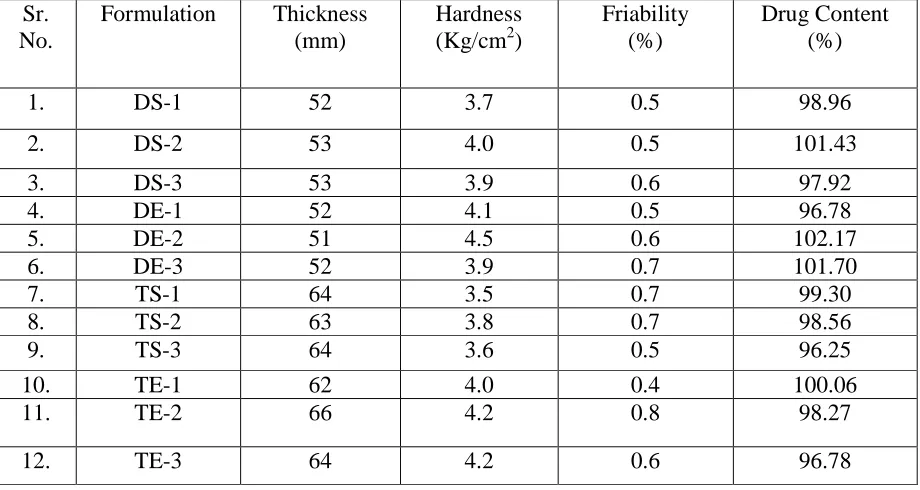
1. DS-1 52 3.7 0.5 98.96
2. DS-2 53 4.0 0.5 101.43
3. DS-3 53 3.9 0.6 97.92
4. DE-1 52 4.1 0.5 96.78
5. DE-2 51 4.5 0.6 102.17
6. DE-3 52 3.9 0.7 101.70
7. TS-1 64 3.5 0.7 99.30
8. TS-2 63 3.8 0.7 98.56
9. TS-3 64 3.6 0.5 96.25
10. TE-1 62 4.0 0.4 100.06
11. TE-2 66 4.2 0.8 98.27
[image:5.595.67.527.457.702.2]335
Results and Discussion
The granules thus prepared using various wax concentrations were evaluated and the results thus obtained are given in table 3.
From the evaluation of granules it was observed that the angle of repose was found between 17-21o. This indicates that the granules have the good flow property. Also, the carr`s compressibility index of all the granules was found below 15. This is also the indicator of the good flowability.
The hardness of the tablets was found between 3.5 and 4.5. This indicates the sufficient hardness imparted by the wax to the tablets. The percent drug content was also observed within the desired range between 96-102 %. From the observed evaluation parameters, DS-2 and TE-1 shows the most satisfactory results for hardness, friability and content uniformity.
[image:6.595.157.442.306.466.2]In vitro drug release profile:-
Fig 1 Dissolution Profile of Diclofenac sodium tablets containing CW and SA
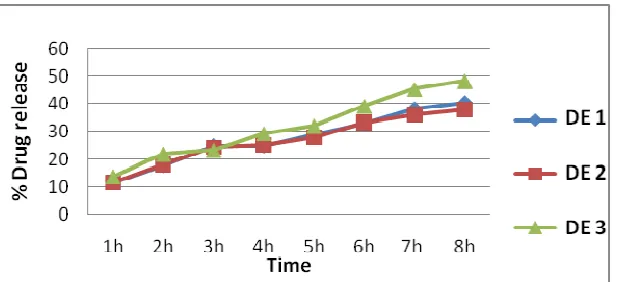
Fig 2 Dissolution Profile of Diclofenac sodium tablets containing CW and EW
[image:6.595.146.456.504.645.2]336
more concentration of CW shows least quantity of drug released and the formulation containing equal amount of CW and SA show maximum drug release after 8 hrs.
Whereas, for the formulation containing EW, the % drug release was observed in the order: DE-2> DE-1>DE-3. Maximum drug release was observed in the formulation containing minimum concentration of EW and formulation containing highest concentration of EW shows minimum drug release. This indicates that EW retards the drug release from the formulation.
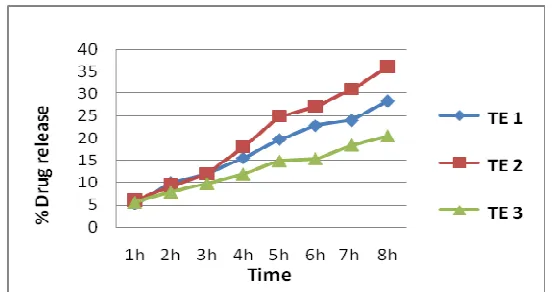
[image:7.595.160.437.477.623.2]For the formulation containing Theophylline, the % drug release in the tablets containing CW and SA was observed in the order: TS-1> TS-3> TS-2. This indicates that the SA retards the drug release from formulation as it shows minimum drug release after 8 hrs. Also for the tablets containing CW and EW, the % drug release pattern was observed in the order: TE-3 > TE-1> TE-2. Hence, it was observed that the formulation containing least quantity of EW shows more drug release within 8 hrs.
Fig 3 Dissolution Profile Theophyllinee tablets containing CW and SA
Fig 4 Dissolution Profile of Theophylline tablets containing CW and EW
Release Experiments:-
337
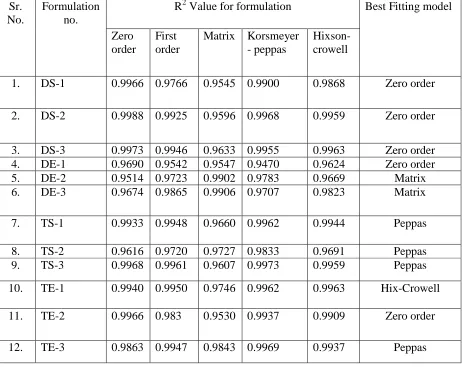
[image:8.595.69.531.174.541.2]model and the release exponent n was calculated using PCP Disso v3 software. Table 5 shows the data for kinetics of tablets.
Table 5 Kinetic release data
Sr. No.
Formulation no.
R2 Value for formulation Best Fitting model
Zero order
First order
Matrix Korsmeyer - peppas
Hixson- crowell
1. DS-1 0.9966 0.9766 0.9545 0.9900 0.9868 Zero order
2. DS-2 0.9988 0.9925 0.9596 0.9968 0.9959 Zero order
3. DS-3 0.9973 0.9946 0.9633 0.9955 0.9963 Zero order
4. DE-1 0.9690 0.9542 0.9547 0.9470 0.9624 Zero order
5. DE-2 0.9514 0.9723 0.9902 0.9783 0.9669 Matrix
6. DE-3 0.9674 0.9865 0.9906 0.9707 0.9823 Matrix
7. TS-1 0.9933 0.9948 0.9660 0.9962 0.9944 Peppas
8. TS-2 0.9616 0.9720 0.9727 0.9833 0.9691 Peppas
9. TS-3 0.9968 0.9961 0.9607 0.9973 0.9959 Peppas
10. TE-1 0.9940 0.9950 0.9746 0.9962 0.9963 Hix-Crowell
11. TE-2 0.9966 0.983 0.9530 0.9937 0.9909 Zero order
12. TE-3 0.9863 0.9947 0.9843 0.9969 0.9937 Peppas
From the release experiments, it was observed that in diclofenac tablets, zero order was the best fitting model for DS-1, DS-2, DS-3 and DE-4 whereas matrix was observed as the best fitting model for DE-2 and DE-3. It was further observed that the best release pattern was observed for DS-2.
338
Conclusion
From the present study it can be concluded that the waxy material can be successfully used for the formulation of sustained release dosage form. The waxy material such as carnauba wax and emulsifying wax are efficient matrix forming agents and can control the release of drug from the formulation. From the tablets of diclofenac sodium, DS-2 was observed as the best formulation in regards of evaluation parameters and release pattern. Whereas, TE-1 was observed as the best formulation in the tablets of Theophylline. The release retarding agents are cheap, readily available, safe and easy to handle. The melt granulation method is best suited for wax forming material as the melting point of such material is low. The formulation containing stearic acid shows more sustained release action as compared to the formulation containing Emulsifying wax.
References
[1] J. H. Block; J. M. Beale. Wilson and Gisvold`s Textbook of organic medicinal and pharmaceutical chemistry. 11th edition, Lippincott Williams & Wilkins publication, 2004; 759, 511, 512.
[2] European pharmacopoeia.6.0, vol 2; 3046-3047.
[3] K.D. Tripathi. Essentials of Medical Pharmacology, 6th edition, Jaypee Publication, 2008;
220-223.
[4] S.Shimpi; B. Chauhan; K. R. Mahadik et al. AAPS PharmSciTech, 2004, 5 (3) Article 43, 1-6.
[5] C. Singh; A.K. Jain; K. Agarwal. Indian drugs, June 2008, 45 (6), 461-467.
[6] S.S.Haider; N.Monnujan; S.M.Shahriyar. Indian Drugs, February 2002, 39(2), 73-79.
[7] M.E.Aulton. Aulton`s Pharmaceutics-The design and manufacture of medicine, 3rd edition, Churchill Livingstone Elsevier publication,2008; 441-450.
[8] L.V. Allen Jr; N.G. Popovich; H.C. Ansel. Ansel`s Pharmaceutical Dosage form & drug Delivery system, 11th Edition, Lippincott William & Wilkins publication, 2008; 186-203.