792 | P a g e
RFID BASED RATION DISTRIBUTION SYSTEM
Suchit Pawar
1, Reshvin Ravindran
2, Shubham Khette
3,
Pratik Kalewagh
4, Mrs. Vidya Dhamdhere
51,2,3,4
UG Students, 5Assistant Professor,
Department of Computer Engineering. G.H. Raisoni College of Engineering and Management.
Pune university, Maharashtra, (India)
ABSTRACT
In this proposed work, we have come up with a concept for developing a smart card for replacing the ration card. In
the current stage, people are allocated with ration cards book and on the respective class of the book; the ration is
allocated to the consumer. But due to corruption and forgery, the consumer would not get his complete grocery. The
amount of grocery sent by the government is forged by the middle means such as grocery vendors. Therefore, this
concept is focused on complete transparency between government and the consumer.
In this system, the consumer is allocated with the personal ration card, where his ration card will have complete
information regarding the consumer. When only the smart card is authenticated the consumer is given the grocery
and the information is updated in the database.
I INTRODUCTION
In an effort to make the public distribution system (PDS) more efficient, various State-run Government in India has
decided to introduce smart cards for the consumers. In the early phase of this project, system must be installed
Special training in operating this system is being given to ration traders over the state. The system would keep
updated consumer information provide online information of all stocks available in a particular PDS outlet. In the
early phase of project each consumer has to register for ration card online from respective ration shop through web
and l the form will be scrutinized by s given by smart card. A smart card has a system chip and enables its holder to
purchase goods or benefit of services, or execute other operations by data stored on the chip. As Government
provides the food, oil and fuel to economically challenged consumer at subsidized tariffs which are dispersed to the
consumer over ration shops. They also fix an upper limit on the consumption per head. Depending on the number of
dependents in a family the system will calculate the upper limit of the rationing and will maintain this record for
future references. It can also maintain a log as to which family has been consuming how much. Once user select the
quantity, his balance account is checked and if it is sufficient user will get the items and account will be
793 | P a g e
The proposed system will be maintaining an account of the material which is coming in the ration shop and will
automatically be maintaining the current status so that the owner cannot claim that the goods are over. In all this
mechanism will be a boon for the economically challenged people who depend on these shops.
A. Rationing System in Maharashtra
Every family is issued one ration card each. It has three categories extreme poverty level (Antyodaya), below
poverty line (BPL) and above poverty line (APL). Poverty lines are the Planning Commission of India every
few years based on data collection and analysis from various sources.
II LITERATURE SURVEY
In this section, we shortly discuss currently working Public Distribution System [1] In an computerized system
traditional ration card is switched by smartcard in which it contains all the data about the user and also contain
AADHAAR number which is cast-off for consumer authentication.
The main goal behind the using of UID number is uniquely authentication of the user.
K. Balakarthik [4] presents the useful technique for the consumer by just sporadic their smart card at RFID reader
and then buy their products in ration shop and the consumer can check their consumption details at the dedicated
website. The paper intends website functionality by taking needs from the authorized consumer’s browser and
returns back to the user by directing HTML doc. (Web pages) and files. Creation of database and design of GUI and
delivers the information of integrated management and keep informed of the database is all done through the web.
Dr.Pralhad K. Rahul J. Jadhav, Mudalkar [7], The structure of the e-PDS system, its implementation and all software
requirements are cited in the paper and also it purposed to generate unlike database tables and using GUI dissimilar
login pages. Role of an admin as well as ration supplier is also remarked in the paper.
R.Ramani ,S.Valarmathy [9] projected to practice Radio frequency identification device and Global system for
mobile technology built Ration cards by screening the RFID tag(smart card) into the projected to practice Radio
frequency identification device, reader. Then supervisor verifies the consumer programs and information of amounts on the consumer’s card. After verification purposed systems show amount details on display. The consumer needs to
enter materials which they require by means of the keyboard, as soon as getting the resources supervisor send detail
information to a government workplace and then send information to the consumer over “GSM technology”. In this
794 | P a g e
III METHODOLOGY
The future system consists of dual parts. Server part and Client part. The server will totally regulate the events like
consumer ID, informing the consumer as well as yard proprietor at the onset of grains and informing the database.
The Government has whole access to Server part by cataloguing into the system. The government can perform the
numerous task which is below his regulate. Another part is client part which is located on the ration card. FPS (Fair
Price Shop) consumer will interrelate with the arrangement by this part and even the consumer registering course is
complete by FPS (Fair Price Shop) proprietor at client part which is linked to the server over the web. The total
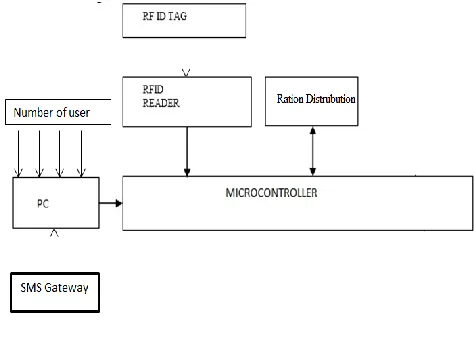
design of the scheme is shown in Fig.1, whereas the main workings are shown.
Fig 1 System Architecture
All consumer has to enroll for the ration card. The registering is completed at the main regulator location. For registering, all consumer has to deliver their individual details about their family. After this “head of the family” is
delivered with a smart card is reused to purchase their once-a-month ration. When grocery is shipped to the ration
yard a message is led to the yard. The message comprises a number of grains assigned for this month as well as the
messages are sent to all consumer correlated to the specific ration yard to aware the consumer that their
once-a-month ration has arrived. At ration yard, we are expending the smart card plus Thumbprint verification ID. After evaluation the ration smart card the” L.C.D” will show message “Enter UID no”. Then the consumer will “Enter UID number” over the keypad, then the supervisor will direct this records to the server, then the server will go over
that ration card is effective or else not. If it will be lawful then it will ask for the consumer verification using a
thumbprint. Again, the thumbprint is tested with the database side if the valid consumer then, the authorized name plus sum of the ration is allotted, then shown on the “L.C.D”. Using keypad consumer has to pass in the product’s
similar serial figure they need to purchase end-to-end with expanse. After receiving the response from the keypad
795 | P a g e
provision otherwise inadequate balance is showed on LCD. The contact information is directing to the consumer
mobile.
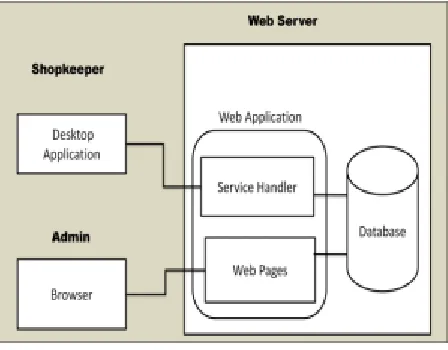
Fig 2 Software Architecture
The software will be acting as an interactive interface between cloud and hardware is sda windows app. It is a GUI
which will be retrieved by the ration yard proprietor and government person. The software design is presented in
Fig.2 Here software is planned in the way that not anything is kept on the local personal all the computers and facts
are either re-claimed from the “cloud” or restructured in the “cloud”.
Database:
A Database store is well-defined as a controlled group of records and custom-made to our arrangement, and database is employed typically pile the consumer’s private and ration info with tables namely Ration card, shop,
Taluka, City, state, management, item, person Allocations Secondarily the database will be used to stock data
collected is from online web-UI interface, such as efficient private info, PIN, message and phone no.by the
consumers. In present more structures to the consumers, our online coordination can deploy the user info by
enquiring the record for difficult data rescue. This contains computerized process, such as brief a person’s monthly
purchase details.
“Graphical User Interface” (GUI):
The UI element of the structure is deliberately developing for approachable communication with the consumers. All
types of consumers, namely staff, consumer and the system managers are given irreplaceable right to use to their
796 | P a g e
grains, while the staffs can right to use their yard information and the supervisor can have right to use all the info
and buyer can initiate or disable the consumer accounts.
IV CONCLUSIONS
In earlier days corruption level goes to very high level in PDS. Because manually store data in register books or
record & they can be easily manipulated records so by using this proposed system we can provide transparencies at
any point any level by storing data in database & higher authority can easily checked record as well as consumer
also keep track their government scheme. Hence implementing this system is very useful to entire nation.
REFERENCES
[1.] Rajesh C. Pingle and P. B. Borole, “Automatic Rationing for Public Distribution System (PDS) using RFID and GSM Module to Prevent Irregularities,” HCTL Open International Journal of Technology
Innovations and Research, vol 2, pp.102-111, Mar 2013.
[2.] Agarwal M., Sharma M., Singh B, Shantanu,” Smart Ration Card Using RFID and GSM Technique” IEEE
Conference on The Next Generation Information Technology.
[3.] A.N.Madur, Sham Nayse,” Automation in Rationing System Using Arm 7,” International journal of
innovative research in electrical, electronics, instrumentation and control engineering, vol.1, Issue Jul
2013.
[4.] K. Balakarthik,” Closed-Based Ration Card System using RFID and GSM Technology,’’ vol.2, Issue 4,
Apr 2013.
[5.] Dhanojmohan, Rathikarani, Gopukumar,” Automation in ration shop using PLC,” International Journal of
Modern Engineering Research, vol.3, Issue 5, Sep-oct 2013, pp 2291-2977, ISSN:2249-6645.
[6.] A N. Madur, P. N. Matte “Replacing Traditional PDS with Smart PDS” International Journal of Emerging
Technology and Advanced Engineering Volume 3, Issue 12, December 2013.
[7.] Rahul J. Jadhav, Dr. Pralhad K. Mudalkar International “Smart Card based e-PDS system” Journal of
Advanced Research in Computer and Communication Engineering Vol. 2, Issue 10, October 2013