ISSN(Online): 2320-9801
ISSN (Print) : 2320-9798
International Journal of Innovative Research in Computer
and Communication Engineering
(An ISO 3297: 2007 Certified Organization)
Vol. 3, Issue 2, February 2015
Detection of Denial of Service (DDOS)
Attack in Wireless Network
P.Thilagavathi1, S.Thirunavukarasu*2
Assistant Professor, Dept. of Information Technology, Jerusalem College of Engineering, Chennai, Tamil Nadu,
India 1
Assistant Professor, Dept. of Information Technology, Bharath University, Chennai, Tamil Nadu, India 2
* Corresponding Author
ABSTRACT: The current trend in wireless network is to share important data among the nodes through some form of wireless network. There are several off-the shelf components that help in stopping this sharing of vital data through the process called jamming. Jamming is simply the cause of a Denial of Service attack. A simple example of this process is when a malicious node can transmit a lot of data to a particular node in the network to stop the reception of data sent by another legitimate node in the network. There are several other types of jamming like radio signal jamming, continual transmission of interference signal, etc. while we deal with data jamming. Here we provide a system with several nodes connected through WiFi and an illegitimate node sends lot of data to stop the communication of the legitimate nodes in the network. This system consists of technique to provide non-interrupted transmission between the legitimate nodes and to protect data during transmission through encryption and to provide
e-mail notification about the jamming node.
KEYWORDS:Wireless Denial of Service, Jamming, Encryption, e-mail notification, security.
I. INTRODUCTION
In recent days, security has been a priority during transmission of data in a wireless network, be it through adhoc, wifi or wireless sensor network. This is because of the existence of hacking and other malicious activities that occurs just like any other common day- to- day routine. Due to the progress in technology, wireless networks are coming into existence as they‟ve become more affordable and easily accessible through off- the- shelf. So they are some equipment to disrupt these advancements. Since wireless networks are more accessible for the use of Internet in the near past and future, it is more vulnerable to attacks than any wired network in existence.
The widely known actuality about the wireless network is that it is easily accessible and sharable nature of the medium. This actuality is both the pro and con when it comes to a wireless network i.e. it is very easy for the rival to initiate an attack. This attack can be the disruption of network operations and flooding the user and kernel buffers. It is termed as Denial of service attack or jamming, depending on whether one looks at the consequence or the cause of the attack. A most common place example of such an attack is while browsing the internet, the page that is to be opened is not getting loaded properly and the refresh button is clicked several times than is necessary. This is an example of the jamming or Denial of Service attack that is done inadvertently. This attack can also be done deliberately. For example, one can use a mobile device to send volumes of SMS in hinterland. This is enough to block communication between any two wireless nodes.
ISSN(Online): 2320-9801
ISSN (Print) : 2320-9798
International Journal of Innovative Research in Computer
and Communication Engineering
(An ISO 3297: 2007 Certified Organization)
Vol. 3, Issue 2, February 2015
the legitimate users provided intimation about the presence of an attacker must be given to the head of the network. It is also not a ethically and morally accepted if the legitimate node/ user communicates with the attacker. At such times the node involved in such a scam must be identified and warned of any other misleading activities in the network to compromise the network and data.
In our paper, we discuss a real time implementation of data jamming done by a node to another node in a network that must receive legitimate data from a legitimate node in the network. Bearing in mind the issues and the responses required in present day necessities, we provide a system where there can be uninterrupted data flow between legitimate nodes. Rinjdael encryption algorithm is provided to ensure secure transmission of data between legitimate users. Also Simple Mail Transfer Protocol (SMTP) is used to send an e-mail notification about the presence of the jammer and also about the legitimate node‟s compromise of network.
Our paper is organized as follows: In section II, we discuss the related theory involved about the jamming and various techniques. Section III comprises of the system design and proposed system. Section IV describes about the two algorithms for encryption and e-mail transmission. Section V will conclude the paper.
II. RELATED THEORY
Denial of service attack is basically done in order to block a node from receiving legitimate data or to block the node completely from another legitimate node. This blocking can be done either with data sent continually or by sending radio signals or any other means of transmission signal jamming. We have several authors who‟ve discussed various jamming techniques and their detection and/ or prevention techniques invented.
In [1], the authors, Pelechrinis, K. Iliofotou, M. and Krishnamurthy,S.V. from the university of California have surveyed the various types of denial of service attacks and the performance issues due to the DoS attack done to each network. They have provided several intrusion detection techniques in their survey and have mentioned that there must be system implementation to avoid real world adversaries. In all of the jamming techniques and the detection algorithms, through put is 0 which effectively reduces the performance of the network.
In [2], the authors have detailed about selective jamming where the adversary chooses the data to jam preferentially a high priority data when it concerns security and privacy. They do so by performing packet classification at the physical layer. The authors have evaluated the effects of packet hiding by measuring the effective throughput of the TCP connection in the following scenarios:
1. No packet hiding (N.H.).
2. MAC-layer encryption with a static key (M.E.). 3. SHCS (C.S.).
4. Time-lock CPHS (T.P.). 5. Hash-based CPHS (H.P.). 6. Linear AONT-HS (L.T.).
7. AONT-HS based on the package transform (P.T.).
In [3], data forwarding without any delay in defending jamming in a wireless sensor network is proposed. This proposal consists of sensor nodes present as clusters for a particular frequency. Here when a frequency where data forwarding occurs is jammed, the cluster of sensor nodes in that frequency becomes inoperative and the other clusters act as backup.
ISSN(Online): 2320-9801
ISSN (Print) : 2320-9798
International Journal of Innovative Research in Computer
and Communication Engineering
(An ISO 3297: 2007 Certified Organization)
Vol. 3, Issue 2, February 2015
of transmitters and jammers. The equilibrium strategies resulting from these jamming games characterize the expected performance under DoS attacks and motivate robust network protocol design for secure wireless communications. A key characteristic of distributed wireless access networks is that users do not have complete information regarding the other user‟s identities, the traffic dynamics, the channel characteristics, or the costs and rewards of other users.
Various forms of uncertainty can be present as illustrated in Fig. 2, including:
• User types: Users may not know each other‟s type, where type refers to whether a node is a transmitter or
jammer.
• Physical presence: Users may not know whether or not the opponent is physically present to transmit.
• Packet traffic: Users may not know traffic dynamics of the opponent, that is, whether or not the opponent‟s queue is backlogged.
• System parameters: Users may not know each other‟s utilities (reward and cost functions).
• Physical channel: Users may not know physical channel characteristics, such as channel gains, channel noise, or packet capture probability.
In [5], there is a discussion about Rinjdael algorithm which was proposed by NIST. This algorithm is very similar to AES encryption algorithm except that the Rinjdael algorithm supports significantly larger key and also various bits of block length (128, 192 and 256) where as in AES algorithm, the block length remains the same (128 bits).
III. SYSTEM DESIGN AND PROPOSED SYSTEM
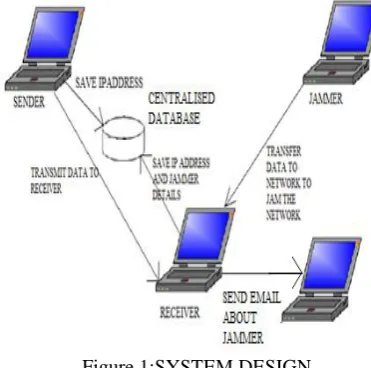
In our system, a wireless network where a few laptops that act as nodes are connected through a wifi network. This is shown in the Fig.1. This system is based on nodes that transfer data through the network and that these data must not reach the intended recipient. This is the jammer‟s activity.[1] The jamming node transmits large number of data to the legitimate node thereby creating buffer overflow of the legitimate user. In our proposed system, there is no interruption in the data transmission between legitimate nodes. We save the IP address of the legitimate nodes from the sender to receiver in the centralized database and the receiver obtains the legitimate IP from the database. If the IP is not recognizable, then that system is deemed an illegitimate node (in other words a jammer causing Denial of service Attack) and the data sent from the jamming node, the time and the receiver node of this jamming attack is sent to a head through e-mail using the SMTP protocol.[3]
Figure 1:SYSTEM DESIGN
ISSN(Online): 2320-9801
ISSN (Print) : 2320-9798
International Journal of Innovative Research in Computer
and Communication Engineering
(An ISO 3297: 2007 Certified Organization)
Vol. 3, Issue 2, February 2015
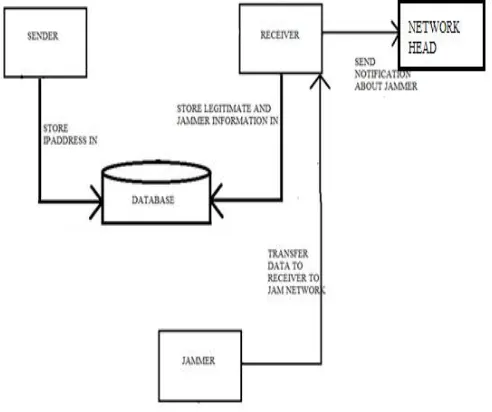
process without the encryption key. The block diagram of the above system is given in Fig.2. This block diagram helps in determining the nature of the proposed system along with its basic features. The system design shows the exact nodes in action whereas the block diagram shows the operation of the proposed system.[4]
The email notification is sent through an SMTP protocol that is integrated through .net coding. This system provides an example for data jamming where the jamming device sends unwanted data to the receiving device in order to stop legitimate access.[2] An email notification unknown to the receiving device is sent to the network head about the presence of some jamming device in the network. The database used is SQL server 2005 where the secure ip addresses are stored and where the sender stores the sending and receiving ip addresses. The receiving device checks the database for the ip address and when data from unknown ip has entered the network, detects the jammer and stores the information sent by the jamming device separately without mixing it with the legitimate sender‟s data.
Figure 2: BLOCK DIAGRAM
In this system, there is uninterrupted flow of data between the legitimate nodes and the jamming device cannot hinder into the activities of the legitimate node. Also there might arise a concern when the jamming node sends lot of data so that the receiving node has buffer overflow. But this concern does not arise because the data sent from the jamming device is stored separately as mentioned above that even if there is data overflow it will not affect the transmission of data through legitimate nodes which is saved separately elsewhere.
IV. RINJDAEL ALGORITHM AND SMTP
As mentioned earlier, we use Rinjdael encryption algorithm in this system to provide secure data transmission and SMTP protocol is used for email notification about the presence of an adversary node that causes the jammer.
A. RINJDAEL ENCRYPTION ALGORITHM
ISSN(Online): 2320-9801
ISSN (Print) : 2320-9798
International Journal of Innovative Research in Computer
and Communication Engineering
(An ISO 3297: 2007 Certified Organization)
Vol. 3, Issue 2, February 2015
algorithm with same functionality except for the block length which can vary between 128, 192 and 256 bits as required by the user. In this algorithm, the block length is kept to 128 bits and the key size is also set to 128 bits for simplicity‟s sake.
The number of rounds in this algorithm is 10 and in the case of 192 bit block and key size, it is 12 rounds and 256 bits it is 14 rounds.
In this algorithm, the single 128 bit key given by the user for data encryption is generated into 10 keys of 128 bits each. These keys are then placed into 4x4 arrays. The plain text is also placed into a 4x4 array. Each of this 128 bit plain text is processed in the above mentioned 10 rounds. After the 10th round is completed the code is generated. Each single byte is substituted in an S box and replaced by the reciprocal on GF (2 8). Then a bit-wise modulo-2 matrix is applied, followed by an XOR operation with 63. The lines of the matrices are sorted cyclically. The columns of the matrix multiplication are interchanged on GF (2 8). The subkeys of each round are subjected to an XOR operation. This is the exact operation of the Rinjdael algorithm.[7]
There is also another special reason for choosing this encryption algorithm. It is nothing but the fact that it takes 149 trillion years for a system to break a 128 bit AES key (assuming that the system could find a DES key in a second i.e. try 255 keys in a second). Hence Rinjdael algorithm, which could use 128, 192 and 256 key and block size, would be more secure and there will not be any compromise of the data through encryption.[8]
B. SMTP PROTOCOL
SMTP is a mail transfer protocol used to transfer mail to different emails. It is a TCP/IP protocol that sends mail with the help of IP address and Email ids given. The mail server is set to a definite browser. In our case it is www.gmail.com and the SMTP uses only the gmail accounts to send and receive mails[9]. An object for the MailMessage() class is created and a subject, to address, from address and the body of the mail is added to the mail through the object. Another object for the SMTP Client () class is initialized and the host, port and the credentials are set and the mail is sent through this object.[10]
The port id of SMTP protocol is usually 25. But for SMTP submission the port number 587 and this is the port number we use to initialize the SMTP protocol. The protocol for new submissions is same as the protocol for SMTP except for the port number.
The SMTP credentials is a class function that is used to get or set the username and password that helps in authenticating the sender. The Network credential() initializes a new object with the username and password that is specified in the function.
Also an IsBodyHtml() function is used to set or get values based on whether the body is in html format or not.
To initiate the function under which the SMTP protocol is defined, the function should be called in the code where appropriate to send e-mail messages. This e-mail message proves to be another indication for the presence of jamming device apart from the detection obtained while the receiver checks for legitimate ip address. [5]
ISSN(Online): 2320-9801
ISSN (Print) : 2320-9798
International Journal of Innovative Research in Computer
and Communication Engineering
(An ISO 3297: 2007 Certified Organization)
Vol. 3, Issue 2, February 2015
Code snippet of SMTP protocol
Above mentioned is the code snippet used to define a mail sent to an email address indicating the presence of jamming node along with the to and from address, subject and the mail body that is passed to this function sendmail().
V. CONCLUSION
This paper provides a jamming technique that is not widely used and is usually not implemented as a real time implementation. The algorithms used ensure that data is transferred in a secure manner and that the presence of jammer is detected by two ways and not just one. The Rinjdael encryption algorithm takes care of security and privacy of data even if the data is compromised to the jamming node.
Also since we save the files from a jamming device and legitimate user separately no confusion arises between the data and the files are saved in their respective folders and not get mixed up with each other.
The SMTP protocol that is used to send mail notification about the jamming node is also a very useful technique to detect the presence of the jammer. It is also brought to the reader‟s notice that the mail sending algorithm is implemented without the knowledge of the receiver or jammer in order to provide a head start to the security personnel.
publicvoid sendmail(string body) {
string eml =
"[email protected]"; MailMessage mail = new MailMessage();
mail.To.Add(eml); mail.From = new
MailAddress("cms.automaticmail@gmail
.com");
mail.Subject = "Mail Notification";
string Body = body.ToString(); mail.Body = Body;
mail.IsBodyHtml = true; SmtpClient smtp = new SmtpClient();
smtp.Host = "smtp.gmail.com"; smtp.Port = 587;
smtp.UseDefaultCredentials = false;
smtp.Credentials = new
System.Net.NetworkCredential("cms.aut [email protected]",
"automaticmail");
smtp.EnableSsl = true; smtp.Send(mail);
ISSN(Online): 2320-9801
ISSN (Print) : 2320-9798
International Journal of Innovative Research in Computer
and Communication Engineering
(An ISO 3297: 2007 Certified Organization)
Vol. 3, Issue 2, February 2015
ACKNOWLEDGMENTS
I must thank, first and foremost my internal guide Mrs. P. Thilagavathi, Asst. Professor, Grade III, Department of Information Technology, and Mrs Mary Kutty Cyriac Head of the department, Senior Lecturer ,Department of Information Technology, without whose guidance and patience, this dissertation would not be possible. I would also like to extend my thanks to engineering, project panel members, Professors of the Department of Information Technology for their consistent encouragement and ideas.
REFERENCES
[1] Konstantinos Pelechrinis, Marios Iliofotou and Srikanth V. Krishnamurthy(2011), “Denial of Service Attacks in Wireless Networks:The Case of Jammers” Communications Surveys & Tutorials, IEEE, vol 13: issue:2, nos 245- 257.
[2] Sree Latha R., Vijayaraj R., Azhagiya Singam E.R., Chitra K., Subramanian V., "3D-QSAR and Docking Studies on the HEPT Derivatives of HIV-1 Reverse Transcriptase", Chemical Biology and Drug Design, ISSN : 1747-0285, 78(3) (2011) pp.418-426.
[3] Proano, A.; Lazos, L.;(2011) “Packet-Hiding Methods for Preventing Selective Jamming Attacks” Dependable and Secure Computing,
IEEE, vol. 9 issue 1. Nos 101- 114.
[4] Masthan K.M.K., Aravindha Babu N., Dash K.C., Elumalai M., "Advanced diagnostic aids in oral cancer", Asian Pacific Journal of Cancer Prevention, ISSN: 1513-7368, 13(8) (2012) pp.3573-3576.
[5] Ghosal, A.; Halder, S.; Mobashir, M.; Saraogi, R.K.; DasBit, S.;(feb- 28th to march 3rd 2011)” A jamming defending data-forwarding scheme for delay sensitive applications in WSN”Wireless Communication, Vehicular Technology, Information Theory and Aerospace & Electronic Systems Technology (Wireless VITAE), 2011 2nd International Conference, nos 1- 5.
[6] Tamilselvi N., Dhamotharan R., Krishnamoorthy P., Shivakumar, "Anatomical studies of Indigofera aspalathoides Vahl (Fabaceae)", Journal of Chemical and Pharmaceutical Research, ISSN : 0975 – 7384 , 3(2) (2011) pp.738-746.
[7]Sagduyu, Y.E.; Berry, R.A.; Ephremides, A.;(aug 2011)” Jamming games in wireless networks with incomplete information”, Communications Magazine, IEEE, vol 49, issue 8, nos 112- 118.
[8] Reddy Seshadri V., Suchitra M.M., Reddy Y.M., Reddy Prabhakar E., "Beneficial and detrimental actions of free radicals: A review", Journal of Global Pharma Technology, ISSN : 0975-8542, 2(5) (2010) pp.3-11.
[9] Jamil, T.;(april- may 2004)” The Rinjdael algorithm”, Potentials, IEEE, vol. 23 issue 2, nos 36 to 28.
[10] Devi M., Jeyanthi Rebecca L., Sumathy S., "Bactericidal activity of the lactic acid bacteria Lactobacillus delbreukii", Journal of Chemical and Pharmaceutical Research, ISSN : 0975 – 7384 , 5(2) (2013) pp.176-180.
[11]B Karthik, TVUK Kumar, A Selvaraj, Test Data Compression Architecture for Lowpower VLSI Testing, World Applied Sciences Journal 29 (8), PP 1035-1038, 2014.
[19].M.Sundararajan .Lakshmi,”Biometric Security system using Face Recognition”, Publication of International Journal of Pattern Recognition and Research. July 2009 pp. 125-134.
[20].M.Sundararajan,” Optical Sensor Based Instrumentation for correlative analysis of Human ECG and Breathing Signal”, Publication of International Journal of Electronics Engineering Research, Research India Publication, Volume 1 Number 4(2009). Pp 287-298.
[21]C.Lakshmi & Dr.M.Sundararajan, “The Chernoff Criterion Based Common Vector Method: A Novel Quadratic Subspace Classifier for Face Recognition” Indian Research Review, Vol.1, No.1, Dec, 2009.
[22]M.Sundararajan & P.Manikandan,” Discrete wavelet features extractions for Iris recognition based biometric Security”, Publication of International Journal of Electronics Engineering Research, Research India Publication, Volume 2 Number 2(2010).pp. 237-241.